

Iceberg Bridge: A Powerful Statement in Sustainable Bridge Design
An iconic sustainable bridge design inspired by melting glaciers, transforming urban mobility into a powerful climate awareness experience.


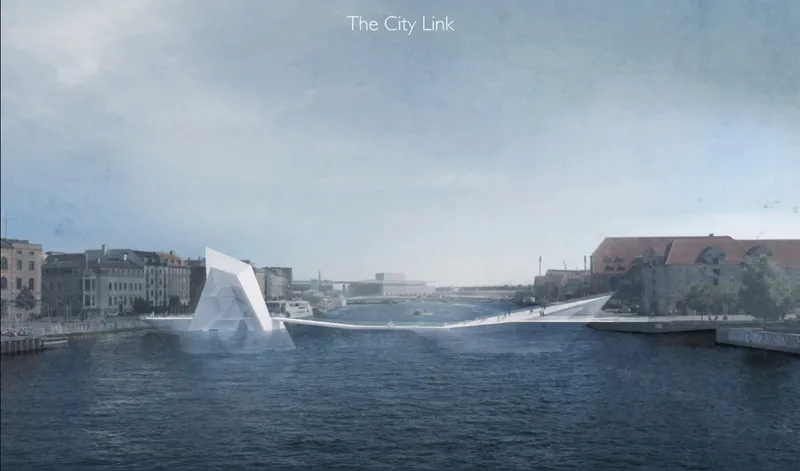
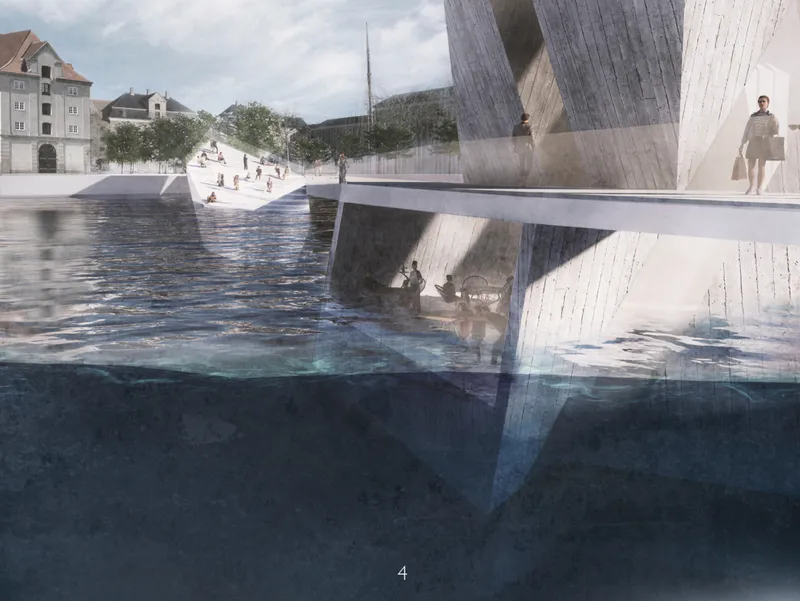
In an era defined by climate urgency, infrastructure must do more than connect two points: it must communicate, educate, and inspire. The Iceberg Bridge is a visionary example of sustainable bridge design that merges climate-responsive architecture with urban mobility. Designed by Kinga Murawska, Ola Milanowska, and Krystian Woźniak, the project transforms a functional crossing into a spatial narrative about melting glaciers, rising sea levels, and the environmental consequences of industrialization.
Positioned within an urban canal context, the bridge is not merely a transportation link. It becomes a symbolic landscape, a built reminder of the fragile Arctic ice sheets that are steadily disappearing in Greenland and Antarctica.
Cycling as Climate Responsibility
More than 100 years after the invention of the bicycle, cycling remains one of the most sustainable forms of daily transportation. In many European cities, it is increasingly regarded not just as an option but as a social responsibility.
The Iceberg Bridge reinforces this cultural shift. It promotes environmentally friendly mobility by prioritizing pedestrian and bicycle circulation over motorized transport. The project highlights a simple yet powerful message: meaningful climate change mitigation can begin with everyday decisions, such as choosing to cycle instead of drive.
With rising CO₂ concentrations, global warming, and sea-level increases threatening low-lying regions like the Netherlands and Florida, sustainable infrastructure must actively support behavioral transformation. This bridge does precisely that by integrating mobility, recreation, and climate education within one architectural gesture.
Urban Design that Encourages Sustainable Transportation
Sustainable bridge design extends beyond structural innovation, it includes urban integration. The Iceberg Bridge connects city fabric while enhancing public space quality.
Efficient infrastructure encourages people to choose bicycles and public transport when routes are faster, safer, and more enjoyable than car travel. The project incorporates:
- Inviting pedestrian paths
- Dedicated cycling routes
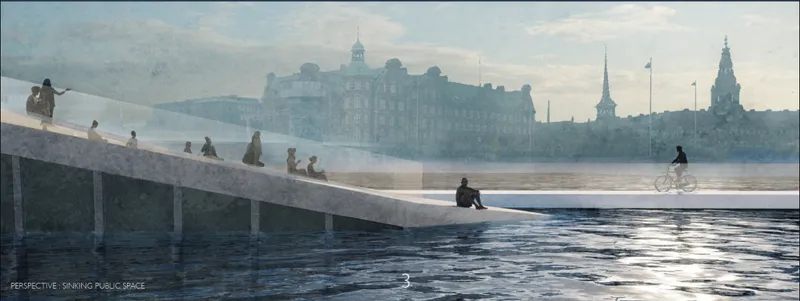
- Recreational seating areas overlooking water
- Green and open spaces that soften the urban edge
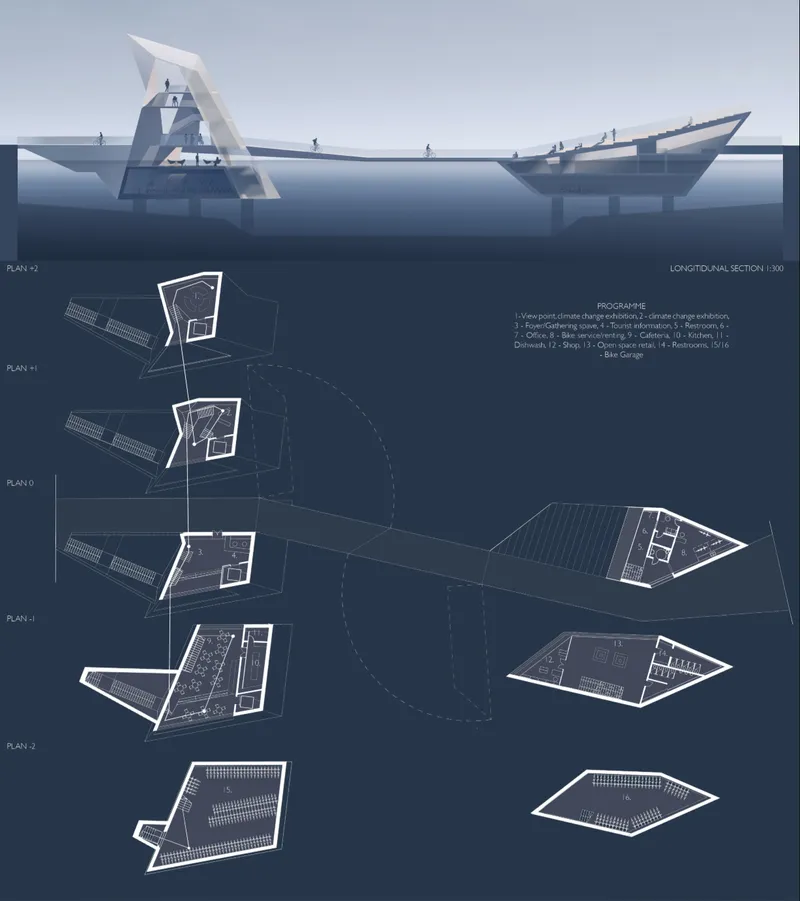
The presence of water and natural elements makes the crossing not just functional but experiential. Attractive surroundings significantly influence how public infrastructure is perceived and used. By creating a desirable environment, the bridge fosters a culture of sustainable mobility.
Architecture Inspired by Melting Glaciers
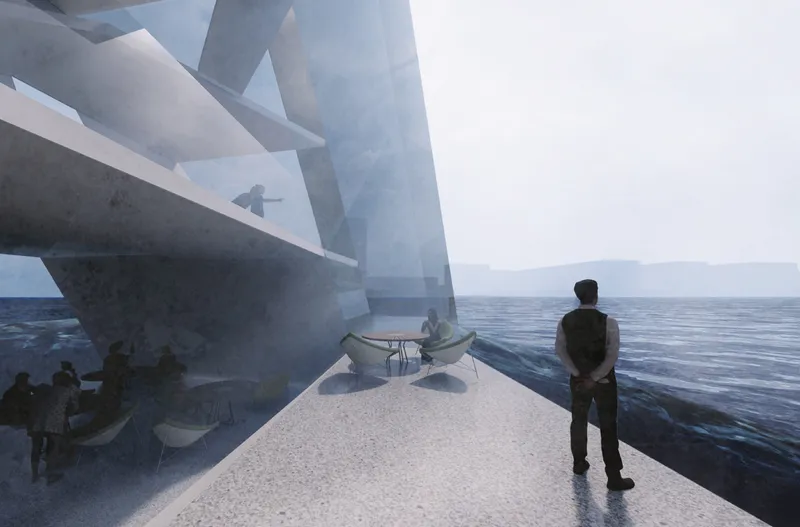
The conceptual core of this sustainable bridge design lies in its iceberg-inspired form. The angular geometry evokes a fragment of ice emerging from, and submerged within, the water.
The form acts as a spatial metaphor for:
- Melting Arctic glaciers
- Rising sea levels
- The hidden mass beneath visible surfaces
- The long-term consequences of industrialization
Visitors experience the bridge through a carefully guided internal route. The implied itinerary transforms the structure into an educational journey. Interior perspectives reveal projected past, present, and future sea levels, reinforcing the reality of climate change in a tangible way.
The bridge becomes more than infrastructure, it becomes a climate narrative embedded in architecture.
Experiencing Sea-Level Rise Through Space
One of the most compelling aspects of the project is its immersive design strategy. The interior spaces allow users to physically experience references to historical and projected sea levels.
This spatial storytelling creates emotional engagement. Instead of reading statistics in isolation, visitors move through an environment shaped by climate data. The architectural language transforms abstract environmental issues into lived spatial experience.
By embedding data visualization within architectural form, the Iceberg Bridge positions sustainable bridge design as an educational tool.
A Bridge as Public Space and Cultural Catalyst
Beyond mobility, the bridge serves as:
- A recreational promenade
- A gathering space overlooking the canal
- A contemplative platform reflecting on environmental change
It strengthens the role of infrastructure as civic architecture. The project enriches the city connection by merging transport, leisure, and awareness. It demonstrates how sustainable architecture can simultaneously address ecological responsibility and urban quality of life.
Sustainable Bridge Design as a Call to Action
The Iceberg Bridge stands as a constant reminder of what humanity risks losing if climate action is delayed. Enormous parts of low-lying territories are predicted to face flooding by 2050. The project responds not with fear, but with awareness.
Through symbolic form, sustainable mobility, and climate education, the bridge becomes an architectural manifesto.
It asks a simple question:
What if infrastructure could inspire change?
By choosing to cycle instead of drive, by rethinking how we design our cities, and by embedding climate consciousness into public space, sustainable bridge design can become an instrument of transformation.




Popular Articles
Popular articles from the community


The Earth Pod: 3D Printed Homes for Resilient Refugee Communities
The Earth Pod reimagines refugee housing through 3D printed homes made from clay, combining resilience, self-sufficiency, and rapid shelter.

Co-Life: Senior Housing Design That Reconnects Older Adults With the City
Co-Life reimagines senior housing design through healing gardens, shared streets, workshops, and a sustainable community across generations.

Co-life: Sustainable Architecture for Age-Friendly Community Living
Co-life reimagines sustainable architecture for seniors through courtyards, rammed earth, shared gardens, and spaces designed for belonging.
EW PARK: Sustainable Architecture Reimagines the Future of Urban Parking
EW PARK reimagines city parking as a modular wooden tower combining automation, solar energy, electric mobility, and adaptable urban design.


Similar Reads
You might also enjoy these articles

Eco Chapel: A Green Architecture Pavilion Designed in Symbiosis with the Forest
Eco Chapel uses green architecture to weave prayer, learning and reuse into a forest pavilion shaped by modular hexagonal canopies for life.
Kaffeebühnen: Coffee Shop Architecture Designed as a Civic Stage Between Vienna’s City and Park
Kaffeebühnen turns coffee shop architecture into a civic stage, linking Vienna’s park edge, urban life, warm timber yards, and coffee craft.
Healing Façade: Sustainable Architecture for Reforestation, Community, and Sacred Ecology in Ethiopia
Healing Façade reimagines sustainable architecture as a living wall that restores soil, catches water and renews Ethiopia's forest churches.


Urban Forest: A Vertical Ecosystem for 5,000 Workers in Singapore's Changi Business Park
Radially stacked pods and layered green decks turn a 7-acre plot into 47 acres of ecological workspace projected for 2040.


Comments (0)
Please login or sign up to add comments
No comments yet. Be the first to comment!