
Il Trateggio: A Tower Designed to Be Dismantled, Relocated, and Reborn
A People's Choice Award winner reimagines Milan's CityLife district with a modular tower built for disassembly and architectural afterlife.


What if a building's demolition was not its death but its migration? Il Trateggio asks a question that most towers never bother with: what happens after the building is no longer needed? Rather than accepting obsolescence, the project proposes a cylindrical tower whose modular components can be dismantled, shipped, and reassembled in an entirely new context. The leftover footprint in Milan would then transform into an open-air amphitheater, continuing its public utility in a radically different form. It is architecture conceived not as a permanent fixture but as a cyclical urban asset.
Designed by Bryan Cruz López, Il Trateggio received the People's Choice Award in the Co-Design Milan 2020 competition. Sited along Piazza Tre Torri in Milan's CityLife district, the tower positions itself in direct dialogue with the neighborhood's existing vertical landmarks: Lo Storto, Il Dritto, and Il Curvo. The name, meaning "The Hatching," signals both its graphic façade pattern and the conceptual idea of creative emergence. It is a tower that completes a visual ensemble while quietly planning its own departure.
A Cylindrical Volume Layered with Horizontal Rhythm

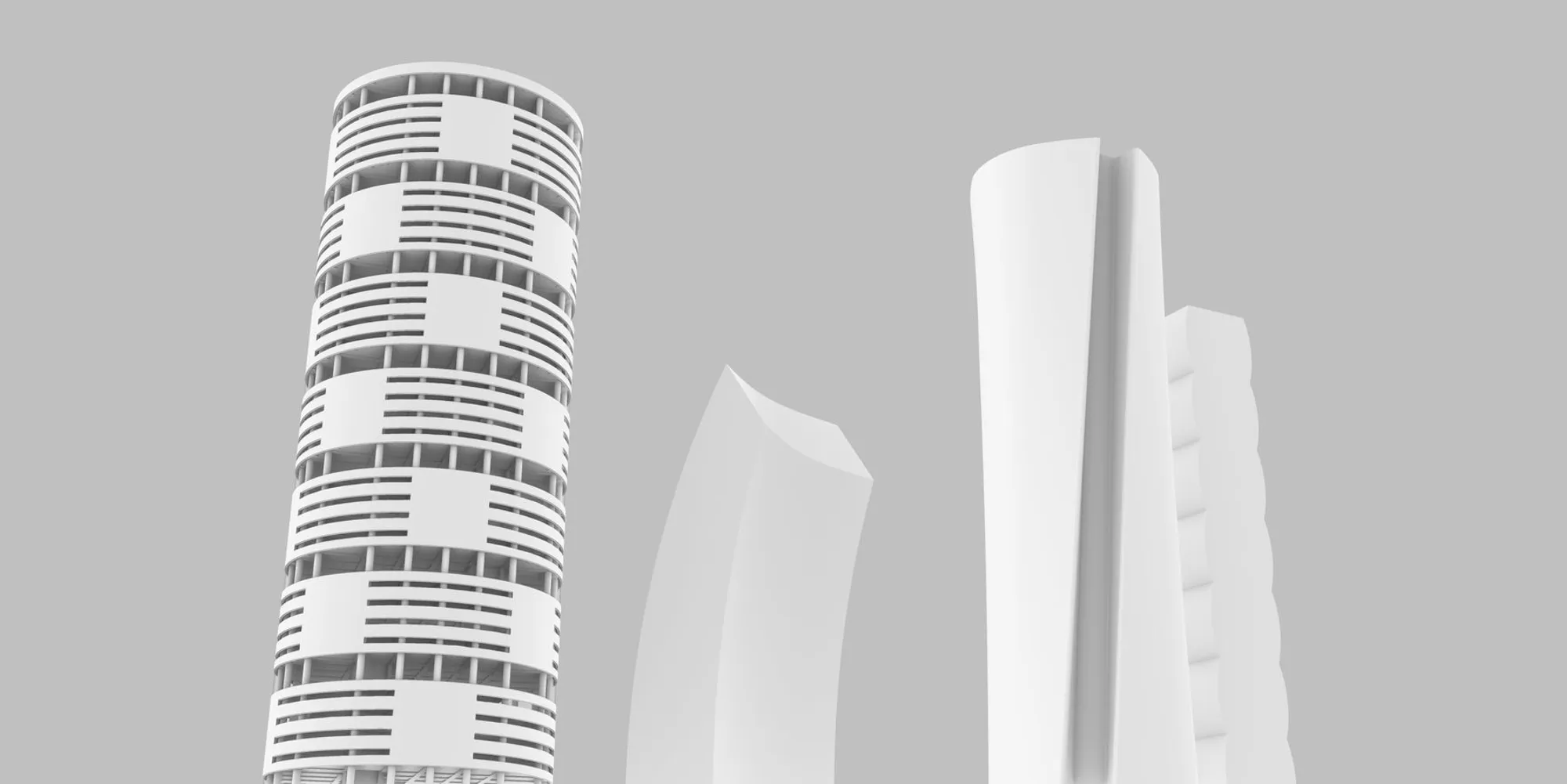
The physical model and accompanying drawings reveal a tower defined by a rhythmic pattern of layered horizontal slits that fragment the façade. These openings give the cylindrical volume a quality of simultaneous solidity and movement, as if the building were breathing through its skin. Plan and elevation studies show a radial organization that governs both the structural grid and the interior layout, producing a form that reads as coherent from every angle along the piazza. The alignment with Milan's existing towers is deliberate: Il Trateggio secures unobstructed views while asserting its own distinct identity through this hatching motif.
Prefabricated Assembly as a Design Principle
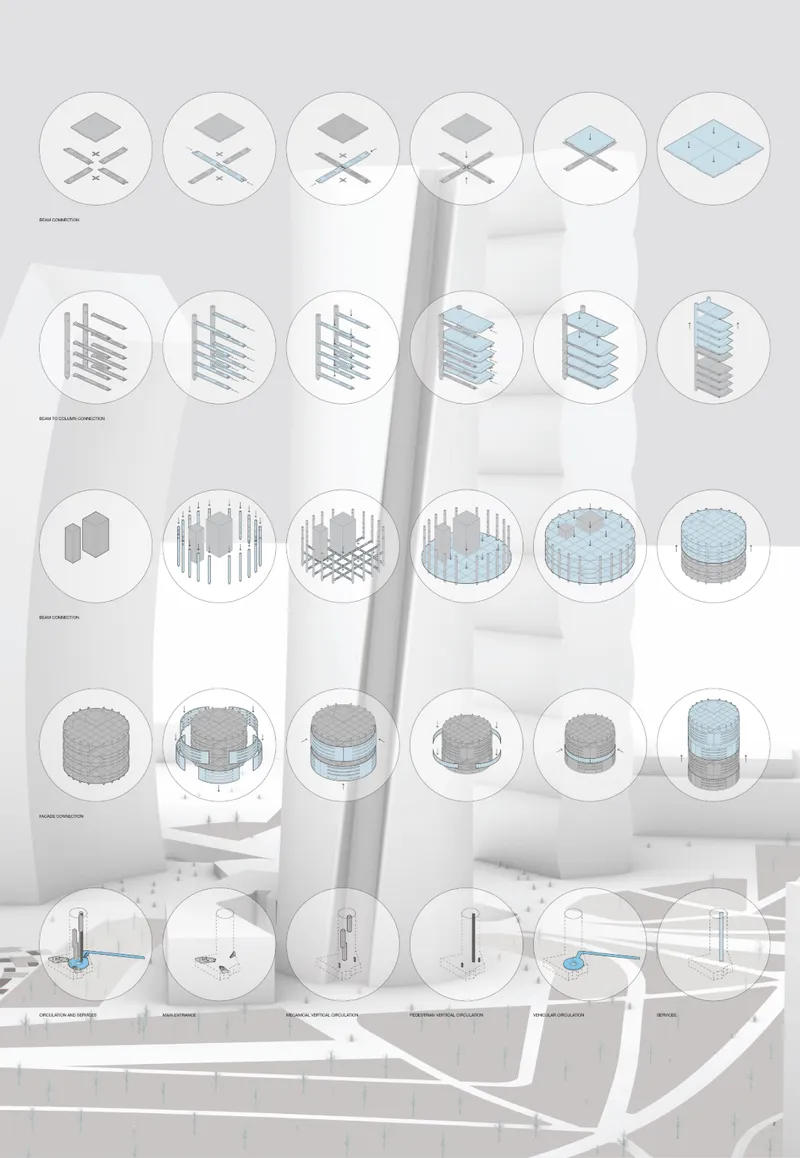
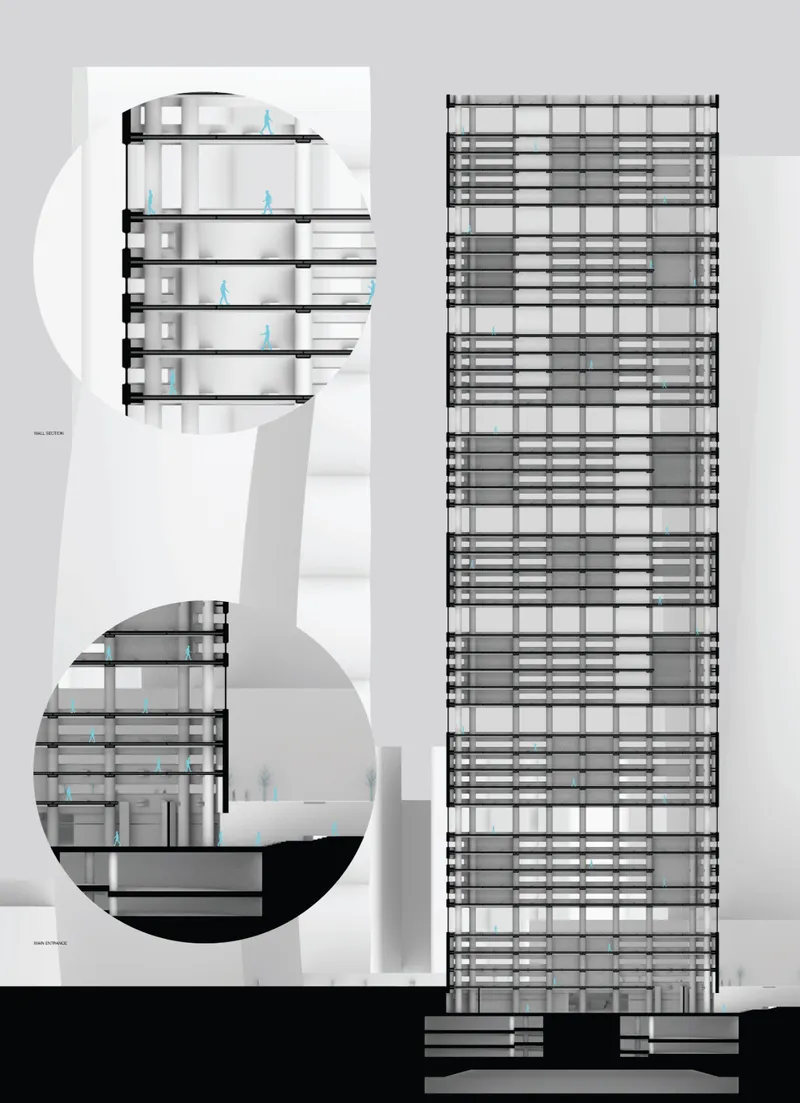
The construction strategy is where the project's ambitions become tangible. Detailed structural diagrams illustrate a rationalized assembly sequence built around modular beam-to-column connections and prefabricated façade panels. Circular vignettes break down the process into discrete steps, showing how each component slots into the radial plan. Service cores and pedestrian circulation paths are clearly defined to optimize both vertical and horizontal movement. The section drawing reinforces this logic, revealing a clean structural grid of floor plates that can be independently accessed, modified, or removed.
This is not modularity as marketing language. The prefabrication logic is embedded at every scale, from the connection details to the overall massing strategy. Because each element is designed for disassembly from the outset, the tower avoids the conventional trap of buildings that can only be demolished, never deconstructed. The economic implications are significant: shared open-plan studios eliminate the boundaries between individual workspaces, reducing rental and maintenance costs while fostering interdisciplinary collaboration among creative professionals.
A Free Plan That Anticipates Change
Il Trateggio's interior is conceived as a free plan capable of absorbing any programmatic demand. The tower's primary function is a vertical workspace for creative professionals, structured around shared open-plan studios where interaction between designers becomes a catalyst for innovation. But the flexibility runs deeper than a single use case. The same floor plates can accommodate co-working studios, public galleries, or educational hubs as social and economic conditions evolve. By refusing to lock the building into a singular identity, the design treats adaptability not as an afterthought but as a core architectural value.
From Piazza Tre Torri to Coastlines and Lunar Landscapes

The final set of drawings and renderings pushes the project into speculative territory. Plan studies of the circular tower are paired with visualizations that relocate it to radically different contexts: a coastal setting, and even a lunar surface. These images are not throwaway provocations. They are the logical conclusion of a design philosophy rooted in portability. If a building is truly modular, truly designed for disassembly, then its site becomes a variable rather than a constant. The tower's circular geometry and self-contained structural logic make it plausible as a deployable system, not just a Milan-specific intervention.
Why This Project Matters
Most modular architecture proposals stop at the moment of assembly. They celebrate the speed and efficiency of construction without addressing the harder question of what comes next. Il Trateggio distinguishes itself by designing for the full lifecycle: construction, use, disassembly, relocation, and the productive reuse of the site left behind. The amphitheater proposal for the vacated footprint is a small but telling detail. It signals that architecture's responsibility to a city does not end when a building is removed.
Bryan Cruz López has produced a project that operates on two registers simultaneously. At the urban scale, it is a thoughtful contextual response to Milan's CityLife skyline, completing a visual composition with a distinct formal language. At the conceptual scale, it is a manifesto for buildings as mobile, cyclical assets rather than permanent monuments. The People's Choice recognition from Co-Design Milan 2020 suggests that this idea of architectural afterlife resonates beyond the discipline, touching a broader audience invested in how cities might adapt, dismantle, and rebuild themselves over time.
View the Full Project
About the Designers
Designer: Bryan Cruz López
Enter a Design Competition on uni.xyz
uni.xyz runs architecture and design competitions year-round that reward proposals with spatial conviction and real site intelligence.
Project credits: Co-Design Milan - "IL TRATEGGIO by Bryan Cruz López Co-Design Milan 2020 (uni.xyz).




Popular Articles
Popular articles from the community


Hill & Cross Opera: Sculptural Opera House Architecture Shaped by Tallinn’s Landscape and Identity
Hill & Cross Opera reimagines opera house architecture in Tallinn through its sculptural hill, civic plaza, glass wave and a luminous cross.

Co-life: Sustainable Architecture for Age-Friendly Community Living
Co-life reimagines sustainable architecture for seniors through courtyards, rammed earth, shared gardens, and spaces designed for belonging.

AL-JANNAH: Sustainable Architecture and Permaculture for Afghan Widows
AL-JANNAH uses sustainable architecture and permaculture to create resilient oasis of housing, learning, work and renewal for Afghan widows.

Conexión: Biophilic Design Reimagines High-Rise Living in Hong Kong
Conexión reimagines high-rise living in Hong Kong through biophilic design, green facades, shared spaces, daylight, water and nature within.

Similar Reads
You might also enjoy these articles

Bao Huynh Watercolor Atelier: A Serene Art Retreat in Hội An
Bao Huynh Watercolor Atelier in Hội An blends multifunctional art spaces, sustainable design, local materials, and family-friendly living in a serene environment.

Atelier Macri Concept Store Interior Design by CASE-REAL
Atelier Macri store features a "ko" counter, walnut wood details, cork displays, blending retail, gallery, and seamless customer experiences.

Manuel Vargas Izquierdo Stadium and High-Performance Sports Center: Architectural Excellence in Jalpa de Méndez
The Manuel Vargas Izquierdo Stadium blends sustainable design, inclusive sports facilities, and cultural-inspired architecture, revitalizing Jalpa de Méndez’s public spaces.

KAKR Buluh Awar Hall: Revitalizing Community and Ecology Through Bamboo Architecture
Community built bamboo hall revitalizes Buluh Awar village, empowering youth, restoring ecology, celebrating vernacular craftsmanship through sustainable architecture and culture.


Comments (0)
Please login or sign up to add comments
No comments yet. Be the first to comment!