
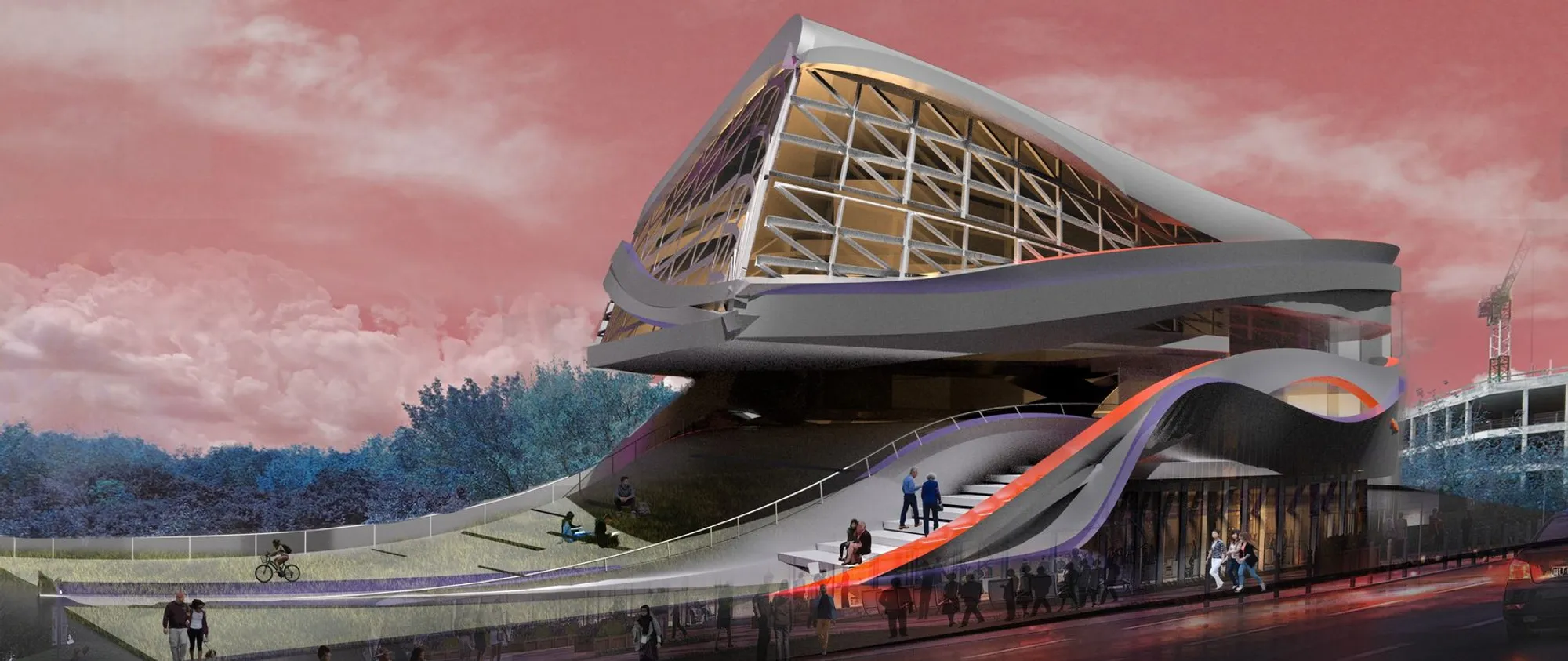
Impact Hub: Where Library, Maker-Space, and Civic Platform Dissolve into One
A hybrid cultural incubator in Warsaw fuses civic engagement, art, and technology across four interlocking programmatic zones.


What happens when a library stops being a library? When a conference hall doubles as a civic launchpad and a test kitchen breeds VR prototypes alongside music synthesizers? Sited at the convergence of the Warsaw Highway, the Vistula River, and the Mokotow District, the Impact Hub refuses every clean category. It is simultaneously a learning space, a maker-space, and a civic platform, and its architecture is engineered to keep those identities in productive collision.
Designed by Sydney Nguyen and Natalie Wanjek, the project was recognized as an Editor's Choice entry in the Libgen 2019 competition. Their proposal responds to a brief asking designers to reimagine the public library for a future driven by collaboration rather than quiet consumption. Nguyen and Wanjek answered with a four-zone hybrid that serves civic leaders, local artists, tech entrepreneurs, and youth in a single continuous building.
A Spiraling White Framework Open to the City
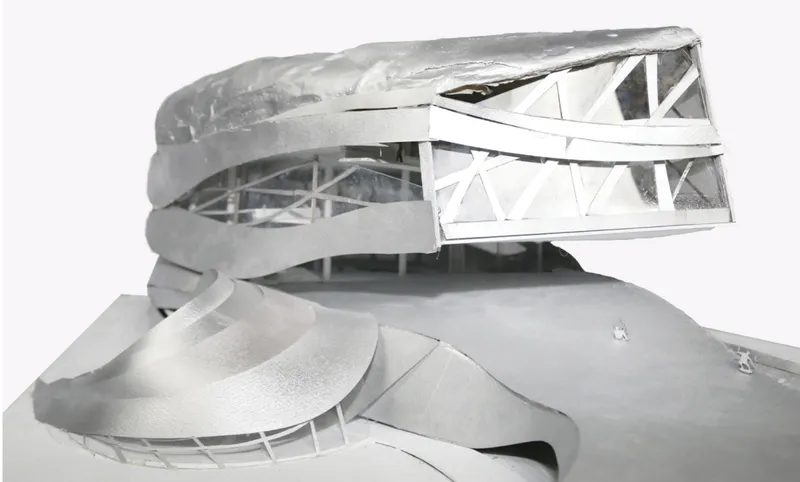
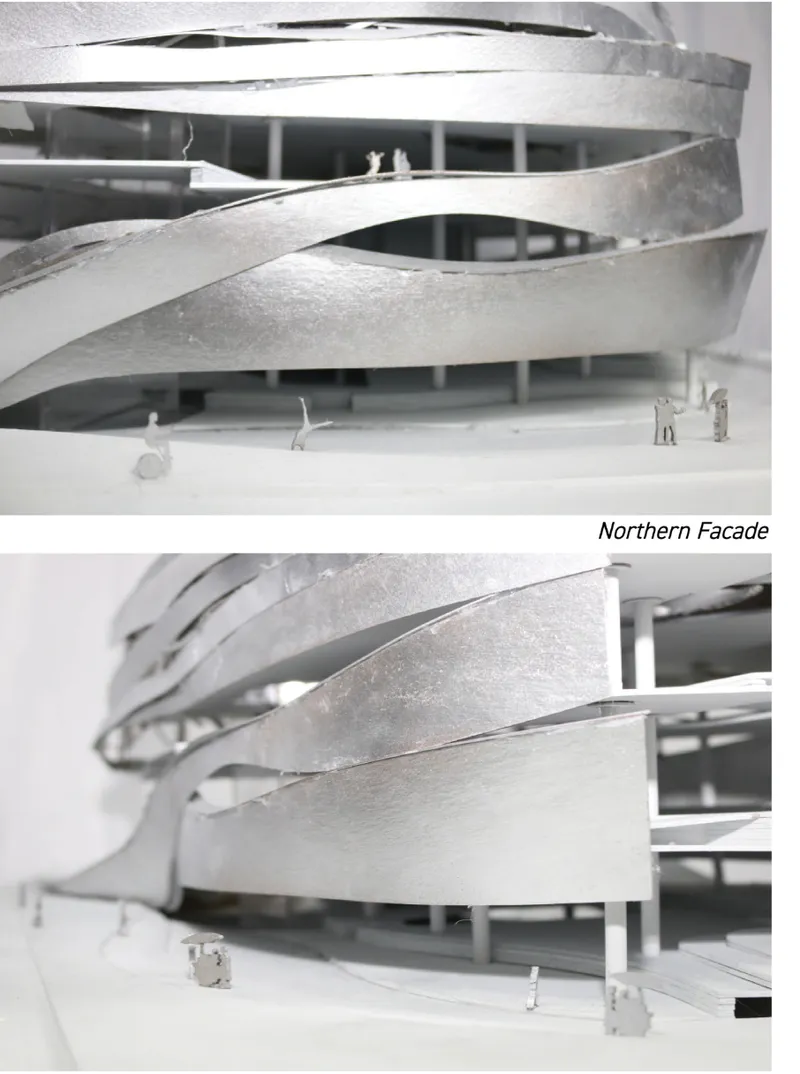
The physical model reveals the project's formal logic immediately: spiraling levels wrap upward through an exposed white structural framework, crowned by a translucent roof shell that filters daylight deep into the plan. There is no monolithic facade here. Instead, the building reads as a ribboned envelope, its aluminum panels "impaled" through the structure while translucent strips "stretch" between them. These aren't arbitrary sculptural gestures. Smaller overlaps on the facade accommodate task-lighting needs for focused work zones, while wider overlaps shade the larger communal gathering spaces below.
At ground level, scale figures populate an open ground plane that extends into the surrounding urban fabric. The designers describe their formal operations as Impale, Melt, Stretch, and Shuffle, and these moves manifest physically in the circulation paths, the facade articulation, and the modulation of natural light. The result is a building with genuine porosity: multiple entry points, visual transparency across programmatic zones, and a street-level presence that invites rather than gatekeeps.
Purple Light and the Vaulted Atrium
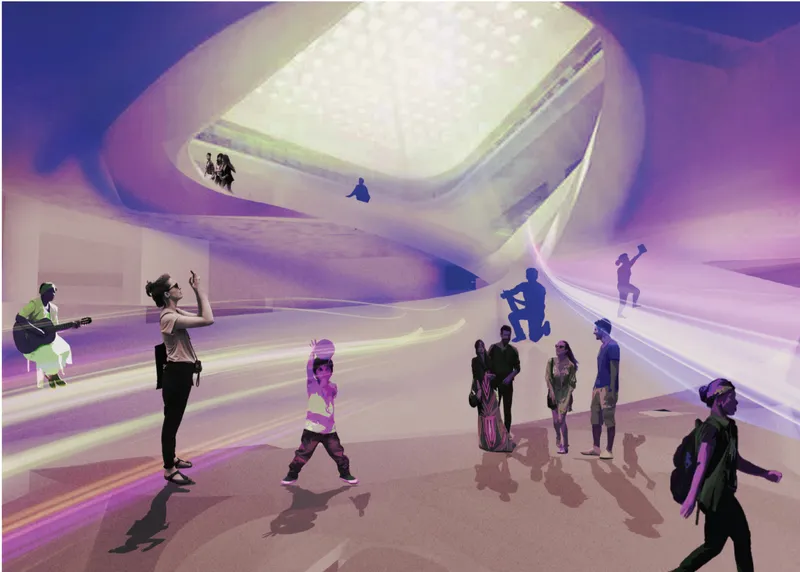
Step inside and the spatial character shifts dramatically. The interior rendering depicts a vaulted atrium bathed in a wash of purple light, with visitors circulating below a canopy of structural ribs that arc overhead. The atmosphere is closer to a cathedral of making than a conventional public building. This is the kind of space that refuses neutrality; it stages encounters. The atrium acts as the connective tissue between the Impact Hub's four core zones: the Charrette Classroom Incubator, where civic engagement programs teach legislative writing and public speaking; the Exhibition and Conference Space for public art and civic music festivals; the Test Kitchen, an interdisciplinary lab for co-developing wearable tech and VR tools; and the Amphitheater, a flexible arena for coding workshops and digital literacy.
Each zone is distinct in character but deliberately unbound by walls. The daylight strategies and layered programmatic zoning ensure that the building responds to both its climatic conditions and its social ambitions. You move through the Impact Hub not by following corridor signs but by following light, sound, and the pull of activity.
Section as Argument: Connecting Two Districts
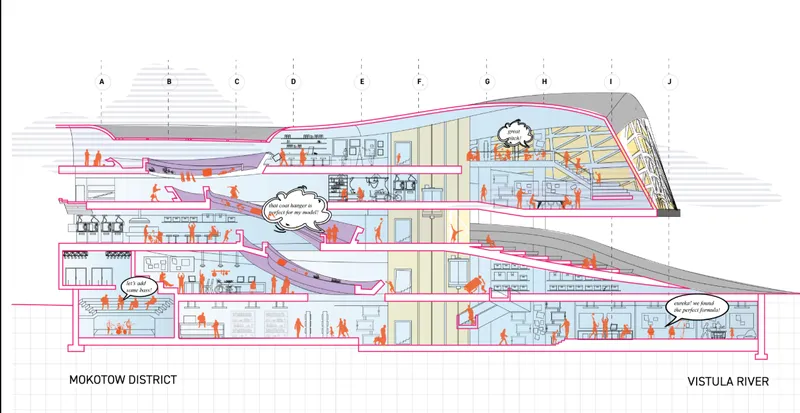
The section drawing is perhaps the most revealing document of the project's intent. It illustrates how interconnected levels bridge between two adjacent urban districts, with circulation paths weaving vertically and horizontally through programmed zones. Rather than stacking functions in a conventional floor-plate arrangement, the designers interlock them: a conference level overlaps with a maker zone; an amphitheater wraps beneath a classroom incubator. The section makes visible what the plan alone cannot: this is a building designed for chance encounter and intergenerational exchange, not efficient departmental separation.
The strategic siting between the Warsaw Highway, the Vistula River, and Mokotow means the building negotiates very different urban conditions on its north and south faces. A northern arcade and a southern plaza each curate distinct types of public engagement, ensuring that the Impact Hub is not just a destination but a threshold between neighborhoods.
Structure as Spectacle, Interior as Workshop
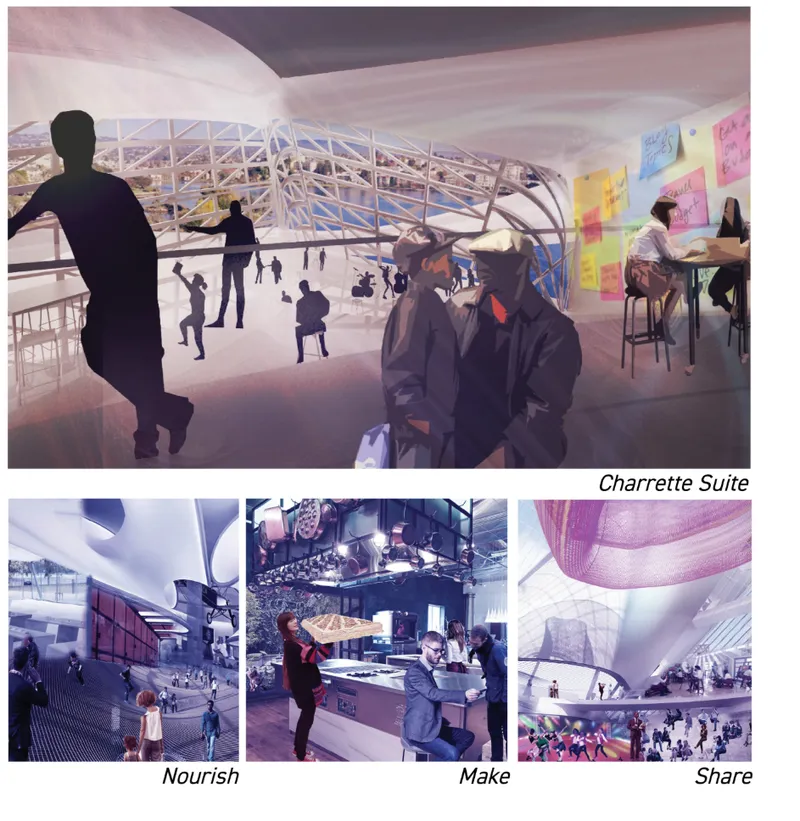
The interior renderings confirm that the structural system is not hidden behind finishes; it is the architecture. Deep trusses remain visible through glazed openings, lending the occupied spaces an honest, almost industrial legibility. People work, talk, and prototype beneath these exposed members, and the effect is of inhabiting a structure that trusts its users to engage with the building at every scale. Circular diagrams developed by Nguyen and Wanjek visualize how the hub's four user groups, civic leaders, local artists, tech entrepreneurs, and youth, nourish, make, and share knowledge in overlapping cycles. The architecture translates those diagrams into real space.
Why This Project Matters
The Impact Hub matters because it takes the brief of "reimagine the library" and actually does so, without nostalgia and without defaulting to a sleek coworking template. Its four programmatic zones, the Charrette Classroom Incubator, the Exhibition and Conference Space, the Test Kitchen, and the Amphitheater, are not stacked amenities but genuinely interdependent ecologies. Civic engagement feeds artistic production; artistic production feeds technological experimentation; technological experimentation feeds back into education. The architecture makes that feedback loop legible through section, envelope, and spatial sequence.
Nguyen and Wanjek's declaration that "the future is within the touch of our human imagination and power of creation" could read as idealism, but the project earns the statement. By grounding their vision in a specific Warsaw site, responding to real urban and climatic forces, and detailing how facade modulation controls light and thermal comfort, they demonstrate that ambitious public architecture does not have to choose between social aspiration and material precision. The Impact Hub is a framework that dissolves boundaries between learning, making, and governing, and in doing so, it offers a genuinely useful model for the next generation of civic buildings.
View the Full Project
About the Designers
Designers: Sydney Nguyen, Natalie Wanjek
Enter a Design Competition on uni.xyz
uni.xyz runs architecture and design competitions year-round that reward proposals with spatial conviction and real site intelligence.
Project credits: Impact Hub by Sydney Nguyen, Natalie Wanjek Libgen 2019 (uni.xyz).


Popular Articles
Popular articles from the community


Co-life: Sustainable Architecture for Age-Friendly Community Living
Co-life reimagines sustainable architecture for seniors through courtyards, rammed earth, shared gardens, and spaces designed for belonging.

Riyadh For All: Intergenerational Urban Design for Active Aging in Rabat
Riyadh For All reimagines urban design in Rabat with intergenerational co-living, adaptive courtyards, and Moroccan cultural exchange today.

Play: Fragments of Their World
Familiar architecture becomes modular playground design, creating safe spaces where displaced children can learn, connect, imagine and play.

The Ocean Hive: Sustainable Architecture for a Self-Sufficient Civilization at Sea
The Ocean Hive imagines sustainable architecture at sea, where modular habitats, algae, wave power and ocean waste sustain a growing colony.

Similar Reads
You might also enjoy these articles

Bao Huynh Watercolor Atelier: A Serene Art Retreat in Hội An
Bao Huynh Watercolor Atelier in Hội An blends multifunctional art spaces, sustainable design, local materials, and family-friendly living in a serene environment.

Atelier Macri Concept Store Interior Design by CASE-REAL
Atelier Macri store features a "ko" counter, walnut wood details, cork displays, blending retail, gallery, and seamless customer experiences.

Manuel Vargas Izquierdo Stadium and High-Performance Sports Center: Architectural Excellence in Jalpa de Méndez
The Manuel Vargas Izquierdo Stadium blends sustainable design, inclusive sports facilities, and cultural-inspired architecture, revitalizing Jalpa de Méndez’s public spaces.

KAKR Buluh Awar Hall: Revitalizing Community and Ecology Through Bamboo Architecture
Community built bamboo hall revitalizes Buluh Awar village, empowering youth, restoring ecology, celebrating vernacular craftsmanship through sustainable architecture and culture.





Comments (0)
Please login or sign up to add comments
No comments yet. Be the first to comment!