
UAD Lifts a Football Pitch into the Sky to Shelter an Entire Sports Complex Beneath It
At Shaoxing University, a vaulted concrete megastructure stacks athletics on top of athletics, opening a new kind of campus public space.


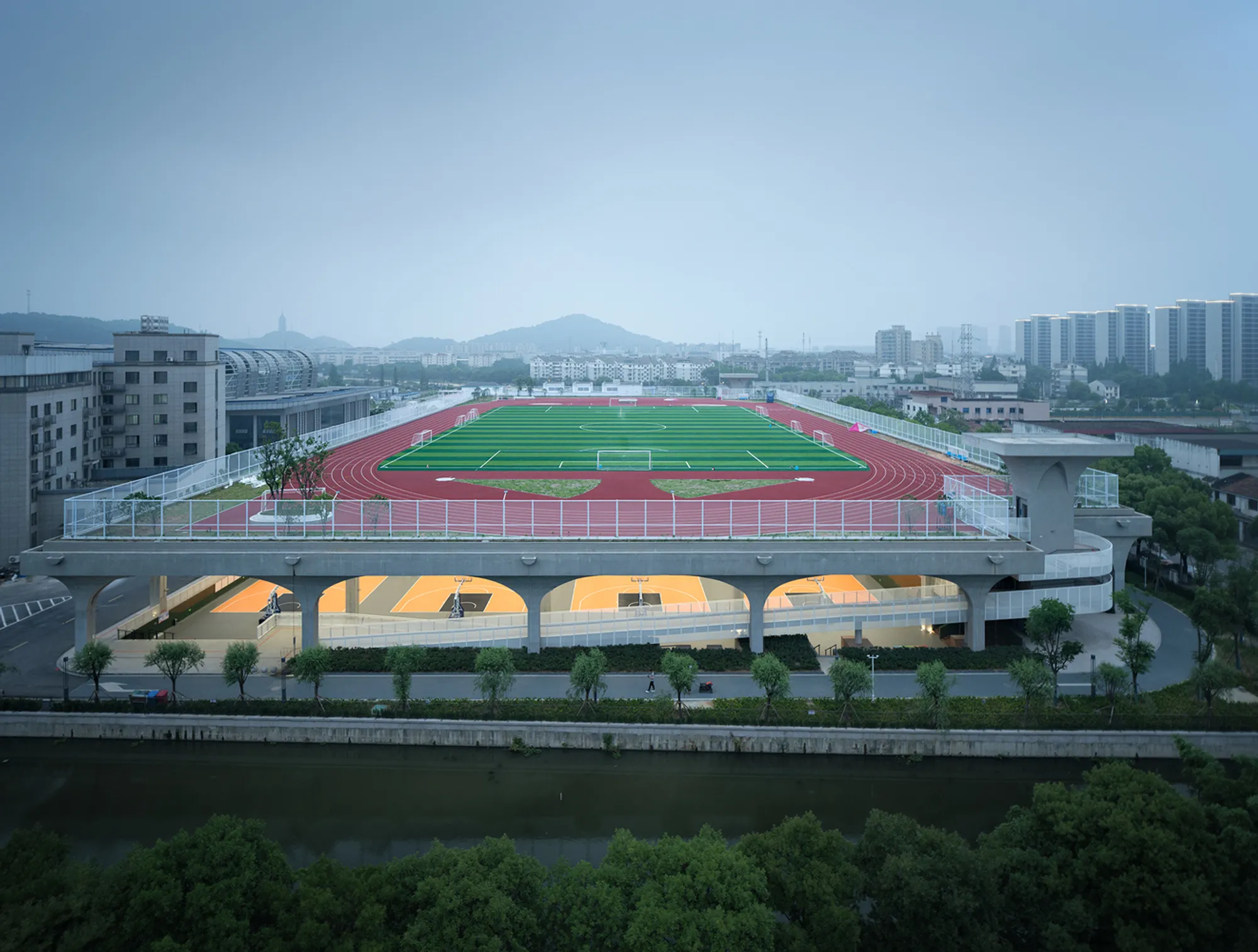
The most radical move in UAD's Indoor Sports Field at Shaoxing University is also the simplest to describe: take a standard 400-meter track and football pitch and put them on the roof. Underneath, where the field would normally sit, pack in basketball courts, badminton halls, a 50-meter track, martial arts rooms, a climbing wall, and extreme sports facilities. The result is a 23,124-square-meter sports complex that occupies a single ground footprint but delivers twice the program, all sheltered beneath a concrete deck that doubles as open-air playing surface.
What makes the project genuinely interesting, though, is not the stacking trick itself but how the architects used it to rethink the relationship between a campus and its surrounding city. Sited at the northwest corner of Shaoxing University, the building sits where old town streets and the Fengze River converge. The arched openings along its perimeter read less like a sports facility and more like a public arcade: a covered, walkable ground plane where shade, airflow, and social life coexist. In a dense urban district where land is scarce, UAD turned a building type that usually walls itself off from the city into one that invites the city in.
The Vault as Organizing Principle

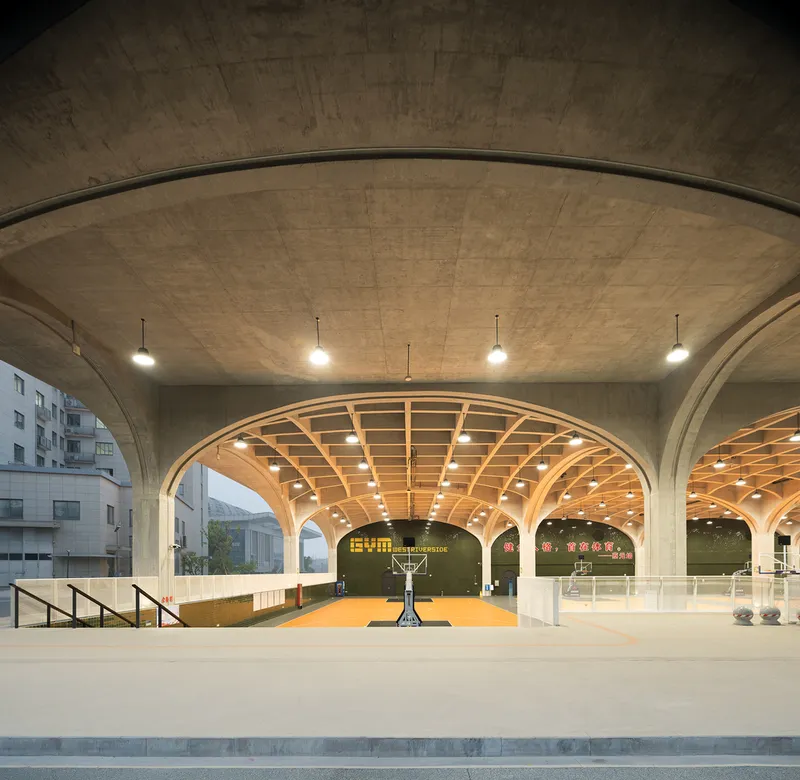
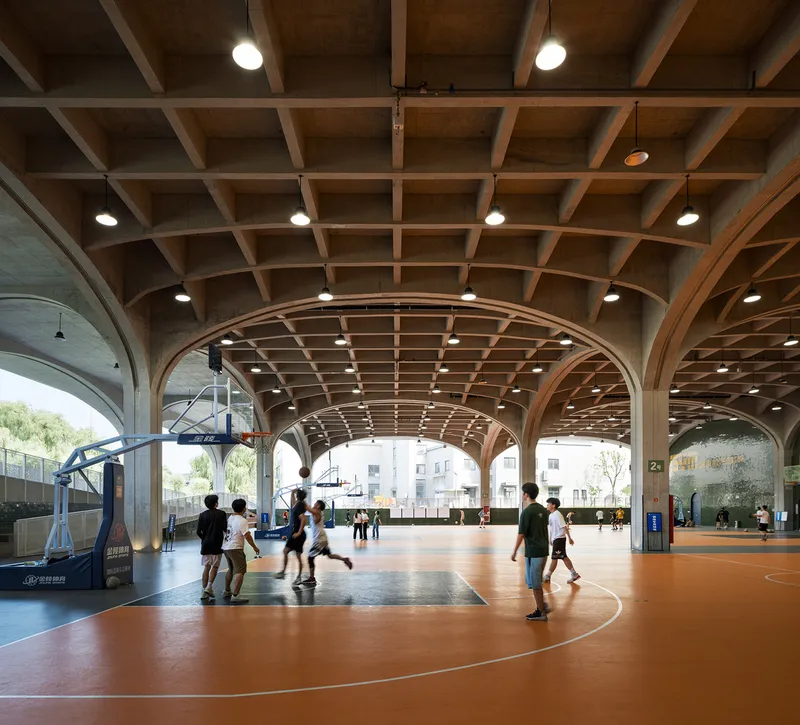
The reinforced concrete arches are the building's structural system, spatial language, and atmospheric engine all at once. They span the full width of the courts below, carrying the elevated football pitch while framing tall, naturally ventilated volumes. The arch is not decorative; it is the most efficient way to bridge the clear spans that basketball and volleyball courts demand while supporting the dead load of an athletics surface above. By repeating the arch module rhythmically along the building's length, UAD creates a continuous spatial rhythm that blurs the distinction between beam, slab, and column.
Inside, the vaulted ceilings transform what could have been oppressive covered courts into generous, cathedral-like spaces. Pendant lights hang from the coffered timber-clad soffits, and the warm tone of the wood offsets the rawness of exposed concrete. The effect is surprisingly comfortable for a utilitarian program. Players on the orange-surfaced courts move through a space that feels civic rather than institutional.
A Rooftop Athletics Field
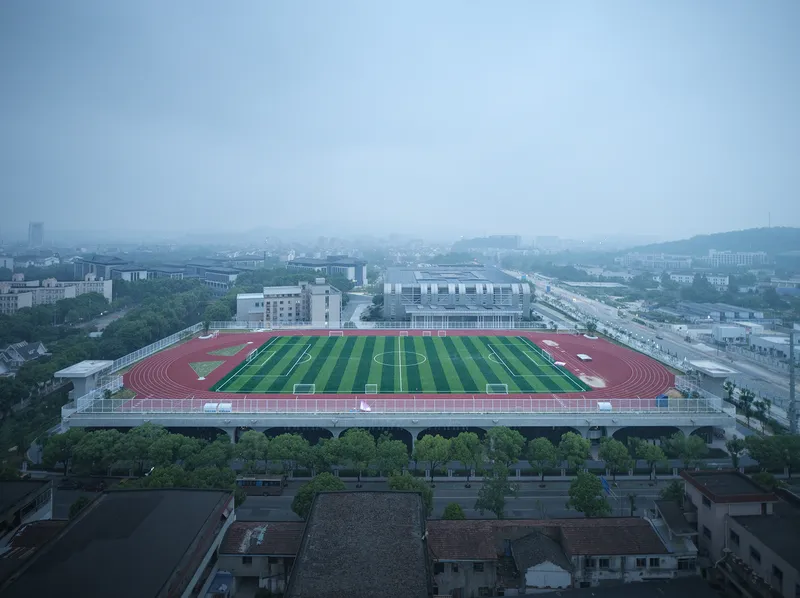
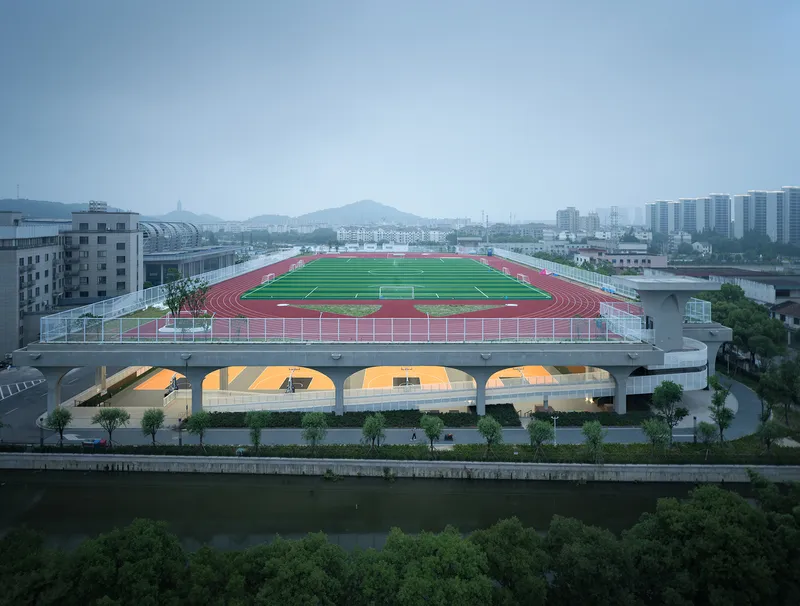
The aerial view reveals the boldness of the proposition. A full-size running track wraps a football pitch in the open air, elevated one story above grade. Runners and footballers train in daylight and breeze while the courts below stay shaded and protected. Two long ramps at the east and west ends lead to spiral staircases that wind up to the pitch, turning the act of arriving at the field into a promenade that offers views over the old city and the river.
At twilight, the arched openings along the waterfront glow from within, and the building's true duality becomes clear. From above, it is a playing field. From the street, it is a luminous colonnade. The elevated deck liberates the ground plane from the fence-and-gate logic that typically isolates campus sports infrastructure, replacing it with a porous threshold between university and neighborhood.
Street Presence and Urban Interface
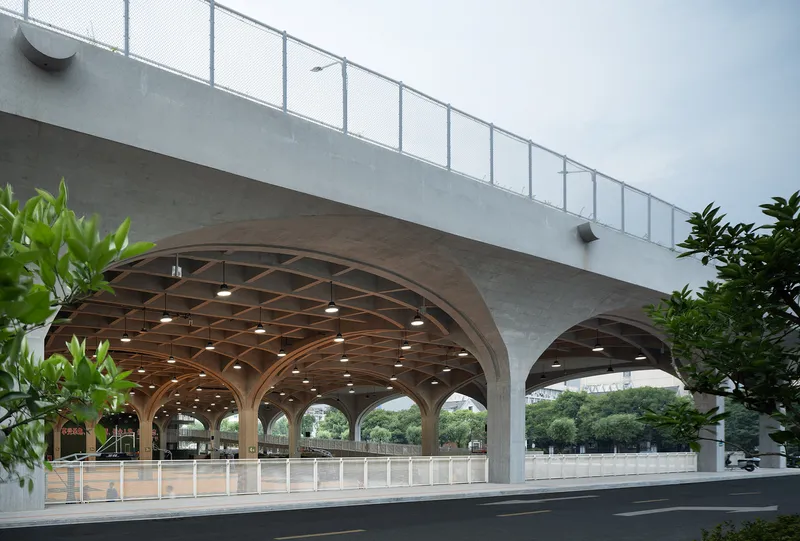
Walk past the building at street level and what you encounter is not a blank wall or a loading dock. The gridded timber vault sits visibly beneath the concrete podium, its scale relatable, its cadence echoing the roadside trees that line the approach. A metal railing above marks the edge of the elevated playing surface, but the dominant impression is of openness. The arches function like the colonnades of a public market: they define territory without enclosing it, creating an all-weather shared space below the elevated floor that the architects liken to the shaded retreats cast by urban buildings.
This porosity is deliberate. Shaoxing's old downtown is increasingly hollowed out, and UAD positioned the sports complex as a connector rather than a boundary. Curved columns complement the cadence of the adjacent trees, and the building's long elevations open directly toward the historic streets to the west and north. Rather than turning its back on the city, the complex becomes an extension of it.
Climate and Material Logic
The program layout follows a clear climate gradient. Basketball courts, volleyball courts, and extreme sports facilities sit at the building's open ends, where they benefit from cross-ventilation and require no mechanical conditioning. Badminton courts, exercise rooms, and martial arts halls, which need a more controlled environment, occupy the center of the elevated floor and are separated by walls. This arrangement minimizes the volume of conditioned air without sacrificing comfort where it matters most.
Material choices reinforce the building's character of robust simplicity. Exposed concrete and brick dominate the structure, while glossy green and black tiles punctuate the interior. White perforated aluminum plates wrap the ramps, filtering light and admitting air. Wooden surfaces appear at rest areas, viewing seats, and interactive zones, softening the acoustics and creating moments of warmth within the otherwise muscular concrete frame. The palette is limited but applied with intention: every finish earns its place.
Plans and Drawings
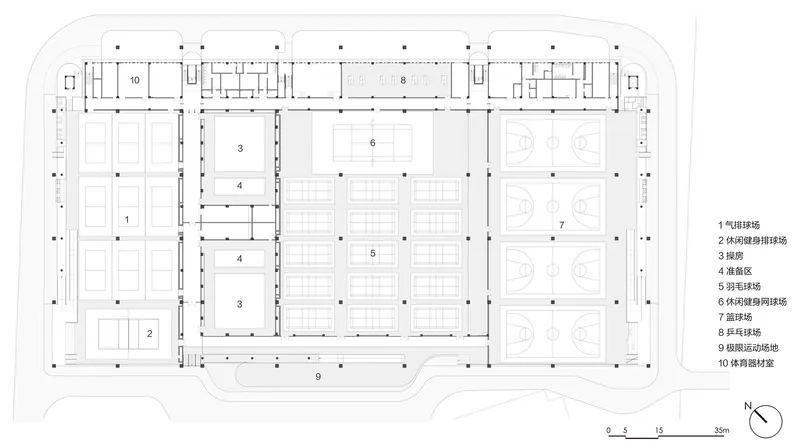


The floor plan reveals the clarity of the organizational strategy: courts line up along the building's long axis, separated by minimal partitions, with circulation concentrated along the edges. The axonometric drawing is the most informative of the three, peeling back the layers to show how a climbing wall, a pool, multiple court types, and the rooftop stadium stack within a single structural envelope. The section, overlaid with a photograph, demonstrates the relationship between the curved roof, the pedestrian deck, and the planted ground level, confirming that the arch is not a surface treatment but the building's structural skeleton.
What the drawings make especially clear is how the sloping site is exploited. Parts of the lower program are partially sunken, and additional ramps and stairs manage the grade changes. The section shows this without romanticizing it: the terrain is uneven, and the building absorbs that unevenness rather than fighting it.
Why This Project Matters
Sports buildings on dense urban campuses are usually compromises. They consume valuable land, they wall off activity behind opaque envelopes, and they serve a single purpose. UAD's design at Shaoxing University refuses every one of those defaults. By lifting the athletics field and letting the ground plane breathe, the architects deliver a building that gives back more public space than it takes. The all-weather arcade beneath the pitch is open to casual use, to wandering, to the kind of spontaneous social life that a conventional gymnasium never generates.
The project also demonstrates that structural ambition and programmatic pragmatism are not opposites. The concrete arches are the building's most dramatic gesture, but they exist because they are the most logical way to span wide courts and support an elevated field. Nothing here is arbitrary. In a moment when campus architecture often defaults to flashy skins over generic boxes, this building earns its form through the honest resolution of a real spatial problem: how to give a crowded city two playing fields on the footprint of one.
Indoor Sports Field of Shaoxing University by UAD. Shaoxing, China. 23,124 m². Completed October 2022. Photography by Qiang Zhao.
About the Studio
Share Your Own Work on uni.xyz
If projects like this are the kind of work you want to make, uni.xyz is a place to publish your own, find collaborators, and enter design competitions.




Popular Articles
Popular articles from the community


The Earth Pod: 3D Printed Homes for Resilient Refugee Communities
The Earth Pod reimagines refugee housing through 3D printed homes made from clay, combining resilience, self-sufficiency, and rapid shelter.

The Ocean Hive: Sustainable Architecture for a Self-Sufficient Civilization at Sea
The Ocean Hive imagines sustainable architecture at sea, where modular habitats, algae, wave power and ocean waste sustain a growing colony.

The Musturak Paradise: Senior Living Architecture for a Connected Future in Temara, Morocco
The Musturak Paradise reimagines senior living architecture in Temara via private homes, social spaces, culture, community, and shared care.

Lunar Spiral: Space Architecture Shaped by the Mathematics of the Universe
Lunar Spiral reimagines space architecture through Fibonacci geometry, lunar regolith, levitating habitats, and self-sustaining Moon living.


Similar Reads
You might also enjoy these articles


Hodi-Mandai Geram
Project Function: Preservation and revitalization of the Intangible heritage and socio-spatial identity of the Hodi by Housing, Cultural Memory Center, Sacred Grove, landscape, local tourism economy


Olio Towers: A Mid-Rise for Performers That Fuses Housing, Rehearsal, and Stage
Located blocks from Houston's Theater District, this modular tower stacks living units around a central performance atrium.

Oasis: Modular Green Housing Carved into Dhaka's Urban Fabric
A shortlisted Plugin Housing entry reclaims unauthorized settlements in Dhaka with stepped concrete volumes, green roofs, and ventilation-driven design.

Black Hole: A Floating Megastructure for the Post-Physical Era
Emiliano Mazzarotto envisions a spherical, self-scaling arena where e-sports, digital hotels, and holographic stadiums replace traditional public space.


Explore Sports Architecture Competitions
Discover active competitions in this discipline



Challenge to design a barrier free sports center


Challenge to design an outdoor ice-rink and park


Challenge to reimagine the Iron Throne


Photograph architecture without architects
Comments (0)
Please login or sign up to add comments
No comments yet. Be the first to comment!