

Infrastructure of Care in Borderlands
An Operational Framework for La Línea de la Concepción, Spain

The city of La Línea de la Concepción, located at the crossroads of Spain and the
overseas British territory of Gibraltar, represents a complex landscape shaped by
cross-border flows between the two countries and within the larger context of the
Bay and Strait of Gibraltar. Like many other borderlands globally, La Línea is subject
to the effects of differentiated socio-economic, political, and cultural dynamics
across the border, which are spatialized into a series of specific urban conditions.
Due to the unbalanced economy across the border, the city is characterized by
the multiplication of internal boundaries and the emergence of social exclusion
patterns. This phenomenon results in a fragmented and vulnerable urban landscape
with disparate access to opportunities and resources. The thesis aims to unravel
such challenges by proposing a trans-scalar strategy and an urban design toolkit,
providing new infrastructures of care.
In the first part, the thesis proposes an understanding of socio-spatial fragmentation
inherent in borderlands by investigating global border studies. The study encourages
perceiving borderlands as laboratories of opportunities, exploring care-centric
urban design alternatives to devise tools for experimentation in urban borderlands.
The second part examines the case of La Línea by addressing its geographical,
historical, morphological, and socio-spatial conditions. Through cartographic
and spatial analysis, press media, and interviews, the thesis aims to highlight the
vulnerabilities and the sense of belonging the city provides its inhabitants. This
ambivalence is examined in two dimensions: fragmented access to opportunities,
the manifestation of urban voids and fragments arising from top-down planning
approaches, and unregulated growth in neglected peripheries.
The third section outlines the Infrastructures of Care strategy and toolbox at two
scales. On the city scale, a schematic framework is proposed, positioning care
infrastructures as catalysts to stitch the urban fabric. The thesis further delves into
a specific urban transect at the intersection of the urban core and the unregulated
periphery on the city’s northern edge. Here, a sequence of urban voids is identified
as an experimental field to test the main strategy and propose a system of local
care infrastructures. By envisioning a future scenario at the neighborhood scale,
infrastructures of care are proposed to facilitate training, create housing and
educational opportunities, provide leisure and cultural exchange occasions, and
establish dialogues across the city and its diverse populations.
The infrastructures of care aim to establish communication between the city and its
inhabitants through an ecological approach, wherein the city nurtures its inhabitants,
and the individuals, in turn, contribute to the city’s well-being, fostering a sense of
belonging in urban borderlands.

Popular Articles
Popular articles from the community

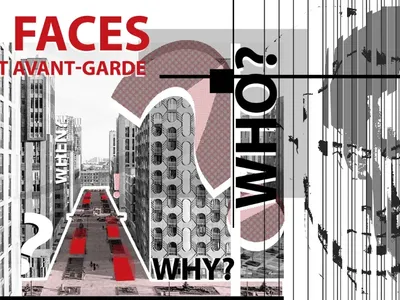
Faces of the Soviet Avant-Garde: Turning Moscow's Street Names into an Open-Air Museum
A network of sculptural installations across a Moscow residential district transforms forgotten architect names into spatial encounters with cultural memor

Extended Shell: Retrofitting Kolkata's Balconies as Living Urban Thresholds
A modular retrofit system recovers the social and environmental intelligence of Kolkata's historic verandas for contemporary Park Street residents.

Temporary Home for Dogs: A Reversed Zoo Rethinks Animal Shelter Architecture
In Bucharest, a sinuous corridor and freed landscape flip the logic of containment, designing a shelter that works to make itself unnecessary.

Singing Woman: An Opera House That Performs Before the Curtain Rises
Ovidiu Cristian Pavel's conceptual opera house translates Estonia's choral identity into a sculpted waterfront landmark facing the Baltic Sea.

Similar Reads
You might also enjoy these articles

Shakur's House: Exposed Brick as an Interior Organiser in a 168 m² Mashhad Residence
Brick moves indoors in this Mashhad residence, where masonry walls, glass partitions and teal planes sequence a compact home without closing it off.

Day and Night Park: A Time-Based Urban Newsstand in Beijing
A temporary urban newsstand in Beijing blending travel, light, and reading through poetic colors, compact form, and community-focused design.

Modernist Patio Renovation in El Masnou, Barcelona by Oliver Segura Arquitectura + Cebrià Arquitectura
Modernist patio renovation blending tradition and innovation with a movable pool, leveled floors, and Catalan materials in El Masnou.

Alto Residencial Coop: Cooperative Housing Development in Santiago de Compostela by Carbajo Barrios Arquitectos
A linear cooperative housing complex blending white volumes and perforated metal façades, enhancing community living, natural light, privacy, and urban integration.

Comments (0)
Please login or sign up to add comments
No comments yet. Be the first to comment!