
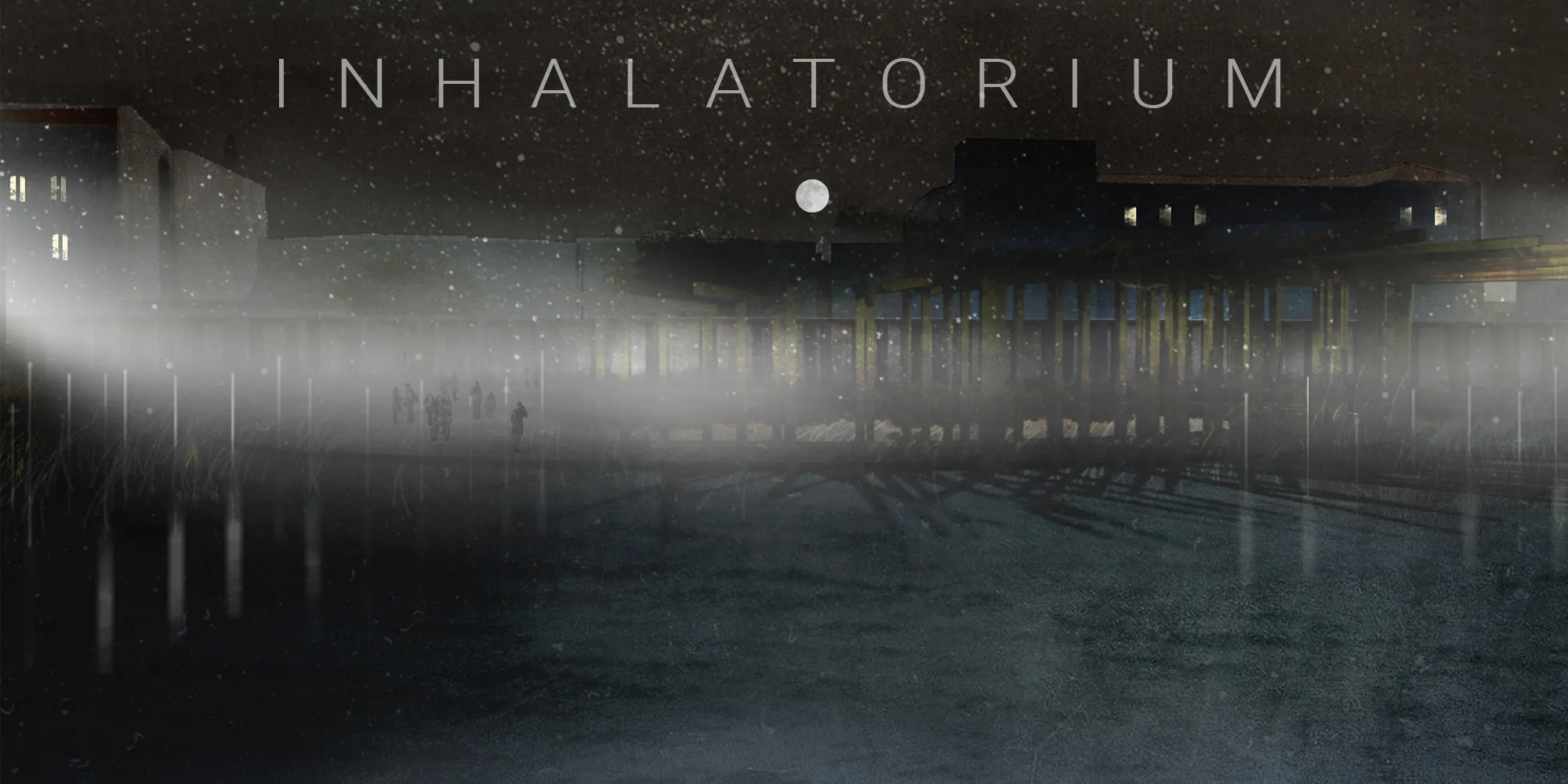
INHALATORIUM
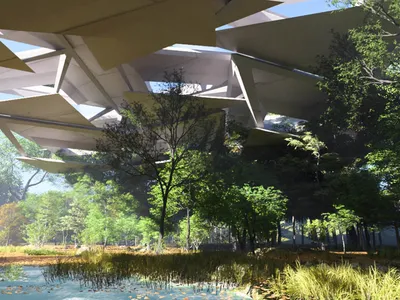
The aim of our project is to create a recreational space for the inhabitants of Florence. The main assumption underlying us during the design process was the conferral of the inhalation function, where the salt graduation works became the main inspiration. The inhalation room along the wall is a multisensory zone where you can forget that you are in a big city. The user, who is surrounded by water vapour enriched with health-promoting microelements, can focus particularly on the process of breathing. This place gave us a pretext to create the lung of Florence. “Inhale – exhale” is the basic sequence when practicing yoga or meditation. Therefore, the passage we designed, whose skeleton was made from a grading plant, may become a suitable place for these practices.The project includes: 1) Pavilion with steam-releasing graduations with aromatapeteutic properties. 2) The paths that stretch from the pavilion to the river Arno and are made of concrete that tends to heat up, releasing the point-shaped irrigation water along the path as steam. Every third ends with a subtle descent into the river, which brings the user directly into contact with the river. 3) Reinforcing element of the experience is a jetty raised above the water, partly covered by a canopy that connects to the local water vegetation. The creative process began with the projects inspired by the Arno River. We wanted her to be an important part of our project. The whole thing was linked to the movement of water and the many possibilities of water extraction. Therefore, the motif of the couple and materials were used that harmonize with its nature and underline its presence. We have considered the time in which the spatial structure is integrated into the fabric of the place/space in the event of a flooding of the site. The greenery there is supposed to absorb more water and so reduce the risk of flooding. Out of respect for the Florentines and their respect for cultural heritage, we have decided to disrupt the fabric as little as possible. We allow the natural course of things without intervening with mechanical structures, based on the elements of nature and its possibilities.

Given the climate prevailing in Florence, with hot and dry summers, we wanted to dedicate the room to the locals. Everyone needs a place to rest their thoughts, to help them breathe again and to protect themselves from the natural influences of the weather. The aim was for the inhabitants of Florence to have their own cosiness, so that this place is always available and still a green spot.The aim of our project is to create a recreational space for the inhabitants of Florence. The main assumption underlying us during the design process was the conferral of the inhalation function, where the salt graduation works became the main inspiration. The inhalation room along the wall is a multisensory zone where you can forget that you are in a big city. The user, who is surrounded by water vapour enriched with health-promoting microelements, can focus particularly on the process of breathing. This place gave us a pretext to create the lung of Florence. “Inhale – exhale” is the basic sequence when practicing yoga or meditation. Therefore, the passage we designed, whose skeleton was made from a grading plant, may become a suitable place for these practices.To this end, we have resorted to history to focus on the process of the first spa activities that began in the 19th century. This innovative project was undertaken in the mid-19th century by Auphan and Sales Giron. Together they designed artificial inhalation devices called vaporators. The stream of water from the spring was driven with high pressure to the stone wall of the room, where it broke and formed fog. In the 1960s, Sales Giron built the first manual liquid spray based on the same principle that can be used to inhale at home. A stream of liquid ejected at increased pressure through the nozzle sprayed on a metal or glass wall. The device became the model for many other atomizers. The construction used in the Polish Ciechocinek grading works of Prof. Jan Szmurło’s project is based on a different principle. In this solution, the atomizer is immersed in a deep glass shade that is filled with brine up to half of the spine. A compressed air stream sucks the brine through the thorn holes to the opposite wall of the lampshade. The tiny particles rise up and the larger droplets drop on the floor of the lampshade. This creates a subtle but dense mist that fills the inhalation rooms.The grading units designed by us have a very simple structure that, thanks to their construction, helps to pump aromatherapy substances to the highest level. From here, the water flows down on a densely laid Faschin made of sloe branches and then slowly evaporates. To enhance the effect, the water is additionally broken by the inhaler, resulting in the aerosol. Inside, there are health components that create a characteristic, humid microclimate that we breathe in as we move through the object. Breathing the air with an aerosol rich in aromatherapy components has a preventive and healing effect. Minerals and trace elements are absorbed by the mucous membranes of the respiratory tract and skin to compensate for the lack of these trace elements in the human body. The healing effect of inhalation has a positive effect on the nervous system, the endocrine gland system and also stimulates the work of the immune system. Respiratory sessions in the grading plant are also recommended for thyroid diseases, allergic skin diseases and for the treatment of high blood pressure.This place emphasizes the values of natural healing forms and allows a new look at the architecture.
The project includes:1) Pavilion with steam-releasing graduations with aromatapeteutic properties.2) The paths that stretch from the pavilion to the river Arno and are made of concrete that tends to heat up, releasing the point-shaped irrigation water along the path as steam. Every third ends with a subtle descent into the river, which brings the user directly into contact with the river.
3) Reinforcing element of the experience is a jetty raised above the water, partly covered by a canopy that connects to the local water vegetation. The creative process began with the projects inspired by the Arno River. We wanted her to be an important part of our project. The whole thing was linked to the movement of water and the many possibilities of water extraction. Therefore, the motif of the couple and materials were used that harmonize with its nature and underline its presence. We have considered the time in which the spatial structure is integrated into the fabric of the place/space in the event of a flooding of the site. The greenery there is supposed to absorb more water and so reduce the risk of flooding. Out of respect for the Florentines and their respect for cultural heritage, we have decided to disrupt the fabric as little as possible. We allow the natural course of things without intervening with mechanical structures, based on the elements of nature and its possibilities.“When we breathe in or out, the air touches the nostrils. Sensitive matter registers the touch of air. In this process, the sensation of touch is matter, and the complete knowledge of that touch is mind. So do not look for answers to the question of mind and matter in others, but watch your breath, and you will experience them through your own experience. ” - Webu Sayadaw 1896 – 1977 Source: Basic Practice Part I Lectures on the Dhamma



Popular Articles
Popular articles from the community


Hill & Cross Opera: Sculptural Opera House Architecture Shaped by Tallinn’s Landscape and Identity
Hill & Cross Opera reimagines opera house architecture in Tallinn through its sculptural hill, civic plaza, glass wave and a luminous cross.

The Earth Pod: 3D Printed Homes for Resilient Refugee Communities
The Earth Pod reimagines refugee housing through 3D printed homes made from clay, combining resilience, self-sufficiency, and rapid shelter.

The Ocean Hive: Sustainable Architecture for a Self-Sufficient Civilization at Sea
The Ocean Hive imagines sustainable architecture at sea, where modular habitats, algae, wave power and ocean waste sustain a growing colony.

Conexión: Biophilic Design Reimagines High-Rise Living in Hong Kong
Conexión reimagines high-rise living in Hong Kong through biophilic design, green facades, shared spaces, daylight, water and nature within.

Similar Reads
You might also enjoy these articles

The Rhythm of Seasons
A Farmers' Market Connecting Nature and the City


More Than a Building-Designing a Living System
More Than a Building-Designing a Living System
Base Beyond
DESERT COMPOUND ARID: TOURISM OF ABSENCE AND ABUNDANCE


Comments (0)
Please login or sign up to add comments
No comments yet. Be the first to comment!