
Inside Out
A Training center for women

There has been a large trend of migration within Nigeria from rural areas to the urban city of Abuja, Nigeria. Our project looks at the migration of women to the urban city. When women migrate, in our case, it is due to social and political conflicts such as forced arranged marriages, lack of land, political unrest and to get a better future in the city. However, upon arrival to Abuja, women face many challenges. They are more likely to be coerced into having sex and going into prostitution. They are also often abused by agents they rely on jobs for. And they can also become homeless if they do not have relatives who already live in the city.
We are looking at this migration through the lens of not pity but Empowerment. Most women in Nigeria are domesticated at a young age to learn cooking, cleaning, child care, and maintaining their homes. When Women from rural areas migrate, they bring these skills with them to the city. As a result, it is not the women who adapt to the city but the city constantly changes to adapt to them. In our case, as you can see, these women put their skills to use in Abuja. They become cooks, vegetable vendors, spice grinders, etc.
As mentioned previously, the type of dwellings these women often migrate from tends to be made out of mud houses surrounded by a field of green. The houses themselves are made out of natural materials such as wood as structure. The wall is then covered by either rock or mud plastered on. The roof usually consists of hay or other forms of materials found around. Our project looks at this concept and inverts the relationship where the field is now inside and the house is outside. This project is specifically for women who move to the city alone and are most vulnerable. This includes single women, divorced women and widowed women.
Therefore, Our Training center focuses on domesticity in three different ways: Preparation, Production and Distribution of food centered around a restaurant where women can train themselves and find employment afterwards. We are training women to be Entrepreneurs, Restaurant owners, vegetable owners and spice distributors. They train for 8 months and then graduate to find employment. After Graduation, they can teach newcomers in the restaurant as a starting job.
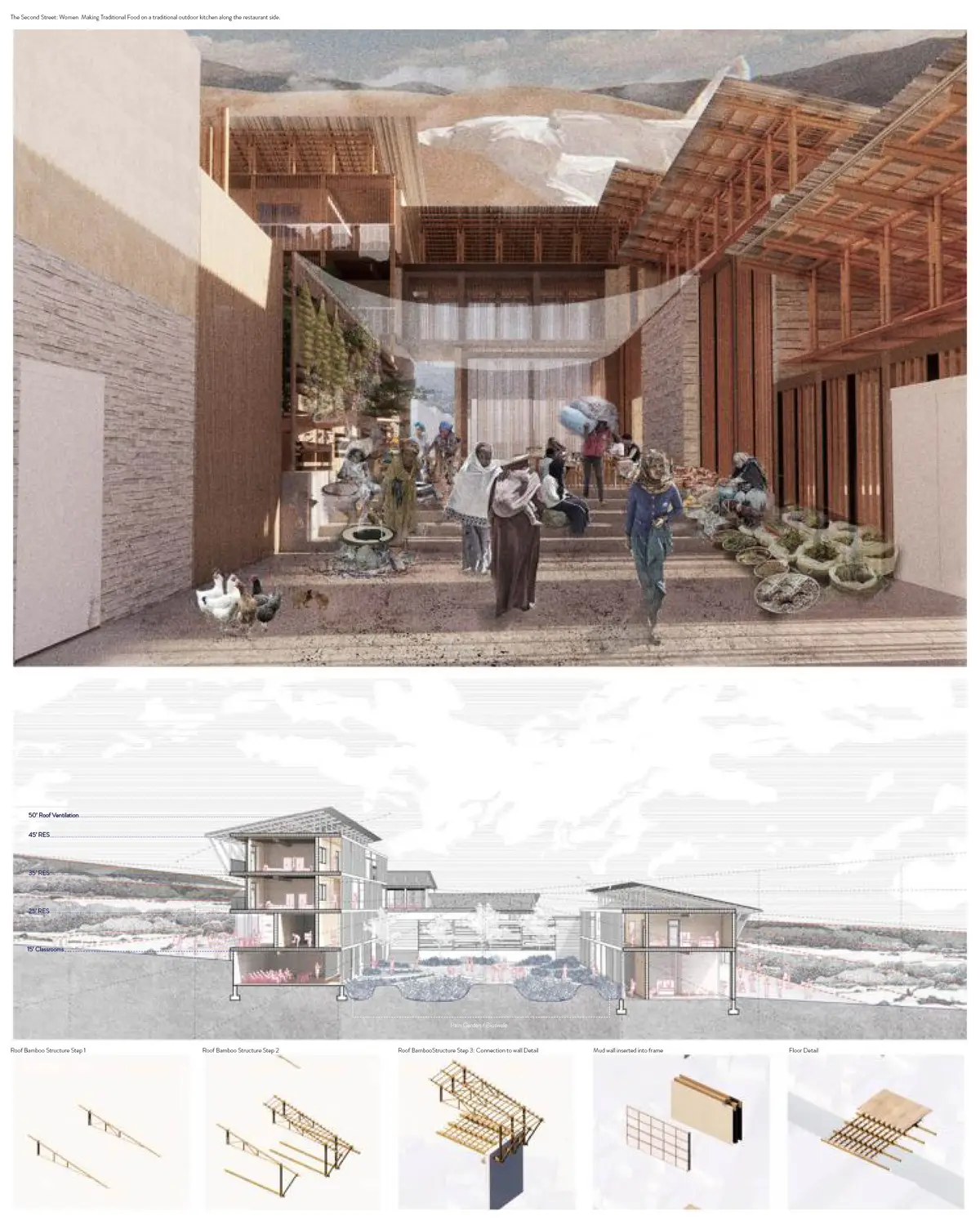
We included a courtyard in the middle for gathering, growing vegetables, drying spaces, clothes, etc. We have also included a second street connecting a dead end from a previous street making a loop through our project to bring in people for economic prosperity. Along this street is the main restaurant with a spice store, grocery store and a juice bar. These are the places that women will train/work in. The remaining edge will consist of fabric stores, community center, public bathrooms and daycare.The classrooms are facing the courtyard.
In Abuja, space is extremely precious. People often rearrange spaces in a typical apartment to either fit more people or program. This means that the current ways of making spaces don't meet the needs of the people. Therefore, we introduced a screen system that separates the spaces to allow for flexibility of needs. For example, The inner screen can make smaller classroom spaces, but the outer one can be included to make the spaces bigger or even all the screens can be pulled apart to make one big space.
A screen separates the two courtyards and acts as a buffer zone for hanging produce for the cooking. Women and the public interact with one another by sharing traditional food and knowledge. In the morning, half of the women attend classes and the other half trains at the restaurant. In the public courtyard, a truck comes to unload the daily goods that the women help to bring inside together. The stoves are brought out and a traditional dish called “garri” is made starting every morning to be sold to the locals. In the afternoon, the temporary shades come out into the public spaces allowing for local street vendors, shoppers and local community members to sit under and sell their goods.
Meanwhile, in the private courtyard, the space is used for the women to grow local vegetables, have tea ceremonies, dry spices and clothes and create a community of their own. When it rains, the water is collected from the roof to the water tank. This water is later used for watering the garden, toilets, etc. The plants create pods where the rainwater collects and helps to infiltrate into the ground creating a rain garden.
On the second floor, four women share an apartment with a corridor that is shared between two apartments. You have to go through the corridor to enter your apartment. The sharing space in between is a private space not seen from outside and only accessible to only women to have smaller communities within the big group. The outer balcony is covered by blinds again so the women can control privacy from outside but have the option of natural ventilation. Each corner of the apartments are open for stairs, bathroom and shared kitchen. On the third floor, you can enter the second floor of the restaurant directly from the living space.
We introduced a double layered roof to allow for cross ventilation and we have a loam finish interior as shown here. The roof extends out to protect the building exterior from weathering.
In terms of materiality, It was important for us to use local materials and build from knowledge that women bring from the rural side. We use mud blocks as the primary wall infill. Traditional Nigerian houses use wood inserts and plaster mud or stone on the outside. Our project uses this knowledge and introduces a wall framing system on the exterior walls of our building. The mud blocks are inserted within the frame and covered with a loam finish on the interior and mud mixed with rock and gravel on the exterior. This makes the walls more durable and earthquake proof. There are three layers of bamboo that are used on top of the beams with a wood finish for the floor. The roof also uses bamboo and corrugated metal sheets. The idea is that because we are using natural materials that people have preexisting knowledge about, the building can be maintained and every 10 years there would be a renovation period where the mud is plastered on again. This way, the house for women is taken care of by the women themselves.

Popular Articles
Popular articles from the community


LT2A and OPEN Architectes Thread a Brick and Glass High School Through a Wooded Belgian Campus
In Braine-l'Alleud, a 3,000 m² wing for Collège Cardinal Mercier pairs pale brick with a glazed colonnade, deferring to a small chapel and a dense wood.

GROUP A Strips a 1969 Rotterdam Harbor Headquarters to Its Frame and Wraps It in Timber Louvers
In Rotterdam's M4H harbor district, Ferro Offices reuses a 1969 frame, adds one timber storey and reaches BREEAM-NL Outstanding.

Architekt Andreas Gruber Scatters 23 Dark Timber Chalets Across a South Tyrolean Forest Edge
In Molini di Tures, Amonti Chalets breaks a resort into a hamlet of gabled timber houses, with parking, storage and services pushed into the slope.

Cube Design Draws an Ecological Corridor Between Two Shenzhen Hills with the Nankai Building
Beside Shenzhen's container docks, the Nankai Building pairs stacked balconies with a climbing green screen to connect two hillsides across its height.

Similar Reads
You might also enjoy these articles


Vereda Arquitetos Renovates a 40-Square-Meter Apartment Inside Niemeyer's Copan Building
A compact unit in São Paulo's most iconic residential tower gets a material overhaul that pairs exposed concrete with bold blue Formica.

Shakur's House: Exposed Brick as an Interior Organiser in a 168 m² Mashhad Residence
Brick moves indoors in this Mashhad residence, where masonry walls, glass partitions and teal planes sequence a compact home without closing it off.

Day and Night Park: A Time-Based Urban Newsstand in Beijing
A temporary urban newsstand in Beijing blending travel, light, and reading through poetic colors, compact form, and community-focused design.

Modernist Patio Renovation in El Masnou, Barcelona by Oliver Segura Arquitectura + Cebrià Arquitectura
Modernist patio renovation blending tradition and innovation with a movable pool, leveled floors, and Catalan materials in El Masnou.


Comments (0)
Please login or sign up to add comments
No comments yet. Be the first to comment!