

Inside Out: Eco Architecture that Restores Ethiopia’s Sacred Forest Landscapes
An eco architecture proposal in Ethiopia where sacred space, bamboo structures, and forest restoration create a regenerative future.


Inside Out Redefines Eco Architecture Through Faith and Landscape
As environmental degradation and rapid urbanization continue to threaten ecosystems across the world, architecture is increasingly being challenged to move beyond construction and become a tool for ecological recovery. The future of eco architecture no longer lies only in energy-efficient buildings or sustainable materials. It lies in creating systems that reconnect people with land, culture, and biodiversity.
The project Inside Out explores this idea through a visionary architectural proposal rooted in the cultural and ecological landscape of Ethiopia. Designed by School of Planning and Architecture, Raghav KR, Avni Gupta, and Ramya Asokan, the project transforms the traditional chapel typology into a regenerative ecosystem where spirituality, forest restoration, and community life exist together.
Described as “a center of faith, forest and nature inside-out of the built, unbuilt and people,” the proposal responds to one of Ethiopia’s most urgent environmental realities: the disappearance of native forests due to desertification and human intervention. Instead of treating architecture as a static object, Inside Out creates a living framework that actively restores the environment while strengthening local culture and livelihoods.
The project positions eco architecture as an instrument for healing landscapes rather than merely occupying them.

Sacred Forests as the Foundation of the Design Concept
The conceptual inspiration behind Inside Out emerges from the sacred forest chapels of Ethiopia. Historically, forests surrounding Ethiopian Orthodox churches survived for centuries because they were protected by spiritual traditions and community practices. These forests became islands of biodiversity within rapidly deforested regions.
The project takes this historical relationship between faith and ecology and expands it into a contemporary architectural strategy.
Rather than simply preserving isolated patches of greenery, the proposal uses architecture as a catalyst for large-scale forest restoration. The chapel becomes the central spiritual anchor around which ecological and social programs unfold.
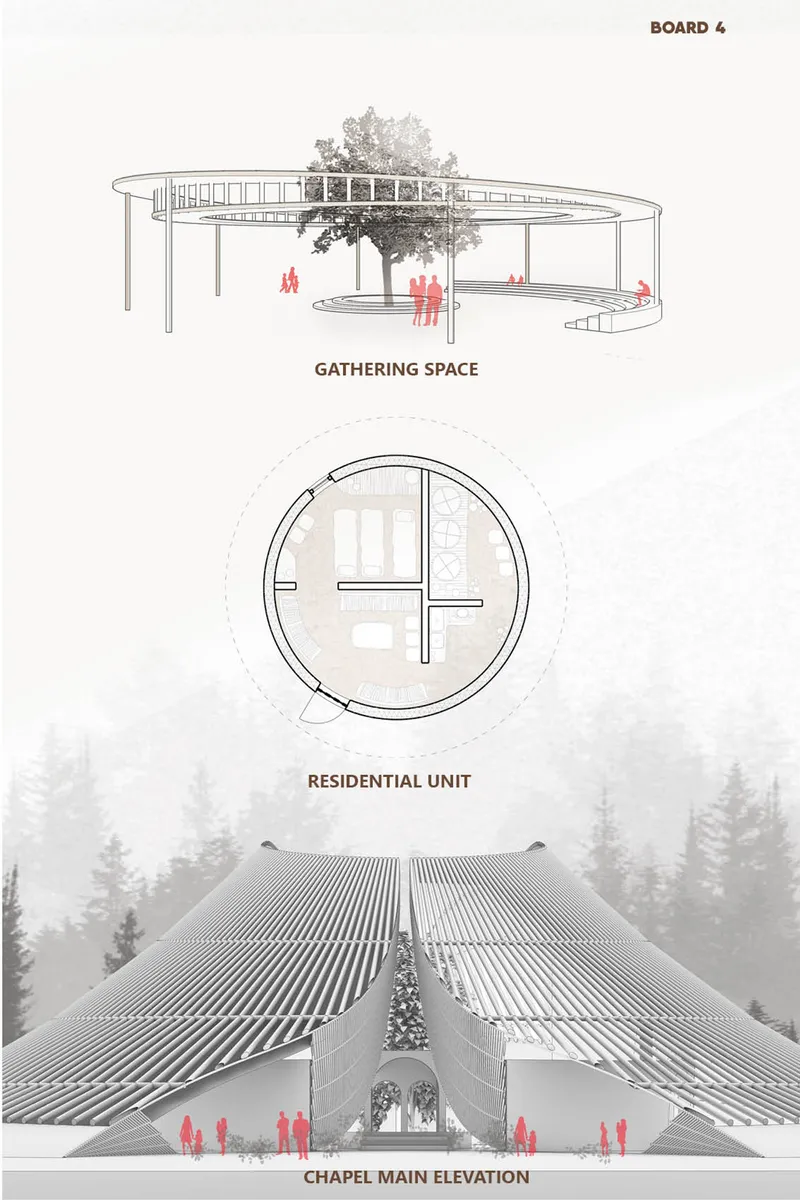
The design follows the traditional three-tier concentric organization of Ethiopian chapel architecture. At the core lies the Maqdas, the most sacred part of the chapel where the Tabot is preserved. Surrounding layers organize spaces for worshippers and community gatherings while maintaining traditional circulation patterns.
Entrances are separated according to customary practices, with women entering from the left and men from the right. This careful integration of local traditions ensures that the architecture remains culturally grounded while addressing contemporary environmental concerns.
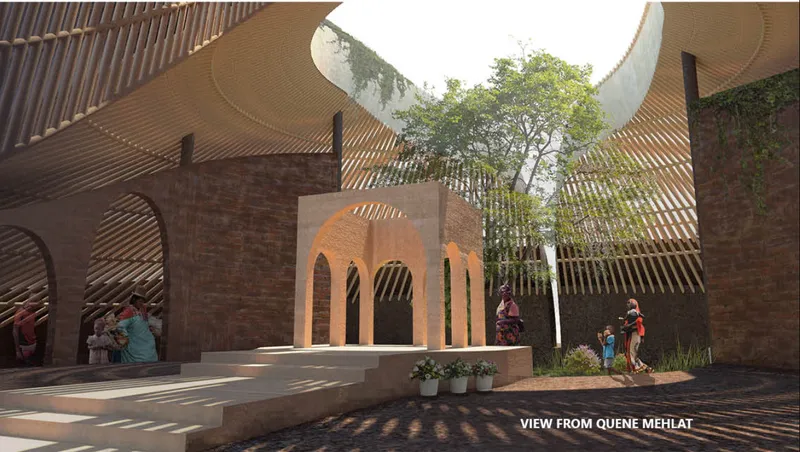
The form itself symbolizes the idea of bringing the forest inside the architecture. Trees, open courtyards, filtered light, and organic circulation paths dissolve the boundary between built and unbuilt space.
The architecture does not dominate nature. Instead, it allows nature to become the primary spatial experience.
Bamboo Architecture and Climate-Responsive Design
One of the strongest architectural qualities of Inside Out lies in its environmentally responsive material strategy. The project embraces locally available materials including bamboo, mud, and brick, creating a low-impact construction system rooted in regional building traditions.
The bamboo shell structure defines the visual identity of the Eco-Chapel. Its flowing organic geometry creates a lightweight yet structurally stable framework capable of responding to the climatic conditions of Addis Ababa.
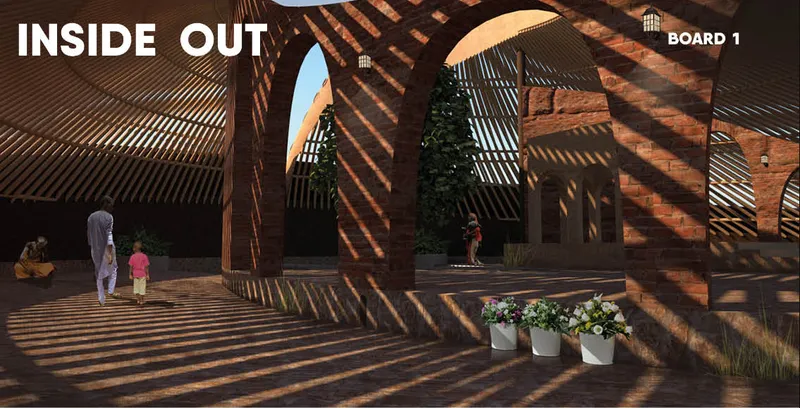
The layered bamboo roof allows natural daylight to filter through the interior, generating dramatic patterns of light and shadow throughout the day. This passive lighting strategy enhances the spiritual atmosphere while reducing dependence on artificial systems.
Mud walls and locally produced bricks provide thermal insulation and temperature regulation, helping maintain comfortable interior conditions naturally. The project avoids excessive mechanical intervention by using climate-responsive architectural principles inspired by vernacular construction.
Vegetation is integrated directly into the architecture rather than treated as decorative landscaping. Mature trees occupy central gathering spaces and courtyards, strengthening the emotional and symbolic relationship between spirituality and ecology.
The resulting architectural language feels both contemporary and deeply connected to place.

Architecture Designed Around Restoration and Community
Unlike conventional religious buildings that function only as spiritual spaces, Inside Out develops an entire ecosystem of social, ecological, and economic programs.
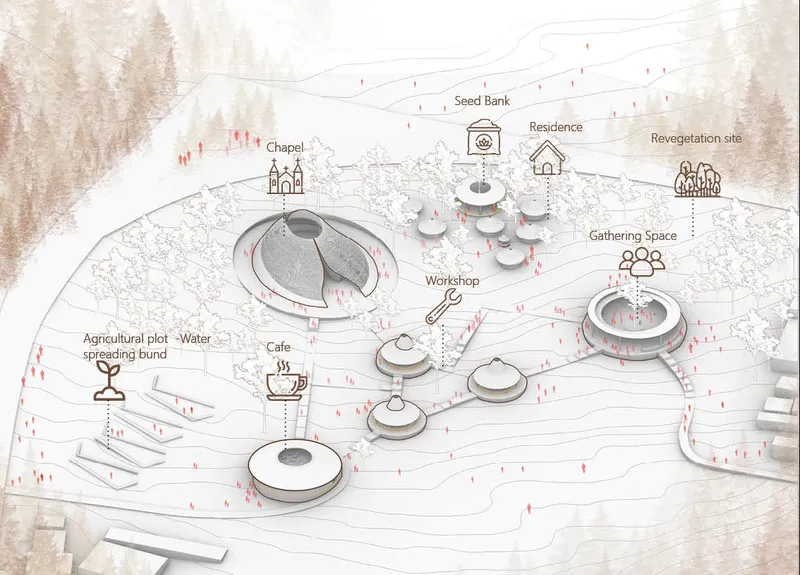
The project includes multiple interconnected functions that support community participation and environmental restoration:
- Chapel and spiritual gathering areas
- Community gathering spaces
- Seed banks
- Workshop units
- Agricultural plots
- Revegetation sites
- Residences for farmers and priests
- Cafes and social interaction spaces
These programs transform the site into a regenerative community hub rather than a standalone building.
The seed bank plays a particularly important role within the proposal. It preserves local grain production while storing indigenous plant seeds required for long-term forest restoration. Architecturally, the circular seed bank reflects ideas of continuity, preservation, and ecological cycles.
The workshop units support local craftsmanship and sustainable material experimentation. Agricultural waste such as rice husk can be reused to create sustainable construction materials and artisanal products. This creates employment opportunities while promoting circular resource systems.
By integrating livelihood generation into ecological restoration, the architecture becomes socially sustainable as well as environmentally responsive.
Spatial Experience Rooted in Light, Shadow, and Nature
The emotional quality of Inside Out is shaped by its powerful use of natural light and spatial openness.
Inside the Eco-Chapel, filtered sunlight enters through the bamboo shell and creates changing patterns across walls, floors, and circulation paths. These shadows transform throughout the day, making time and nature visible within the architecture itself.
The project creates a calm and contemplative atmosphere where visitors remain constantly connected to the surrounding environment. Open courtyards, circular gathering areas, and transitional pathways blur the distinction between interior and exterior space.
The gathering spaces are intentionally designed around trees and landscape elements rather than enclosed rooms. This creates a communal experience rooted in openness, interaction, and shared ecological awareness.
Even the residential and workshop units maintain strong visual relationships with the surrounding forest landscape, ensuring that every function within the project contributes to the broader ecological vision.
The architecture consistently prioritizes experience over monumentality.
Eco Architecture Beyond Sustainability
A significant aspect of Inside Out is its shift from sustainable architecture toward regenerative eco architecture.
Many sustainability-focused projects concentrate primarily on reducing environmental damage. Inside Out, however, attempts to actively repair damaged ecosystems. The project does not merely reduce impact. It contributes positively to biodiversity, forest recovery, and local economies.
This regenerative approach aligns with emerging global discussions around ecological urbanism, landscape architecture, and climate-responsive design.
The project also demonstrates how cultural traditions can guide contemporary environmental solutions. Instead of importing generic sustainability models, the proposal builds upon existing Ethiopian relationships between faith and forest conservation.
This creates a more authentic and context-sensitive architectural response.
The architecture becomes a mediator between spiritual identity, ecological recovery, and collective participation.
A Visionary Model for Future Ecological Design
Inside Out presents an inspiring architectural vision for a future shaped by environmental uncertainty and cultural resilience.
Through its integration of sacred space, bamboo architecture, local materials, community programs, and forest restoration strategies, the proposal demonstrates how architecture can become an active participant in healing landscapes.
The project expands the role of eco architecture beyond aesthetics and technical sustainability. It proposes architecture as a living ecological system capable of supporting biodiversity, preserving cultural identity, and empowering local communities.
At a time when climate change demands new relationships between humans and the environment, Inside Out offers a powerful reminder that architecture can nurture ecosystems as much as it creates spaces.
The project ultimately transforms the chapel into more than a place of worship. It becomes a center for regeneration, coexistence, and environmental renewal.


Popular Articles
Popular articles from the community


Cloaked Colonization: A Mobile Underwater Habitat That Moves Like a Fish
Micah Abaya's shortlisted EHC Pacific entry reimagines ocean settlement as a dispersed network of self-sustaining architectural organisms.
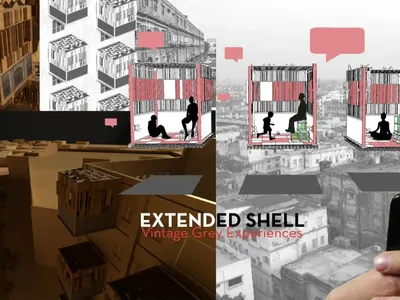
Extended Shell: Retrofitting Kolkata's Balconies as Living Urban Thresholds
A modular retrofit system recovers the social and environmental intelligence of Kolkata's historic verandas for contemporary Park Street residents.

Tsunami Convergenics: Turning Catastrophic Ocean Forces into Underwater Housing Infrastructure
A speculative underwater settlement off the coast of Onagawa, Japan, treats tsunamis and typhoons as energy sources rather than threats.

Opera by the Sea Estonia: Three Shells Dissolving Architecture into Tallinn's Coastline
A winning opera house proposal replaces monumental form with interconnected shells that blur the boundary between building, park and Baltic Sea.

Similar Reads
You might also enjoy these articles

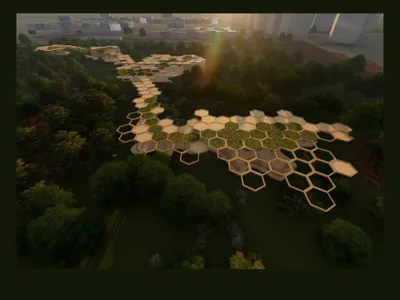
Eco Chapel: A Green Architecture Pavilion Designed in Symbiosis with the Forest
Eco Chapel uses green architecture to weave prayer, learning and reuse into a forest pavilion shaped by modular hexagonal canopies for life.
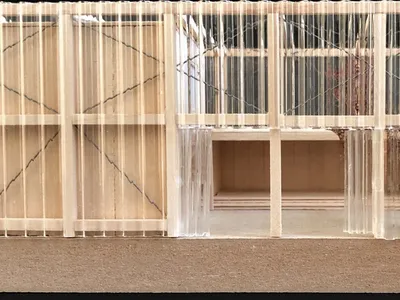
Kaffeebühnen: Coffee Shop Architecture Designed as a Civic Stage Between Vienna’s City and Park
Kaffeebühnen turns coffee shop architecture into a civic stage, linking Vienna’s park edge, urban life, warm timber yards, and coffee craft.
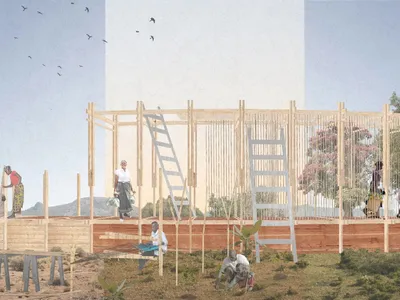
Healing Façade: Sustainable Architecture for Reforestation, Community, and Sacred Ecology in Ethiopia
Healing Façade reimagines sustainable architecture as a living wall that restores soil, catches water and renews Ethiopia's forest churches.


Urban Forest: A Vertical Ecosystem for 5,000 Workers in Singapore's Changi Business Park
Radially stacked pods and layered green decks turn a 7-acre plot into 47 acres of ecological workspace projected for 2040.

Explore Environmental Architecture Competitions
Discover active competitions in this discipline

Challenge to reimagine the Iron Throne

Photograph architecture without architects

Illustrate the lost glory of Angkor Wat - Render Challenge

Design challenge to reuse E-waste
Comments (0)
Please login or sign up to add comments
No comments yet. Be the first to comment!