
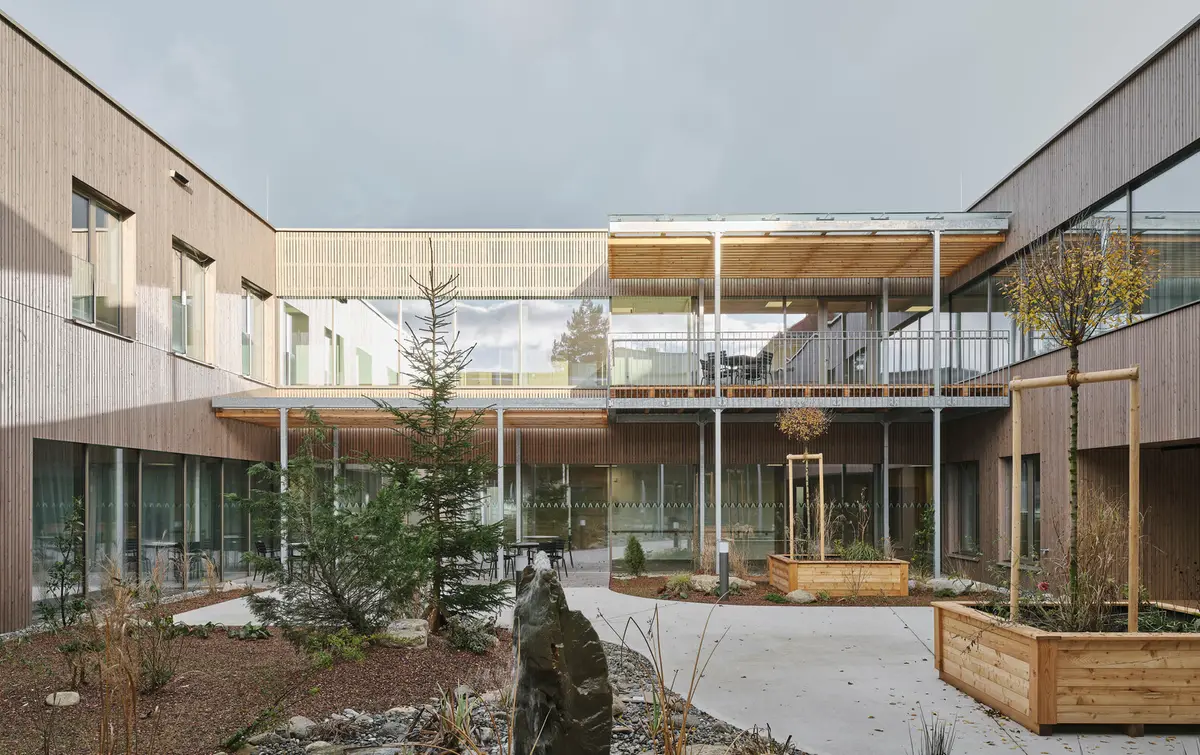
Intergenerational Care Center Knittelfeld by Dietger Wissounig Architekten
Intergenerational care center in Austria combines elderly housing and childcare around courtyard spaces, promoting community interaction, daylight, wood façades, and nature.


The Multi-Generational Care Knittelfeld, designed by Dietger Wissounig Architekten, represents an innovative approach to social architecture, intergenerational living, and community-centered care facilities. Located in Knittelfeld, Austria, the project reimagines the concept of a traditional care center by integrating elderly care, childcare services, and communal spaces into a unified architectural environment. Completed in 2023, the project spans approximately 2,995 square meters and demonstrates how thoughtful architectural design can strengthen connections between generations while promoting well-being, accessibility, and social interaction.
Developed through the renovation of an existing state care center and the addition of new facilities, the project was commissioned by Gem. Wohn- und Siedlungsgenossenschaft Ennstal for Volkshilfe Steiermark. The intervention carefully balances preservation and expansion, ensuring that the existing structure remains functional while introducing new spatial opportunities for residents, caregivers, and children.
Integrating Elderly Care and Childcare in One Architectural Framework
A defining aspect of the Multi-Generational Care Knittelfeld is its commitment to intergenerational interaction. The expanded facility includes a new care home extension alongside a childcare center, creating opportunities for natural encounters between elderly residents and young children.
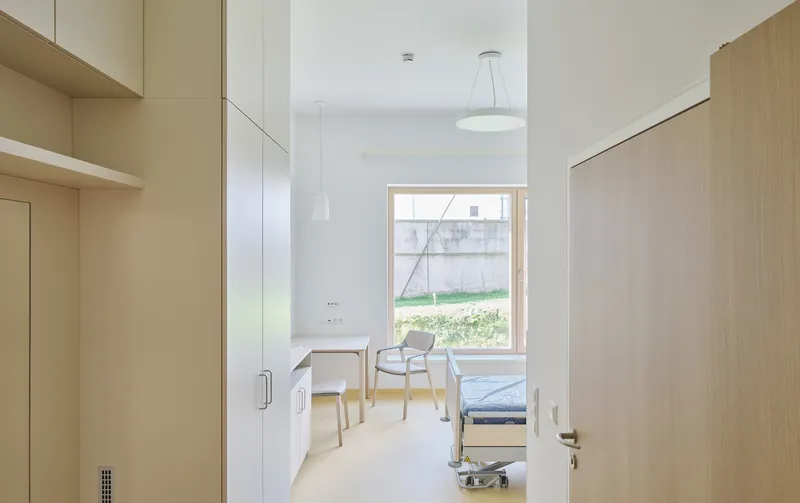
The new care home wing accommodates three residential communities, each with 15 beds, complementing the existing nursing home’s 45-bed capacity. These residential units are designed to foster a sense of domestic comfort and collective living, rather than institutional care. The rooms, both single and double occupancy, are distributed across two full floors, organized around a variety of shared social areas that encourage communication and interaction among residents.
These communal spaces play a central role in the architectural strategy, supporting daily life activities while reinforcing the social dimension of care architecture. Through this arrangement, the design promotes dignity, independence, and social engagement for elderly residents.

Spatial Organization Inspired by the Courtyard Typology
The architectural layout of the building draws inspiration from the traditional square courtyard typology, a spatial concept that has long been associated with community living and internalized outdoor spaces. This configuration defines clear edges around the site while creating differentiated outdoor zones that support recreation, relaxation, and movement.
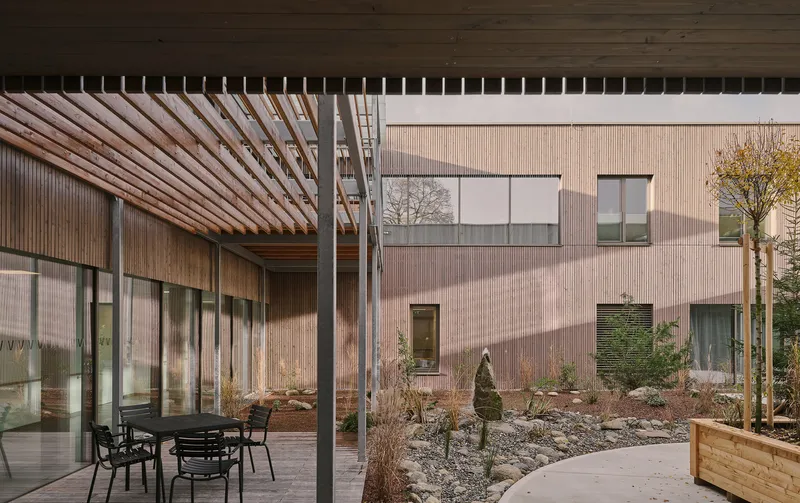
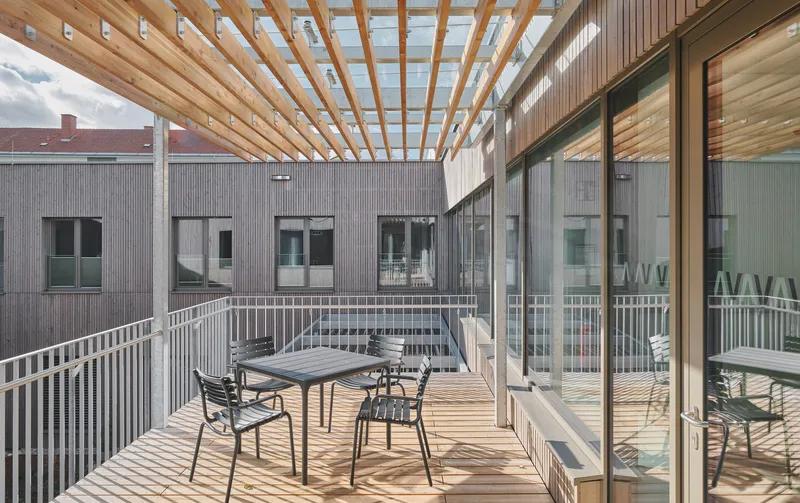
At the heart of the complex lies a central courtyard, which serves as a protected outdoor area for residents and children alike. Surrounding this courtyard are covered verandas, open-air terraces, and internal circulation spaces, forming a network of sheltered environments where residents can spend time outdoors regardless of seasonal conditions.
The design creates a large internal recreation and exercise area, where outdoor and indoor experiences merge seamlessly. Despite the building’s relatively high density, the architectural composition ensures that the spaces remain visually open and spatially interconnected, providing clear sightlines and strong visual relationships throughout the complex.
Interior Circulation and the “Village Square” Concept
Inside the building, the architects created a sequence of interconnected spaces that resemble the spatial hierarchy of a small village. Visitors and residents enter through the foyer, which leads to a central gathering space referred to as the “village square.”
This central area acts as the social heart of the building, connecting different residential and communal zones while offering a welcoming environment for meetings, daily activities, and informal encounters. From here, circulation paths extend toward residential rooms, communal areas, and the inner courtyard, ensuring intuitive movement throughout the complex.
This spatial arrangement enhances the human scale of the architecture, transforming what might otherwise be a large institutional building into a series of smaller, community-oriented spaces.

A Childcare Facility Designed for Light and Comfort
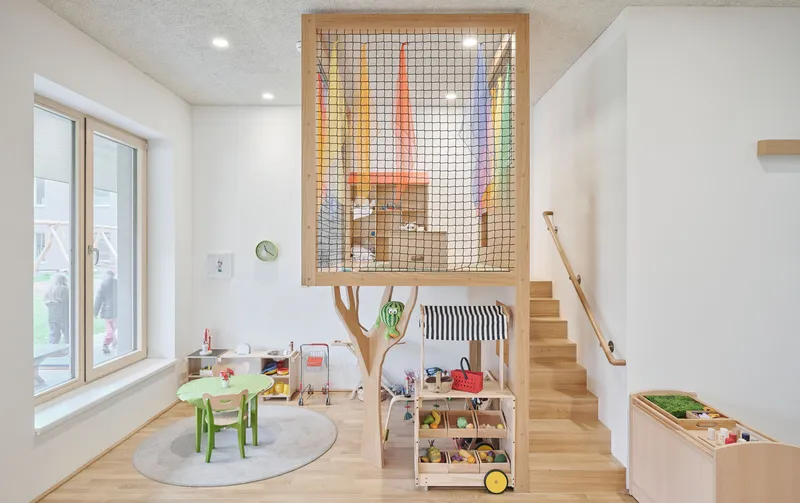
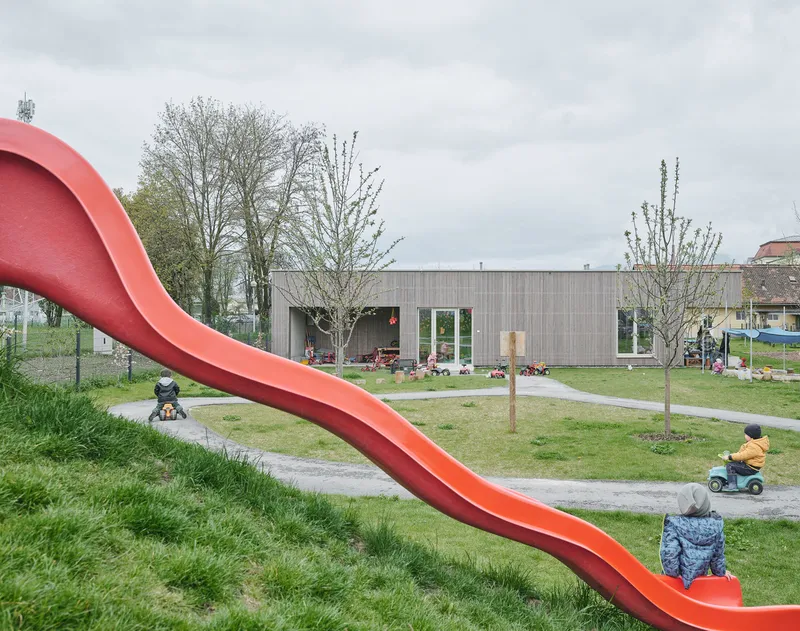
The project also introduces a new childcare center, carefully integrated within the architectural framework. The facility includes three childcare groups, ranging from nursery groups to kindergarten programs, reflecting the needs of different age groups.
These childcare units are housed in three spacious day rooms, each designed to maximize natural daylight and spatial openness. The rooms open toward a south-facing wraparound veranda, which functions as both a transitional threshold space and a sun-shading element.
This veranda extends the indoor learning spaces outward, providing children with opportunities to engage with the outdoors while remaining protected from excessive sunlight. At the same time, the functional and service areas of the childcare facility are located on the northern side of the building, optimizing the orientation for daylight and thermal comfort.
The childcare center adopts a slightly introverted spatial orientation, facing away from the surrounding neighborhood. However, it does not isolate itself completely; instead, it maintains a careful balance between privacy, safety, and openness.
Architectural Dialogue Between Old and New Structures
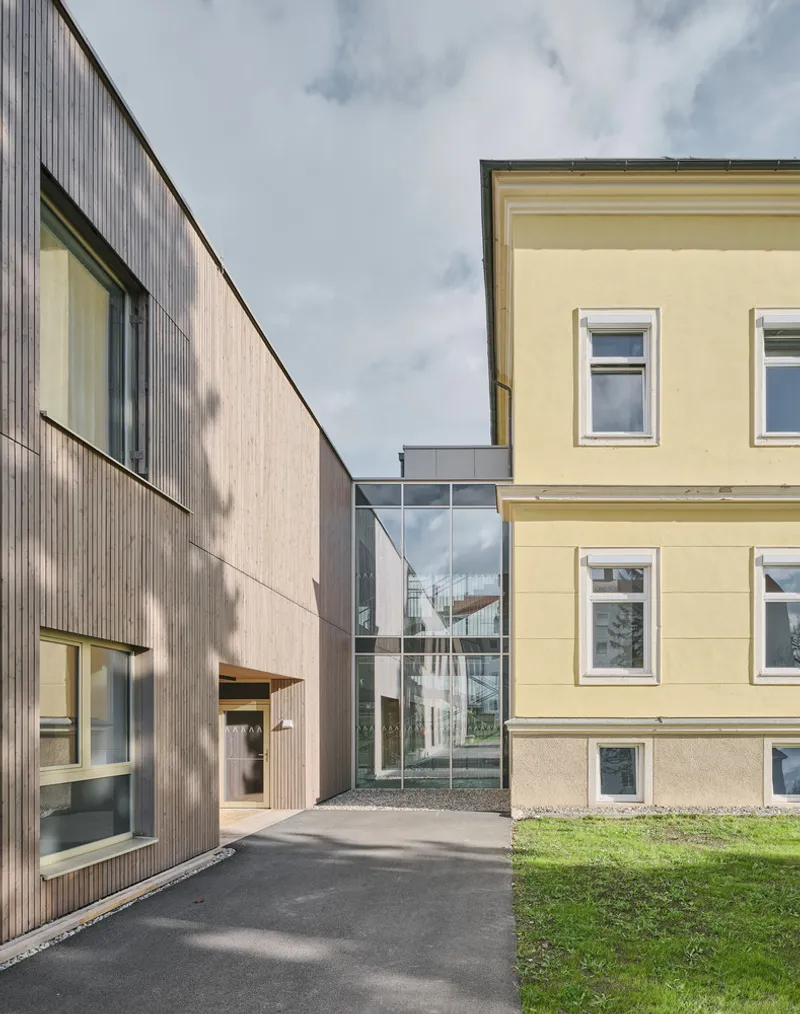
A key design challenge of the project involved integrating new construction with the existing care facility. Rather than attempting to replicate the original structure, the architects chose a strategy that clearly distinguishes old and new while maintaining architectural harmony.
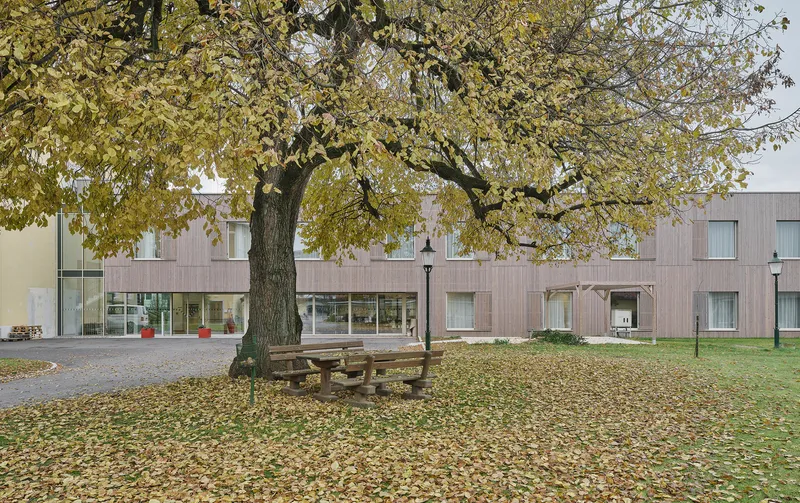
The connection between the buildings is expressed through a glazed joint, which acts as a transitional element between the historic structure and the contemporary addition. This transparent interface creates a subtle visual separation while symbolizing the synergy between past and present architectural layers.
The open space created at this junction also marks the main entrance, functioning as an inviting gesture for visitors and residents. This transitional area operates as a spatial distributor, directing movement into the various sections of the complex.
Larch Wood Façades and a Cohesive Architectural Identity
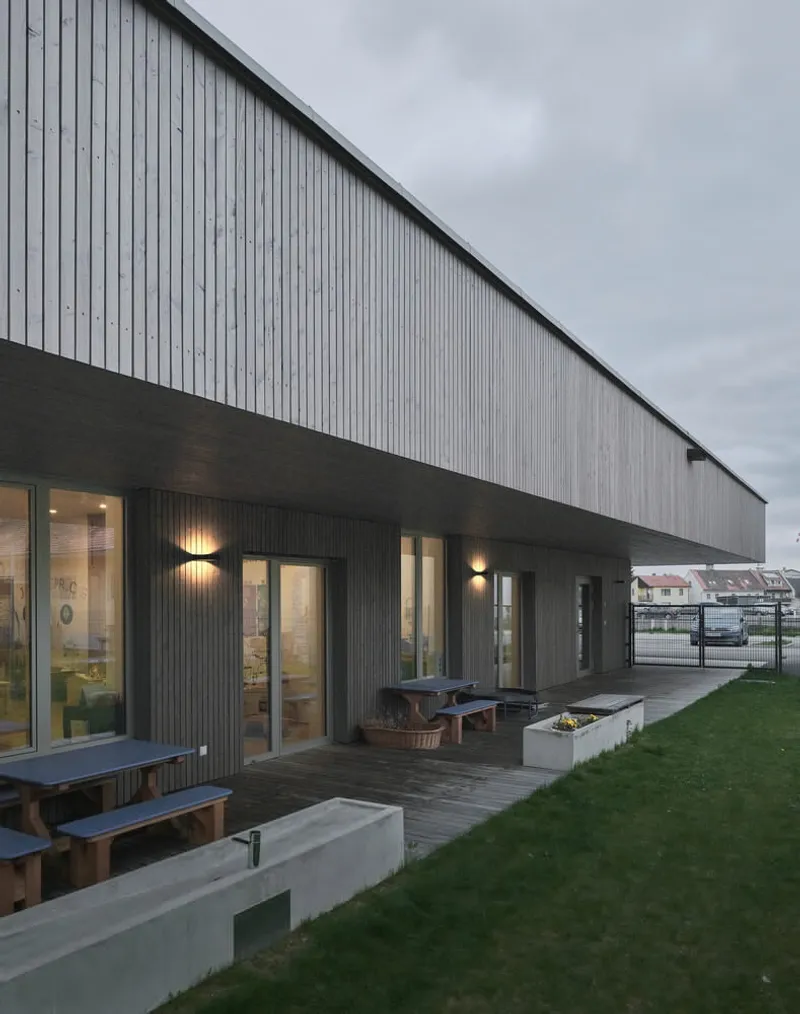
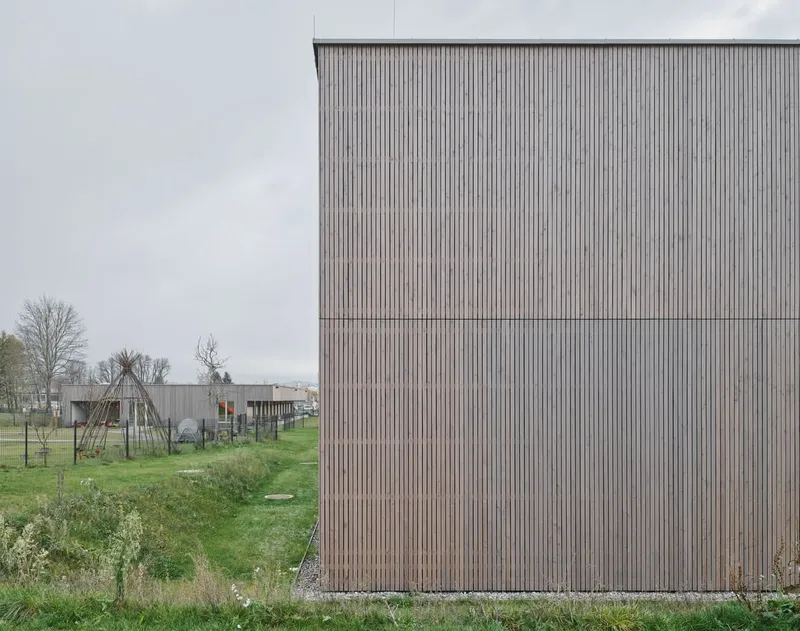
The exterior expression of the Multi-Generational Care Knittelfeld is defined by a cohesive façade design, characterized by subtle yet thoughtful architectural interventions. The façades are primarily clad in larch wood, a natural material that enhances the building’s warmth while ensuring durability and sustainability.
This uniform material palette establishes a visual connection between the existing structure and the new additions, creating a harmonious architectural identity across the site.
Permeable façade elements introduce depth and texture, allowing the building to interact dynamically with changing light conditions. At night, these elements generate dramatic shadow patterns, giving the structure a distinctive presence within the surrounding neighborhood.
At the same time, the façade design references the regular rhythm of the original building, ensuring continuity between the old and new architectural elements.
Strengthening the Relationship Between Interior Spaces and Nature
One of the most important architectural goals of the project was to create a strong connection between indoor living spaces and the surrounding landscape. To achieve this, the building incorporates large window openings that frame views of the courtyard and outdoor areas.
These windows are designed with parapets at seating height, allowing residents to comfortably sit by the window while enjoying natural light and outdoor views. In many cases, the openings also function as direct exits, further blurring the boundary between interior and exterior spaces.
By extending the living environment beyond the building envelope, the design encourages residents to engage with nature throughout the year, reinforcing the therapeutic and emotional benefits of outdoor contact.
A Model for Future Intergenerational Care Architecture
The Multi-Generational Care Knittelfeld exemplifies how architecture can address contemporary social challenges by creating environments that support intergenerational relationships, community interaction, and holistic well-being.
Through the careful integration of elderly care facilities, childcare spaces, communal areas, and outdoor environments, the project transforms a traditional nursing home into a dynamic social ecosystem.
By combining sensitive renovation, thoughtful spatial planning, and sustainable material choices, Dietger Wissounig Architekten have created a building that not only meets functional requirements but also enhances the quality of life for residents, caregivers, and children.
The project stands as an inspiring example of how modern healthcare architecture and community-focused design can reshape the way society approaches aging, childcare, and shared living environments.
All photographs are works of
David Schreyer


Popular Articles
Popular articles from the community


FCC Arquitectura Expands a Portuguese Granite House with a Board-Marked Concrete Wing
In Portugal, JV House pairs a cleaned-up whitewashed and granite dwelling with a timber-shuttered concrete extension, courtyards and a garden pool.

graciastudio Turns a Viewless Tijuana Lot Inward Around a Courtyard of Concrete, Timber and Trees
In Tijuana, Jorge Gracia's GA2 House stacks a timber-clad private floor over exposed concrete and replaces a missing view with a planted interior patio.


The Amber Palace Opera: A Geological Fiction Surfaces on Tallinn's Baltic Waterfront
Pierre Brillard reimagines a Baltic legend as a public landscape, opera house, and waterfront promenade rooted in Tallinn's coastal identity.

Cube Design Draws an Ecological Corridor Between Two Shenzhen Hills with the Nankai Building
Beside Shenzhen's container docks, the Nankai Building pairs stacked balconies with a climbing green screen to connect two hillsides across its height.

Similar Reads
You might also enjoy these articles
Cube Design Draws an Ecological Corridor Between Two Shenzhen Hills with the Nankai Building
Beside Shenzhen's container docks, the Nankai Building pairs stacked balconies with a climbing green screen to connect two hillsides across its height.

Praksis A and Studio Sted Bend a Red Timber Cabin Across the Granite of Norway's Southern Coast
On the southern Norwegian coast, a 105 m² cabin follows the rock on slender posts, pairing red cladding outside with pine, brick and plywood within.

David Ortega Stacks a Two-Story Mexico City Penthouse Around a Steel Stair and a Pergola-Shaded Roof Terrace
In Colonia Roma, a 300 m² penthouse uses oak joinery, a planted steel stair and a slatted roof pergola to make a new-build apartment feel like a house.

PARALELA and LB2 Thread a Public Walkway Through the Base of a Las Condes Residential Tower
In Las Condes, Santiago, the Hamlet Building gives its fenceless ground floor to a 70-metre wooded passage linking two streets and the metro.

Explore Intergenerational Competitions
Discover active competitions in this discipline

Challenge to reimagine the Iron Throne

Photograph architecture without architects

Illustrate the lost glory of Angkor Wat - Render Challenge

Design challenge to reuse E-waste
Comments (0)
Please login or sign up to add comments
No comments yet. Be the first to comment!