

Interspecies Refugium: A Sustainable Architecture Proposal Reimagining Koala Rehabilitation in Australia
A regenerative wildlife architecture project reconnecting koalas, forests, and communities through ecological rehabilitation and immersive design.


In the face of accelerating climate change, habitat destruction, and ecological fragmentation, architecture is increasingly being challenged to move beyond human-centered environments. The project Interspecies Refugium, designed by Marina Pizzotti and Suhas Vasudeva, proposes a new model of sustainable architecture where wildlife rehabilitation, environmental education, and ecological regeneration coexist within a single spatial system.
As a shortlisted entry of Haven 2020, the proposal rethinks how architecture can support endangered species through immersive environmental design. Located in the Mount Tamborine region of Australia, the project focuses on the rehabilitation of koalas while creating a broader ecological corridor capable of reconnecting fragmented habitats and restoring relationships between humans and wildlife.
Sustainable Architecture Rooted in Ecological Recovery
The project emerges from the growing ecological crisis affecting koalas across Australia. Bushfires, urban expansion, habitat loss, disease, vehicle collisions, and environmental degradation continue to threaten the survival of one of Australia’s most iconic species. Rather than treating wildlife rehabilitation as an isolated veterinary facility, Interspecies Refugium introduces an integrated architectural ecosystem designed around coexistence.
The proposal positions itself within a rural living zone located between two expanding urban growth areas. This strategic site allows the architecture to function simultaneously as a rehabilitation center, ecological refuge, educational institution, and public destination. The design consolidates wildlife corridors while strengthening local biodiversity networks and encouraging long-term ecological recovery.
The architectural vision extends beyond a conventional building typology. Instead, the project operates as a living landscape where circulation systems, elevated walkways, vegetation zones, research facilities, and immersive public experiences collectively nurture mutualistic relationships between humans and wildlife.
Architecture That Responds to Site and Landscape
One of the strongest aspects of the project lies in its careful response to the natural topography and existing environmental conditions. The masterplan preserves remnant vegetation and aligns built interventions with existing ecological systems, minimizing disruption to water runoff, native vegetation, and wildlife movement.
The site strategy establishes a network of environmental links connecting forested areas, koala habitats, pedestrian routes, and water systems. Instead of imposing a rigid architectural object onto the landscape, the proposal carefully inserts lightweight structures into the terrain.
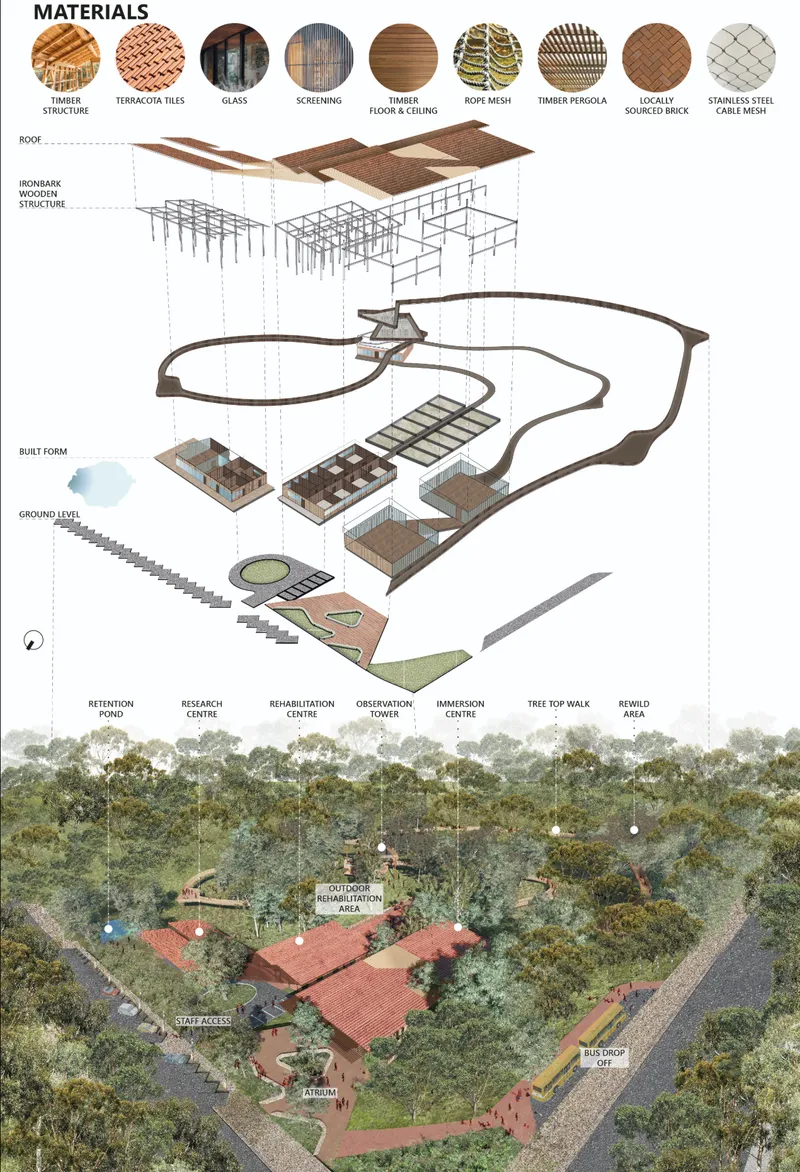
The rehabilitation center, immersion center, and research facilities are distributed across the site through low-impact circulation paths that allow visitors to move through the environment while remaining sensitive to wildlife recovery processes.
This approach transforms the architecture into an extension of the landscape itself. Elevated walkways float above sensitive ecological zones while creating opportunities for observation, education, and interaction. The treetop walk and observation tower immerse visitors within the forest canopy, encouraging awareness of ecological systems from multiple spatial levels.
Koala Rehabilitation Through Spatial Design
At the core of the project is a carefully organized rehabilitation process designed around the physical and behavioral needs of koalas. The architecture coordinates three primary flows across the site: visitors, staff, and wildlife. These circulation systems operate independently while intersecting at carefully controlled points of interaction.
The rehabilitation sequence begins with critical care and medical treatment spaces before transitioning toward semi-covered rehabilitation areas and outdoor rewilding zones. This spatial progression allows recovering koalas to gradually re-enter natural environments with minimal stress.
The rehabilitation facilities are integrated with extensive koala food production zones and native planting systems. Reforestation strategies help restore ecological balance while expanding future habitat possibilities.
Research facilities positioned alongside rehabilitation areas support long-term ecological monitoring and scientific investigation. The project recognizes that wildlife recovery requires not only rescue infrastructure but also continuous environmental research and public education.


Immersive Environmental Education and Public Engagement
A major component of the proposal is its educational and immersive architectural strategy. The project transforms environmental awareness into a spatial experience.
Visitors enter through the Immersion Centre, an educational facility designed around framed views, exhibition spaces, interpretive signage, and open public circulation. Instead of separating people from wildlife, the project carefully choreographs moments of encounter and observation.
The architecture uses circulation as a narrative device. Visitors move through pathways that reveal rehabilitation zones, ecological restoration areas, retention ponds, and forest systems while gradually ascending into elevated canopy walkways.
The observation tower acts as both a landmark and research infrastructure. Its interconnected ramps and elevated platforms allow visitors and researchers to experience the forest canopy while minimizing ecological disturbance below.
This immersive architectural approach creates emotional engagement with environmental conservation. By allowing visitors to witness rehabilitation processes and ecological systems firsthand, the project transforms architecture into an educational instrument capable of generating empathy and awareness.
Materiality and Climate-Responsive Design
The project’s architectural language is deeply connected to local material traditions and passive environmental strategies. Buildings are positioned according to contour lines and oriented to maximize thermal comfort, natural ventilation, and framed views across the landscape.
Locally sourced Grey Ironbark timber forms the primary structural system, supporting elevated platforms, observation towers, treetop walkways, and screened facades. Terracotta tile roofing contributes thermal stability while reinforcing the project’s connection to regional construction techniques.
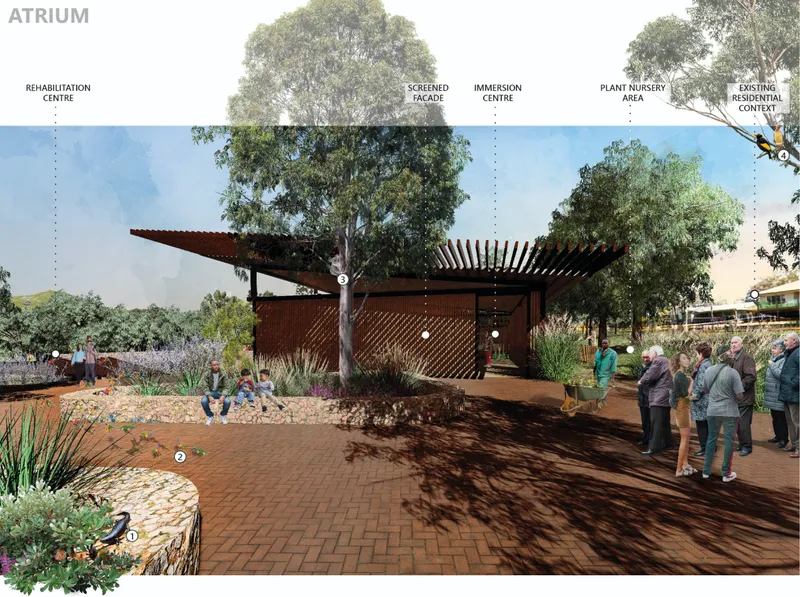
The Immersion Centre incorporates pivoting timber boards that allow flexible control over sunlight, airflow, and exhibition conditions. Large overhangs and permeable facades create shaded transitional spaces that blur indoor and outdoor boundaries.
The architecture relies heavily on passive environmental design principles. Elevated structures minimize disturbance to the ground while supporting airflow beneath buildings. Natural shading systems, timber screening, and carefully positioned openings reduce solar gain and improve thermal comfort throughout the year.
Rather than pursuing technological spectacle, the proposal demonstrates how ecological sensitivity and local construction knowledge can shape meaningful sustainable architecture.
Designing Human-Wildlife Interfaces
A defining feature of Interspecies Refugium is its exploration of architectural interfaces between species. The project does not simply accommodate wildlife within a human environment. Instead, it creates overlapping spatial territories where coexistence becomes possible.
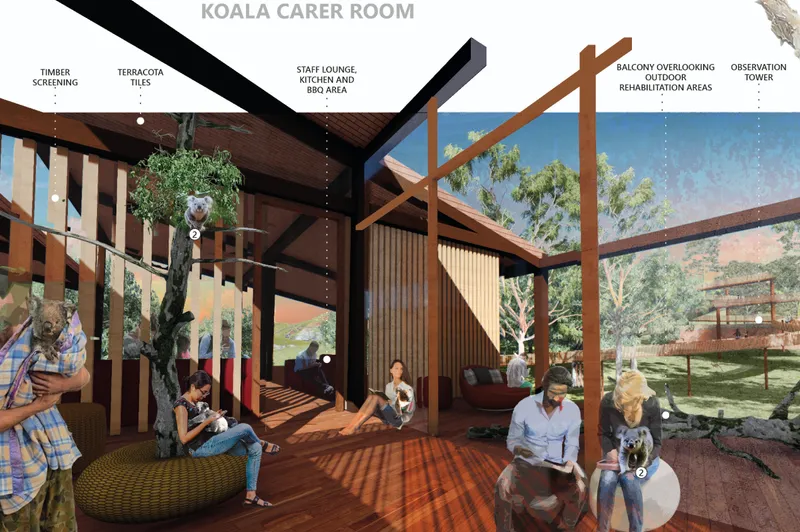
The koala carer room, rehabilitation facilities, observation walkways, and immersive landscape zones establish carefully managed encounter points between humans and wildlife. These spaces encourage emotional connection while respecting ecological boundaries and recovery conditions.
The architecture also acknowledges broader seasonal and ecological rhythms. Plant nurseries, food production landscapes, retention ponds, and native vegetation systems contribute to the long-term regeneration of the ecosystem.
The proposal introduces programs such as the ‘Adopt a Koala Tree’ initiative, encouraging visitors and local communities to participate in reforestation and habitat restoration. Through these strategies, architecture extends beyond physical infrastructure and becomes part of a larger environmental stewardship framework.
A New Direction for Wildlife Architecture
Interspecies Refugium demonstrates how sustainable architecture can evolve into a mediator between ecological systems, public education, and wildlife conservation. The project rejects the idea of architecture as an isolated object and instead proposes a dynamic environmental network rooted in coexistence.
The integration of rehabilitation infrastructure, immersive education, ecological restoration, and climate-responsive design positions the proposal as a compelling example of regenerative architecture.
As environmental crises continue to reshape landscapes across the world, projects like Interspecies Refugium reveal the growing importance of architecture that actively contributes to ecological healing. Through its sensitive site response, integrated rehabilitation systems, and immersive public spaces, the project establishes a powerful model for future wildlife conservation architecture.
Designed by Marina Pizzotti and Suhas Vasudeva, this shortlisted Haven 2020 proposal presents an architectural vision where care, restoration, and environmental awareness become inseparable parts of the built environment.




Popular Articles
Popular articles from the community


Singing Woman: Contemporary Architecture Inspired by Estonia’s Voice and the Sea
Singing Woman turns Estonia’s song culture into flowing opera house architecture, blending public life, landscape, sea, and national memory.
Faces of the Soviet Avant-Garde: Turning Moscow's Street Names into an Open-Air Museum
A network of sculptural installations across a Moscow residential district transforms forgotten architect names into spatial encounters with cultural memor

Opera on the Sea: Driftwood Logic Shapes a Timber Opera House on Estonia's Coast
Trevor Orgill's opera house translates the entangled drift of floating timber into a civic building where wood, water, and music converge.
Tsunami Convergenics: Turning Catastrophic Ocean Forces into Underwater Housing Infrastructure
A speculative underwater settlement off the coast of Onagawa, Japan, treats tsunamis and typhoons as energy sources rather than threats.

Similar Reads
You might also enjoy these articles

Eco Chapel: A Green Architecture Pavilion Designed in Symbiosis with the Forest
Eco Chapel uses green architecture to weave prayer, learning and reuse into a forest pavilion shaped by modular hexagonal canopies for life.
Kaffeebühnen: Coffee Shop Architecture Designed as a Civic Stage Between Vienna’s City and Park
Kaffeebühnen turns coffee shop architecture into a civic stage, linking Vienna’s park edge, urban life, warm timber yards, and coffee craft.
Healing Façade: Sustainable Architecture for Reforestation, Community, and Sacred Ecology in Ethiopia
Healing Façade reimagines sustainable architecture as a living wall that restores soil, catches water and renews Ethiopia's forest churches.


Urban Forest: A Vertical Ecosystem for 5,000 Workers in Singapore's Changi Business Park
Radially stacked pods and layered green decks turn a 7-acre plot into 47 acres of ecological workspace projected for 2040.

Comments (0)
Please login or sign up to add comments
No comments yet. Be the first to comment!