
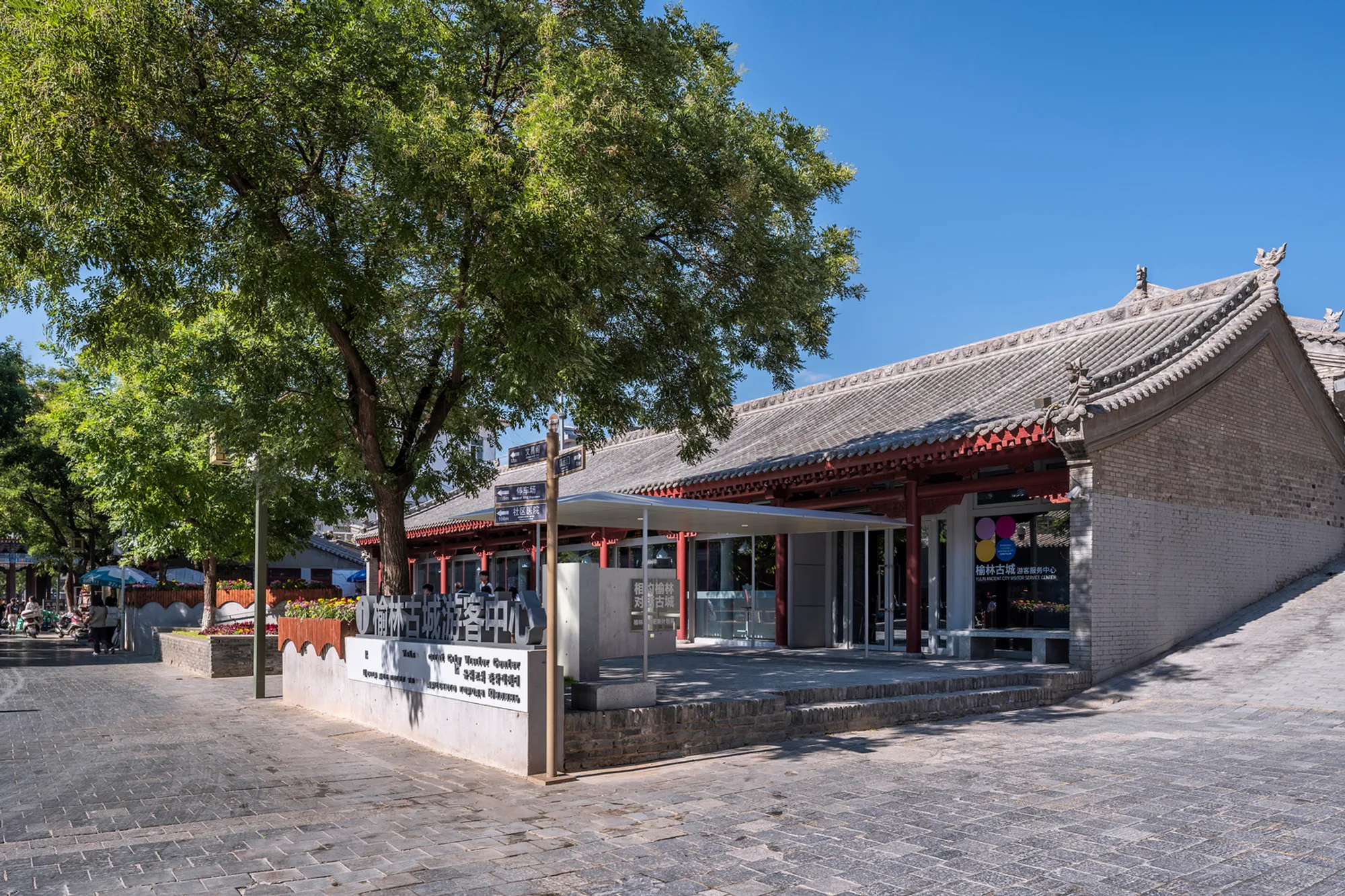
Intervention of the Yulin Courtyard House by Tumushi Architects
Tumushi Architects revitalized a historic Yulin courtyard into a modern cultural hub blending heritage preservation, public leisure, and contemporary exhibition spaces.


Revitalizing Heritage Through Contemporary Architectural Renewal in Shaanxi, China
Located in the historic heart of Yulin, Shaanxi Province, the Intervention of the Yulin Courtyard House by Tumushi Architects represents a sensitive and forward-looking architectural renewal. The project transforms an antiquated courtyard into a multifunctional urban space that merges heritage preservation, contemporary design, and community engagement. Completed in 2023, the 1,050-square-meter intervention redefines how traditional Chinese courtyards can adapt to modern urban life.
Historical Context: Reviving the Heart of Yulin Old Town
Yulin Old Town, established during the Ming Dynasty, has long been one of China’s significant frontier cities. Its ancient city walls, six watchtowers, and the prominent “Six-Tower Street” form a rare and well-preserved urban fabric that reflects centuries of cultural exchange and military significance.
In 2022, as part of a revitalization initiative led by the Yuyang Government and the CBC, Tumushi Architects was invited to reimagine a historic courtyard within the town’s Industry and Trade Department precinct. The task: to introduce new civic and cultural functions while maintaining the integrity of the site’s historical essence.
Design Philosophy: Tradition Meets Contemporary Life
Led by architects Yan Bai and Qili Yang, the project embodies the studio’s belief that renewal must be rooted in history yet expressed through contemporary architectural language. The design respects the courtyard’s existing spatial order while strategically inserting new programs that respond to modern urban needs.
The original courtyard, constructed in 2006 in a traditional style, was re-envisioned as a leisure yard, tourist center, and exhibition hall. Tumushi’s renewal strategy—summarized as “Tree Yard, Street House, and Town Exhibition”—creates a sequence of spaces that transition from the open public realm to intimate cultural experiences.
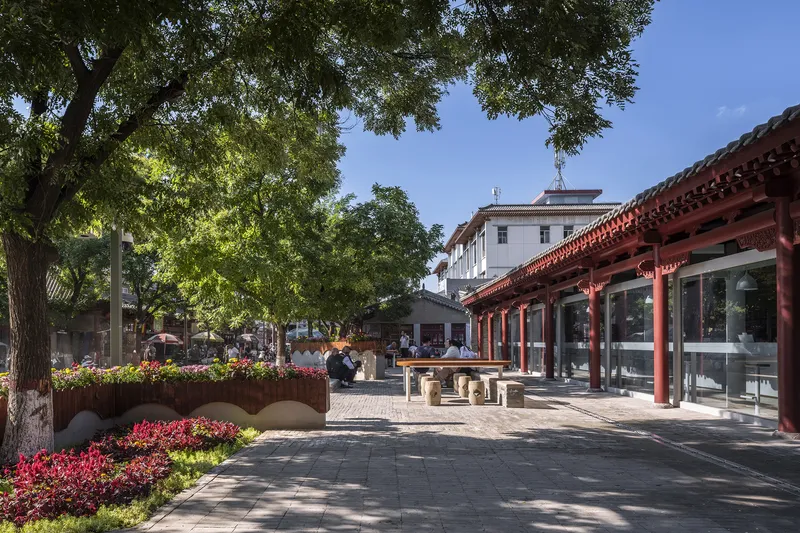
The “Tree Yard”: A Public Oasis Beneath the Canopy
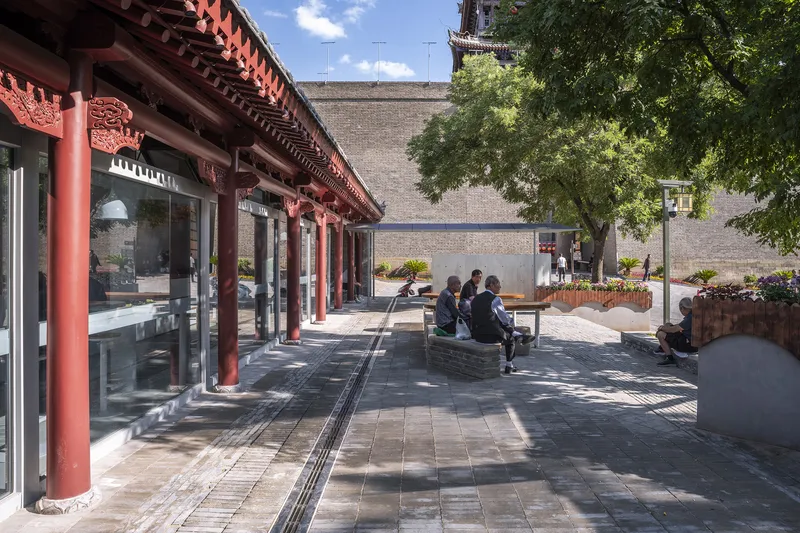
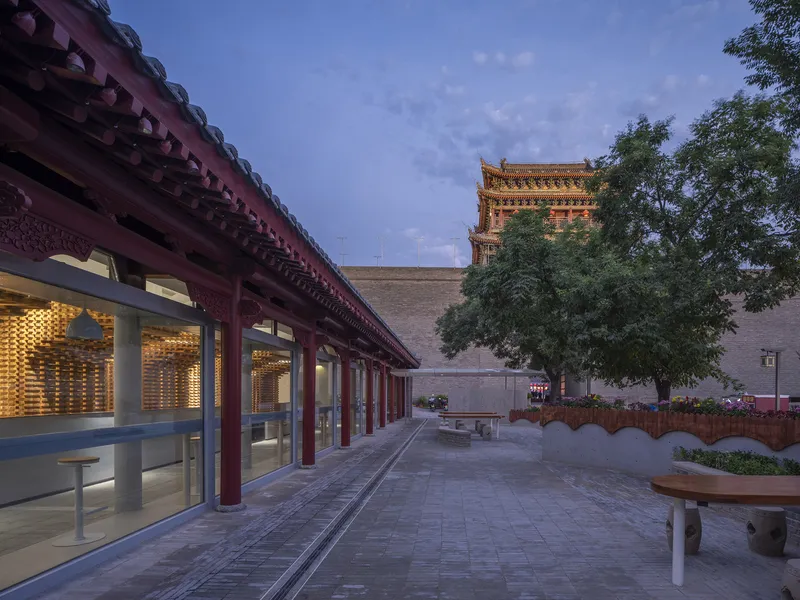
At the entrance, a 27-by-8-meter rectangular courtyard unfolds beneath the shade of three large existing trees. This space, known as the Tree Yard, acts as both a social plaza and a green buffer between the bustling street and the interior programs.
Recycled blue bricks pave the courtyard, echoing Yulin’s vernacular material palette while contrasting elegantly with the modern glazed façade of the building. Fixed seating beneath the tree canopy encourages visitors to pause and gather, transforming the space into a tranquil urban retreat. The Tree Yard sets the tone for a design approach that honors the natural and cultural layers of the site.
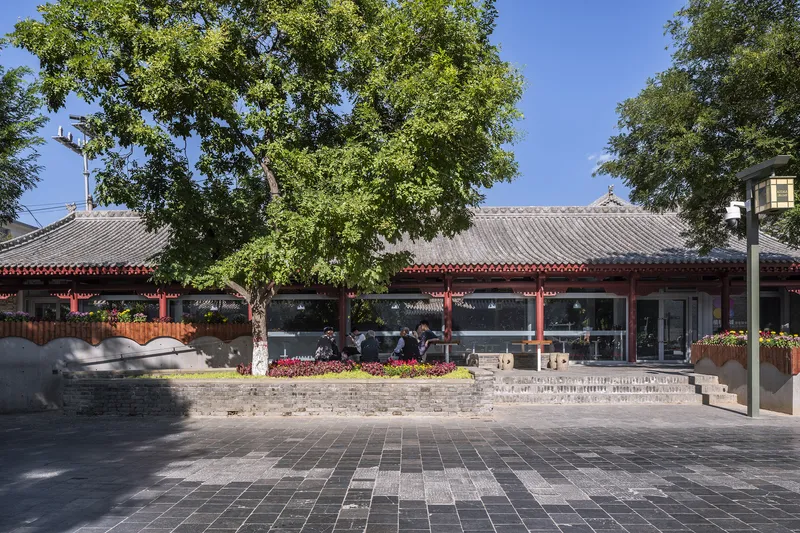
The “Street House”: Reinterpreting the Traditional Shopfront
The ground floor, once a row of independent shops, was reconfigured into a 27-by-9-meter linear tourist center. By removing partitions, the architects revealed a continuous interior volume, emphasizing visual connection and spatial fluidity.
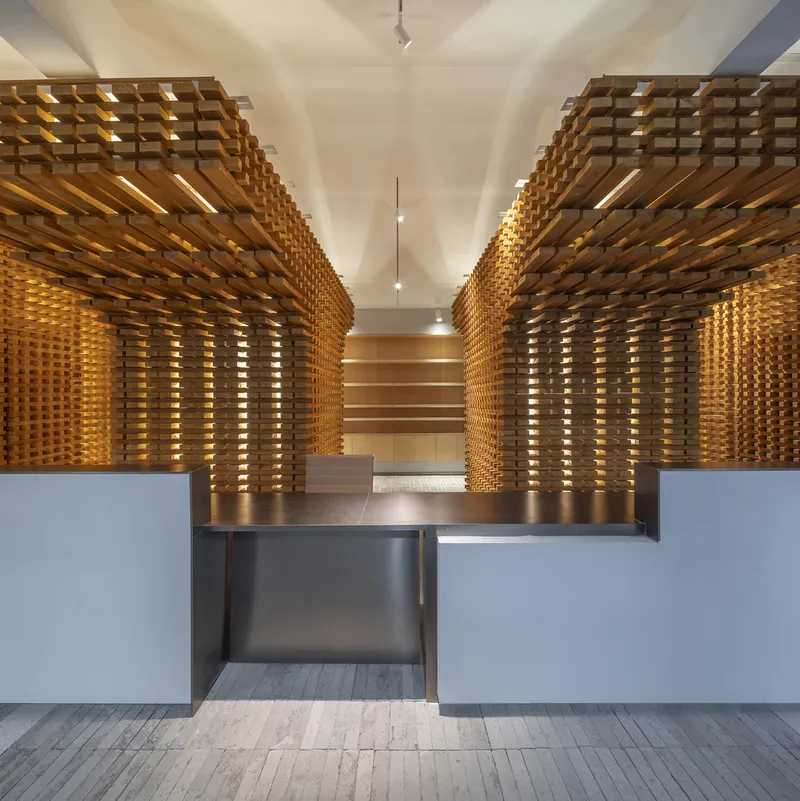
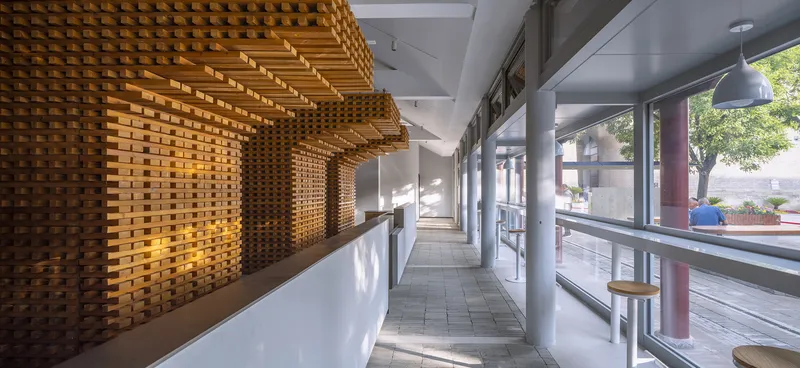
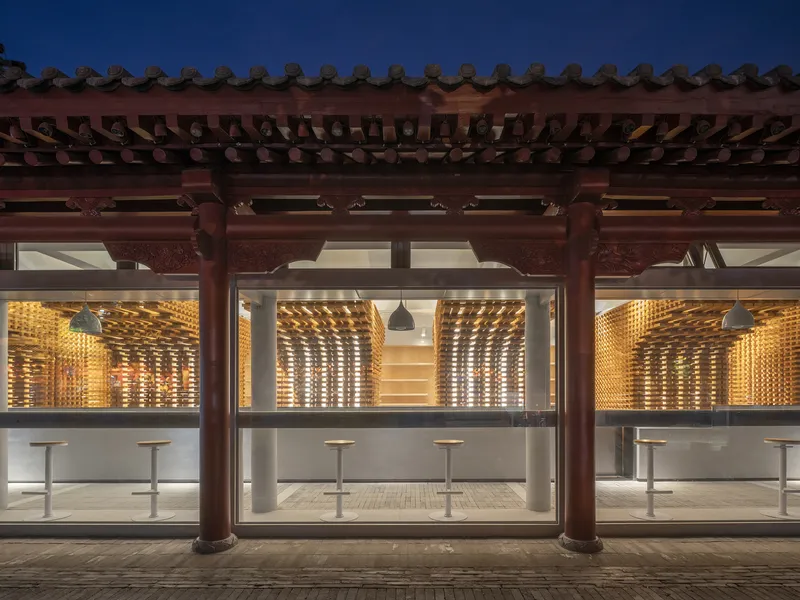
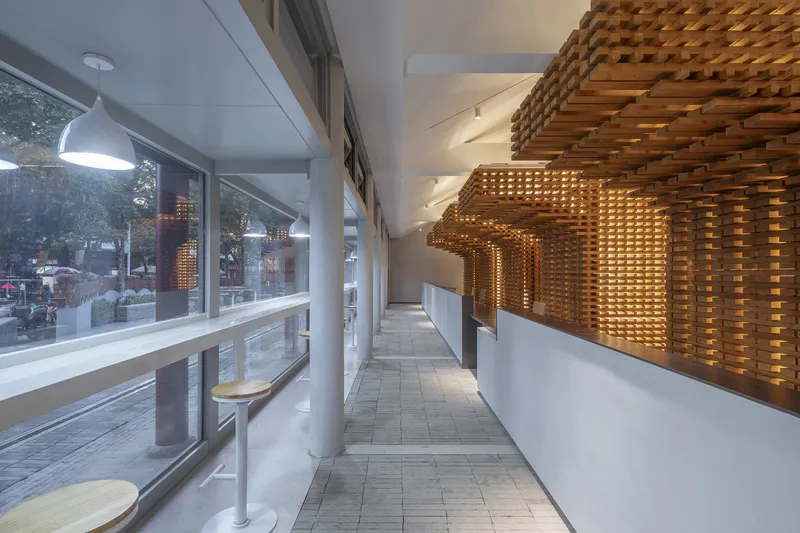
To break the rigidity of the original antiqued façade, Tumushi replaced the wooden shop doors with transparent glass panels, allowing daylight to penetrate deep into the space. Inside, six wood-clad box structures are carefully positioned along the central axis. These boxes conceal existing columns, function as storage, and introduce rhythm to the elongated plan.
The form of each box—arched and cantilevered towards both the interior and exterior—evokes the arcades of the Six-Tower Street, subtly tying the new intervention to its historical context. The combination of blue brick paving, timber textures, and linear geometry defines the renewed Street House as a warm and welcoming civic space.
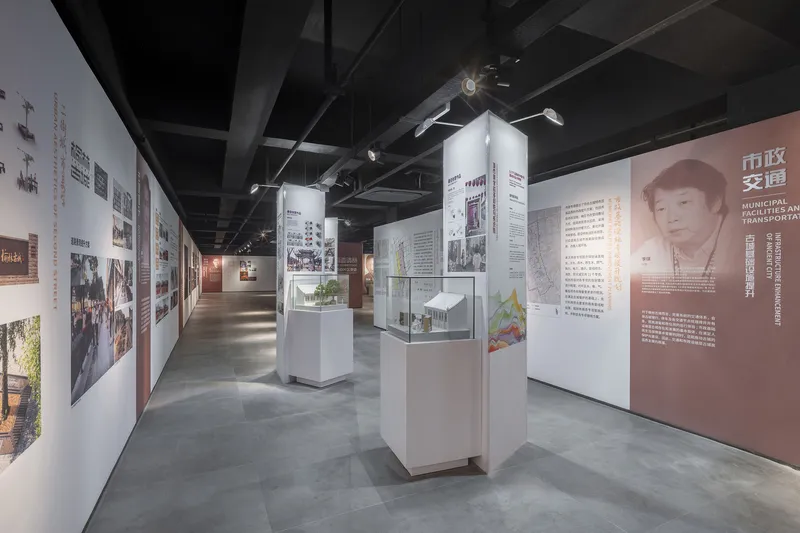
The “Town Exhibition”: An Underground Chronicle of Urban Memory
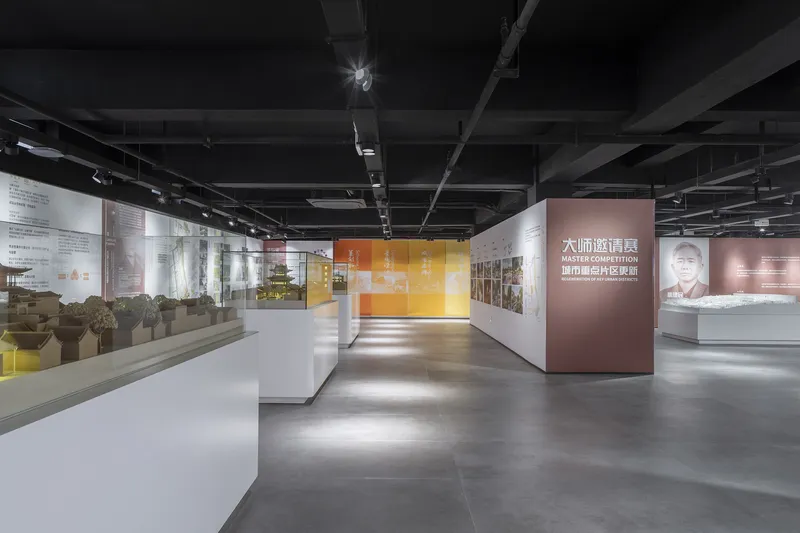
Beneath the courtyard lies the “Town Exhibition”, a 27-by-30-meter exhibition hall that transforms the underground floor into an immersive cultural venue. The space originally featured sixteen columns in a 4x4 grid—an obstacle to creating the openness required for exhibitions.
Tumushi resolved this by integrating twelve outer columns into a continuous circular exhibition wall, which also serves to divide the hall into two distinct spatial experiences: a narrow outer corridor and a wide inner plaza. At the center, a micro-scale model of Yulin Old Town anchors the exhibition, allowing visitors to visualize the city’s evolution over time.
The architectural language of the exhibition—simple, geometric, and quietly monumental—mirrors the logic of the town it represents. The “Town Exhibition” is thus both a gallery and a spatial metaphor for Yulin’s layered history.
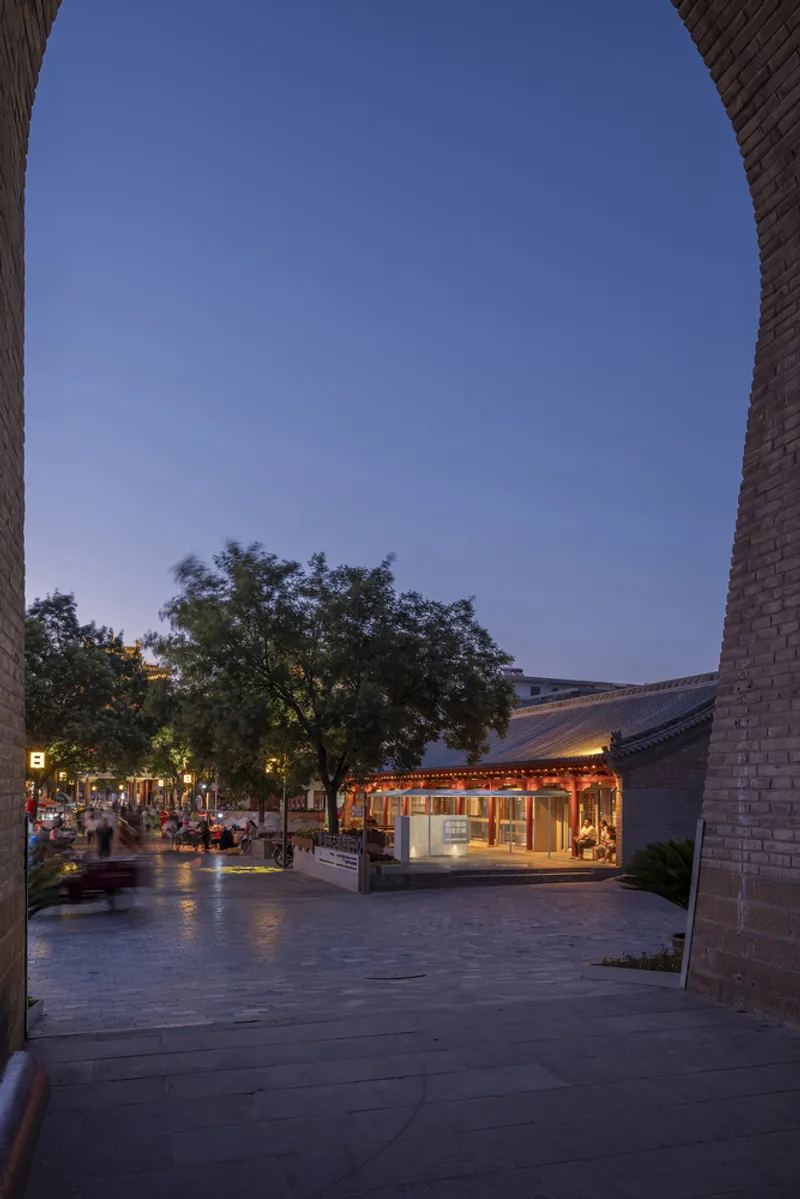
Spatial Narrative: From Public to Private, Noise to Stillness
The project’s three core interventions—Tree Yard, Street House, and Town Exhibition—create a gradual transition from open public space to intimate cultural enclosure. Visitors move from the bustling street into the shaded calm of the courtyard, then into the crafted interior of the Street House, and finally descend into the contemplative quiet of the Town Exhibition.
This spatial journey reflects the architects’ intent to let users experience the cultural resonance of the old town while engaging with its renewed functions. Inverting the conventional logic of privacy, Tumushi Architects created an architecture that grows more introspective as it moves inward—offering a layered encounter with both history and modernity.
A Contemporary Dialogue with the Past
The Intervention of the Yulin Courtyard House demonstrates how architectural renewal can preserve a site’s historical character while infusing it with modern vitality. Through material sensitivity, spatial clarity, and cultural empathy, Tumushi Architects have created a new civic landmark that connects Yulin’s past with its evolving urban identity.
The result is not just a renovation, but a conversation between centuries—one that bridges heritage and future, community and culture, memory and modernity.
All photographs are works of Weiqi Jin




Popular Articles
Popular articles from the community


Hill & Cross Opera: Sculptural Opera House Architecture Shaped by Tallinn’s Landscape and Identity
Hill & Cross Opera reimagines opera house architecture in Tallinn through its sculptural hill, civic plaza, glass wave and a luminous cross.

The Ocean Hive: Sustainable Architecture for a Self-Sufficient Civilization at Sea
The Ocean Hive imagines sustainable architecture at sea, where modular habitats, algae, wave power and ocean waste sustain a growing colony.

Riyadh For All: Intergenerational Urban Design for Active Aging in Rabat
Riyadh For All reimagines urban design in Rabat with intergenerational co-living, adaptive courtyards, and Moroccan cultural exchange today.

AL-JANNAH: Sustainable Architecture and Permaculture for Afghan Widows
AL-JANNAH uses sustainable architecture and permaculture to create resilient oasis of housing, learning, work and renewal for Afghan widows.


Similar Reads
You might also enjoy these articles


Hodi-Mandai Geram
Project Function: Preservation and revitalization of the Intangible heritage and socio-spatial identity of the Hodi by Housing, Cultural Memory Center, Sacred Grove, landscape, local tourism economy


Olio Towers: A Mid-Rise for Performers That Fuses Housing, Rehearsal, and Stage
Located blocks from Houston's Theater District, this modular tower stacks living units around a central performance atrium.

Oasis: Modular Green Housing Carved into Dhaka's Urban Fabric
A shortlisted Plugin Housing entry reclaims unauthorized settlements in Dhaka with stepped concrete volumes, green roofs, and ventilation-driven design.

Black Hole: A Floating Megastructure for the Post-Physical Era
Emiliano Mazzarotto envisions a spherical, self-scaling arena where e-sports, digital hotels, and holographic stadiums replace traditional public space.


Explore Public Building Competitions
Discover active competitions in this discipline



Challenge to design locus for the upliftment of human rights


Challenge to reimagine the Iron Throne


Photograph architecture without architects


Illustrate the lost glory of Angkor Wat - Render Challenge
Comments (0)
Please login or sign up to add comments
No comments yet. Be the first to comment!