
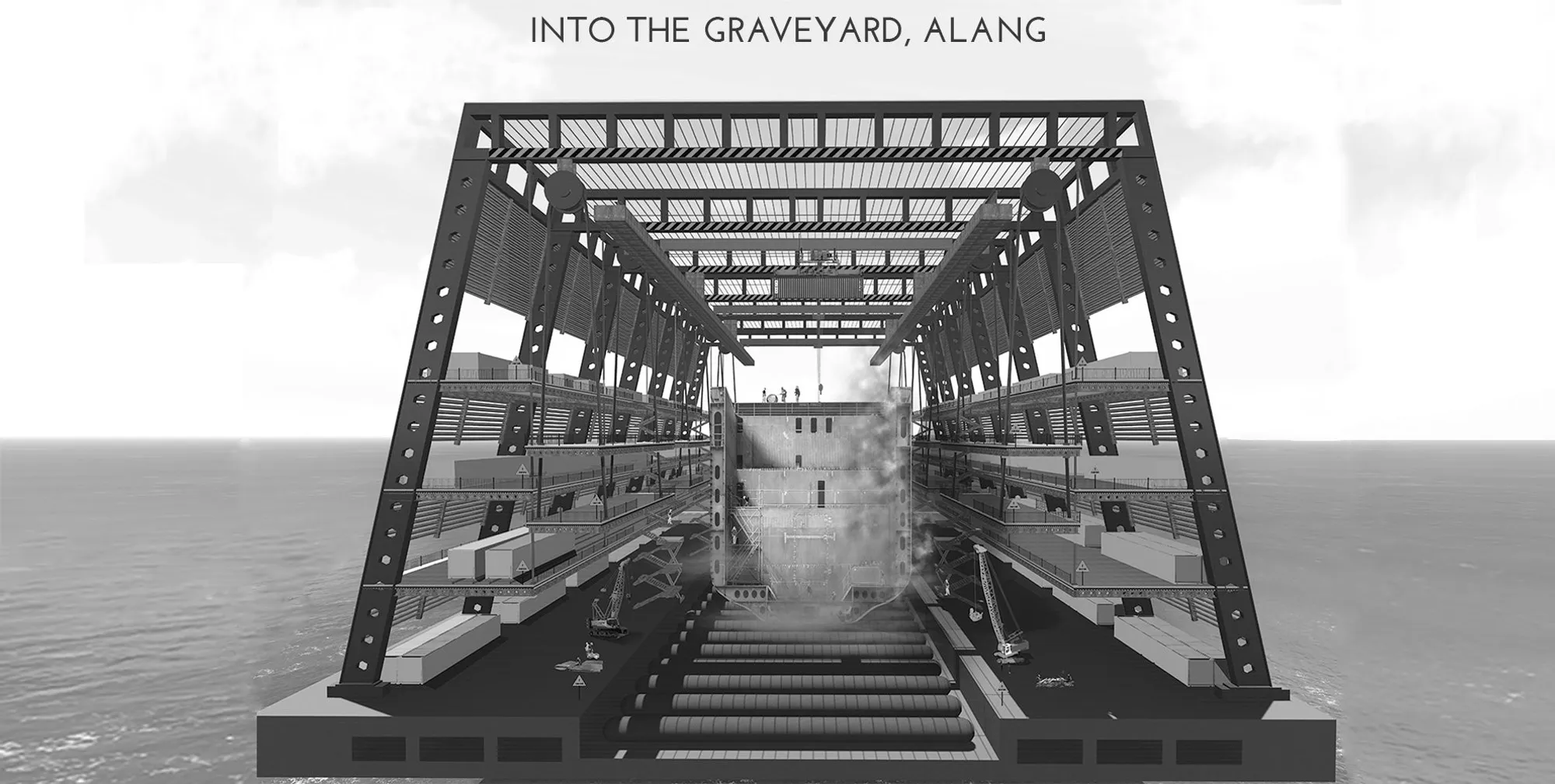
INTO THE GRAVEYARD, ALANG
Reimagining Alang through sustainable industrial architecture, transforming ship breaking into a safe, structured, and humane system.


Alang, located on the Gulf of Khambhat in Gujarat, India, is globally known as the world’s largest ship-breaking yard. Every year, thousands of workers dismantle massive vessels that have reached the end of their 25 to 30 year lifespan. While ship recycling is essential to the global maritime economy, the existing process in Alang remains labor-intensive, hazardous, and environmentally damaging.
Into the Graveyard, Alang by Shubham Hankare proposes a radical transformation of this reality through sustainable industrial architecture. Instead of viewing ship breaking as a temporary, improvised activity on the intertidal beach, this thesis introduces a prototypical ship recycling facility that integrates safety infrastructure, modular housing, environmental systems, and structural innovation into one cohesive architectural system.
The project does not deny the necessity of ship dismantling. Rather, it reimagines how architecture can intervene to make the process safe, organized, and environmentally responsible.
The Problem: Hazardous Ship Breaking in Alang
At present, ships are beached during high tide and dismantled manually using gas torches. Workers climb over 35 meters to access decks, cut through steel plates without protective platforms, and carry heavy sections manually. Toxic materials such as asbestos, oil residue, and lead-based paint pose constant threats. On average, multiple fatalities occur annually due to falls, explosions, and fire hazards.
Beyond the yard, migrant laborers live in informal slum settlements called “kholis,” exposed to poor sanitation and environmental contamination. The absence of structured infrastructure makes it nearly impossible to prevent hazardous runoff into the intertidal zone.
This thesis asks a critical architectural question:
How can sustainable industrial architecture restructure the shipbreaking process to improve environmental, economic, and social conditions?
Architectural Strategy: Infrastructure as Protection
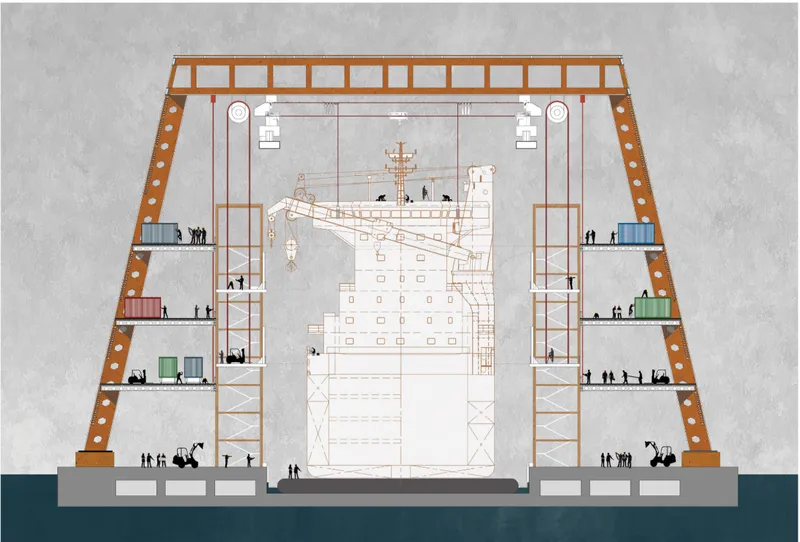
The proposal introduces a large-scale structural gantry system that encloses the ship during dismantling. This vertical steel framework functions as both:
- A structural docking system
- A multi-level cutting platform
- A crane-supported material handling system
Instead of workers climbing unstable ship surfaces, suspended floors, movable platforms, and integrated gantry cranes provide safe access at multiple levels. Sections are lifted systematically and transported to designated cutting zones, eliminating uncontrolled falling debris.
The infrastructure is driven by process. Every movement: from docking to cutting, sorting, washing, and resale, is mapped spatially. The architecture becomes a machine for safety.
Programmatic Zoning: Organized Industrial Ecology
The project restructures the yard into clearly defined zones:
1. Ship Breaking Zone
- Gantry cranes
- Docking platforms
- Heavy and light cutting areas
- Segregation zones
- Locker rooms and safety facilities
2. Training Facilities
- Enrollment and instruction rooms
- Medical units
- Open practice spaces
Training becomes mandatory to reduce accidents in this labor-intensive industry.
3. Administrative Block
- Gujarat Maritime Board interface
- Ship breaker offices
- Registration and documentation areas
- Pollution control offices
Governance and monitoring are integrated physically within the site.
4. Auction Market
Recovered utilities, machinery, and materials are transported via rail-based container systems to an organized auction yard. This reduces random dumping along the 8 km commercial stretch leading to Alang.
5. Supporting Infrastructure
- Rainwater harvesting
- Fire-fighting systems
- Solar roofing
- Waste segregation units
Through structured yard planning, the project aligns with international environmental conventions.
Container Housing: Human-Scale Intervention
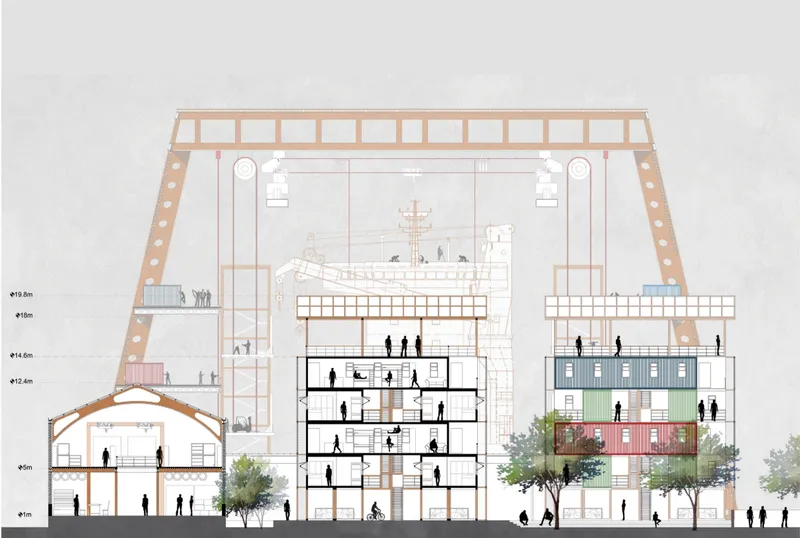
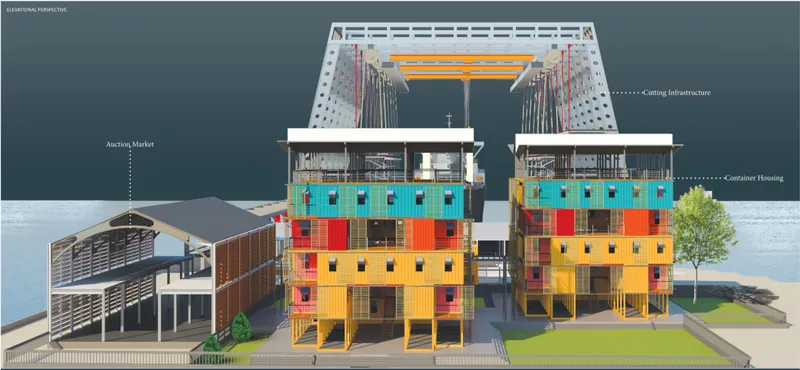
Parallel to the monumental industrial structure, the thesis introduces modular container housing for laborers. Repurposed shipping containers: salvaged directly from dismantled ships: are reassembled into dormitories, kitchens, sanitation cores, and communal terraces.
Architectural features include:
- Solar panel roofing
- North-light glazing
- Louvers from reclaimed marine wood
- Shared terraces for community interaction
This micro-scale housing contrasts with the massive ship-breaking machine. It establishes dignity and safety for workers who previously lived in informal settlements.
The project’s identity emerges from this scale transition, between the human and the industrial.
Environmental Systems: Protecting the Intertidal Zone
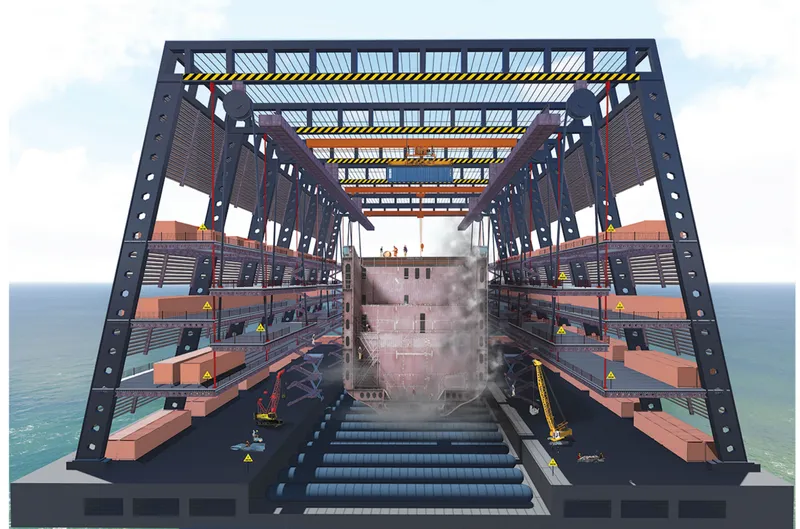
Currently, toxic runoff flows directly into the beach. The proposed impervious cutting platforms prevent contamination of the intertidal zone. Hazardous waste is segregated and transported using controlled systems.
Marine airbags support the ship while winch mechanisms move it safely. Gantry cranes lift vertical sections to designated oil-cleaning and cutting areas before material resale.
The result is a structured material flow that minimizes ecological damage.
Spatial Experience: Architecture as Industrial Theatre
The sectional drawings reveal a dramatic spatial condition: a colossal structural frame enveloping a ship like a cathedral of steel. Suspended floors, moving platforms, and overhead cranes animate the interior.
This is not merely a shed. It is a high-tech industrial scaffold that transforms a chaotic beach yard into a controlled, modular, and scalable infrastructure.
Through isometric and exploded axonometric studies, the thesis demonstrates that every structural element, from cellular rafts to suspended decks, is system-driven and repeatable.
Social and Economic Impact
By formalizing ship recycling through sustainable industrial architecture, the project aims to:
- Reduce annual fatalities
- Improve worker housing conditions
- Prevent toxic contamination
- Increase efficiency and productivity
- Integrate governance within the industrial site
Rather than eliminating ship breaking, the project modernizes it.
Reframing “The Graveyard”
Ships travel oceans for decades before reaching their final shore. Alang has long been perceived as a graveyard, an end point of global maritime life.
This thesis challenges that narrative.
Through sustainable industrial architecture, the graveyard becomes a regenerative system: where materials are responsibly recycled, labor is protected, and infrastructure replaces improvisation.
Into the Graveyard is not about death.
It is about redesigning the afterlife of ships through architecture.



Popular Articles
Popular articles from the community


Hill & Cross Opera: Sculptural Opera House Architecture Shaped by Tallinn’s Landscape and Identity
Hill & Cross Opera reimagines opera house architecture in Tallinn through its sculptural hill, civic plaza, glass wave and a luminous cross.

The Earth Pod: 3D Printed Homes for Resilient Refugee Communities
The Earth Pod reimagines refugee housing through 3D printed homes made from clay, combining resilience, self-sufficiency, and rapid shelter.

Conexión: Biophilic Design Reimagines High-Rise Living in Hong Kong
Conexión reimagines high-rise living in Hong Kong through biophilic design, green facades, shared spaces, daylight, water and nature within.

Lunar Spiral: Space Architecture Shaped by the Mathematics of the Universe
Lunar Spiral reimagines space architecture through Fibonacci geometry, lunar regolith, levitating habitats, and self-sustaining Moon living.
Similar Reads
You might also enjoy these articles

Eco Chapel: A Green Architecture Pavilion Designed in Symbiosis with the Forest
Eco Chapel uses green architecture to weave prayer, learning and reuse into a forest pavilion shaped by modular hexagonal canopies for life.
Kaffeebühnen: Coffee Shop Architecture Designed as a Civic Stage Between Vienna’s City and Park
Kaffeebühnen turns coffee shop architecture into a civic stage, linking Vienna’s park edge, urban life, warm timber yards, and coffee craft.
Healing Façade: Sustainable Architecture for Reforestation, Community, and Sacred Ecology in Ethiopia
Healing Façade reimagines sustainable architecture as a living wall that restores soil, catches water and renews Ethiopia's forest churches.


Urban Forest: A Vertical Ecosystem for 5,000 Workers in Singapore's Changi Business Park
Radially stacked pods and layered green decks turn a 7-acre plot into 47 acres of ecological workspace projected for 2040.


Comments (0)
Please login or sign up to add comments
No comments yet. Be the first to comment!