
Sascha Wurm Architektur Turns a Franconian Hillside into a Split-Level Family House in Iphofen
A 362-square-meter residence at the foot of Mount Schwanberg absorbs its sloping site through split-level floors and a deceptively traditional shell.


Iphofen is a small Franconian town with tight development codes and a strong architectural identity: gabled roofs, rendered facades, compact forms. Any new house here has to fit that mold, at least from the street. Sascha Wurm Architektur took that constraint and made it productive. IPHO House, completed in 2024, presents a rectangular footprint and a clay-tiled gable to its neighbors, checking every box on the local plan. Then it quietly subverts the interior, using the site's natural slope to stack split-level floors that stretch rooms up to the roofline and pull the garden deep into the center of the plan.
What makes the project worth paying attention to is less its sustainability credentials (energy class A+, photovoltaics, heat pump) and more the way it weaponizes a sloped site that most developers would simply terrace flat. The ascending terrain becomes the organizing logic for the whole house: parallel staircases, half-level shifts, and a central living volume that opens fully onto the garden at grade. The result is a house that feels far larger and more spatially varied than its 362 square meters suggest, wrapped inside a shell so quiet it nearly disappears into the streetscape.
A Conventional Shell, a Radical Interior
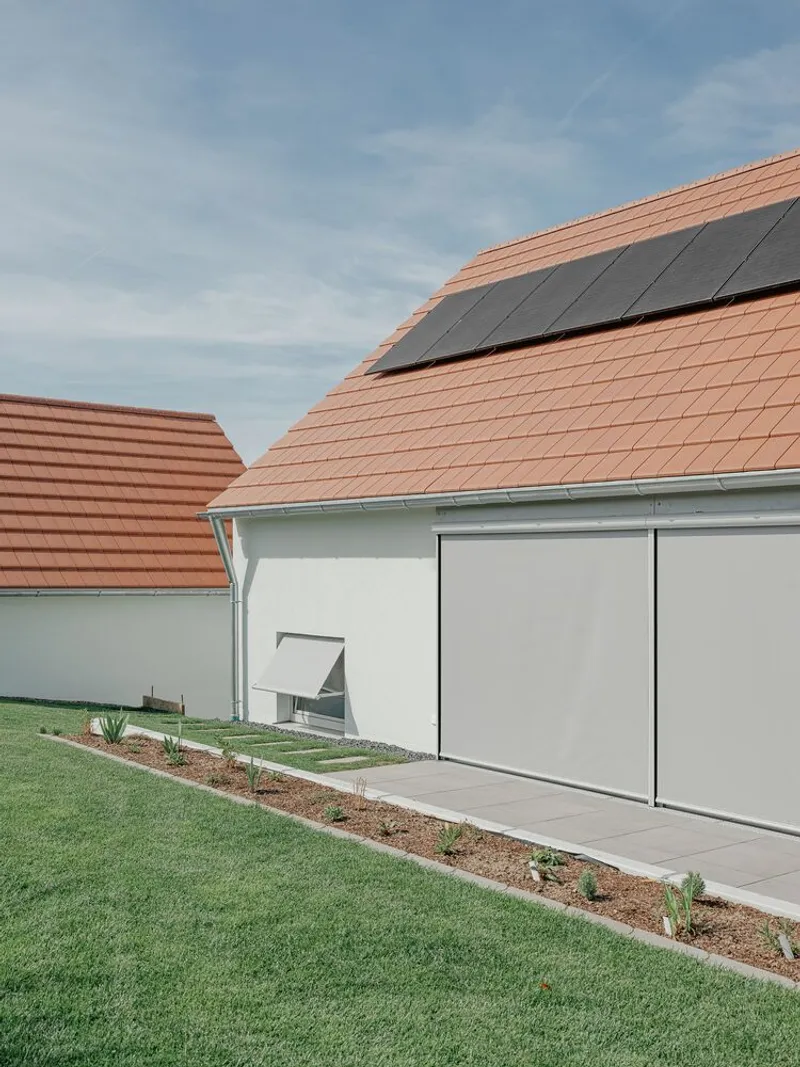
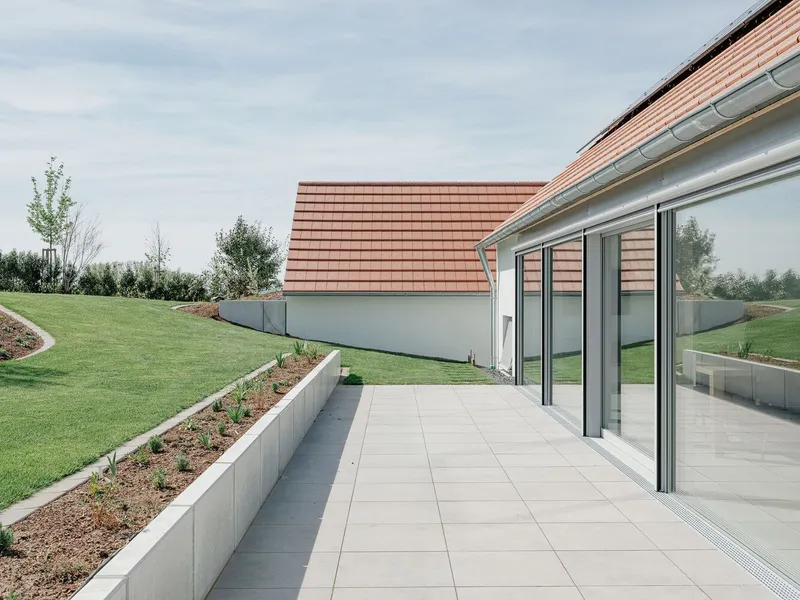
From outside, IPHO House could pass for any well-built Franconian home. The white-rendered walls, the pitched clay tile roof, the planted slope: everything reads as local, measured, appropriate. The integrated photovoltaic panels sit flush within the roof tiles, almost invisible from the street. But the garden elevation tells a different story. A broad terrace paved in large-format slabs extends the living floor directly onto the hillside, bordered by a concrete planter bed that doubles as a retaining edge. The slope is not fought; it is folded into the architecture.
The contrast between the defended street facade and the porous garden side echoes a pattern Wurm drew from Iphofen's own history, specifically the Rödelseer Tor and the town's tradition of presenting solid walls to the public realm while opening generously to private courts and gardens. Here, that duality becomes the governing spatial idea.
Concrete as Structure, Surface, and Furniture
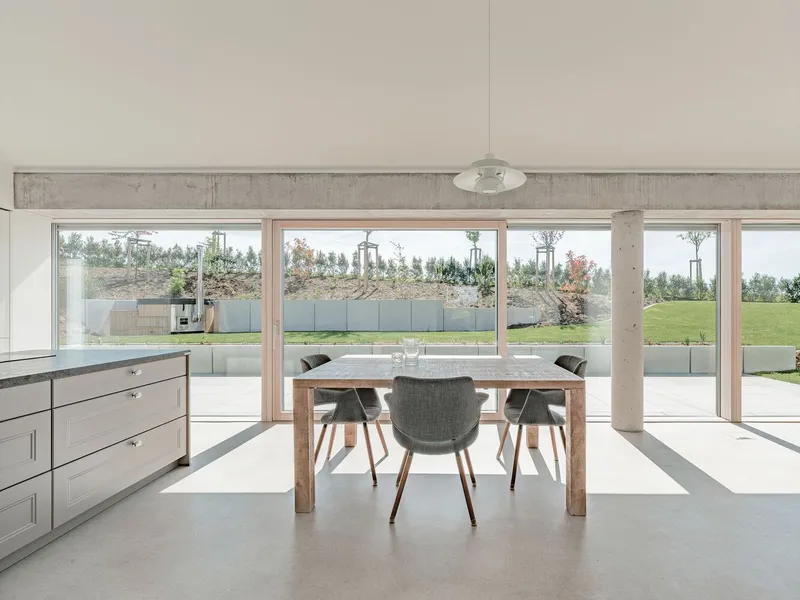
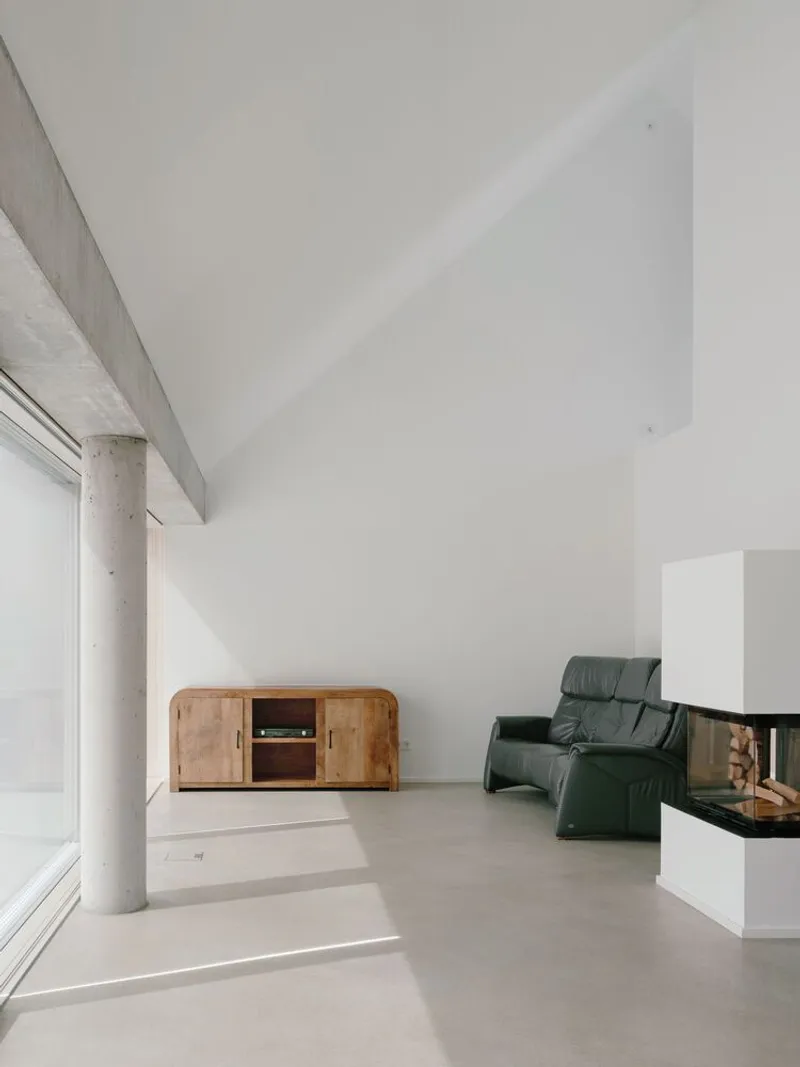
Exposed concrete does a lot of work in this house, and it is asked to perform at several registers simultaneously. Overhead, board-formed ceilings and beams give the dining area a muscular horizontality, anchoring the full-height glazing that opens the room to terrace and lawn. In the living room, a cylindrical concrete column marks the structural center while a continuous window band wraps the perimeter, filtering soft daylight across polished floors. The concrete is never decorative; it is always doing something, spanning, supporting, or storing heat as thermal mass.
The structural engineering by Bollinger+Grohmann (Sebastian Dietrich) deserves credit here. Load-bearing exterior walls and a central ridge wall form the primary structure, allowing the interior partitions to be kept minimal. That is what makes the open circulation and lofty, roof-height rooms possible within such a strict external envelope.
The Teal Threshold
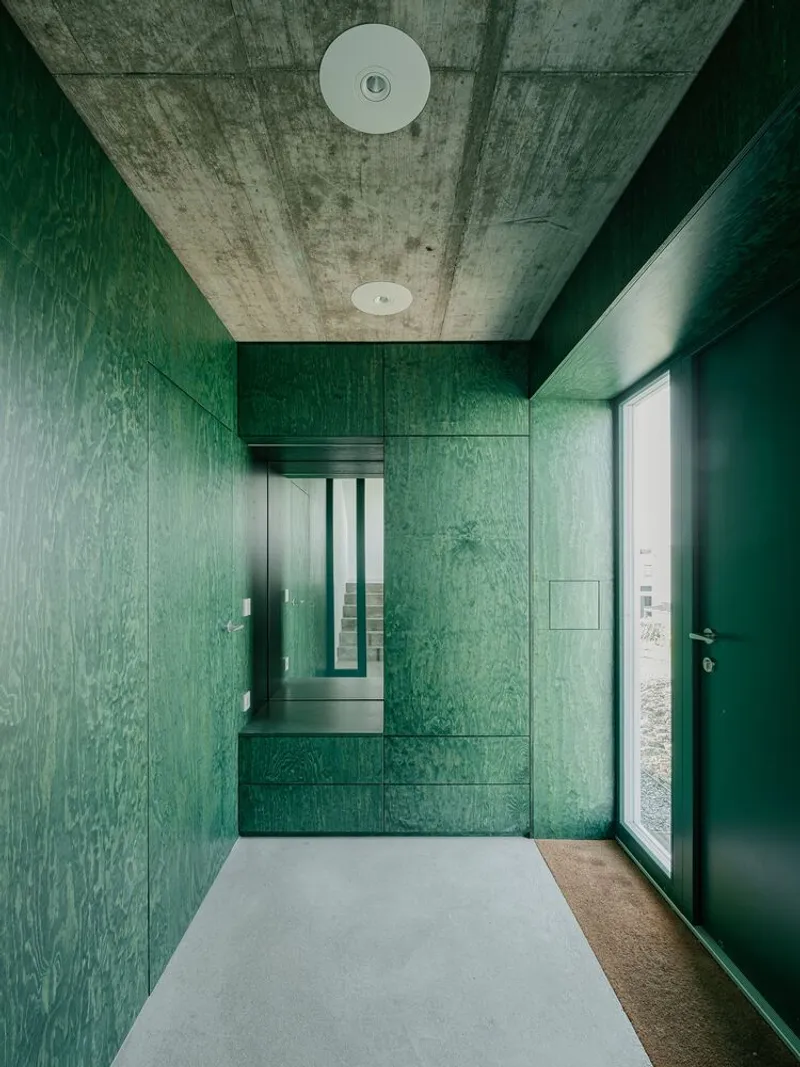
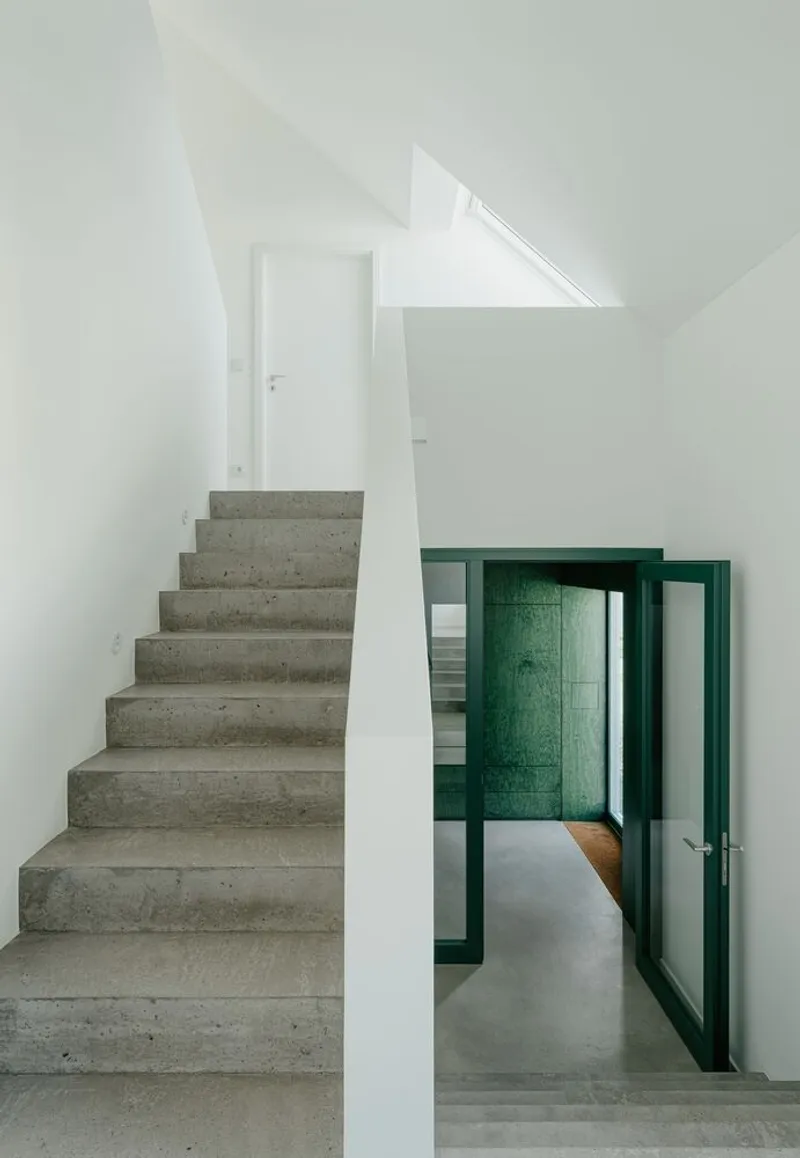
If the concrete provides the house's structural bass note, the teal-stained timber is its sharp counterpoint. The entry hall is clad floor to ceiling in these deeply saturated panels, an unexpectedly bold move beneath the raw concrete slab above. The color recurs at the staircase, where teal-painted timber frames a doorway under the sloped ceiling, linking the two moments across levels and confirming that this is not an accent but a material strategy.
The choice reads as deliberate provocation against the neutral exterior. Where the street facade is polite, the entry sequence is assertive, almost theatrical. You step from rendered plaster into a saturated interior world. That tonal shift, white to teal to raw concrete, compresses the transition from public to private into a single threshold, and it works precisely because the exterior gives so little away.
Split Levels and Parallel Stairs
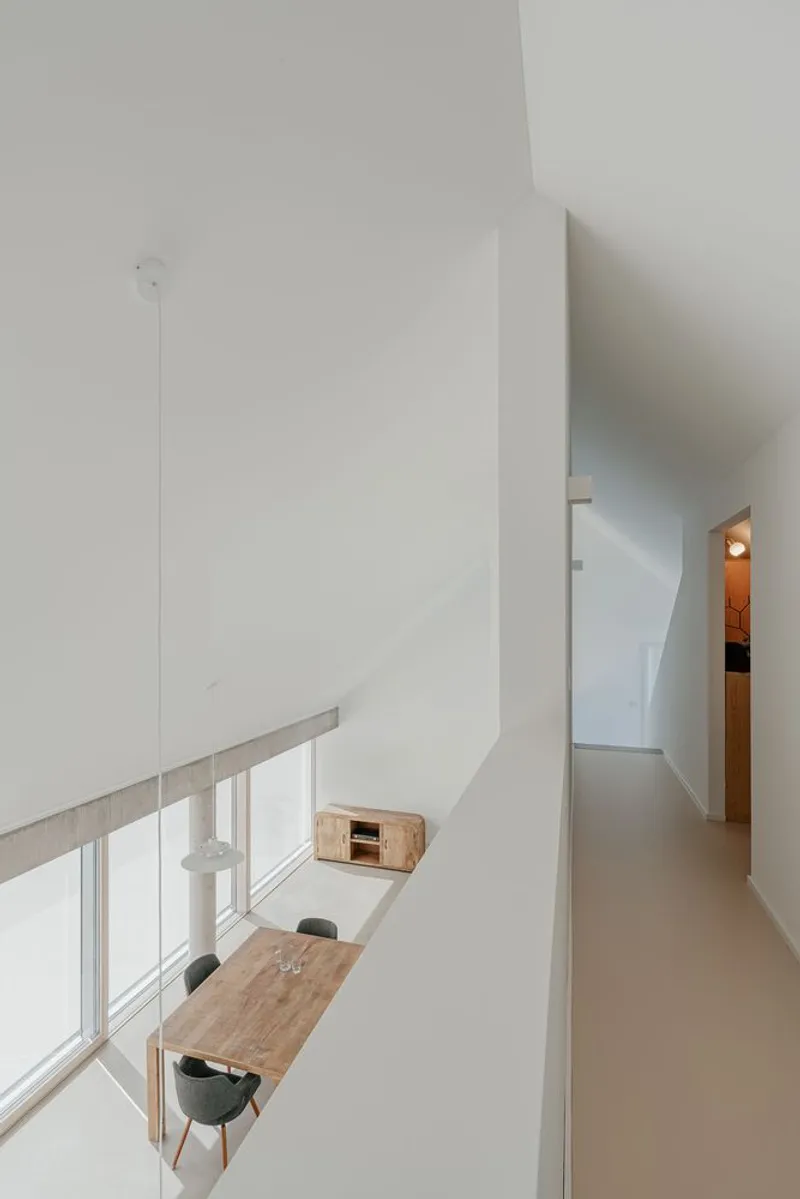
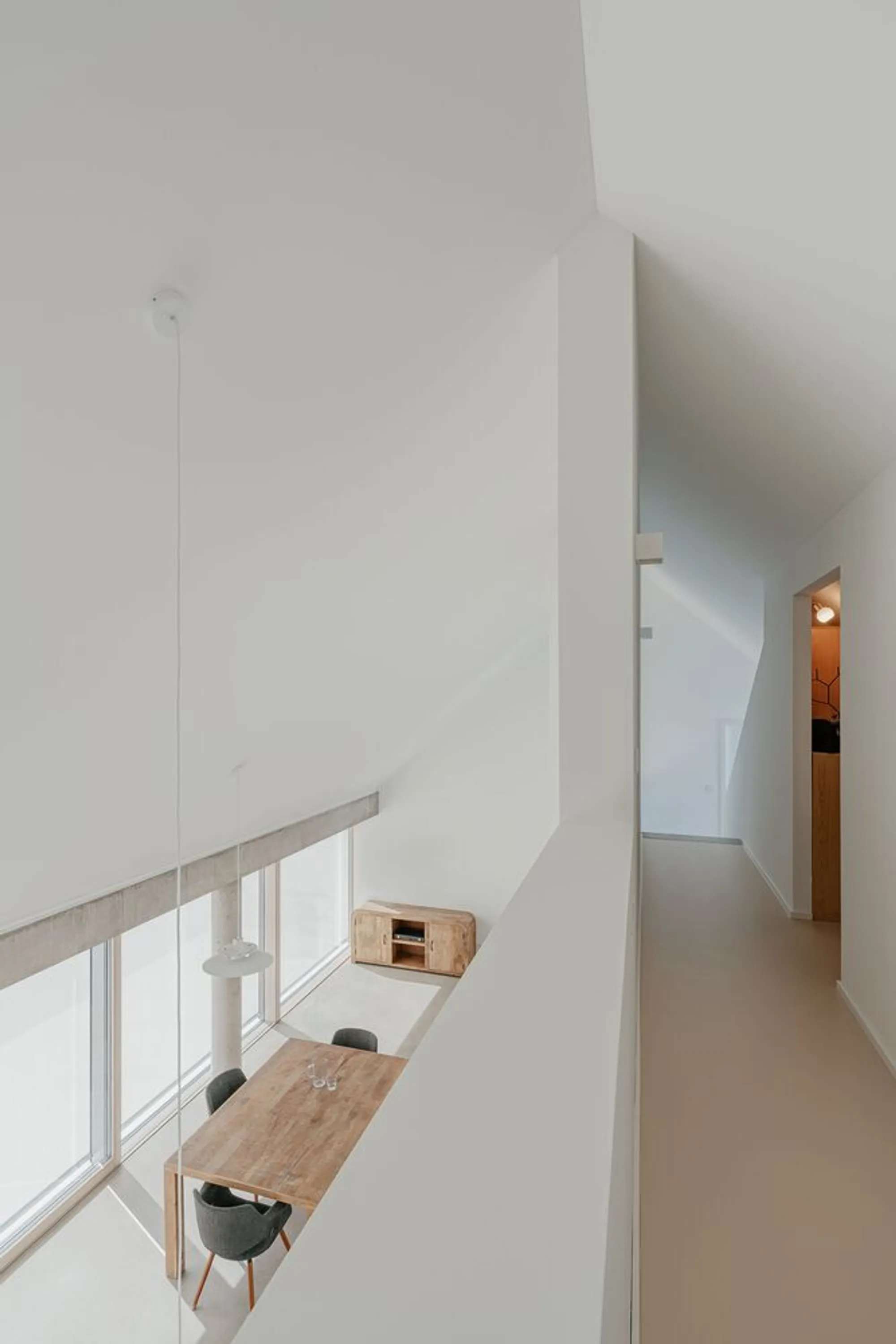
The most inventive move in the plan is the arrangement of parallel staircases side by side, creating two routes through the section. This is not just circulation; it is a spatial device that allows half-level shifts to cascade through the house without dead-end corridors. From the upper hallway, you look down past the concrete stair to the dining area below, the timber table and pendant light framed by the concrete structure like a scene in a sectional drawing brought to life.
These split-level floors absorb the site's grade change so that every room sits at a slightly different datum, giving each space its own identity within the continuous volume. The effect is cinematic. Moving through the house means constantly shifting elevation, gaining and losing views, discovering connections between rooms that seemed separate a moment earlier.
Material Discipline in the Details
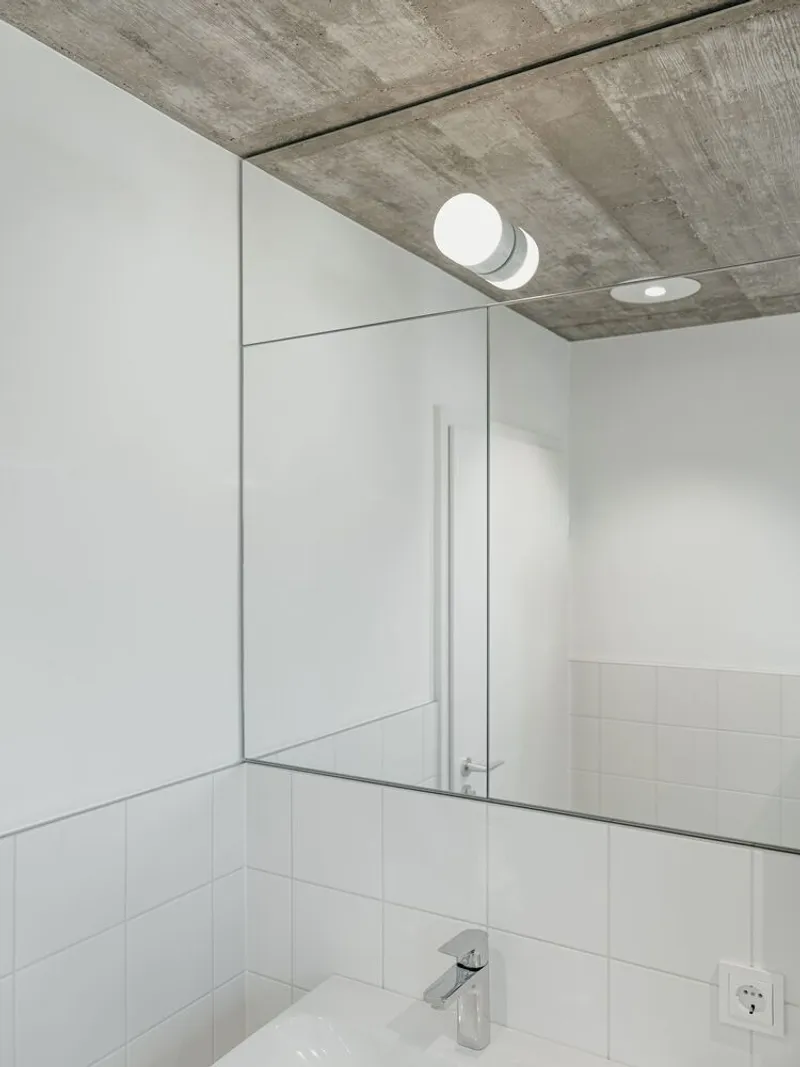
The bathroom distills the house's material logic into a single room. White tile, exposed concrete ceiling, recessed fixtures: nothing competes, nothing decorates. The mirror reflects the concrete slab above, reinforcing the idea that structure is always visible, always honest. Wood-aluminum windows throughout the house maintain the same discipline, providing strong thermal performance without introducing a fourth or fifth material into an already resolved palette.
Wurm's restraint here is worth noting because it would be easy, in a house this spatially complex, to let the finishes proliferate. Instead, the palette stays tight: concrete, plaster, teal timber, white tile. Every surface earns its place. The energy consultant Markus Behr contributed to a package that achieves A+ certification, but the sustainability is embedded in the construction logic rather than bolted on, monolithic brick masonry for the walls, concrete for thermal mass, and the photovoltaic array integrated invisibly into the roof.
Why This Project Matters
IPHO House is a useful case study in what happens when a talented architect takes a prescriptive development code seriously rather than fighting it. The gabled roof, the plaster facade, the rectangular footprint: none of these were choices Sascha Wurm made freely. They were constraints. The design intelligence lies entirely in what happens inside and behind that mandated shell, the split levels, the parallel stairs, the bold material palette, the garden-facing transparency. It is a reminder that the most creative architecture often emerges not from blank-slate sites but from sites that push back.
More broadly, the project demonstrates that a 362-square-meter family house can be both regionally appropriate and spatially ambitious without resorting to formal exhibitionism. The street sees a good neighbor. The garden sees an entirely different building. And the occupants get to live in both at once. That kind of double reading, quiet outside and inventive inside, is harder to pull off than it looks, and it is the mark of an architect who understands that context is not a limitation but a material.
IPHO House by Sascha Wurm Architektur, Iphofen, Germany. 362 m², completed 2024. Photography by Lennard Zimmermann.
About the Studio
Share Your Own Work on uni.xyz
If projects like this are the kind of work you want to make, uni.xyz is a place to publish your own, find collaborators, and enter design competitions.




Popular Articles
Popular articles from the community


Co-Life: Senior Housing Design That Reconnects Older Adults With the City
Co-Life reimagines senior housing design through healing gardens, shared streets, workshops, and a sustainable community across generations.

Play: Fragments of Their World
Familiar architecture becomes modular playground design, creating safe spaces where displaced children can learn, connect, imagine and play.

Hill & Cross Opera: Sculptural Opera House Architecture Shaped by Tallinn’s Landscape and Identity
Hill & Cross Opera reimagines opera house architecture in Tallinn through its sculptural hill, civic plaza, glass wave and a luminous cross.

The Musturak Paradise: Senior Living Architecture for a Connected Future in Temara, Morocco
The Musturak Paradise reimagines senior living architecture in Temara via private homes, social spaces, culture, community, and shared care.


Similar Reads
You might also enjoy these articles


Hodi-Mandai Geram
Project Function: Preservation and revitalization of the Intangible heritage and socio-spatial identity of the Hodi by Housing, Cultural Memory Center, Sacred Grove, landscape, local tourism economy


Olio Towers: A Mid-Rise for Performers That Fuses Housing, Rehearsal, and Stage
Located blocks from Houston's Theater District, this modular tower stacks living units around a central performance atrium.

Oasis: Modular Green Housing Carved into Dhaka's Urban Fabric
A shortlisted Plugin Housing entry reclaims unauthorized settlements in Dhaka with stepped concrete volumes, green roofs, and ventilation-driven design.

Black Hole: A Floating Megastructure for the Post-Physical Era
Emiliano Mazzarotto envisions a spherical, self-scaling arena where e-sports, digital hotels, and holographic stadiums replace traditional public space.

Explore Architecture Competitions
Discover active competitions in this discipline



Challenge to reimagine the Iron Throne


Photograph architecture without architects


Illustrate the lost glory of Angkor Wat - Render Challenge


Design challenge to reuse E-waste
Comments (0)
Please login or sign up to add comments
No comments yet. Be the first to comment!