
Irreversible Dim: A Tower That Fades as the City Forgets
Luminous columns mark each death to the second, then slowly darken over centuries, turning a memorial tower into a living clock of collective memory.

What if a building could forget? Not all at once, but gradually, floor by floor, light by light, over the span of centuries. "When they die, they die." is a memorial tower that replaces the permanence of headstones with something far more unsettling and honest: columns of light that brighten at the moment of someone's death, then dim irreversibly as time passes. The building itself becomes a measure of how long the living remember the dead, its facade shifting from radiant white to eventual darkness. It is architecture designed to expire.
Designed by Major Tang, 杨捷, yy p, and 雨馨任, the project was shortlisted in the Circle of Life competition. Against a brief that asked designers to reconsider how architecture mediates death and remembrance, the team proposed a vertically growing tower where each floor corresponds to a specific decade, beginning at the base with the year 2019. The result is a structure that accumulates both remains and meaning, rejecting digital resurrection in favor of a slow, physical reckoning with mortality.
Columns of Light as Living Timelines
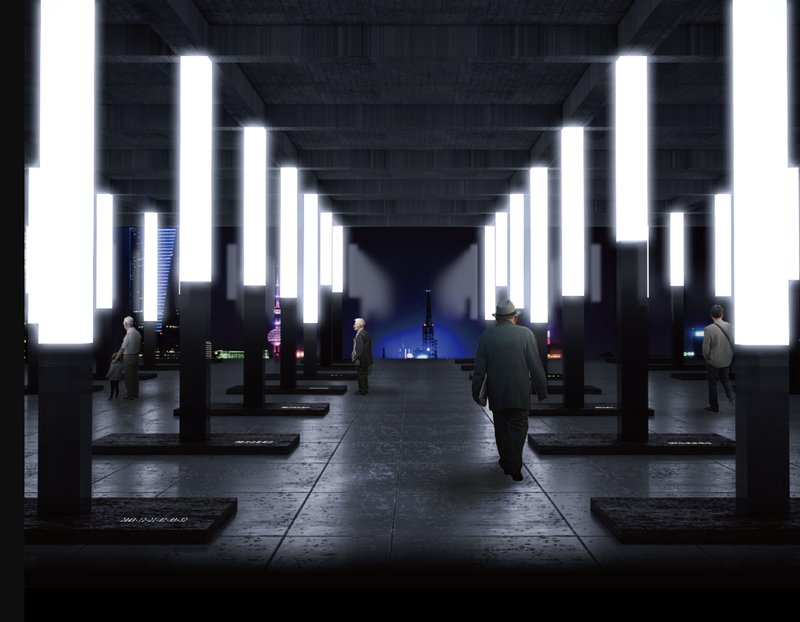
Step inside the tower and you encounter an interior unlike any mausoleum. Vertical luminous columns rise between dark structural piers, each one a vessel containing the ashes of a single person. Visitors move through the space surrounded by these glowing markers, the brightness of each column communicating how recently the person died. A column representing someone who passed last year burns steady and clear; one from decades ago has already begun its slow retreat into shadow. Every column is engraved with a unique identifier formatted down to the second: year, month, day, hour, minute, second. That precision collapses biography into a single coordinate in time, grounding memory in something verifiable rather than sentimental.
Each column is segmented vertically into three phases: from birth to death, from death to the present, and from the present into the unknown future. The illuminated portion represents the span of a life lived. The dimming section that follows tracks elapsed time since death. As years accumulate, the light fades further, making visible the slow erosion of individual memory. There is no switch to flip, no restoration. The dimming is irreversible.
A Pixelated Beacon on the Urban Skyline
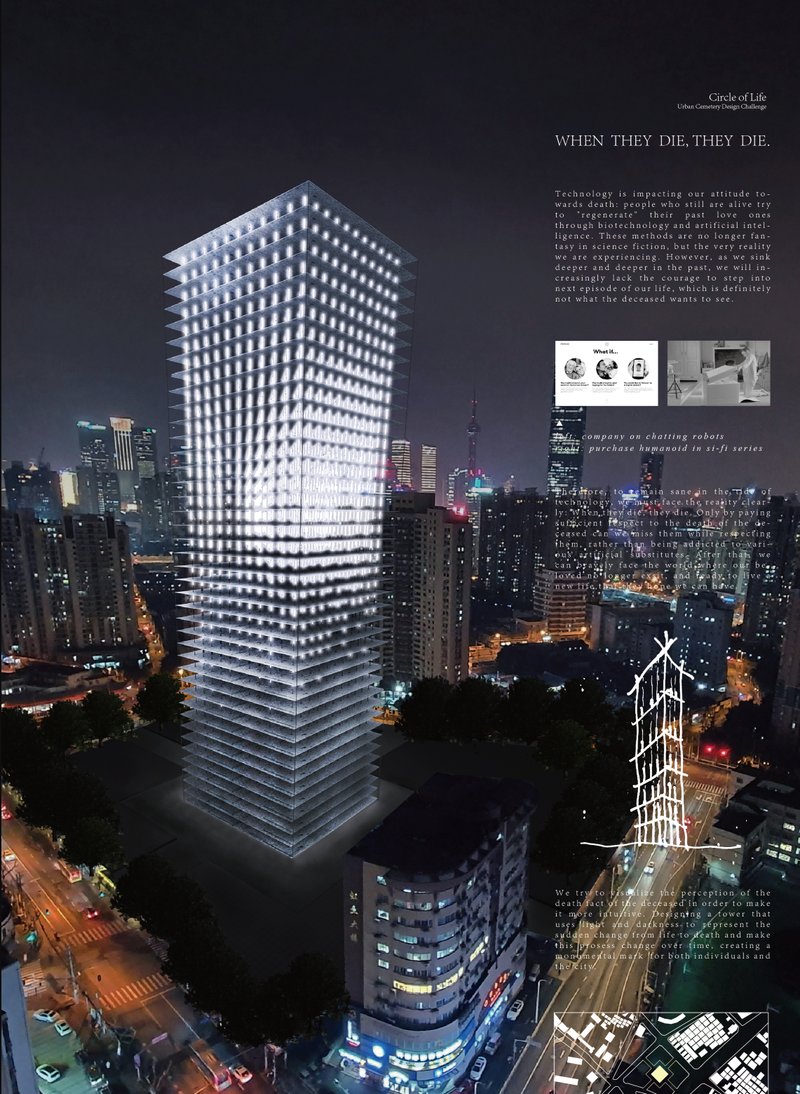
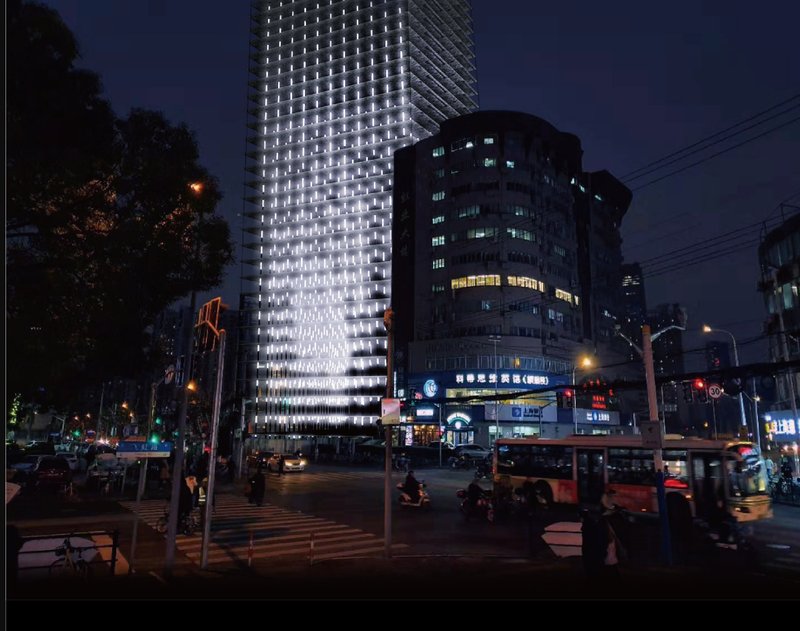
From the street, the tower reads as an enormous pixelated facade glowing against the city at night. The presentation board reveals how it rises above a dense urban context, its illuminated surface creating an almost digital texture that shifts as columns brighten and fade across floors. At dusk, the facade radiates white against the evening sky, asserting itself not as a somber monument tucked into a cemetery but as a civic presence integrated into the rhythms of daily life. Passersby see the light and are quietly reminded that the building is, at every moment, changing.
The architectural ambition here is significant. Each floor houses a generation's worth of memorial columns, and new floors are constructed above as new decades arrive. The tower grows upward over time, physically accumulating the weight of collective loss. The newest, brightest floors always sit at the top while the oldest, dimmest floors occupy the base. From the outside, this produces a gradient: luminous crown, darkening core, near-black foundation. The building never goes fully dark at once. It simply migrates its light upward, like a flame climbing a wick.
Centuries Compressed into a Section Drawing
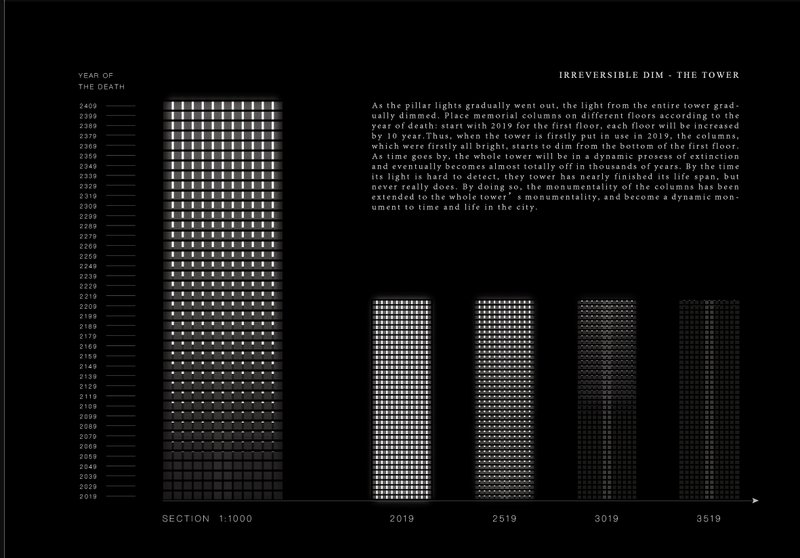
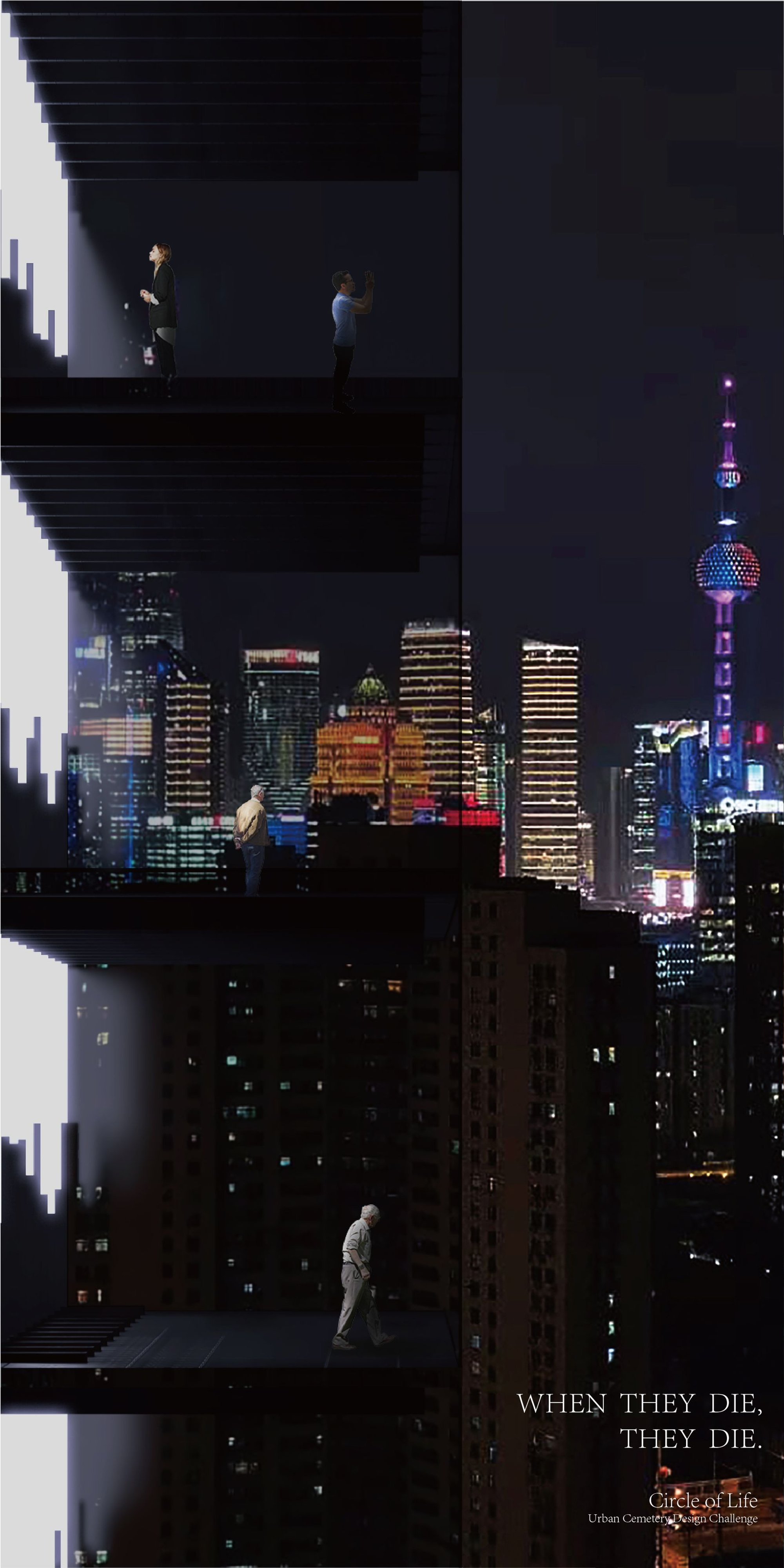
The sectional diagram is where the project's temporal logic becomes clearest. Elevation drawings illustrate how the tower's facade transforms over extended timescales: decades, centuries, a full millennium. The base floors, representing deaths from 2019 onward, gradually lose their glow as those memories recede. Meanwhile, upper floors continue to flicker with new arrivals. In a thousand years, the designers project that only the uppermost levels may still shine. The drawing makes explicit what the architecture implies: that remembrance has a half-life, and this building is calibrated to track it.
The diagram also underscores the structural premise. This is not a fixed monument to be completed and then maintained. It is infrastructure for ongoing loss, a framework that anticipates its own obsolescence at the base while continuously renewing itself at the top. The section reads less like a conventional building drawing and more like a graph of cultural attention, plotting luminosity against time.
Why This Project Matters
"When they die, they die." takes a direct stance against the contemporary impulse to preserve the dead indefinitely through AI replicas, digital archives, and simulated personas. The phrase at the heart of the project is deliberately blunt: it insists that the past should be allowed to remain past. In a culture increasingly uncomfortable with finality, this memorial tower proposes that letting go is not negligence but a form of respect. The dimming light is not failure. It is the architecture doing exactly what it was designed to do.
What makes the proposal compelling is its refusal to separate emotion from system. The luminous columns are simultaneously poetic objects and calibrated instruments. The tower is both a contemplative space for grief and a growing urban landmark visible across the city. By encoding mortality into the physical behavior of the building, the design team has produced something rare: a memorial that evolves with the same inevitability as the process it commemorates. Architecture, here, does not preserve memory. It accompanies memory as it fades.
View the Full Project
About the Designers
Designers: Major Tang, 杨捷, yy p, 雨馨任
Enter a Design Competition on uni.xyz
uni.xyz runs architecture and design competitions year-round that reward proposals with spatial conviction and real site intelligence.
Project credits: When they die, they die by Major Tang, 杨捷, yy p, 雨馨任 Circle of Life (uni.xyz).



Popular Articles
Popular articles from the community

Kaffeebühnen: Coffee Shop Architecture Designed as a Civic Stage Between Vienna’s City and Park
Kaffeebühnen turns coffee shop architecture into a civic stage, linking Vienna’s park edge, urban life, warm timber yards, and coffee craft.
Eco Chapel: A Green Architecture Pavilion Designed in Symbiosis with the Forest
Eco Chapel uses green architecture to weave prayer, learning and reuse into a forest pavilion shaped by modular hexagonal canopies for life.
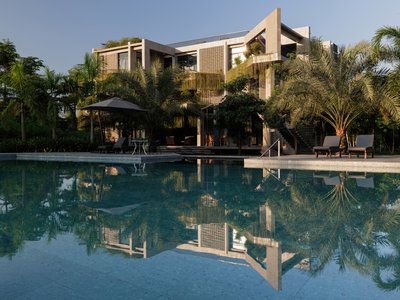
Reincarnation Weaves a Three-Story Retreat into the Green Landscape of Rural Bangladesh
Ara Manor in Narsingdi dissolves the line between domestic architecture and its lush surroundings through screens, courtyards, and planted rooftops.
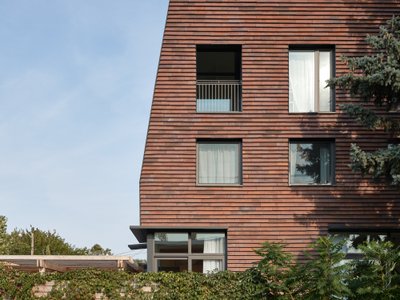
LGA Architectural Partners Build Toronto's First Multiplex Condo on a Single-Family Lot
Ulster House packs five zero-carbon units into a Harbord Village lot, proving gentle density can be market-ready and livable.


Similar Reads
You might also enjoy these articles

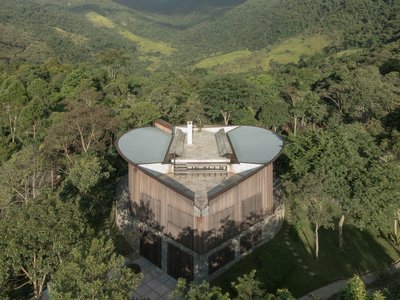
House in Bocaina by Ana Altberg + Cesar Jordão: A Circular Retreat Embracing the Atlantic Forest
Circular forest home in Brazil by Ana Altberg and Cesar Jordão, blending sustainable materials, passive design, and immersive landscape integration.
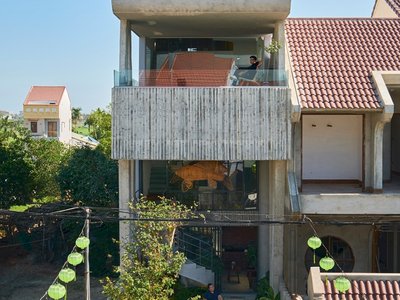
Cherry Homestay: A Harmonious Blend of Modern Design and Traditional Hoi An Architecture
Cherry Homestay blends modern architecture with traditional Hoi An elements, featuring spiral stairs, rooftop mezzanine, sustainable materials, and open, airy spaces.
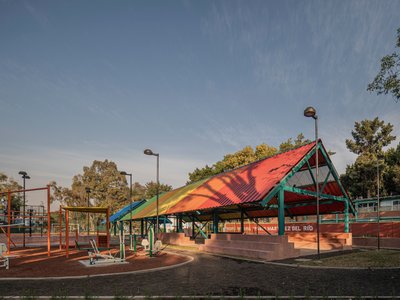
Revitalizing Culhuacán: Housing Unit Infonavit CTM Square by AMASA Estudio
AMASA Estudio revitalized CTM Culhuacán Square, transforming neglected housing unit spaces into vibrant, accessible, community-focused public areas with sustainable design elements.
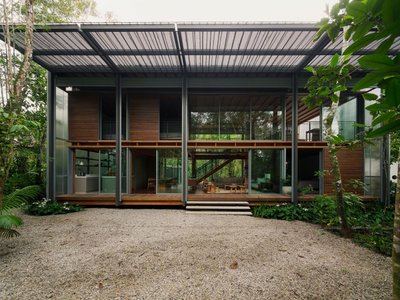
FR House by Andrade Morettin Arquitetos Associados: A Coastal Retreat Embedded in Brazil’s Native Landscape
Coastal vacation house blending into native vegetation, using translucent polycarbonate, timber structure, passive shading, and elevated design for climate-responsive living.


Explore Sustainable Design Competitions
Discover active competitions in this discipline




The Global Benchmark for Architecture Dissertation Awards


Challenge to design locus for the upliftment of human rights


Challenge to re-imagine a department store in present times


Design challenge fostering public involvement in wildlife research
Comments (0)
Please login or sign up to add comments
No comments yet. Be the first to comment!