

24 7 Arquitetura Crowns an Itatiba Hilltop with a Red Steel and Recycled Brick Residence
Perched on a seven-meter slope outside São Paulo, this 285 square meter house turns construction waste into expressive architecture.


A house that reads as two entirely different buildings depending on where you stand is always worth a closer look. From the pool terrace, 24 7 Arquitetura's Itatiba House presents itself as a bold red steel pavilion cantilevered over the terrain, its perforated brise-soleils catching light like a piece of industrial sculpture. Walk around to the street side and the same residence dissolves into a quieter composition of modulated ecological brick boxes, offset on different planes, grounded and earthy. Designed by lead architects Giuliano Pelaio and Gustavo Tenca and completed in 2021, the 285 square meter home occupies a hilltop lot in a residential condominium near Itatiba, Brazil, where views of distant mountain ridges and valleys reward anyone willing to work with difficult topography.
What makes the project genuinely interesting is the discipline behind the spectacle. Every material choice, from the recycled brick to the prefabricated concrete slabs left exposed without interior lining, is driven by a cost reduction logic that doubles as an aesthetic commitment. The house was implanted obliquely on the lot, skewed away from the street grid, so that living spaces face north to south for optimal winter sunlight while shielding occupants from peak summer radiation. That oblique positioning also pushes the footprint away from future neighboring plots, buying privacy without relying on tall walls. The result is a residence where environmental strategy, structural economy, and visual punch are essentially the same thing.
Two Faces on a Hilltop
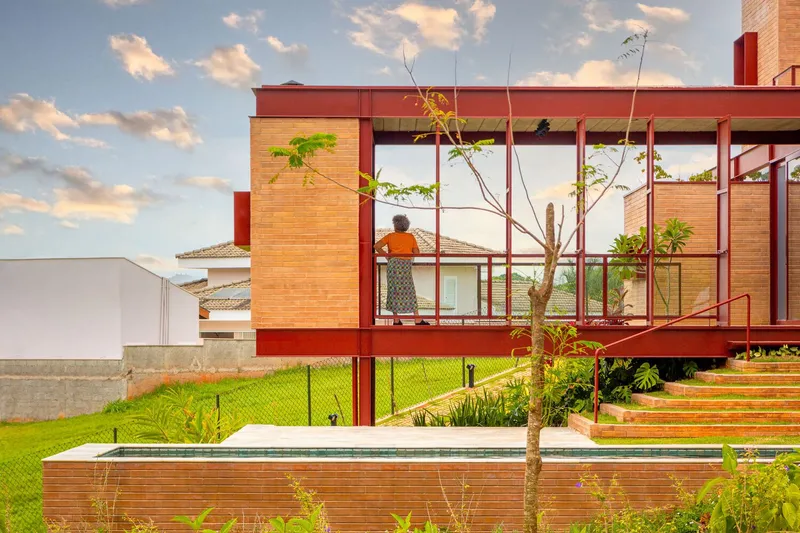

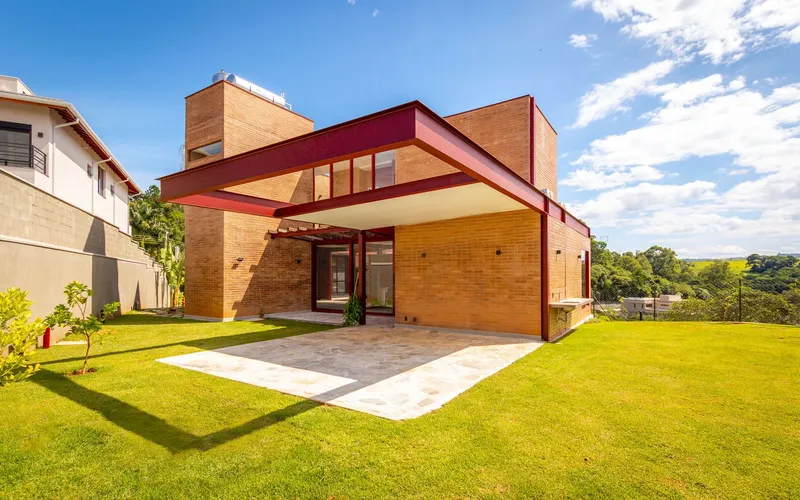
The dual reading of the house is its strongest formal move. On the landscape side, the upper floor cantilevers past the ground level, supported by a red steel frame that wraps balconies and organizes the perforated screen panels into a rhythmic facade. It is aggressive, almost infrastructural. From the street, brick volumes step forward and back, their modulated surfaces absorbing light in a way that softens the composition entirely. The red entry canopy acts as a hinge between these two identities, signaling arrival while hinting at the metallic drama waiting on the other side.
Implanting the house at an angle to the lot boundaries was a calculated gamble. It sacrifices the conventional alignment that would simplify construction and drainage, but it gains a longer diagonal axis through the interior and orients the primary openings toward the best views and the most favorable solar path. On a site with more than seven meters of fall to the rear and four meters of change across the front, the oblique placement also lets the architects tuck vehicular access along a ramp at the lower side, keeping the elevated social spaces uninterrupted.
Red Steel as Climate Device


The red metallic elements are not decoration. The perforated plate brises are articulated, meaning they rotate to adjust shading angles through the day and across seasons. Steel plate flaps on the brick side windows serve the same function in a quieter register, folding out to block high summer sun while allowing low winter light to penetrate. Together, these two shading systems address the full solar envelope without relying on mechanical cooling.
Choosing red for the steel was a deliberate provocation against the natural palette of São Tomé stone and earth-toned brick. It declares the mechanical and structural systems rather than concealing them, an honest expression that aligns with the decision to leave prefabricated concrete panels unlined on the interior. There is a consistency here: nothing is hidden, nothing is merely cosmetic.
Ground and Water


The swimming pool is perhaps the most cinematic element, positioned so that it appears to float at the edge of the terrain with the red pavilion rising behind it. On overcast days the water reflects the cloud formations overhead, turning the pool deck into a mirror for the São Paulo interior sky. A brick staircase with grass-filled treads negotiates the grade change between the pool level and the veranda and barbecue area above, creating a sequence of outdoor rooms that descend with the slope.
The landscape strategy, designed by Letícia Fortuna, keeps the planted areas simple: grass terraces, young trees, and garden beds that will thicken over time. The covered terrace, paved in São Tomé stone and open on two sides through the red steel frame, functions as the social center of gravity, connecting kitchen, barbecue, and pool in a single gesture. It is generous without being extravagant, scaled to daily life rather than to occasional entertaining.
Interior Honesty
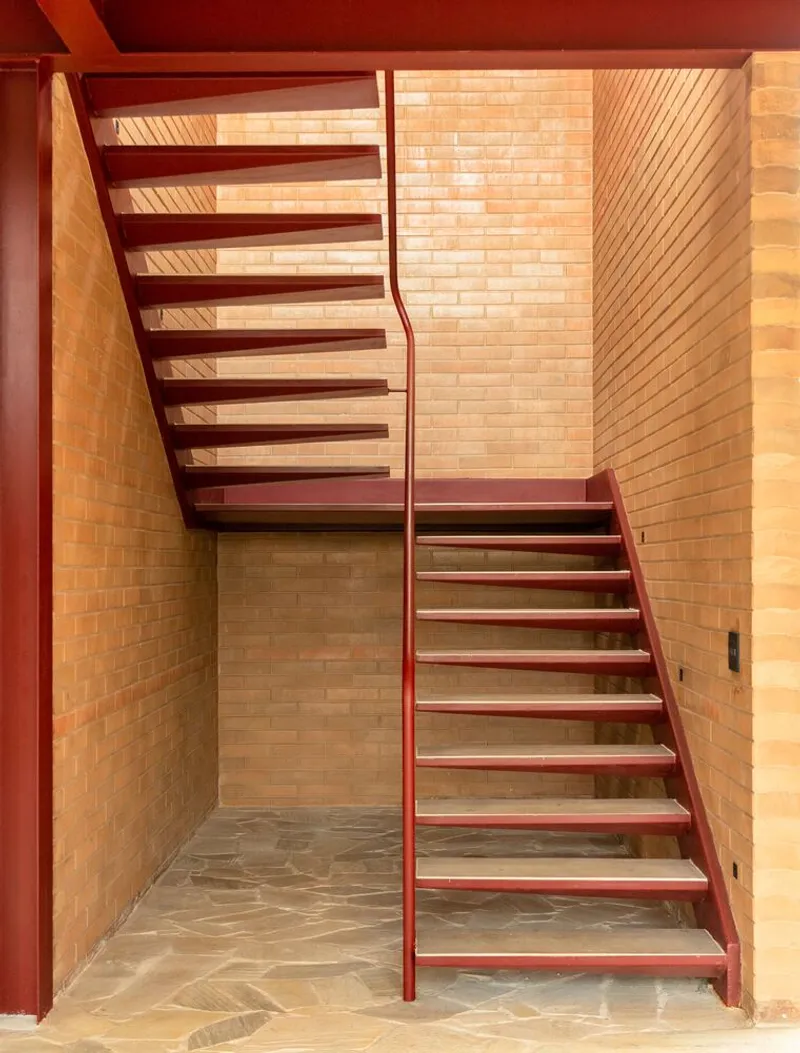

Inside, the staircase is the most revealing space. Timber treads turn through a brick shaft flooded with natural light from above, and the red steel stringers and handrails maintain the exterior color code without softening it. The brick is unplastered, the steel is painted but not clad, and the light is controlled but never blocked. It is a small space that communicates the entire material thesis of the house.
At ground level the ecological brick appears again as the primary facade material, this time paired with louvered windows and a red door opening onto a paved courtyard with grass joints. The courtyard mediates between the public street and the private interior, offering a decompression zone where the language of the house is established before you step inside. The ecological bricks, manufactured from recycled construction waste, serve triple duty here: structural wall, privacy screen, and aesthetic surface. That kind of material efficiency is where the project's environmental argument becomes most convincing.
Why This Project Matters
Itatiba House demonstrates that sustainability in Brazilian residential architecture does not require expensive proprietary systems or a muted aesthetic vocabulary. Recycled brick, exposed concrete panels, and a steel structure are standard construction materials redeployed with precision: oriented to climate, modulated for economy, and left visible for honesty. The passive design strategy of north-south orientation, adjustable shading, and cross-ventilation is nothing new, but 24 7 Arquitetura applies it with enough rigor that the house barely needs to apologize for its energy footprint.
More importantly, the project proves that a modest program of 285 square meters on a difficult slope can generate real architectural complexity. The two-faced reading, the cantilevered upper floor, the oblique implantation, and the integration of landscape with structure all result from engagement with constraints rather than their avoidance. For a studio working outside the major metropolitan centers, this is exactly the kind of project that earns attention: specific to its site, clear in its logic, and unafraid of color.
Itatiba House by 24 7 Arquitetura (Lead Architects: Giuliano Pelaio and Gustavo Tenca). Itatiba, Brazil. 285 m². Completed 2021. Landscape design by Letícia Fortuna. Photography by Adriano Pacelli.
About the Studio
Share Your Own Work on uni.xyz
If projects like this are the kind of work you want to make, uni.xyz is a place to publish your own, find collaborators, and enter design competitions.




Popular Articles
Popular articles from the community


Co-Life: Senior Housing Design That Reconnects Older Adults With the City
Co-Life reimagines senior housing design through healing gardens, shared streets, workshops, and a sustainable community across generations.

Co-life: Sustainable Architecture for Age-Friendly Community Living
Co-life reimagines sustainable architecture for seniors through courtyards, rammed earth, shared gardens, and spaces designed for belonging.

Riyadh For All: Intergenerational Urban Design for Active Aging in Rabat
Riyadh For All reimagines urban design in Rabat with intergenerational co-living, adaptive courtyards, and Moroccan cultural exchange today.

AL-JANNAH: Sustainable Architecture and Permaculture for Afghan Widows
AL-JANNAH uses sustainable architecture and permaculture to create resilient oasis of housing, learning, work and renewal for Afghan widows.

Similar Reads
You might also enjoy these articles


Hodi-Mandai Geram
Project Function: Preservation and revitalization of the Intangible heritage and socio-spatial identity of the Hodi by Housing, Cultural Memory Center, Sacred Grove, landscape, local tourism economy


Olio Towers: A Mid-Rise for Performers That Fuses Housing, Rehearsal, and Stage
Located blocks from Houston's Theater District, this modular tower stacks living units around a central performance atrium.

Oasis: Modular Green Housing Carved into Dhaka's Urban Fabric
A shortlisted Plugin Housing entry reclaims unauthorized settlements in Dhaka with stepped concrete volumes, green roofs, and ventilation-driven design.

Black Hole: A Floating Megastructure for the Post-Physical Era
Emiliano Mazzarotto envisions a spherical, self-scaling arena where e-sports, digital hotels, and holographic stadiums replace traditional public space.


Explore Architecture Competitions
Discover active competitions in this discipline



Challenge to reimagine the Iron Throne


Photograph architecture without architects


Illustrate the lost glory of Angkor Wat - Render Challenge


Design challenge to reuse E-waste
Comments (0)
Please login or sign up to add comments
No comments yet. Be the first to comment!