

croixmariebourdon Wraps a 1990s Nursery School in a New Skin That Cuts Energy Use by 70 Percent
A bioclimatic refurbishment in Chevilly-Larue gives perforated metal, larch slats, and a unifying gallery to a thermally struggling school.


Thirty years is a long time for a building that was designed around poetry rather than performance. The Jacques Gilbert-Collet Nursery School in Chevilly-Larue, originally drawn by ETRA architecture (Philippe Maillard) in 1990, organized its pavilions around a child's sensory relationship with the four classical elements: earth, water, air, fire. It was a noble conceit, but expansive, unshielded glass surfaces and morphological complexity made the building a thermal nightmare, hitting 35°C indoors in summer and burning through 245 kWhep/m² per year. By the time croixmariebourdon architectes associés arrived, the task was clear: keep the original spirit alive while making the building actually livable.
What makes this project worth studying is not just the performance numbers, though those are striking: energy consumption dropped to 91 kWhep/m² per year, a 70 percent reduction, and peak summer temperatures fell by more than seven degrees. The real lesson is how the architects achieved all of this without demolishing the original character. They added a new dismountable envelope, a connecting gallery, and a restricted palette of materials that together reframe the 1990s pavilions as something coherent, calm, and unapologetically contemporary. The budget was a restrained €2.9 million excluding tax, which makes the scope of the transformation even more notable.
The Gallery as Connective Tissue
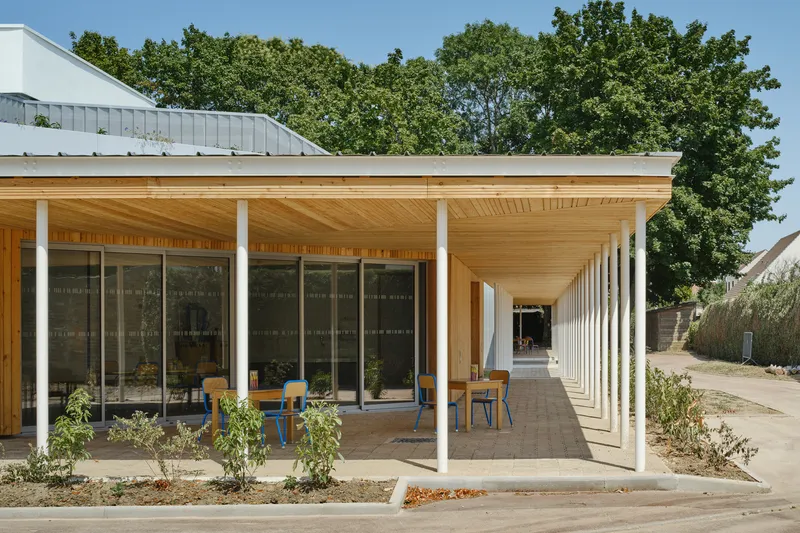

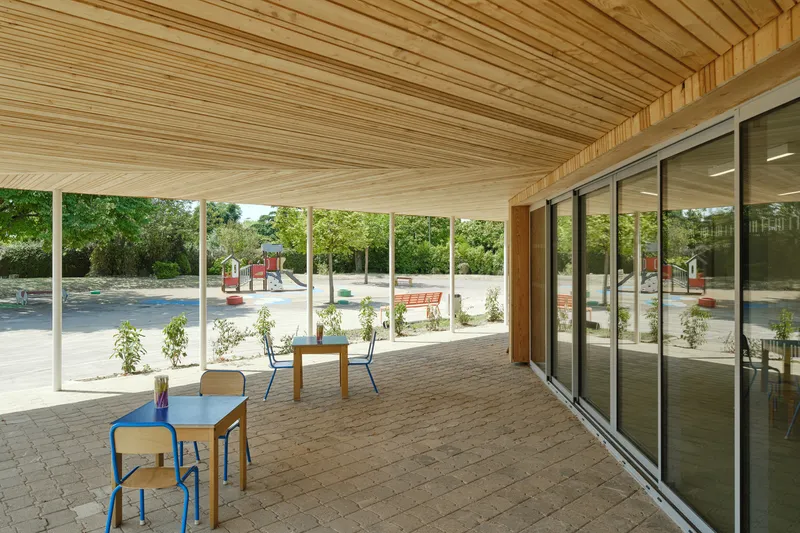
The most legible move in the project is the new gallery, a covered walkway that stitches the school's separate wings together around their perimeters. It functions as a two-way indoor/outdoor corridor, part circulation spine and part passive climate device. In summer, the golden larch-slatted ceiling filters sunlight while the bright metal roof bounces sky light downward. In winter, the gallery captures solar gains and shields glazed walls from wind. At the street entrance, the same structure widens into a reception area that opens the school to the neighborhood.
The light white steel colonnade supporting the gallery reads as minimal and almost domestic in scale. It does not compete with the mature trees on the site, which were clearly preserved with care. The paved floor uses reused draining concrete pavers from the original landscape, a quiet gesture of circularity that avoids waste without making a spectacle of it.
A Dismountable Envelope

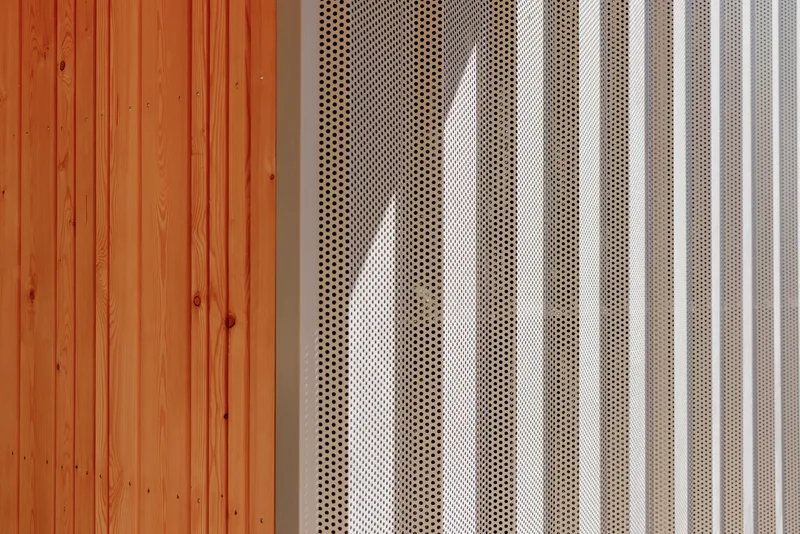
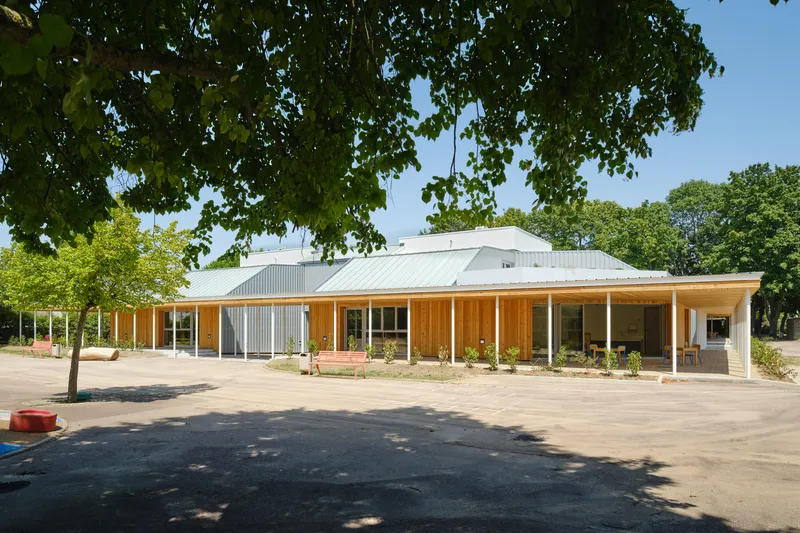
The architects describe the new facade system as "dismountable," and this matters. Rather than permanently altering the original structure, the renovation wraps it in 14 cm of external rock wool insulation and then layers on a cladding system of perforated metal screening and natural larch slats. The Océane Arval steel cladding is ribbed, micro-perforated, and thermolacquered, working alongside the existing zinc roofing in a palette that stays within silver, white, and warm timber tones. The restricted material range is deliberate: it clarifies the architectural expression of a building that was, by most accounts, visually complicated.
The perforated metal panels do double duty. They filter direct sunlight before it reaches the new aluminum-framed solar control glazing behind, and they give the facade a layered depth that changes with the angle of light. The detail where vertical timber cladding meets the metal screen is particularly well resolved: two very different materials brought into alignment through careful dimensioning rather than decorative trim.
Interior Spaces That Breathe
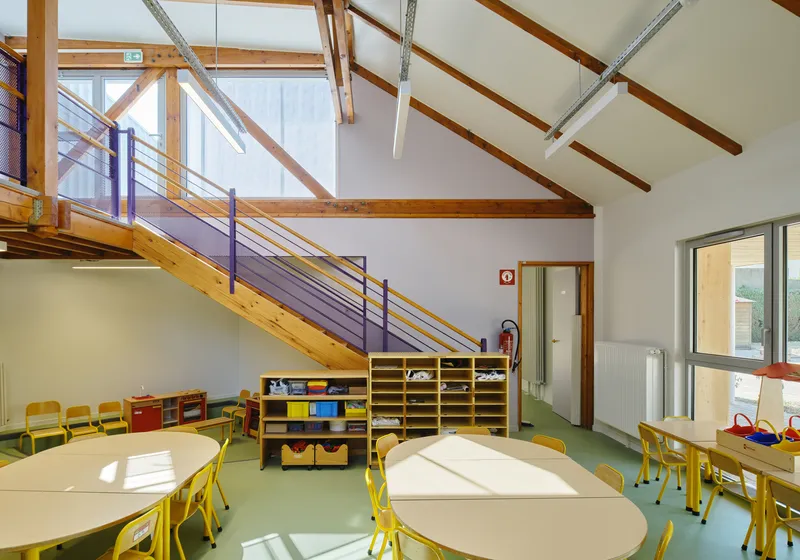

The original pavilion organization, grouping two classrooms with mezzanines around a shared workshop, survives intact. What has changed is how light enters and how heat behaves. Double-height classrooms now benefit from carefully resized clerestory windows that admit controlled daylight without the old overheating problems. The exposed timber roof trusses remain on full display, lending warmth and scale to rooms designed for very small children. Sliding glass doors open classrooms directly onto the covered terrace, collapsing the boundary between indoor learning and outdoor play.
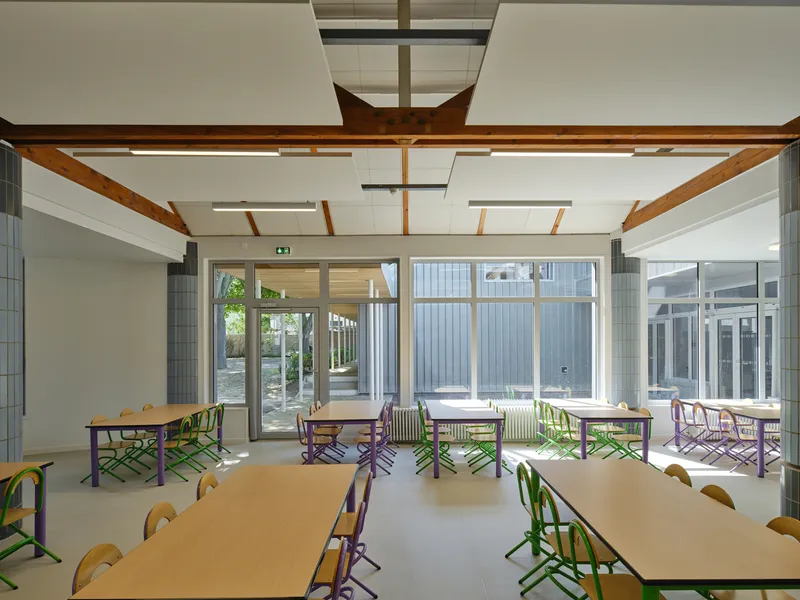
The dining hall with its skylights and colorful furniture demonstrates that the refurbishment did not strip the school of personality. The palette is restrained, mostly timber, white surfaces, and bright accents, but it allows the architecture to set the mood rather than relying on applied graphics or thematic decoration. For a nursery, this is a confident choice.
The Courtyard and the Trees


The site plan preserves the school's existing mature trees, and this decision shapes the experience of every approach. The entry facade at dusk, framed by large canopies casting dappled shadows across the forecourt, reads as more landscape than building. The symmetrical entrance with its standing seam roof and flanking wings sits low and recessive, deferring to the green canopy overhead. For parents arriving to pick up children, the effect is welcoming rather than institutional.
In the courtyards, children play beneath the same trees that shade the pavilions, surrounded by lacquered steel planters filled with new vegetation. The architects also repurposed timber from a felled tree on site to create outdoor furniture and play structures. These are small moves, but they add up to a consistent ethic: spend less, waste less, reuse what is already here.
Structural Legibility
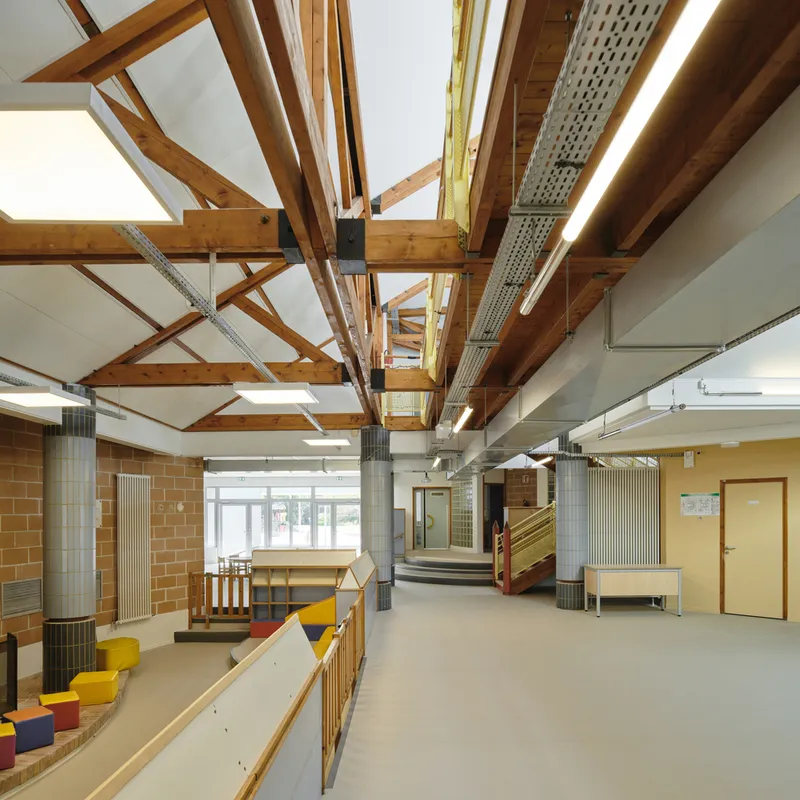
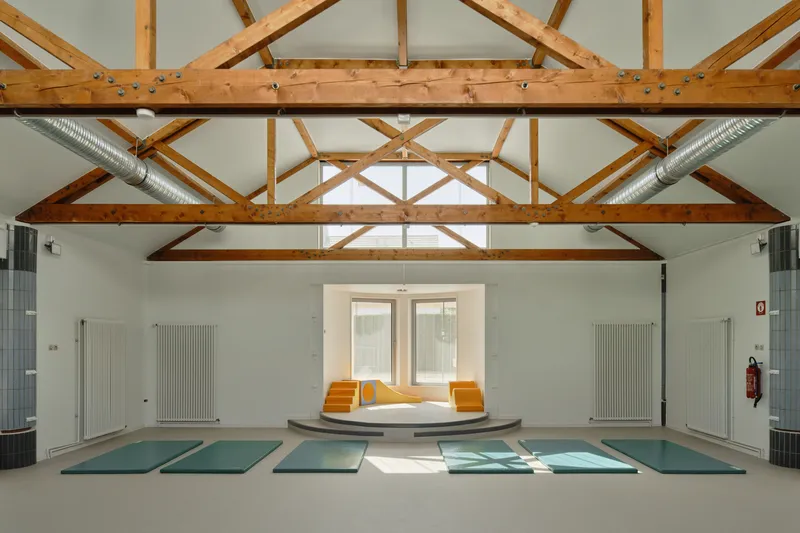
One of the pleasures of the refurbished school is how honestly it shows its bones. The exposed timber roof structure with steel connectors and perforated acoustic panels in the circulation spaces is left visible, celebrating the 1990s construction rather than concealing it behind drywall. The multipurpose hall takes this further: timber trusses span the full width of the room, landing on walls punctuated by symmetrical windows. Exercise mats on the floor and a raised platform suggest a room that serves many purposes without needing to change its identity.
This structural honesty reinforces the pedagogical philosophy of the original school. If the 1990 design wanted children to engage with the elements, the 2022 renovation wants them to understand how a building is put together. Trusses, connections, the grain of wood: these are all legible at a child's eye level.
Participation and Process

A photograph of a child pointing at a wall covered in pinned drawings, site plans, and photographs tells a story that the finished architecture cannot. The design process included interviews with school staff to identify pain points, and the resulting solutions, better shading, improved circulation, a real entrance, respond directly to daily operational frustrations. The wall of diagrams suggests that the process was also made visible to the children themselves, which is a generous pedagogical gesture.
Why This Project Matters
The refurbishment of the Jacques Gilbert-Collet Nursery School is a case study in what renovation can accomplish when architects resist the urge to start over. The original building had real problems, not cosmetic ones, but the response was calibrated and precise: wrap, insulate, shade, connect. The result is a 70 percent reduction in energy consumption and a dramatic improvement in thermal comfort, achieved without altering the fundamental spatial organization that made the school worth saving in the first place.
For the broader conversation about educational architecture, this project argues that sustainability and sensory richness are not competing goals. The new envelope is austere in its material palette, but the larch, the perforated metal, the play of filtered light across covered walkways: these produce an environment that is warmer and more varied than many purpose-built green schools. At €2.9 million for 1,678 m², it also argues that budgetary restraint can sharpen rather than compromise design thinking. More architects renovating public buildings should study this one closely.
Jacques Gilbert-Collet Nursery School Refurbishment by croixmariebourdon architectes associés. Chevilly-Larue, Val-de-Marne, France. 1,678 m². Completed 2022. Photography by Takuji Shimmura and Alex Bonnemaison.
About the Studio
Share Your Own Work on uni.xyz
If projects like this are the kind of work you want to make, uni.xyz is a place to publish your own, find collaborators, and enter design competitions.


Popular Articles
Popular articles from the community


Cube Design Draws an Ecological Corridor Between Two Shenzhen Hills with the Nankai Building
Beside Shenzhen's container docks, the Nankai Building pairs stacked balconies with a climbing green screen to connect two hillsides across its height.

LT2A and OPEN Architectes Thread a Brick and Glass High School Through a Wooded Belgian Campus
In Braine-l'Alleud, a 3,000 m² wing for Collège Cardinal Mercier pairs pale brick with a glazed colonnade, deferring to a small chapel and a dense wood.

David Ortega Stacks a Two-Story Mexico City Penthouse Around a Steel Stair and a Pergola-Shaded Roof Terrace
In Colonia Roma, a 300 m² penthouse uses oak joinery, a planted steel stair and a slatted roof pergola to make a new-build apartment feel like a house.

GROUP A Strips a 1969 Rotterdam Harbor Headquarters to Its Frame and Wraps It in Timber Louvers
In Rotterdam's M4H harbor district, Ferro Offices reuses a 1969 frame, adds one timber storey and reaches BREEAM-NL Outstanding.

Similar Reads
You might also enjoy these articles


Hodi-Mandai Geram
Project Function: Preservation and revitalization of the Intangible heritage and socio-spatial identity of the Hodi by Housing, Cultural Memory Center, Sacred Grove, landscape, local tourism economy


Olio Towers: A Mid-Rise for Performers That Fuses Housing, Rehearsal, and Stage
Located blocks from Houston's Theater District, this modular tower stacks living units around a central performance atrium.

Oasis: Modular Green Housing Carved into Dhaka's Urban Fabric
A shortlisted Plugin Housing entry reclaims unauthorized settlements in Dhaka with stepped concrete volumes, green roofs, and ventilation-driven design.

Black Hole: A Floating Megastructure for the Post-Physical Era
Emiliano Mazzarotto envisions a spherical, self-scaling arena where e-sports, digital hotels, and holographic stadiums replace traditional public space.

Explore Educational Building Competitions
Discover active competitions in this discipline

Challenge to design public laboratory

Challenge to reimagine the Iron Throne

Photograph architecture without architects

Illustrate the lost glory of Angkor Wat - Render Challenge
Comments (0)
Please login or sign up to add comments
No comments yet. Be the first to comment!