
James Harbard Architects Builds a Home from Fragments of Memory in Clifton Hill
A 250-square-metre refurbishment in Melbourne layers literary influence, sculptural steel, and rich materiality for a young family.


The best residential projects don't just shelter a family; they construct a narrative. Ramsden House, by James Harbard Architects, takes that idea literally. Sited in Clifton Hill, Melbourne, the 250-square-metre refurbishment stitches an existing weatherboard cottage to a pale brick rear extension, drawing conceptual inspiration from W. G. Sebald's The Rings of Saturn, a book that wanders between personal recollection and broader history without ever settling into a single mode. The architecture does something similar: it drifts from Victorian lace trim to spiraling blue steel, from veined marble to timber joinery, assembling a home not from a single stylistic conviction but from curated fragments that feel both collected and deeply personal.
What makes Ramsden genuinely interesting is its refusal to treat the old and new as a simple before-and-after. The cottage front remains almost untouched, white picket fence and all, while the rear addition speaks an entirely different language of vertical-bond brickwork, generous glazing, and a swimming pool that doubles as a reflective plane. Between these two poles the plan threads a sequence of moments, each with its own material palette, scale, and light quality, as if you are turning pages in a novel rather than walking through a corridor.
Two Faces on One Lot
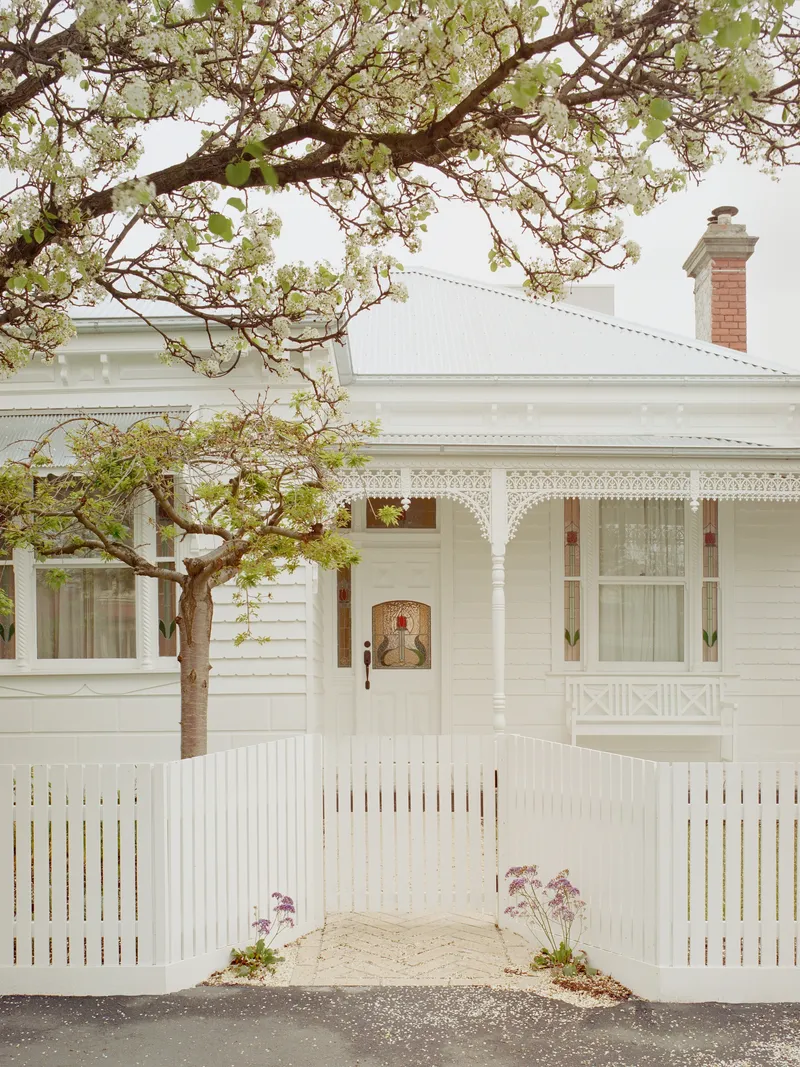
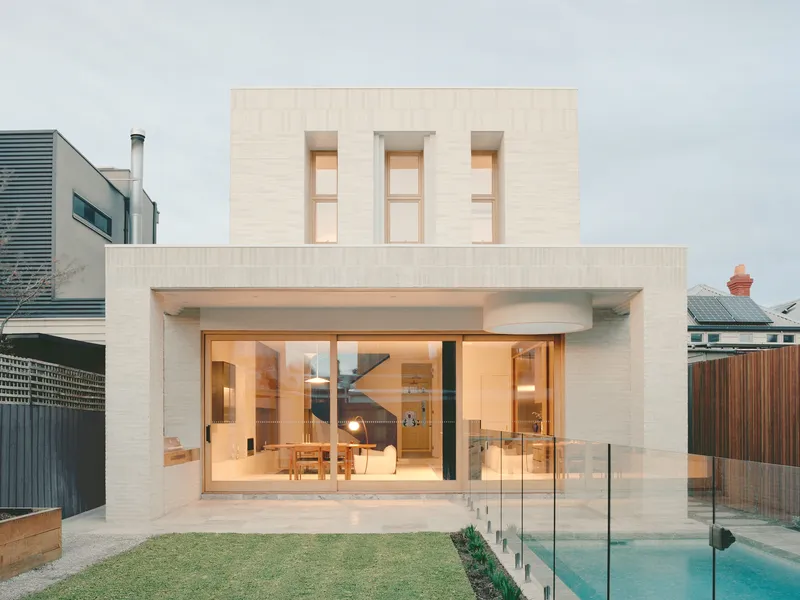
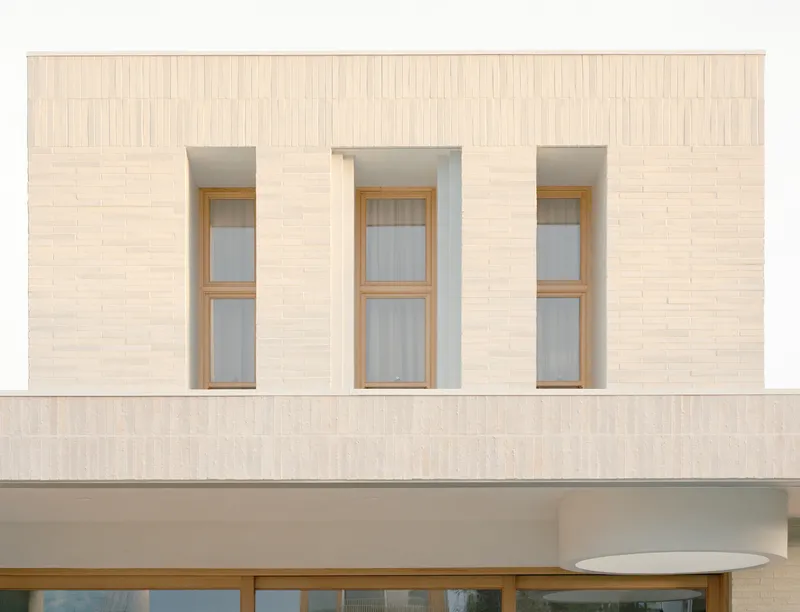
From the street, Ramsden House is a polite Victorian cottage. The white weatherboard facade, decorative verandah lacework, and flowering canopy tree announce nothing of the ambition behind. Walk through the house and the rear elevation reveals an altogether different proposition: a planar composition of pale brick with three tall, timber-framed windows arranged in a deliberate rhythm. The vertical bond of the brickwork gives the wall a textile quality, subtly distinguishing it from the heritage front.
The dual identity is not a contradiction but a deliberate strategy. By leaving the street presentation intact, Harbard preserves the grain of Clifton Hill's residential fabric while concentrating architectural invention where it faces the private garden and pool. It is a quiet act of civic generosity that also happens to generate a powerful surprise when you move from one end of the house to the other.
The Blue Staircase as Spine
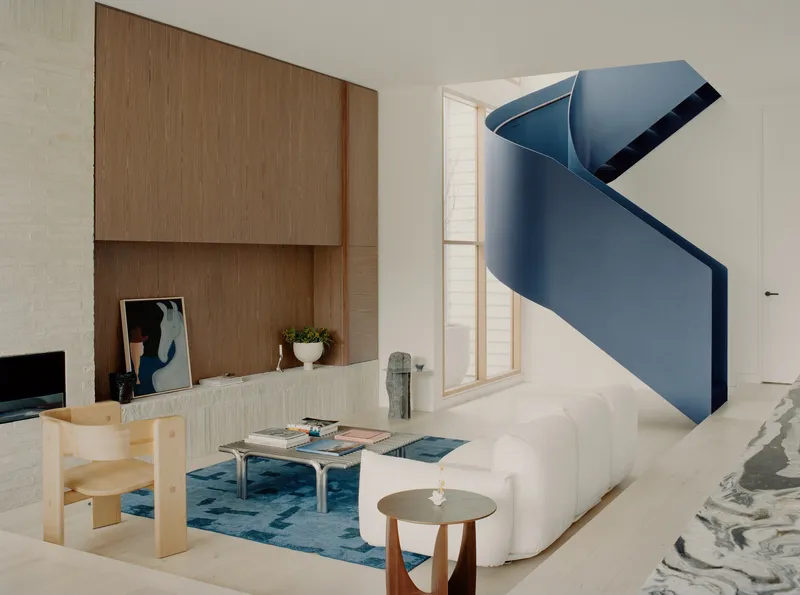
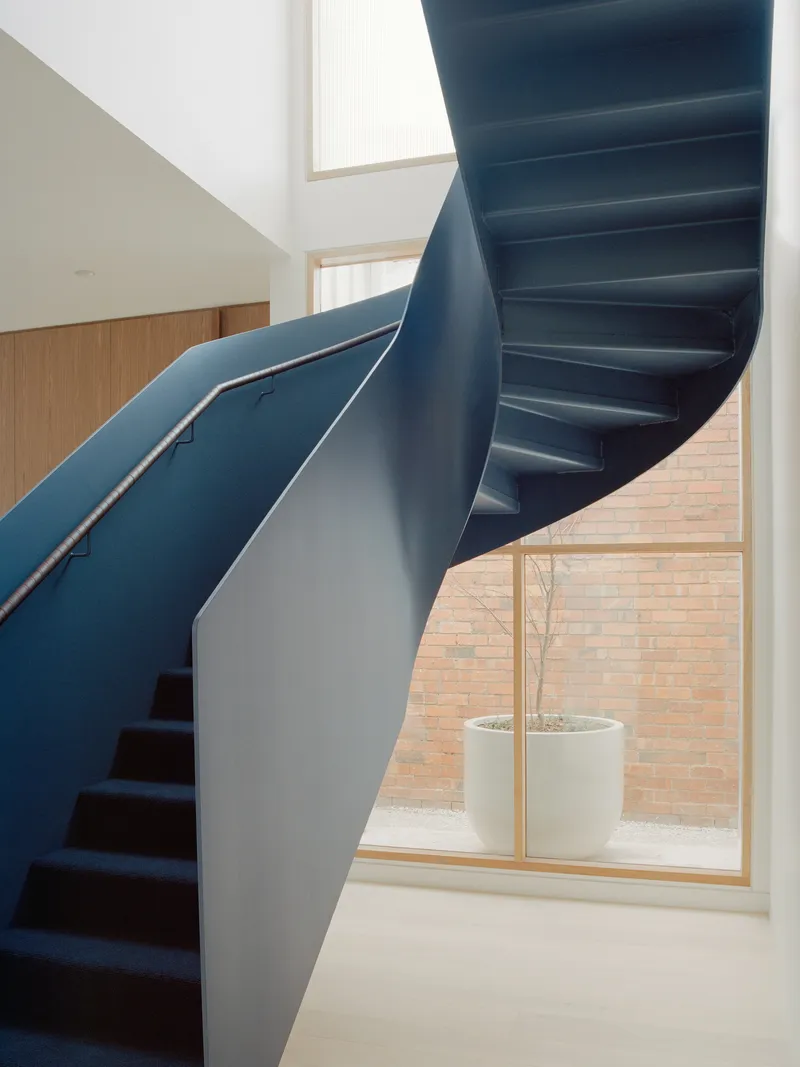
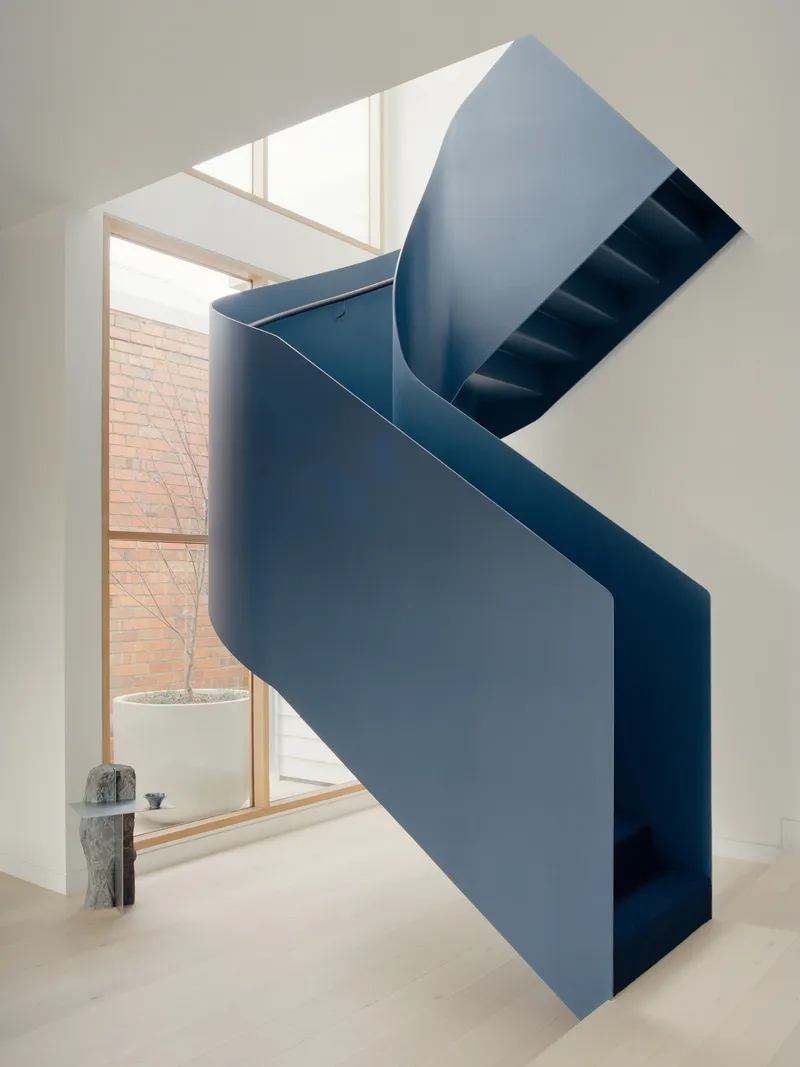
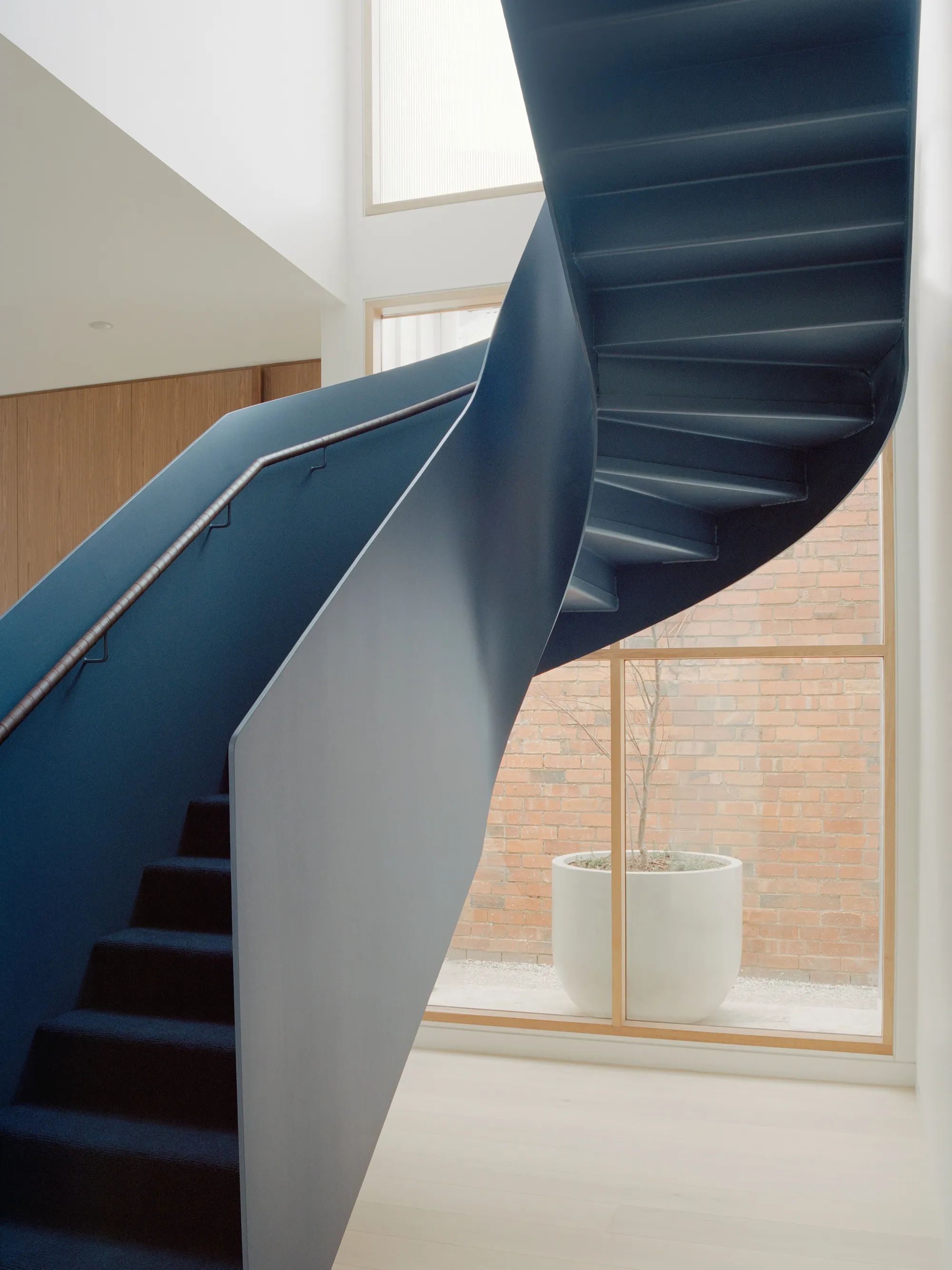
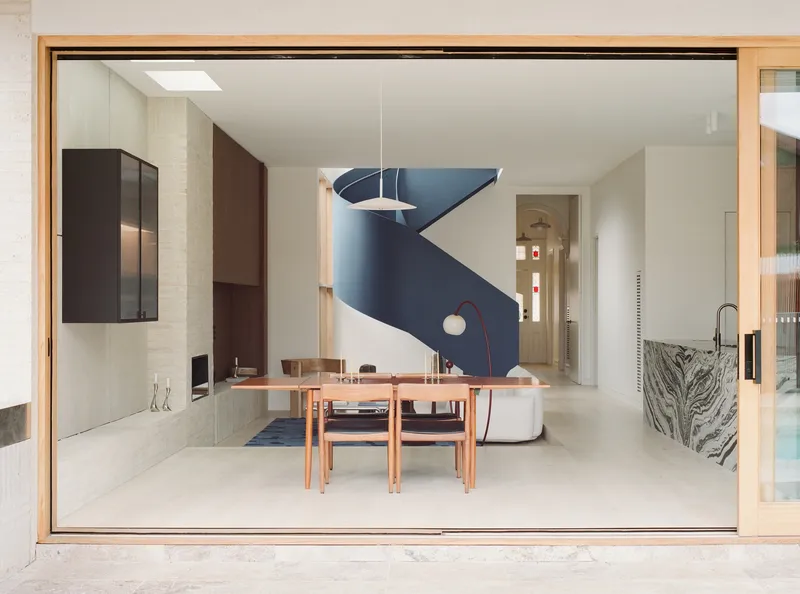
If the plan is a narrative, the sculptural blue steel staircase is its punctuation mark. Folded from sheet metal and finished in a deep navy, the spiral cuts through a double-height void, connecting the ground floor living areas to the upper level. It is the one element visible from almost every room, acting as a spatial anchor and a chromatic counterpoint to the warm timber and pale stone elsewhere.
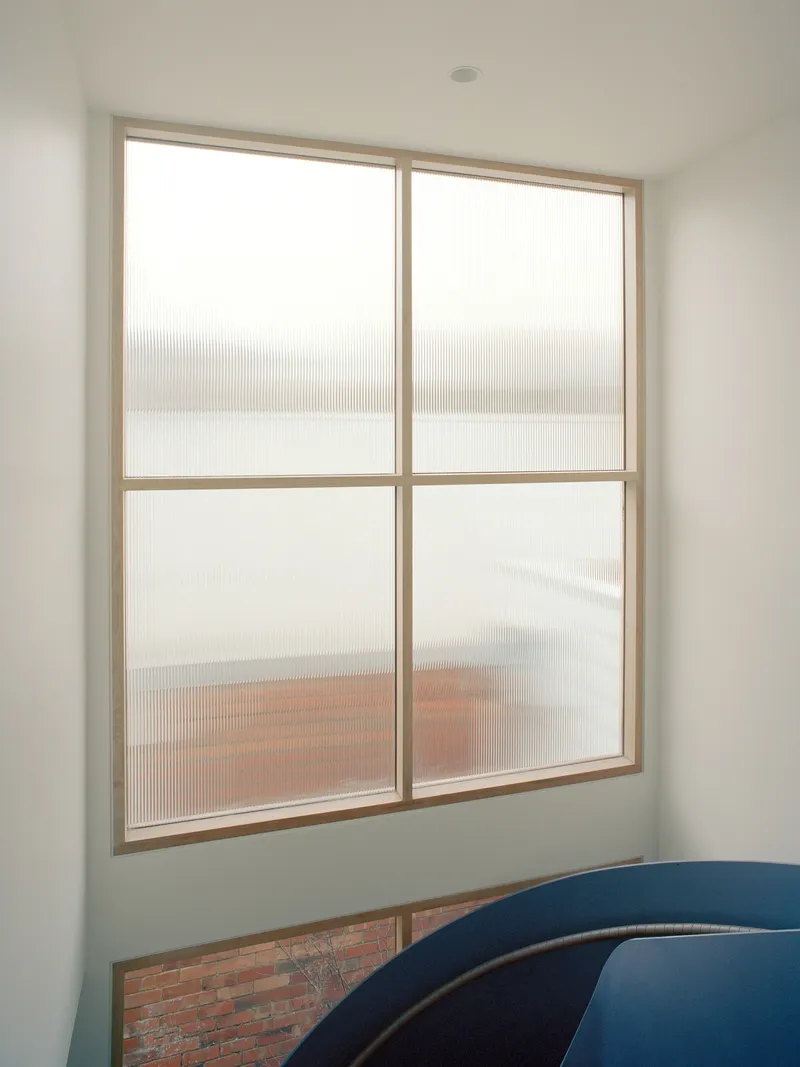
More than decorative, the staircase works as a light well. Its open treads and the tall window beside it draw daylight deep into the center of the plan, a zone that would otherwise suffer from the long, narrow lot typical of inner Melbourne. The blue finish reads as simultaneously industrial and painterly, a nod to both the steel's honest materiality and the kind of considered color choices you might find in a Scandinavian interior. It is the single bravest gesture in the project, and the one that binds the fragments together.
Kitchen and Dining: Marble, Timber, and Overhead Light
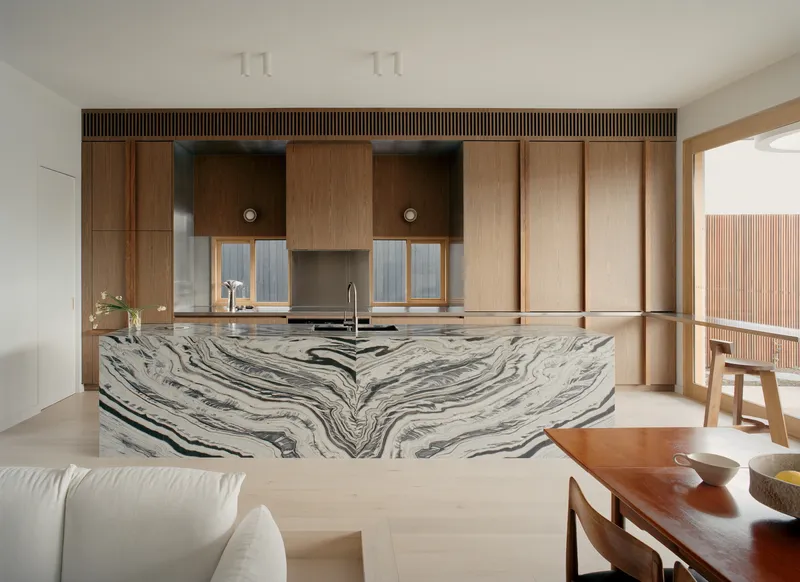
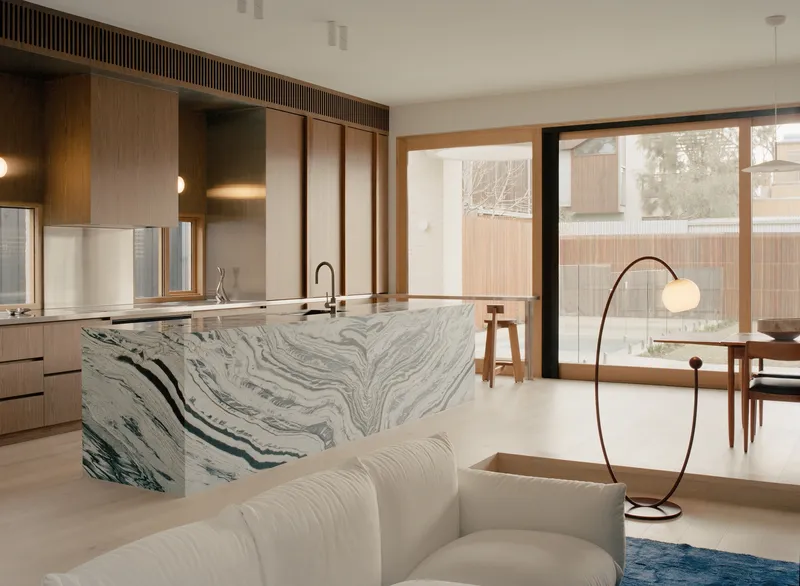
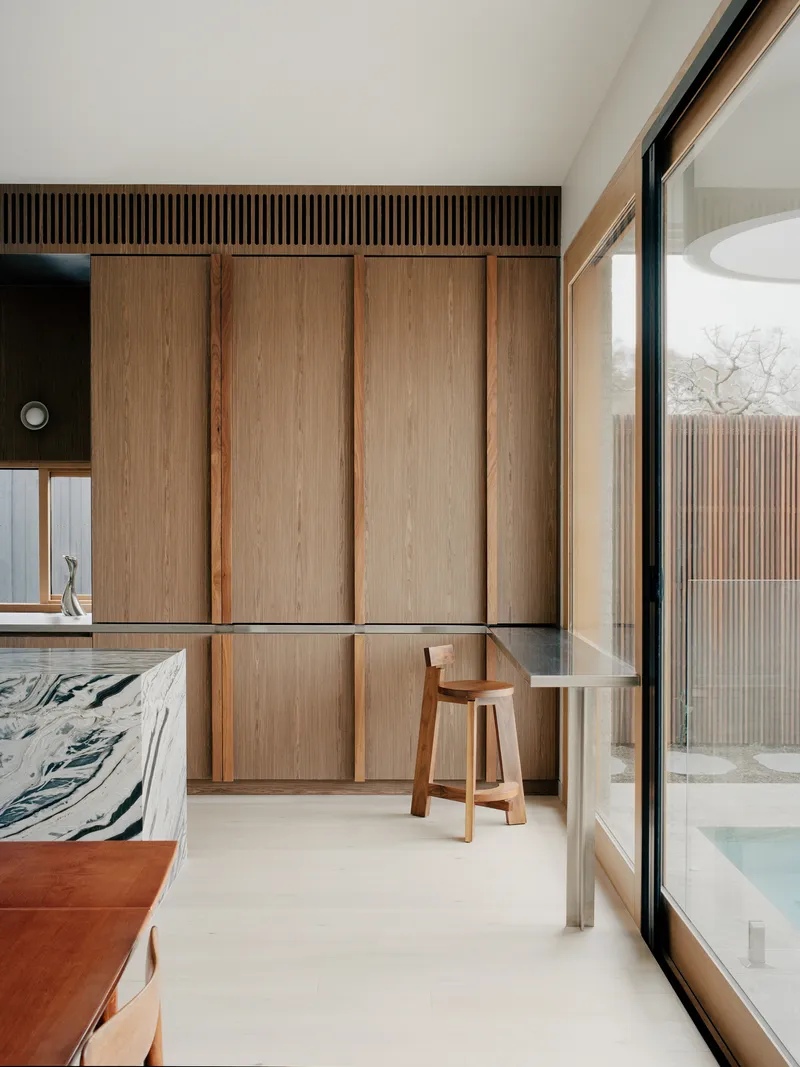
The kitchen island is wrapped in swirling grey and white marble, a geological counterpart to the literary meanderings that inspired the house. Above, timber cabinetry and mirrored splashback panels bounce light around the room without feeling gratuitous. The mirrors are a practical device on a tight plan: they double the apparent width of the kitchen and reflect greenery from the courtyard back into the interior.
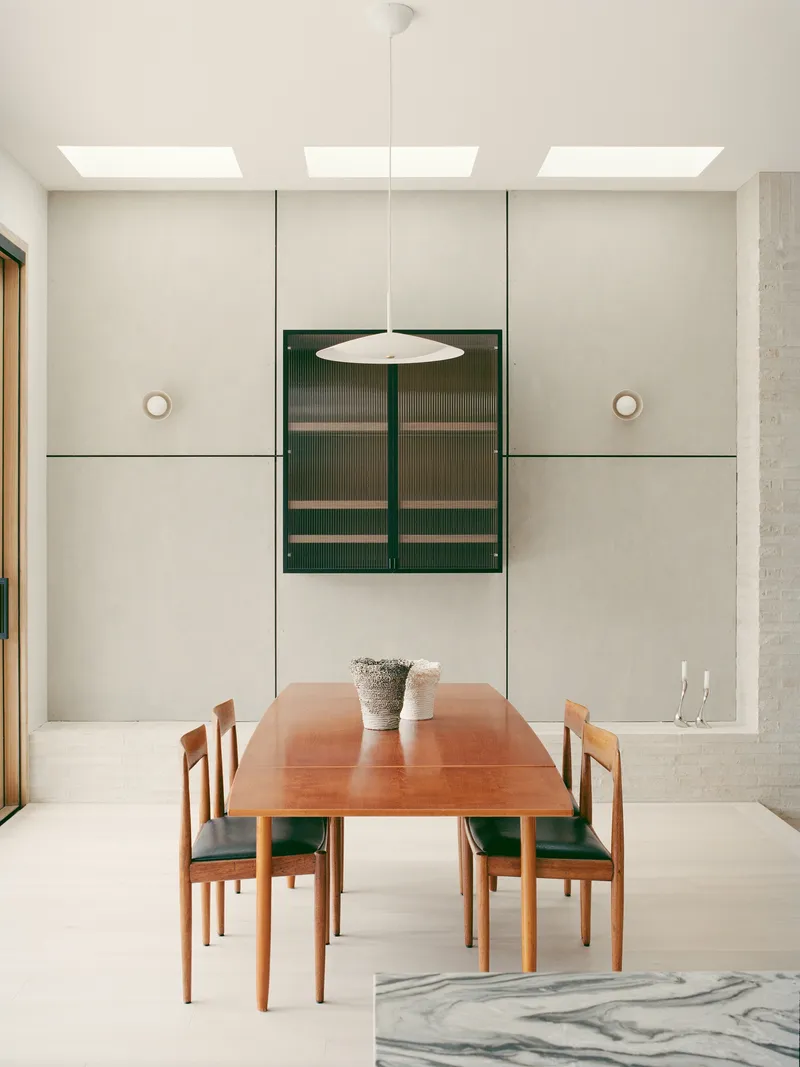
In the adjoining dining room, three skylights punch through the roof, casting pools of light onto a solid timber table surrounded by green upholstered chairs. The pendant fixture hangs low, creating a sense of intimate enclosure even under the generous ceiling height. The palette here, warm timber against cool stone and muted green fabric, is restrained enough to let the daylight itself become the dominant material.
Living Spaces and the Fireplace Wall
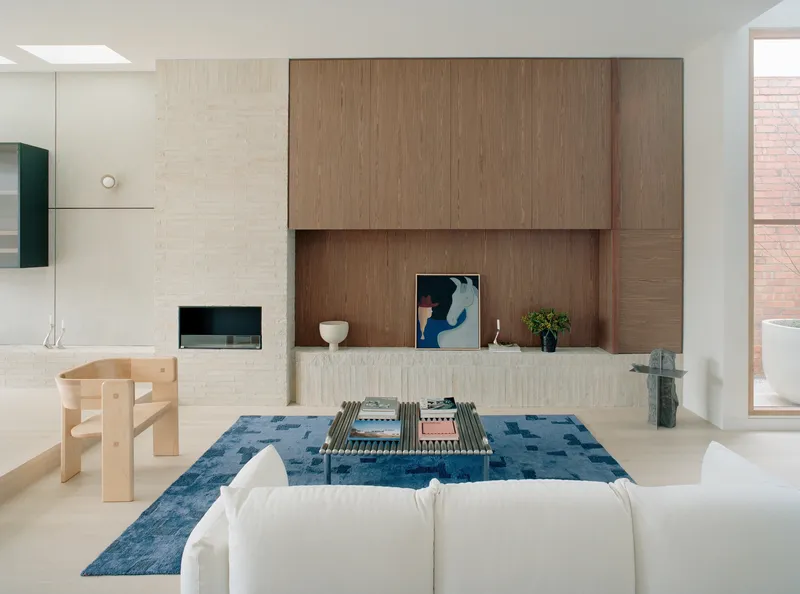
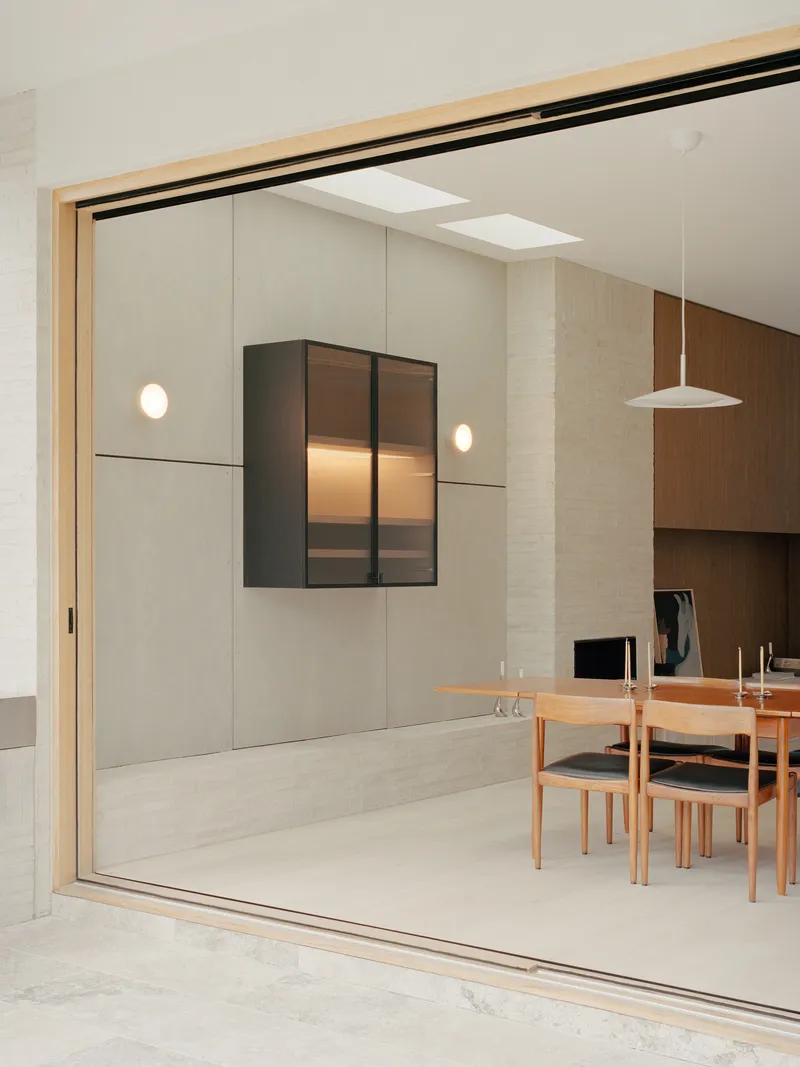
A white painted brick fireplace anchors the living area, its rough texture a reminder that the original cottage fabric is never far away. The blue patterned rug picks up the staircase's color in a softer register, while built-in timber entertainment joinery wraps the wall beneath a skylight. Harbard treats every surface as an opportunity for storage or display without letting the room feel cluttered, a difficult balancing act in 250 square metres for a growing family.
Sliding glass doors between living and dining blur the boundary between inside and out. When open, the rear courtyard becomes an extension of the living room floor, and the pool's reflective surface amplifies the daylight reaching back into the plan. The spatial generosity of the ground floor belies the modest footprint.
The Library Wall and Upper Bedrooms
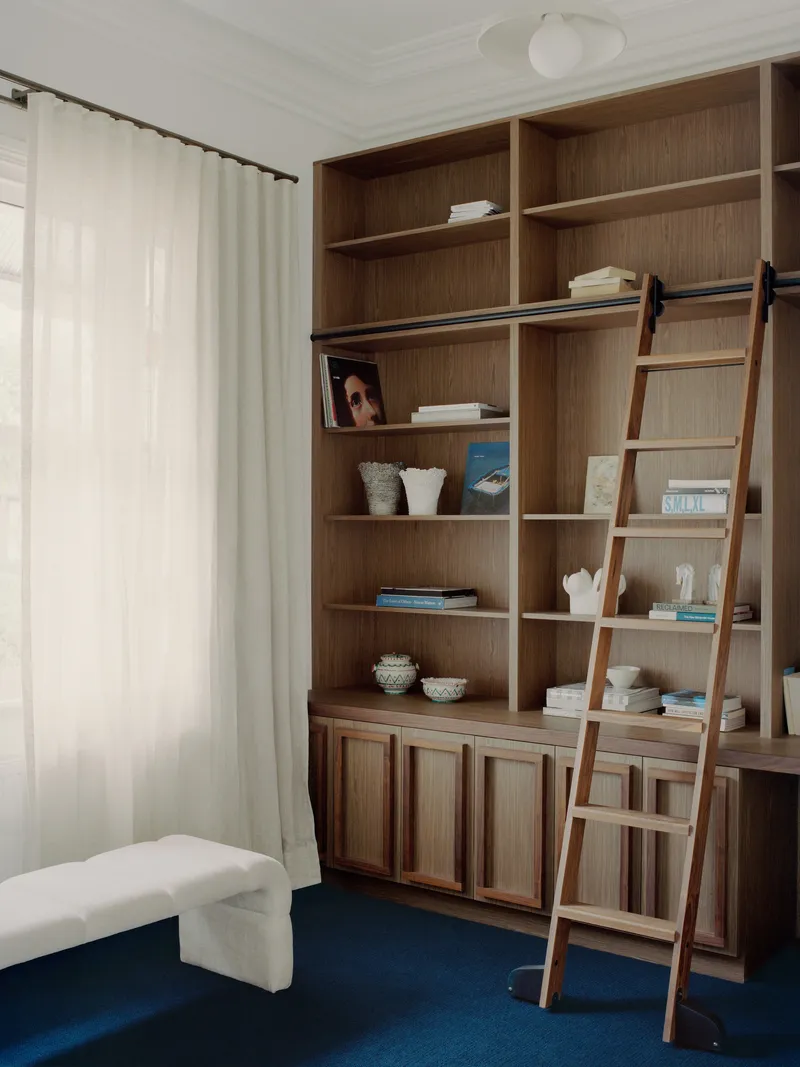
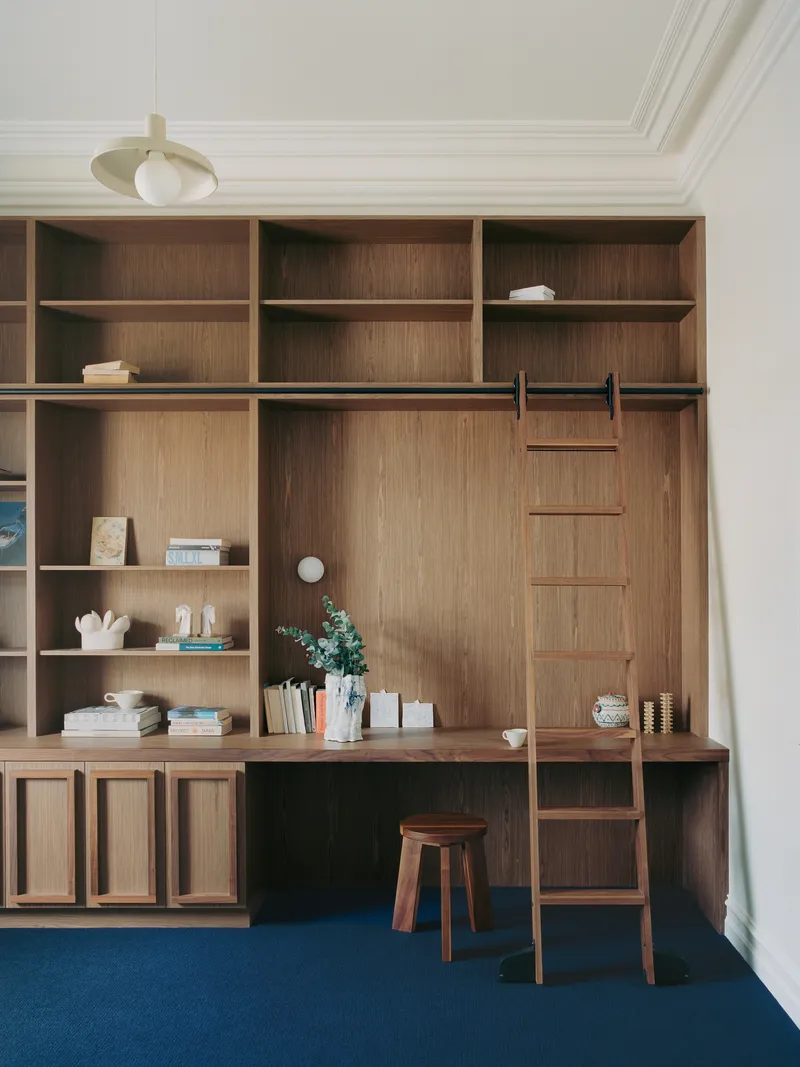
Upstairs, a full-height timber shelving unit with a rolling library ladder turns a circulation zone into the most characterful room in the house. The blue carpet carries the staircase's chromatic thread into the private quarters, creating a continuity of mood between public and private. A timber desk is slotted into the shelving wall, converting what could have been a dead corridor into a functional study nook.
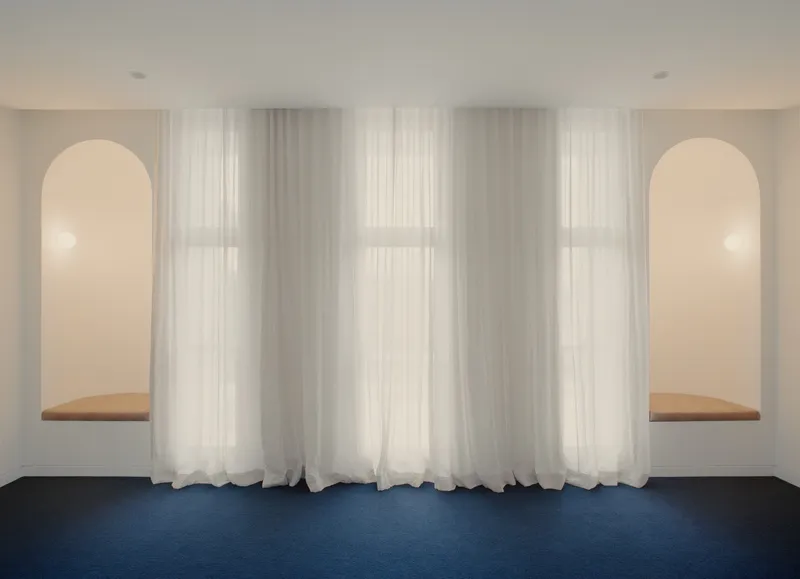
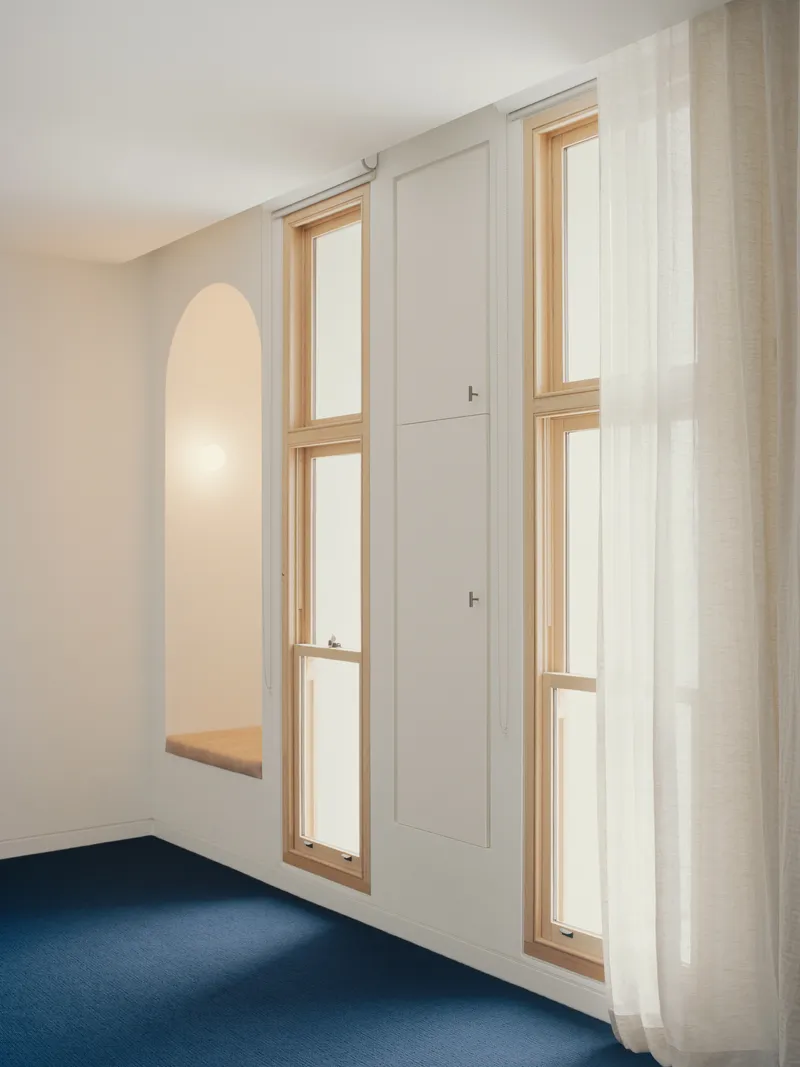
Twin arched alcoves in the bedroom zone frame timber window seats behind floor-length sheer curtains. The arches are a gentle historical reference, not mimicking the Victorian front but acknowledging it, the way a good conversation returns to an earlier point without repeating itself. Tall vertical windows fill the niches with soft sidelight, making them ideal for reading or simply sitting with a cup of tea.
Bathing Rituals: Courtyards, Skylights, and Marble
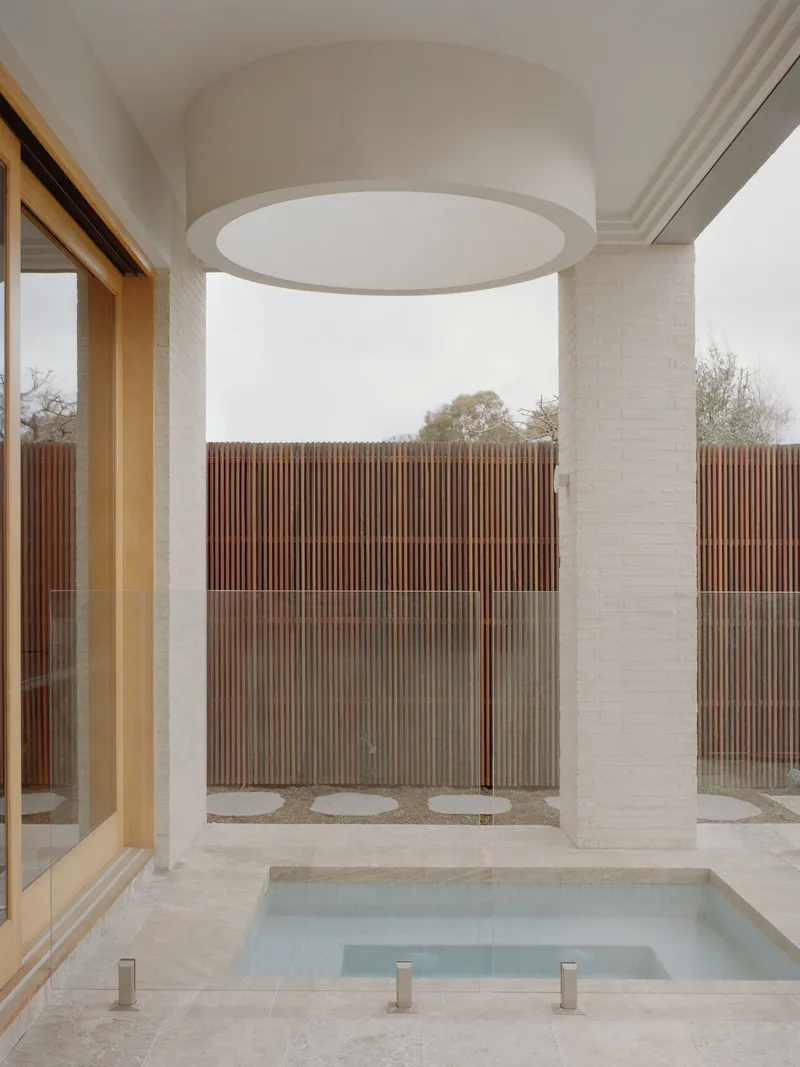
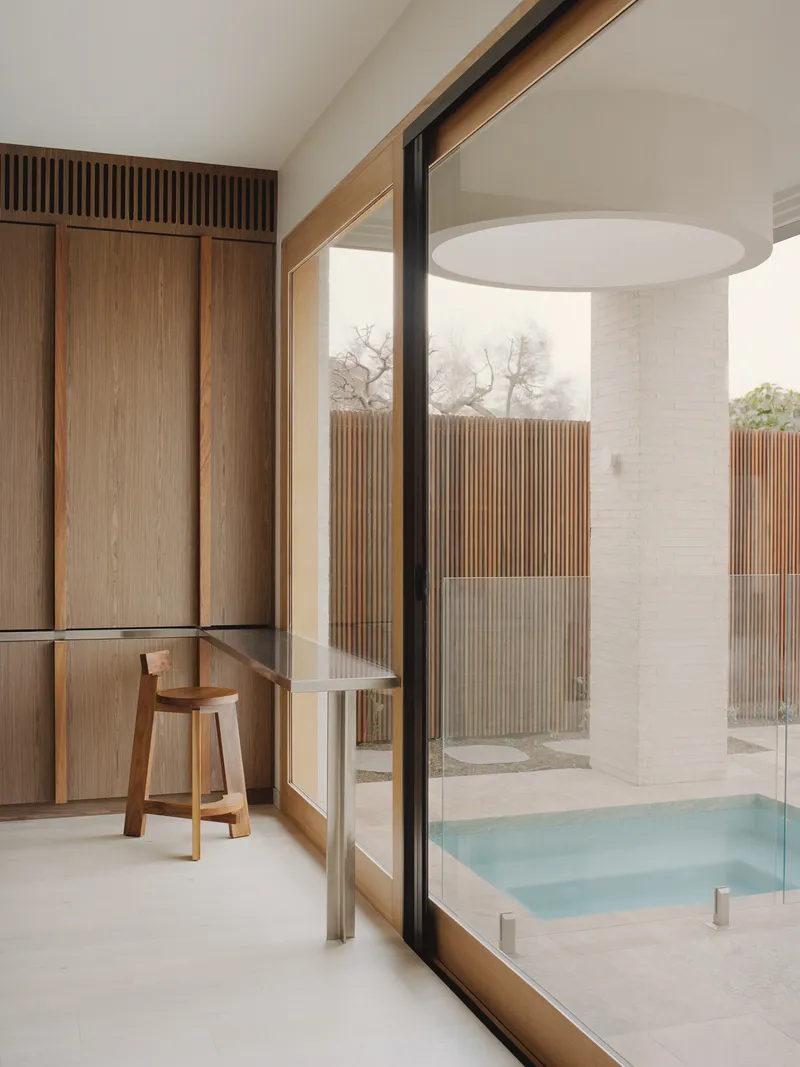
The most evocative space in Ramsden House may be the sunken bathtub beneath a cylindrical skylight that opens to a private courtyard screened by vertical timber slats and a brick column. It is part Roman bath, part Japanese engawa: a place where the boundary between interior and exterior dissolves entirely. The decision to invest this level of spatial ambition in a bathroom, rather than reserving it for a living room, says something about Harbard's priorities. Domestic ritual is taken seriously here.
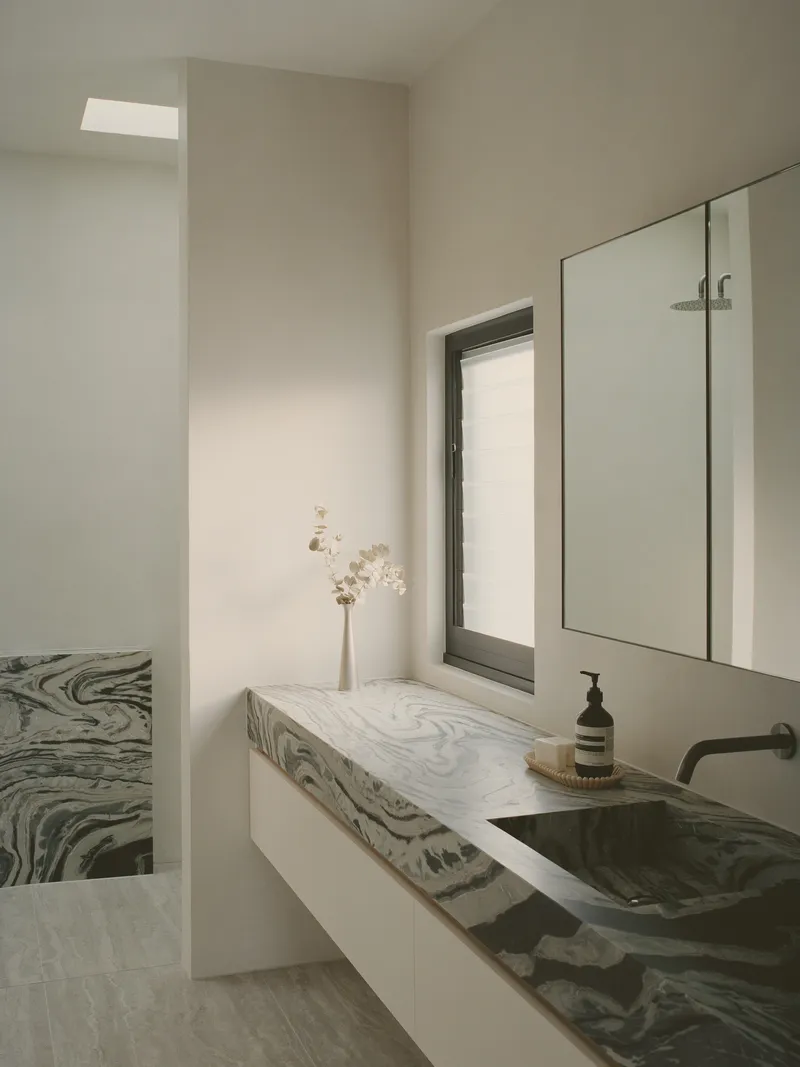
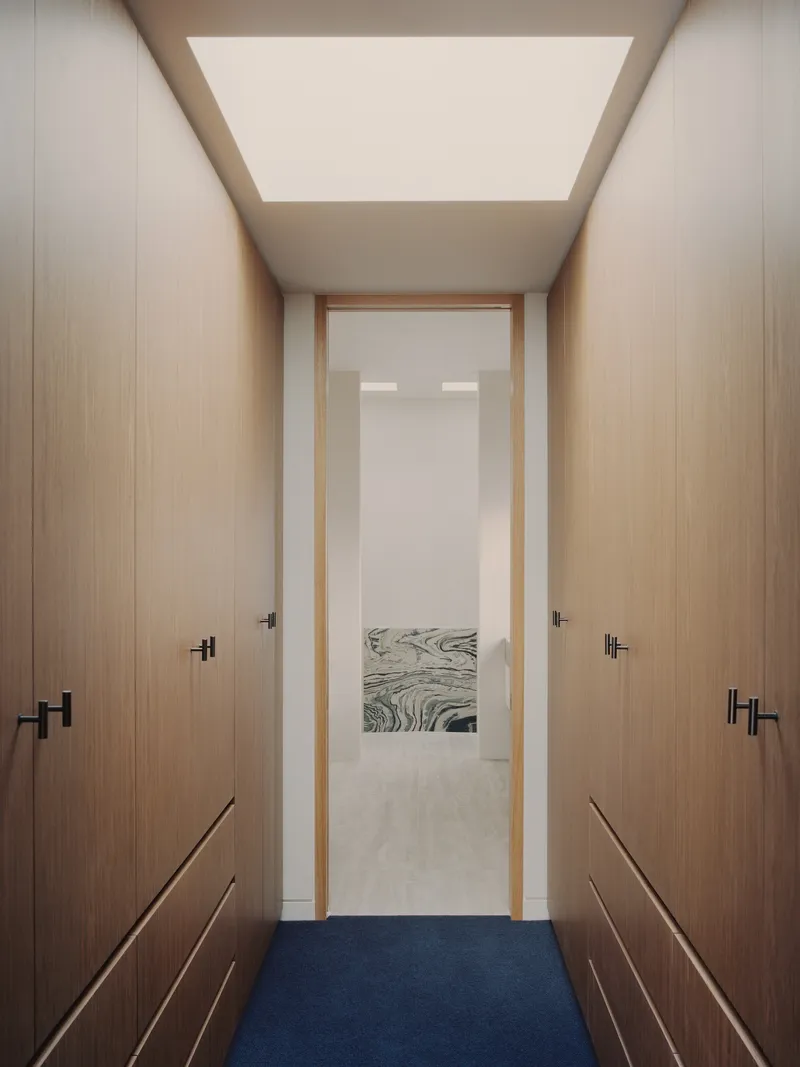
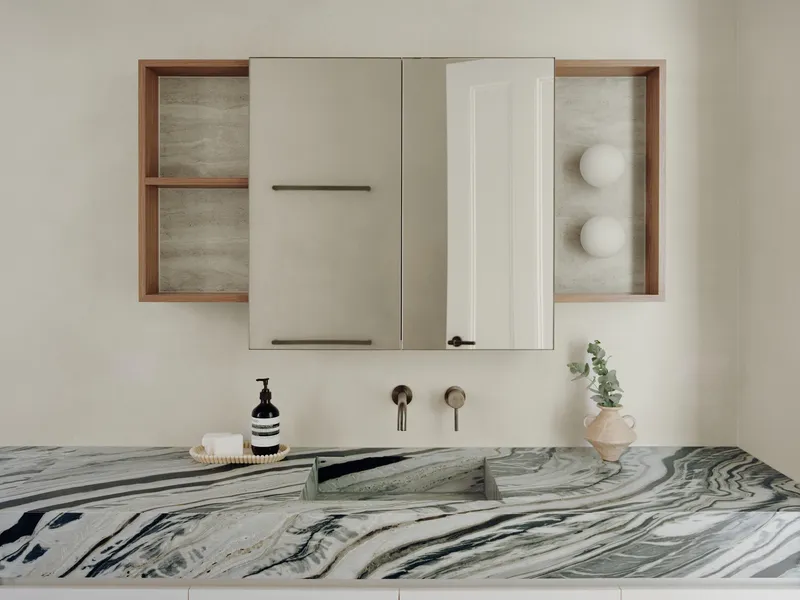
Elsewhere, the marble vanity with its integrated basin continues the veined stone palette from the kitchen, tying the house together through materiality. Brass fixtures and a timber-framed mirror cabinet add warmth, while a large ceiling skylight in the dressing corridor ensures that even transitional spaces receive natural light.
Courtyard and Pool
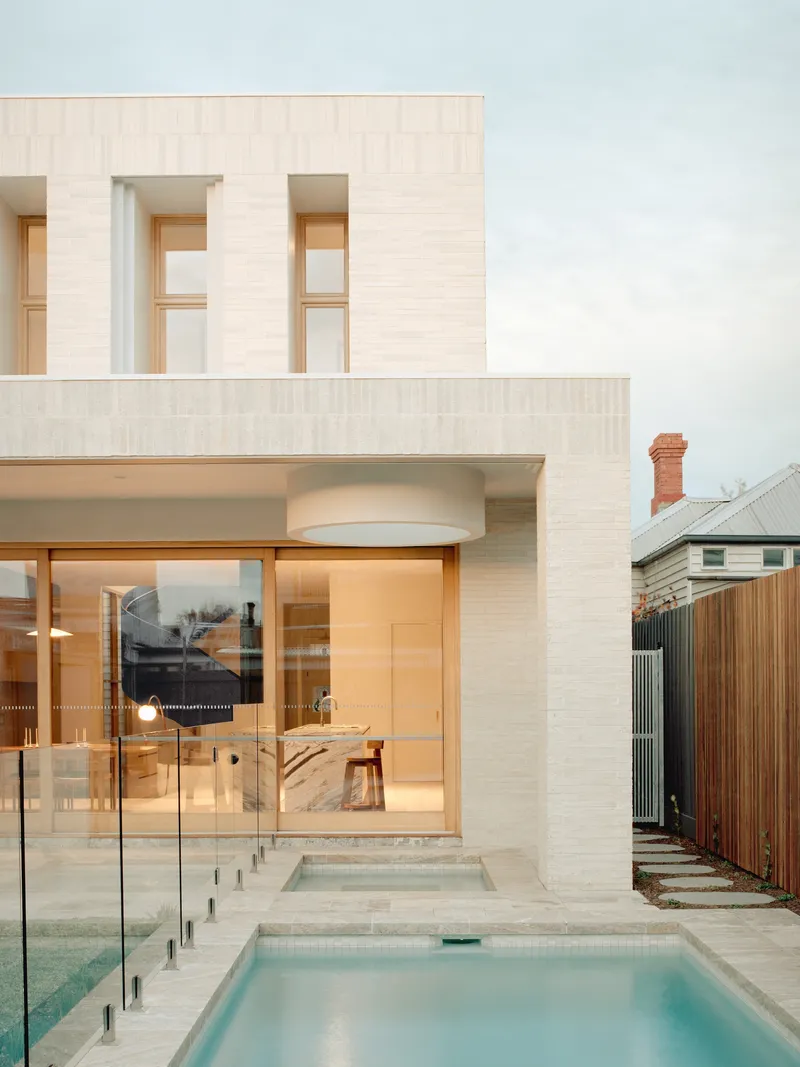
The rear courtyard is deliberately understated: a rectangular pool, a glass balustrade, and a timber fence. The restraint is the point. Against the rich interior palette of marble, blue steel, and figured timber, the courtyard acts as a palate cleanser, a zone of calm that gives the eye a place to rest. The pool's still surface doubles as a mirror for the rear facade, reflecting the brick piers and window rhythm back into the house.
Plans and Drawings
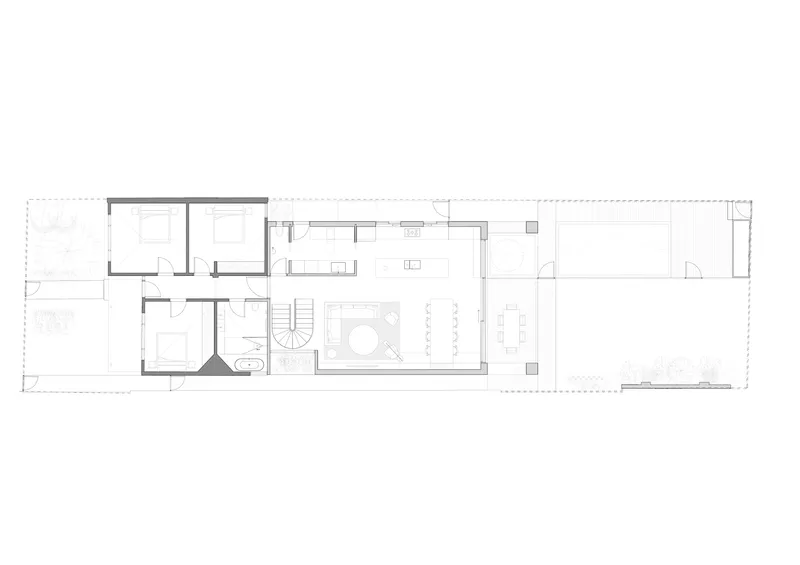
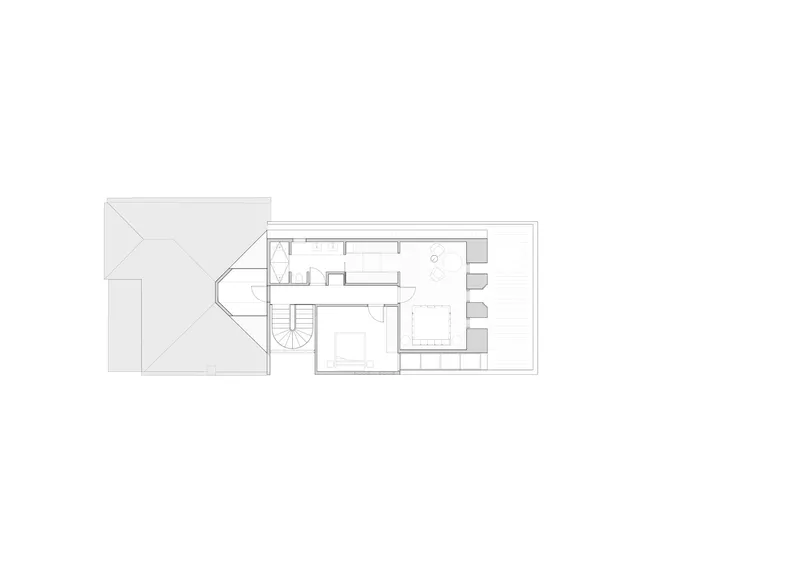
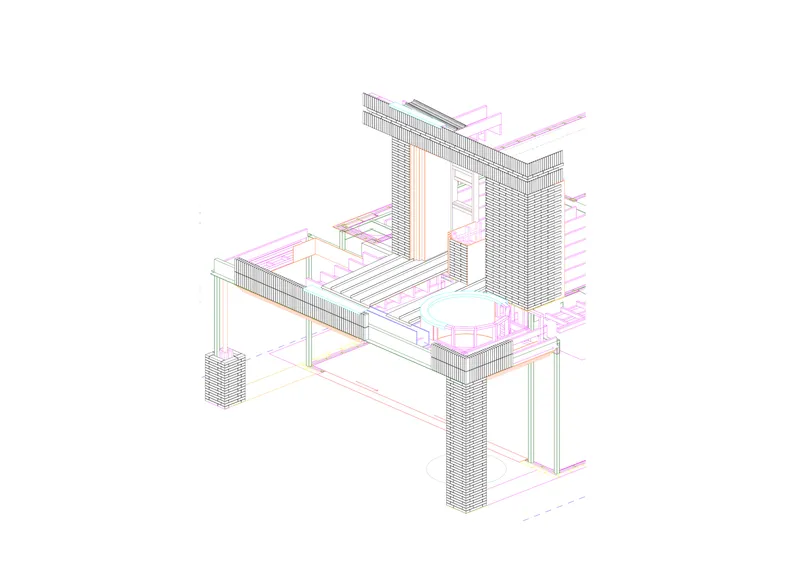
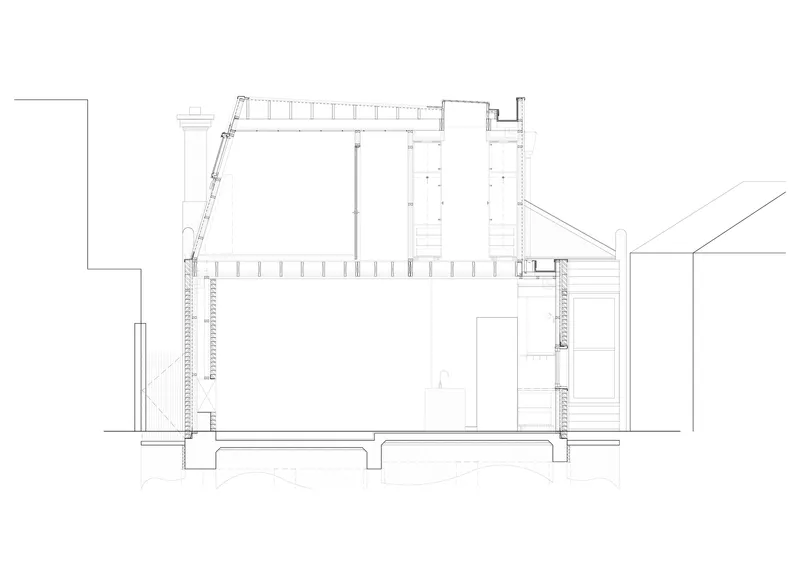
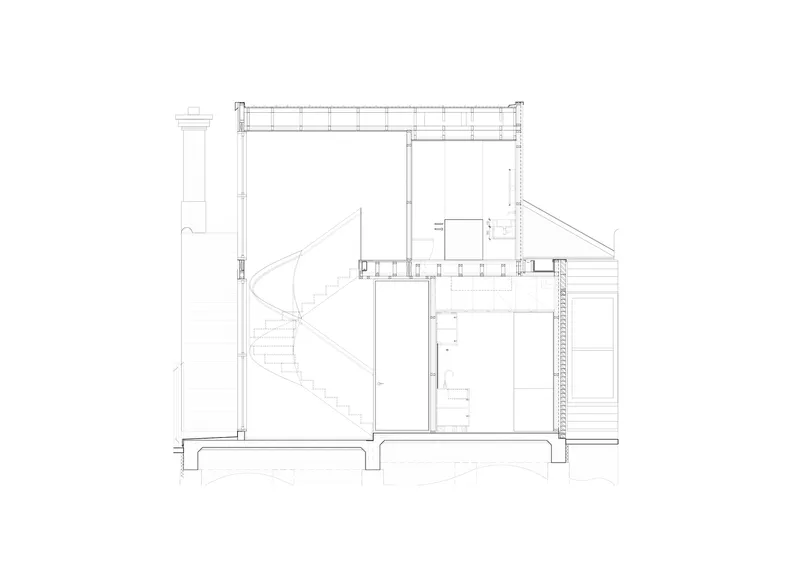
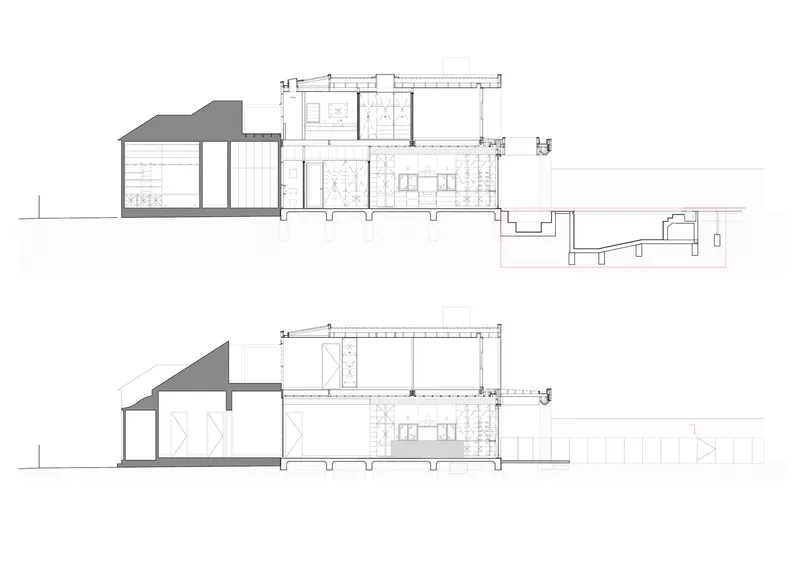
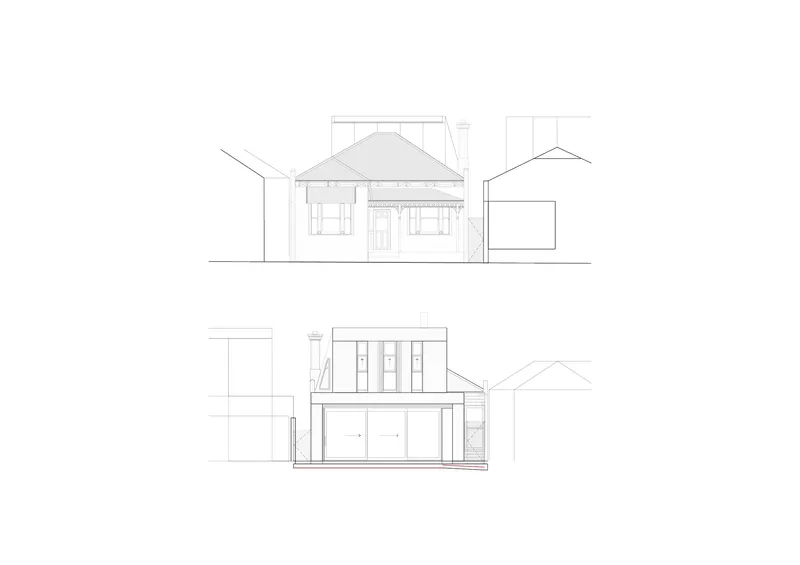
The floor plans confirm the linear logic of the scheme: bedrooms and bathrooms occupy the existing cottage footprint, while the living, kitchen, and dining spaces push out into the new brick extension at the rear. The spiral staircase sits exactly at the hinge between old and new, a spatial pivot that you read clearly in section. The axonometric drawing reveals the structural concept: a table-like frame of masonry piers and horizontal members that carries the new roof independently of the heritage structure, allowing the two volumes to read as distinct but connected.
Section drawings show how the existing pitched roof transitions to the flat-roofed extension and how skylights are strategically placed over the dining table, the dressing corridor, and the bathtub. Longitudinal sections make visible the generous ceiling heights achieved in the new work, which contrast with the more compressed proportions of the original cottage rooms. Every drawing reinforces the idea that old and new are in dialogue, not competition.
Why This Project Matters
Melbourne is saturated with rear-extension refurbishments. The formula is well established: preserve the front, open up the back, add a courtyard or pool. What separates Ramsden House from the pattern is the depth of its conceptual ambition. Taking a literary work as a design prompt is not new, but Harbard translates Sebald's method, layering disparate fragments until a larger meaning emerges, into a genuine spatial strategy. Each room has its own material identity, yet the blue steel staircase, the veined marble, and the consistent use of overhead natural light stitch these episodes into a coherent whole.
The project also demonstrates that a 250-square-metre budget need not constrain invention. The sunken courtyard bath, the arched alcoves, and the library ladder are all compact moves that punch well above their square meterage. Ramsden House is a reminder that domestic architecture is at its best when it treats the everyday, cooking, bathing, reading, climbing a staircase, as worthy of the same imaginative attention that bigger commissions receive.
Ramsden House by James Harbard Architects. Clifton Hill, Melbourne, Victoria, Australia. 250 m². Completed 2025. Photography by Pier Carthew.
About the Studio
Share Your Own Work on uni.xyz
If projects like this are the kind of work you want to make, uni.xyz is a place to publish your own, find collaborators, and enter design competitions.




Popular Articles
Popular articles from the community


The Musturak Paradise: Senior Living Architecture for a Connected Future in Temara, Morocco
The Musturak Paradise reimagines senior living architecture in Temara via private homes, social spaces, culture, community, and shared care.

Riyadh For All: Intergenerational Urban Design for Active Aging in Rabat
Riyadh For All reimagines urban design in Rabat with intergenerational co-living, adaptive courtyards, and Moroccan cultural exchange today.

The Earth Pod: 3D Printed Homes for Resilient Refugee Communities
The Earth Pod reimagines refugee housing through 3D printed homes made from clay, combining resilience, self-sufficiency, and rapid shelter.

Play: Fragments of Their World
Familiar architecture becomes modular playground design, creating safe spaces where displaced children can learn, connect, imagine and play.


Similar Reads
You might also enjoy these articles

Bao Huynh Watercolor Atelier: A Serene Art Retreat in Hội An
Bao Huynh Watercolor Atelier in Hội An blends multifunctional art spaces, sustainable design, local materials, and family-friendly living in a serene environment.

Atelier Macri Concept Store Interior Design by CASE-REAL
Atelier Macri store features a "ko" counter, walnut wood details, cork displays, blending retail, gallery, and seamless customer experiences.

Manuel Vargas Izquierdo Stadium and High-Performance Sports Center: Architectural Excellence in Jalpa de Méndez
The Manuel Vargas Izquierdo Stadium blends sustainable design, inclusive sports facilities, and cultural-inspired architecture, revitalizing Jalpa de Méndez’s public spaces.

KAKR Buluh Awar Hall: Revitalizing Community and Ecology Through Bamboo Architecture
Community built bamboo hall revitalizes Buluh Awar village, empowering youth, restoring ecology, celebrating vernacular craftsmanship through sustainable architecture and culture.
Explore Residential Building Competitions
Discover active competitions in this discipline



Challenge to design a barrier free sports center


Challenge to design an outdoor ice-rink and park


Challenge to design mud housing for contemporary communities
Comments (0)
Please login or sign up to add comments
No comments yet. Be the first to comment!