

JC Architecture Transforms 70-Year-Old Taiwanese Railcars into a Moving Fine-Dining Restaurant
Three retired train carriages circle Taiwan's coastline as a 54-seat restaurant celebrating rattan, timber, and the island's dual landscapes.


In February 2019, Taiwan's government debuted an expensive new tourism train that was so widely ridiculed for its aesthetics that it became a national embarrassment. JC Architecture, led by Johnny Chiu, chose not to pile on the criticism. Instead, the firm proposed an alternative: take three semi-retired railcars, some nearly 70 years old, and retrofit them into a full-service restaurant that would loop the island, serving a tasting menu while framing Taiwan's mountains on one side and its ocean on the other. The result, completed in 2022 for the Taiwan Railways Administration after two years of negotiation and planning, is The Moving Kitchen.
What makes this project genuinely compelling is its refusal to treat the train as a blank canvas. Structural profiles could not be altered. Skylights were off the table. Fixed seating was mandated by rail regulations. Electrical systems had to be boosted three times over to power a real kitchen. Every design decision had to negotiate these constraints, and the quality of the result lies precisely in how JC Architecture turned limitations into a spatial logic that feels inevitable rather than compromised.
From Retirement to Reinvention
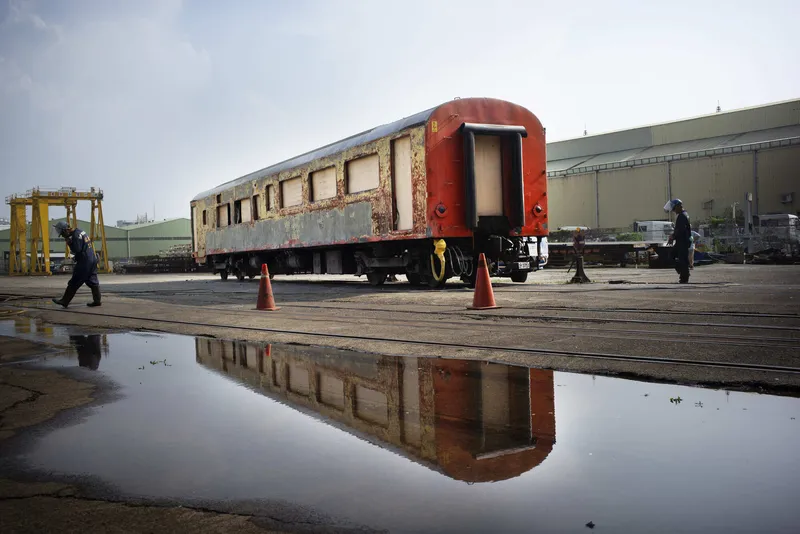
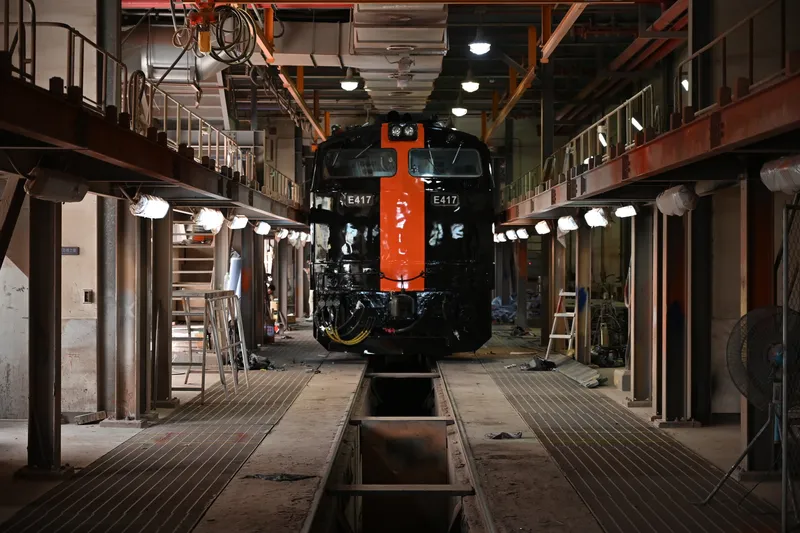

The before-and-after tells a stark story. These were not heritage showpieces but workhorses: weathered steel shells sitting on wet tarmac, awaiting the scrapyard. The maintenance shed images, with their overhead cranes and exposed metal walkways, reveal the industrial reality of the starting condition. JC Architecture's decision to reuse rather than replace was both a sustainability argument and a design statement. The firm treated the existing structure as a constraint worth honoring, stripping interiors back to the steel frame and rebuilding inward.
The comparison image of the original steel skeleton alongside the finished dining space is perhaps the most instructive frame in the set. It shows that the curved timber ceiling, the integrated lighting channel, and the booth arrangements are all insertions within an envelope that the architects were forbidden to reshape. The discipline this demanded is the project's quiet strength.
An Asymmetric Ceiling That Reads the Landscape


The most inventive spatial move is the asymmetrical ceiling. Because the train always circles Taiwan in the same direction, the ocean is permanently on the left and the mountains permanently on the right. JC Architecture designed the perforated timber ceiling to respond to this fixed orientation: warmer wood tones and softer profiles lean toward the mountain side, while larger, dark-framed windows open toward the sea. The ceiling is not decorative pattern-making; it is a directional device that tells you where to look.
Practically, this asymmetry also solves a mechanical problem. Lighting, air conditioning, and speakers are concentrated into a single integrated profile running along one side, doubling as a wayfinding line that guides diners through the narrow carriage. It is a clever consolidation that frees the opposite wall for uninterrupted glazing, and it avoids the clutter of ceiling-mounted services that plagues most rail interiors.
Dining Between Mountain and Ocean

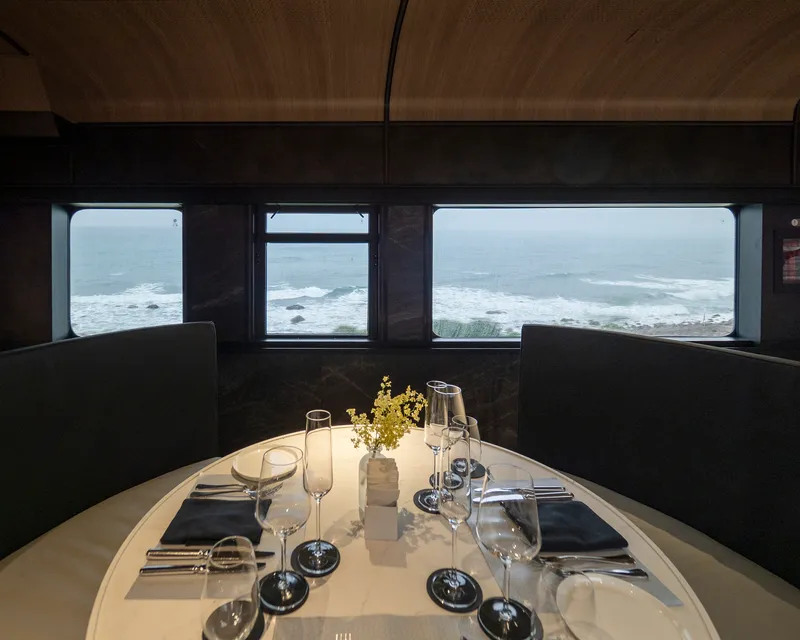

The booth configurations range from intimate two-person tables to circular banquettes for larger groups, all held in place by the rail regulation mandate for fixed seating. The rattan chairs are a deliberate cultural reference: JC Architecture cites the memory of sitting on a grandmother's rattan chair as the tactile anchor of the interior. Against the dark paneling and black window frames, the cane weave reads as warmly domestic, pulling the formality of fine dining back toward something personal.
The ocean-side windows are sized generously and framed in deep black reveals that compress the view into something cinematic. Motion blur in several images is not incidental; it is the defining condition of this space. The landscape is never still, and the design acknowledges this by giving the windows enough depth and darkness to function as screens rather than mere apertures. You are not looking through a wall. You are watching a film with a tasting menu.
A Working Kitchen on Rails


One of the three carriages is a dedicated prep kitchen, and the galley counters visible in the dining cars are operational workspaces where chefs plate in real time while the train is in motion. The electrical infrastructure had to be tripled to support professional cooking equipment, a logistical challenge that rarely surfaces in architectural discussion but fundamentally shapes this project. Without it, there is no restaurant, only a lounge car with pretensions.
The curved ring pendant over the plating station is one of a series of metallic sculptural lights that JC Architecture designed to evoke a floral sensation. They are unapologetically decorative, and they work. In the narrow, low-ceilinged galley, they break the monotony of the linear counter and give the kitchen a theatricality that matches the experience of watching food being assembled at speed, literally, on a moving train.
Details in the Dark


The sculptural light fixtures deserve a closer look. Held in a passenger's hand against a darkened window, the illuminated form reads almost like a lantern, something carried rather than installed. This is a small but telling decision: the lighting objects are scaled to the body, not to the architecture, which keeps the interior from feeling like a miniature hotel lobby. The bathroom, meanwhile, is a compact exercise in grey marble and circular geometry, with a backlit mirror that manages to feel luxurious without overselling itself. In a carriage where every square centimeter is contested, these details matter disproportionately.
Plans and Drawings


The floor plans of the three railcars reveal the spatial economy at work. One car is given over entirely to kitchen and prep. The remaining two are dining cars seating 26 and 28 respectively, with a mix of booth types, a bar, and a lounge. Mechanical systems are pushed consistently to one side, reinforcing the asymmetric logic visible in the ceiling. The section drawing, rendered with diners beneath a domed roof and flanked by autumn trees, is more aspirational than technical, but it communicates the ambition: this is not a food truck on tracks. It is architecture in motion, complete with a considered relationship to the landscape it passes through.
Why This Project Matters
The Moving Kitchen matters because it reframes adaptive reuse as an act of restraint rather than spectacle. JC Architecture could not add skylights, could not alter the structural shell, could not even free the seating from its bolts. The project's intelligence lies in how it turned those non-negotiable constraints into a coherent design language: an asymmetric ceiling that responds to geography, a material palette rooted in cultural memory, and a lighting system that doubles as infrastructure. It is a reminder that the most productive design challenges are often the ones with the tightest boundaries.
More broadly, the project offers a credible counterargument to the tendency to commission new, flashy vehicles for tourism purposes. When the original 2019 train was criticized, the default response would have been to spend more money on a shinier replacement. JC Architecture's proposal, to look backward at what already existed and to invest design intelligence rather than raw capital, produced something that the new train never could: a space with history embedded in its bones, traveling through a landscape it was built to serve seven decades ago.
The Moving Kitchen Restaurant by JC Architecture, Taiwan. 54-seat restaurant across three retrofitted railcars. Completed 2022. Photography by Kuomin Lee.
About the Studio
Share Your Own Work on uni.xyz
If projects like this are the kind of work you want to make, uni.xyz is a place to publish your own, find collaborators, and enter design competitions.


Popular Articles
Popular articles from the community


Opera on the Sea: Driftwood Logic Shapes a Timber Opera House on Estonia's Coast
Trevor Orgill's opera house translates the entangled drift of floating timber into a civic building where wood, water, and music converge.

Tsunami Convergenics: Turning Catastrophic Ocean Forces into Underwater Housing Infrastructure
A speculative underwater settlement off the coast of Onagawa, Japan, treats tsunamis and typhoons as energy sources rather than threats.

Singing Woman: Contemporary Architecture Inspired by Estonia’s Voice and the Sea
Singing Woman turns Estonia’s song culture into flowing opera house architecture, blending public life, landscape, sea, and national memory.

Manzana Morphosis: Stretching Barcelona's Grid into a Living Landscape for 2050
A radical reworking of the Eixample manzana turns density into a tool for generous public space, vertical ecology, and environmental performance.

Similar Reads
You might also enjoy these articles

Bao Huynh Watercolor Atelier: A Serene Art Retreat in Hội An
Bao Huynh Watercolor Atelier in Hội An blends multifunctional art spaces, sustainable design, local materials, and family-friendly living in a serene environment.

Atelier Macri Concept Store Interior Design by CASE-REAL
Atelier Macri store features a "ko" counter, walnut wood details, cork displays, blending retail, gallery, and seamless customer experiences.

Manuel Vargas Izquierdo Stadium and High-Performance Sports Center: Architectural Excellence in Jalpa de Méndez
The Manuel Vargas Izquierdo Stadium blends sustainable design, inclusive sports facilities, and cultural-inspired architecture, revitalizing Jalpa de Méndez’s public spaces.

KAKR Buluh Awar Hall: Revitalizing Community and Ecology Through Bamboo Architecture
Community built bamboo hall revitalizes Buluh Awar village, empowering youth, restoring ecology, celebrating vernacular craftsmanship through sustainable architecture and culture.

Comments (0)
Please login or sign up to add comments
No comments yet. Be the first to comment!