
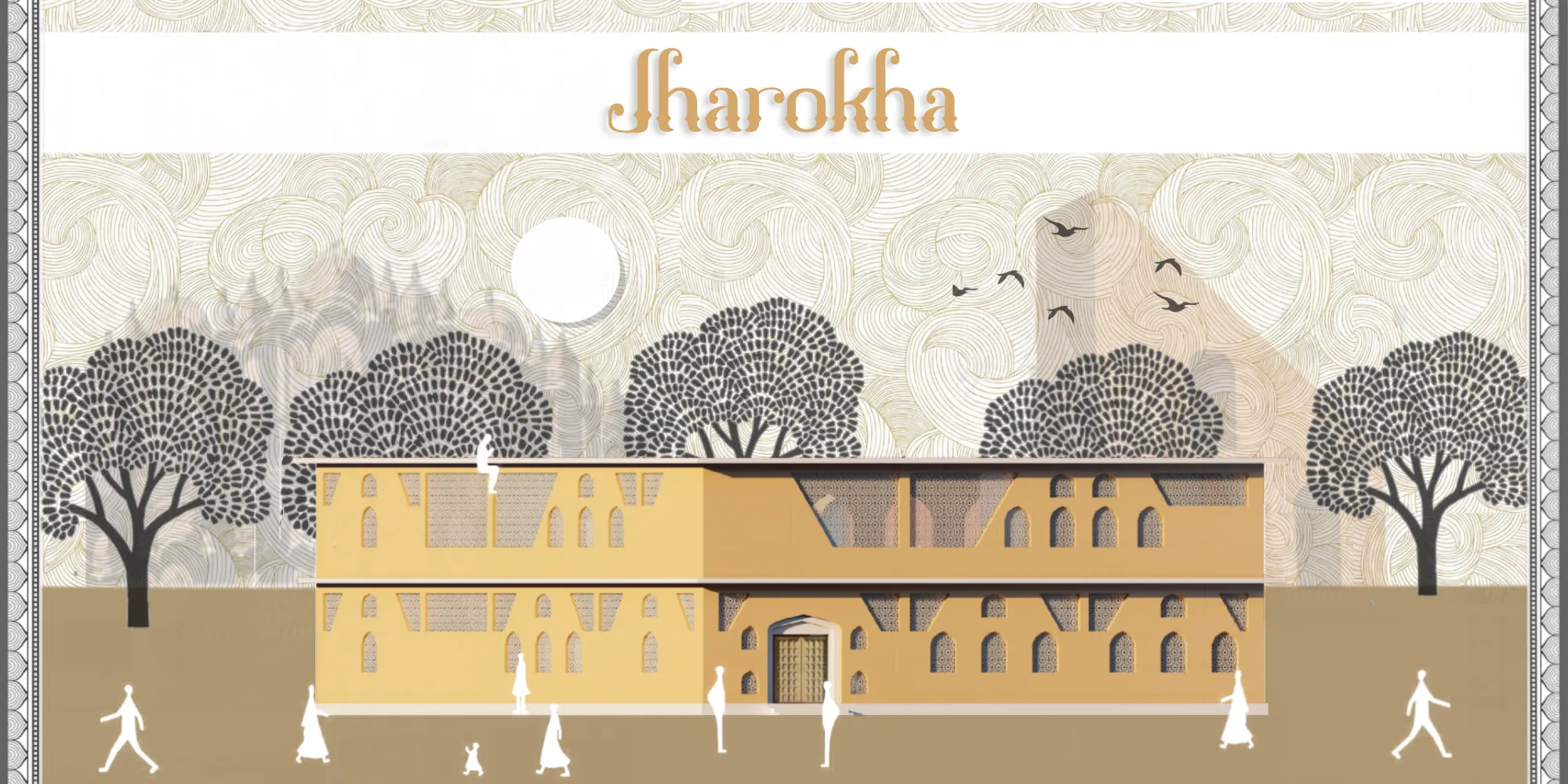
Jharokha
An education hub that sticks to the roots of Rajasthani Culture and reflects the achievements in astronomy that old structures from Jantar Mantar are reputed for.

BRIEF:
The concept of “TITLE” proposed by the project is to offer the willing minds of the remote areas a learning space where they can READ, LEARN and GROW, even when the world is shut down. The primary user group considered was the youth of the community. Interaction of the community was kept in mind by giving a centrally located multipurpose courtyard as well as a fun and playing outdoor learning space for the youth.
THE SITE:
The site is located in Kalasar, Rajasthan, at a distance of 17 km from the nearest city. It is in close proximity to Another village (Meghasar), 5 schools, a few Hindu temples etc. Site context and climate were kept in mind while zoning for incorporating passive strategies. as well as enhancing the locality by showcasing their culture which in turn would attract the people from the village as well as the neighbouring village. This unique library would also become a landmark for the area.
THE CONCEPT:
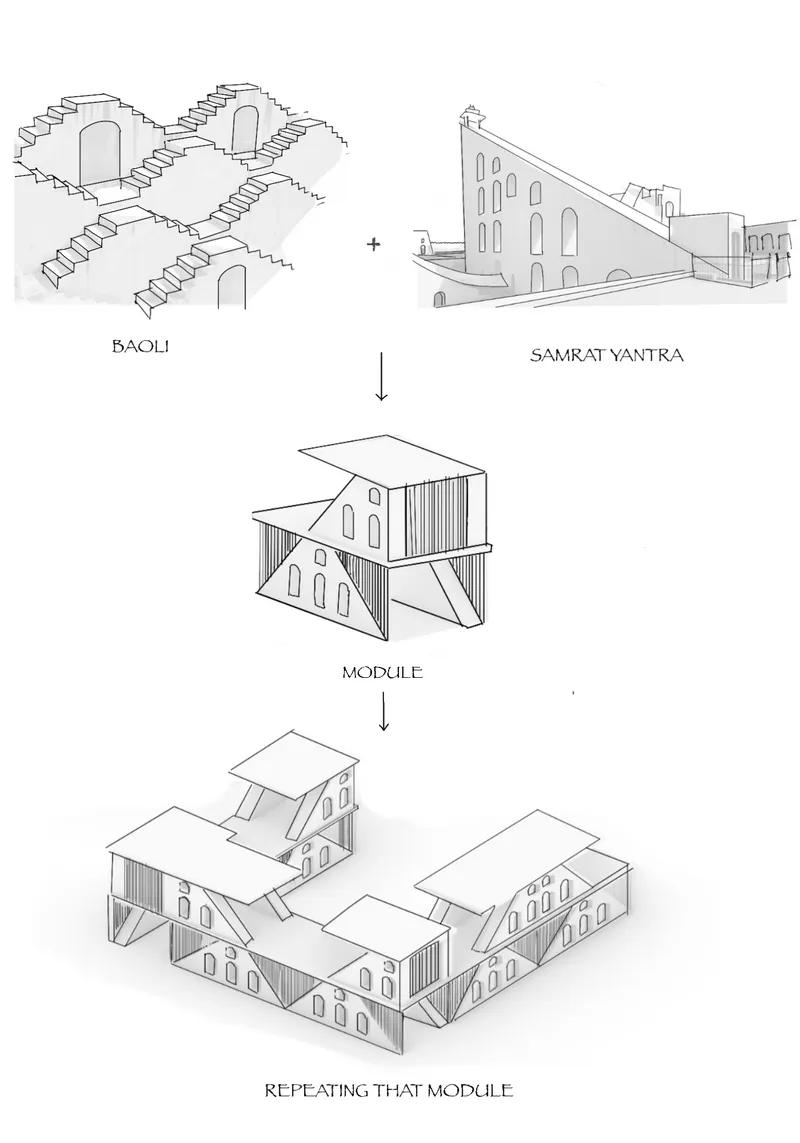
The site concept is a combination of traditional as well as modern. Mixing the context of rural as well as the location- Rajasthan. The design is modular, which is flexible and adaptable and is formed by repeating a single module horizontally as well as vertically. The module is inspired by the old heritage site of Jantar Mantar of Jaipur which carries huge importance in the field of astronomy and was one of the first attempts in exploring the elements of outer space, that too in 1734, before any other country.
Our building will inspire all the village kids to aim for the stars and discover many more things that fascinate them and also teaches them how their culture unwraps itself to them in the most convenient way. This building will act as a place that provides the village kids with the kind of exposure that they need to excel in life and carry on the legacy of coming up with new inventions.
The Sundial structure taken from Jantar Mantar is Samrat Yantra (World’s largest sundial), and in addition to which Baoli of Rajasthan was also used to develop the module. Apart from these, other elements taken were Jaali, Courtyard and different types of Arches.
ZONING OF SPACES:
The zoning of the site is done such that the orientation of the building protects the courtyard from harsh sunlight during daytime and as the sun moves towards the west, the café is placed in such a way that it gets most of the evening sun and provides ambient lighting.
MATERIALS:
Materials chosen are locally available materials like stone walls with sandstone tile cladding (Since all the old structures in Rajasthan invested in it), terracotta jaali and marble flooring. Tires and straws are also used as outdoor furniture around the site since the furniture industry over there ventures in reusing tires and making something good out of them.
EXPANSION:
It can be placed anywhere with similar site conditions. The size of the library can be altered as per other locations’ site constraints. If in another state, can remind people of the culture and tradition of Rajasthan.


Popular Articles
Popular articles from the community


Riyadh For All: Intergenerational Urban Design for Active Aging in Rabat
Riyadh For All reimagines urban design in Rabat with intergenerational co-living, adaptive courtyards, and Moroccan cultural exchange today.

Co-life: Sustainable Architecture for Age-Friendly Community Living
Co-life reimagines sustainable architecture for seniors through courtyards, rammed earth, shared gardens, and spaces designed for belonging.

The Earth Pod: 3D Printed Homes for Resilient Refugee Communities
The Earth Pod reimagines refugee housing through 3D printed homes made from clay, combining resilience, self-sufficiency, and rapid shelter.

Hill & Cross Opera: Sculptural Opera House Architecture Shaped by Tallinn’s Landscape and Identity
Hill & Cross Opera reimagines opera house architecture in Tallinn through its sculptural hill, civic plaza, glass wave and a luminous cross.

Similar Reads
You might also enjoy these articles
The Rhythm of Seasons
A Farmers' Market Connecting Nature and the City


More Than a Building-Designing a Living System
More Than a Building-Designing a Living System
Base Beyond
DESERT COMPOUND ARID: TOURISM OF ABSENCE AND ABUNDANCE


Comments (0)
Please login or sign up to add comments
No comments yet. Be the first to comment!