

Jiading New City Experimental School: A Cross-Border Model for Future Educational Architecture in Shanghai
Innovative Shanghai school integrating architecture, landscape, and flexible learning spaces with child-friendly design, sustainable features, and a connected multi-axis campus layout.


The Jiading New City Experimental School in Shanghai represents a new generation of educational architecture—an innovative model that blends cross-boundary design, sustainable landscape strategies, and student-centered learning environments. Designed by Jianxue Architecture and Engineering Design Institute with landscape design by Da Landscape, the 77,233 m² campus embodies the spirit of experimentation that defines the city’s rapid urban development. Completed in 2024, the project challenges conventional school planning by integrating architecture, interior spaces, and landscape into one unified learning ecosystem.

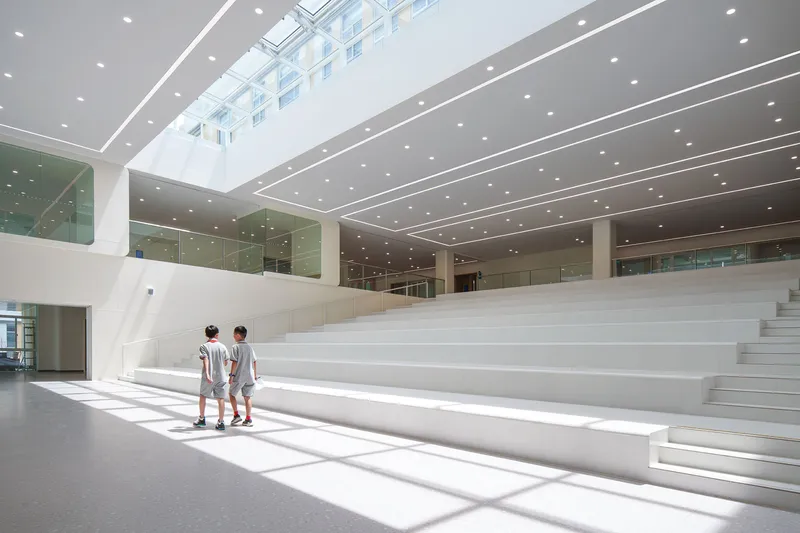
A Cross-Border Approach to Learning and Urban Integration
As one of Shanghai’s “high-quality expansion schools,” the project embraces the idea of a “Cross-Border School”, redefining boundaries between disciplines, functions, and urban life. – At the urban scale, the campus extends beyond the limits of the surrounding road grid, becoming a porous, accessible public landscape. – At the project level, the school principal participated throughout the design process, blurring the boundary between education and architecture. – At the spatial level, architecture, interiors, and landscape were developed as a single continuous environment, fostering cohesion and flexibility.
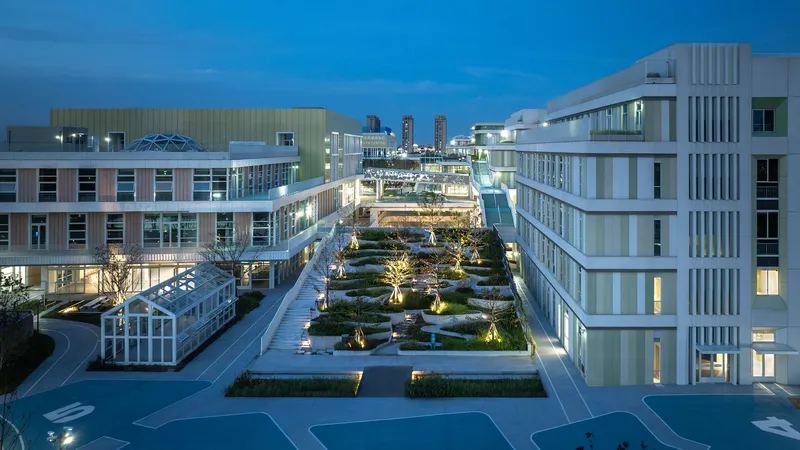
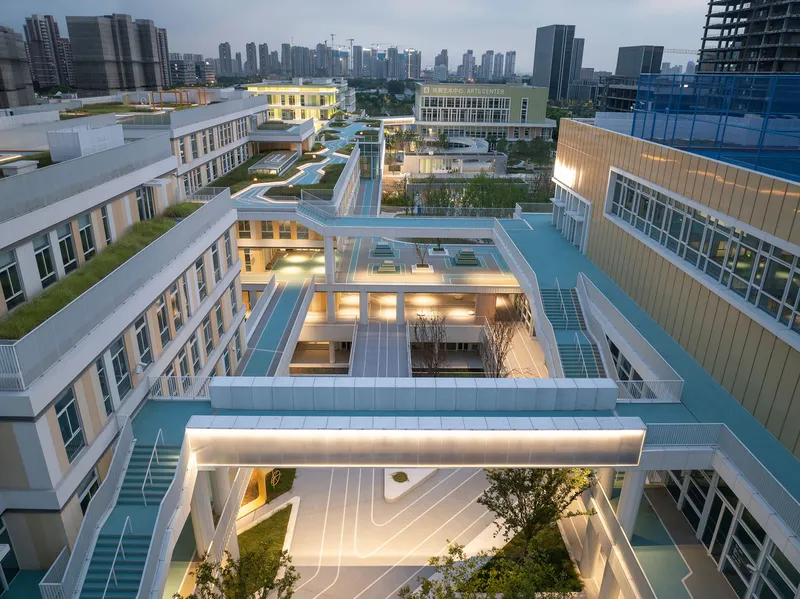
Masterplan: One Body, Two Wings, Three Axes
The school’s main program—teaching spaces, art and sports facilities, future learning center, and community-oriented areas—is organized into a dynamic framework known as “One Body, Two Wings, and Three Axes.”
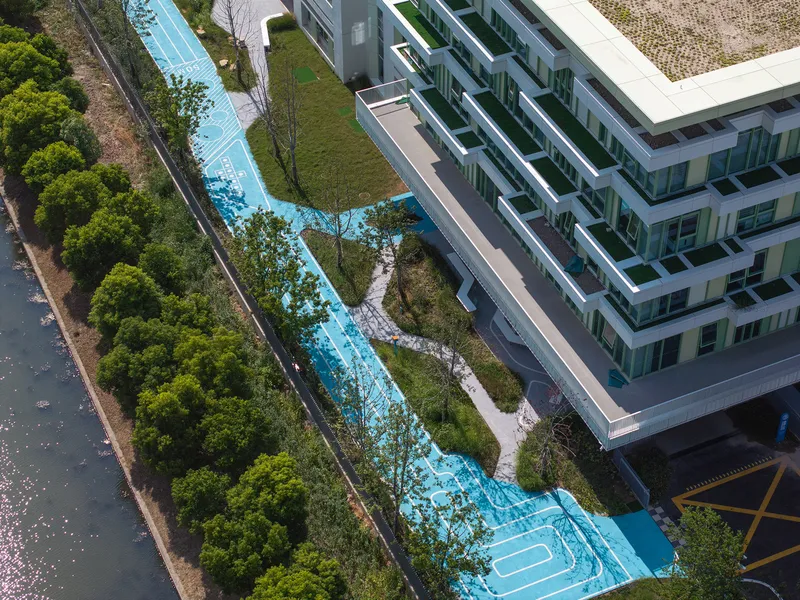
One Body: A Connected Learning Core
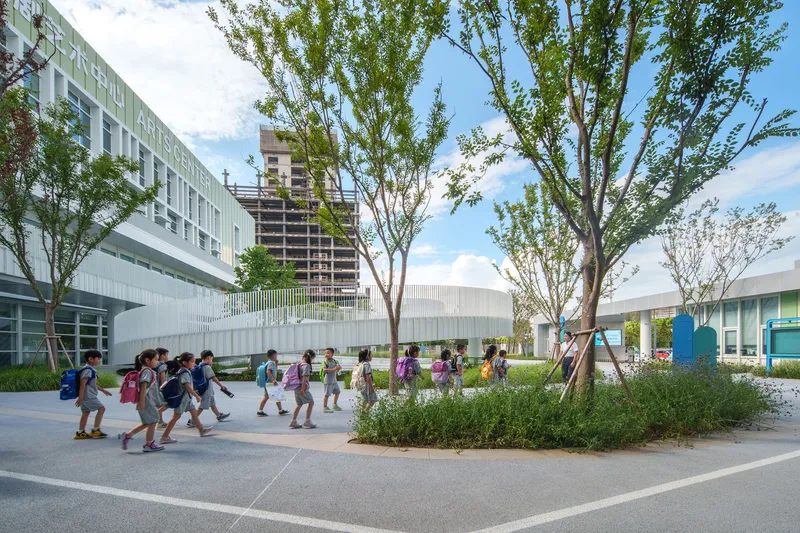
Multiple north-south corridors at different levels connect the buildings, creating a pedestrian-friendly campus that prioritizes accessibility, safety, and child-friendly circulation.
Two Wings: East and West Learning Communities
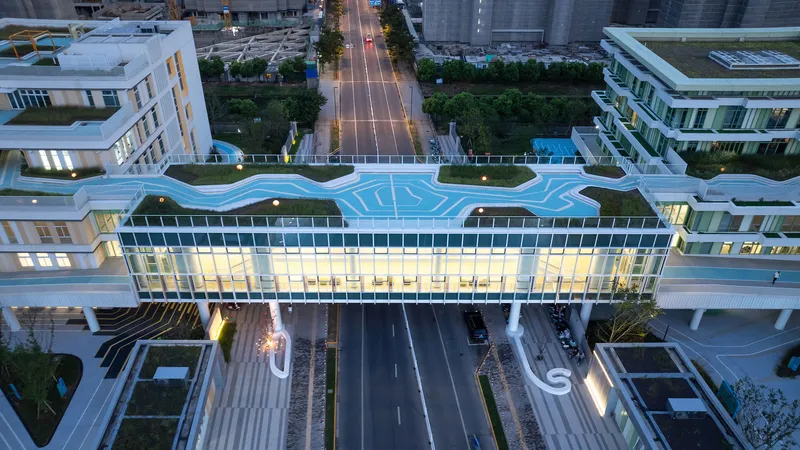
The campus spans two separate urban plots, linked through elevated sky corridors and public streets, forming an “independent yet connected” block complex. – West Wing – Learning Center: Designed for lower-grade students, featuring flexible classrooms and informal learning spaces. – East Wing – Future Center: A multifunctional zone for meetings, performances, exhibitions, and collaborative activities, created through a layered, vertical spatial strategy.
Both main entrances reinterpret the school gate as park-like public spaces, welcoming students and visitors into a greener, more open educational environment.
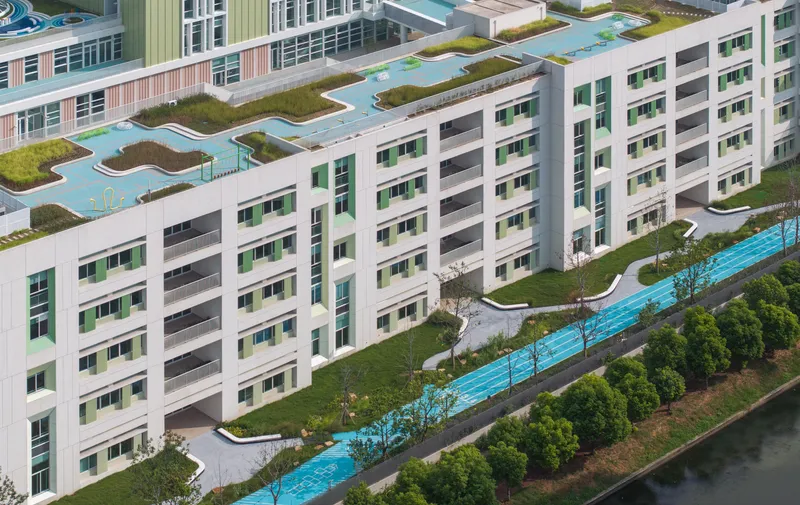
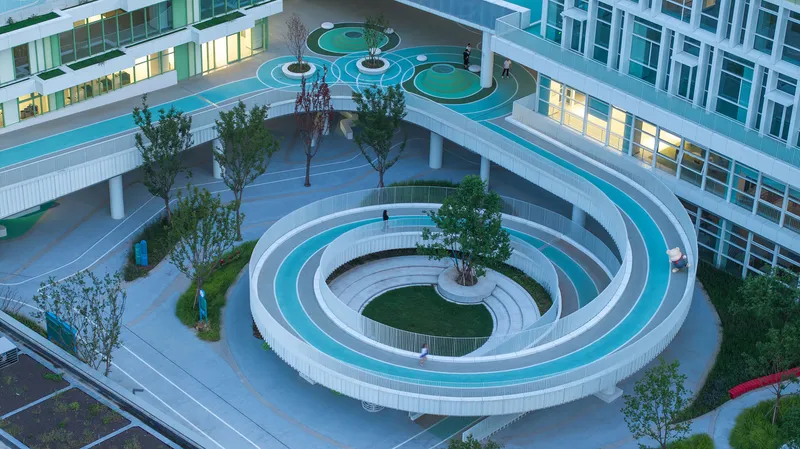
Three Axes: South, North, and Central Campus Spines
South Axis – River-Facing Learning Zone
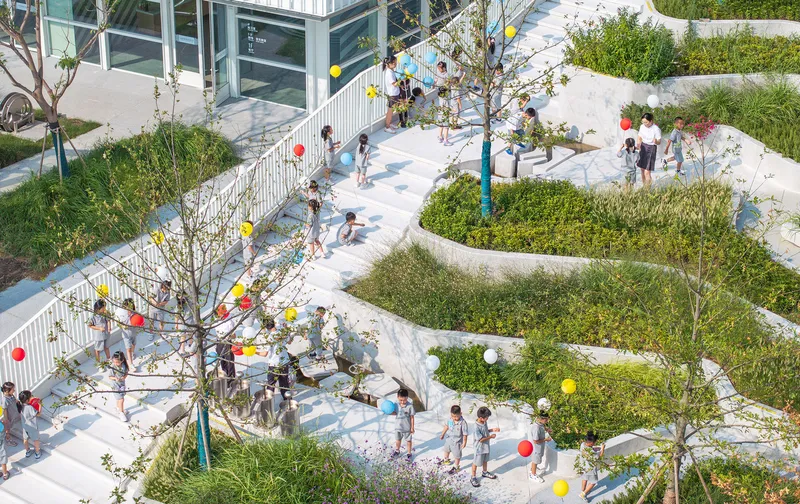
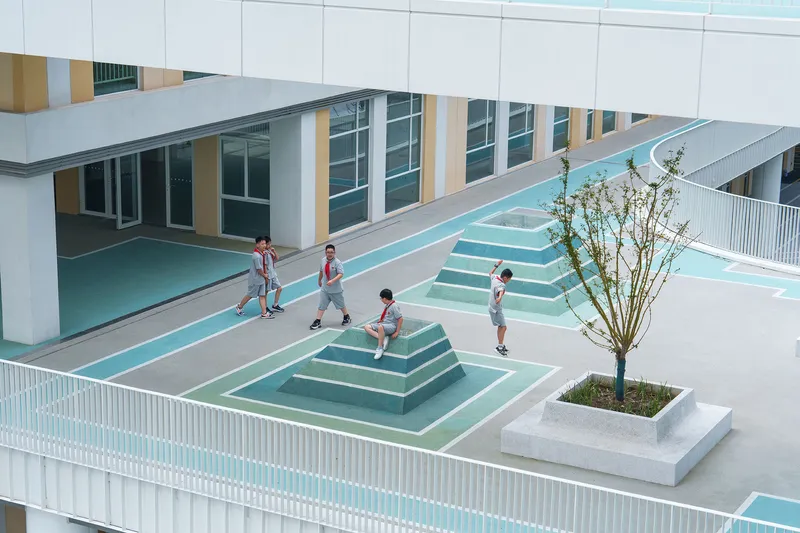
This axis houses the main teaching buildings, oriented for optimal sunlight and river views. Each academic floor includes three clusters of “two classrooms + one discussion hall”, encouraging collaboration and student interaction. Widened corridors serve as informal activity zones, while adjacent “game gardens” and “relaxation gardens” support outdoor play and resting spaces. The landscaped fire-escape garden integrates safety and recreation.
North Axis – A Quiet Edge with Cultural and Sports Facilities
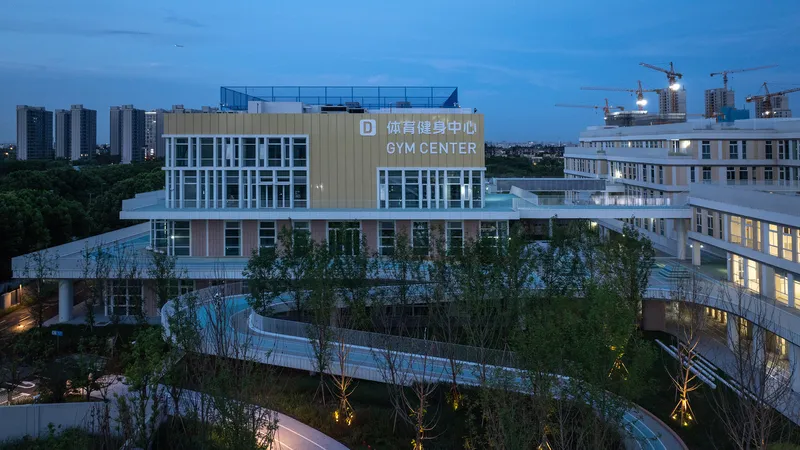
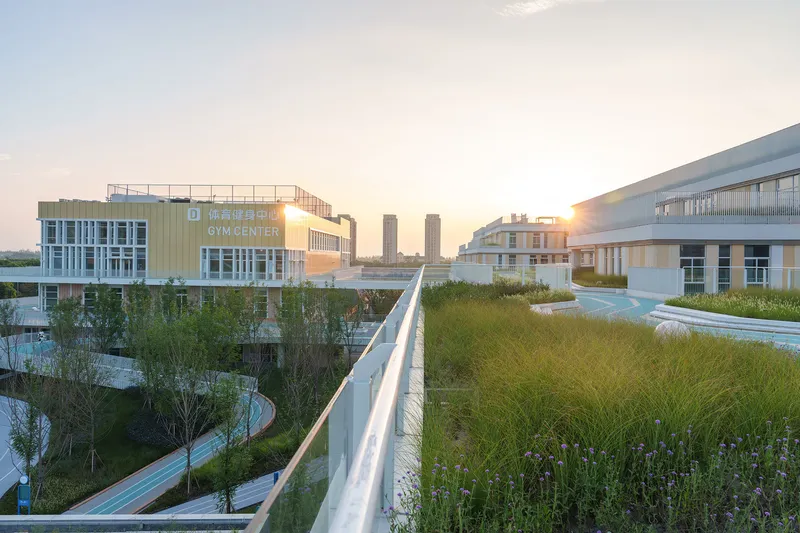
Bordering the preserved Camphor Forest, the North Axis minimizes road noise and enhances the campus skyline. – The Art Center consolidates a theatre, studios, and canteen within a compact volume. – The Sports Center, the largest building on campus, spans three accessible levels and offers diverse athletic facilities. A playful slide located in the northeast corner brings a sense of fun and human scale to the large structure.
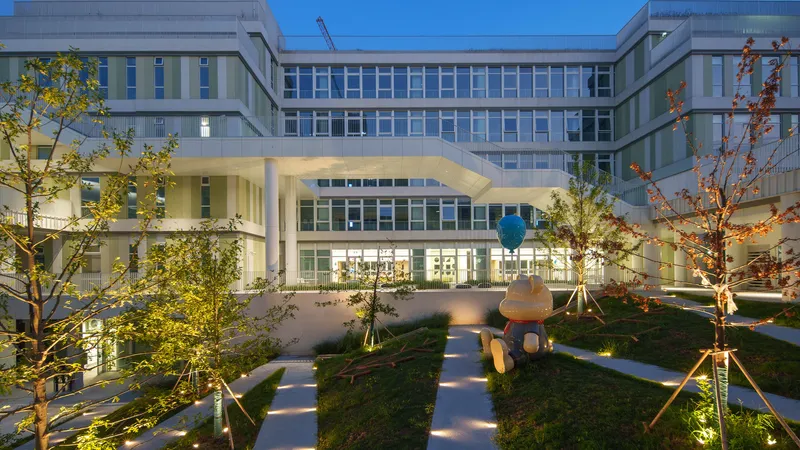
Central Axis – A 550-Meter Landscape Corridor
The campus’s central spine is a fully open green corridor that visually aligns with the surrounding cityscape. Courtyards, overhead bridges, platforms, and underground levels merge into Shanghai’s most active public campus space. Key features include: – Track Park: An 8,000 m² non-powered play area with nature exploration, sports zones, and a wrap-around track. – Geo Garden & Dry Creek Boardwalk: Stormwater-responsive landscape designed for infiltration, collection, and reuse. – Tree Table Garden: A shaded outdoor learning commons for senior students. – Sports Park: A full-size football field, 300-meter running track, multipurpose courts, and community-ready floodlit turf.
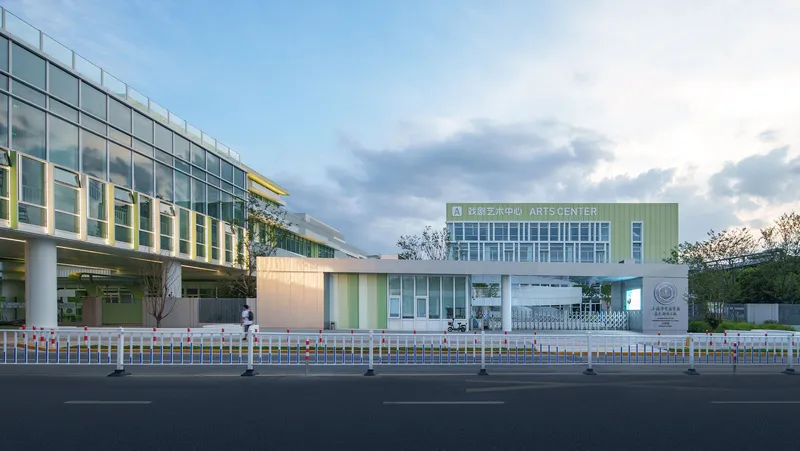
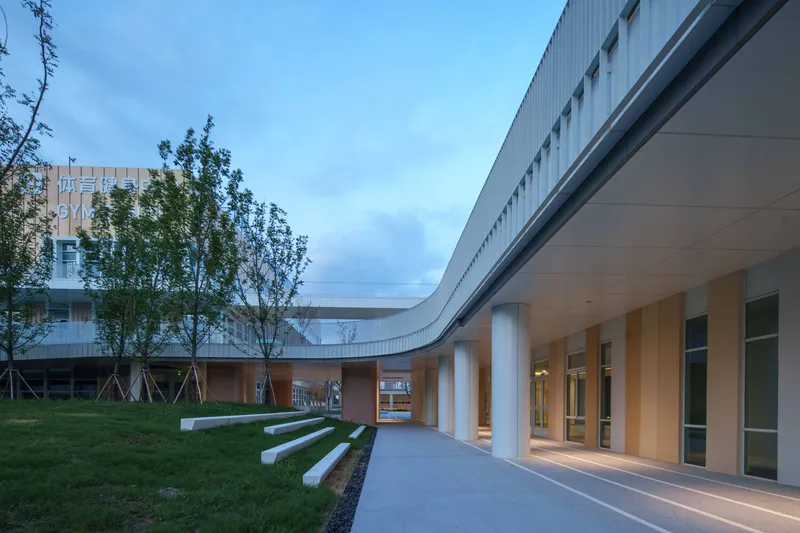
Layers of Learning: Vertical and Underground Spatial Innovation
The school’s multi-level design enhances both connectivity and environmental quality. – The second-floor platform, situated 5 meters above ground, forms a continuous elevated terrain linked by valley and terrace gardens. – The Underground Hall, with a height of 10 meters, accommodates sports venues, performance areas, and student pick-up zones. – Above it, the Halo Playground features playful light wells, bringing natural daylight deep into the complex and reducing energy consumption.
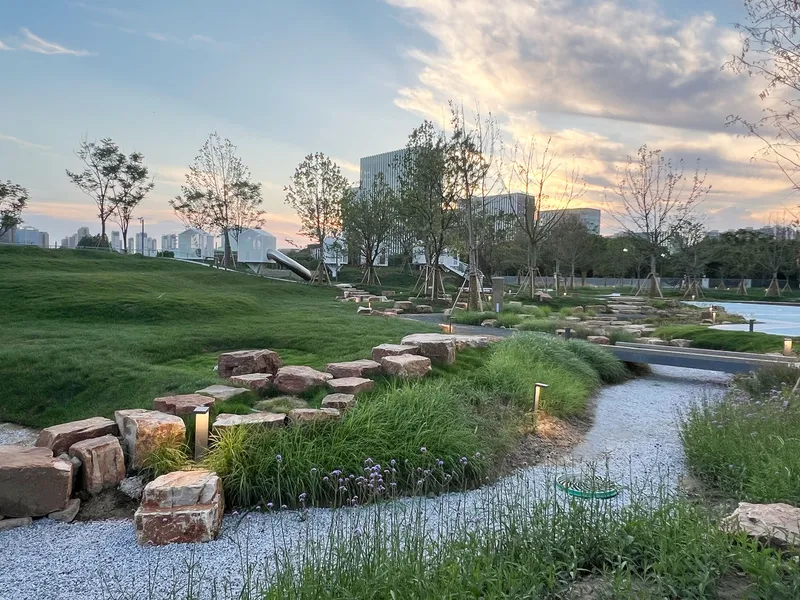
A New Educational Paradigm: From City to Desk
The design challenges the conventional “handover-and-move-in” approach to school construction. Through continuous collaboration between educators and architects, the campus becomes more than a collection of buildings—it becomes a living educational landscape.
The cross-border philosophy allows the school to: – Maximize public space and inclusivity – Promote environmental stewardship and nature-based learning – Support diverse teaching methods, from collaborative learning to outdoor education – Create an inspiring, future-ready environment for every student
A Vision for the Future of Learning Environments
Jiading New City Experimental School is a landmark project that redefines what a contemporary school can be—open, integrated, sustainable, and deeply connected to its urban context. By dissolving the boundaries between architecture, landscape, and education, the school represents a visionary model for future learning spaces in China and beyond.




Popular Articles
Popular articles from the community


Riyadh For All: Intergenerational Urban Design for Active Aging in Rabat
Riyadh For All reimagines urban design in Rabat with intergenerational co-living, adaptive courtyards, and Moroccan cultural exchange today.

Co-Life: Senior Housing Design That Reconnects Older Adults With the City
Co-Life reimagines senior housing design through healing gardens, shared streets, workshops, and a sustainable community across generations.

The Ocean Hive: Sustainable Architecture for a Self-Sufficient Civilization at Sea
The Ocean Hive imagines sustainable architecture at sea, where modular habitats, algae, wave power and ocean waste sustain a growing colony.

Hill & Cross Opera: Sculptural Opera House Architecture Shaped by Tallinn’s Landscape and Identity
Hill & Cross Opera reimagines opera house architecture in Tallinn through its sculptural hill, civic plaza, glass wave and a luminous cross.

Similar Reads
You might also enjoy these articles


Hodi-Mandai Geram
Project Function: Preservation and revitalization of the Intangible heritage and socio-spatial identity of the Hodi by Housing, Cultural Memory Center, Sacred Grove, landscape, local tourism economy


Olio Towers: A Mid-Rise for Performers That Fuses Housing, Rehearsal, and Stage
Located blocks from Houston's Theater District, this modular tower stacks living units around a central performance atrium.

Oasis: Modular Green Housing Carved into Dhaka's Urban Fabric
A shortlisted Plugin Housing entry reclaims unauthorized settlements in Dhaka with stepped concrete volumes, green roofs, and ventilation-driven design.

Black Hole: A Floating Megastructure for the Post-Physical Era
Emiliano Mazzarotto envisions a spherical, self-scaling arena where e-sports, digital hotels, and holographic stadiums replace traditional public space.


Explore Educational Building Competitions
Discover active competitions in this discipline



Challenge to design public laboratory


Challenge to reimagine the Iron Throne


Photograph architecture without architects


Illustrate the lost glory of Angkor Wat - Render Challenge
Comments (0)
Please login or sign up to add comments
No comments yet. Be the first to comment!