
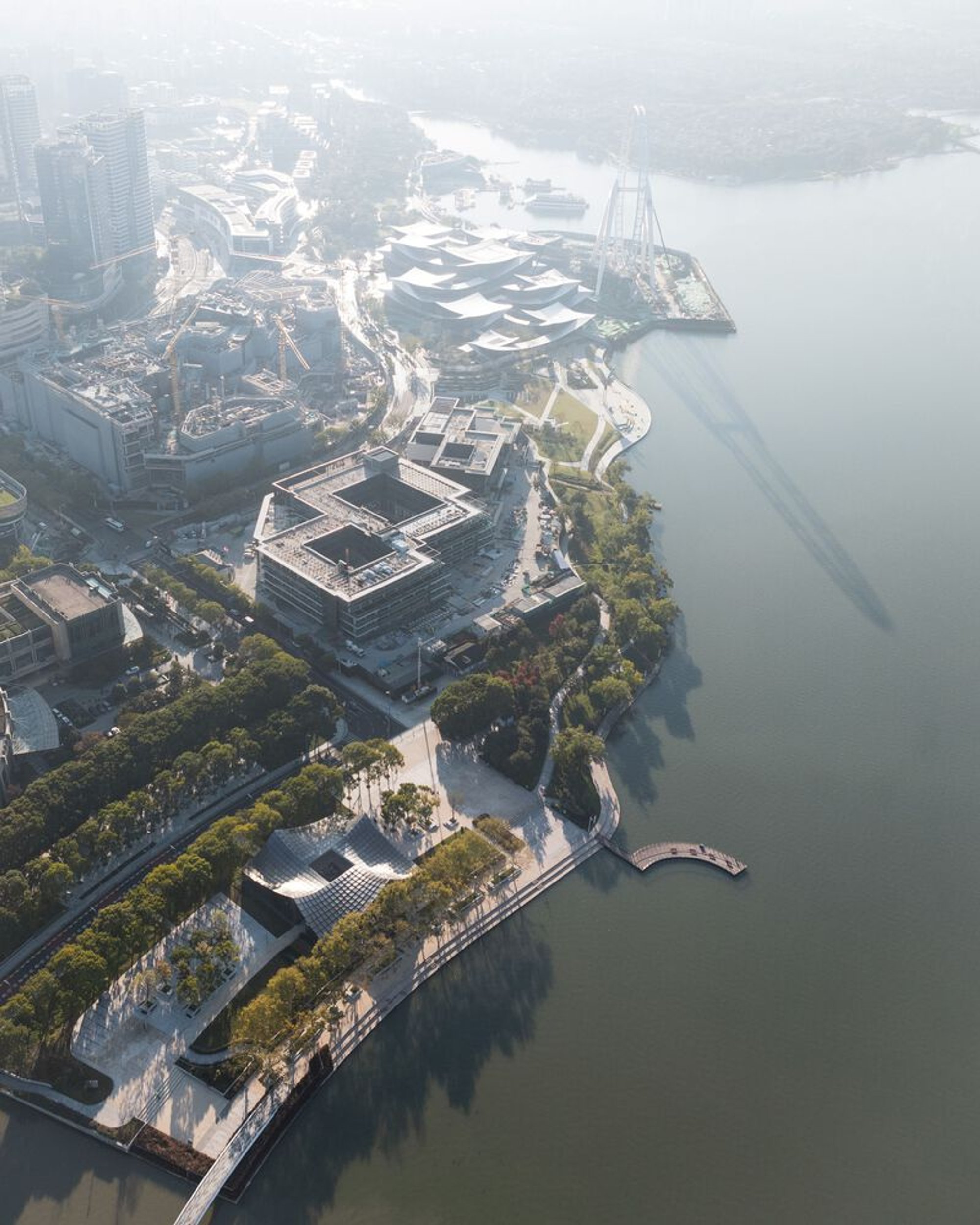
BIG Wraps Four Public Rooms Under a Pixelated Glass Canopy on Suzhou's Jinji Lake
A 1,200 square meter pavilion along Suzhou's lakefront trail reimagines the Chinese courtyard teahouse in perforated steel and glass.

Suzhou is a city that knows its gardens. For centuries, its walled compounds of rock, water, and vegetation have served as a masterclass in calibrated enclosure, places where architecture recedes and nature takes the lead. So when Bjarke Ingels Group (BIG) was tasked with designing one of eleven permanent pavilions along the 13-kilometer Jinji Lake trail, the question was never whether to reference that tradition but how to make it feel genuinely new. The answer, completed in 2025 in collaboration with ARTS Group, is a 1,200 square meter complex of four interconnected volumes arranged around a central courtyard, all sheltered beneath a single undulating roof of glass tiles and perforated steel. It is BIG's first finished building in Suzhou, and it reads less like an import than like something the lakefront camphor trees have always been waiting for.
What makes the Jinji Lake Pavilion genuinely compelling is not the courtyard typology itself, which is ubiquitous in Chinese architecture, but the way the roof transforms a familiar diagram into something optically strange and thermally clever. Two layers of perforated sheet metal sit within a laminated glass assembly, casting dappled shadows that shift throughout the day in a deliberate echo of sunlight through a tree canopy. The building does not just sit beneath the camphor trees; it competes with them on their own terms, filtering light rather than blocking it, inviting the landscape through rather than holding it at arm's length.
A Roof That Behaves Like Foliage

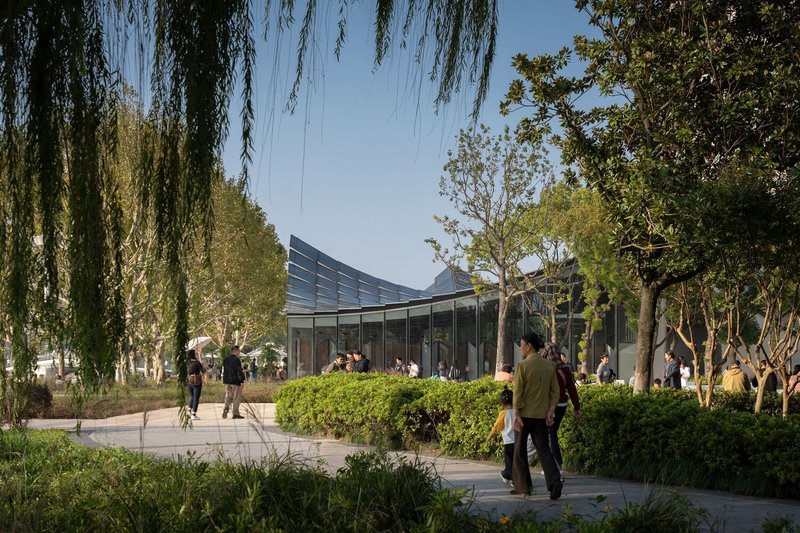
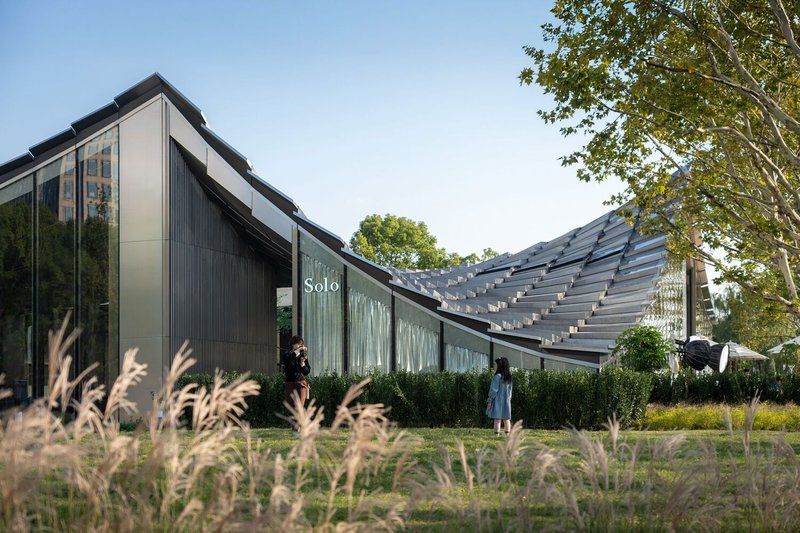
The roof is the protagonist here. From the air, its scalloped forms drape across the waterfront like oversized leaves, their edges lifting to create double-height entrances at each of the four volumes. The glass tiles that replace traditional glazed ceramic create a paradox: the roof has mass and presence from a distance, yet up close it dissolves into transparency and light. This is not ornamentation pretending to be structure. The dual-layer perforated system, with an outer layer integrated into the glass assembly and an inner layer forming the ceiling, is doing real work: regulating daylight, eliminating glare, and reducing solar heat gain without mechanical intervention.
The pixelated quality of the perforations is deliberate. Rather than smooth gradients, the roof produces a pointillist pattern of light and shadow on the floor below, changing hour by hour. It is the kind of detail that rewards lingering, which is exactly what a lakefront pavilion should encourage.
The Courtyard as Quiet Center
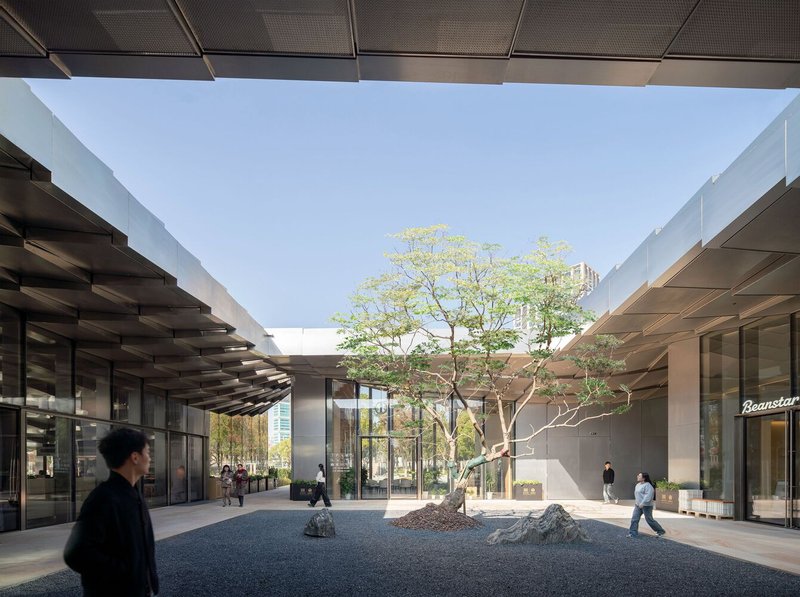
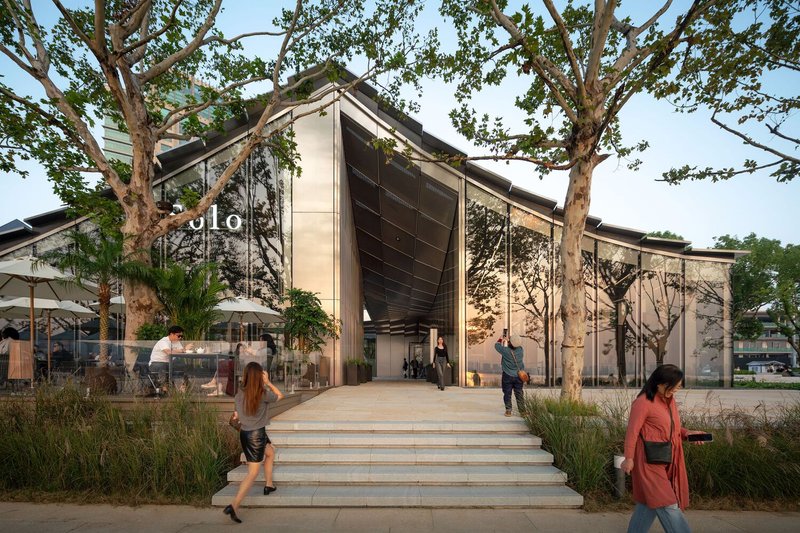
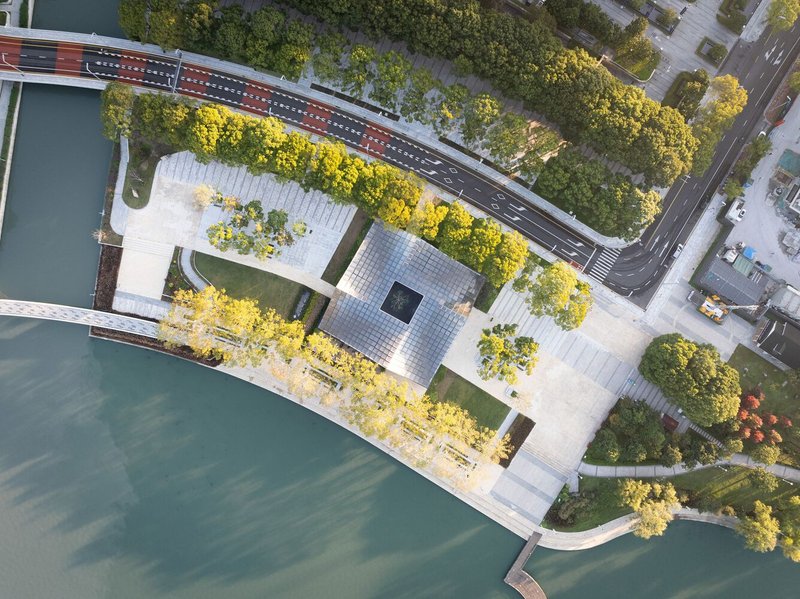
At the heart of the plan sits a courtyard with raked gravel and a single sculptural tree, a gesture so spare it borders on provocation in a city famous for its densely planted gardens. But the restraint works. The lone tree becomes a focal point that anchors the four surrounding volumes, a café, a boutique, a restaurant, and a visitor center, giving each a shared visual reference. Visitors moving between programs always pass through or alongside this void, which means the courtyard functions less as ornamental space and more as a hinge.
The overhanging canopies frame the courtyard from above, their photovoltaic surfaces tilting inward. From ground level, looking up, the roof edges and the tree canopy overlap in a layered composition that collapses the distinction between built shelter and organic shade. It is a simple move executed with precision.
Steel, Glass, and the Art of Reflection
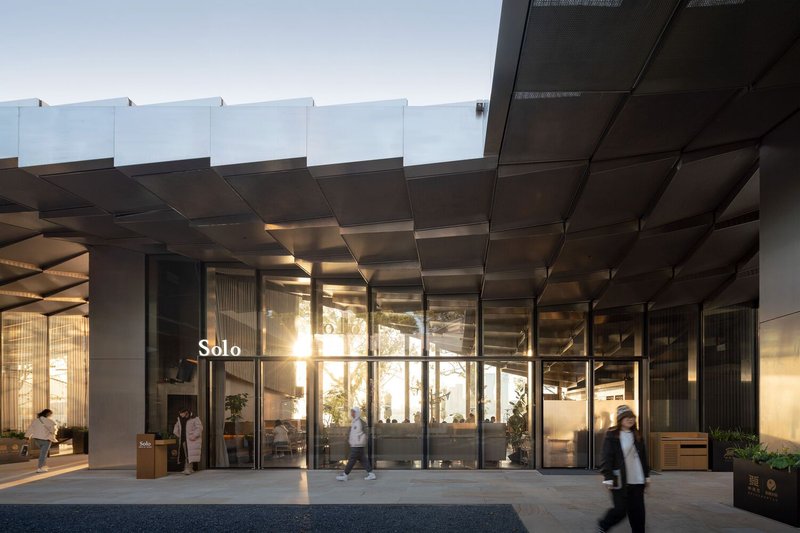
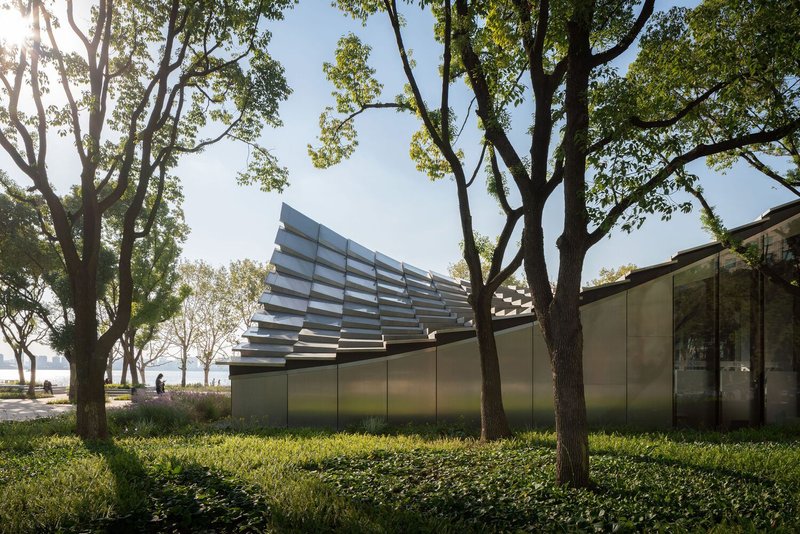
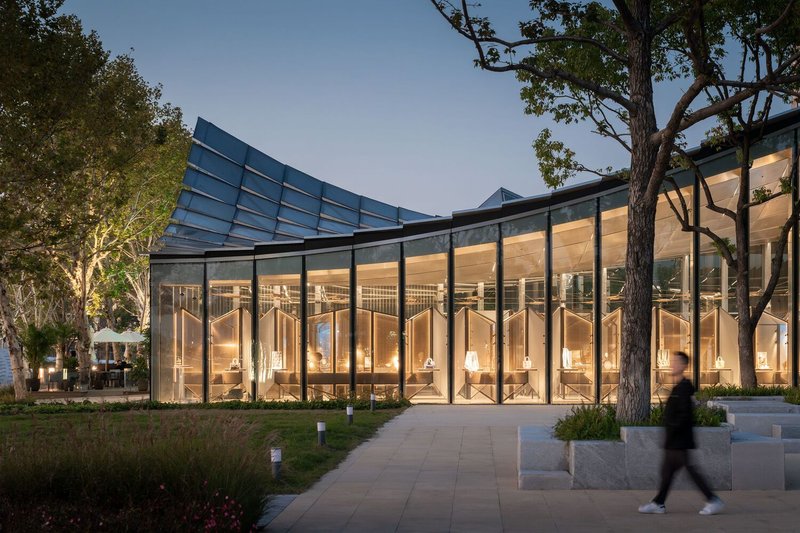
Polished steel columns and wall surfaces do something specific in this context: they pull the surrounding camphor trees, water, and sky into the building's skin. At dusk, the glass walls glow from within while the steel catches the last colors of the lake, and the pavilion oscillates between solid and ephemeral. BIG has used reflective surfaces before, but here the effect is tuned to a particular landscape. The curved metal panels seen through tree trunks in afternoon sun look almost organic, their faceted geometry softened by the play of light across their surfaces.
The entrance canopies, with their layered metal panels extending over glazed doors, transition visitors from the open lakefront into the interior without a hard threshold. The roof slopes low enough to feel intimate at entry points, then rises to double height inside, a compression-and-release sequence borrowed from traditional garden architecture but executed in industrial materials.
Interior Spaces That Earn Their Light
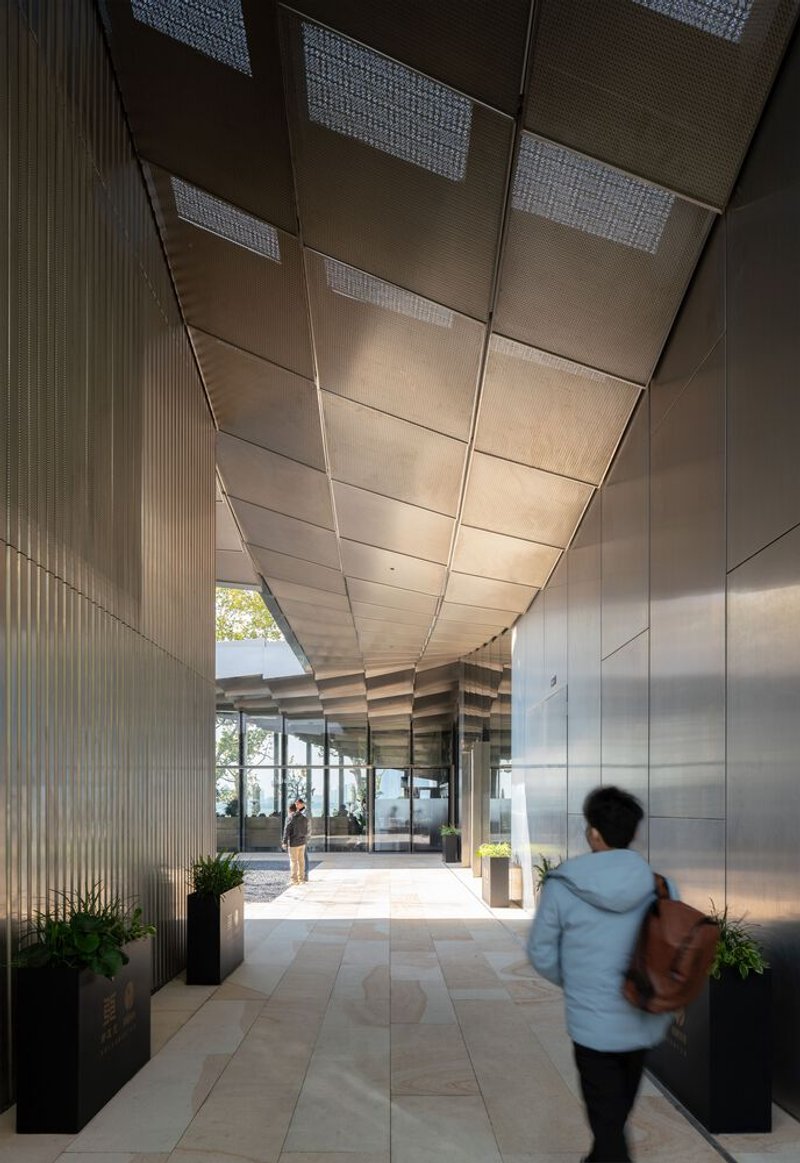
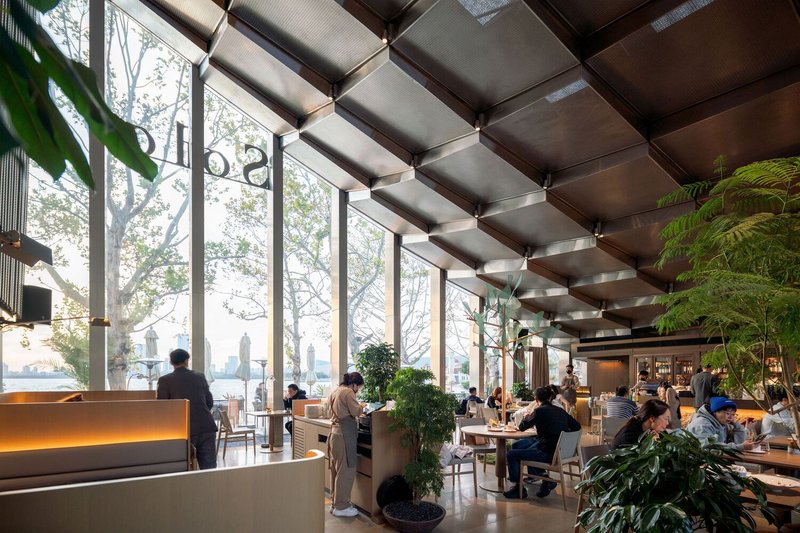
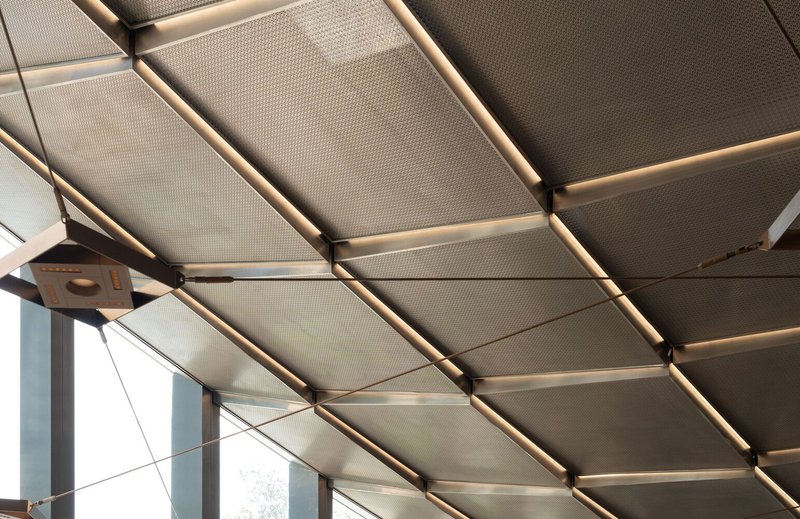
Inside, the coffered ceiling system reveals the structural logic of the dual-layer roof. Metal-edged panels with integrated linear lighting create a modular grid overhead that is both functional and visually rich. The corridors, where folded metal ceiling panels and perforated vents run above the heads of pedestrians, have the quality of a covered garden walk: directional, rhythmic, open to the sides. In the dining hall, floor-to-ceiling windows frame bare winter trees and the city skyline beyond, turning the meal into a landscape experience.
The interiors are restrained in their material palette. Steel, glass, and controlled natural light do nearly all the atmospheric work. There is no applied decoration, no accent walls. The architecture trusts its own section to create the mood, and that confidence pays off in spaces that feel calm without being austere.
Nestled in the Waterfront Canopy
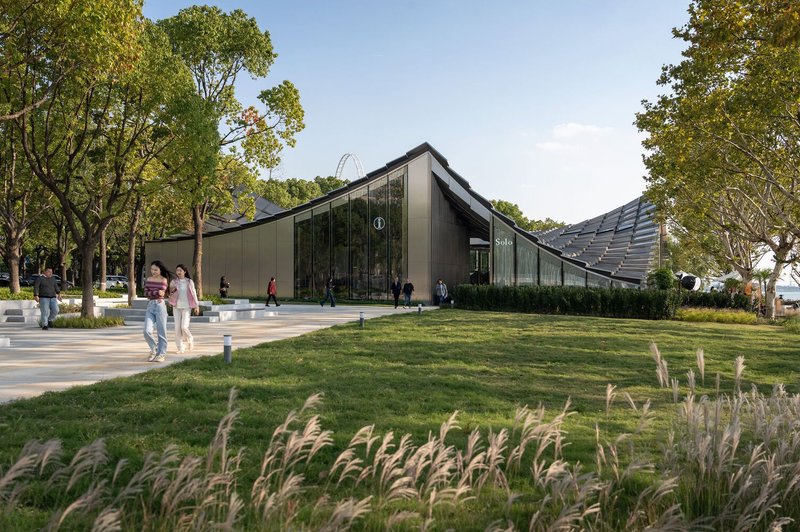
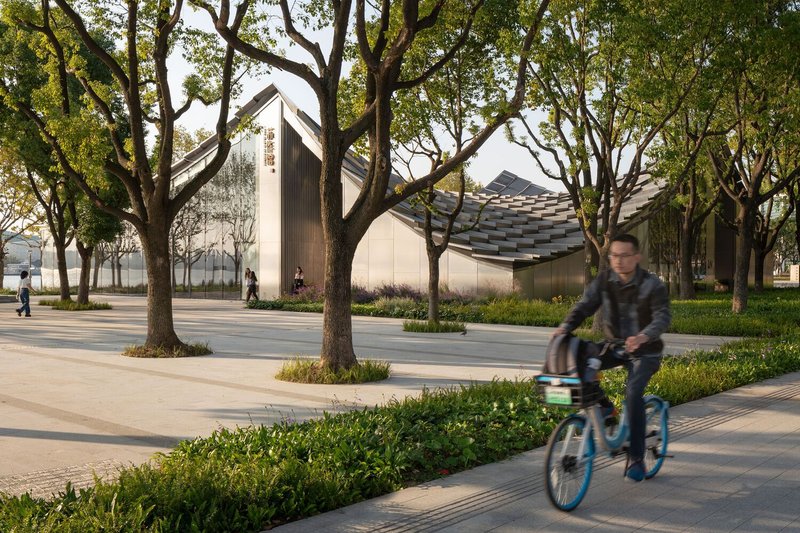
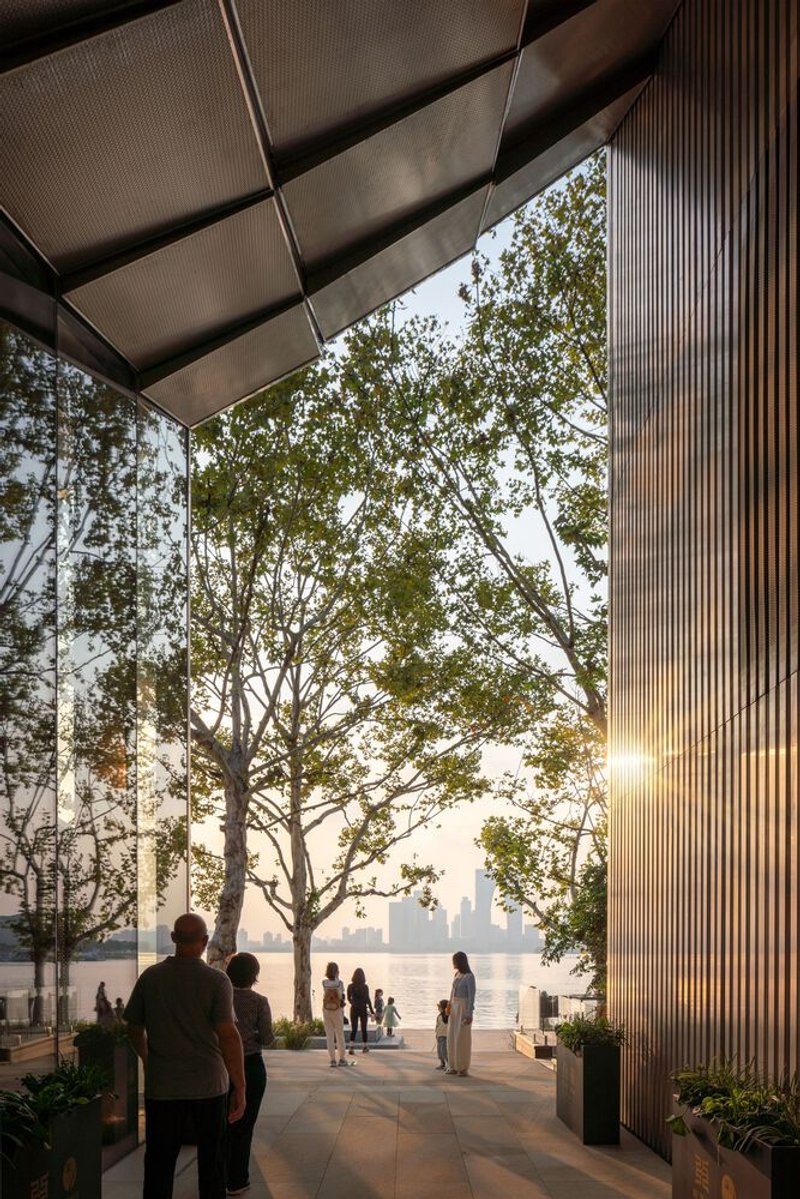
The pavilion's relationship to its site is its most underrated achievement. Jinji Lake is a 7 square kilometer freshwater reservoir in a metropolis of 12 million, and the north and west shores have been developed in recent years as a vibrant public promenade. BIG's building does not announce itself with a grand gesture toward the water. Instead, it tucks beneath the existing grove of camphor trees, its low profile and curved edges allowing cyclists, joggers, and strollers to move around and through it without breaking stride. The paved pathways, lawn edges, and landscaped grasses knit the building into the trail network as a natural stopping point rather than an interruption.
From across the lake, the pavilion reads as part of the treeline. From within the grove, it reveals itself gradually through gaps in the trunks. This is architecture that understands its role in a sequence: one of eleven pavilions, not a solo act.
Plans and Drawings
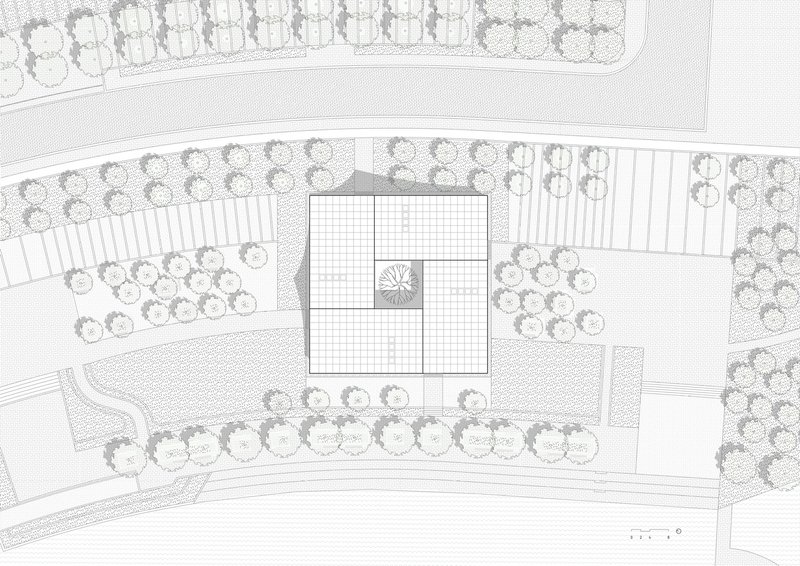
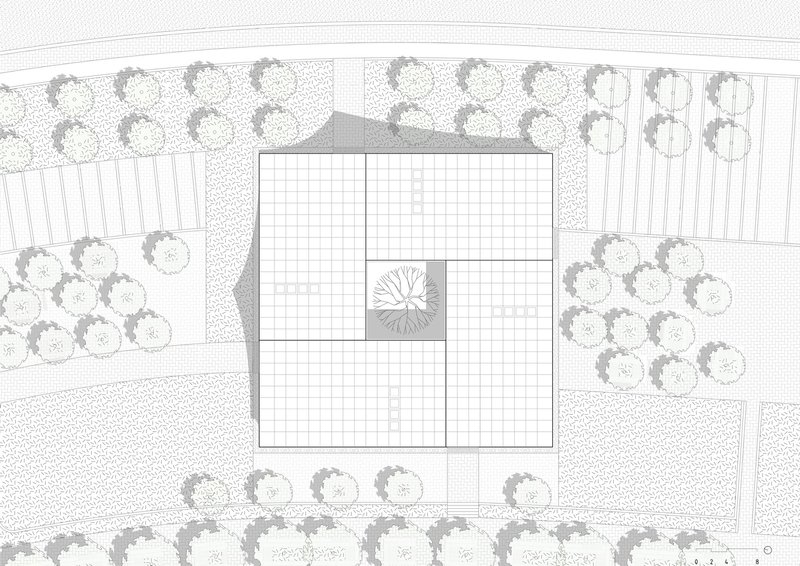
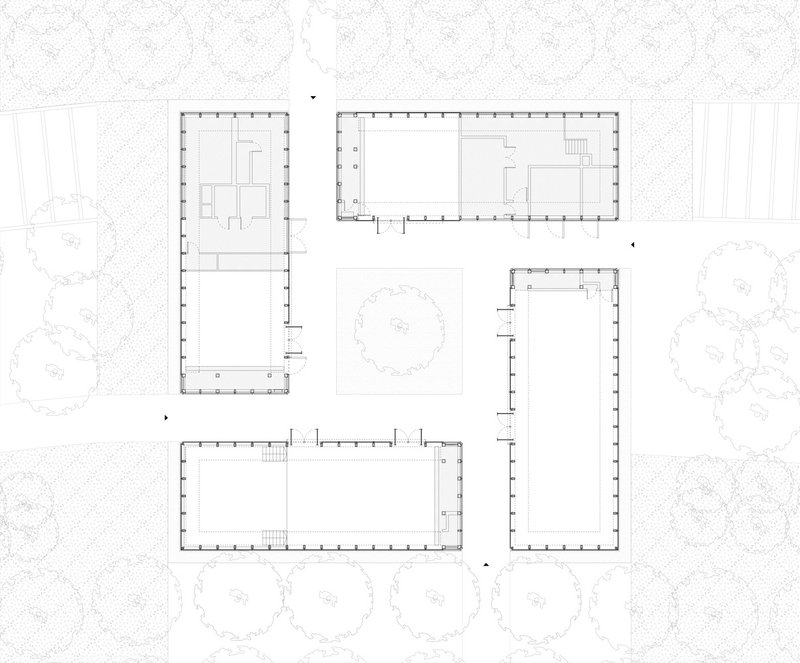
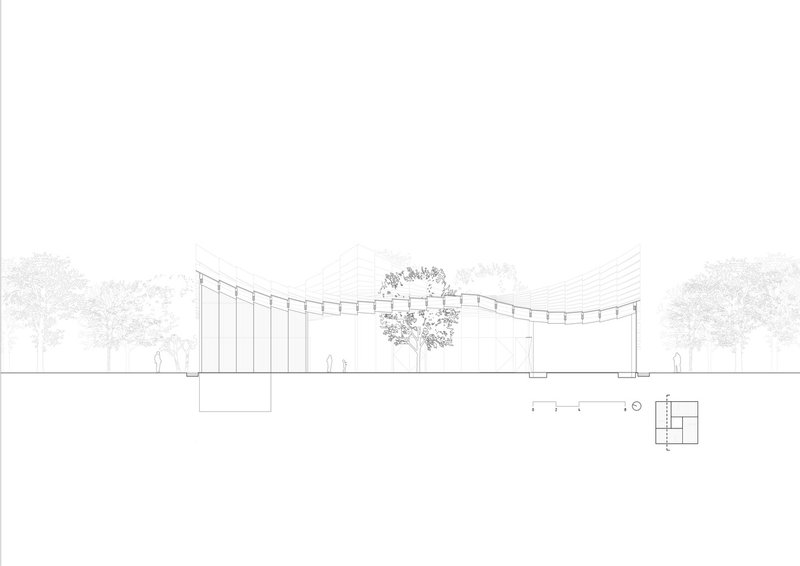
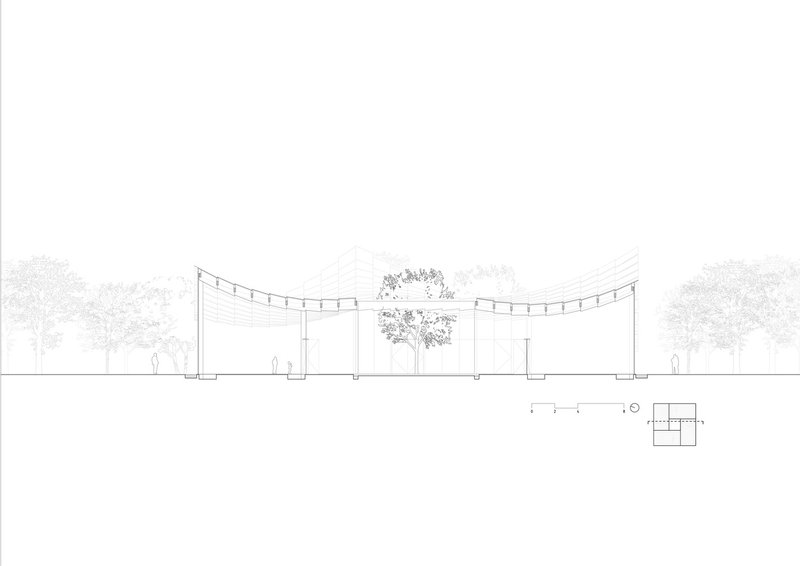
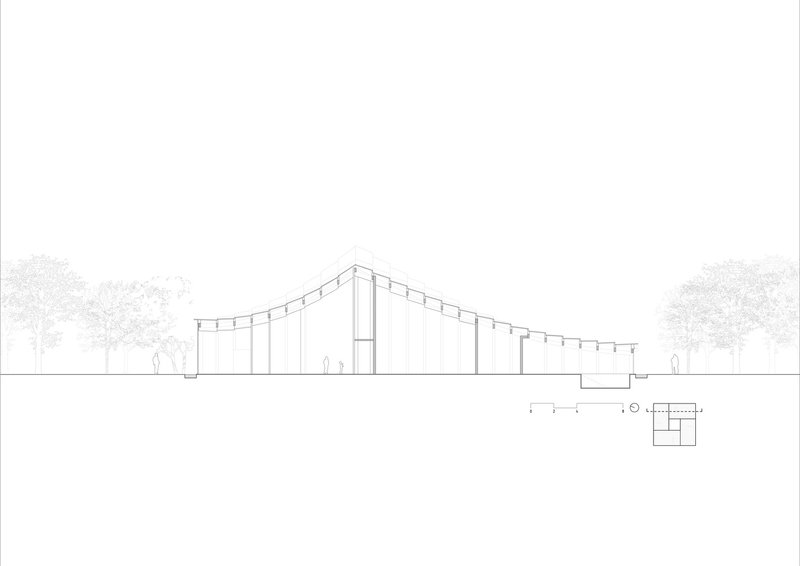
The site plans reveal how tightly the building is woven into its landscape. Tree-lined pathways wrap the perimeter, and the central courtyard aligns with planted zones on either side, creating a continuous green axis through the project. The floor plan shows five rectangular pavilion volumes arranged around circular planted courtyards, a clear and legible diagram that belies the complexity of the roof above. In section, the undulating roofline becomes the dominant formal gesture, rising and falling to create varied ceiling heights while the courtyard tree holds the center. Human figures in the section drawings underscore the building's modest scale: this is architecture at eye level, not monument-making.
Why This Project Matters
The Jinji Lake Pavilion matters because it demonstrates that referencing historical typologies does not require literal imitation. The courtyard, the teahouse roof, the garden wall: all are present in the DNA of this building, but none are quoted directly. Instead, BIG and ARTS Group have translated spatial principles into a contemporary material language where glass replaces ceramic, perforated steel replaces timber lattice, and a single tree replaces an entire planted microcosm. The translation is rigorous enough to feel respectful and inventive enough to feel fresh.
It also matters as a model for public architecture along urban waterfronts. In a city investing heavily in lakefront infrastructure, BIG has delivered a building that serves four distinct programs without overbuilding, manages its own climate without heavy mechanical systems, and defers to its landscape context at every turn. For a firm known for bold formal moves, the restraint here is the boldest move of all.
Jinji Lake Pavilion by Bjarke Ingels Group (BIG) in collaboration with ARTS Group. Jinji Lake waterfront, Suzhou, China. 1,200 m². Completed 2025. Client: Suzhou Harmony Development Group. Photography by StudioSZ Photo / Justin Szeremeta.
About the Studio
Share Your Own Work on uni.xyz
If projects like this are the kind of work you want to make, uni.xyz is a place to publish your own, find collaborators, and enter design competitions.




Popular Articles
Popular articles from the community

20 Most Popular Office Building Projects of 2025
From biophilic workspaces in India to net-positive energy offices in New Delhi, 20 office building projects that defined architecture in 2025.

Rojkind Arquitectos and Think Parametric Build a Glueless Pavilion from 67 Interlocking Panels
A serpentine fiber-cement installation in Chapultepec Park celebrates a decade of architectural media in Mexico City.
20 Most Popular Furniture Design Projects of 2025
Modular street systems, parametric benches, and insect hotels: the furniture design projects that captivated architects on uni.xyz in 2025.
Bernardes Arquitetura Stretches a Timber Roof Along a Reservoir's Edge in Minas Gerais
Dam House in Itaúna lets a sweeping wooden canopy dissolve the boundary between hillside terrain and open water.


Similar Reads
You might also enjoy these articles

Bamboo Housing Challenge 2026: Design Affordable, Sustainable Homes Using Bamboo
An international design competition by Bamboo U and IBUKU inviting architects and designers to reimagine affordable housing using bamboo — with the winning design built full-scale in Bali.

Computational Design & Education: Beegraphy Design Awards Introduces 7th Category (Featuring Jiyun's Innovative Approach)
Dive into Beegraphy’s 7th Design Awards category, where computational design meets education to create immersive, interactive learning tools, inspired by Jiyun’s work.

From Parametric Lighting to Urban Furniture: Join the 2nd Workshop in Beegraphy’s Computational Design Series
Dive into Cutting-Edge Design Techniques and Practical Applications with Industry Experts

Introducing Sphere by UNI: Pioneering a New Era in AEC Industry
Unlocking Global Potential with BIM and Agile Management


Explore Architecture Competitions
Discover active competitions in this discipline




The International Standard for Design Portfolios


The Global Benchmark for Architecture Dissertation Awards


The Global Benchmark for Graduation Excellence


Challenge to reimagine the Iron Throne
Comments (0)
Please login or sign up to add comments
No comments yet. Be the first to comment!