
João Mendes Ribeiro Builds a 25 m² Cabin Around a Century-Old Chestnut Tree in Northern Portugal
In Vale Flor's rural hillside, a black timber shelter yields its geometry to the trunk and branches of an ancient tree.


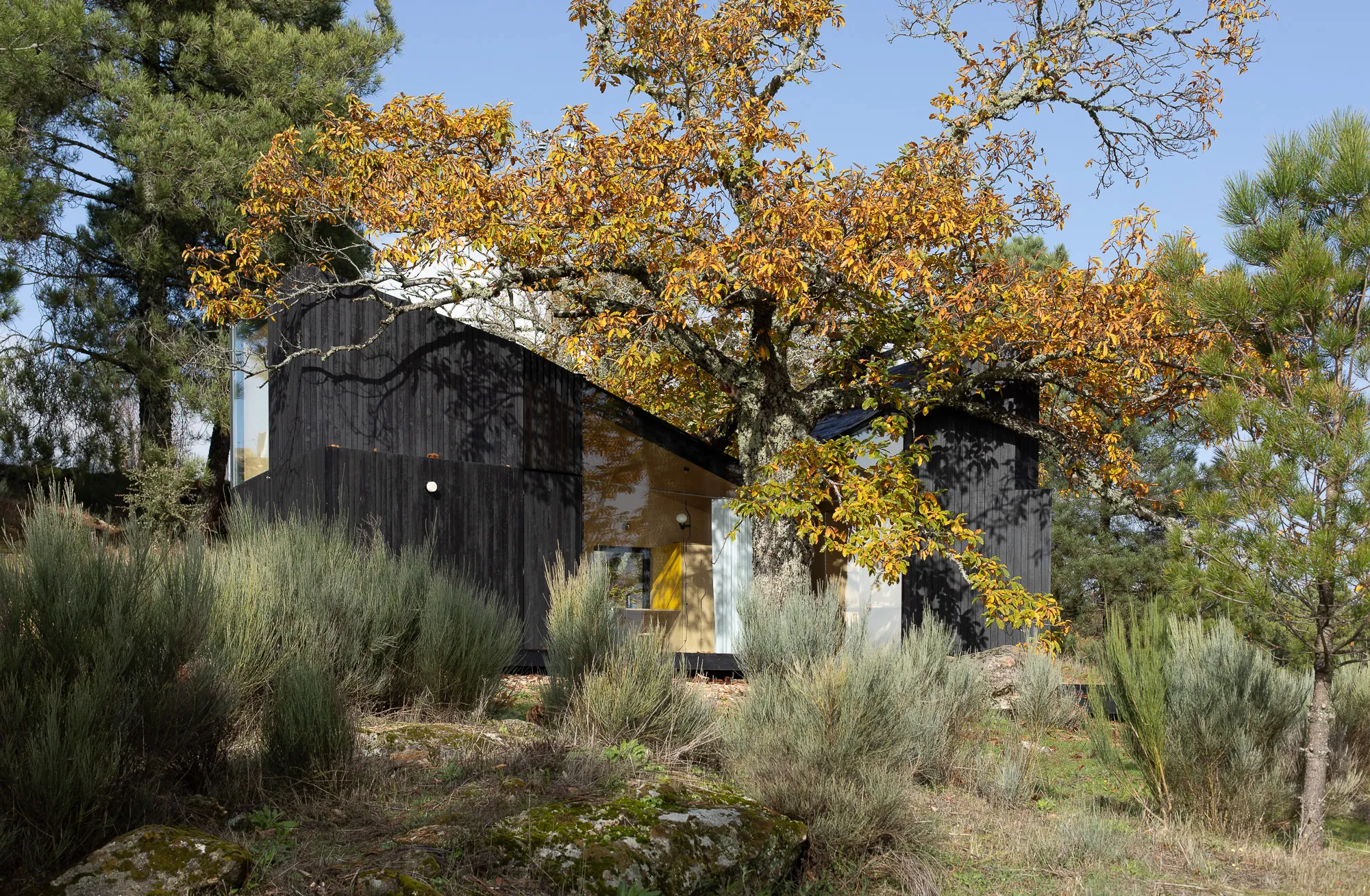
Most small cabins claim to respect the landscape. The Chestnut House, designed by João Mendes Ribeiro, actually deforms itself to prove it. Sited on a grassy slope in Vale Flor in northern Portugal, the 25 m² shelter is organized as two linked cubes, each with a 4.1-meter edge, whose eastern walls angle inward to accommodate the trunk of a large secular chestnut tree discovered during the first site visit. The tree does not ornament the architecture; it literally breaks the building's perfect geometry, forcing the structure to mold around its morphology without disturbing the root system beneath.
What makes the project genuinely interesting is not the small footprint or the pastoral setting but the precision with which Mendes Ribeiro negotiates between minimum interior volume and maximum engagement with the outdoors. There is no traditional living room: living happens outside, under the chestnut canopy, on a timber deck that wraps around the trunk. Inside, a single continuous space stacks kitchen, bathroom, sleeping area, and a mezzanine reached by a wooden ladder. Every surface is birch plywood. Every window is positioned to frame the tree or the valley beyond. The house is, in effect, a viewing instrument disguised as a shelter.
Black Timber and the Hillside


The exterior is clad in thermo-modified wood, painted black, with vertical boards that give the volumes a monolithic, almost carbonized presence against the golden hillside grasses and the Serra da Marofa ridge in the background. The dark finish is not decorative posturing: modified wood treatment guarantees dimensional stability and durability in this exposed rural setting, while the color lets the building recede beneath the tree canopy rather than competing with it.
From a distance the cabin reads as a shadow under the branches. Up close, the corrugated texture of the vertical ribs and the butterfly-style roof planes, which rise at either end to admit large windows, give the form a taut, origami-like crispness. It sits over-elevated on a light pine structure, hovering above the slope just enough to leave the ground undisturbed.
The Tree as Co-Author


The defining gesture of the project is the way the building wraps around the chestnut tree rather than clearing it. The timber deck extends from the interior through a glass wall and curves around the cut trunk, creating an outdoor room that is neither fully inside nor fully outside. Fallen leaves accumulate on the decking in autumn, reinforcing the idea that the tree, not the architect, sets the seasonal character of the space.
Inside, the corridor-like passage along the glazed eastern wall reveals the trunk and a gravel courtyard at close range. The angled walls that hug the tree are visible from this vantage, and the distortion they introduce into the plan is the clearest evidence of Mendes Ribeiro's commitment to the genius loci concept: the shelter conforms to what was already there.
Facade Detail and Fenestration

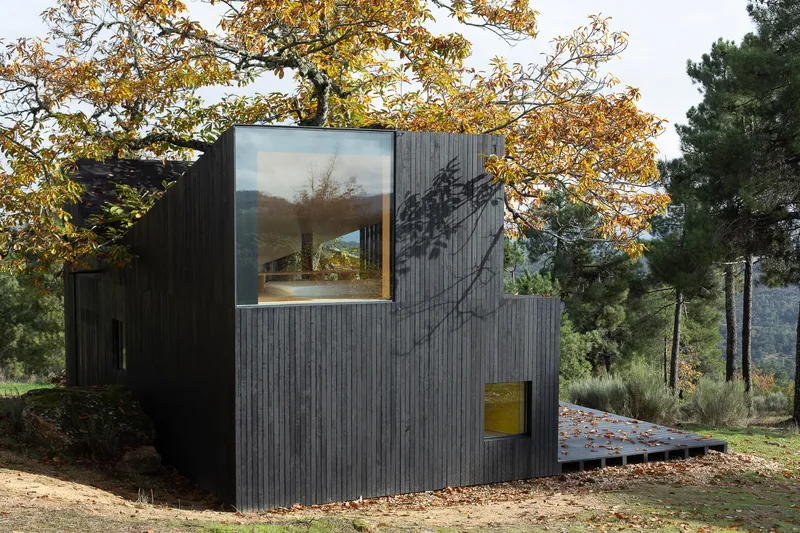

Windows are punched into the black cladding with deliberate restraint. A framed rectangular opening on one facade looks out across the valley; square apertures elsewhere catch lichen-covered branches and bare winter silhouettes. Each opening is sized and placed to frame a specific view rather than to flood the interior with indiscriminate light.
The vertical ribbing of the modified wood creates a strong graphic rhythm that makes even the smallest window read as a precise incision. At dusk, the warm plywood interior glows through these cuts, turning the black volume into a lantern among the trees.
Interior: Plywood, Stove, Mezzanine


Birch plywood lines every interior surface: walls, ceiling, built-in furniture. The effect is warm, continuous, and deliberately simple, a single material doing triple duty as structure, finish, and storage. A yellow cabinet provides the only chromatic interruption, a sharp accent against the pale wood.
A black metal salamander stove anchors the living zone and heats the mezzanine above, which serves as an extra sleeping platform reached by a leaning timber ladder. The mezzanine sits at the southern end of the plan; the bathroom occupies the northern end. Between them, the entire domestic program compresses into 25 m² without feeling like a concession.
Living at the Edge of Interior and Exterior
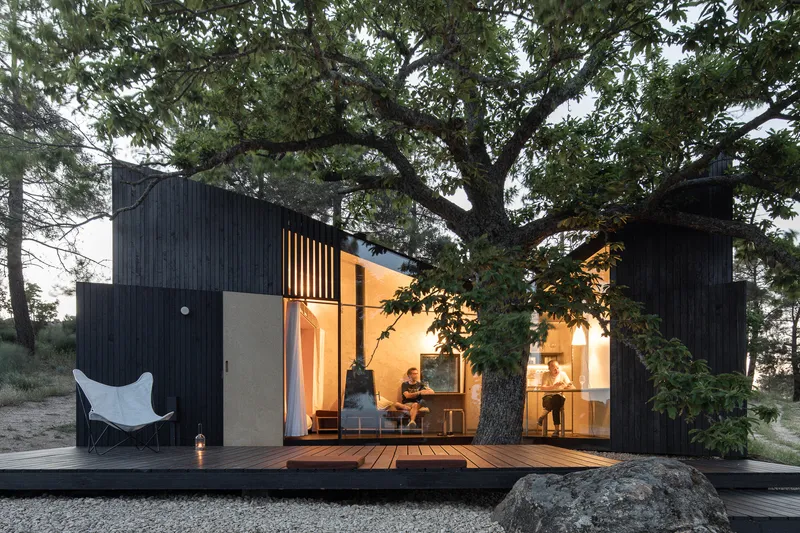


The floor-to-ceiling glazing along the eastern and southern walls dissolves the boundary between the plywood interior and the timber deck outside. In the evening shots, occupants seated inside appear almost to be sitting in the landscape itself, backlit by the warm glow of the stove while the misty pine forest drops away below.
A folding chair on the deck, a broad tree canopy overhead, a vertical slatted screen filtering the light: the outdoor room is furnished with almost nothing, yet it functions as the primary living space for much of the year. The architecture's real ambition is not to enclose but to provide the minimum shelter needed so that life can happen outside.
Bathroom and Intimate Spaces
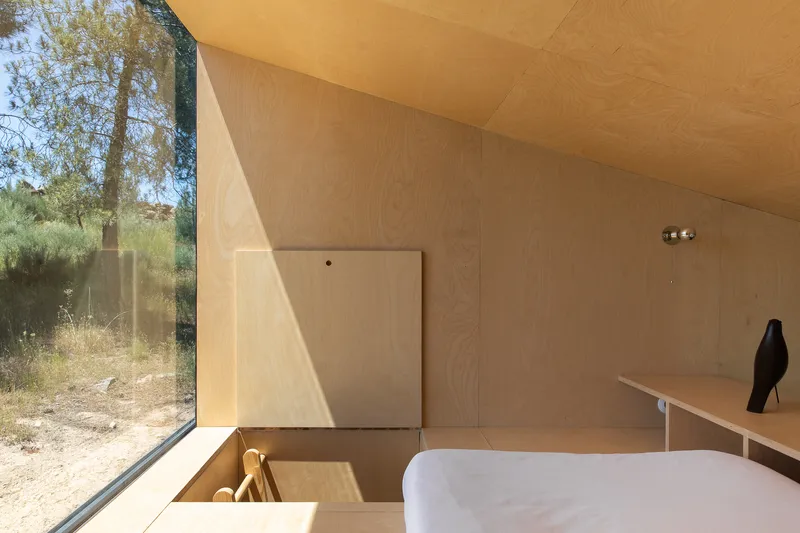

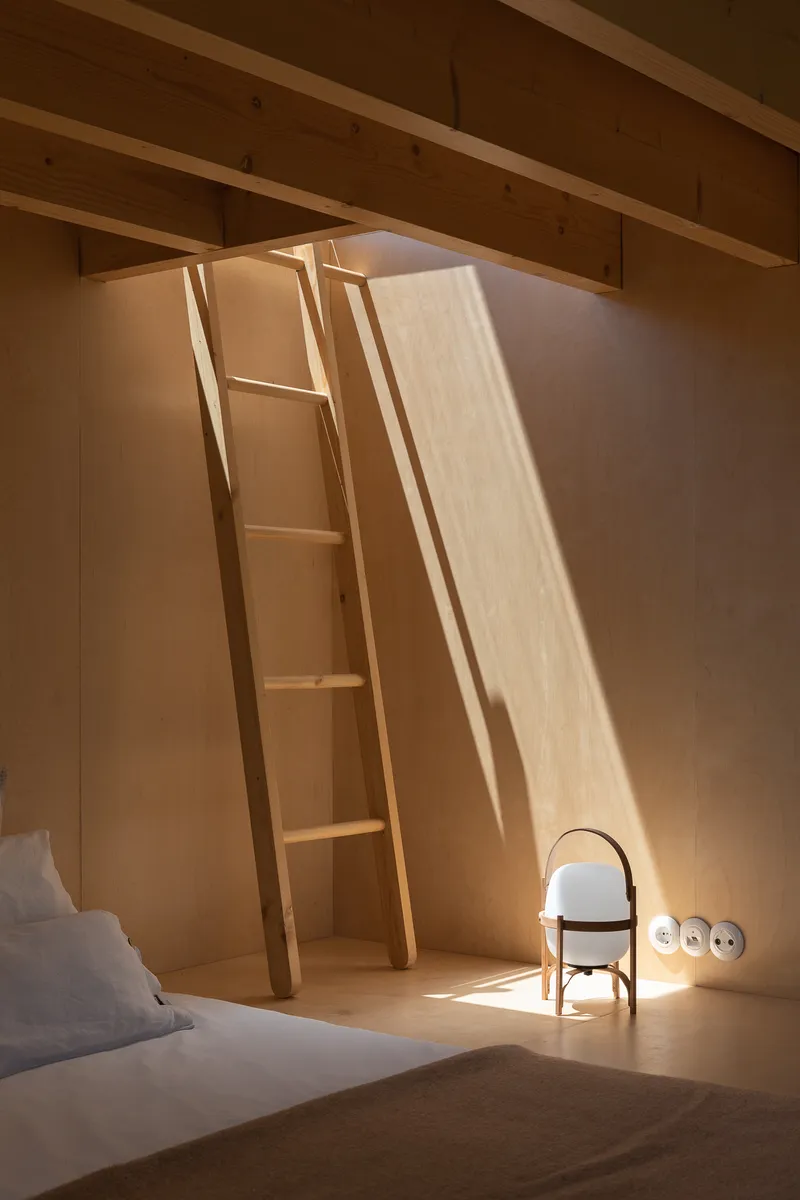
Even the bathroom gets a corner window that frames dry summer grasses at eye level from a freestanding white bathtub. It is a luxury that feels earned in a 25 m² cabin: the view is the amenity, not the square footage. Elsewhere, a plywood desk beneath a window catches dappled sunlight through the branches, and a timber ladder leans against the wall beneath exposed roof beams, catching afternoon light in a composition that is almost still-life in its precision.
Seasonal Character
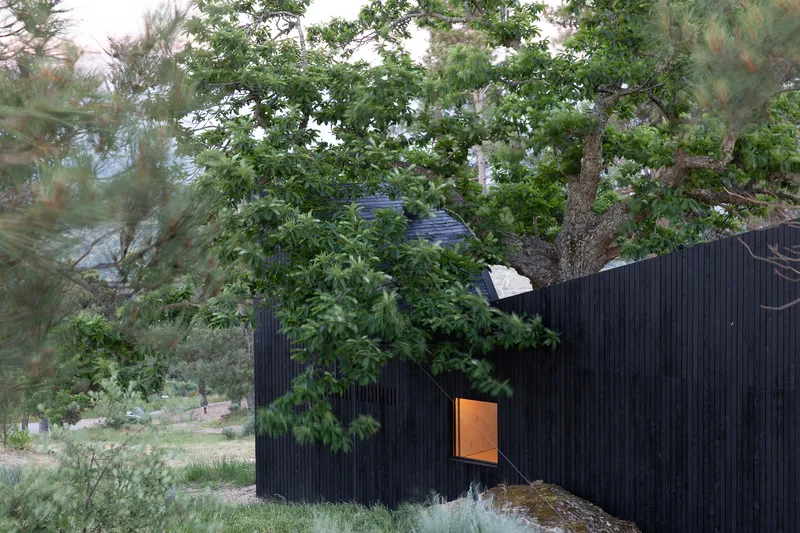
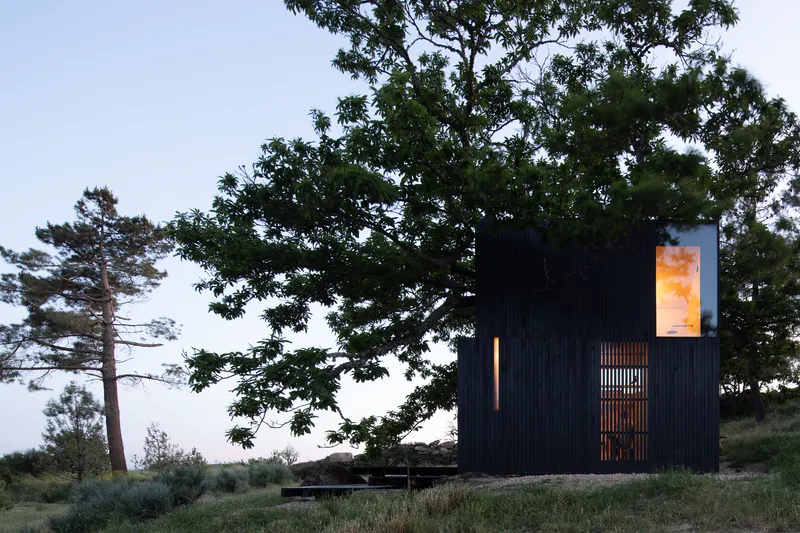

The photographs across seasons reveal a building that changes its personality without changing its form. In summer, dense foliage envelops the black volumes and the glowing square window reads as a firefly in the canopy. In winter, bare branches expose the butterfly roofline against an overcast sky, and moss-covered limbs frame the dark cladding in greens and grays.
Cork insulation panels, chosen for their negative carbon footprint due to CO2 sequestration during the cork oak's growth, and the high degree of thermal and acoustic insulation they provide, keep the interior comfortable across these shifts. The cabin is designed to be inhabited year-round, not just as a fair-weather retreat.
Plans and Drawings
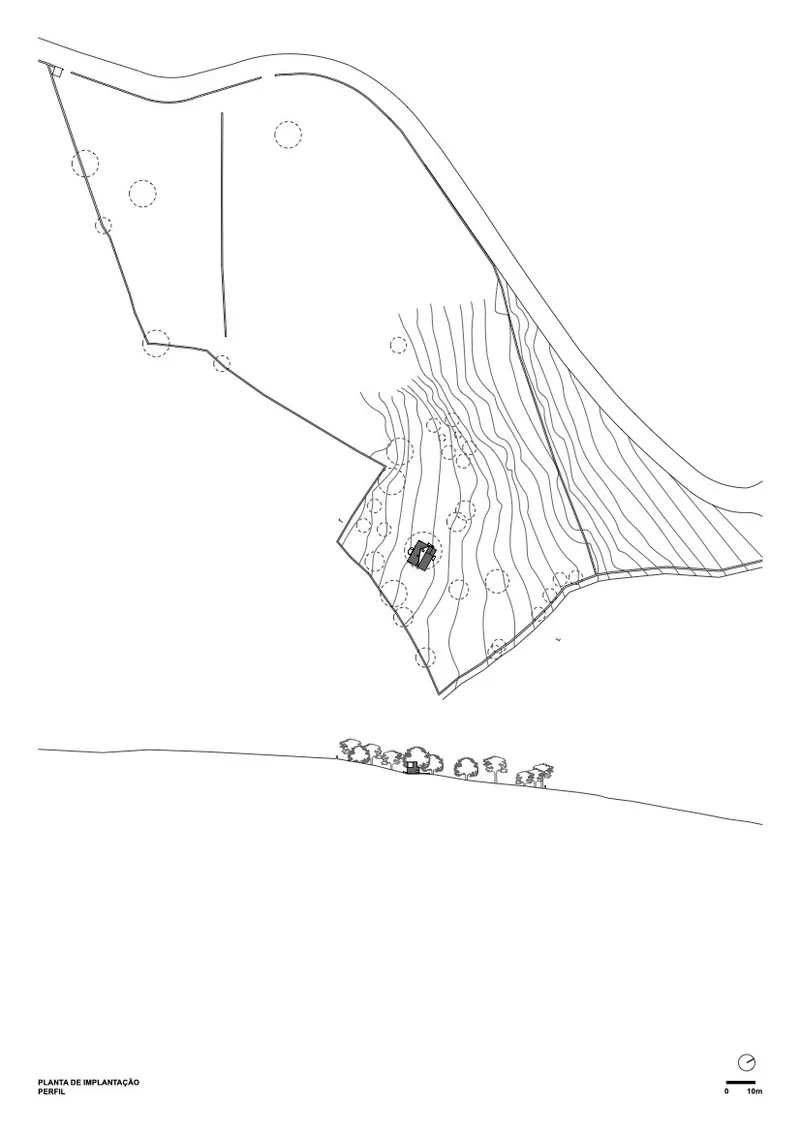

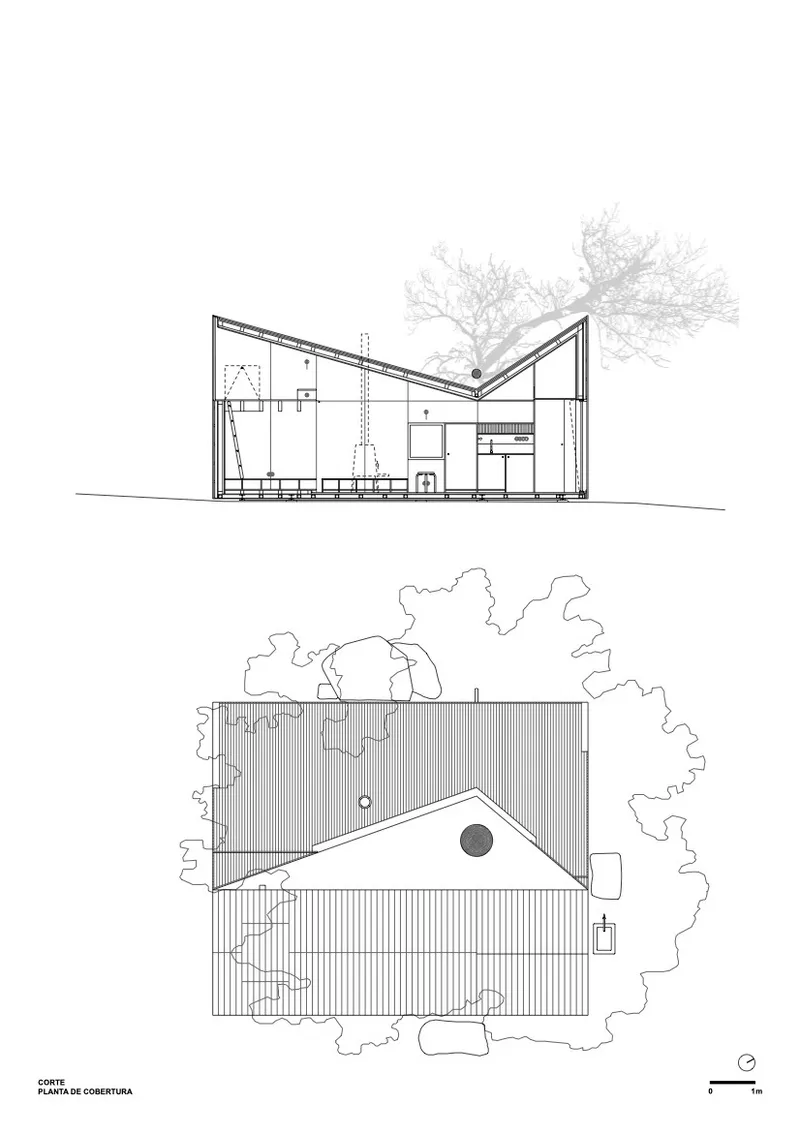


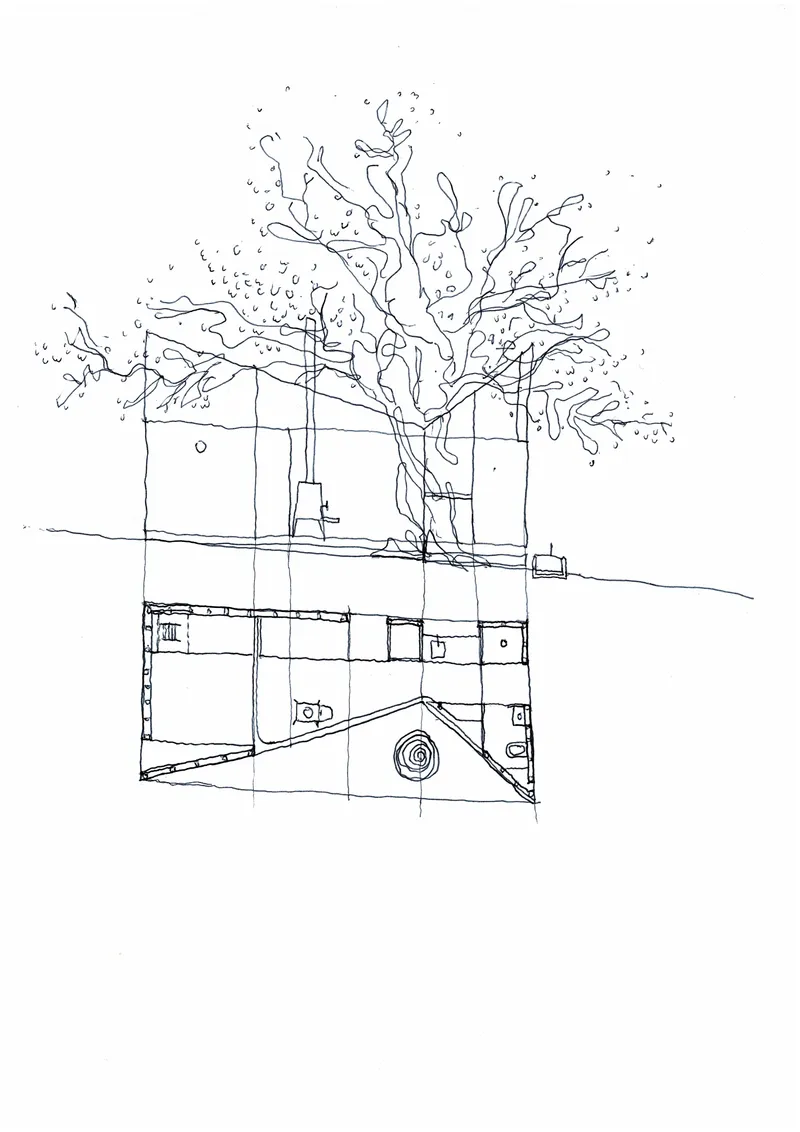


The drawings tell the story of how the project evolved. Early conceptual sketches show mannequin figures testing various pitched-roof configurations, exploring how much space a person actually needs. The axonometric studies reveal a systematic process of massing development, from simple volumes to the final complex composition with its angled walls and split roof planes.
The exploded axonometric is particularly revealing: the structural system of certified pine pillars and beams (100×70 mm) is separated into roof, deck, and foundation layers, showing how OSB boards coat both the interior and exterior of the timber frame before cork insulation and modified wood cladding are applied. The section drawing with the tree growing through the structure is the project's clearest conceptual statement: the building is a guest of the landscape, not its owner.
Why This Project Matters
Chestnut House matters because it treats smallness not as a constraint to overcome but as a design principle to exploit. At 25 m², the project cannot afford a wasted gesture, and Mendes Ribeiro does not offer one. Every material decision, from cork insulation with a negative carbon footprint to certified pine framing described as fast-growing and reusable, serves both a performative and an ethical purpose. The result is a cabin that sequesters more carbon than it emits, shelters its occupants through four seasons, and leaves its site essentially undisturbed.
More importantly, the project redefines what minimum space means. By eliminating the living room and relocating daily life to the deck beneath the chestnut canopy, Mendes Ribeiro argues that interior square footage is not the measure of inhabitable space. The landscape is the living room. The cabin is just the place you sleep, cook, and bathe. It is a radical proposition delivered in the quietest possible voice, a black box in a forest that yields its geometry to a tree.
Chestnut House by João Mendes Ribeiro, Vale Flor, Portugal. 25 m². Completed in 2020. Photography by José Campos and João Mendes Ribeiro.
About the Studio
Share Your Own Work on uni.xyz
If projects like this are the kind of work you want to make, uni.xyz is a place to publish your own, find collaborators, and enter design competitions.




Popular Articles
Popular articles from the community


AL-JANNAH: Sustainable Architecture and Permaculture for Afghan Widows
AL-JANNAH uses sustainable architecture and permaculture to create resilient oasis of housing, learning, work and renewal for Afghan widows.

The Musturak Paradise: Senior Living Architecture for a Connected Future in Temara, Morocco
The Musturak Paradise reimagines senior living architecture in Temara via private homes, social spaces, culture, community, and shared care.

Conexión: Biophilic Design Reimagines High-Rise Living in Hong Kong
Conexión reimagines high-rise living in Hong Kong through biophilic design, green facades, shared spaces, daylight, water and nature within.

Co-Life: Senior Housing Design That Reconnects Older Adults With the City
Co-Life reimagines senior housing design through healing gardens, shared streets, workshops, and a sustainable community across generations.


Similar Reads
You might also enjoy these articles

Bao Huynh Watercolor Atelier: A Serene Art Retreat in Hội An
Bao Huynh Watercolor Atelier in Hội An blends multifunctional art spaces, sustainable design, local materials, and family-friendly living in a serene environment.

Atelier Macri Concept Store Interior Design by CASE-REAL
Atelier Macri store features a "ko" counter, walnut wood details, cork displays, blending retail, gallery, and seamless customer experiences.

Manuel Vargas Izquierdo Stadium and High-Performance Sports Center: Architectural Excellence in Jalpa de Méndez
The Manuel Vargas Izquierdo Stadium blends sustainable design, inclusive sports facilities, and cultural-inspired architecture, revitalizing Jalpa de Méndez’s public spaces.

KAKR Buluh Awar Hall: Revitalizing Community and Ecology Through Bamboo Architecture
Community built bamboo hall revitalizes Buluh Awar village, empowering youth, restoring ecology, celebrating vernacular craftsmanship through sustainable architecture and culture.


Explore Residential Building Competitions
Discover active competitions in this discipline


Challenge to design mud housing for contemporary communities


Challenge to reimagine the Iron Throne


Photograph architecture without architects


Illustrate the lost glory of Angkor Wat - Render Challenge
Comments (0)
Please login or sign up to add comments
No comments yet. Be the first to comment!