
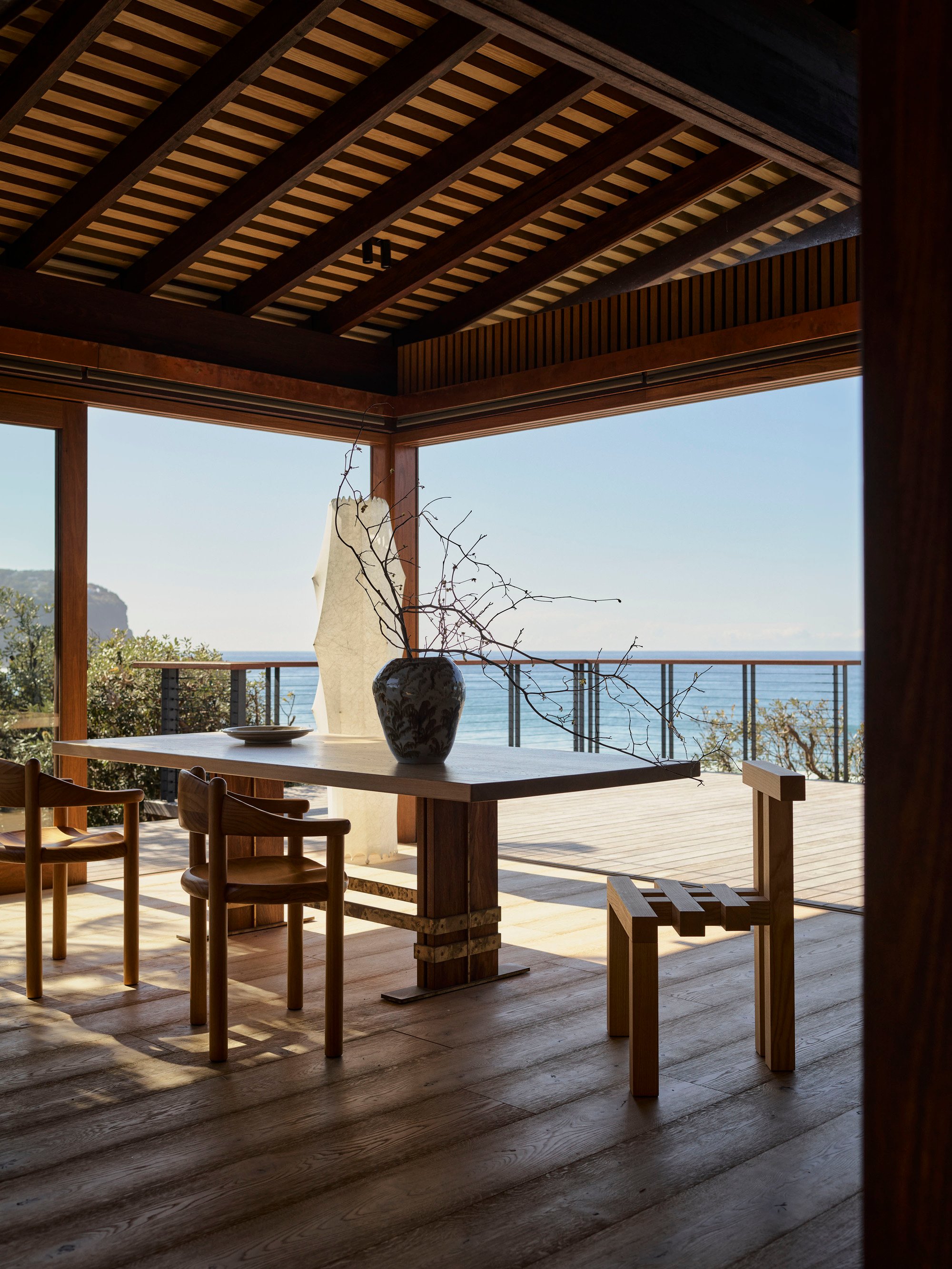
Jorge Hrdina Architects Builds a Timber Pier House on an Australian Sand Dune
Perched 50 meters from the surf at MacMasters Beach, a 600 square meter home channels wharf construction on five-story-deep piers.

Building a house on a coastal sand dune is an act of structural faith. At MacMasters Beach on the New South Wales Central Coast, Jorge Hrdina Architects drove piers roughly five stories into shifting sand to anchor a 600 square meter residence just 50 meters from the breaking surf. The result is a house that does not sit on the land so much as bridge it, conceived explicitly as a pier that mediates between the raw power of the Pacific Ocean and the sheltered canopy of a coastal dune.
What makes the project genuinely interesting is its refusal to hide the engineering. Twin posts of Victorian Ash, spaced on a tight 1800mm grid, are left fully exposed throughout the interior. Black stainless steel straps and eave plates brace the timber frame at critical junctions, creating a visual language borrowed directly from wharf and jetty construction. The house wears its structural logic on its sleeve, and the rawness becomes the architecture.
Wharf Logic as Domestic Architecture
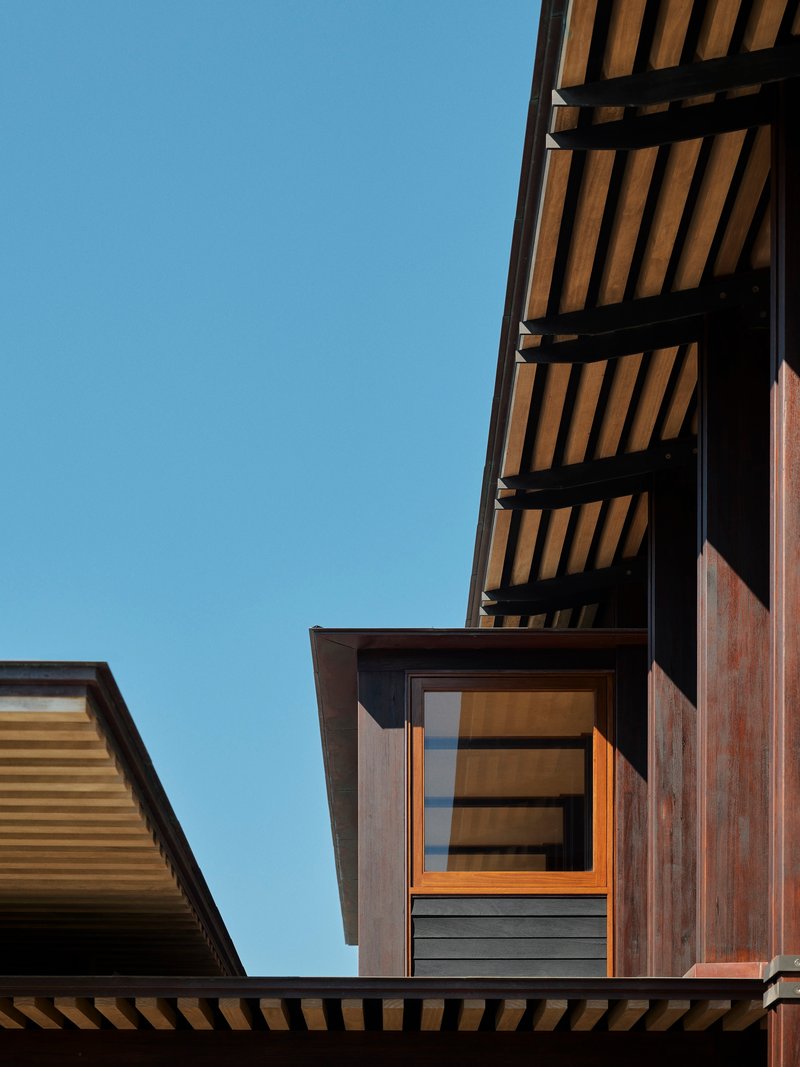
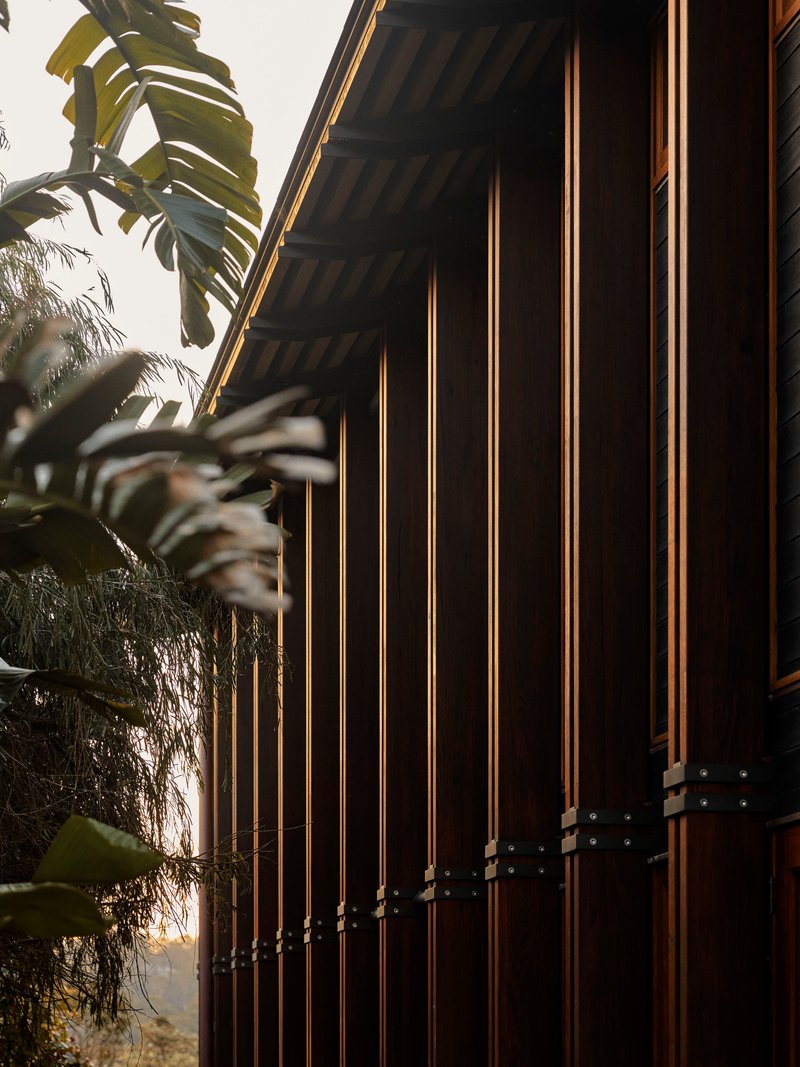
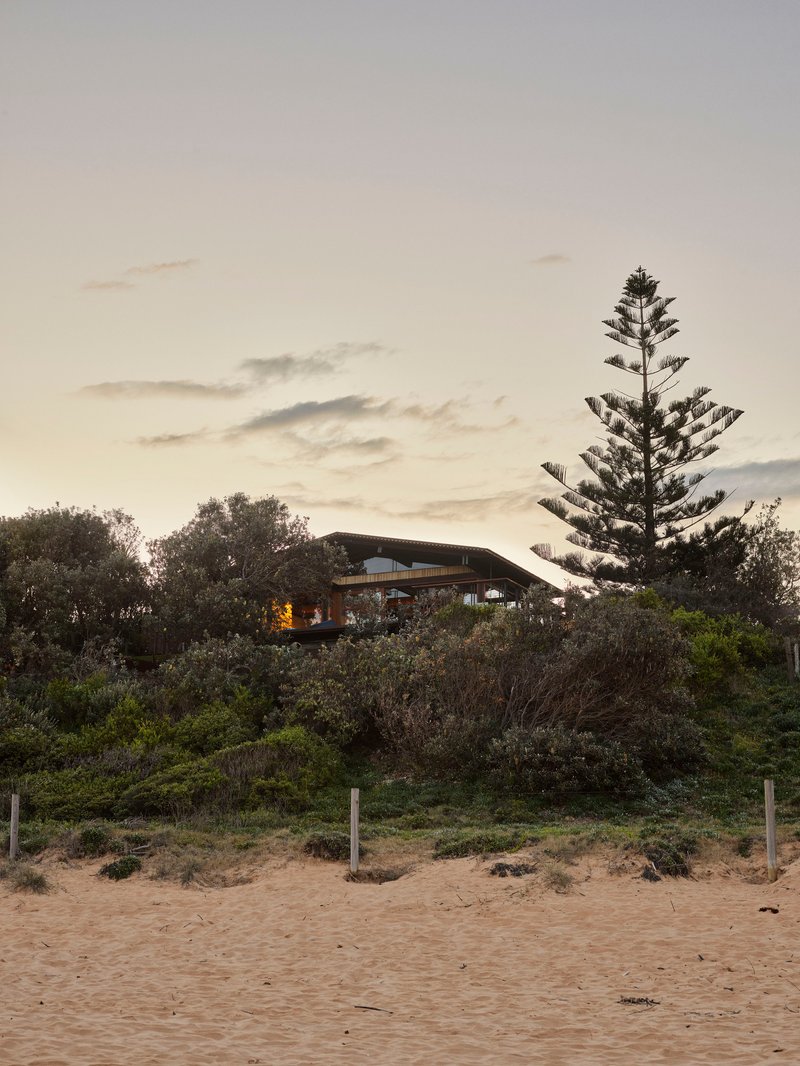
From the beach, the building reads as a series of stacked timber volumes with slatted cladding and cantilevered roof overhangs, nestled into the dune vegetation rather than imposed upon it. The curved roof structure that appears in the dusk view from the shore gives the house a profile that is more vessel than villa. Vertical timber battens clad the darker facades, punctuated by exposed metal connectors beneath deep eaves, turning structural necessity into a craft statement.
The pier metaphor is not decorative. Those subterranean foundations, reaching deep into unstable ground, are a direct response to the threat of coastal erosion. The house is designed to survive a landscape that is, by definition, retreating. This makes the exposed timber frame read less as aesthetic choice and more as honest declaration: the building's survival depends on these elements, so why conceal them?
The Timber Frame as Interior Order
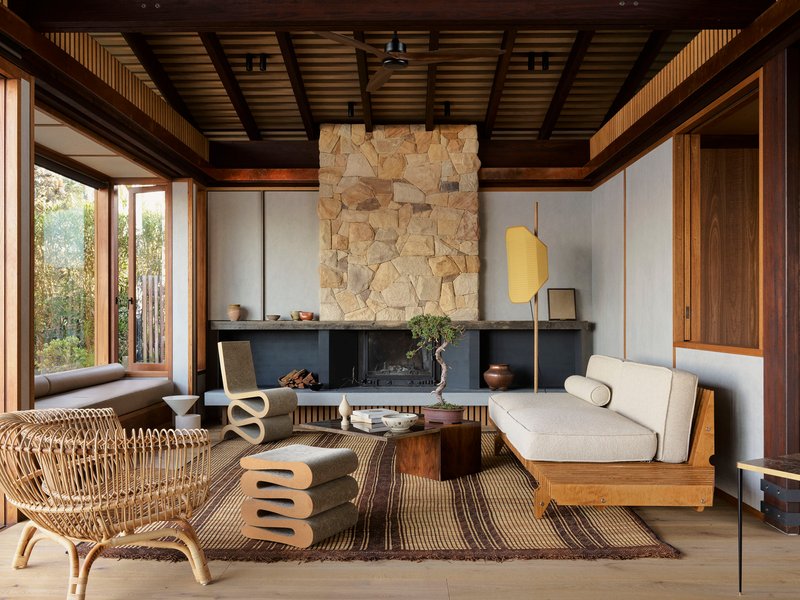
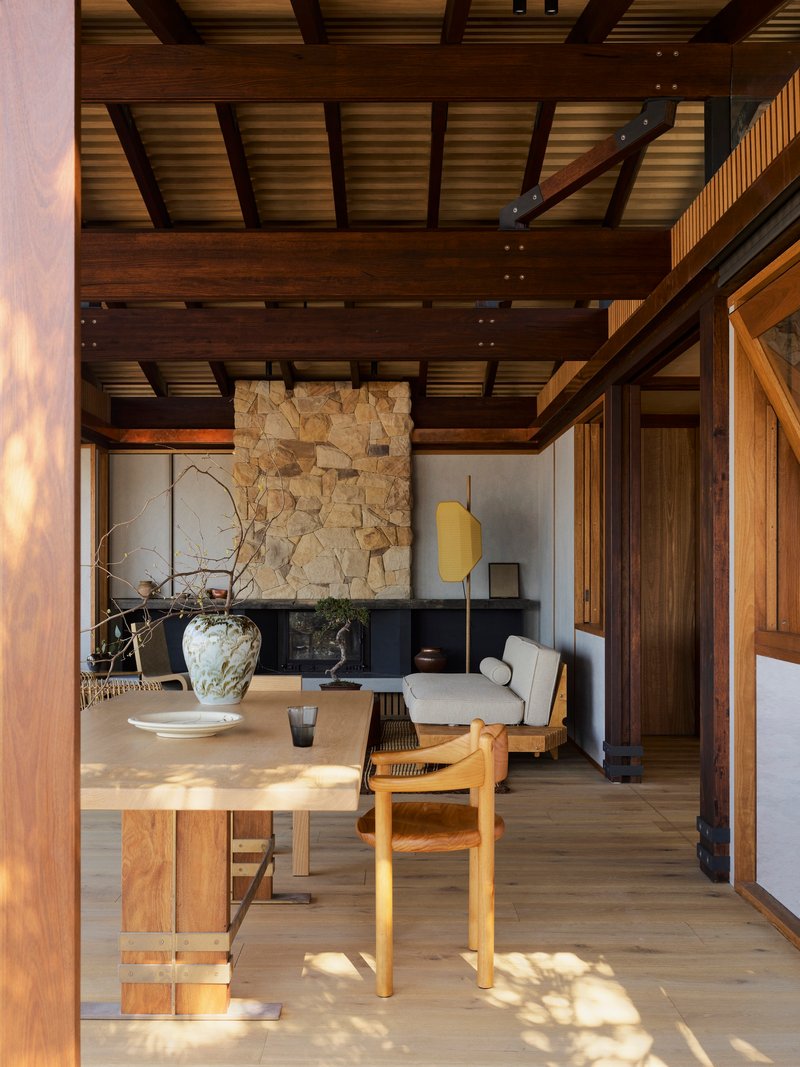
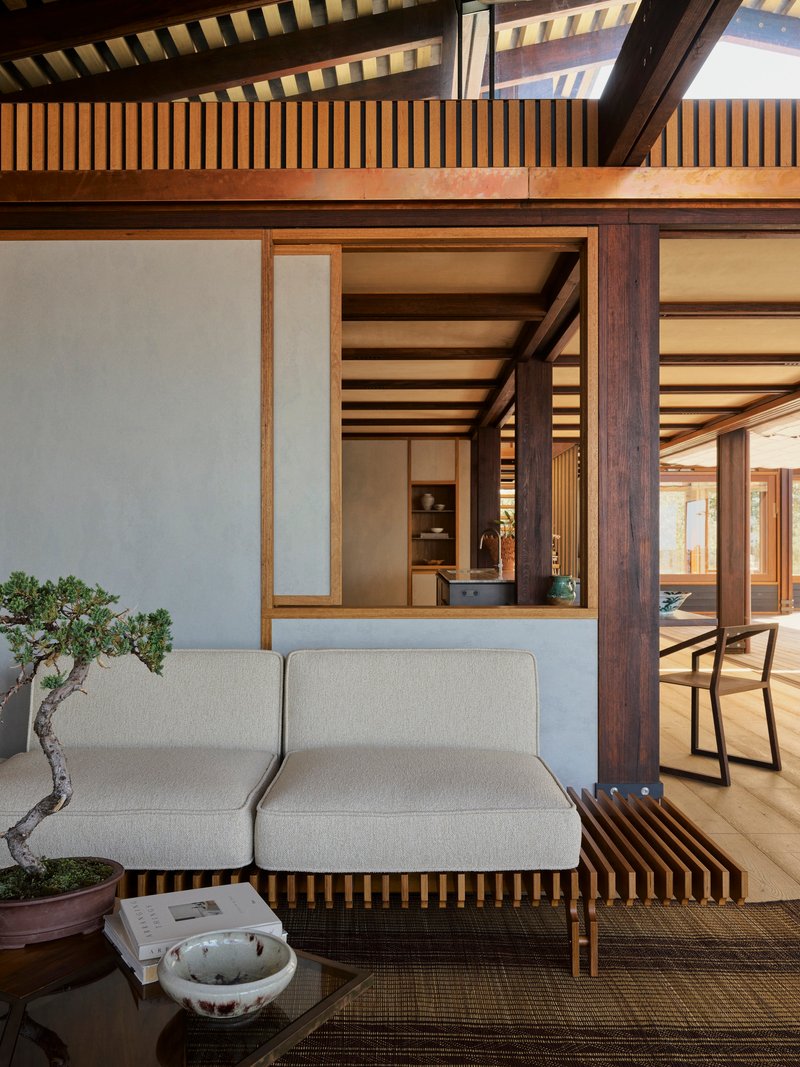
Inside, the 1800mm grid of Victorian Ash posts and beams creates a rhythm that organizes every room. In the main living space, the exposed ceiling structure works in counterpoint with a rough stone fireplace surround, setting up a material dialogue between worked timber and raw masonry. Dappled afternoon sunlight filters through the coastal canopy and into the space, animating the grain of the timber and the texture of the stone.
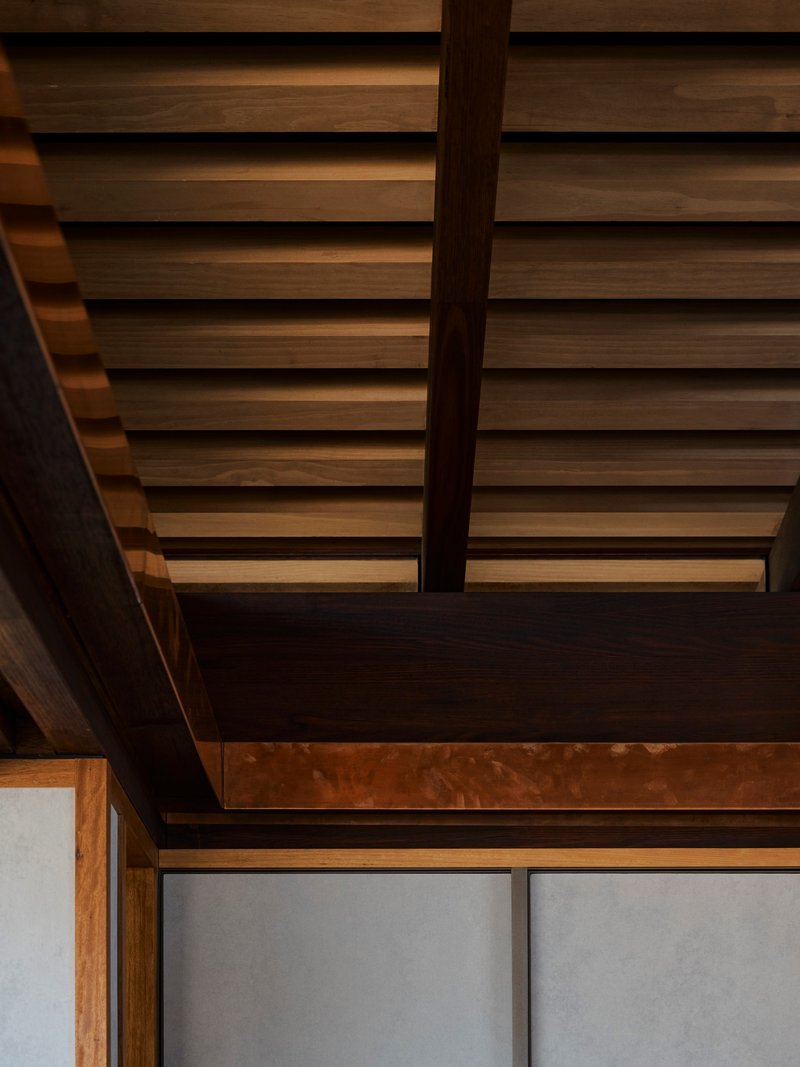
The ceiling detail is worth studying closely. Horizontal wood slats span between exposed beams, and at the junctions where timber meets steel, dark connectors mark the transfer of forces. These details are not hidden above plasterboard; they are the ceiling. The effect is a kind of tectonic transparency that gives the interiors their particular warmth and clarity.
Living Between Canopy and Ocean
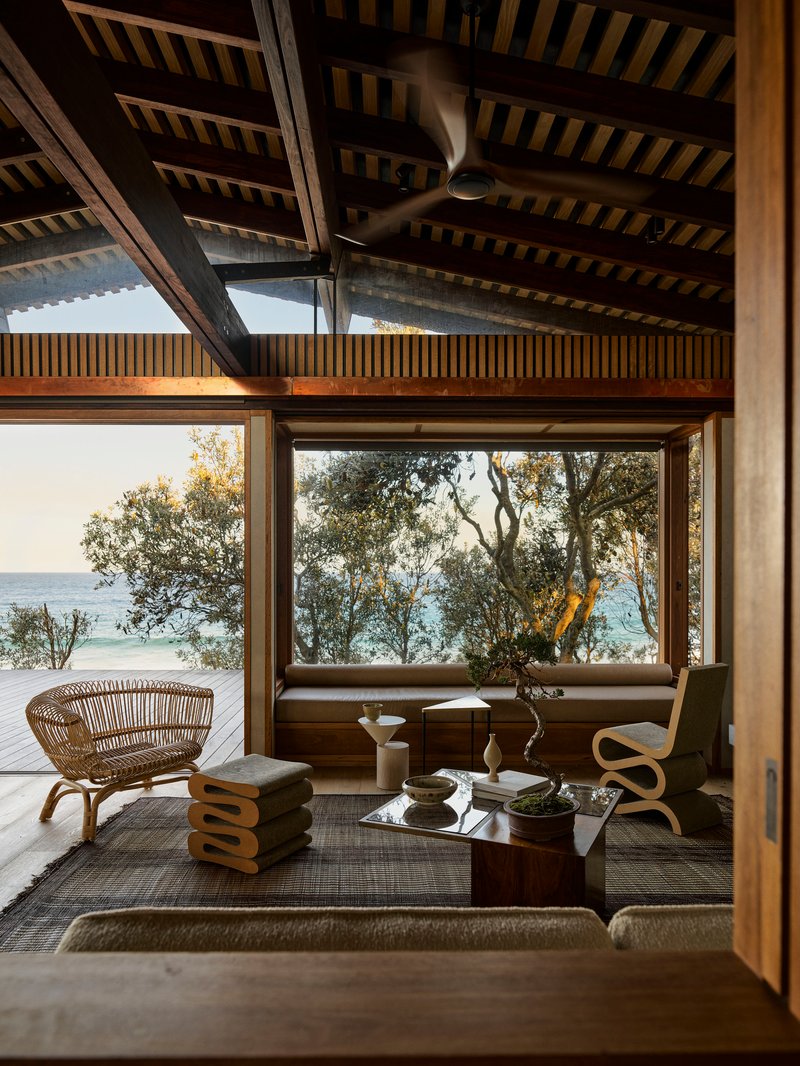
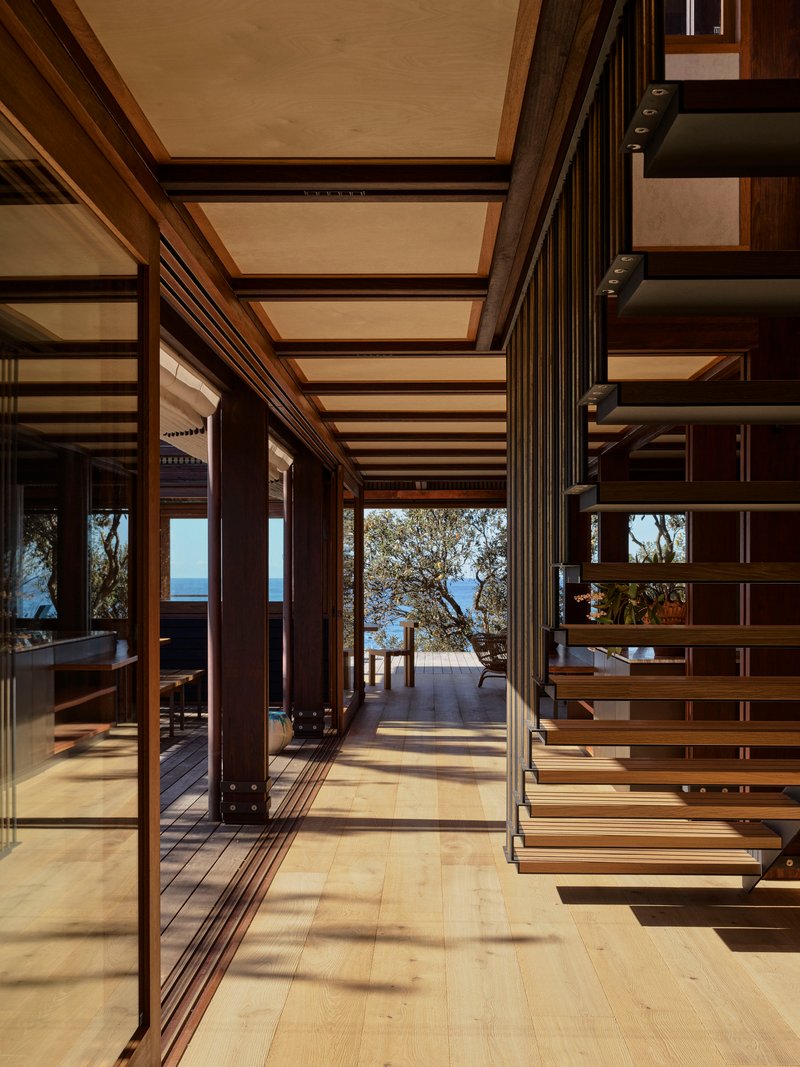
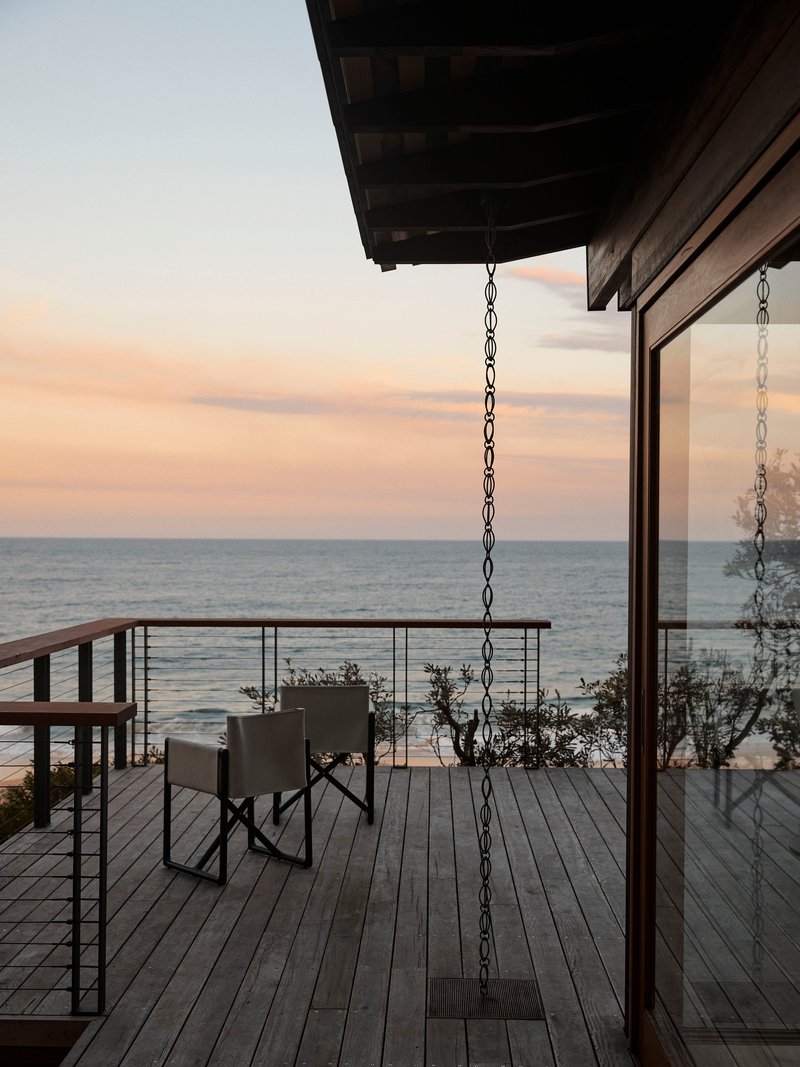
The house is calibrated to frame two very different landscapes. From glazed corner openings, the Pacific Ocean appears through layers of coastal vegetation, filtered and softened by the dune ecology. An open-tread timber stair beside folding glass doors leads down to a deck where the ocean horizon is presented without interruption. The transition from sheltered interior to exposed deck happens quickly, and the architecture makes that threshold legible.
At dusk, a chain-suspended bench on the timber deck becomes perhaps the most telling detail of the project's attitude: relaxed, physical, a little rough. The sliding glass doors behind it dissolve the enclosure entirely, so the bench belongs as much to the interior as to the coastline. It is furniture as infrastructure, consistent with the pier logic that runs through the whole design.
Outdoor Rooms and the Forecourt
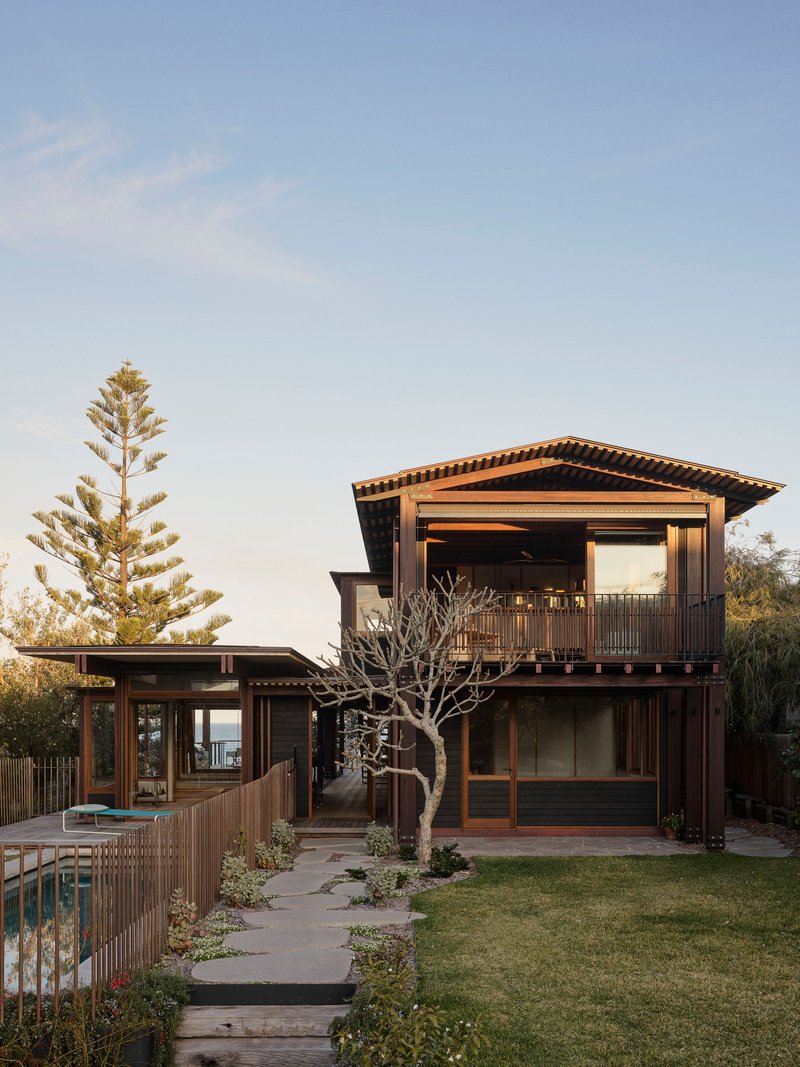
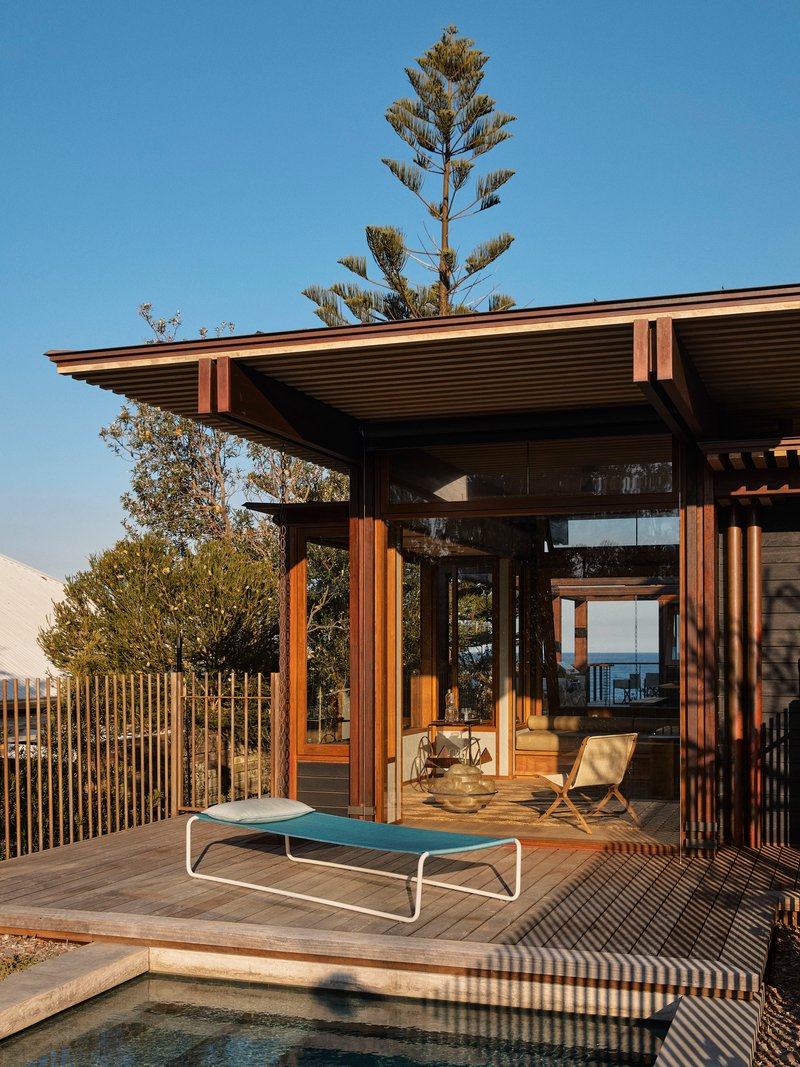
The garden side of the house reveals a quieter register. Timber-framed volumes with deep overhangs create sheltered zones around a lawn where a bare tree anchors the composition. The poolside deck, screened by timber louvers and protected by wide eaves, catches late afternoon light in a way that makes it function as an outdoor room rather than a leftover between building and boundary.
A covered seating area with a slatted timber bench and exposed beam ceiling operates as a transitional threshold, looking through to interior spaces beyond. The forecourt that the plan describes, framed by roof gardens and water features, binds these outdoor rooms into a coherent sequence. The house does not simply open onto its site; it constructs a series of calibrated outdoor enclosures.
Interior Moments and Material Restraint
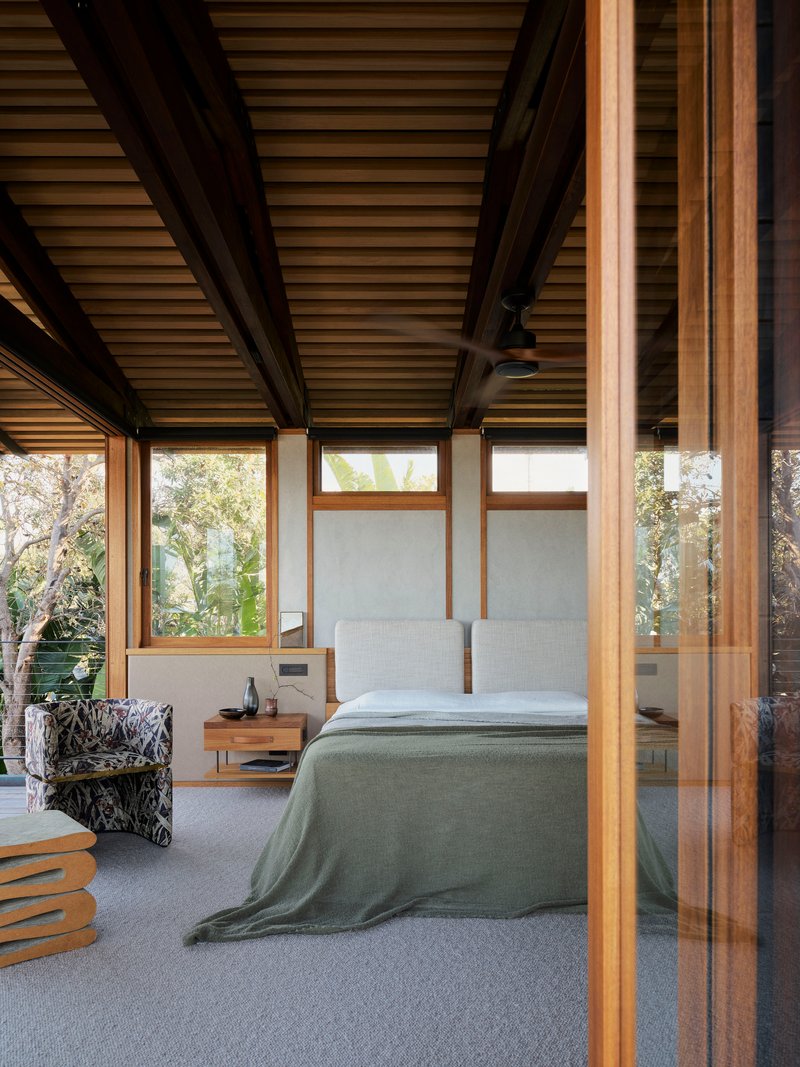
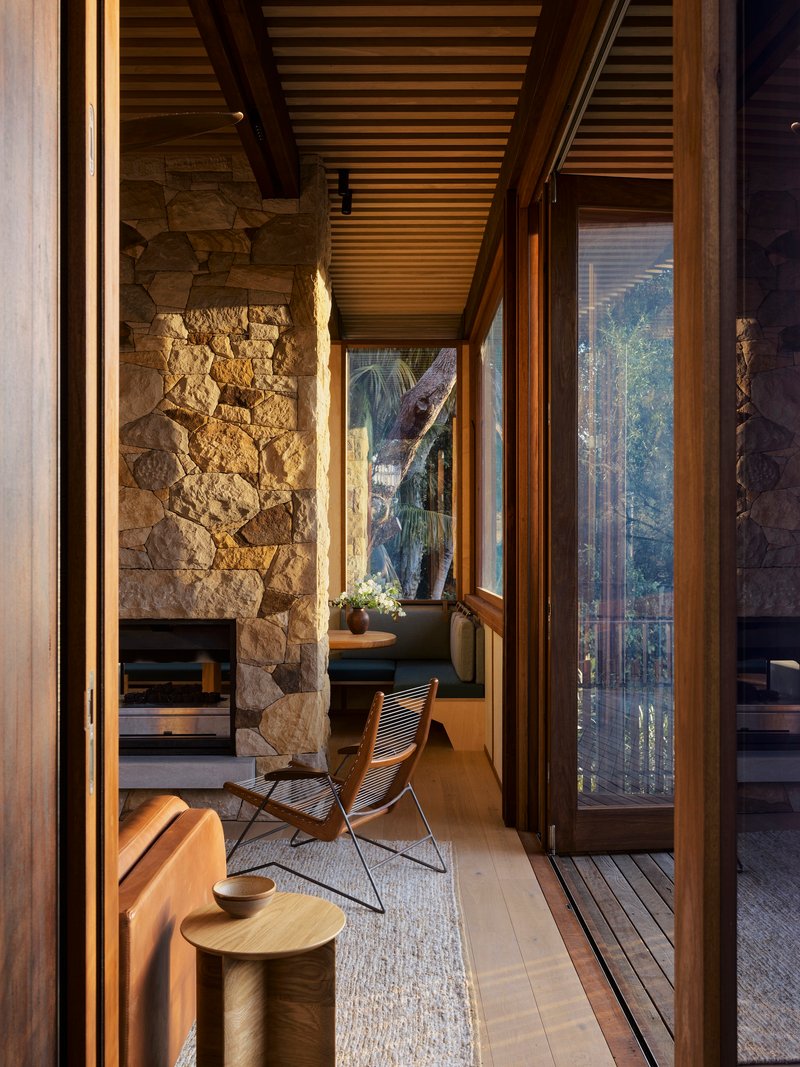
The bedrooms sit within the dark timber structure, with continuous ribbon windows that float the eye line across the treetops. It is a smart move: the bed level gets canopy, not surf, reinforcing the sense of sleeping within a sheltered nest above the dune. A narrow reading nook lined with stone wall and furnished with a single timber chair captures the project's spatial economy, carving out a moment of stillness within the exposed structural grid.
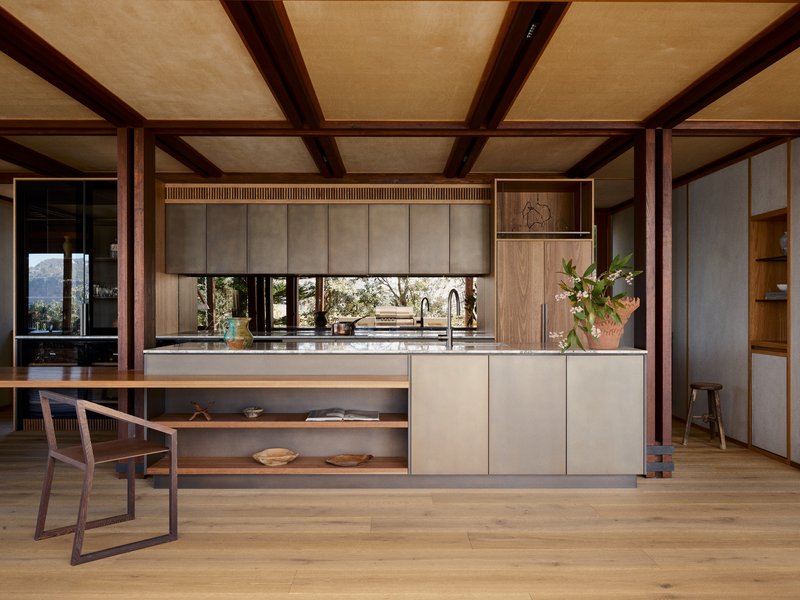
The kitchen, by contrast, pulls back. Pale cabinetry and flat ceiling panels provide visual relief beneath the timber frame, letting the structure register without dominating the functional core of the house. The material palette throughout is deliberately limited: timber, stone, steel, glass. No plaster heroics, no gratuitous color. The restraint lets the structural system remain the primary visual event.
Thresholds and Circulation
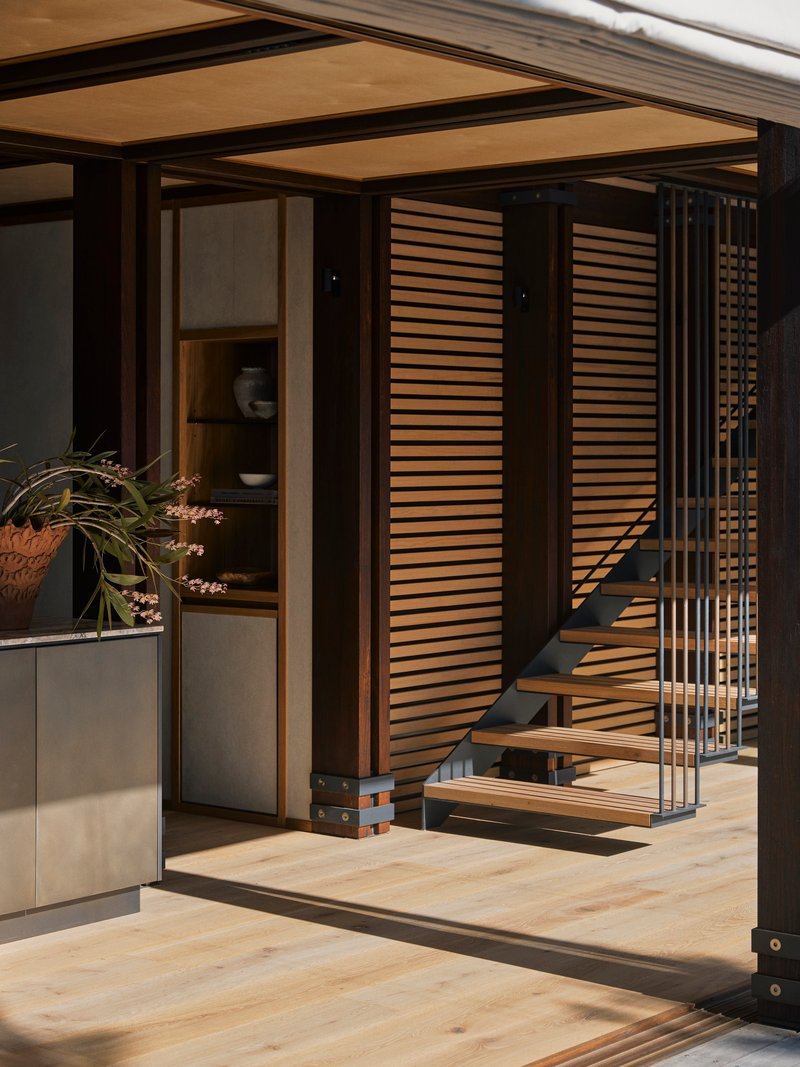
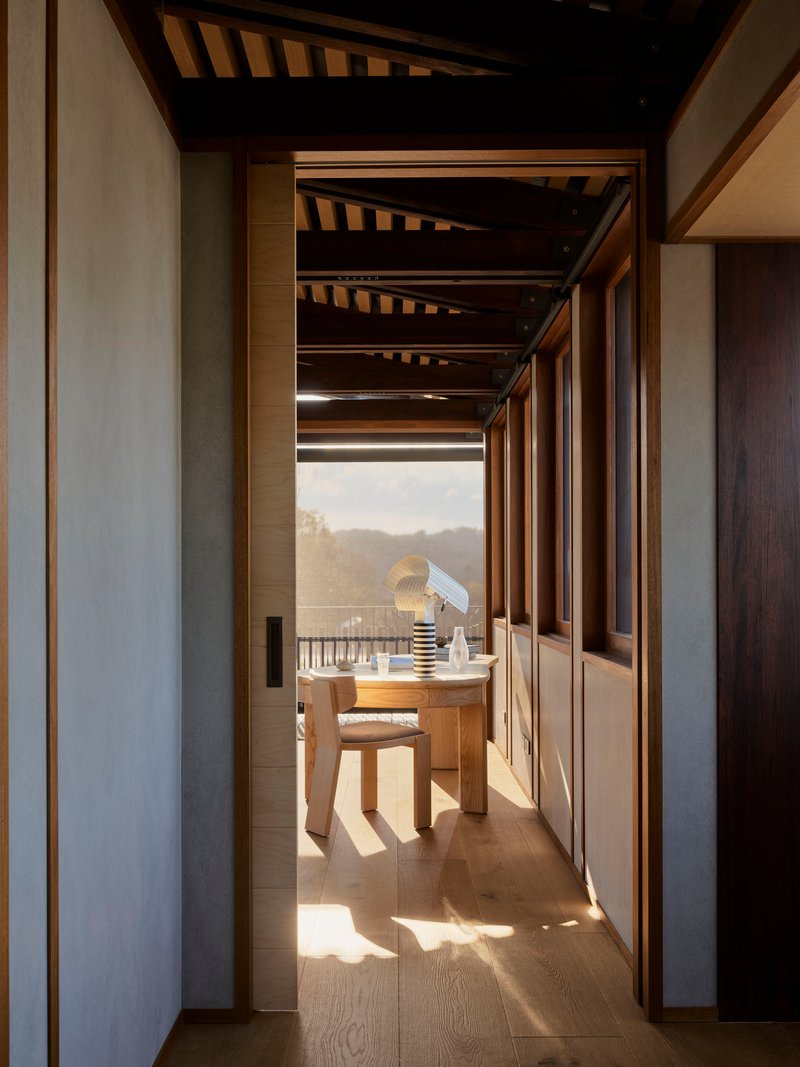
The circulation spaces deserve attention because they are where the pier metaphor becomes most convincing. An open timber-framed threshold flanked by horizontal slatted screens frames a steel and wood staircase that reads like a gangway. A narrow hallway with exposed timber ceiling beams leads to a desk and chair lit by a single wash of sunlight, turning what could be dead corridor space into a habitable pause.
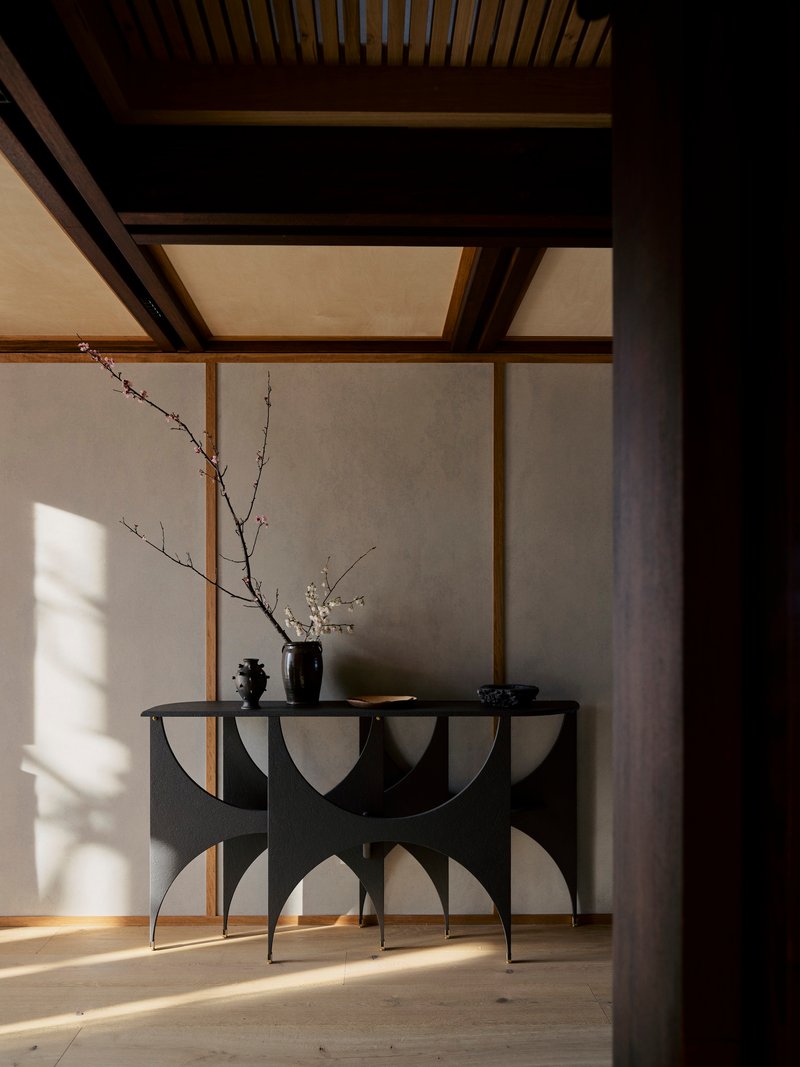
Even the decorative moments play along. A sculptural black console table with a flowering branch sits against a timber-framed wall in morning light, and the composition feels earned precisely because the architecture behind it is so direct. Ornament works best when the structure it adorns is already legible.
Plans and Drawings
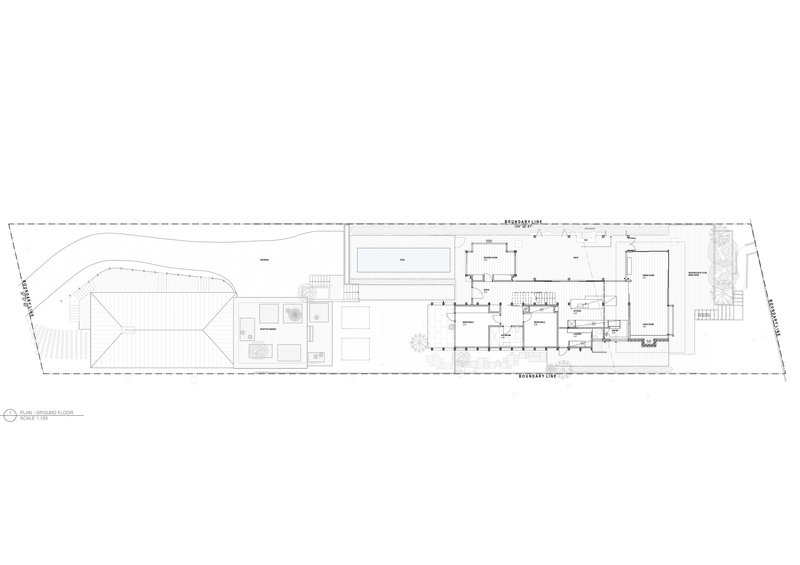
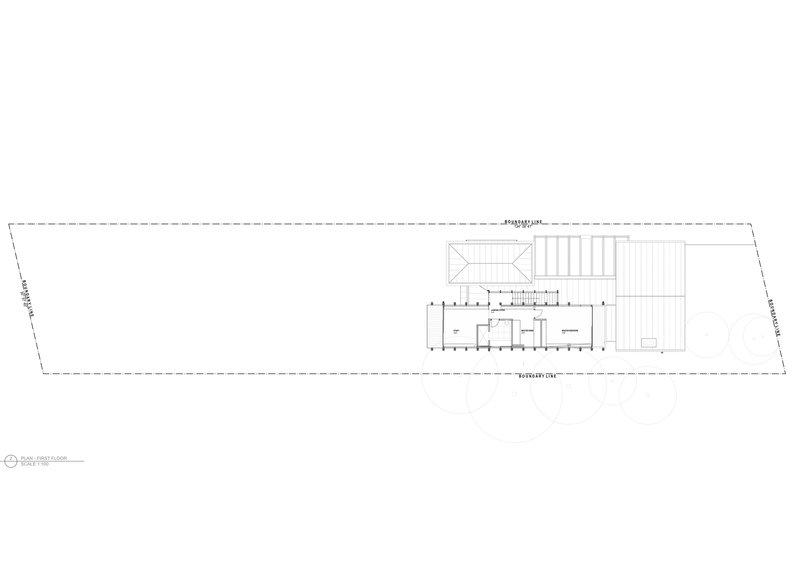
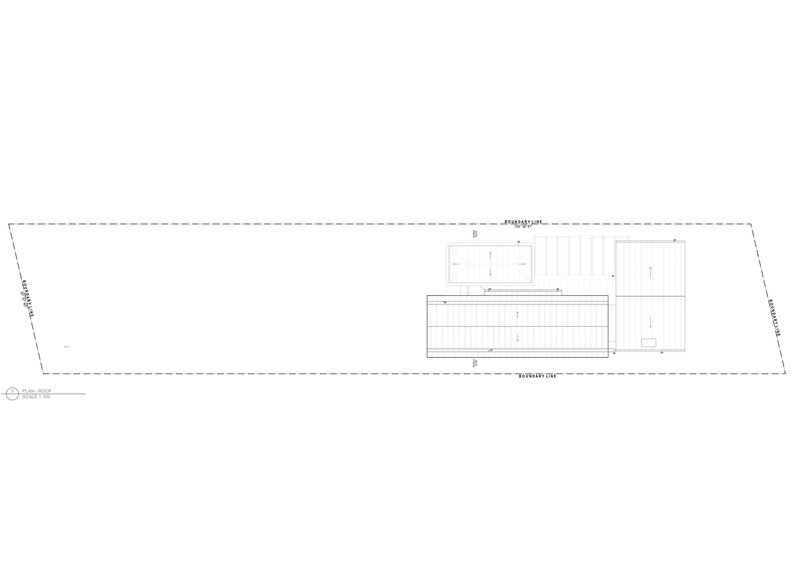
The ground floor plan reveals how the house organizes itself along the narrow dune site, with a pool and a curved-roof volume defining the primary gesture. The upper level opens onto generous decks and covered areas that extend the footprint beyond the enclosed rooms. The roof plan makes the curved canopy legible as the project's most distinctive formal move, a sweeping line that ties the disparate volumes together and channels wind over the building rather than against it.
Reading these plans together, the structural grid becomes clear as the generating idea. Every wall, every opening, every beam aligns to the 1800mm module. The discipline of the grid is what allows the house to feel both open and robust, because every element is doing structural work and every span is controlled.
Why This Project Matters
Coastal houses in Australia have a long and uneven history of treating the beach as backdrop. Too many default to white walls and picture windows, producing interiors that could be anywhere with a view. Macmasters takes a different position. By grounding its entire architectural language in the structural reality of building on an eroding sand dune, Jorge Hrdina Architects produces a house that could only exist in this specific, precarious place. The pier is not a metaphor layered on afterward; it is the literal engineering solution that shapes every room.
The broader lesson here is about honesty of means. When the structure is the architecture, when the material palette is governed by what the site demands rather than what a mood board suggests, the result tends to age well. Victorian Ash will silver and weather. The steel straps will patina. The dune will continue to shift. This house is designed not just to survive those changes but to look better because of them, and that kind of long-term thinking is rarer than it should be.
Macmasters by Jorge Hrdina Architects, MacMasters Beach, Australia. 600 m², completed 2023. Photography by Anson Smart.
About the Studio
Share Your Own Work on uni.xyz
If projects like this are the kind of work you want to make, uni.xyz is a place to publish your own, find collaborators, and enter design competitions.




Popular Articles
Popular articles from the community

Flow: Spatializing Well-being Through Intersecting Layers
Transforming the inner depth of wellness into a spatial reality.

Tanghua Architects and Associates Build a Documentary Film Museum from Folded Concrete in Xichang
A museum dedicated to documentary cinema uses raw concrete planes and circular apertures to frame China's Anning River Valley.

Taller MACAA Weaves Adobe Lodging into the Sacred Valley at 3,100 Meters Above Sea Level
Dormis Donata bridges permanent and temporary inhabitation through earthen construction in the agricultural highlands of Taray, Peru.
OMAMBO and DORON Atelier Weave Two Cultural Identities into an 80 m² Bucharest Apartment
Rather Two layers Romanian and Angolan heritage through stucco, recycled plastics, and deliberate spatial contrasts in central Bucharest.


Similar Reads
You might also enjoy these articles

20 Most Popular Furniture Design Projects of 2025
Modular street systems, parametric benches, and insect hotels: the furniture design projects that captivated architects on uni.xyz in 2025.

STEM School Mechelen by LAVA Architecten: A Future-Ready Educational Architecture in Belgium
Flexible, sustainable STEM school in Mechelen featuring modular classrooms, acoustic innovation, and energy-efficient design supporting future-focused collaborative learning environments.
Marvila Apartment Renovation in Lisbon: A Bright Minimalist Attic Transformation by KEMA Studio
Bright attic transformed into minimalist Lisbon apartment with skylights, sustainable materials, open plan layout, and industrial-inspired interior design elements.
20 Most Popular Commercial Architecture Projects of 2025
From sustainable market concepts to heritage factories, the commercial buildings and proposals that drew the most attention on uni.xyz this year.


Explore Architecture Competitions
Discover active competitions in this discipline




The International Standard for Design Portfolios


The Global Benchmark for Architecture Dissertation Awards


The Global Benchmark for Graduation Excellence


Challenge to reimagine the Iron Throne
Comments (0)
Please login or sign up to add comments
No comments yet. Be the first to comment!