
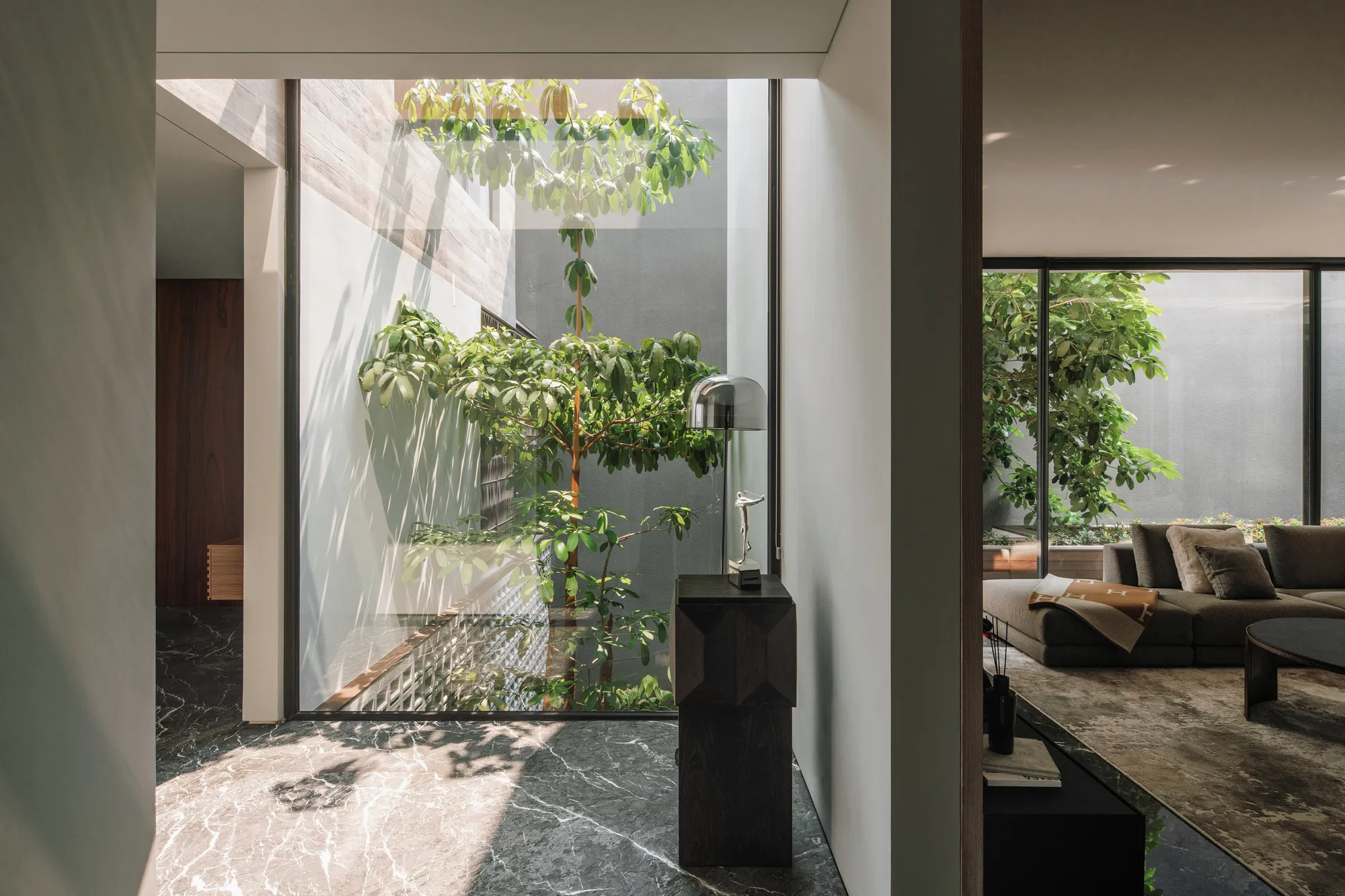
JT Residence Wraps Jakarta Living in Woven Light
Wahana Architects layers lattice screens and interior courtyards to craft an 800 sqm tropical house that breathes through every surface.


Jakarta's residential fabric tends toward two extremes: sealed glass boxes that rely entirely on mechanical cooling, or heritage kampung houses that lack the structural ambition of contemporary programs. The JT Residence by Wahana Architects refuses both poles. Lead architect Rudy Kelena has designed an 800 square meter house that stacks, screens, and perforates its way toward a convincing third option, one where tropical climate is not a problem to solve but a resource to harness.
What makes the project genuinely interesting is not the woven lattice alone, which has become something of a trope in Southeast Asian residential architecture. It is the way the lattice works in concert with planted courtyards, cantilevered volumes, and carefully calibrated section cuts to produce a house that modulates light, airflow, and privacy simultaneously. Every room connects to an outdoor condition, and every outdoor condition is shaped by architecture rather than merely enclosed by it.
A Facade That Filters Rather Than Blocks
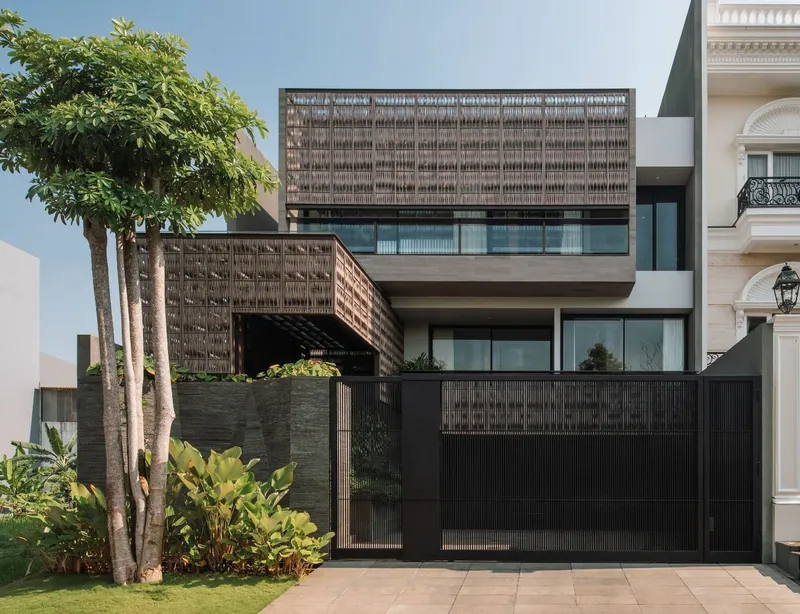
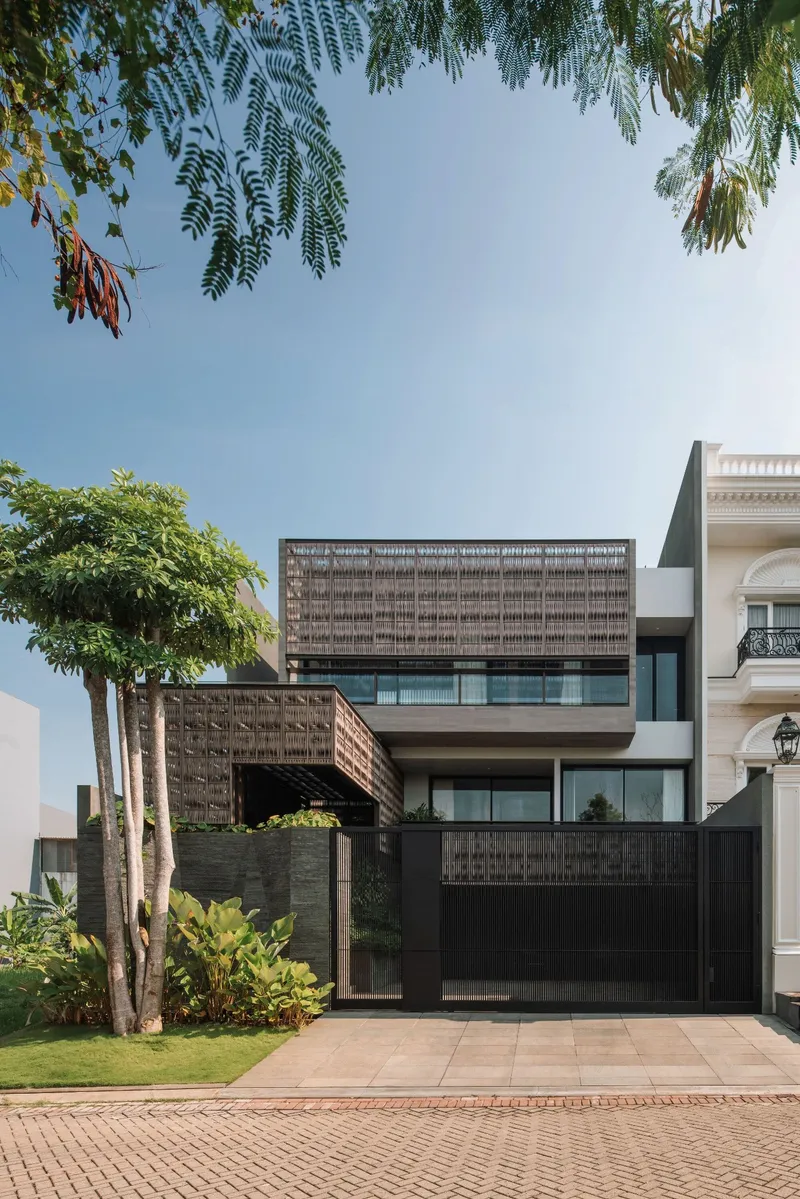
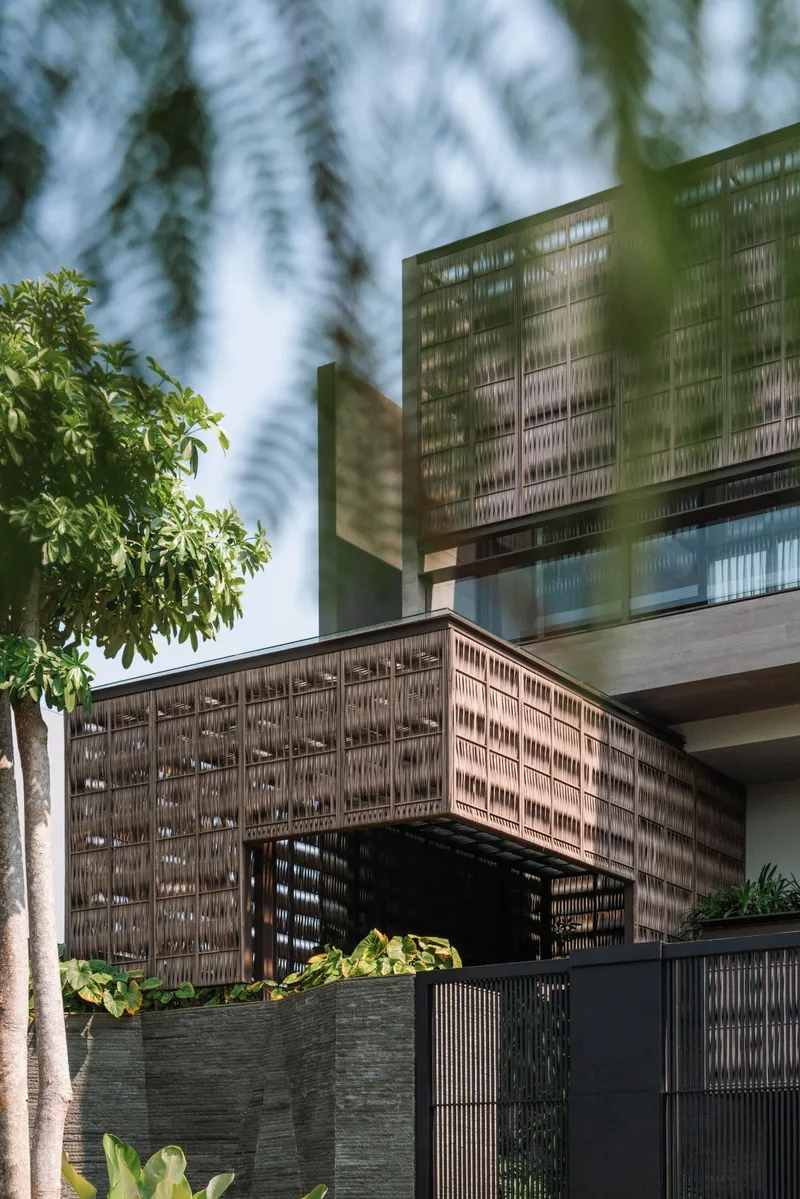
From the street, the JT Residence reads as a composition of stacked volumes wrapped in woven lattice screens. The texture is consistent but never monotonous: ground-level panels are set behind a black metal gate and flanked by tropical planting, while the upper volume cantilevers outward, changing the depth of shadow cast across the facade throughout the day. Viewed from below, the screens dissolve into a luminous mesh, filtering equatorial sun into a fine grain of dappled light.
The cantilevered upper floor is a bold structural gesture, but it also serves a practical purpose. It shelters the entrance zone and the ground floor from direct rainfall while drawing fresh air upward through the gap between the two volumes. The lattice is not decorative overlay; it is the primary environmental mediator between the Jakarta streetscape and the private interior world.
Courtyards as Rooms, Rooms as Courtyards
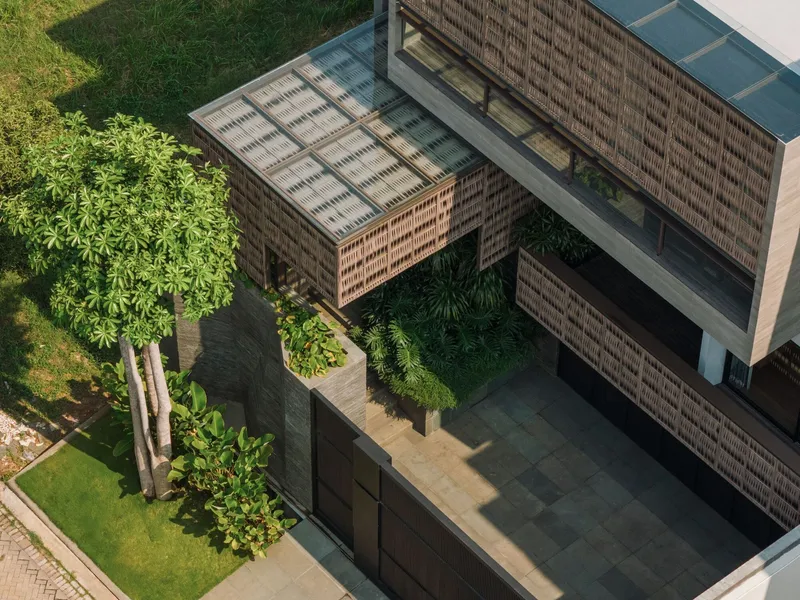
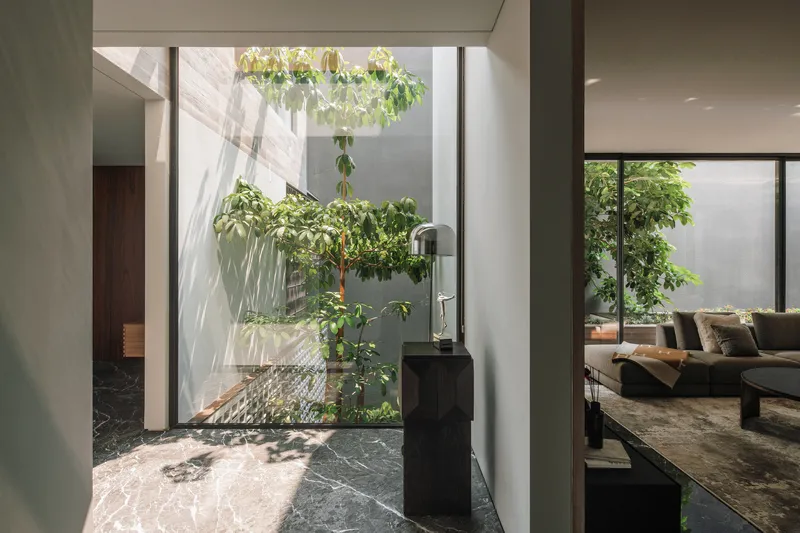
Seen from above, the house reveals its organizing logic: brick-screened volumes frame a central courtyard planted with trees. The courtyard is not leftover space between built mass. It is the center of gravity for the entire plan, pulling light and air down into the heart of the house. At ground level, dark marble flooring meets a single tree illuminated by filtered daylight, creating an almost sacred atmosphere in what is functionally a circulation hub.
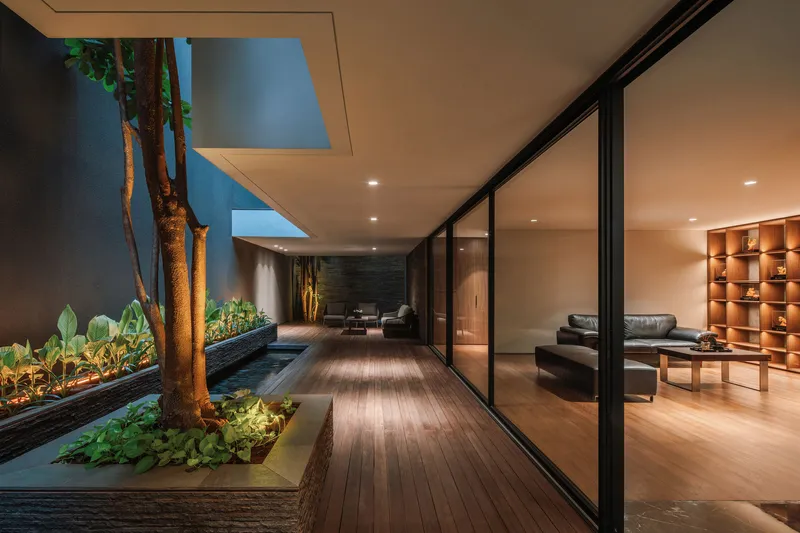
At night, the relationship inverts. The glazed living room glows outward into the planted court, turning the interior into a lantern and the courtyard into a viewing gallery. The architects understand that a courtyard house in the tropics has two entirely different characters across the diurnal cycle, and they have designed for both.
Living Spaces That Open on Every Side
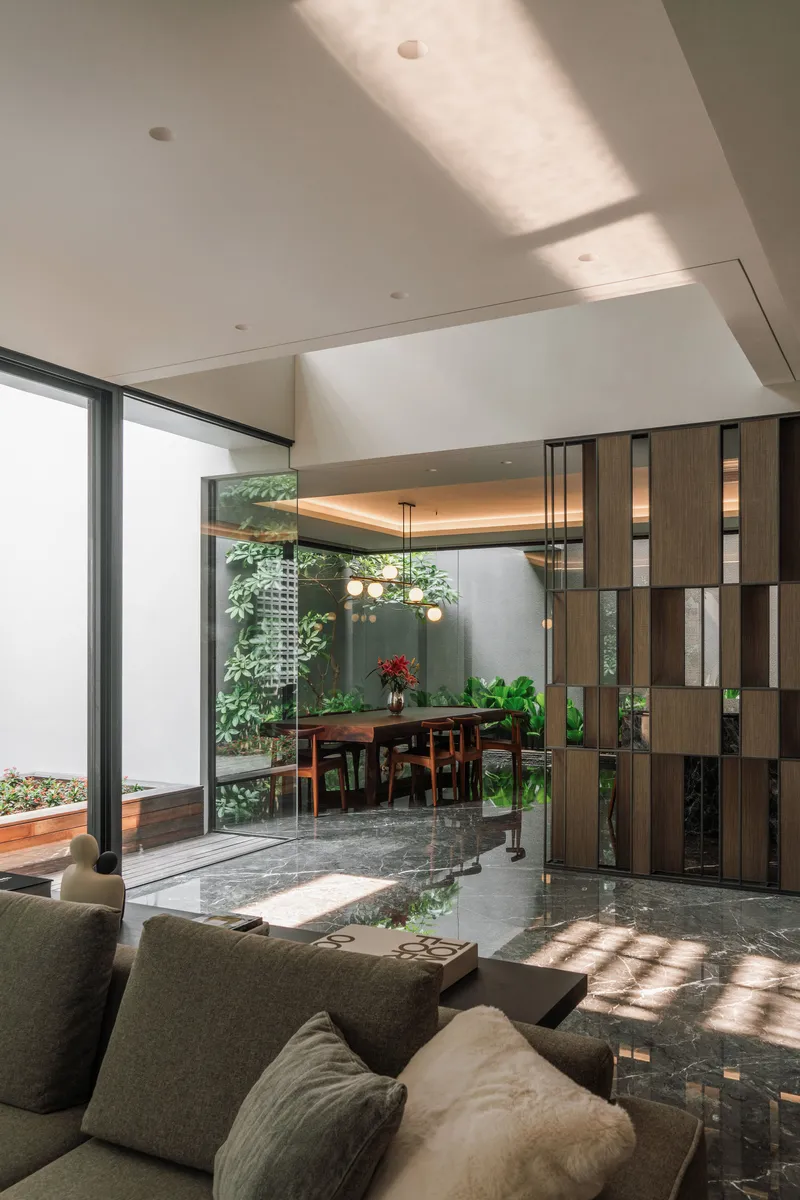
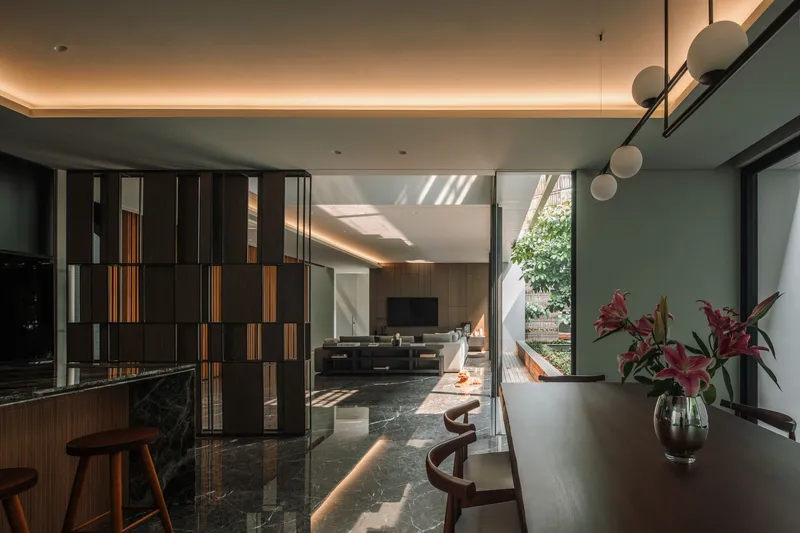
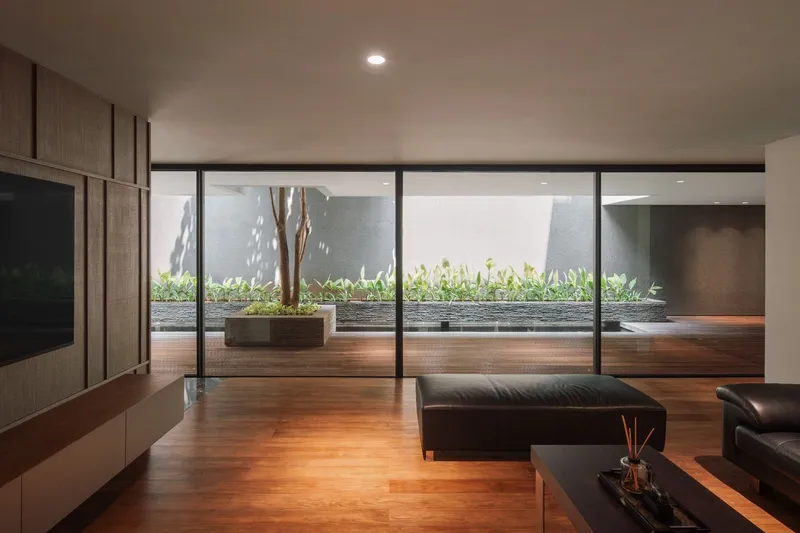
The open-plan living area deploys a timber-and-metal screen as an internal divider rather than a solid wall, maintaining visual connectivity between the living and dining zones while offering acoustic separation. A recessed ceiling cove with indirect lighting gives the dining area its own spatial identity without boxing it in. Floor-to-ceiling glass walls on the courtyard side collapse the boundary between inside and out, framing the single courtyard tree like a painting that changes with the weather.
These are generous rooms, but they never feel oversized. The sectional play of recessed ceilings, dropped soffits, and varying floor materials breaks the 800 square meters into a sequence of distinct spatial episodes rather than a single loft-like volume. The house breathes without being cavernous.
The In-Between: Corridors, Terraces, and Thresholds
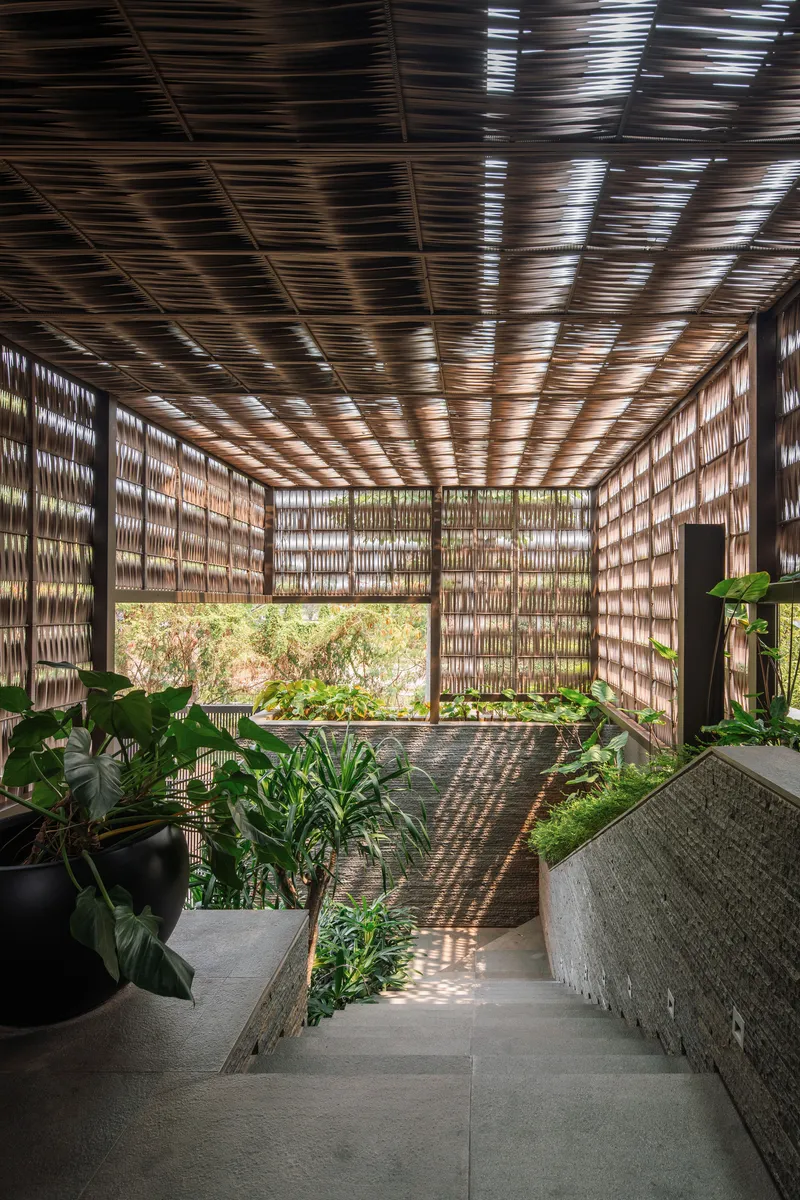
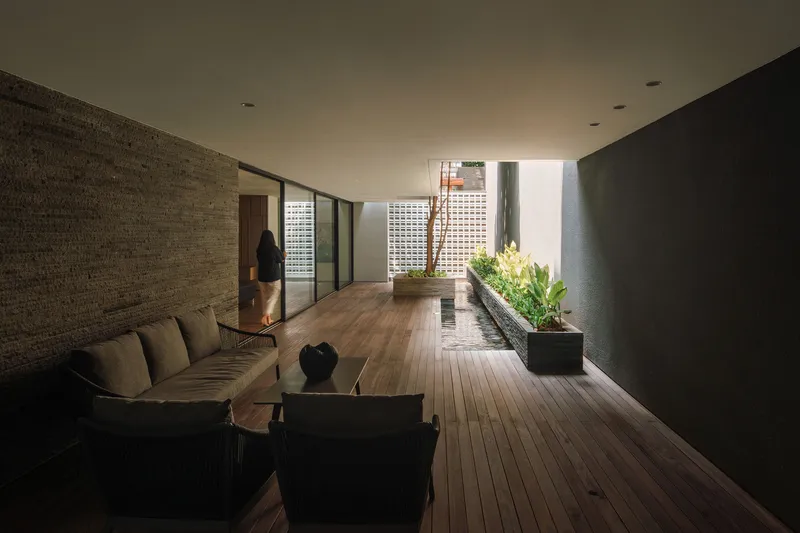
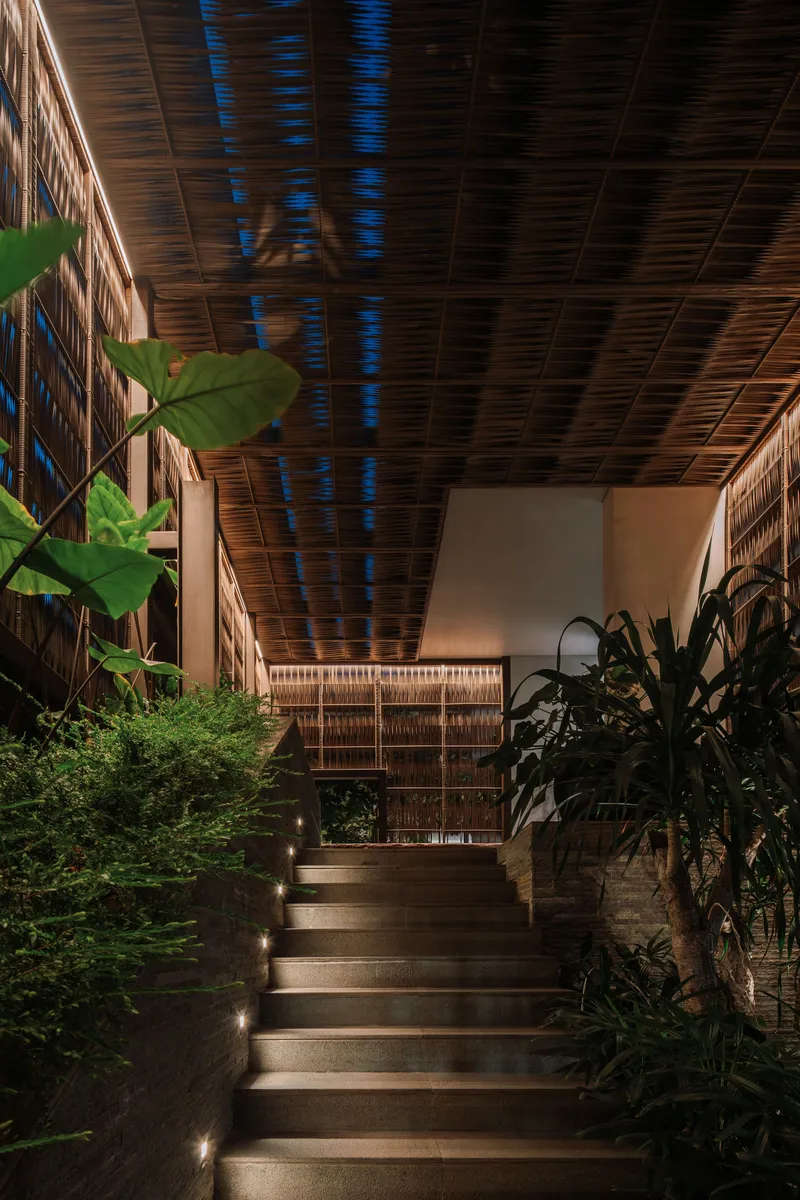
Some of the most compelling moments in the JT Residence happen in spaces that are neither fully inside nor fully outside. An interior terrace enclosed by woven lattice walls and ceiling casts a shifting pattern of light over planted beds, turning a corridor into a microclimate. A timber-decked walkway with brick walls opens to a courtyard, making the act of moving between rooms a sensory event. A staircase with timber treads ascends through a planted void under a slatted wood ceiling, its handrail replaced by greenery.
These transitional zones are where the tropical ambition of the project is most convincing. They prove that Wahana Architects has thought carefully about the entire gradient between conditioned interior and exposed exterior, rather than treating the boundary as a single line drawn by a glass wall.
Private Quarters: Screened, Planted, Quiet
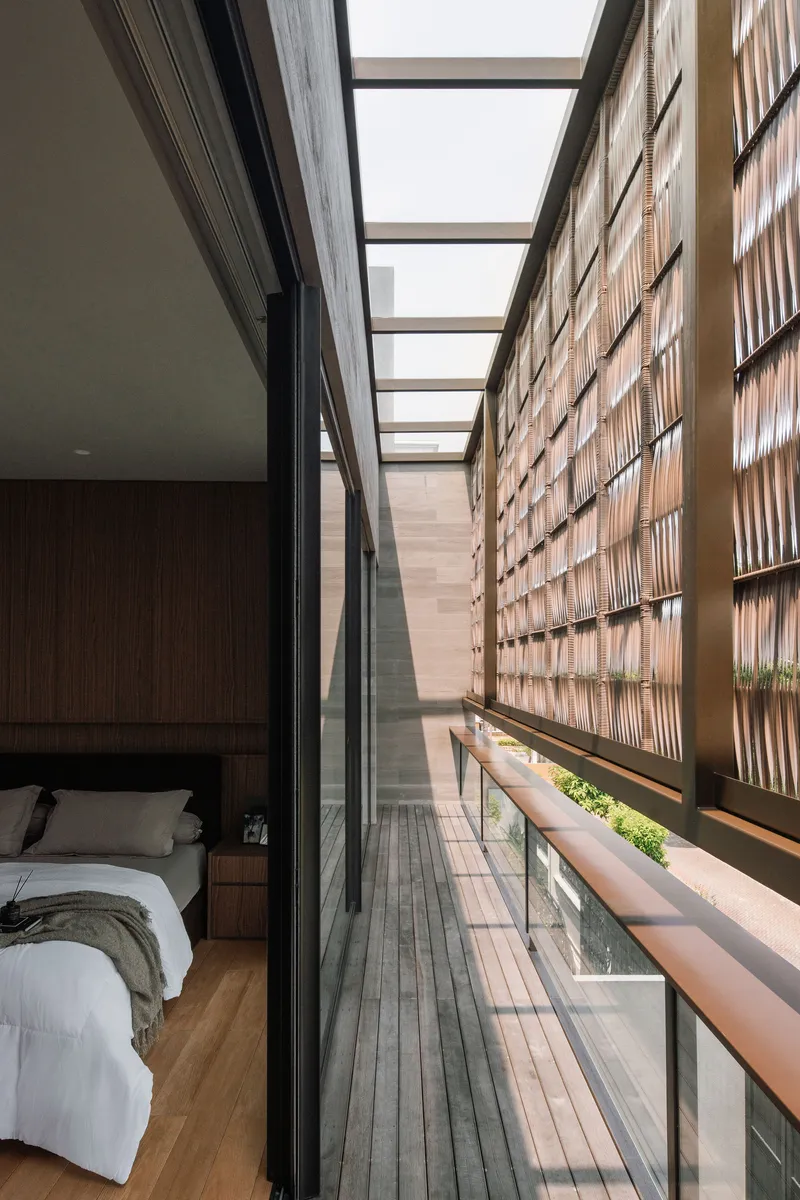
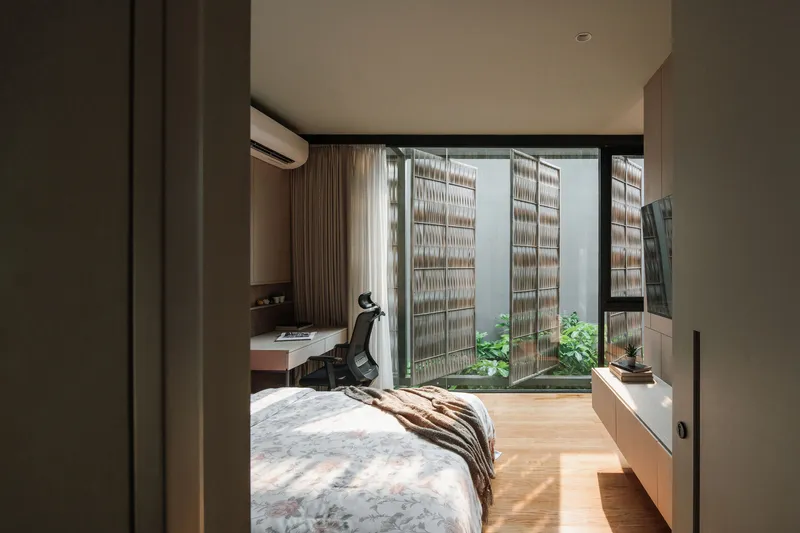
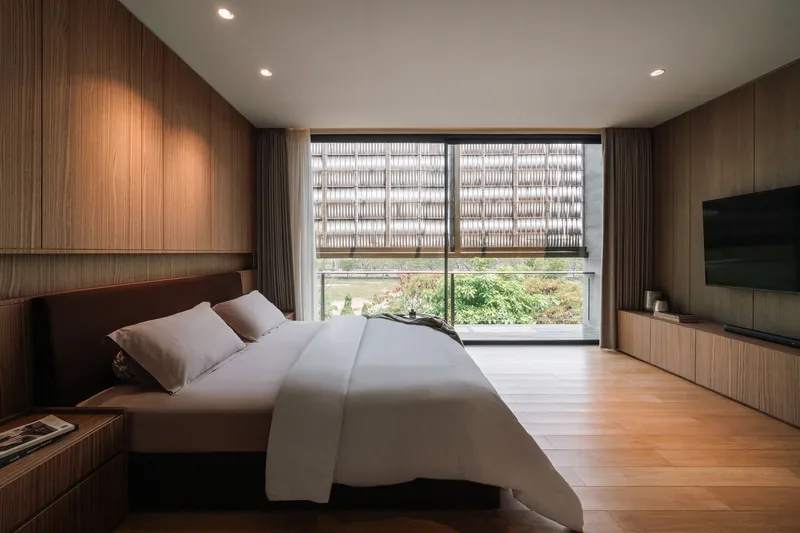
The bedrooms continue the material language of timber and lattice but dial down the spatial drama in favor of intimacy. Ribbed timber paneling adds warmth and texture to walls, while patterned screen windows modulate views toward planted gardens. Sliding doors open onto narrow balconies and small courtyard gardens, so every bedroom has its own relationship with the outdoors without sacrificing privacy from neighbors.
A narrow balcony with timber decking runs alongside one bedroom, screened by a woven lattice wall that turns the outdoor space into a kind of sleeping porch. It is a small gesture with a large impact: you can sleep with the doors open, protected from sun and sight, and wake up to filtered light rather than an alarm.
Material Continuity: Timber, Lattice, and Stone
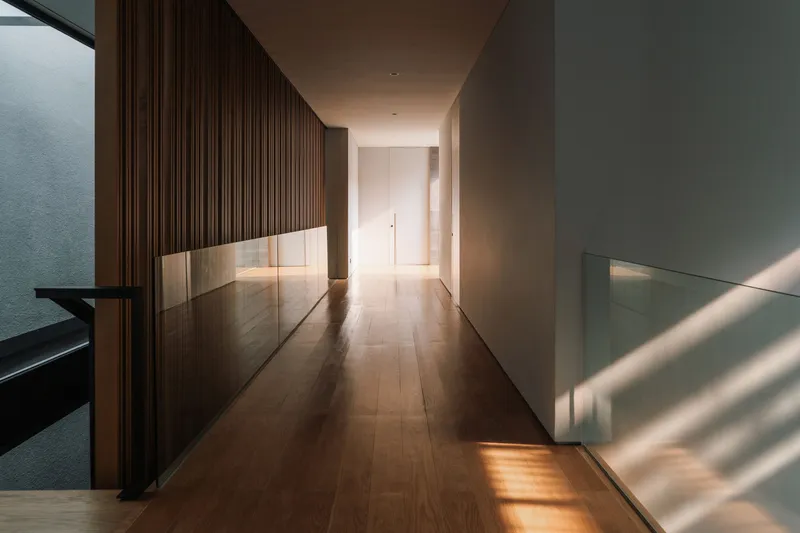
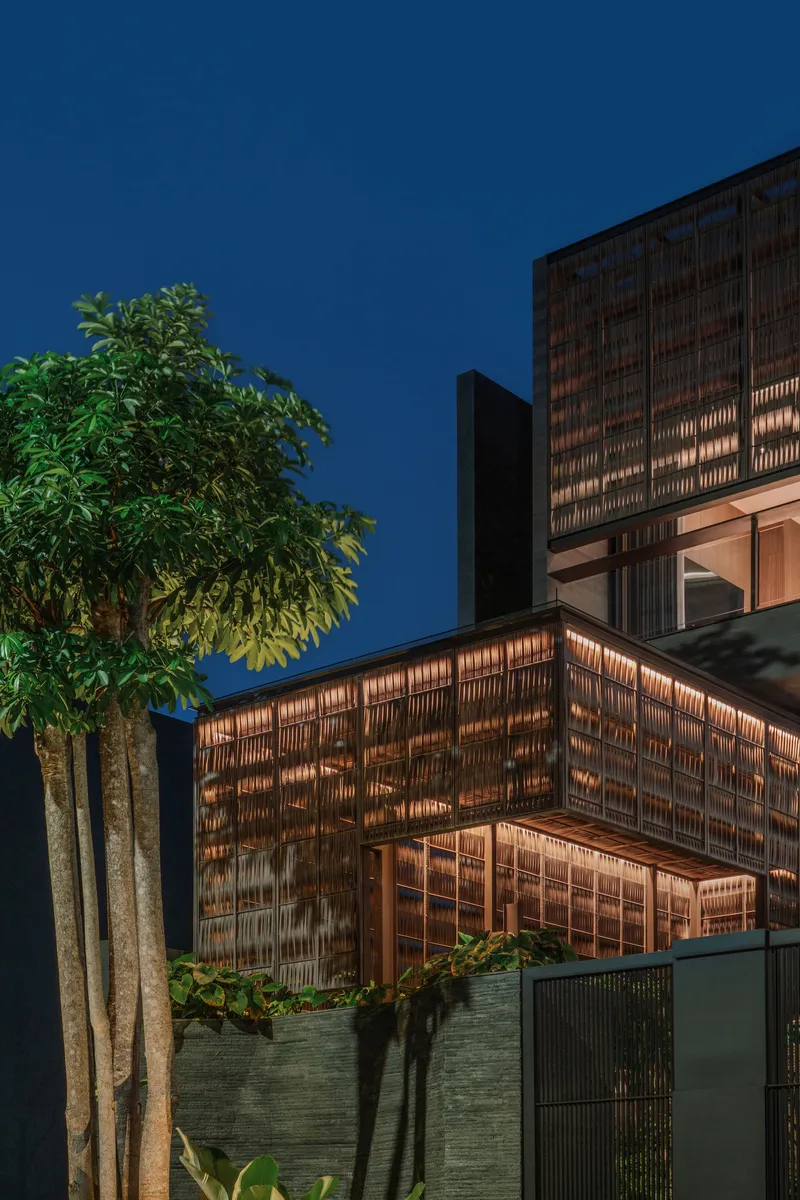
The material palette is deliberately restrained. Timber appears as wall paneling, stair treads, decking, and ceiling slats. Lattice screens migrate from the exterior facade into interior partitions and terrace enclosures. Dark stone grounds the public floors, while lighter finishes lift the private rooms. The discipline pays off: there is no moment where the house feels confused about what it is. Every surface reinforces the reading of a permeable, layered shelter.
At twilight, the layered timber screen facade and a single planted tree compose an image that is almost abstract, reducing the house to a rhythm of horizontal lines and soft ambient glow. It is the clearest evidence that the material system works at every scale, from the grain of a timber plank to the silhouette of the entire building.
Plans and Drawings
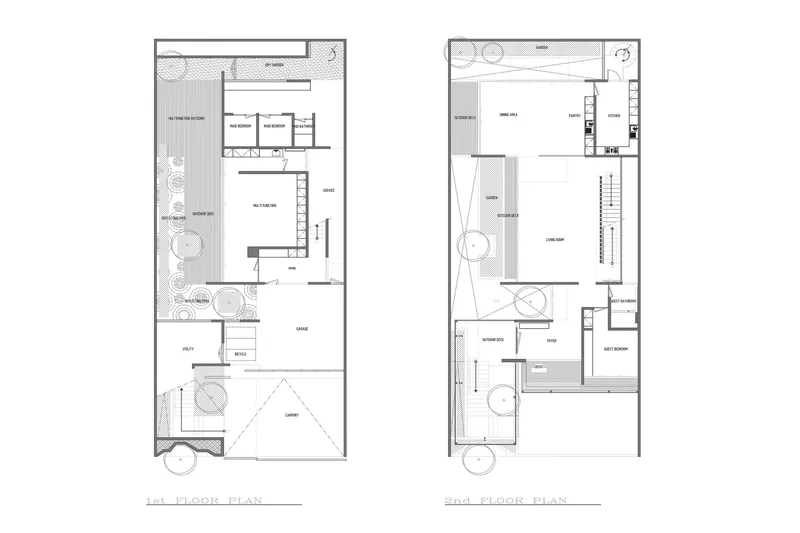
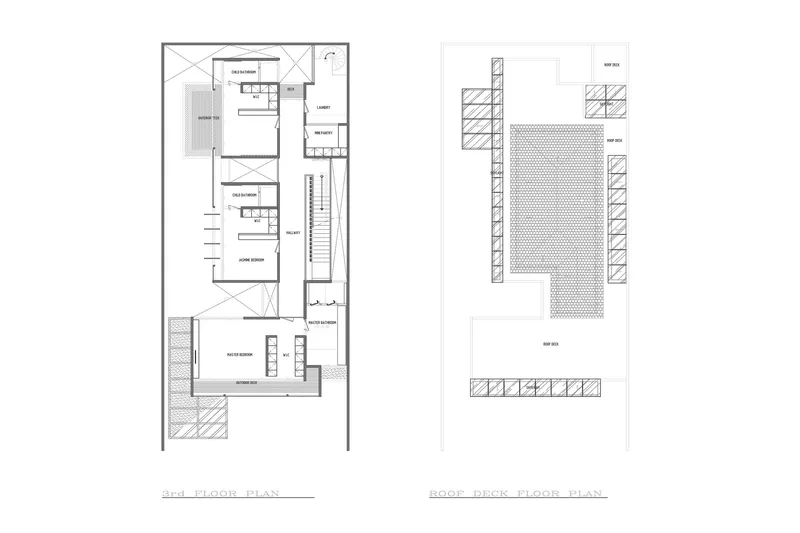
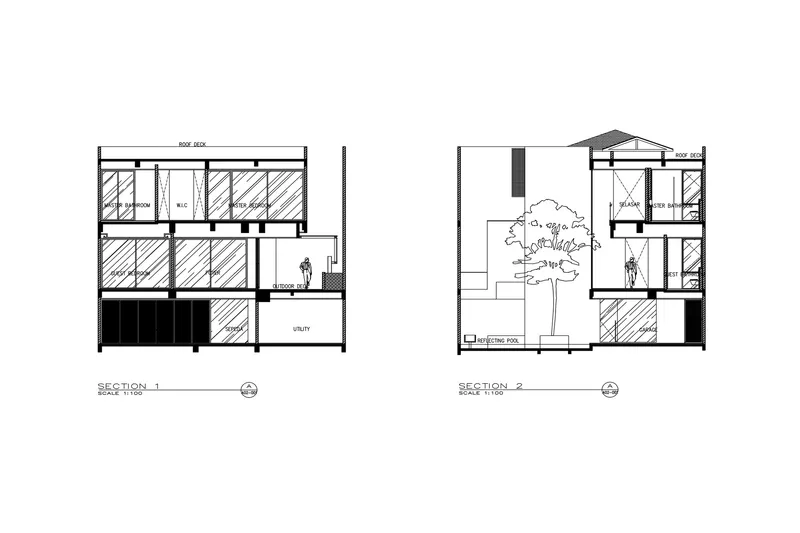
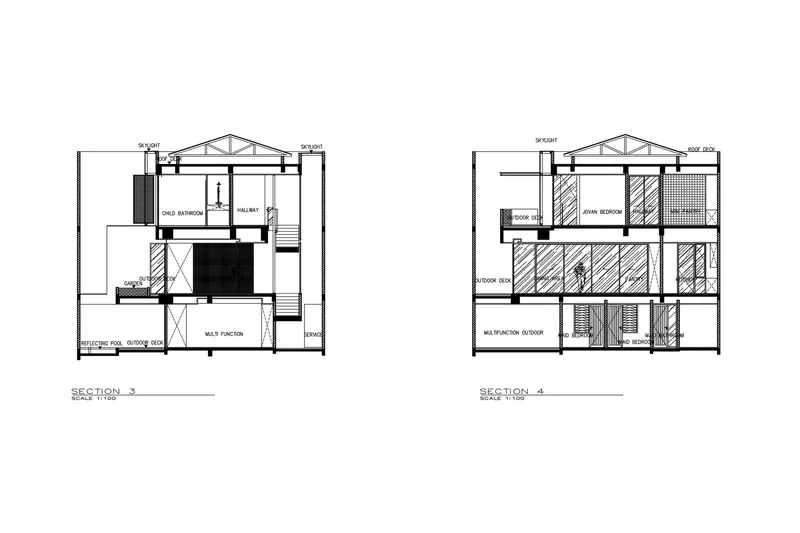
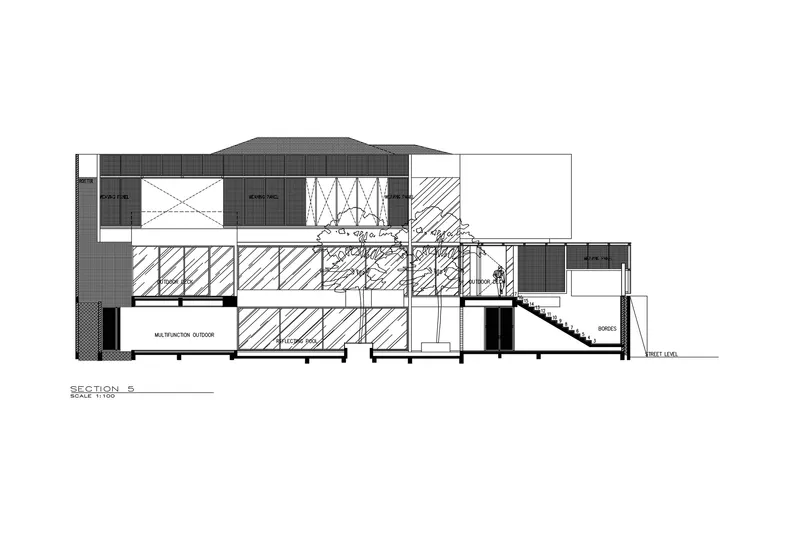
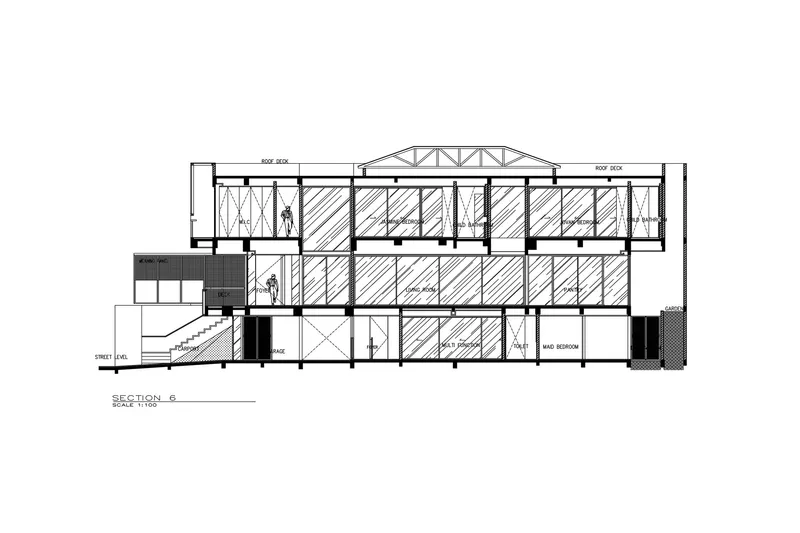
The floor plans confirm what the photographs suggest: the house is organized around two interior courtyards that puncture the building mass at strategic points, pulling light and ventilation deep into the plan. The first and second level plans show bedrooms and living spaces wrapping around these voids, with circulation kept tight against the edges. The roof deck plan reveals a large textured terrace that crowns the composition.
The section drawings are where the real ambition becomes legible. Exposed truss roofs span over three stories of bedrooms and living spaces, with an atrium containing a full-height tree. Sloped roof structures and multilevel outdoor terraces cascade down toward street level, demonstrating that the house steps through its site rather than sitting flatly on it. The sections also reveal just how many of the house's rooms have at least one open side, confirming the commitment to cross-ventilation as a design principle rather than an afterthought.
Why This Project Matters
The JT Residence matters because it treats the tropical house not as a style but as a performance standard. Every architectural decision, from the woven screens to the courtyard placement to the cantilevered volumes, is legible as a response to sun, rain, heat, and humidity. The house does not need to announce its environmentalism with photovoltaic panels or green roof labels; its passive strategies are baked into the form itself.
For Jakarta, a city where rapid development often produces hermetically sealed interiors indistinguishable from those in Dubai or Shanghai, this house is a quiet corrective. Wahana Architects demonstrates that density, privacy, and comfort are fully compatible with openness to the equatorial climate. The lesson is transferable far beyond this particular site: if you design the threshold carefully enough, you do not need a wall.
JT Residence by Wahana Architects (lead architect: Rudy Kelena). Jakarta, Indonesia. 800 m². Completed 2024. Photography by Ernest Theofilus.
About the Studio
Share Your Own Work on uni.xyz
If projects like this are the kind of work you want to make, uni.xyz is a place to publish your own, find collaborators, and enter design competitions.




Popular Articles
Popular articles from the community


Riyadh For All: Intergenerational Urban Design for Active Aging in Rabat
Riyadh For All reimagines urban design in Rabat with intergenerational co-living, adaptive courtyards, and Moroccan cultural exchange today.

The Ocean Hive: Sustainable Architecture for a Self-Sufficient Civilization at Sea
The Ocean Hive imagines sustainable architecture at sea, where modular habitats, algae, wave power and ocean waste sustain a growing colony.

Play: Fragments of Their World
Familiar architecture becomes modular playground design, creating safe spaces where displaced children can learn, connect, imagine and play.

Hill & Cross Opera: Sculptural Opera House Architecture Shaped by Tallinn’s Landscape and Identity
Hill & Cross Opera reimagines opera house architecture in Tallinn through its sculptural hill, civic plaza, glass wave and a luminous cross.


Similar Reads
You might also enjoy these articles

Bao Huynh Watercolor Atelier: A Serene Art Retreat in Hội An
Bao Huynh Watercolor Atelier in Hội An blends multifunctional art spaces, sustainable design, local materials, and family-friendly living in a serene environment.

Atelier Macri Concept Store Interior Design by CASE-REAL
Atelier Macri store features a "ko" counter, walnut wood details, cork displays, blending retail, gallery, and seamless customer experiences.

Manuel Vargas Izquierdo Stadium and High-Performance Sports Center: Architectural Excellence in Jalpa de Méndez
The Manuel Vargas Izquierdo Stadium blends sustainable design, inclusive sports facilities, and cultural-inspired architecture, revitalizing Jalpa de Méndez’s public spaces.
KAKR Buluh Awar Hall: Revitalizing Community and Ecology Through Bamboo Architecture
Community built bamboo hall revitalizes Buluh Awar village, empowering youth, restoring ecology, celebrating vernacular craftsmanship through sustainable architecture and culture.


Explore Residential Building Competitions
Discover active competitions in this discipline


Challenge to design mud housing for contemporary communities


Challenge to reimagine the Iron Throne


Photograph architecture without architects


Illustrate the lost glory of Angkor Wat - Render Challenge
Comments (0)
Please login or sign up to add comments
No comments yet. Be the first to comment!