
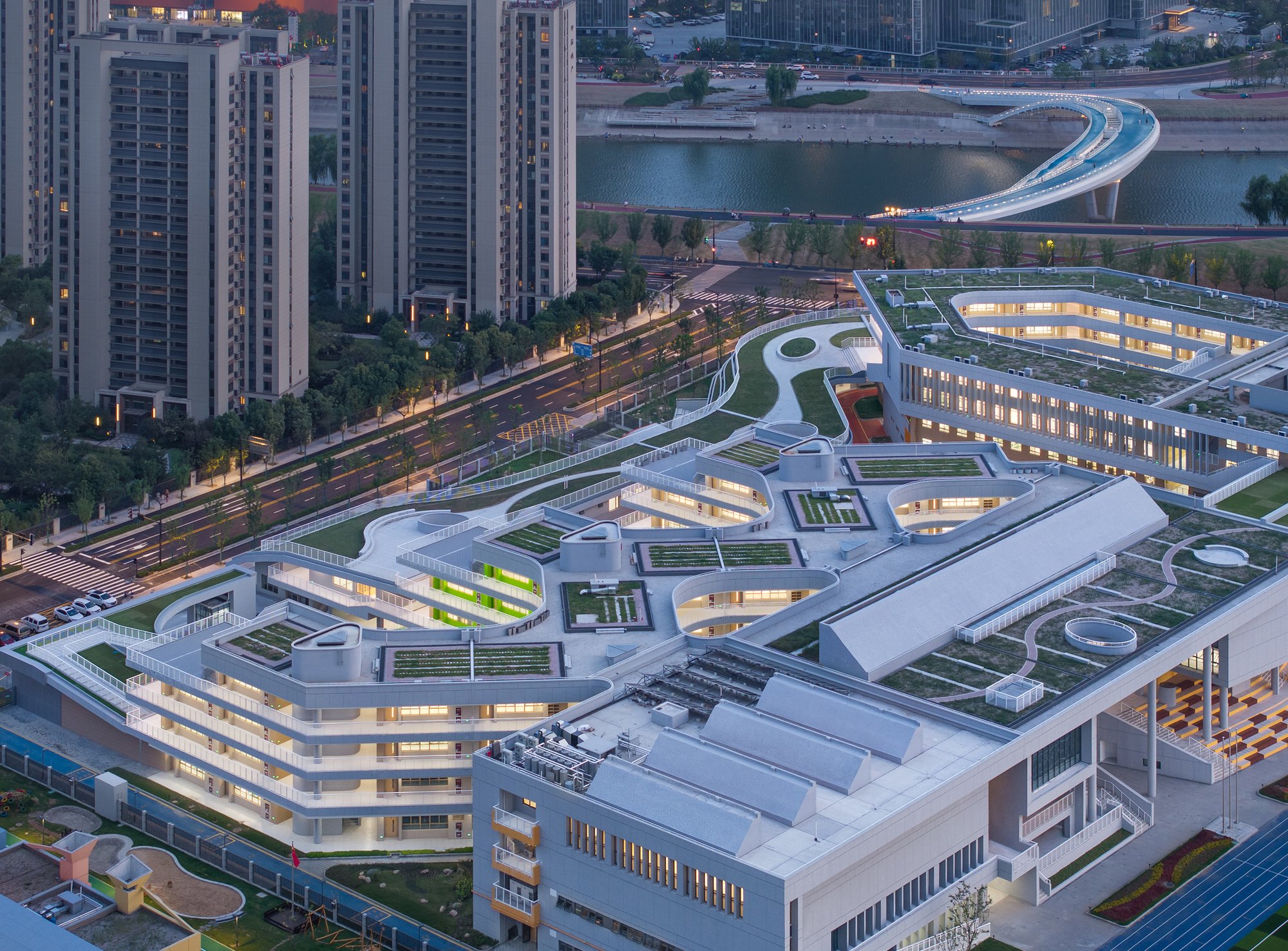
A Campus That Grows Up With Its Students
Nanjing's Kangsheng Road Education Complex stacks three schools into one layered landscape of courtyards, color, and collective life.

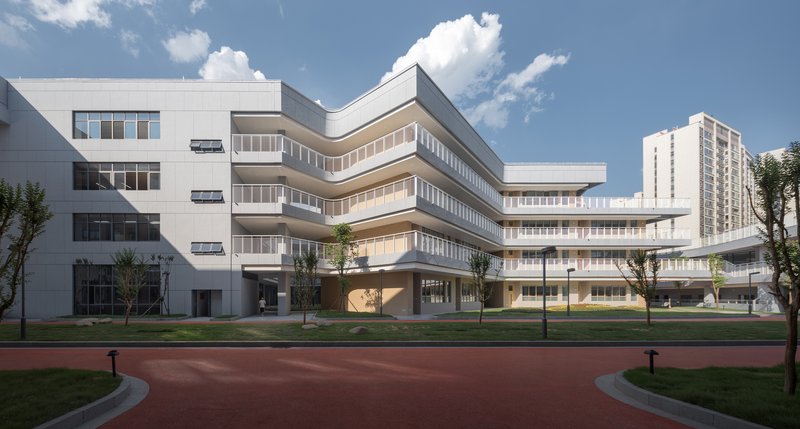
Most school campuses are discrete buildings separated by fences and parking lots. The Kangsheng Road Education Complex in Nanjing takes a fundamentally different approach: it merges a kindergarten, a primary school, and a junior high school into a single 78,300 square meter organism. Designed by SEU-ARCH, ZRADI, and UA GROUP, the project reads from the air as a continuous white topography punctuated by green sports fields and terraced rooftops. On the ground, it dissolves into a network of courtyards, covered walkways, and tiered gathering spaces that shift in scale and character as students age from one program to the next.
What makes the complex genuinely compelling is not its size but its thesis: that architecture can calibrate spatial experience to developmental stage without fragmenting the campus into isolated compounds. The kindergarten gets curving, intimate courtyards; the primary school gets bright staircases and covered play terraces; the junior high gets more civic, atrium-like spaces. The gradient is legible in plan, section, and color. It is a rare example of educational architecture that treats pedagogy not as a program checklist but as a spatial narrative.
Roofscape as Infrastructure
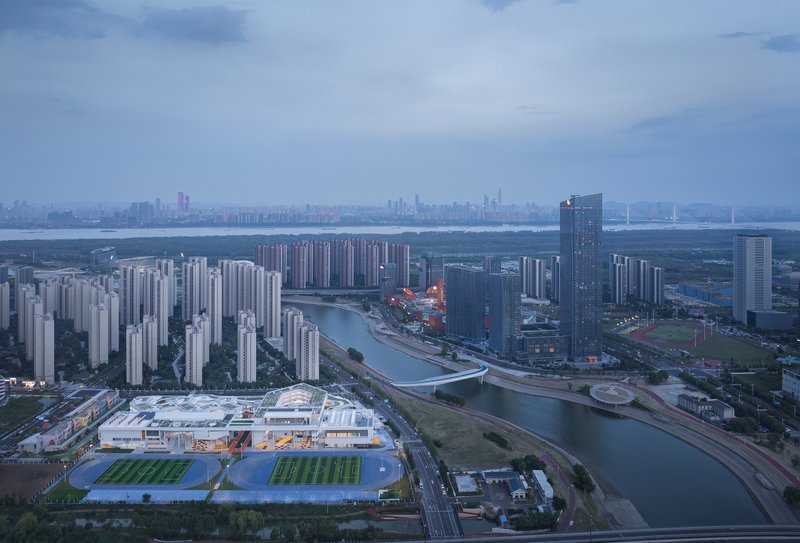
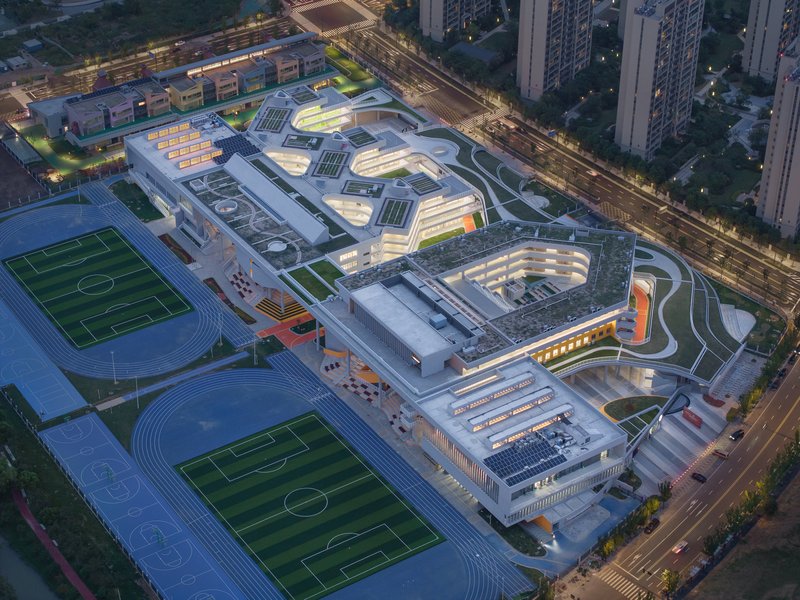
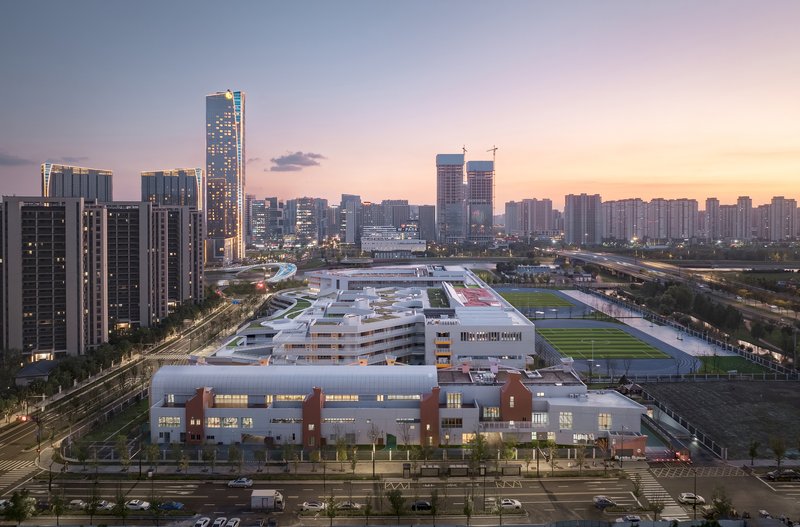
Seen from above at twilight, the complex reveals its most striking move: the roof is not leftover space but an active layer of the campus. Sports courts sit atop classroom volumes, solar panels line the edges, and green terraces create outdoor rooms at upper levels. The decision to push athletics skyward frees the ground plane for courtyards and covered circulation, a trade-off that pays off in density without claustrophobia.
The low-rise massing, rarely exceeding four or five stories, sits comfortably beside the residential towers that define the surrounding neighborhood. Against Nanjing's typical high-rise fabric, the campus reads as a horizontal landscape, a civic clearing rather than another vertical extrusion. The winding canal along the eastern edge reinforces the sense that this is a precinct with its own topographic logic.
Courtyards Tuned to Scale
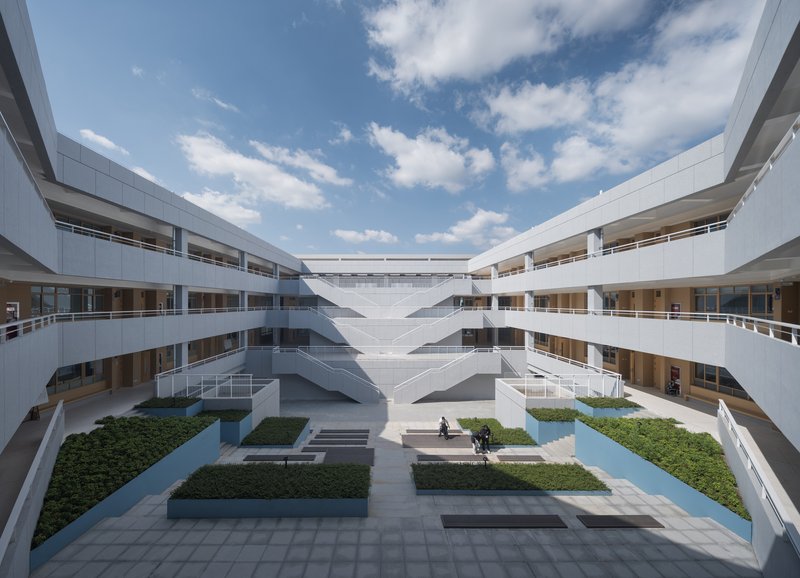
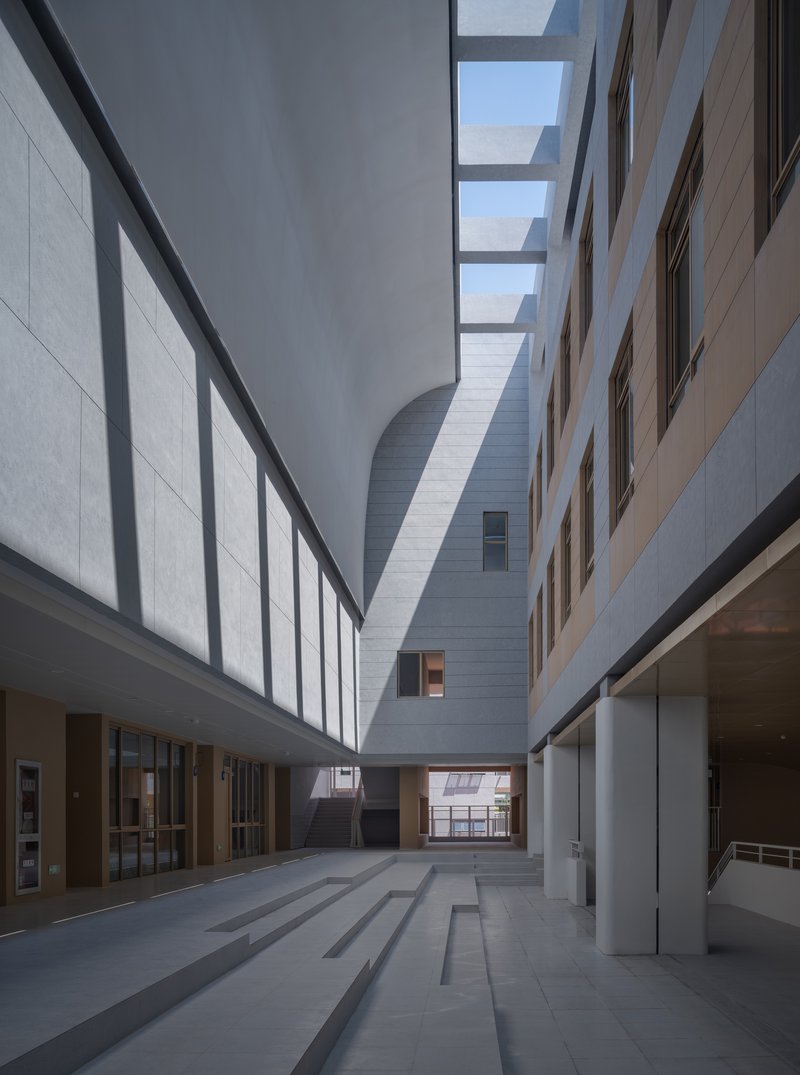
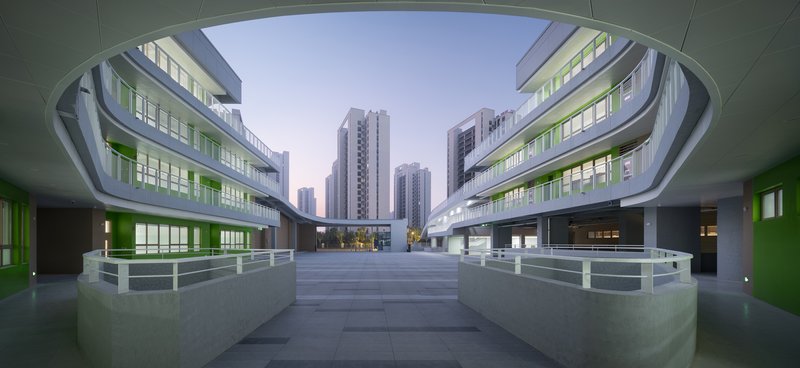
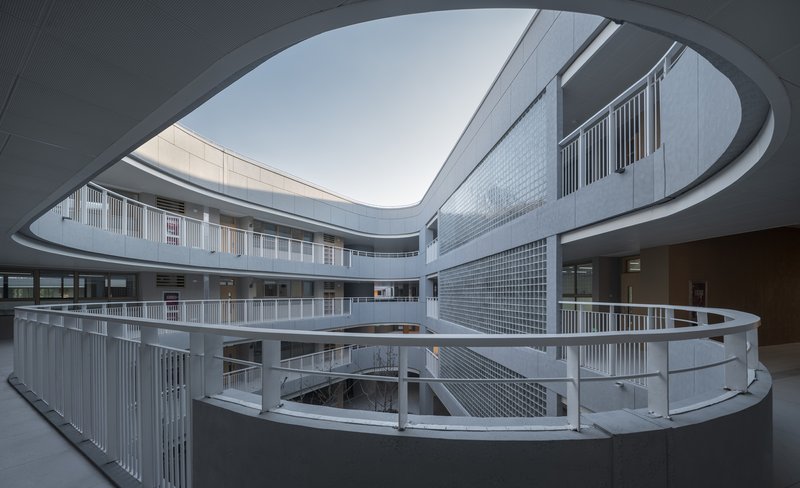
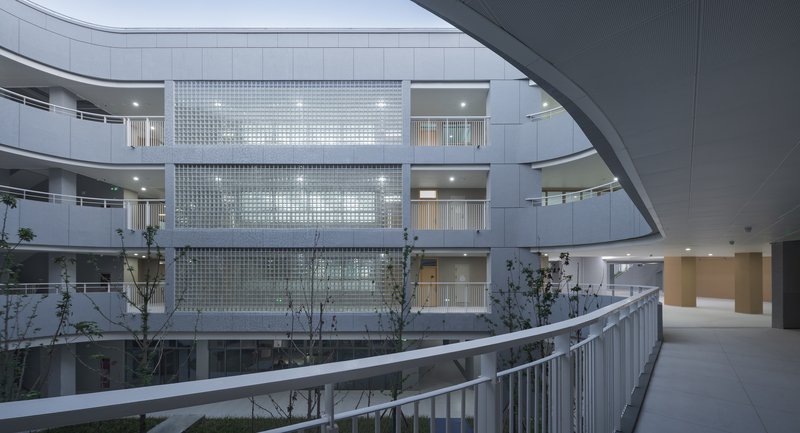
The courtyard is the project's fundamental unit of organization, but no two feel alike. Some are tight vertical slots carved between stacked white volumes, admitting controlled light through skylight bands. Others open wide to the sky, framed by elliptical apertures that offer cinematic glimpses of the city beyond. The variety is deliberate: younger children encounter enclosed, garden-scaled yards; older students pass through more expansive, civic-scaled voids.
The oval courtyard, visible through its curving white railings, is perhaps the most spatially inventive moment. Its geometry breaks the orthogonal logic of the classroom wings and creates a centripetal gathering space that feels more like a small amphitheater than a corridor intersection. It is the kind of space that invites lingering, a quality too many school buildings actively discourage.
Color as Wayfinding
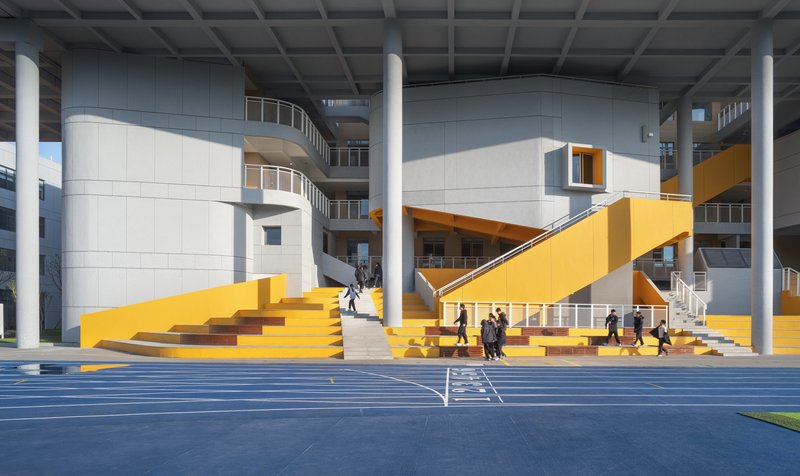
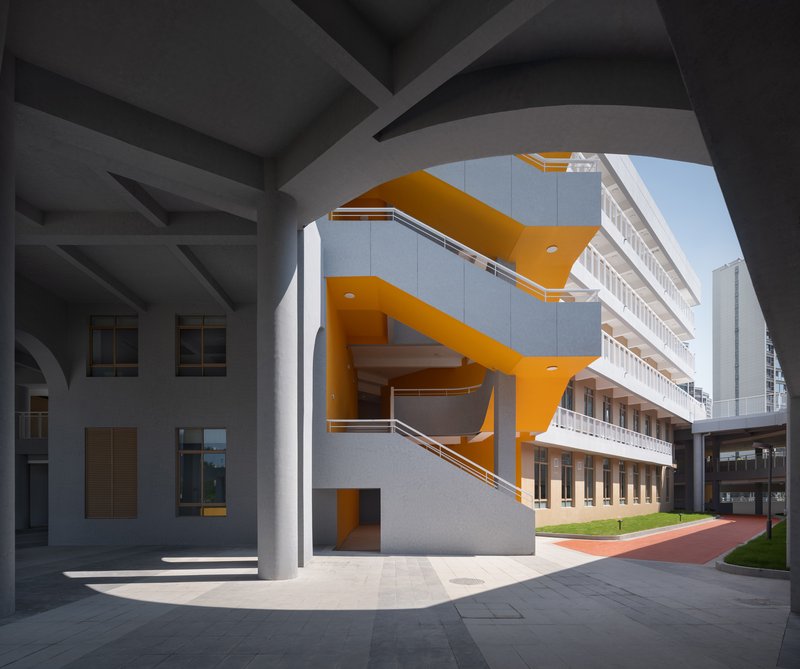
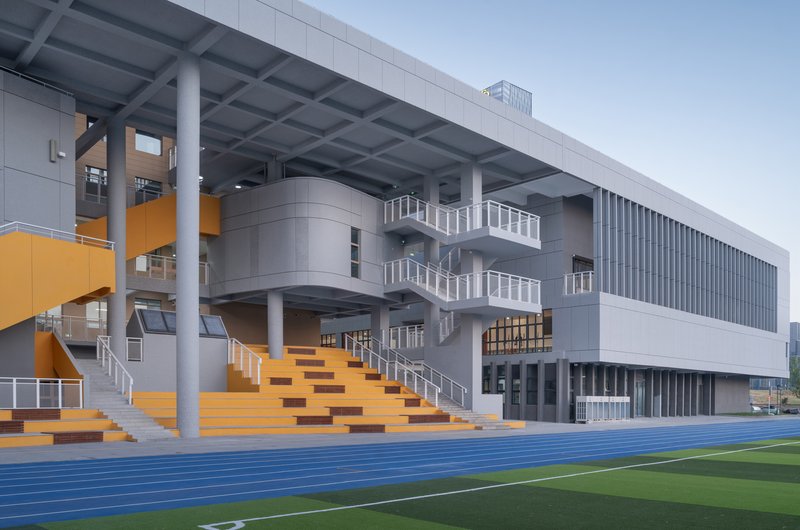
Against the prevailing palette of white concrete and grey structure, the architects deploy color surgically. Bright yellow staircases mark vertical circulation in the primary school zones. Orange zigzag stairs and tiered seating announce the entrance courtyards and sports edges. These are not decorative gestures; they function as wayfinding devices in a campus where the plan is complex enough to disorient.
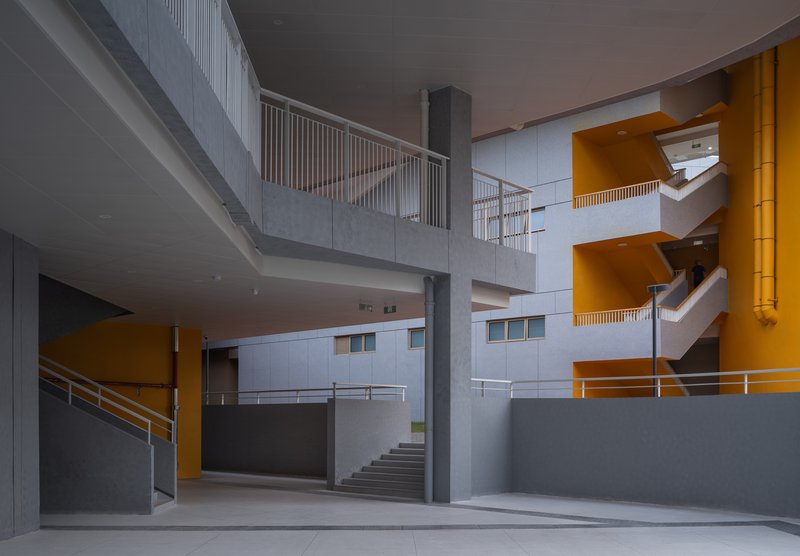
The coffered ceilings above covered courtyards deserve particular attention. They lend a civic weight to what could have been utilitarian canopies, and when paired with the amphitheater steps and colored staircases, they create outdoor rooms that rival the quality of the interior spaces. The orange-ceilinged bleachers overlooking the athletic track are a standout: simultaneously functional seating, covered shade structure, and threshold between building and landscape.
Interior Atmospheres
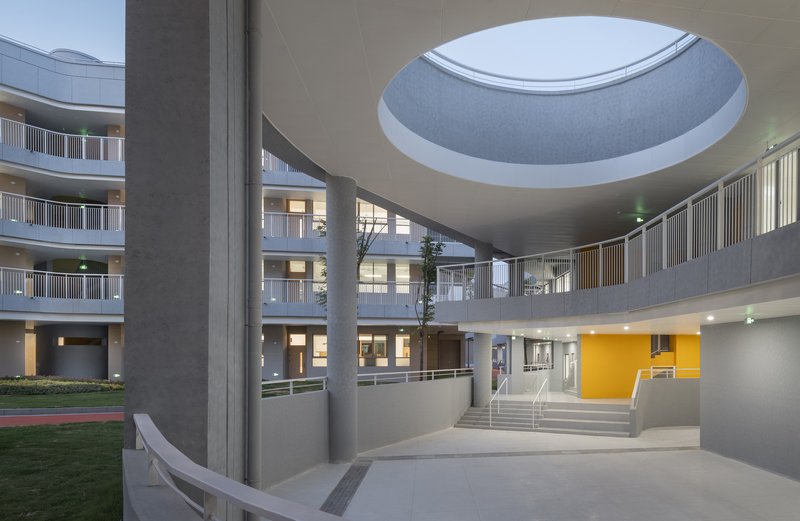
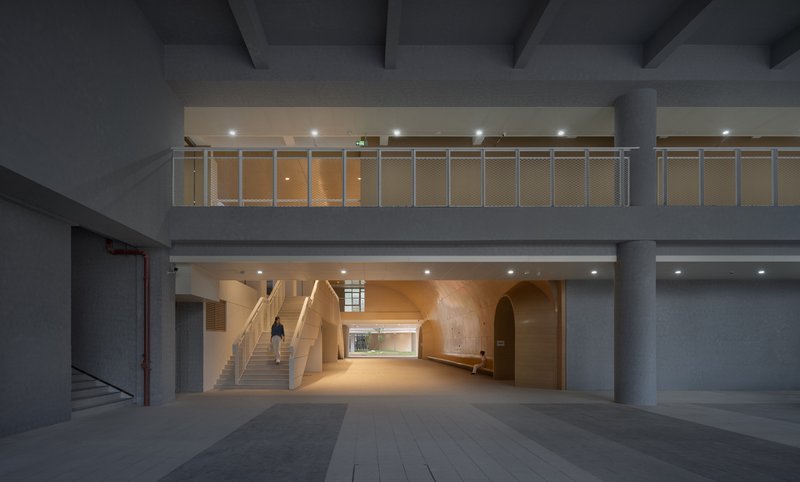
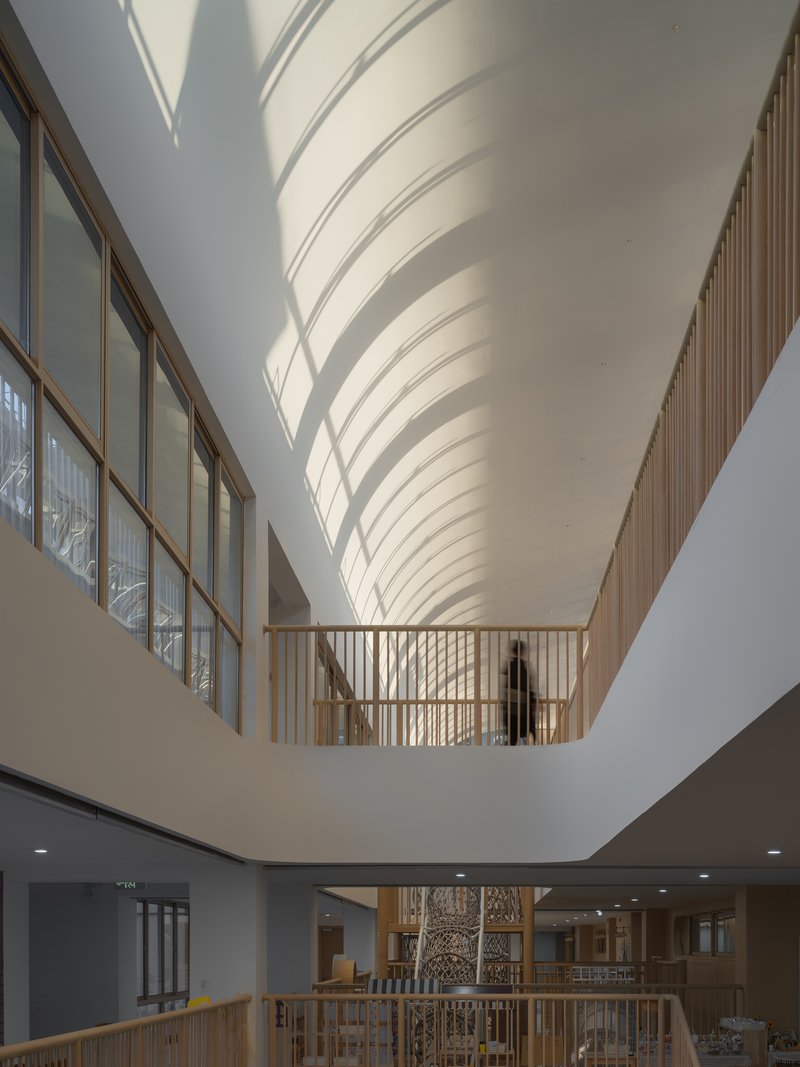
Inside, the complex oscillates between monumental and intimate. The main atrium, anchored by a circular skylight and ringed by tiered balconies, gives the junior high school a sense of institutional gravity. Concrete columns and exposed structure read as honest and legible, qualities appropriate for students beginning to understand how buildings work. The timber-lined arched passage and sculptural staircase in the lobby area bring warmth to what might otherwise feel austere.
The ribbed ceiling of the upper-level atrium, visible through glazed corridors, suggests a more expressive structural ambition. Timber balustrades soften the concrete framework and introduce a domestic register that keeps the interiors from feeling institutional. It is a careful balancing act: serious enough for a public building, warm enough for children.
Circulation as Experience
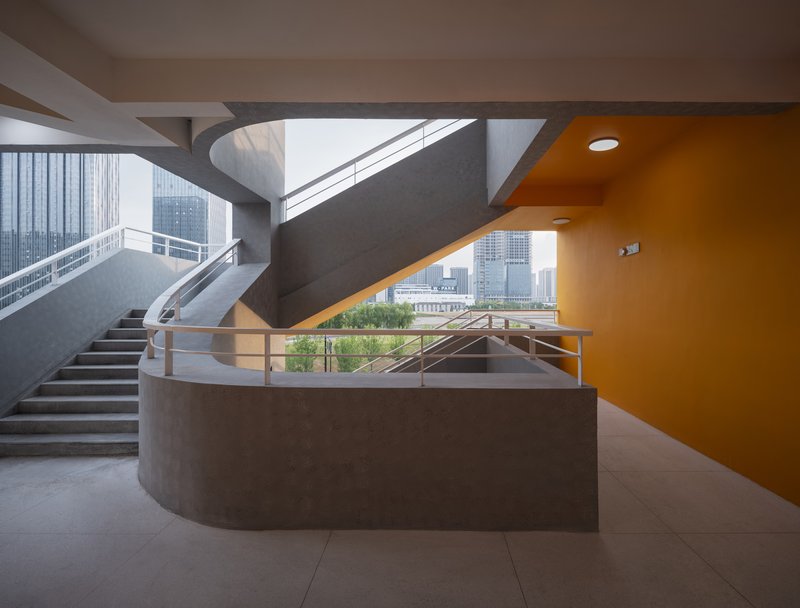
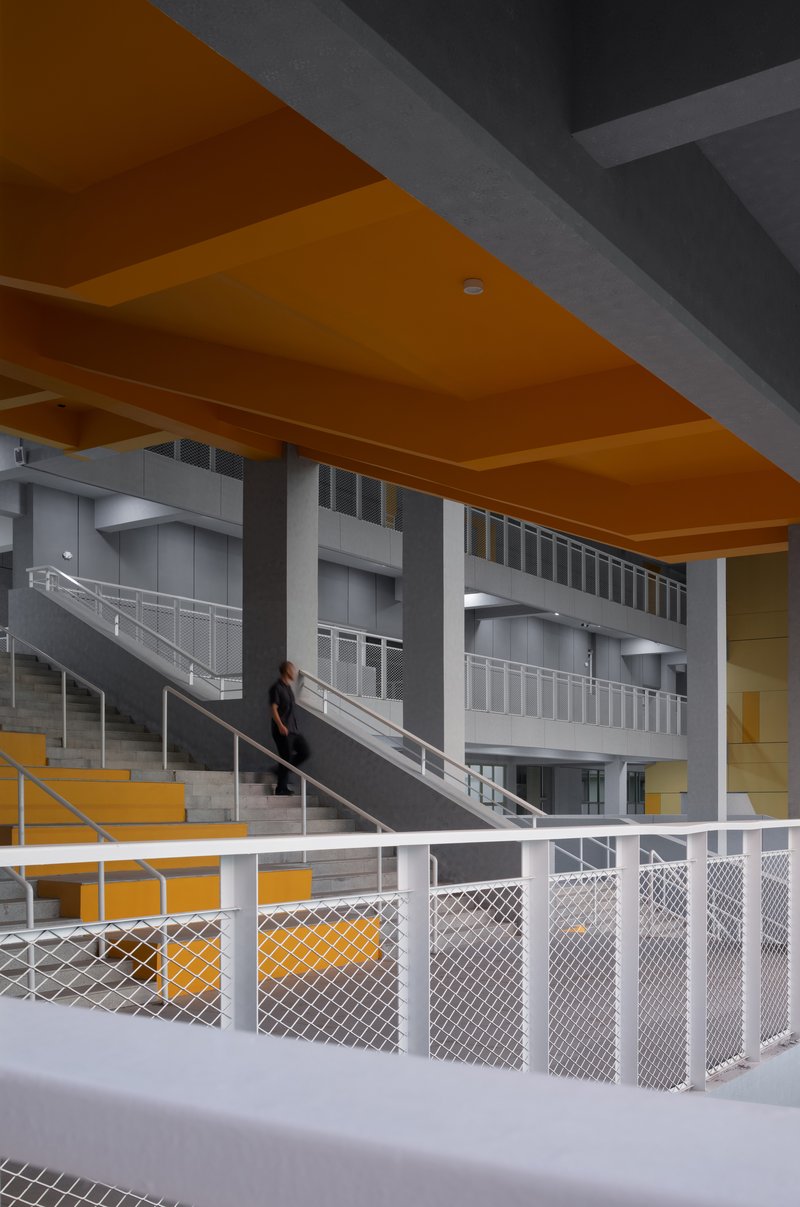
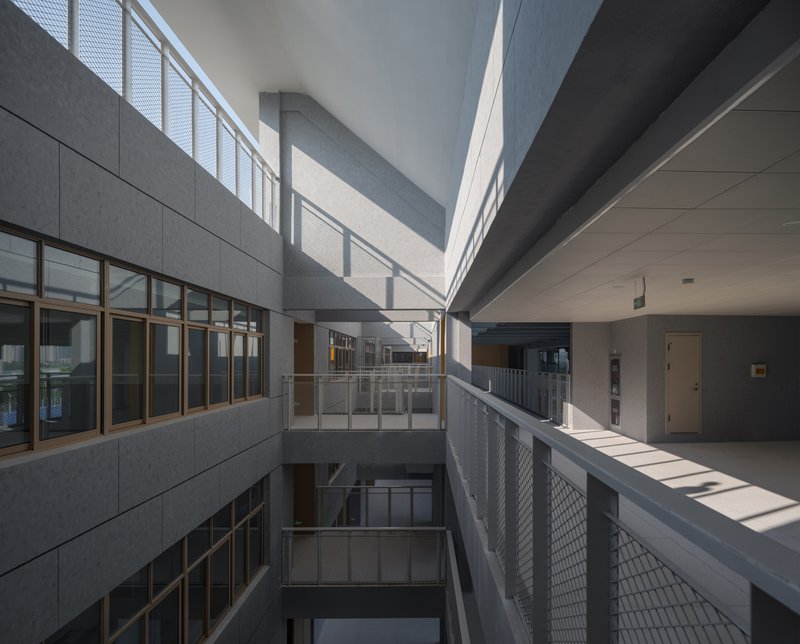
Corridors and staircases in school buildings are typically afterthoughts, dimensioned to code minimums and finished in the cheapest available material. Here, they are treated as primary architectural spaces. Curved concrete stairs with orange soffits frame views toward the athletic fields. Multi-level circulation spaces combine white mesh railings, timber treads, and yellow-painted ceilings into compositions that reward movement through the building.
The morning light captured in the multilevel courtyard, casting sharp diagonal shadows across metal mesh railings, demonstrates that these spaces are designed with solar geometry in mind. Circulation is not just about getting from classroom to classroom; it is about encountering light, air, and view at every turn. For students who will spend years navigating these paths, that quality of daily experience compounds.
Ground Plane and Gathering
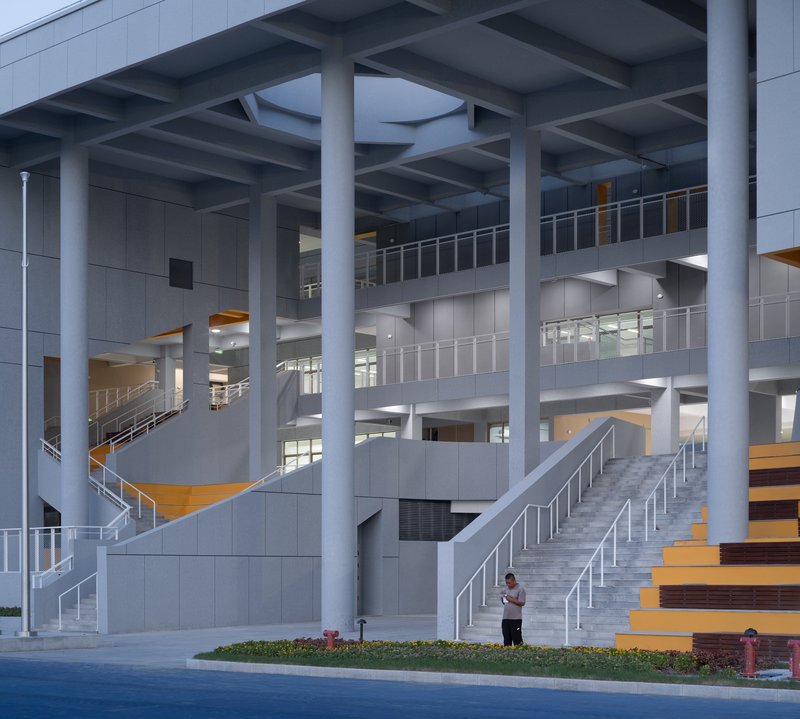
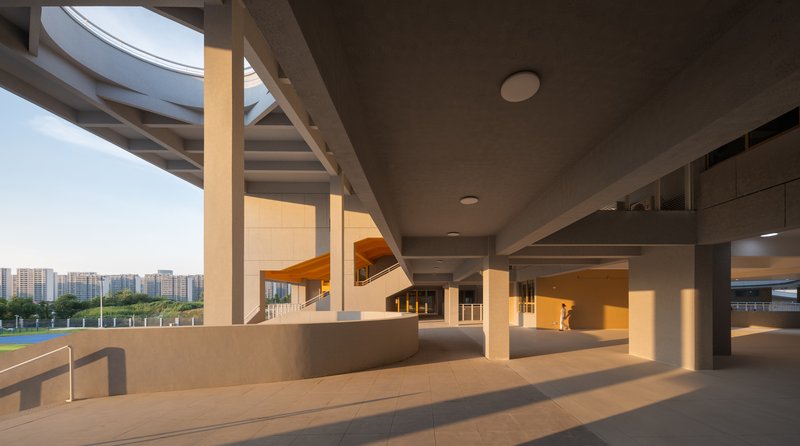
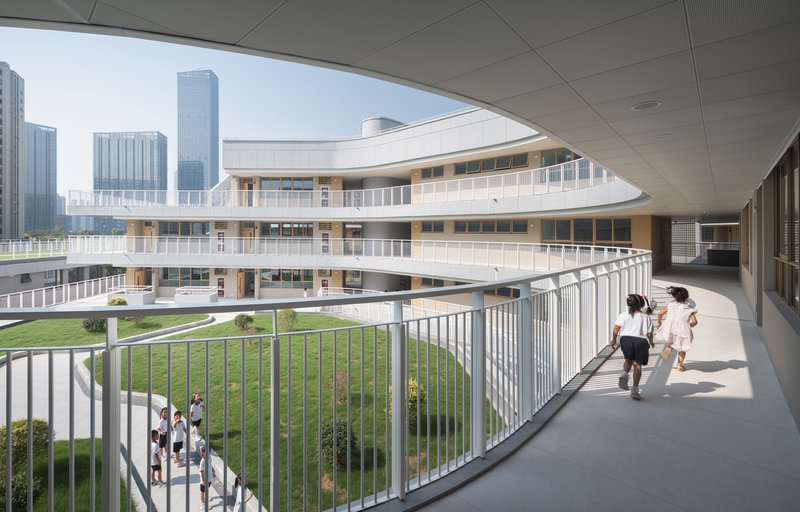
The ground level is conceived as a porous, covered landscape rather than a sealed interior. Grey concrete columns support coffered ceilings that shelter walkways, atriums, and open-air passages. Students and pedestrians move freely beneath the building mass, blurring the boundary between inside and outside. The covered terrace bathed in golden hour sunlight shows how the deep overhangs create microclimates that extend usable outdoor time through Nanjing's humid summers and cold winters.
The walkway overlooking a central lawn, with students visible below, captures the social ambition of the project. Every level offers vantage points onto shared spaces, creating a culture of seeing and being seen that reinforces community. The architecture makes collective life visible.
Athletic and Programmatic Edges
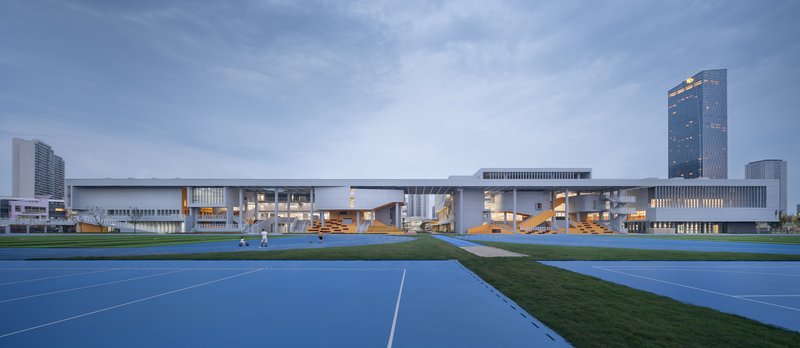
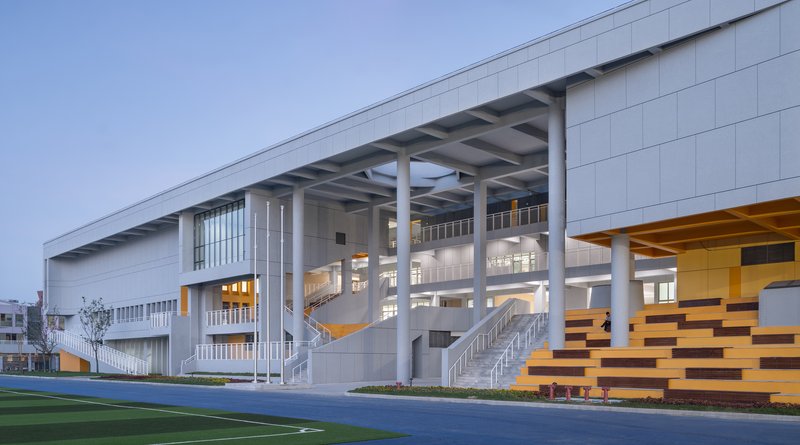
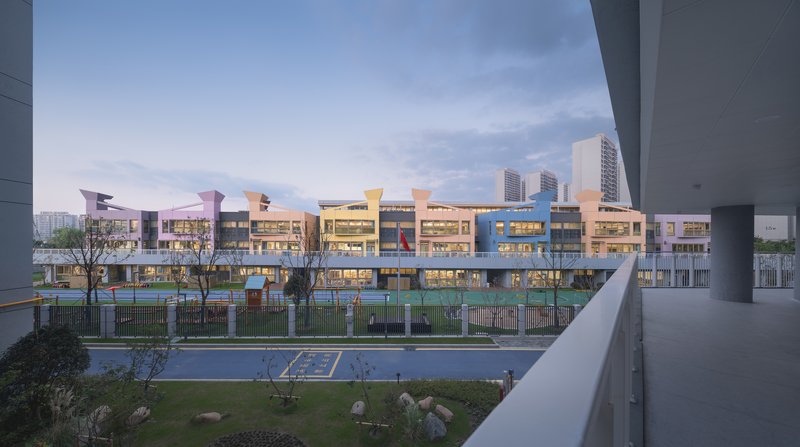
The long horizontal facade at dusk, with its continuous ribbon of illuminated glazing behind a blue running track, reveals the project's institutional scale without resorting to monumental gestures. The athletic fields act as a buffer between the campus and the city, providing open space and sight lines that prevent the complex from feeling introverted. Timber bleachers beneath raised volumes at the field's edge give spectators a sheltered vantage without enclosing the landscape.
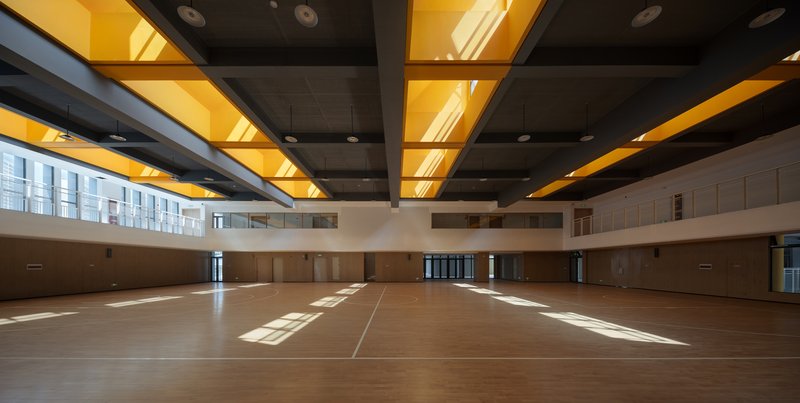
The gymnasium interior, with its alternating grey and yellow coffered ceiling panels catching sunlight across a timber floor, is among the most refined spaces in the complex. It proves that utilitarian programs do not require utilitarian architecture. The ceiling pattern introduces rhythm and warmth to a room that in lesser buildings would be a metal shed.
Plans and Drawings
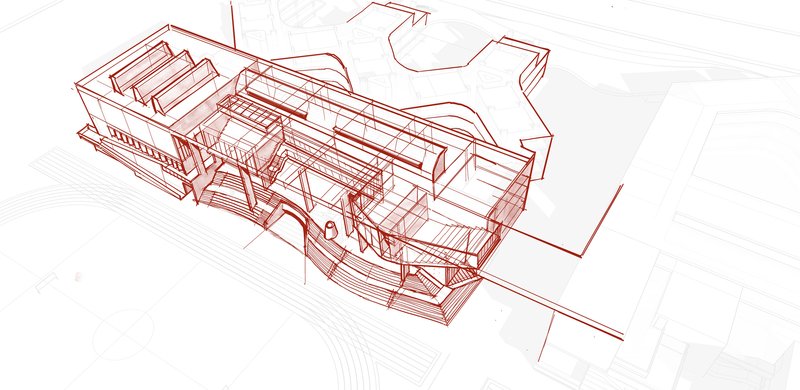
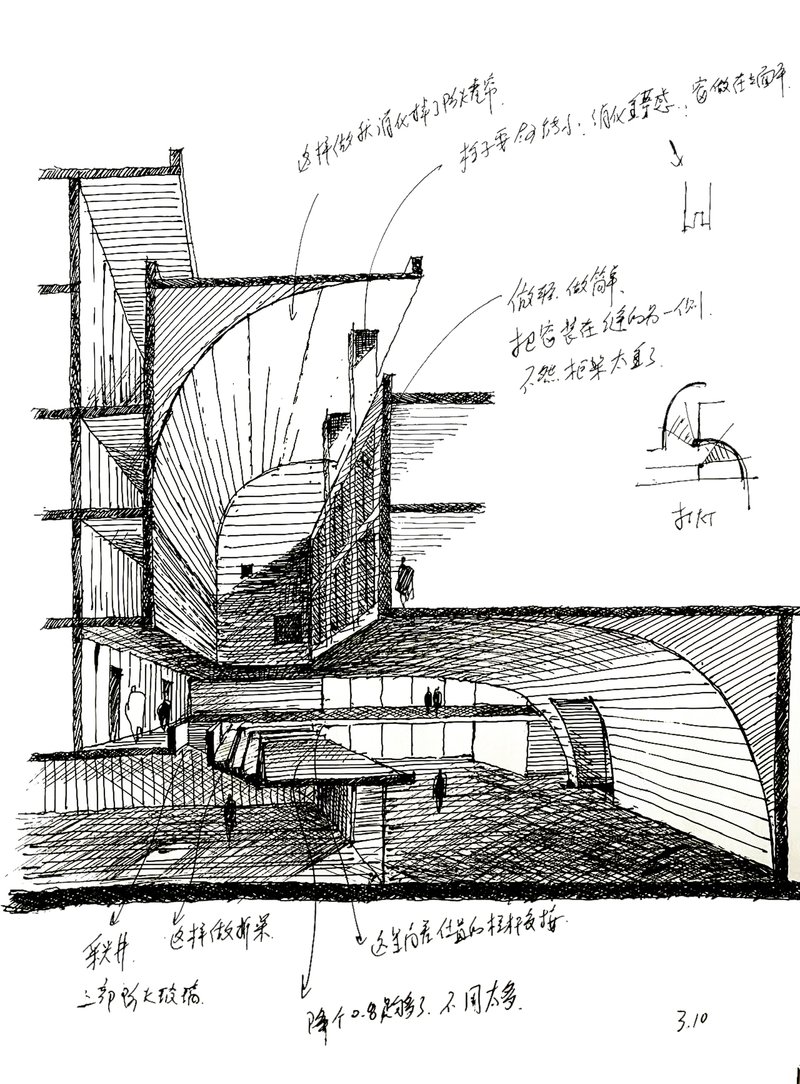
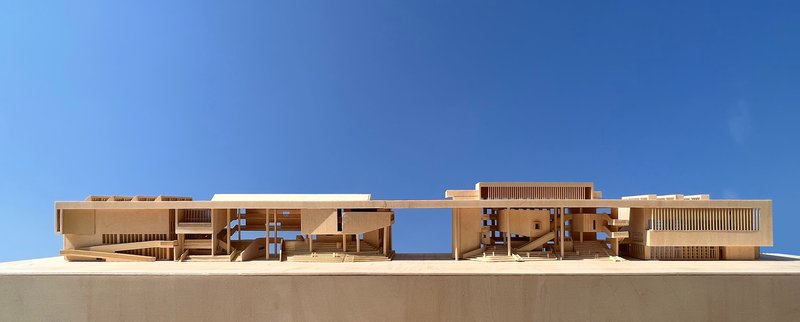
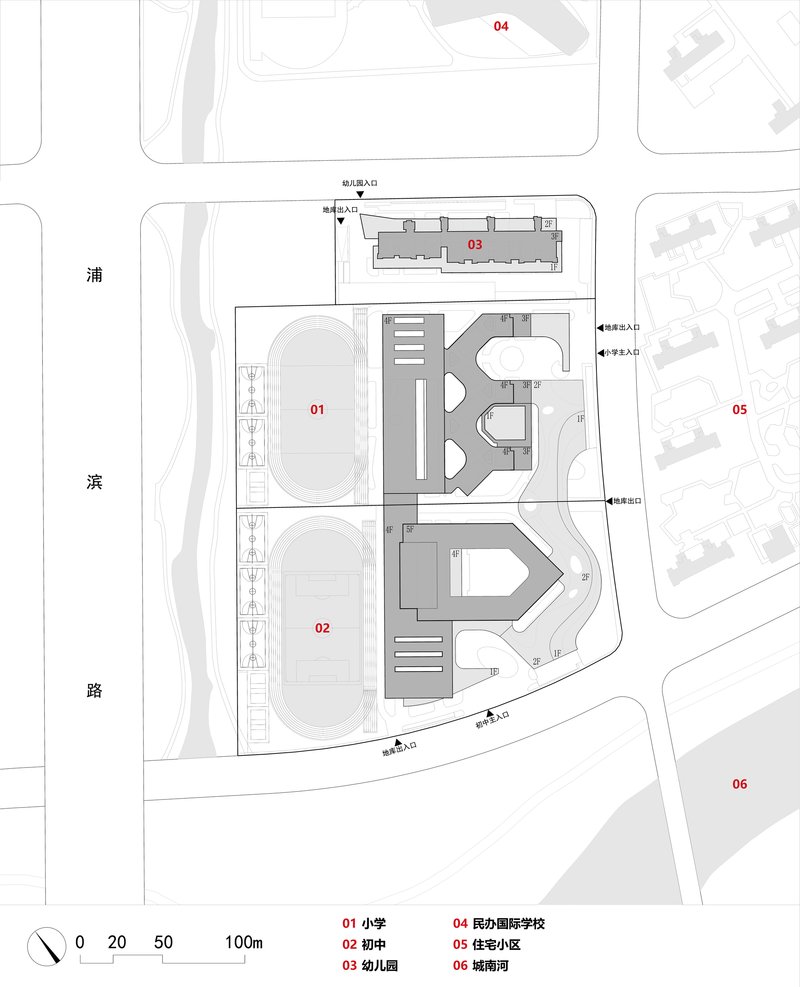
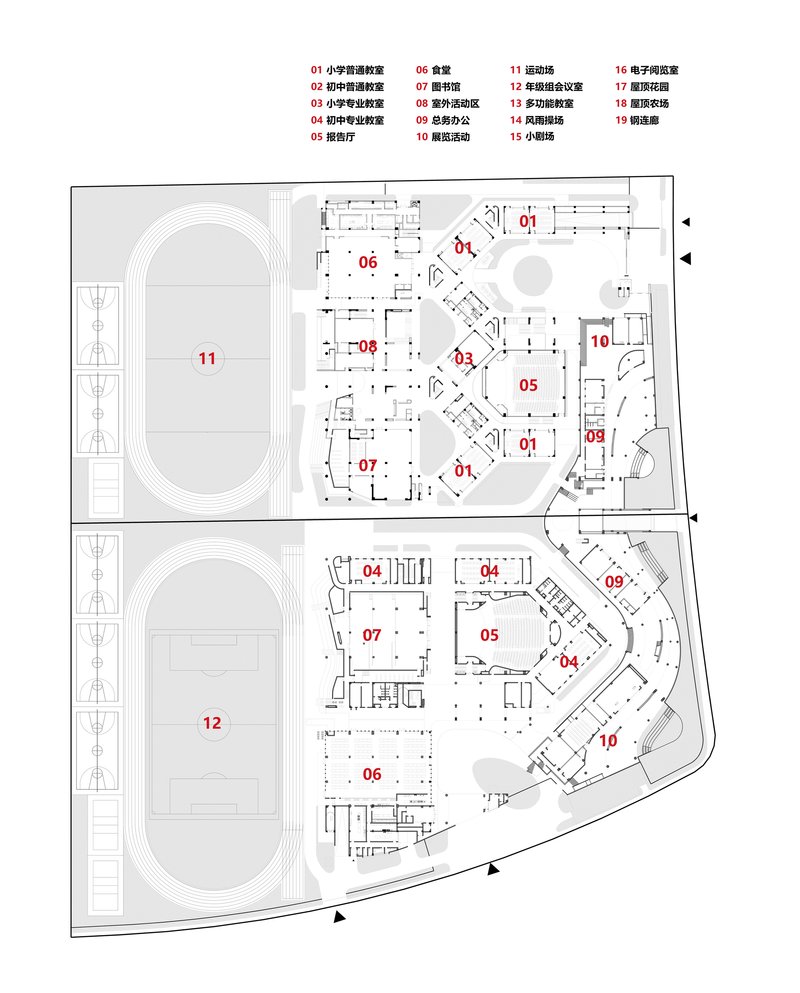
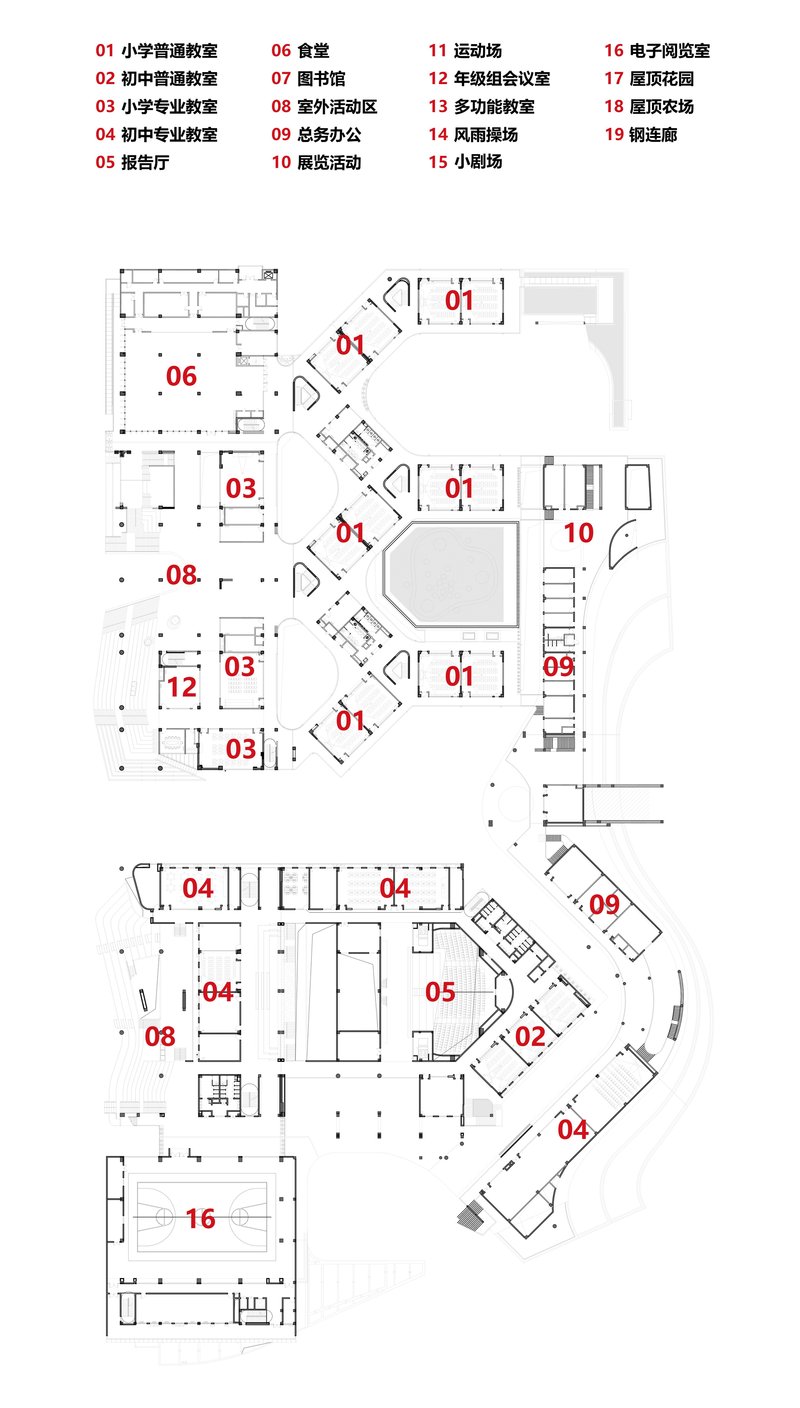
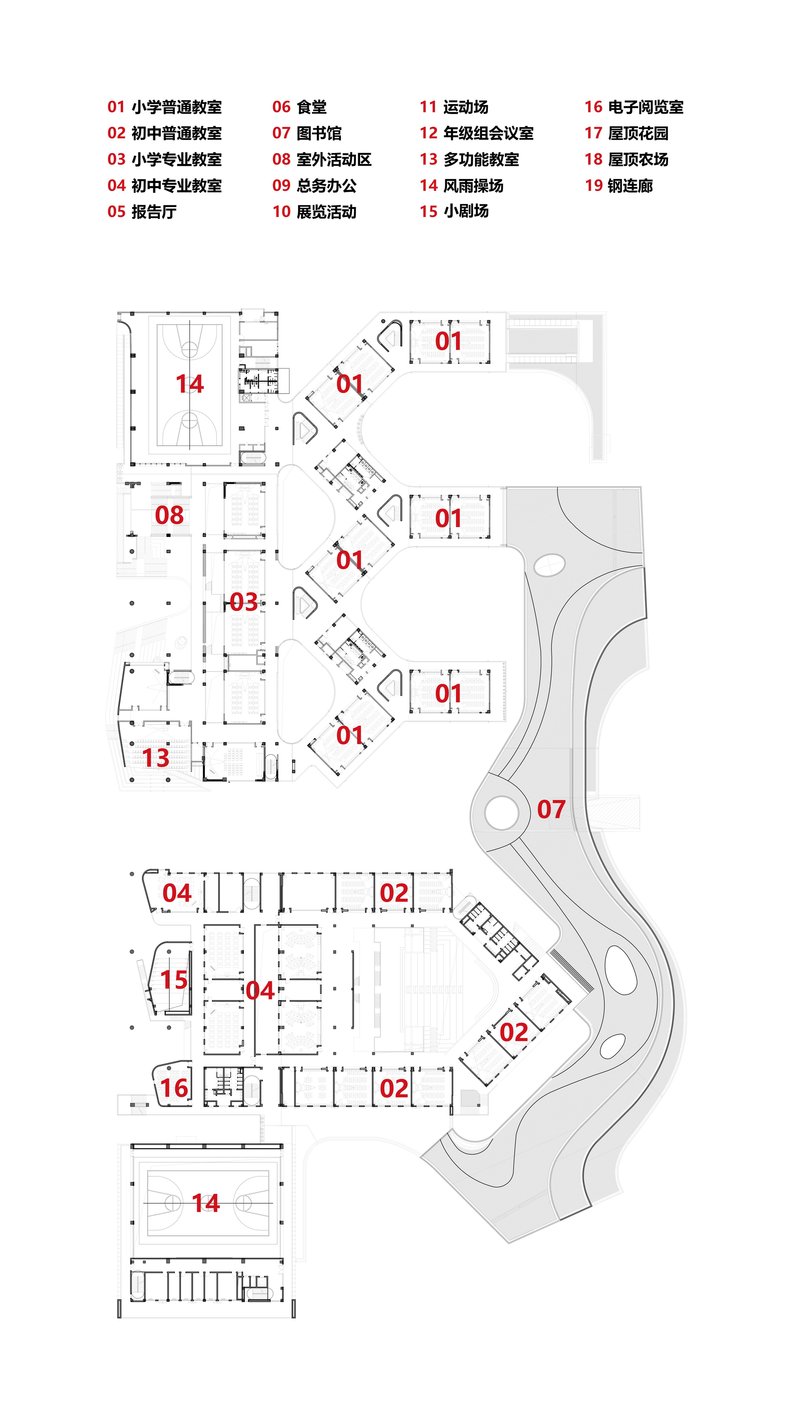
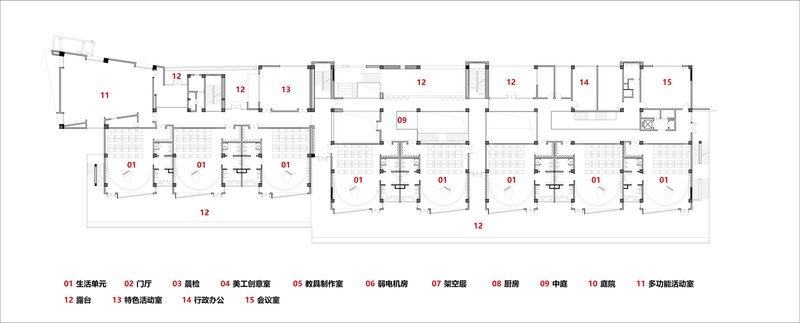
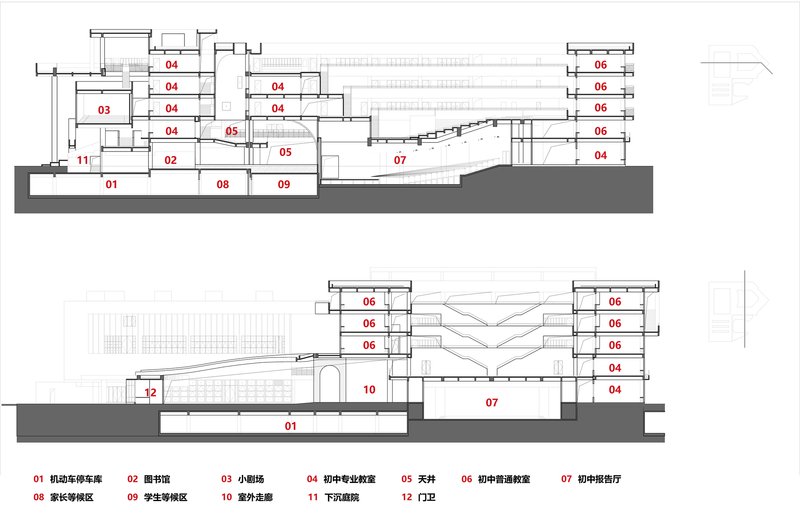
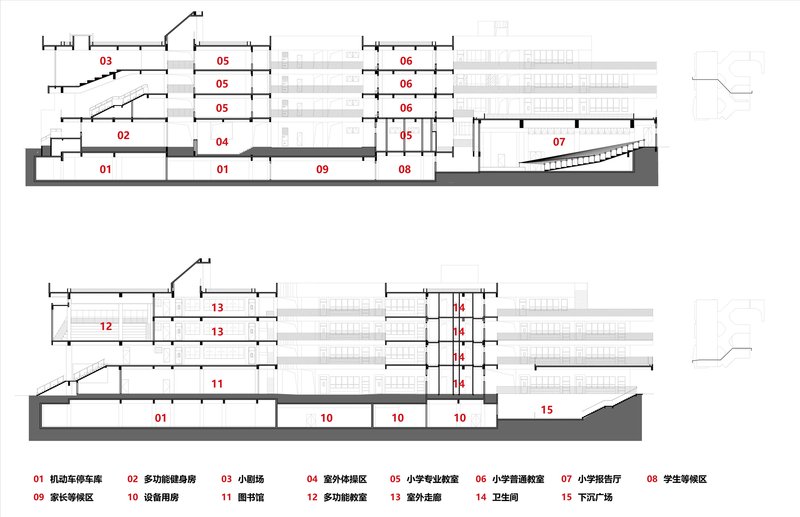
The axonometric and section model drawings reveal the structural and spatial logic that is not immediately legible from photographs. Curved roof volumes, exposed frameworks, and the way courtyards cut vertically through the massed floors become clear in section. The site plan confirms the sequential south-to-north arrangement: kindergarten, primary school, junior high, each with its own courtyard cluster but sharing athletic infrastructure and landscape systems.
The floor plans show the distinct organizational strategies at work. The kindergarten adopts radial classroom clusters around a central courtyard, appropriate for its smaller population and need for supervision. The primary and junior high schools use more linear, corridor-based arrangements but break them with organic landscape contours and courtyard interruptions that prevent any wing from feeling like an endless hallway. The sections illustrate how stepped terraces and sloped auditoriums create sectional variety within what appears from outside to be a uniform horizontal mass.
Why This Project Matters
The Kangsheng Road Education Complex challenges two persistent assumptions in school design. The first is that different age groups require completely separate campuses. By threading kindergarten, primary, and junior high into a continuous fabric, the project creates efficiencies in land use and shared infrastructure while maintaining distinct spatial identities for each program. The second assumption is that density and quality are inversely proportional. At nearly 80,000 square meters on a constrained urban site, the complex delivers generous courtyards, covered outdoor rooms, and rooftop landscapes that rival campuses with far more land.
For architects working on educational projects in dense Asian cities, this is a significant reference. It demonstrates that the courtyard typology, when deployed at multiple scales and calibrated to program, can produce humane environments even at institutional scale. It also reminds us that the spaces between classrooms, the stairs, corridors, terraces, and gathering yards, are where school culture actually forms. SEU-ARCH, ZRADI, and UA GROUP have designed not just a building but a framework for growing up.
Kangsheng Road Education Complex by SEU-ARCH + ZRADI + UA GROUP. Nanjing, China. 78,300 m². Completed 2025. Photography by Bowen Hou.
About the Studio
Share Your Own Work on uni.xyz
If projects like this are the kind of work you want to make, uni.xyz is a place to publish your own, find collaborators, and enter design competitions.




Popular Articles
Popular articles from the community

Inside a Timeless Mumbai Residence by Aether Studio
Aether Studio's 2,250 sq ft apartment in Malad, Mumbai uses marble, brass, boucle, and disciplined restraint to build a quiet retreat from the city.

IKC de Geluksvogel: Sustainable School Architecture Designed for Free Movement and Digital Learning
IKC de Geluksvogel turns sustainable school architecture into a flexible Maastricht campus for digital learning, nature, and free movement.
Eco Chapel: A Green Architecture Pavilion Designed in Symbiosis with the Forest
Eco Chapel uses green architecture to weave prayer, learning and reuse into a forest pavilion shaped by modular hexagonal canopies for life.
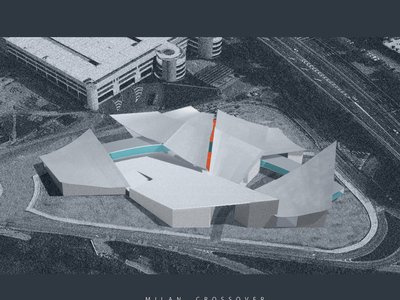
Milan Crossover: Sustainable Architecture for a New Fashion Culture in Milan
Milan Crossover transforms fashion culture through sustainable architecture, linking material libraries, remake studios, and public runways.


Similar Reads
You might also enjoy these articles
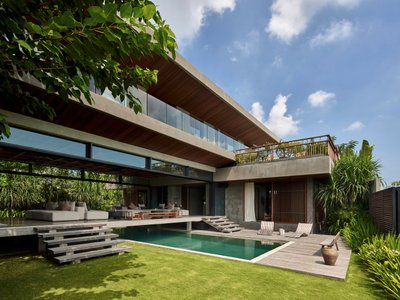
Freebird Residence by Alexis Dornier: A Tropical Modernist Sanctuary in Bali
Floating living pavilion above pool anchors H-shaped tropical villa, blending Japanese minimalism, sustainable strategies, lush landscape, and sculptural interiors.
127af Flips a Tiny Bagnolet Rowhouse Upside Down with a Handcrafted Roof Extension
A 55-square-meter terraced house on the edge of Paris gains a luminous upper living floor through lightweight timber and steel.
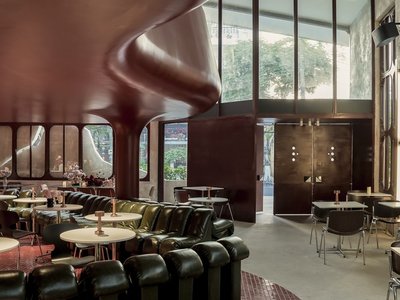
1.61 Design Workshop Wraps a 600-Square-Meter Café in Vietnam in Sculptural Burgundy Drama
Reden Café & Bistro pairs a helical staircase, mosaic floors, and deep red interiors to rethink Vietnamese hospitality space.

The Unbound Brain: A School Shaped by Cognitive Architecture
Cylindrical learning pods radiate like neurons from a central cortex, turning the floor plan into a spatial model of human thought.


Explore Infrastructure Design Competitions
Discover active competitions in this discipline




The Global Benchmark for Architecture Dissertation Awards


Challenge to design public laboratory
Comments (0)
Please login or sign up to add comments
No comments yet. Be the first to comment!