
KCAP Weaves 250,000 Square Meters of Housing and Parkland into a Single Neighborhood in Oss
Sibeliuspark replaces a conventional Dutch suburb with a compact district where brick housing and generous landscapes are genuinely inseparable.


The default suburban playbook in the Netherlands, and almost everywhere else, treats housing and open space as separate budget lines. Developers build the blocks, then a park department fills whatever is left over. KCAP's Sibeliuspark in Oss reverses that logic on a quarter-million square meters: the landscape isn't surplus land between buildings but the connective tissue that gives the entire district its structure and identity.
What makes the project genuinely interesting is the discipline with which it integrates program. Skate bowls, naturalized planting, playgrounds, picnic clearings, and shared paths are not scattered as amenity dots on a masterplan. They are threaded through the housing fabric so that the boundary between private threshold and public park is always in your peripheral vision. The result is a neighborhood that feels both compact and generous, an outcome that is harder to pull off than it sounds.
The Park as Armature
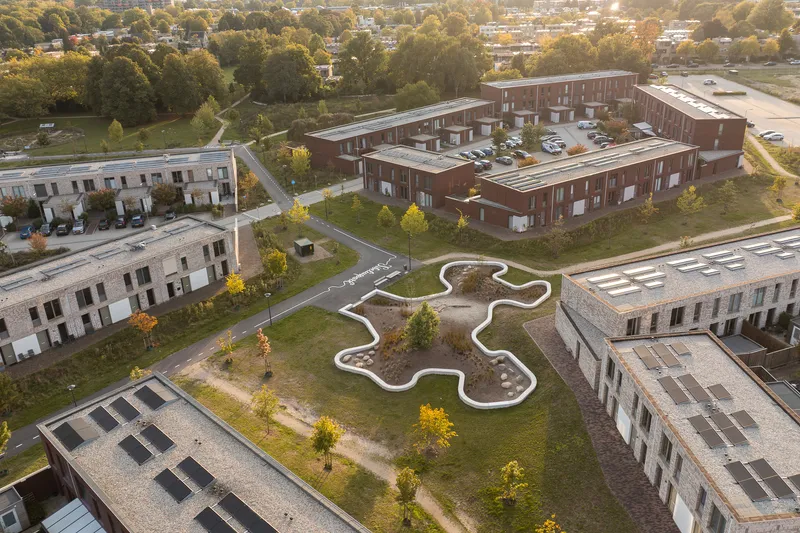
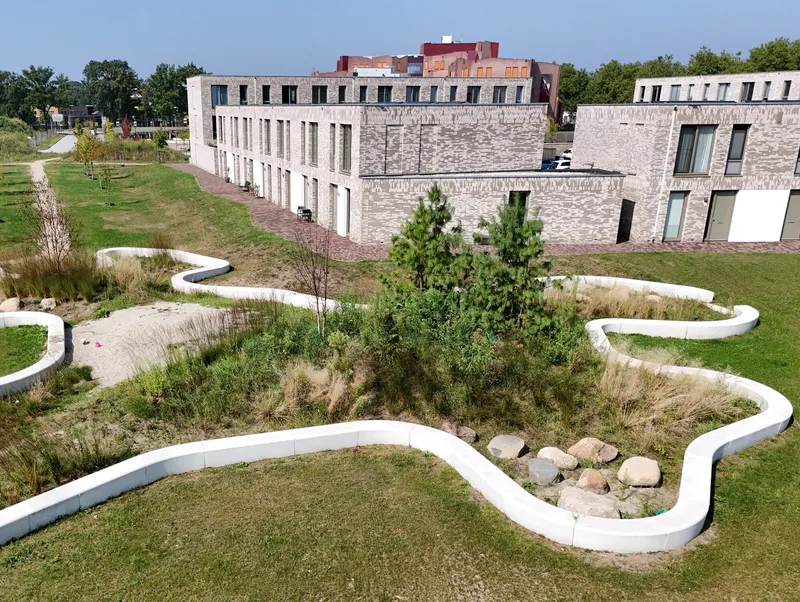
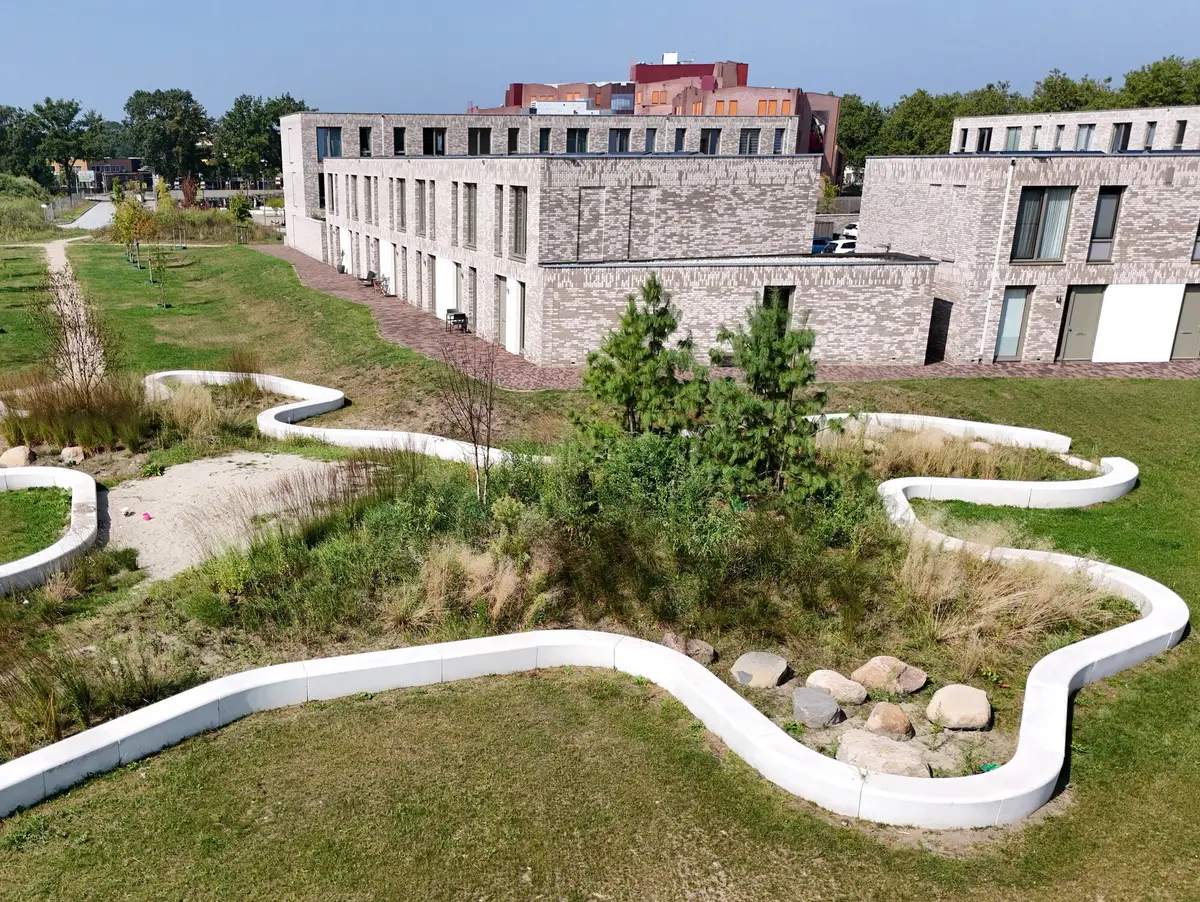
From the air, Sibeliuspark reads as a series of sinuous green corridors running between clusters of brick housing. Curvilinear planting beds, edged in white, mediate between lawn, gravel paths, and the hard edges of residential blocks. The geometry is neither rigid nor arbitrary: it creates pockets of enclosure while maintaining long sight lines through the district.
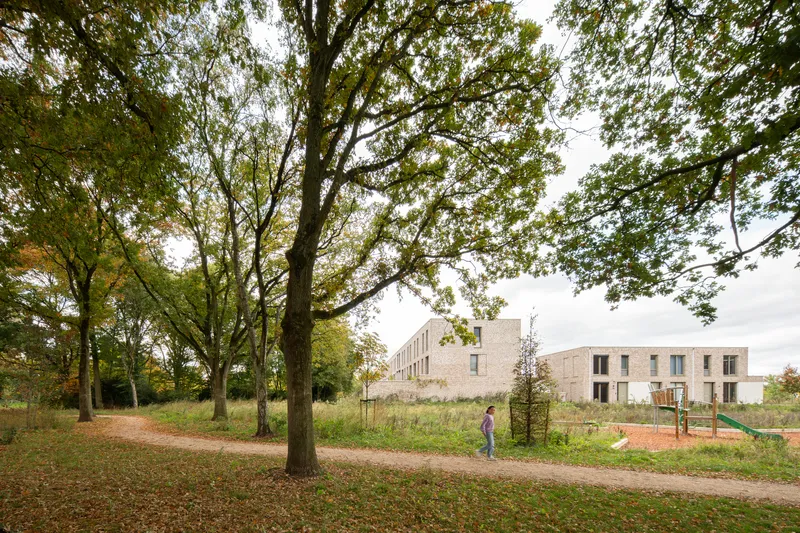
At ground level, this translates into a constant alternation between open field, canopy shade, and built edge. Children on playground equipment occupy the foreground while mature trees anchor the middle distance and housing completes the frame. It is a layered spatial experience that keeps you oriented without any single element dominating.
Concrete Bowls and Golden Light
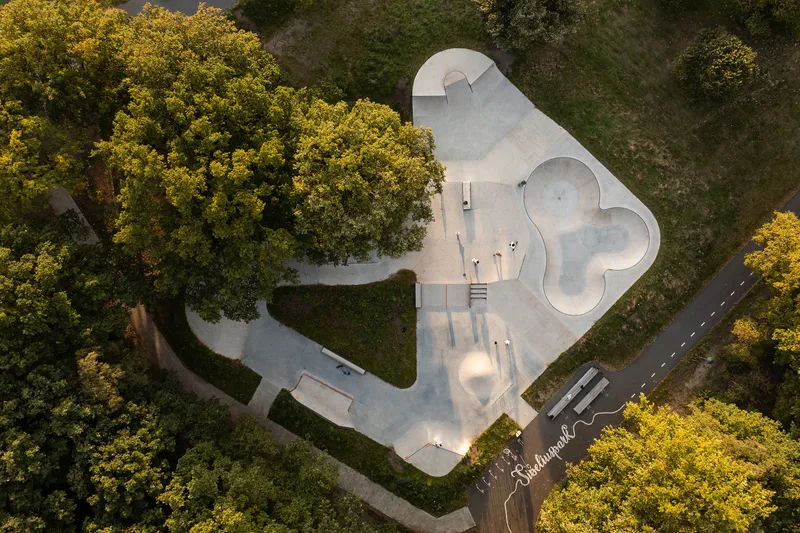
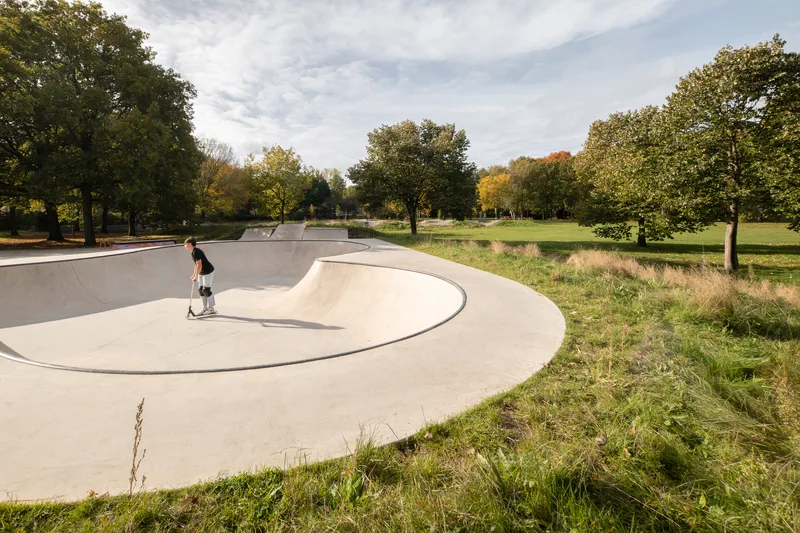
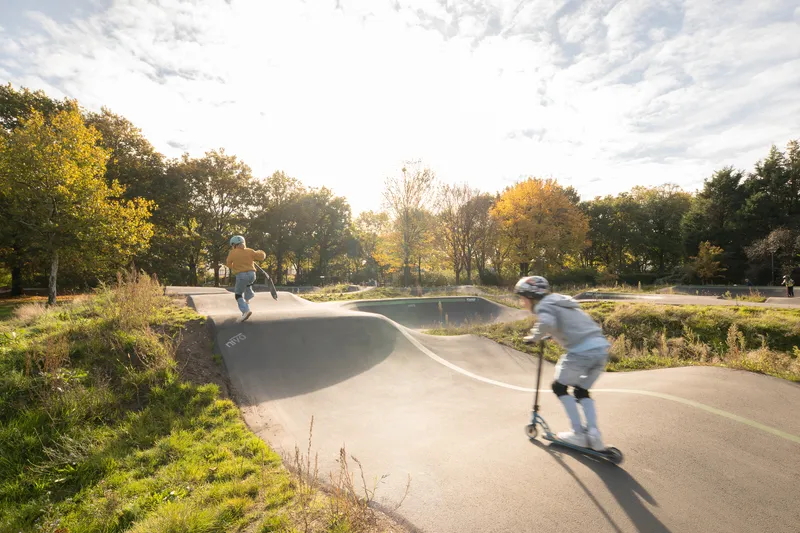
The skate park is the project's most photogenic element, and for good reason. Its curving concrete bowls sit within a clearing of dry grasses and autumn trees, and the material honesty of poured concrete against naturalized planting gives the space a toughness that resists the twee tendencies of many Dutch public realm projects.
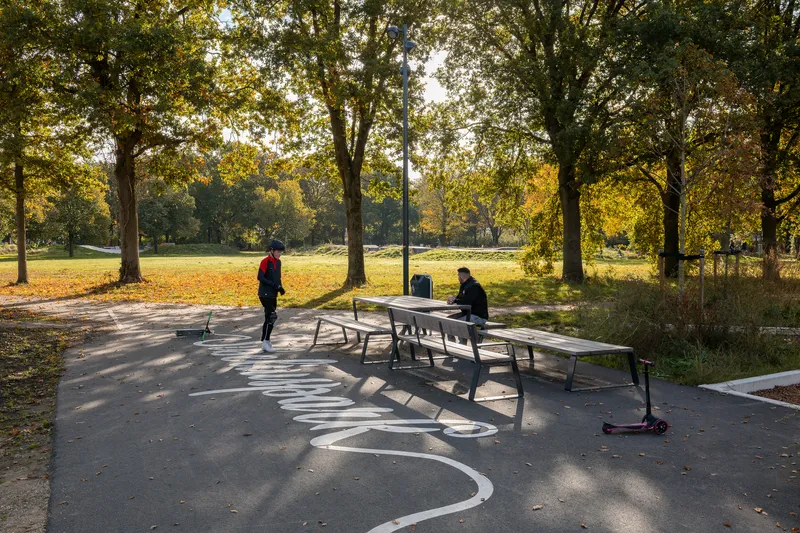
More importantly, the facility is sized and positioned to function as a genuine neighborhood anchor. Skateboarders, scooter kids, and spectators occupy the space simultaneously, and the surrounding landforms provide informal seating. It is civic infrastructure disguised as recreation, the kind of investment that pays back in social cohesion over decades.
Playgrounds That Refuse to Be Generic
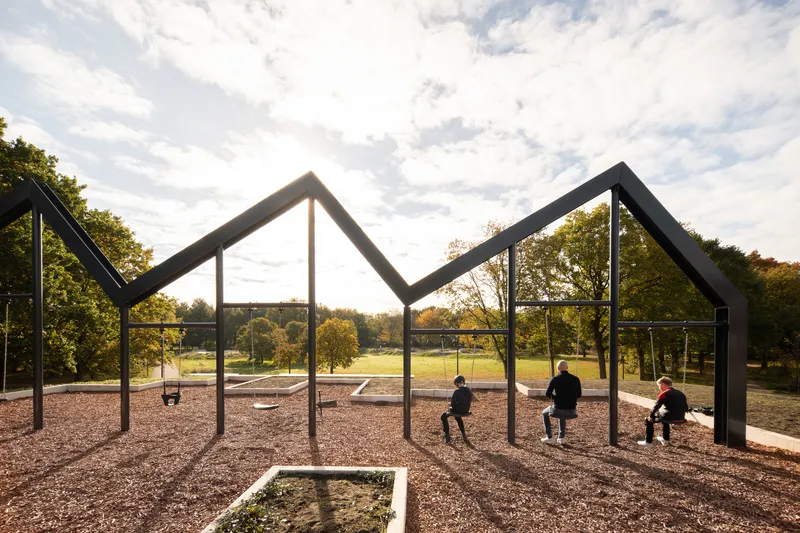
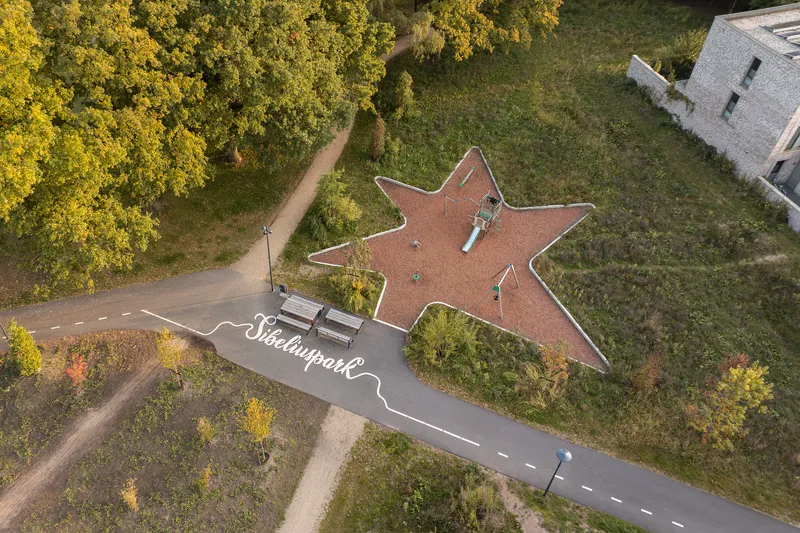
KCAP distributes several distinct play environments across the site rather than consolidating everything into one fenced zone. A star-shaped red rubber surface accommodates climbing and balancing equipment for younger children. A steel-frame gabled pavilion doubles as a swing structure and a recognizable landmark. A ping pong table on a curved court offers low-key activity for older kids and adults.
The variety matters because it allows different age groups and temperaments to find their own territory without competing for space. Each installation has a clear material character, rubber, steel, concrete, that distinguishes it from its neighbors while remaining visually coherent with the broader landscape palette.
Shared Ground Between Thresholds
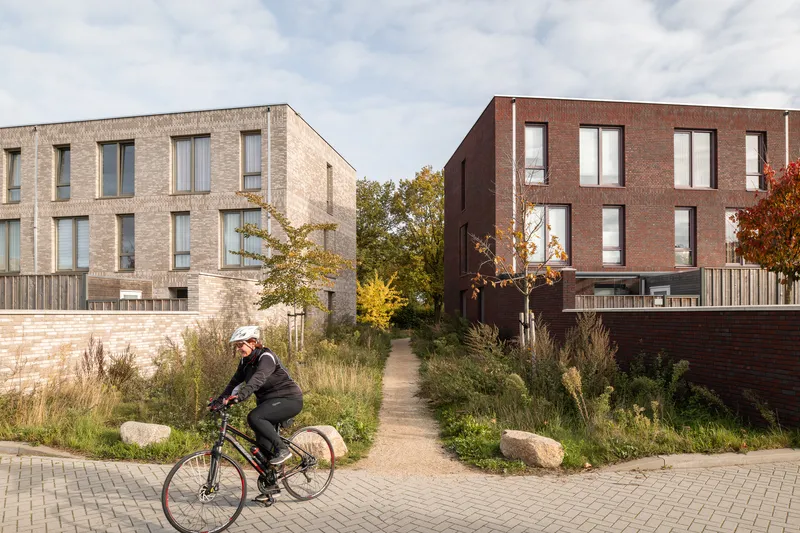
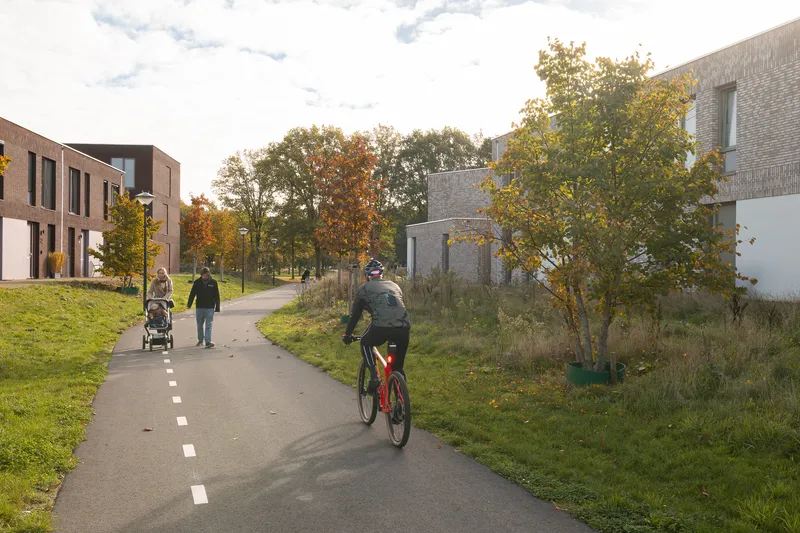
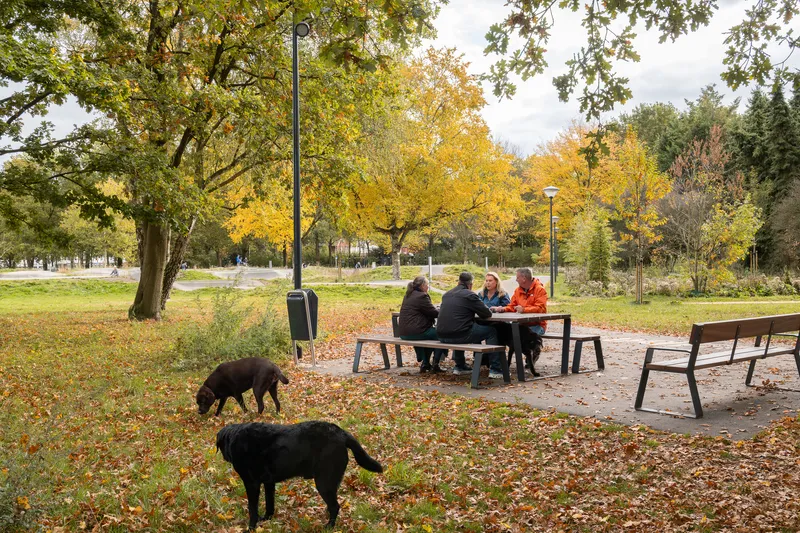
The spaces between housing rows are where Sibeliuspark's ambition is tested most directly. Gravel paths lined with naturalized planting separate facing brick facades, and the width is calibrated to allow cyclists, pedestrians, and dogs to coexist without anyone feeling squeezed. Timber picnic furniture in park clearings extends the domestic threshold into the landscape.
These interstitial zones succeed because they refuse to be purely functional. The planting is varied and seasonal, the paving shifts from asphalt to gravel to grass, and the sightlines are broken by tree trunks rather than fences. It is a subtle but deliberate strategy to slow movement and encourage lingering, which is ultimately what distinguishes a neighborhood from a housing estate.
Detailing the Public Realm
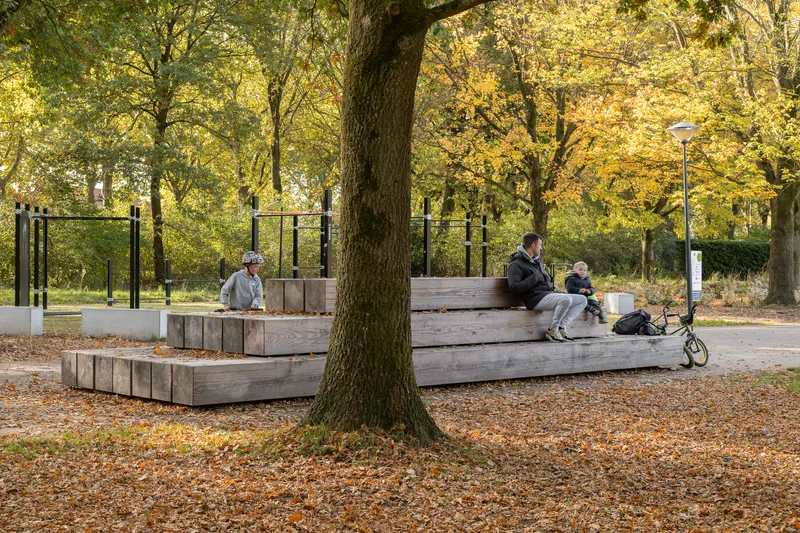
A stepped timber seating platform wraps around the trunk of a mature tree, turning an obstacle into a gathering point. It is a small move, but it encapsulates KCAP's approach: every existing asset, whether a tree, a slope, or a patch of sun, becomes a design opportunity rather than something to work around.
The material vocabulary across the park is deliberately restrained. Concrete, timber, steel, and rubber recur in different configurations, and the limited palette keeps maintenance straightforward while lending the district a visual unity that survives the inevitable wear of daily use.
Plans and Drawings
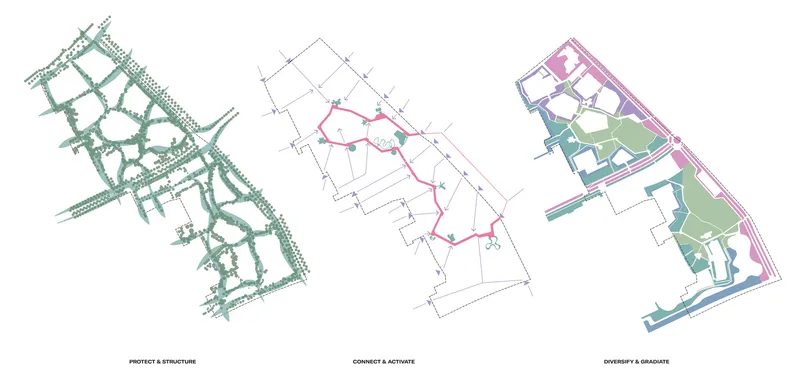
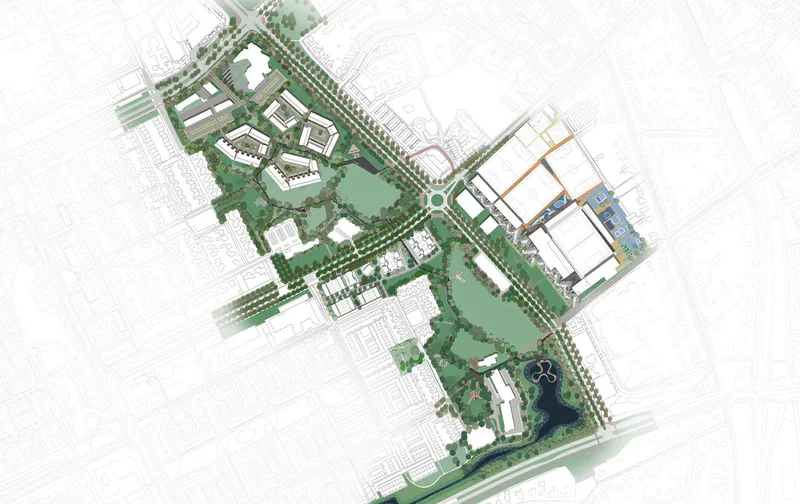
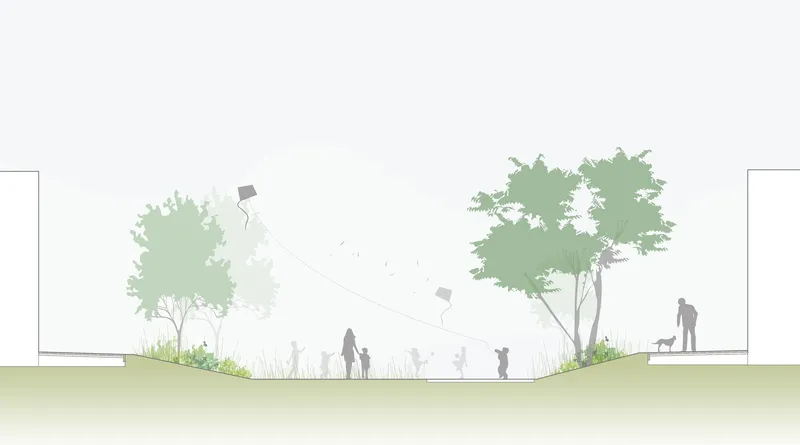
The site plan diagrams reveal a layered analytical method: protected zones, pedestrian routes, and landscape gradients are mapped separately before being synthesized into the masterplan. The masterplan itself shows residential clusters organized around green corridors, with the street network treated as a secondary system subordinate to the landscape structure.
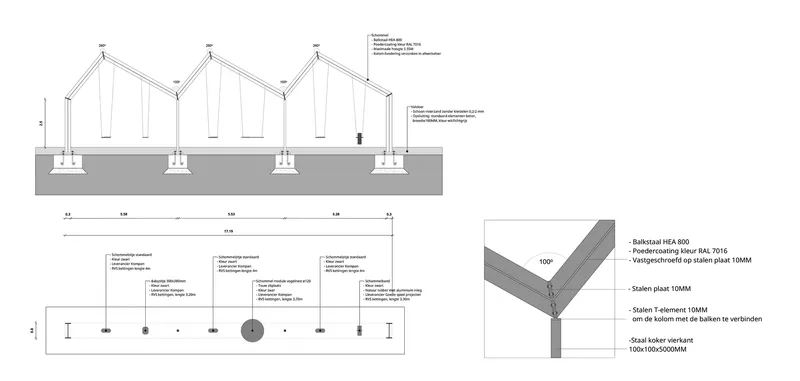
A longitudinal section illustrates how the terrain slopes gently across the site, accommodating trees of varying maturity and informal recreation, figures with dogs, kites overhead, in a continuous public ground plane. Construction detail drawings for the gabled steel pavilions show moment connections and column base assemblies, evidence that the playful forms seen in the photographs rest on carefully engineered foundations.
Why This Project Matters
Sibeliuspark matters because it demonstrates that density and landscape quality are not competing goals. At 250,000 square meters, the district is large enough to register as a credible model for suburban development rather than an isolated experiment. KCAP's insistence on making the park the organizational spine, not an afterthought, produces a neighborhood where walking to the skate bowl or the picnic clearing is a genuine alternative to driving somewhere else.
It also offers a quiet rebuttal to the idea that Dutch residential design peaked in the Vinex era. The brick housing is straightforward, the landscape moves are legible, and the program is generous without being extravagant. If Oss can do this, the question for every other mid-sized European city is why it hasn't tried.
Sibeliuspark by KCAP. Oss, The Netherlands. 250,000 m². Completed 2025. Photography by Aiste Rakauskaite.
About the Studio
Share Your Own Work on uni.xyz
If projects like this are the kind of work you want to make, uni.xyz is a place to publish your own, find collaborators, and enter design competitions.


Popular Articles
Popular articles from the community


Hill & Cross Opera: Sculptural Opera House Architecture Shaped by Tallinn’s Landscape and Identity
Hill & Cross Opera reimagines opera house architecture in Tallinn through its sculptural hill, civic plaza, glass wave and a luminous cross.

Little Red Riding Hood: Architectural Design as a Journey Through Fear, Light, and Storytelling
Little Red Riding Hood reimagines the fairy tale through architectural design shaped by fear, light, scale, memory, uncertainty, and choice.

Conexión: Biophilic Design Reimagines High-Rise Living in Hong Kong
Conexión reimagines high-rise living in Hong Kong through biophilic design, green facades, shared spaces, daylight, water and nature within.

Co-Life: Senior Housing Design That Reconnects Older Adults With the City
Co-Life reimagines senior housing design through healing gardens, shared streets, workshops, and a sustainable community across generations.

Similar Reads
You might also enjoy these articles

Bao Huynh Watercolor Atelier: A Serene Art Retreat in Hội An
Bao Huynh Watercolor Atelier in Hội An blends multifunctional art spaces, sustainable design, local materials, and family-friendly living in a serene environment.

Atelier Macri Concept Store Interior Design by CASE-REAL
Atelier Macri store features a "ko" counter, walnut wood details, cork displays, blending retail, gallery, and seamless customer experiences.

Manuel Vargas Izquierdo Stadium and High-Performance Sports Center: Architectural Excellence in Jalpa de Méndez
The Manuel Vargas Izquierdo Stadium blends sustainable design, inclusive sports facilities, and cultural-inspired architecture, revitalizing Jalpa de Méndez’s public spaces.
KAKR Buluh Awar Hall: Revitalizing Community and Ecology Through Bamboo Architecture
Community built bamboo hall revitalizes Buluh Awar village, empowering youth, restoring ecology, celebrating vernacular craftsmanship through sustainable architecture and culture.

Comments (0)
Please login or sign up to add comments
No comments yet. Be the first to comment!