
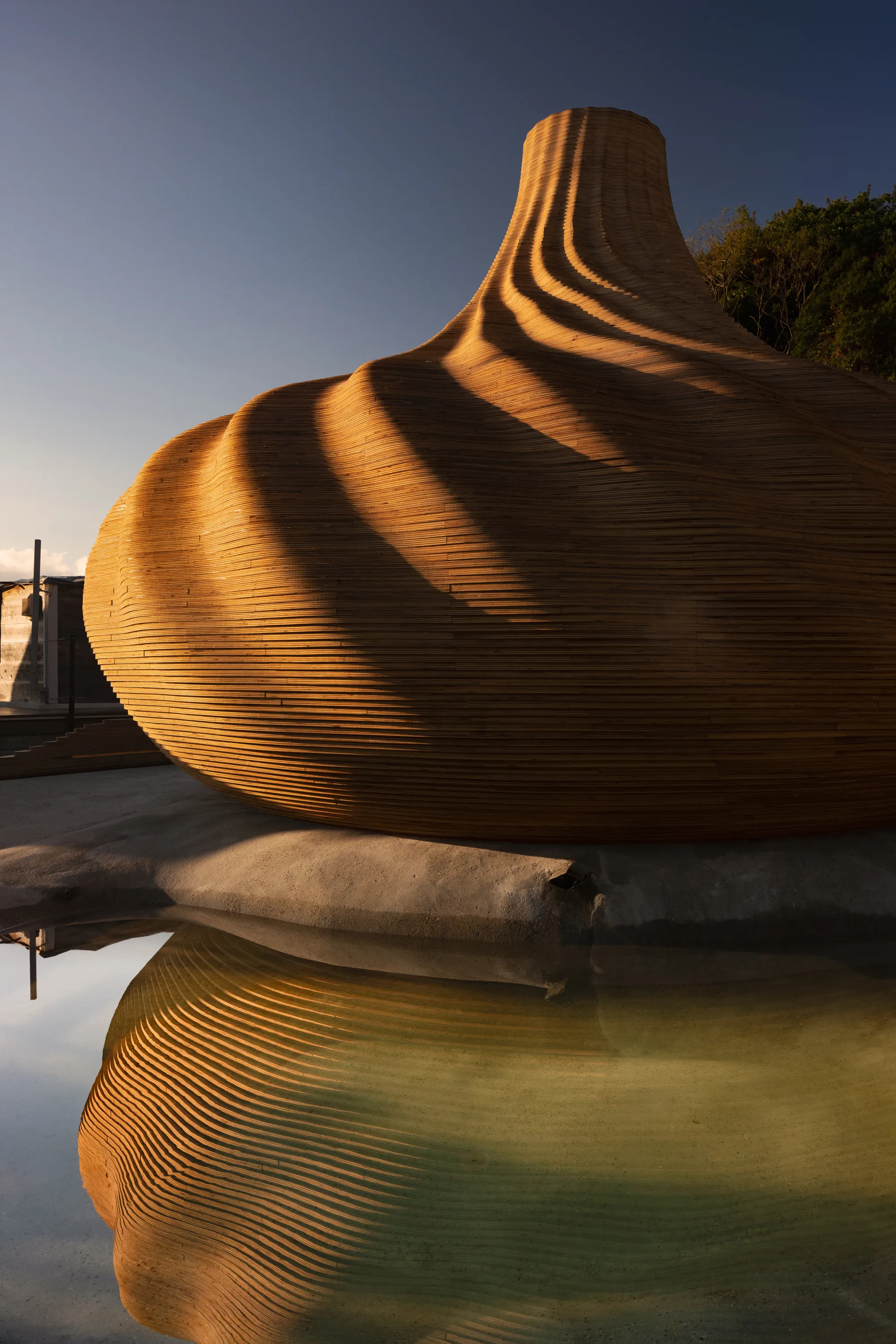
Kengo Kuma Stacks 1,500 Plywood Sheets into a Shell-Shaped Sauna on Naoshima
An 8-square-meter biomimetic sauna on Japan's art island channels the geometry of a turban shell through CNC-cut timber layers.


An island already saturated with experimental architecture and art gets one more provocation, and it might be the smallest yet most obsessively crafted of them all. Sauna Sazae, designed by Kengo Kuma & Associates, sits at the center of the Sana Mane glamping facility on Naoshima's western coast: a bulbous timber shell that reads as equal parts sea creature and sacred space. At just 8 square meters, it is a building that refuses to be minor.
The name SAZAE refers to Turbo cornutus, the horned turban shell found in Japanese waters, and the building takes the reference seriously. Its walls are made from roughly 1,500 CNC-processed plywood sheets, each 28 millimeters thick, stacked in 150 layers to achieve an average wall thickness of 450 millimeters. The result is a structure that performs thermally like a cave and visually like a living organism, its exterior covered in countless folds that catch and release shadow throughout the day. Designed in collaboration with structural engineers at Ejiri Structural Engineers and lighting specialists ALG, the project was led by Taichi Kuma and supervised by TTNE, a sauna specialty brand.
A Shell on a Glamping Shore
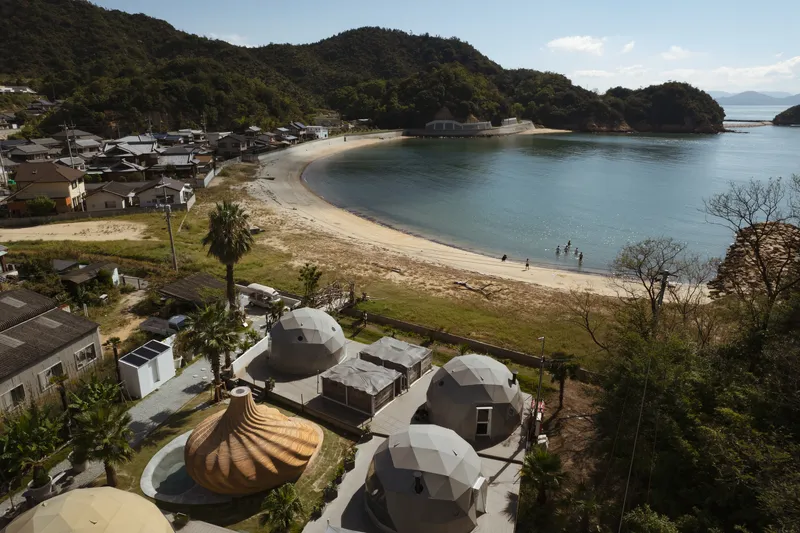
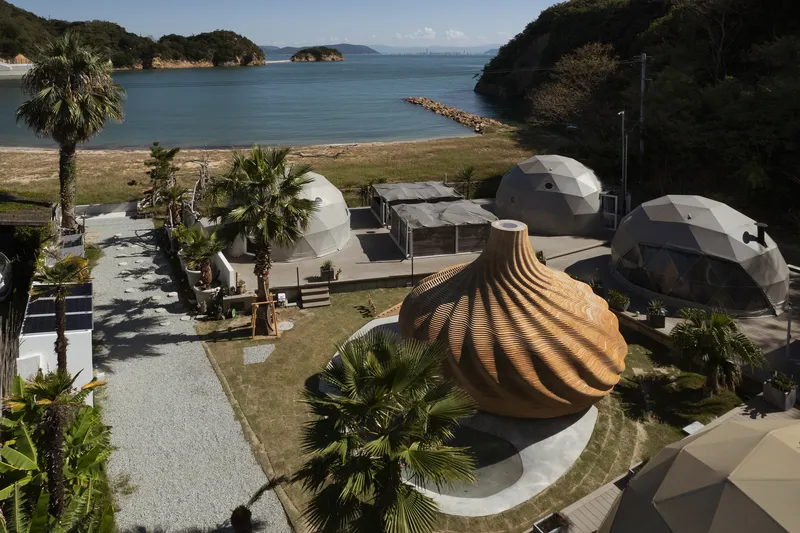
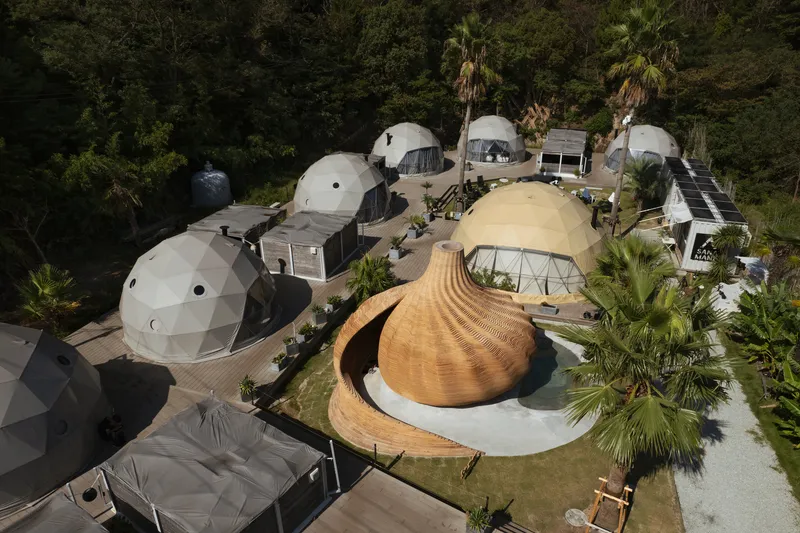
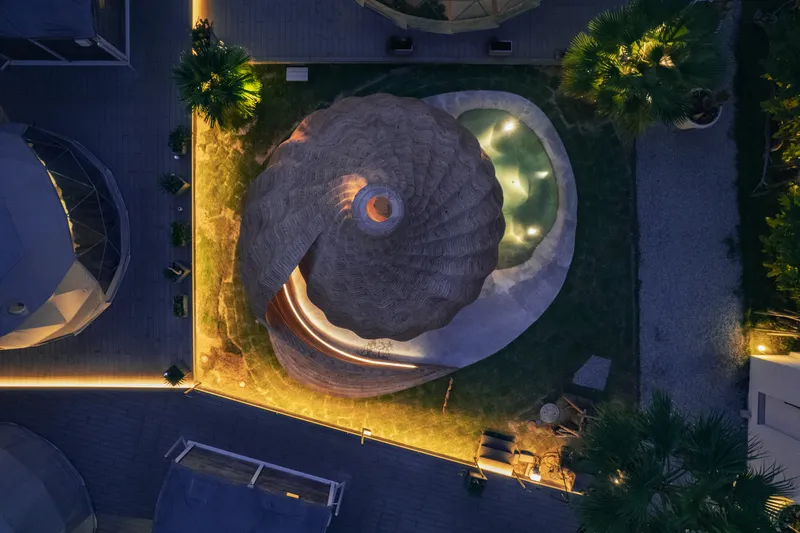
From above, the Sana Mane site reads as a tidy constellation of white geodesic domes, rectangular modules, and palm trees strung along a coastal lawn. The sauna disrupts that order completely. Its bulging, ribbed profile breaks the grid, asserting a different logic rooted in organic curvature rather than modular repetition. The contrast is deliberate: it turns the sauna into a destination within the compound, the thing you walk toward.
Naoshima's identity as an art island sets a high bar for any new addition. Buildings here are expected to carry conceptual weight. Sauna Sazae earns its place not through monumental scale but through the intensity of its craft and the strangeness of its form against the placid bay and forested hills behind it.
Biomimetic Geometry in Stacked Plywood
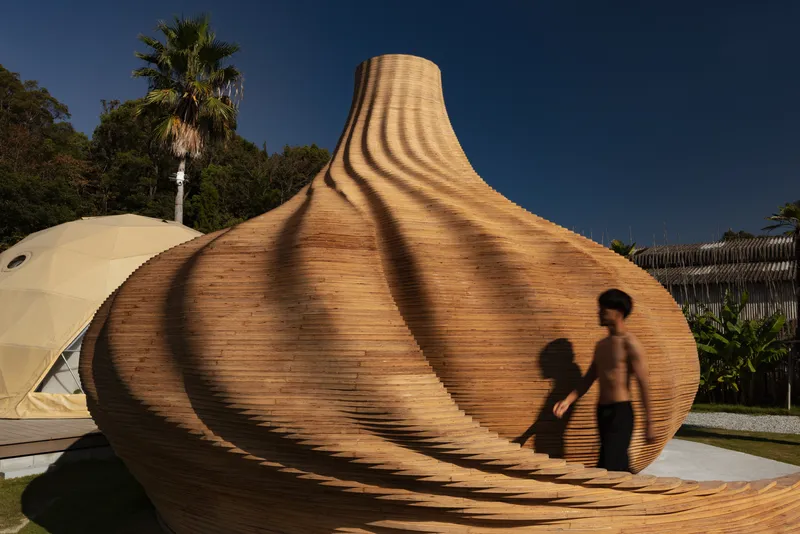
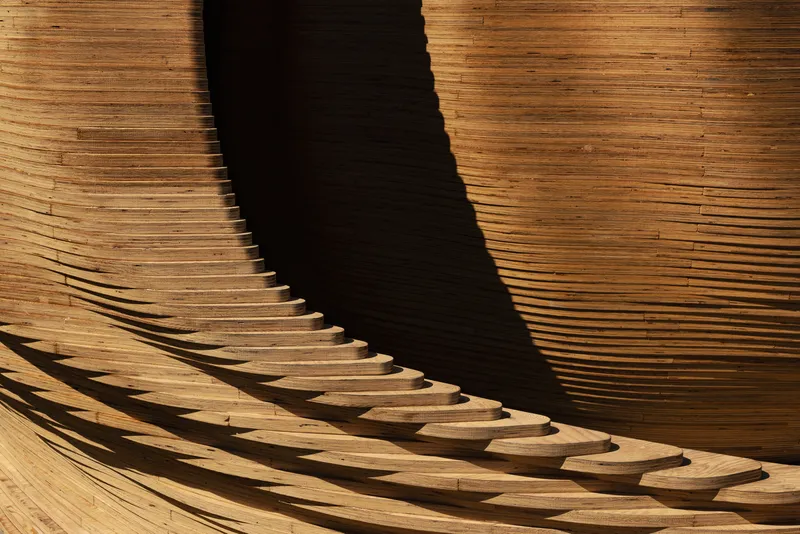
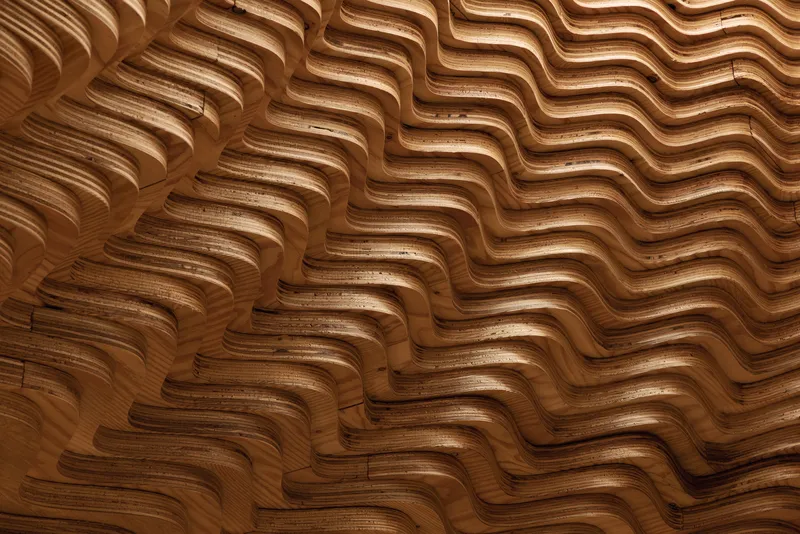
Walk up close and the construction logic reveals itself. Each plywood sheet is a unique shape, CNC-cut and assembled on site like a three-dimensional puzzle. The sheets stack horizontally, creating fine striations across the surface that recall geological strata or the growth rings of a shell. Approximately 5,000 individual pieces were assembled to achieve this, each one's geometry controlled by 3D CAD and custom programming.
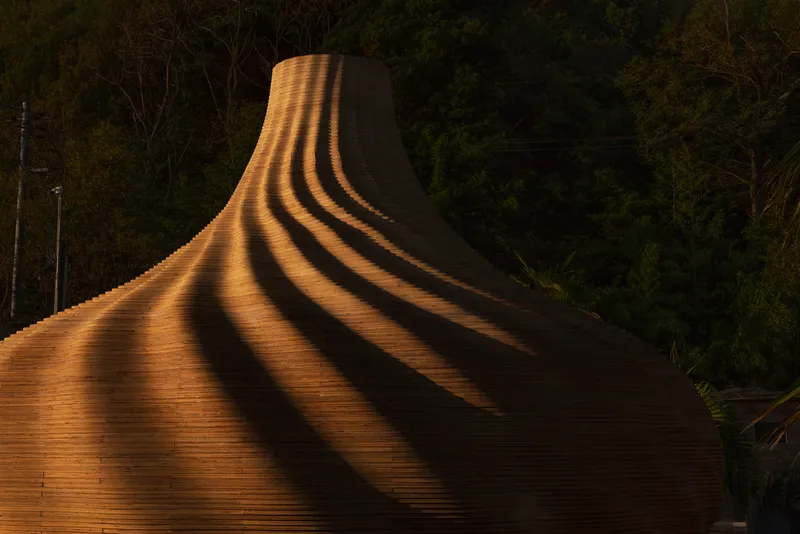
The shadow play is extraordinary. Because the stacked layers are not flush but step in and out to generate the form's undulations, each rib catches light at a slightly different angle. In the afternoon, this produces a moiré of sharp, parallel shadows that migrate across the surface. It is ornamentation generated entirely by structure, a move that is characteristic of Kuma's broader practice but here is compressed into an almost impossibly small footprint.
The Oculus and the Cave
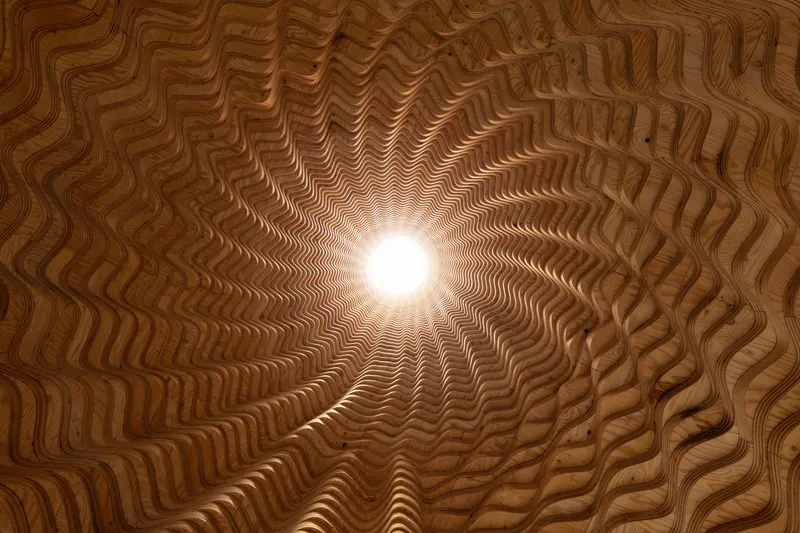
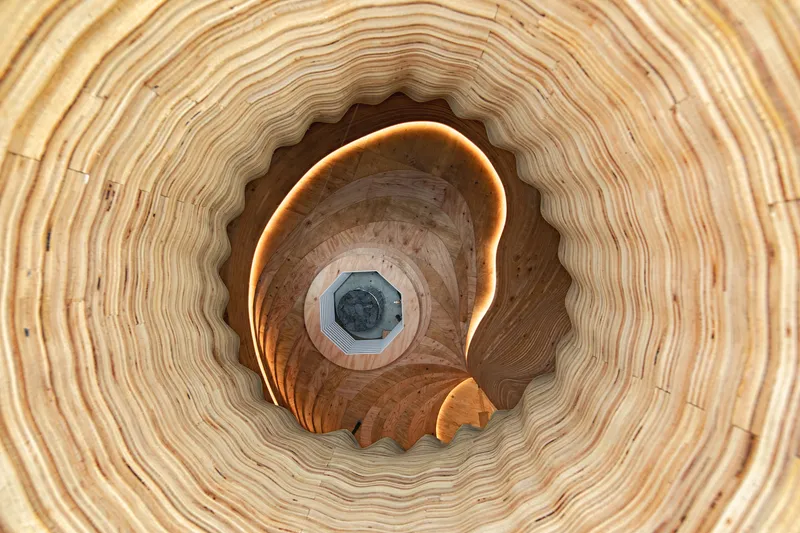
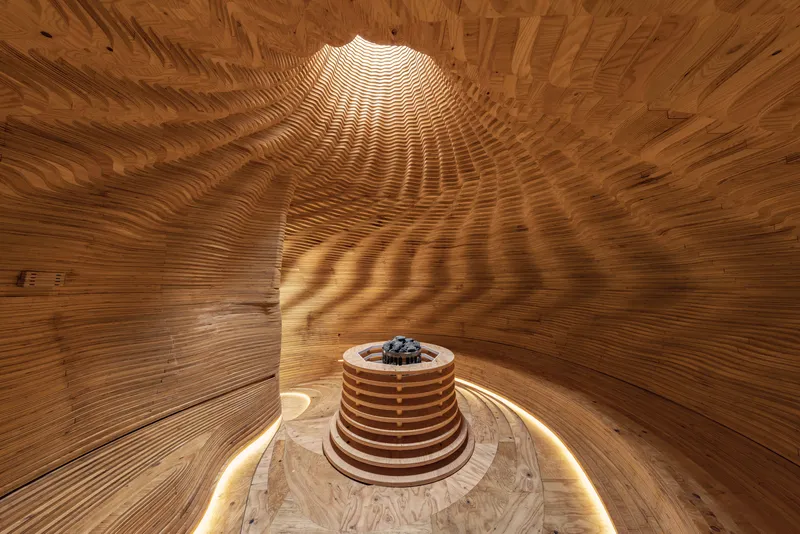
The single most dramatic spatial move is the oculus at the top of the dome. Looking up from inside, the stacked plywood ribs spiral inward like the interior of a nautilus, converging on a bright opening that admits a controlled column of light. The effect is meditative: you are simultaneously inside a constructed object and inside something that feels grown. The herringbone ceiling panels between the ribs add a finer texture that rewards sustained attention.
The entrance evokes the aperture of a turban shell, a narrow cave-like opening that compresses the body before releasing it into the domed interior. That threshold sequence, from bright coastal daylight to tight passage to softly lit dome, stages the transition from the everyday to the contemplative that a good sauna demands.
A Sauna That Performs Like a Thick Wall
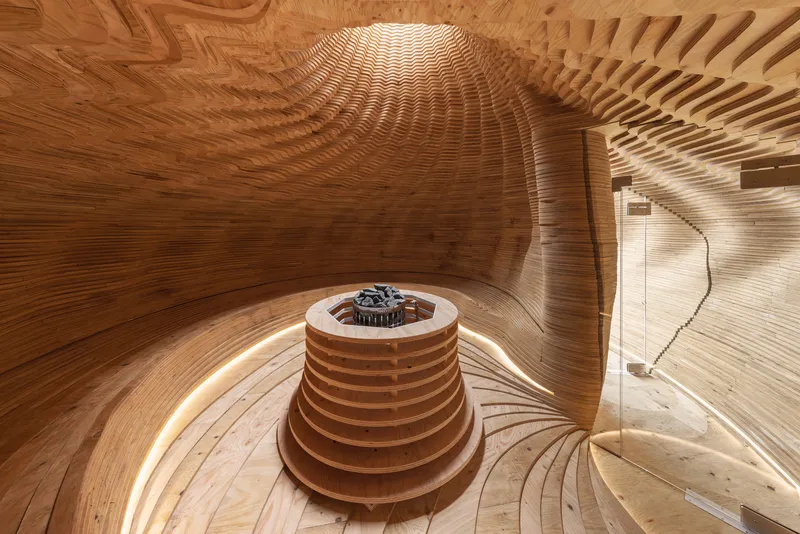
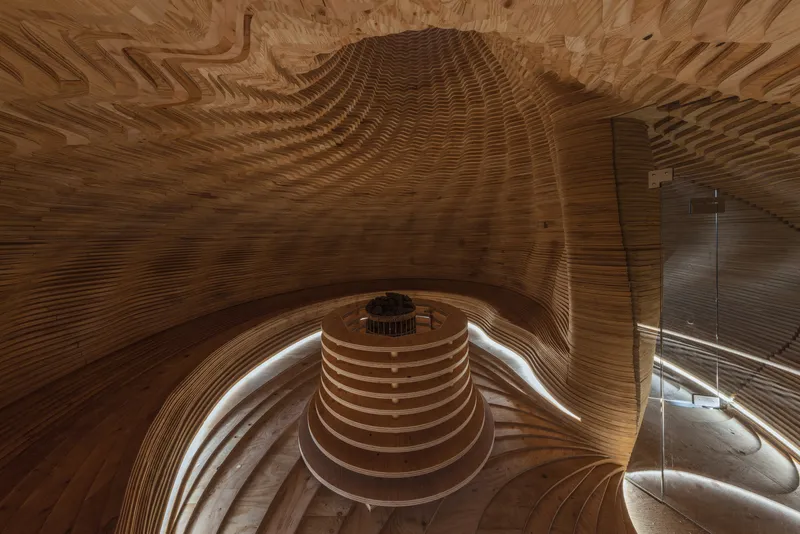
Inside, the floor plan is circular, with radial benches whose interior pleats are shaped to conform to the seated body. A central tiered heater column anchors the room. Perimeter lighting washes the curved walls from below, reinforcing the cave analogy and keeping the upper dome in relative shadow so the oculus reads as the primary light source.
The 450-millimeter-thick walls are not decorative excess. They serve as thermal mass, retaining heat far more effectively than a conventional thin-walled sauna. Environmental simulations drove the design of a forced ventilation system with intake from the top and exhaust from the bottom, maintaining optimal temperature and humidity despite the high ceiling. For a structure this sculptural, the engineering is notably pragmatic.
Twilight and Water
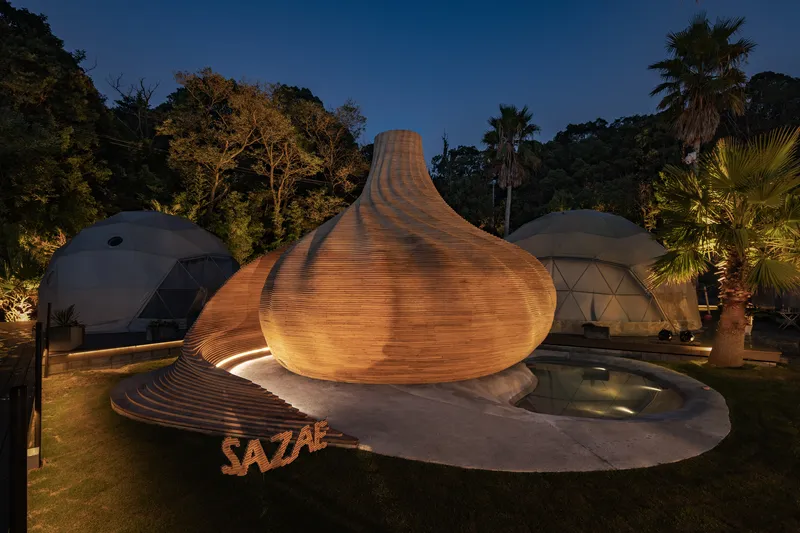
At dusk, the sauna transforms. Internal light escapes through the gaps between plywood layers, turning the shell into a softly glowing lantern. The adjacent reflecting pool doubles the image, and the geodesic domes in the background become pale satellites orbiting a warmer, stranger planet. Photographed by Keishin Horikoshi, these night views make the strongest case for the building as a piece of land art rather than mere infrastructure.
The curved concrete pool at the base is both a cold plunge for the sauna ritual and a visual device that anchors the floating quality of the timber shell to the ground plane. By day it reflects sky and ribs; by night it catches warm light. It is a small move, but it completes the composition.
Detail at the Seam
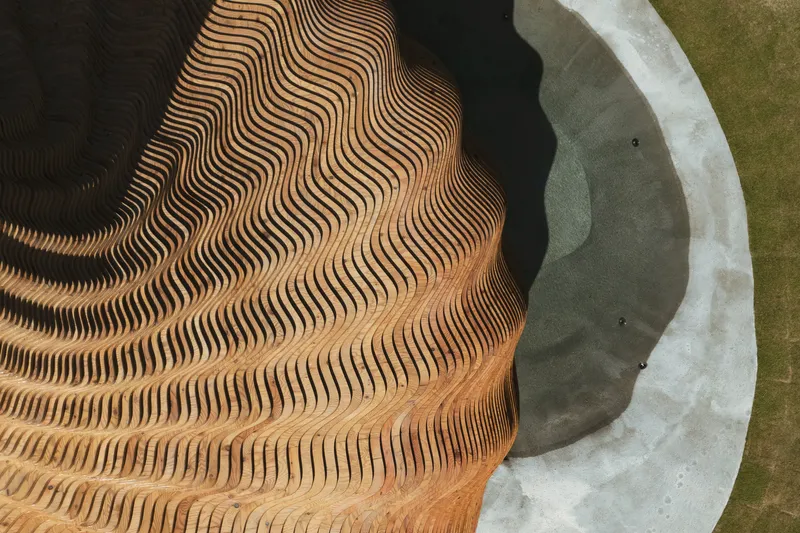
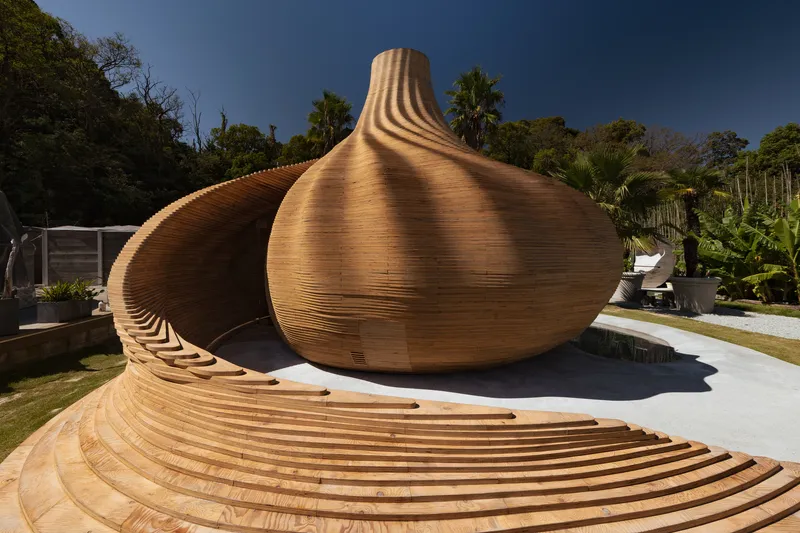
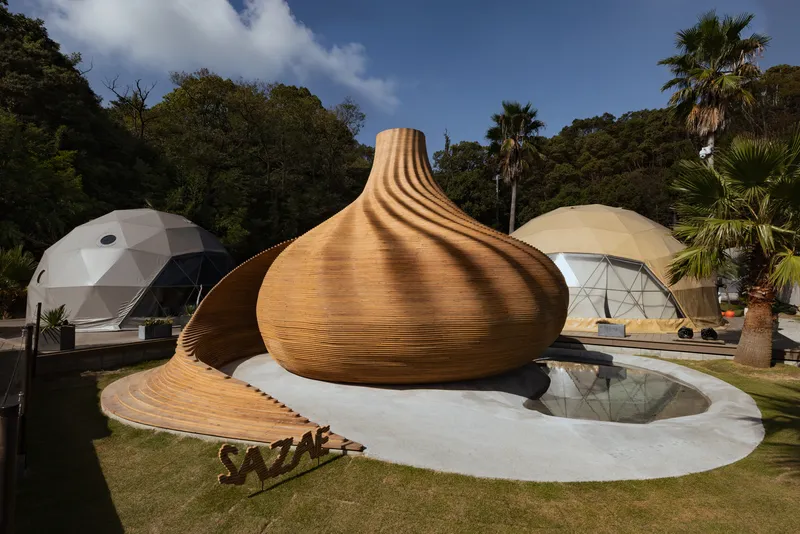
The junction between the timber shell and its white concrete base is where the building's two material logics meet. The concentric plywood ribs terminate against a clean curved edge, establishing a dialogue between the organic and the engineered that runs through the entire project. The extended canopy deck offers a transition zone, a place to cool down while still within the shell's gravitational pull.
There is an argument that this building's most interesting surface is the one you look down at from above. The overhead views reveal the spiral geometry most clearly, the way the oculus is offset from center, the way the ribs wrap and tighten like the whorls of the shell that inspired them. The plan is the diagram, and the diagram is visible.
Plans and Drawings
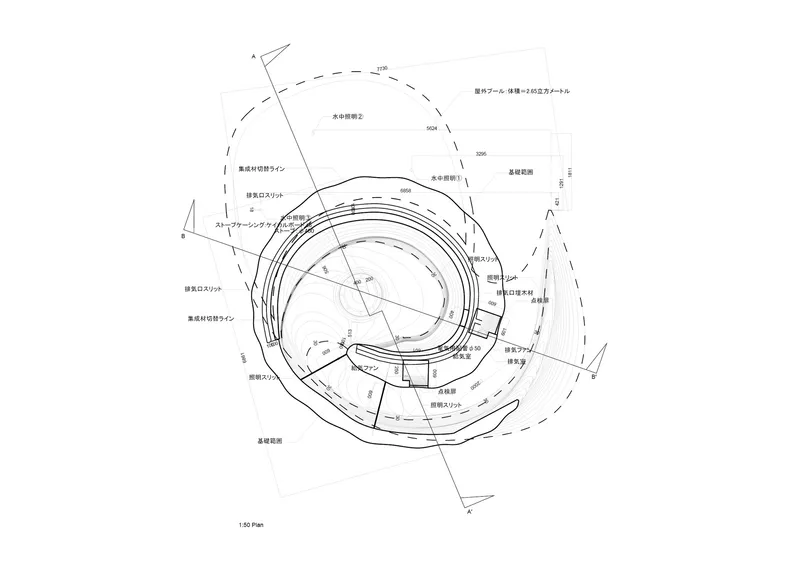
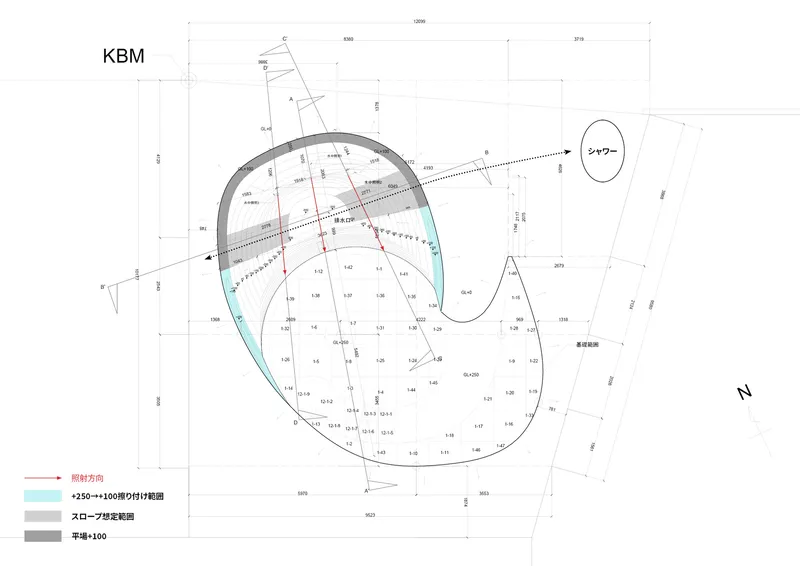
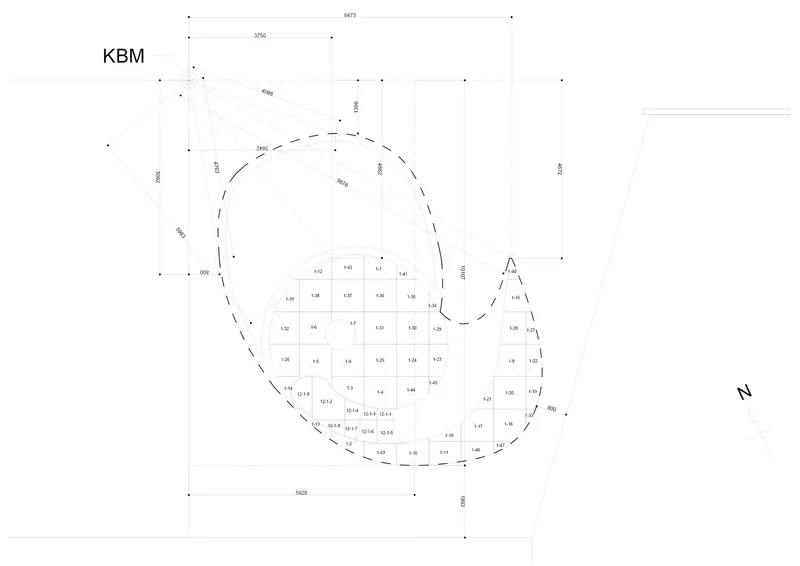
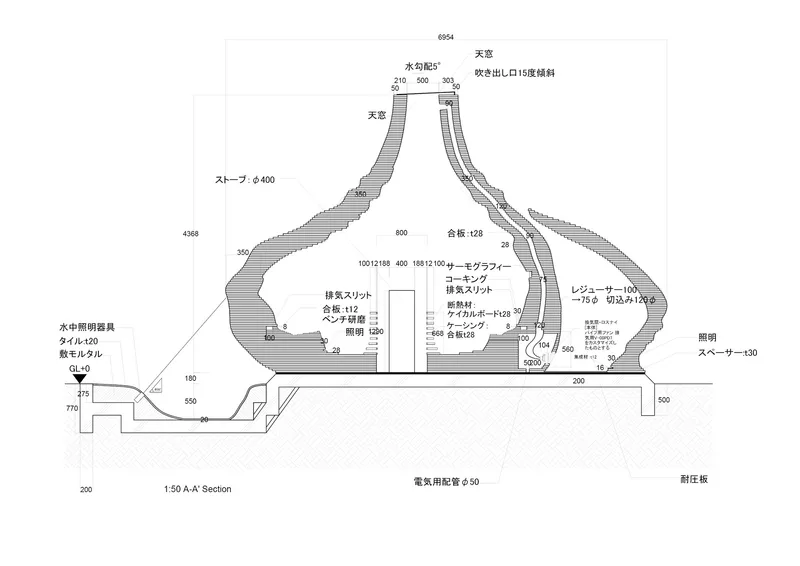
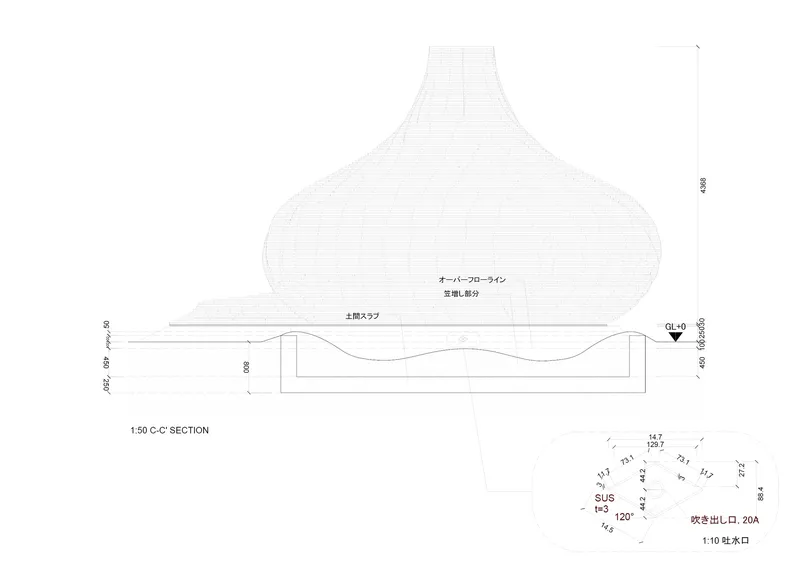
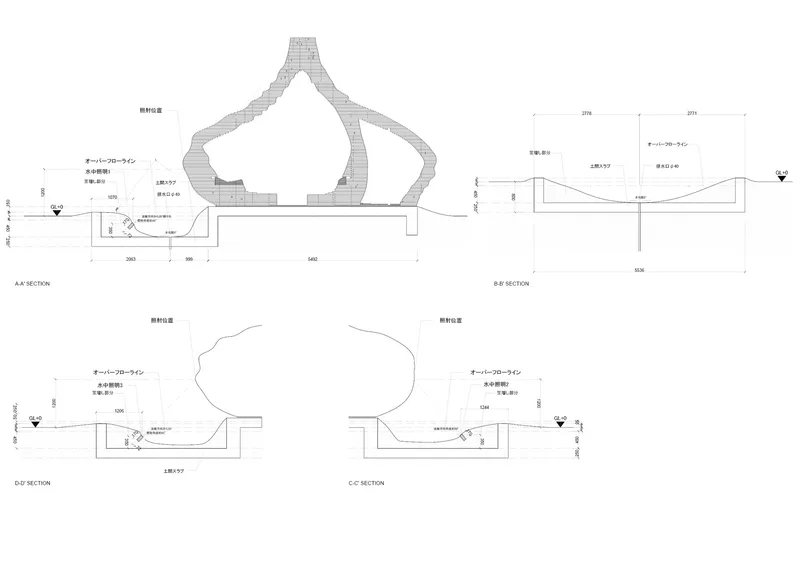
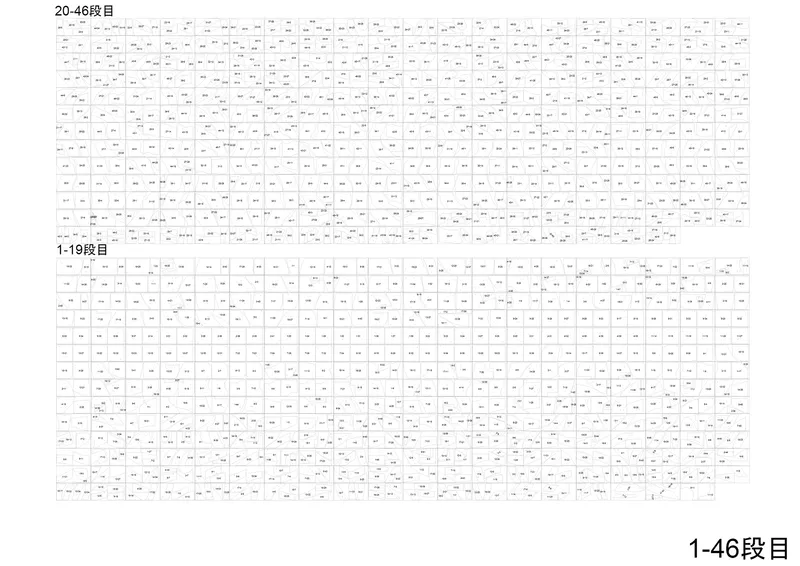
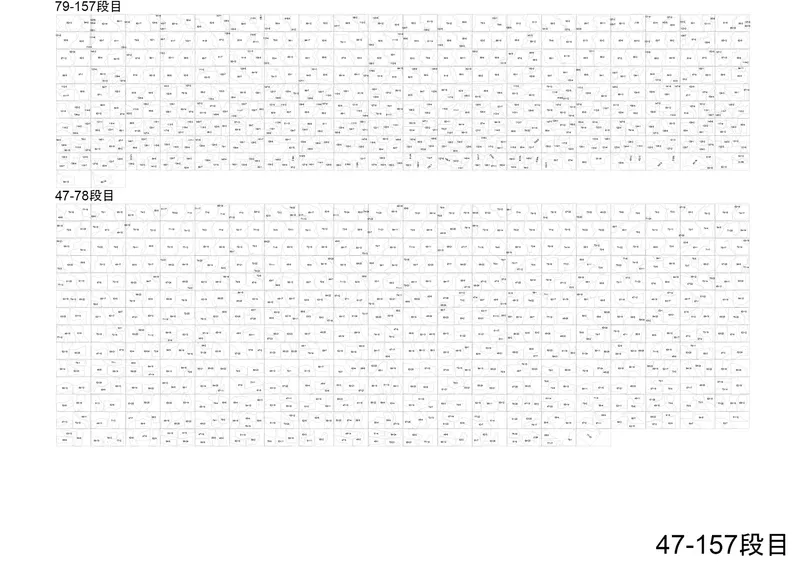
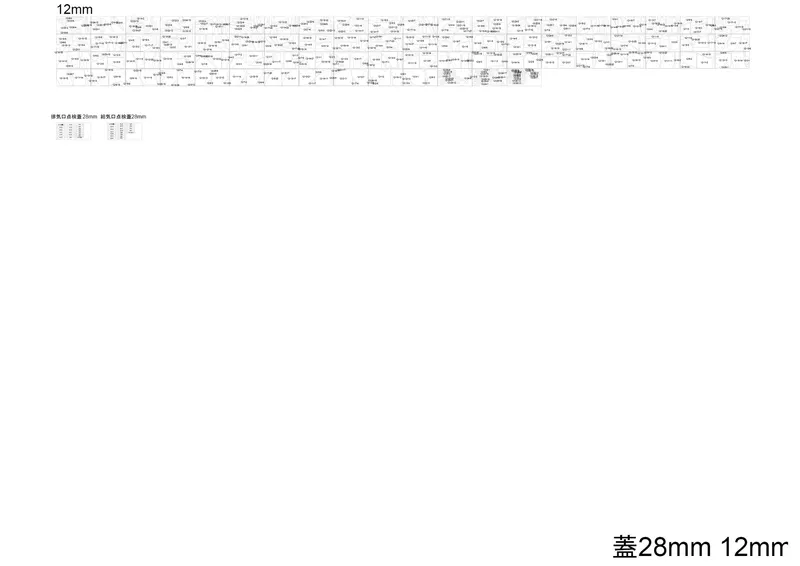
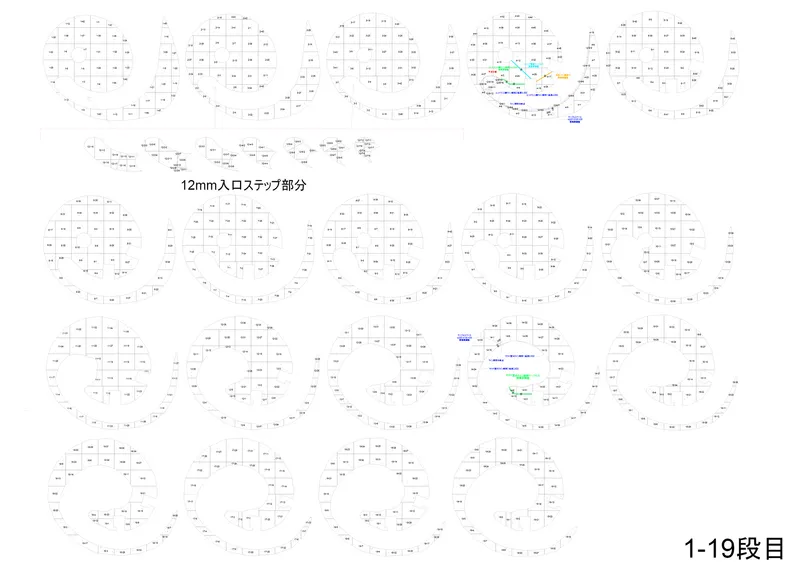
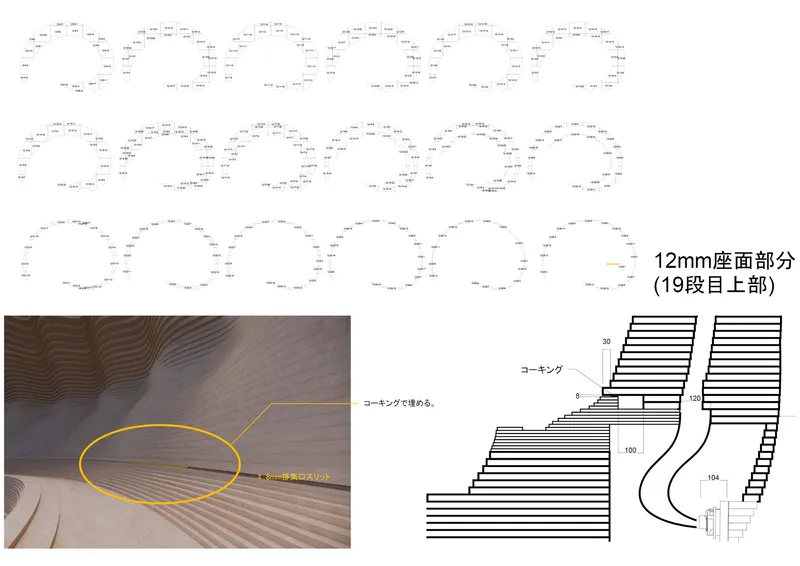

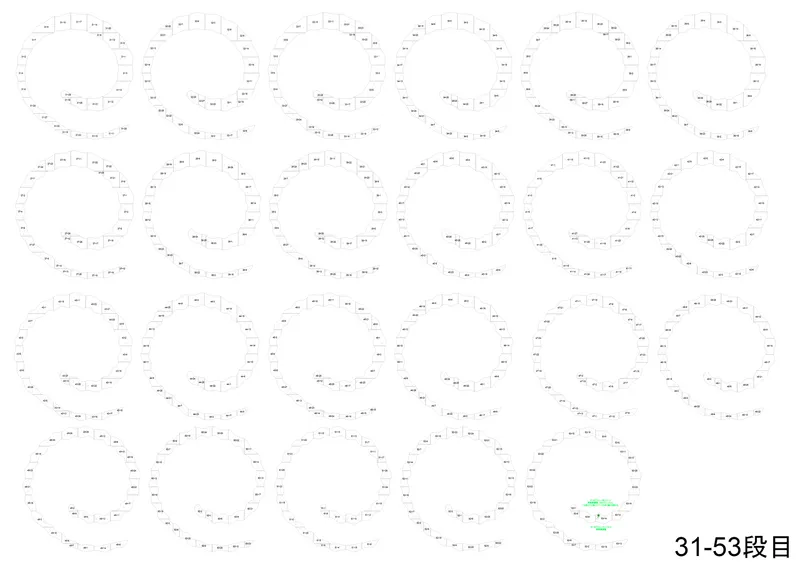
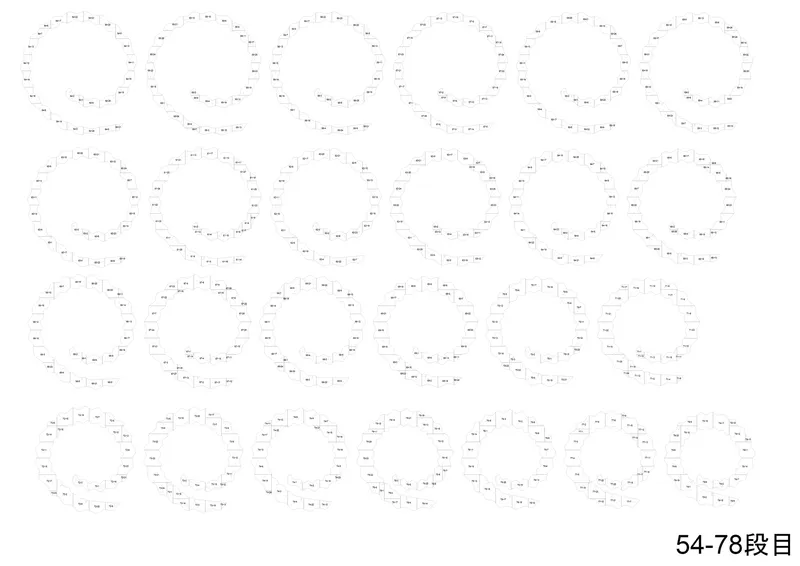
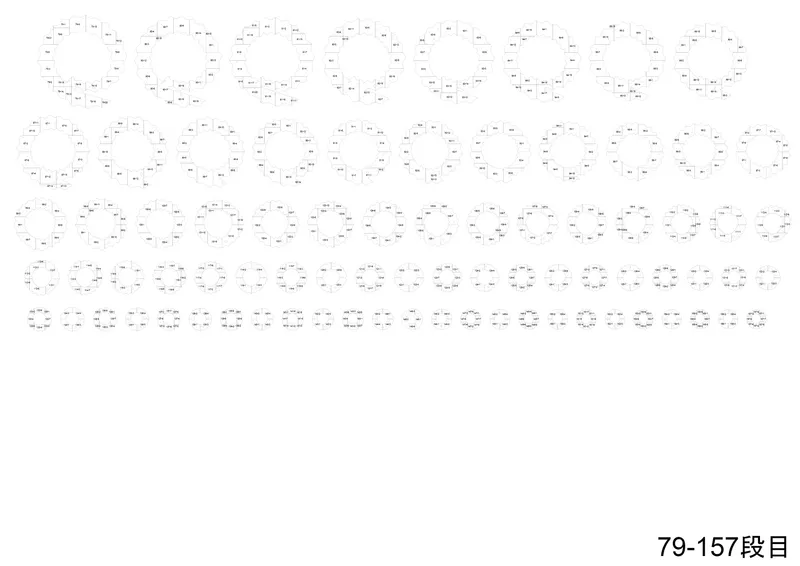
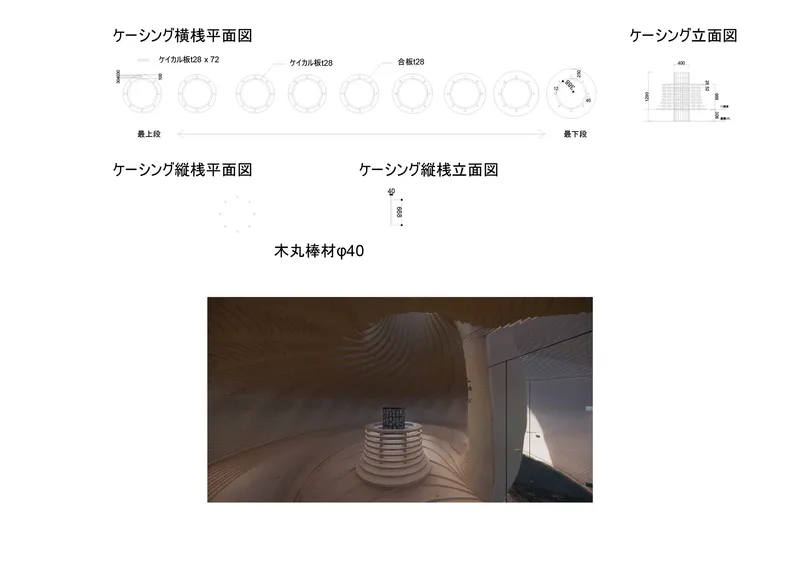
The drawing set exposes the obsessive precision behind the organic form. Site plans show the sauna's curved footprint within the larger glamping compound, with dimensional grids and color-coded elevation zones. Sections reveal the onion-shaped dome rising from a recessed base, its double curvature reading like a vessel turned upside down. The elevation drawings document the brick-like coursing of the stacked plywood, each layer annotated with material specifications.
Most revealing are the circular seating plans, which document every one of the 150 stacking layers. From levels 20 through 157, the drawings show how the plan geometry shifts from compressed ovals to near-circles and back, each step adjusting the interior contour by millimeters. These drawings are the project's DNA: proof that the shell form was not sculpted by eye but computed, verified, and assembled piece by piece.
Why This Project Matters
Sauna Sazae is a proof of concept for what happens when digital fabrication meets biomimicry at a domestic scale. At 8 square meters, the building is barely a room, yet it required a level of computational design and on-site assembly precision that most projects ten times its size never approach. That disproportion between size and ambition is exactly what makes it compelling. It suggests that the most interesting architecture right now is not necessarily the largest but the most intensely resolved.
Kuma's office has long pursued the dissolution of heavy building mass into fine, layered textures, from the Prostho Museum's interlocking timber grid to the V&A Dundee's stacked stone bands. Sazae takes that agenda and folds it literally, wrapping the layers into a closed shell where structure, insulation, ornament, and spatial experience are all produced by the same operation: stacking plywood. On an island where architecture is expected to double as art, this small sauna holds its own.
Sauna Sazae by Kengo Kuma & Associates. Naoshima, Japan. 8 m². Completed 2022. Photography by Keishin Horikoshi / SS Inc.
About the Studio
Share Your Own Work on uni.xyz
If projects like this are the kind of work you want to make, uni.xyz is a place to publish your own, find collaborators, and enter design competitions.



Popular Articles
Popular articles from the community


Play: Fragments of Their World
Familiar architecture becomes modular playground design, creating safe spaces where displaced children can learn, connect, imagine and play.

The Earth Pod: 3D Printed Homes for Resilient Refugee Communities
The Earth Pod reimagines refugee housing through 3D printed homes made from clay, combining resilience, self-sufficiency, and rapid shelter.

The Ocean Hive: Sustainable Architecture for a Self-Sufficient Civilization at Sea
The Ocean Hive imagines sustainable architecture at sea, where modular habitats, algae, wave power and ocean waste sustain a growing colony.

The Musturak Paradise: Senior Living Architecture for a Connected Future in Temara, Morocco
The Musturak Paradise reimagines senior living architecture in Temara via private homes, social spaces, culture, community, and shared care.

Similar Reads
You might also enjoy these articles

Bao Huynh Watercolor Atelier: A Serene Art Retreat in Hội An
Bao Huynh Watercolor Atelier in Hội An blends multifunctional art spaces, sustainable design, local materials, and family-friendly living in a serene environment.

Atelier Macri Concept Store Interior Design by CASE-REAL
Atelier Macri store features a "ko" counter, walnut wood details, cork displays, blending retail, gallery, and seamless customer experiences.

Manuel Vargas Izquierdo Stadium and High-Performance Sports Center: Architectural Excellence in Jalpa de Méndez
The Manuel Vargas Izquierdo Stadium blends sustainable design, inclusive sports facilities, and cultural-inspired architecture, revitalizing Jalpa de Méndez’s public spaces.

KAKR Buluh Awar Hall: Revitalizing Community and Ecology Through Bamboo Architecture
Community built bamboo hall revitalizes Buluh Awar village, empowering youth, restoring ecology, celebrating vernacular craftsmanship through sustainable architecture and culture.


Explore Installations Competitions
Discover active competitions in this discipline



Challenge to design a portable theatre


Challenge to design a portable music platform


Challenge to design an open learning module for the elderly


Challenge to reimagine the Iron Throne
Comments (0)
Please login or sign up to add comments
No comments yet. Be the first to comment!