

Kengo Kuma Wraps a Paris Museum in a Biological Skin of Aluminum and Wood
The Albert Kahn Museum in Boulogne-Billancourt reinterprets the Japanese engawa as a filter between city street and historic garden.


Albert Kahn was a French banker and philanthropist who amassed one of the early twentieth century's most remarkable private collections of photographs and films, documenting cultures across five continents. After the 1929 crash wiped him out, the Département des Hauts-de-Seine eventually acquired his Boulogne-Billancourt estate, its gardens, and its archive. The property opened to the public in 1986, but decades of growing attendance and conservation needs called for something more ambitious. In 2012, a competition drew 92 proposals. Kengo Kuma & Associates won unanimously, and after six years of construction the new museum opened in 2022 with 4,980 square meters of program spread across a new building and eight repurposed heritage structures.
What makes the project genuinely interesting is not just the building's material palette, which is vintage Kuma, but the way it operates as a threshold. The new volume is an elongated bar that sits between the Rue du Port and the four-hectare garden, acting simultaneously as urban facade, park gateway, and atmospheric mediator. One side presents aluminum to the street; the other dissolves into wood facing the garden. Between those two skins, the architecture borrows from the engawa, the traditional Japanese veranda that is neither fully interior nor fully exterior, to create a zone of indeterminate belonging. The result is a museum you enter sideways, slipping beneath the galleries through a sequence that passes a small Zen garden before you ever reach a ticket desk.
A Dual Facade That Changes Character


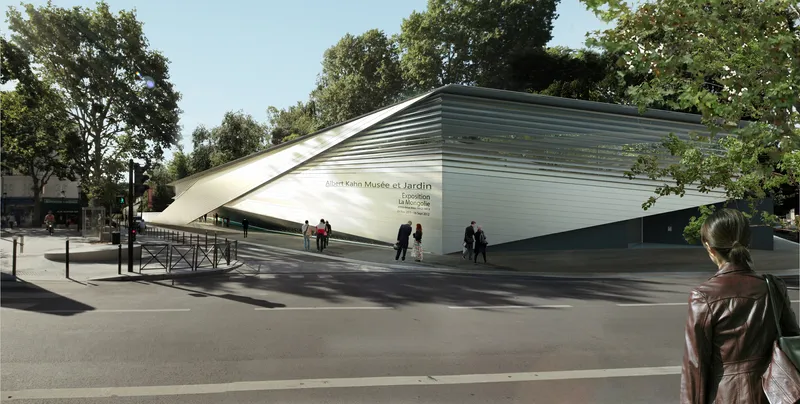
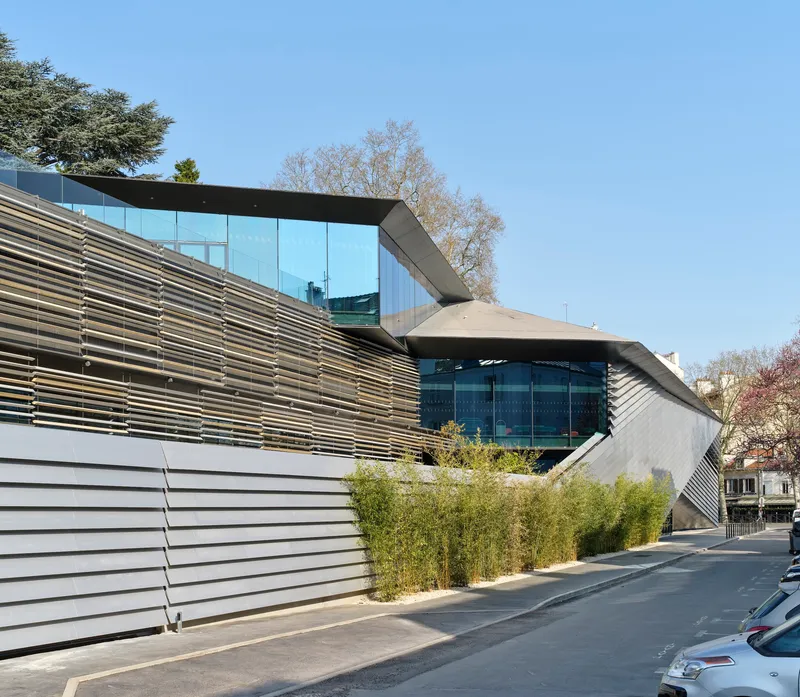
From the street, the building reads as a sculptural ribbon of horizontal aluminum louvers, precisely spaced and gently curving to follow the site boundary. The effect is civic and assertive: it holds the building line, reflects winter light, and signals institution. Walk around the corner and the aluminum begins to give way to timber, the two materials interleaving in irregularly positioned strips until, on the garden side, wood dominates entirely. Kuma has described the envelope as a biological skin, and the metaphor holds. Like skin, it responds differently to different stimuli: deflecting the noise and scale of the road, absorbing the green and shade of the park.
The sculptural quality is most legible in oblique views, where the louvers compress into a dense screen that conceals the glazing behind them. This layering creates a moiré effect as you move along the sidewalk. Pedestrians appear and disappear between the fins, a kinetic quality that keeps the building from ever reading as a static object.
The Garden Side: Screening, Not Separating


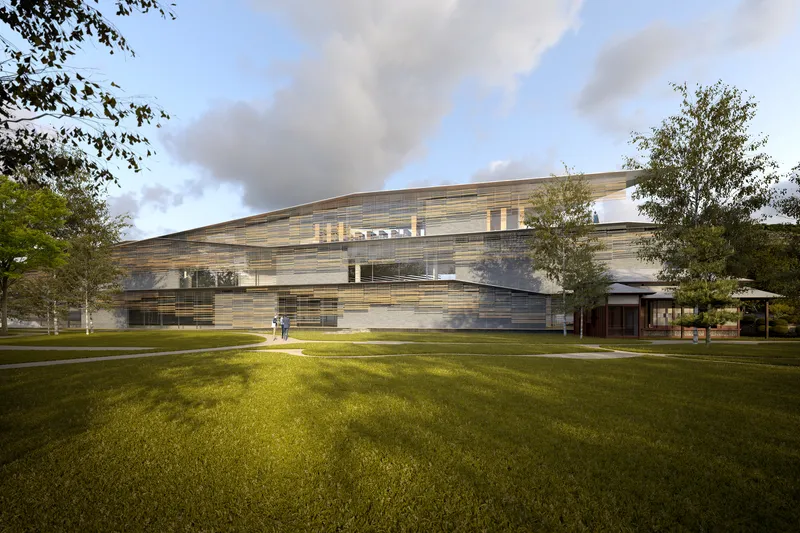
The garden elevation is a different building. Horizontal timber battens replace aluminum, and the facade pulls back behind deciduous trees and bamboo plantings. From the reflecting pond, the architecture reads as a series of warm, banded layers visible through bare trunks, more textile than tectonic. In summer, foliage will screen the building almost entirely, a deliberate move by landscape architect Michel Desvigne, who overhauled the property's plantings and restored the original gardens, which showcase landscape traditions from five continents.
The relationship between museum and garden is the project's central achievement. Kuma did not design an object placed in a landscape. He designed a border condition, a long, narrow volume whose primary job is to calibrate the transition between a Parisian street and a Japanese garden built by gardeners hired from Japan over a century ago. That calibration happens through material, through depth of facade, and through the careful alignment of interior circulation with garden paths.
The Engawa Threshold


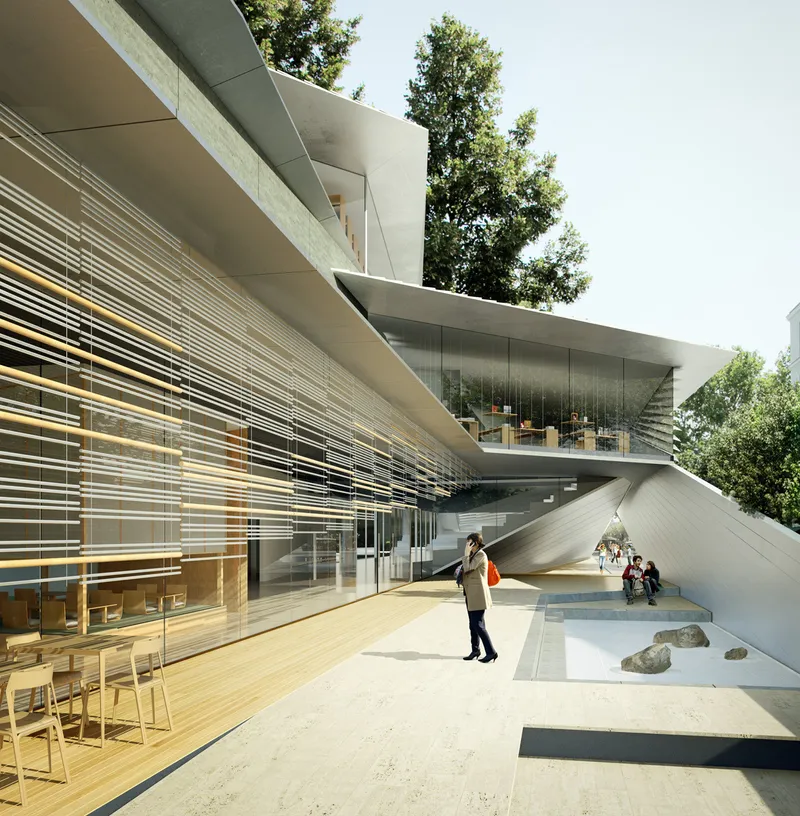
The concept of engawa, the covered veranda space in traditional Japanese architecture, is not just a talking point here. It is literally built. Along the garden side, a timber deck walkway runs between the louver screen and the glazed interior walls, creating a sheltered passage that is outdoors in temperature but enclosed in spatial character. Overhead, timber slat ceilings filter light into stripes. Underfoot, decking absorbs sound. The louvers frame garden views without ever offering a panoramic reveal. You are always looking through something.
The entrance sequence extends this logic. Instead of a frontal arrival, visitors step beneath the cantilevered galleries and walk alongside a small Zen garden before entering the building. It is a decompression chamber, a way of slowing your pace and resetting your attention before encountering the collection. The covered terrace at the entrance acts as a gathering space where the concrete soffit and horizontal louvers frame views up and outward, pulling your gaze toward the canopy before drawing it into the building.
Timber Interiors and Gallery Sequence


Inside, the material language shifts from screen to structure. Oak flooring runs continuously through corridors and galleries, while rhythmic timber battens span the ceilings, establishing a horizontal grain that echoes the louvers outside. The double-height lobby reveals a glass-walled mezzanine overhead, and the spatial openness here contrasts deliberately with the linear compression of the exhibition galleries beyond.
The galleries themselves are organized as an extended linear sequence, following the logic of the garden paths outside. One gallery houses the permanent collection; the other accommodates temporary installations. Grey partition walls and controlled lighting keep the focus on the photographic and filmic material. Above, a radiating timber baffle ceiling adds texture without competing with the work on display. It is a restrained approach, and a correct one: Kahn's archive of color photographs from the early 1900s needs careful presentation, not architectural drama.
The Auditorium: Old Building, New Geometry

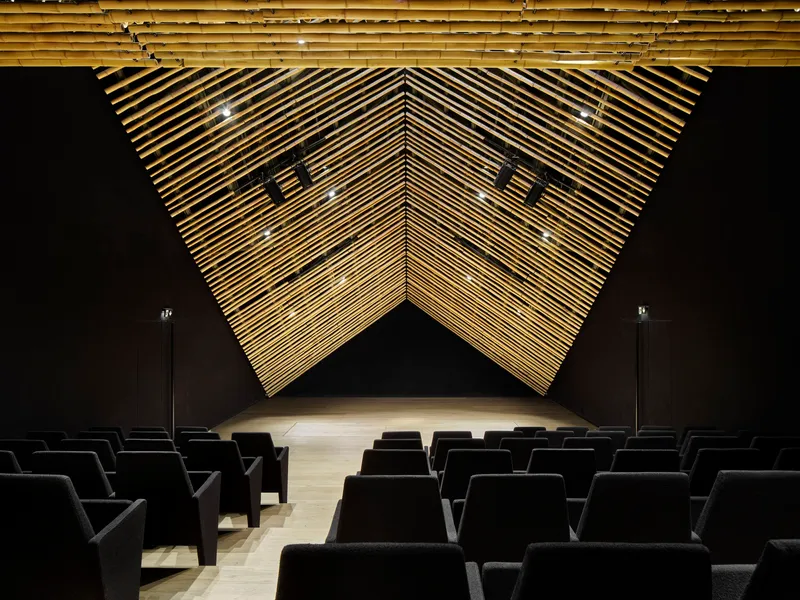
The former museum building has been converted into an auditorium, a move that recycles an existing structure while giving the institution a proper public event space. Inside, a folded timber baffle ceiling creates a geometric chevron pattern that is at once acoustically functional and visually commanding. Dark seating faces a black angled wall, and the room has the focused gravity of a lecture hall without the institutional sterility. Wood and bamboo, materials already present elsewhere in the project, tie the auditorium back to the main building despite its separate structure.
Living Between Street and Garden
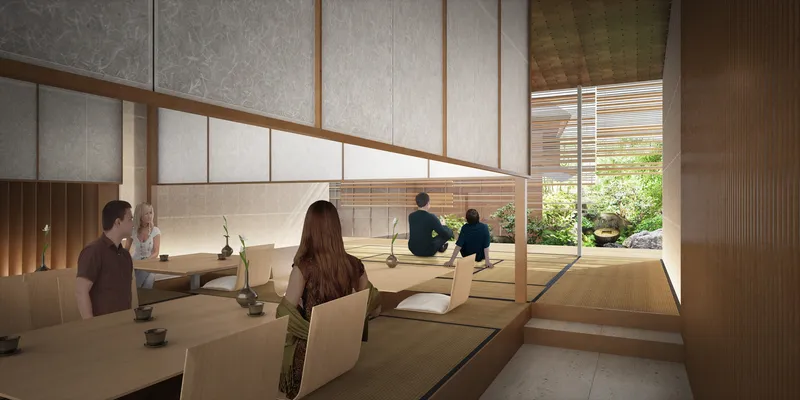

The upper floor houses a restaurant and archive facility, and the seating areas offer quiet moments that the galleries do not. Low timber tables sit beside translucent panels overlooking a courtyard garden, a space where the engawa logic is internalized: you are inside a building, looking through a screen, at a garden. The wide timber and concrete staircase connecting levels has a generous, almost domestic quality, with exposed wood ceilings and glass balustrades that keep sightlines open.
These smaller programmatic moments matter because they complete the museum's argument. The Albert Kahn Museum is not a building you visit for a single gallery experience. It is a campus of eight repurposed outbuildings, a greenhouse for events, restored gardens spanning five continents of planting traditions, and a new structure that stitches all of it together. Kuma's contribution is not a monument. It is connective tissue.
Plans and Drawings

The interior rendering reveals the spatial section: a double-height gallery space with a mezzanine library above and an open stairwell below. The section confirms how Kuma stacks public and archival programs vertically while keeping the ground level porous and connected to the landscape. The mezzanine library is essentially a bridge, hovering over the gallery below and reinforcing the idea that every floor is in visual dialogue with every other.
Why This Project Matters
The Albert Kahn Museum is significant not because Kengo Kuma built another timber-screened building, which at this point in his career could reasonably be called a genre, but because the project forces an interesting question: what does it mean to design a museum as a boundary? Most institutional buildings seek to be destinations. This one seeks to be a membrane. Its value lies in what it mediates: the urban grid on one side, a century-old collection of gardens on the other, and a photographic archive that documents cultural landscapes from around the world. The building's job is to prepare you for all of that without dominating any of it.
There is also the matter of scale. Kuma won this commission against 91 competitors with a proposal that did not try to make a grand architectural gesture on a four-hectare estate already loaded with historical significance. He made a long, thin building that defers to its context and saves its architectural energy for the experience of crossing thresholds. In a discipline that still rewards conspicuous form-making, that restraint is worth paying attention to.
Albert Kahn Museum by Kengo Kuma & Associates, Boulogne-Billancourt, France. 4,980 m². Completed 2022. Photography by Think Utopia, Olivier Ravoire, and Michel Denancé.
About the Studio
Share Your Own Work on uni.xyz
If projects like this are the kind of work you want to make, uni.xyz is a place to publish your own, find collaborators, and enter design competitions.


Popular Articles
Popular articles from the community


Opera on the Sea: Driftwood Logic Shapes a Timber Opera House on Estonia's Coast
Trevor Orgill's opera house translates the entangled drift of floating timber into a civic building where wood, water, and music converge.

Extended Shell: Retrofitting Kolkata's Balconies as Living Urban Thresholds
A modular retrofit system recovers the social and environmental intelligence of Kolkata's historic verandas for contemporary Park Street residents.

Faces of the Soviet Avant-Garde: Turning Moscow's Street Names into an Open-Air Museum
A network of sculptural installations across a Moscow residential district transforms forgotten architect names into spatial encounters with cultural memor

Opera by the Sea Estonia: Three Shells Dissolving Architecture into Tallinn's Coastline
A winning opera house proposal replaces monumental form with interconnected shells that blur the boundary between building, park and Baltic Sea.

Similar Reads
You might also enjoy these articles

Bao Huynh Watercolor Atelier: A Serene Art Retreat in Hội An
Bao Huynh Watercolor Atelier in Hội An blends multifunctional art spaces, sustainable design, local materials, and family-friendly living in a serene environment.

Atelier Macri Concept Store Interior Design by CASE-REAL
Atelier Macri store features a "ko" counter, walnut wood details, cork displays, blending retail, gallery, and seamless customer experiences.

Manuel Vargas Izquierdo Stadium and High-Performance Sports Center: Architectural Excellence in Jalpa de Méndez
The Manuel Vargas Izquierdo Stadium blends sustainable design, inclusive sports facilities, and cultural-inspired architecture, revitalizing Jalpa de Méndez’s public spaces.
KAKR Buluh Awar Hall: Revitalizing Community and Ecology Through Bamboo Architecture
Community built bamboo hall revitalizes Buluh Awar village, empowering youth, restoring ecology, celebrating vernacular craftsmanship through sustainable architecture and culture.

Explore Genetic Museum Competitions
Discover active competitions in this discipline

Challenge to reimagine the Iron Throne

Photograph architecture without architects

Illustrate the lost glory of Angkor Wat - Render Challenge

Bring back Drive In's
Comments (0)
Please login or sign up to add comments
No comments yet. Be the first to comment!