

Celoria Architects Stacks a Concrete Kindergarten Above a Cold War Bunker in Swiss Ticino
In Torricella-Taverne, a tripartite school volume in exposed concrete and glass gives four- and five-year-olds their own civic monument.


Switzerland's civil defense shelters are one of those infrastructural curiosities that most architects politely ignore. Celoria Architects did the opposite. Their Kindergarten Torricella, completed in 2021 in the municipality of Torricella-Taverne near Lugano, sits directly on top of an existing bunker, converting that Cold War relic into a service plinth for kitchens, storerooms, and mechanical systems. Everything above it belongs to the children.
What makes this 1,500-square-meter building genuinely interesting is not the bunker gimmick but the architectural language that grows out of it. Lead architect Aldo Celoria, with collaborator Barbara Reber, conceived the volume as three horizontal strata: a podium at grade, then two school floors that taper as they rise, each one slightly lighter and more open than the one below. The result reads as a civic building scaled for very small people, which is exactly right. It is the first phase in a larger plan for schools and sports facilities in the Traversée area, and it sets a tonal standard that the future buildings will have to live up to.
A Concrete Tripartition
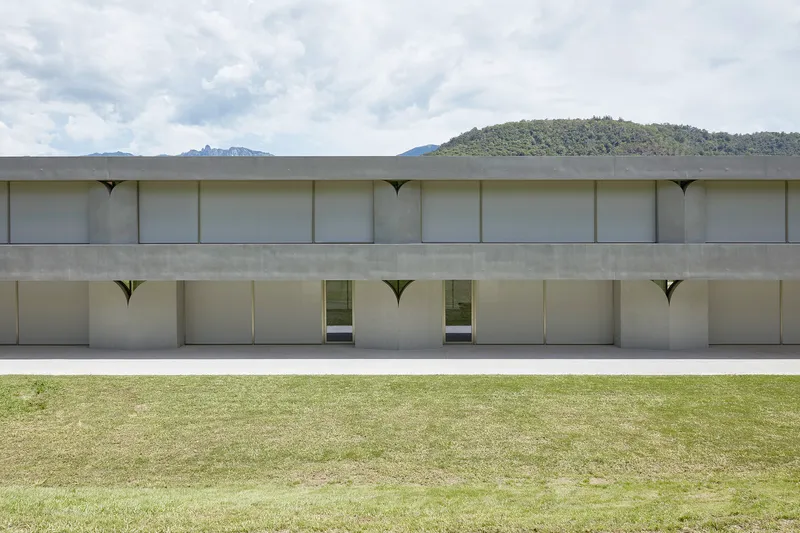
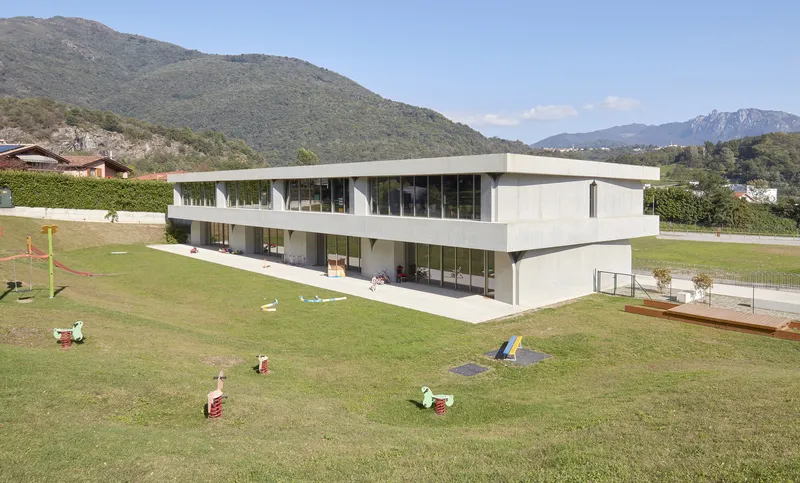
The building's identity is carried almost entirely by its exposed concrete envelope. Viewed from the north or south, where the facades are deliberately closed, the mass reads as a solid, heavy object: stacked slabs with arched spandrels punched through at the edges, giving the impression of a viaduct or an aqueduct fragment transplanted to a suburban school site. Viewed from the east or west, where extensive glazing opens the interior to the landscape, it becomes transparent, almost weightless. That duality is the building's central architectural argument.
The three-layer composition, podium to first floor to second floor, tapers progressively. Celoria describes this as a move "from earth to sky," which could easily be pretentious but actually registers in the built form. The cantilevered upper terrace floats above the garden, and the soffit reveals carefully formed arched cutouts that soften what could be a brutally heavy overhang. It is concrete that has been taught some manners.
Arched Voids and the Entrance Courtyard
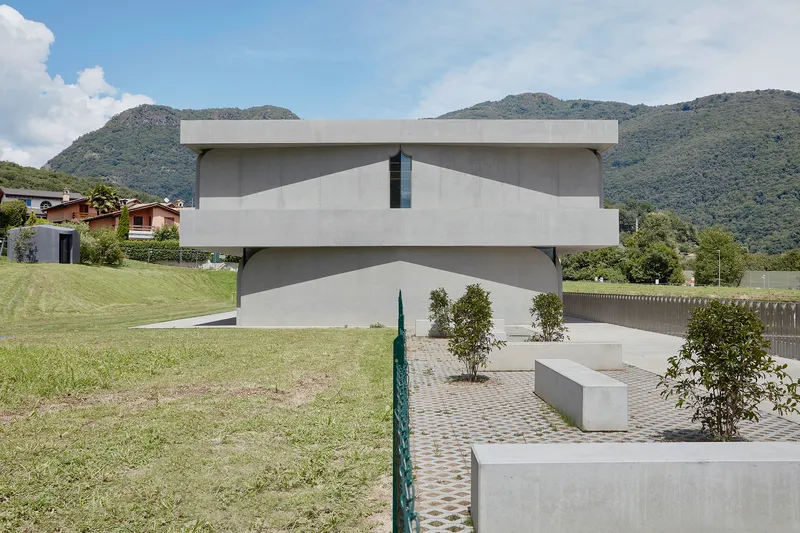
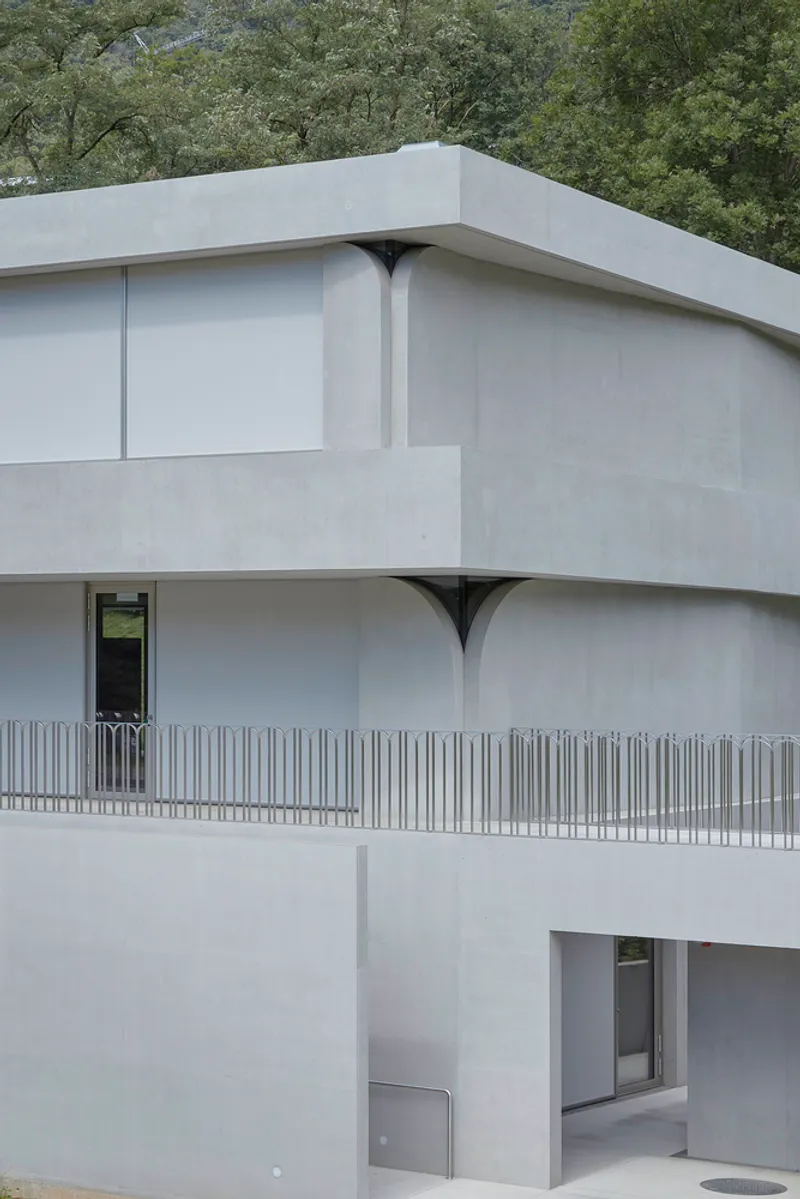
The most distinctive formal move is the series of curved voids cut into the concrete balcony edges and spandrel panels. These arches do not come from nostalgia for Romanesque cloisters; they serve a practical role in lightening the visual mass of the slab edges while creating sheltered zones beneath the overhangs. At the entrance courtyard, checkerboard paving and planted beds set up a threshold that feels more like a small piazza than a school drop-off. The scale is generous enough for parents and children to linger without congestion.
Four separate entrances feed into individual atriums, one for each of the kindergarten's four sections. This is a deliberate anti-corridor strategy: rather than funneling everyone through a single lobby, the building distributes arrival across its length, giving each group of children a sense of ownership over their corner of the building. Stairs are positioned between pairs of sections, so vertical circulation doubles as spatial divider. There are no traditional corridors to speak of.
Maroon Ceilings and Terrazzo Floors
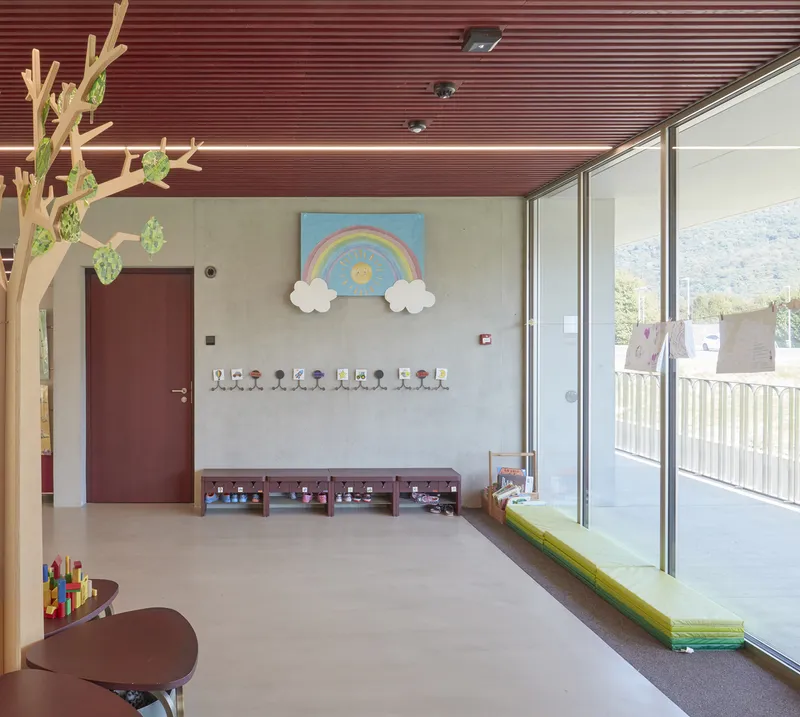
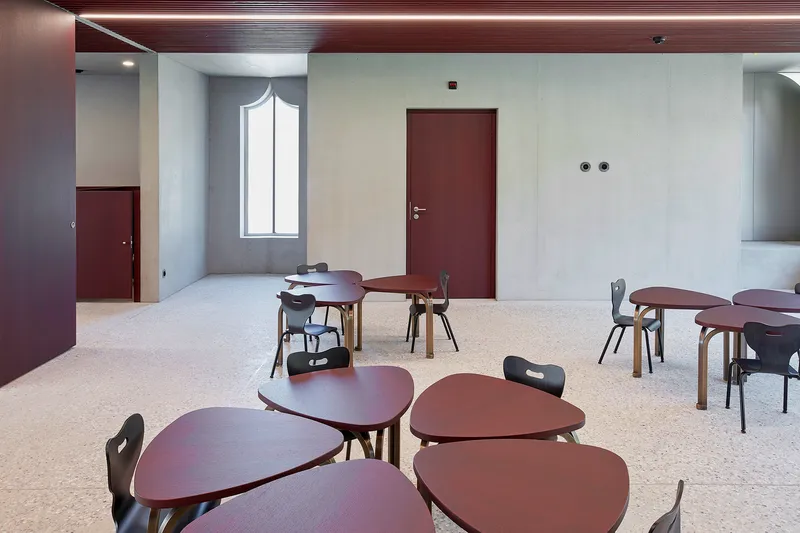
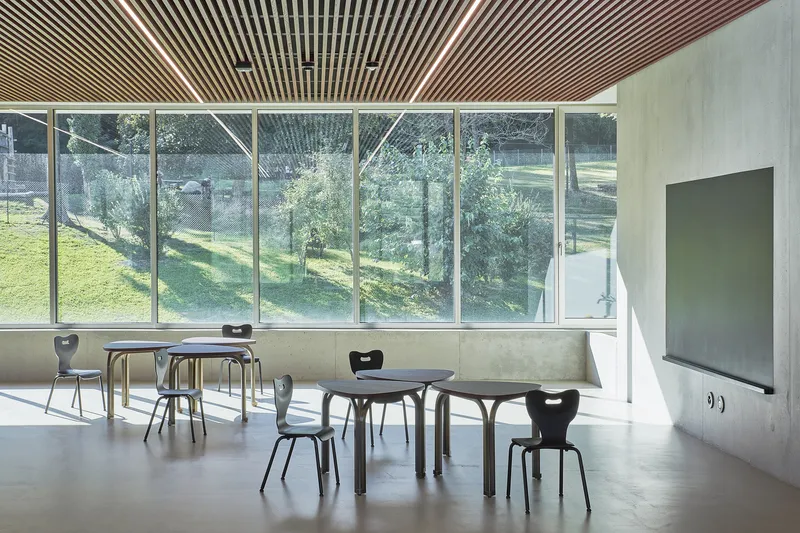
Inside, the material palette pivots from the raw grey of the exterior to a warm interplay of maroon timber slats, pale concrete walls, and terrazzo flooring. The slatted ceiling panels, stained a deep burgundy, run continuously through classrooms and corridors, establishing a warm overhead plane that contrasts with the cooler tones of the floor and structure. It is a surprisingly rich interior for a kindergarten, which often defaults to primary-color overload.
The upper floor houses four classrooms for quiet activities alongside refectory spaces and hygiene rooms. Full-height glazing on the east and west walls floods these rooms with natural light while framing views of the hills and the grassy slope below. Automated external blinds adjust to solar radiation, a requirement for Minergie certification but also a welcome defence against the fierce Ticino sun. The children don't control the blinds; the building does.
Ground Floor: Movement and Transition
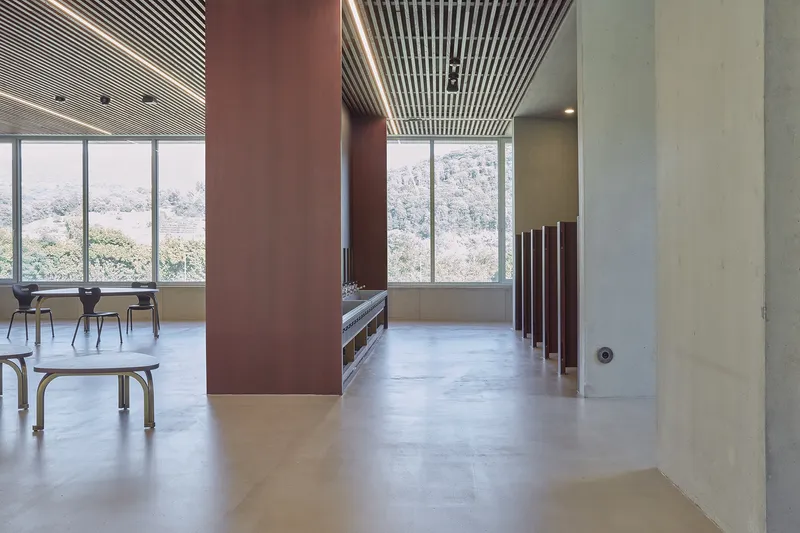
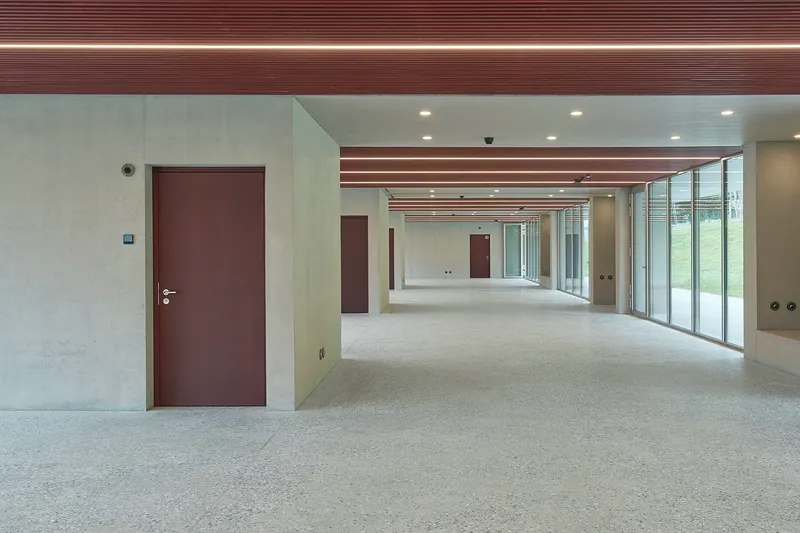
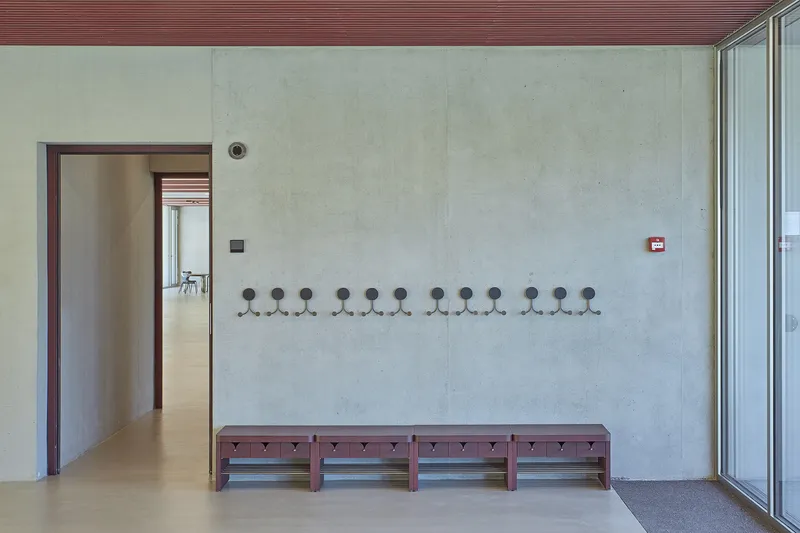
At the first-floor level, the program shifts from quiet concentration to physical activity. Movement-activity classrooms open onto a covered paved area that extends into an enclosed garden, housing storage for outdoor toys and equipment. The transition from inside to outside is gradual: slatted ceiling, then concrete soffit, then sky. A child moving through this sequence experiences changing light, temperature, and sound without encountering a single hard boundary.
The entry corridors, lined with coat hooks above deep burgundy benches, reveal the care Celoria Architects took with child-scale details. The benches are low enough for a four-year-old to sit independently, and the hooks are within reach. These are not afterthoughts; they shape the daily ritual of arrival. The terrazzo floor throughout is durable and easy to clean, a pragmatic choice that also gives the interior a coherent base note.
Furniture as Architecture
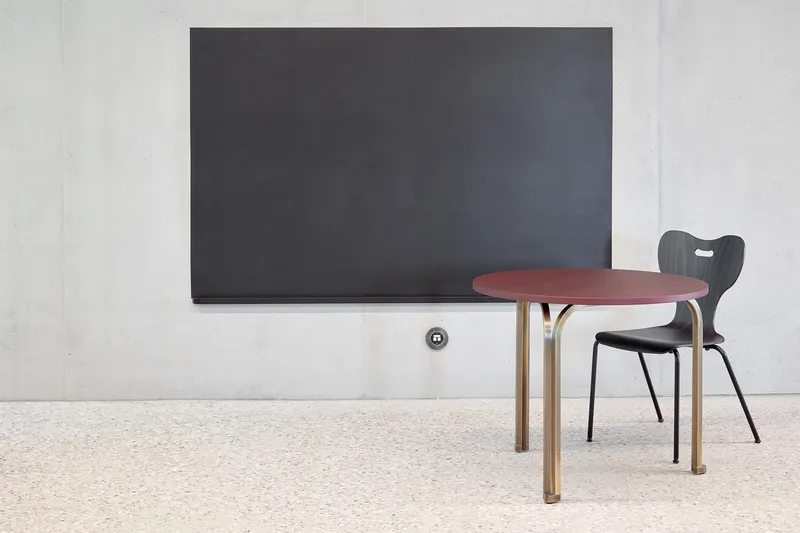
A small detail worth noting: the custom tables with their organic curved shapes and tubular steel legs, paired with plywood chairs, sit against concrete walls and blackboards as if they have always been there. The furniture does not try to be whimsical or cartoonish. It is simply well-proportioned for small bodies and robust enough to survive daily use. A tall arched window in one room echoes the arched cutouts on the facade, creating an interior-exterior dialogue that even a child might notice, if only subconsciously.
Why This Project Matters
Kindergarten Torricella demonstrates that designing for children does not require condescension. Celoria Architects treated this building as a civic project first and a school second, giving it the material weight and spatial ambition that Swiss municipalities typically reserve for town halls or libraries. The exposed concrete, the arched voids, the tripartite composition: none of these moves are conventionally "child-friendly," yet they produce an environment that is dignified, luminous, and genuinely stimulating.
As the first phase of a larger masterplan for the Traversée area, the kindergarten also sets a high bar for what follows. Future sports facilities and school buildings will have to contend with this building's presence, its confident horizontality, its restrained palette, its refusal to apologize for being made of concrete. In a country where Minergie-certified efficiency is standard practice, the real achievement here is architectural character. This is a building that knows what it is.
Kindergarten Torricella by Celoria Architects (lead architect Aldo Celoria, collaborating architect Barbara Reber). Torricella-Taverne, Lugano district, Switzerland. 1,500 m². Completed 2021. Photographs by Franco Mattei.
About the Studio
Share Your Own Work on uni.xyz
If projects like this are the kind of work you want to make, uni.xyz is a place to publish your own, find collaborators, and enter design competitions.


Popular Articles
Popular articles from the community


Jaramillo Van Sluys Arquitectura and Urbanismo Turn a Demolished Registry Lot in Quito into an Orchard Plaza
In Quito's Centro Histórico, a 2,800 m² plaza exposes the San Agustín convent wall and redraws its lost Augustinian orchard in volcanic stone.

GROUP A Strips a 1969 Rotterdam Harbor Headquarters to Its Frame and Wraps It in Timber Louvers
In Rotterdam's M4H harbor district, Ferro Offices reuses a 1969 frame, adds one timber storey and reaches BREEAM-NL Outstanding.

Cube Design Draws an Ecological Corridor Between Two Shenzhen Hills with the Nankai Building
Beside Shenzhen's container docks, the Nankai Building pairs stacked balconies with a climbing green screen to connect two hillsides across its height.

LT2A and OPEN Architectes Thread a Brick and Glass High School Through a Wooded Belgian Campus
In Braine-l'Alleud, a 3,000 m² wing for Collège Cardinal Mercier pairs pale brick with a glazed colonnade, deferring to a small chapel and a dense wood.

Similar Reads
You might also enjoy these articles


Hodi-Mandai Geram
Project Function: Preservation and revitalization of the Intangible heritage and socio-spatial identity of the Hodi by Housing, Cultural Memory Center, Sacred Grove, landscape, local tourism economy


Olio Towers: A Mid-Rise for Performers That Fuses Housing, Rehearsal, and Stage
Located blocks from Houston's Theater District, this modular tower stacks living units around a central performance atrium.

Oasis: Modular Green Housing Carved into Dhaka's Urban Fabric
A shortlisted Plugin Housing entry reclaims unauthorized settlements in Dhaka with stepped concrete volumes, green roofs, and ventilation-driven design.

Black Hole: A Floating Megastructure for the Post-Physical Era
Emiliano Mazzarotto envisions a spherical, self-scaling arena where e-sports, digital hotels, and holographic stadiums replace traditional public space.

Explore Educational Building Competitions
Discover active competitions in this discipline

Challenge to design public laboratory

Challenge to reimagine the Iron Throne

Photograph architecture without architects

Illustrate the lost glory of Angkor Wat - Render Challenge
Comments (0)
Please login or sign up to add comments
No comments yet. Be the first to comment!