

Koala Haven – Wildlife Rehabilitation Center
A sustainable wildlife rehabilitation center architecture that merges care, research, and public engagement within a fluid, nature-driven design.


Koala Haven, designed by Nicolaos Nicolaou, proposes a forward-thinking model for wildlife rehabilitation center architecture, where ecological sensitivity and spatial intelligence converge. The project addresses the urgent need for environments that not only treat and rehabilitate wildlife but also educate the public and support ongoing research.
Set within a natural landscape, the design moves away from rigid institutional typologies and instead adopts an organic architectural language. The fluid geometry reflects the unpredictability and softness of nature, aligning the built form with the behavioral and environmental needs of koalas.

Programmatic Integration Through Spatial Continuity
The project consolidates three primary functions into a unified architectural system: a rehabilitation center, a museum, and an administration and research facility. Rather than isolating these programs, Koala Haven integrates them into a continuous spatial loop.
This interconnected planning strategy enables seamless transitions between public and semi-private zones. Visitors are gradually introduced to the rehabilitation process, moving from exhibition spaces into observational zones without disrupting animal care. The architecture carefully balances transparency and privacy, ensuring that the welfare of the koalas remains uncompromised.
Organic Form and Circulation Logic
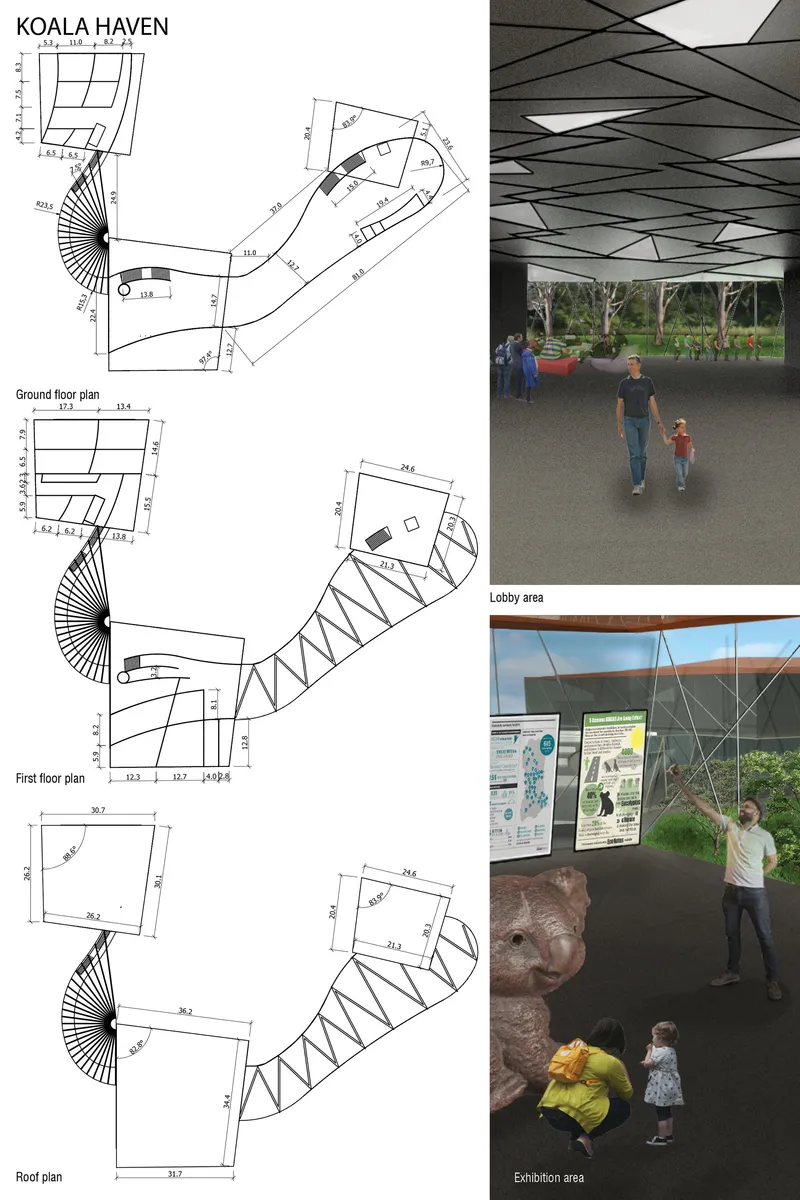
The ground, first, and roof plans reveal a flowing circulation spine that connects distinct volumes. This spine operates as both a movement corridor and a structural gesture, anchoring the entire composition.
The curvature of the plan is not merely aesthetic. It responds to site contours and creates a series of courtyards and open green pockets that act as therapeutic landscapes. These outdoor zones serve dual purposes: they are controlled habitats for koalas and immersive environments for visitors.
The circulation sequence is choreographed to maintain a calm and intuitive user experience. Gradual transitions, soft edges, and visual permeability ensure that movement through the space feels natural and unforced.
Structural Expression and Material Strategy
The architectural expression is defined by a lightweight yet robust structural system. Wooden beams and glass form the primary palette, supported by localized steel reinforcement where necessary. This hybrid approach achieves both structural efficiency and environmental responsiveness.
The facade features a distinctive triangulated glazing pattern inspired by eucalyptus leaf structures. This design move is both symbolic and functional. It filters daylight, reduces glare, and establishes a visual identity rooted in the habitat of the koalas.
The roof adopts a wave-shaped geometry, constructed using sandwich copper plates with insulation. This not only enhances thermal performance but also creates a dynamic silhouette that resonates with the surrounding landscape.


Environmental Performance and Sustainability
Sustainability is embedded at multiple levels within the project. The use of wood as a primary material reduces the carbon footprint while reinforcing the connection to nature. The building envelope is optimized for daylight penetration and passive ventilation, minimizing reliance on mechanical systems.
Green courtyards and open spaces improve microclimatic conditions, offering shade and natural cooling. These interventions contribute to a healthier environment for both animals and visitors.
The integration of landscape and architecture ensures that the project does not impose itself on the site but rather evolves from it.
Interior Experience and Public Engagement
Internally, the project creates a layered experience. The lobby and exhibition areas feature dynamic ceiling geometries that diffuse light and create a sense of movement. Educational displays and interactive installations are positioned to engage visitors while maintaining visual connections to the outdoor habitats.
The museum component plays a critical role in raising awareness about wildlife conservation. It transforms the building into more than just a functional facility, positioning it as a cultural and educational landmark.
Rehabilitation as Architecture
At its core, Koala Haven redefines the role of architecture in wildlife care. It moves beyond containment and control, instead fostering an environment of recovery, observation, and coexistence.
The project demonstrates how wildlife rehabilitation center architecture can operate at the intersection of ecology, design, and human experience. By merging programmatic efficiency with spatial empathy, Koala Haven sets a precedent for future projects in this domain.
It is not simply a building, but an ecosystem designed to heal, educate, and connect.


Popular Articles
Popular articles from the community


Faces of the Soviet Avant-Garde: Turning Moscow's Street Names into an Open-Air Museum
A network of sculptural installations across a Moscow residential district transforms forgotten architect names into spatial encounters with cultural memor
Opera by the Sea Estonia: Three Shells Dissolving Architecture into Tallinn's Coastline
A winning opera house proposal replaces monumental form with interconnected shells that blur the boundary between building, park and Baltic Sea.

Manzana Morphosis: Stretching Barcelona's Grid into a Living Landscape for 2050
A radical reworking of the Eixample manzana turns density into a tool for generous public space, vertical ecology, and environmental performance.

Tsunami Convergenics: Turning Catastrophic Ocean Forces into Underwater Housing Infrastructure
A speculative underwater settlement off the coast of Onagawa, Japan, treats tsunamis and typhoons as energy sources rather than threats.

Similar Reads
You might also enjoy these articles

Eco Chapel: A Green Architecture Pavilion Designed in Symbiosis with the Forest
Eco Chapel uses green architecture to weave prayer, learning and reuse into a forest pavilion shaped by modular hexagonal canopies for life.
Kaffeebühnen: Coffee Shop Architecture Designed as a Civic Stage Between Vienna’s City and Park
Kaffeebühnen turns coffee shop architecture into a civic stage, linking Vienna’s park edge, urban life, warm timber yards, and coffee craft.
Healing Façade: Sustainable Architecture for Reforestation, Community, and Sacred Ecology in Ethiopia
Healing Façade reimagines sustainable architecture as a living wall that restores soil, catches water and renews Ethiopia's forest churches.


Urban Forest: A Vertical Ecosystem for 5,000 Workers in Singapore's Changi Business Park
Radially stacked pods and layered green decks turn a 7-acre plot into 47 acres of ecological workspace projected for 2040.

Explore Koala Competitions
Discover active competitions in this discipline

Challenge to reimagine the Iron Throne

Photograph architecture without architects

Illustrate the lost glory of Angkor Wat - Render Challenge

Design challenge to reuse E-waste
Comments (0)
Please login or sign up to add comments
No comments yet. Be the first to comment!