

Koalas Claw: An Earth-Sheltered Rehabilitation Centre That Grips the Landscape Like a Claw
A shortlisted Haven 2020 entry that curls a grass-roofed crescent around a natural core, giving koalas a quiet refuge in eucalyptus woodland.


Most buildings for animals are designed for the people who run them. Koalas Claw starts from the other side of that equation. Its curved, partially submerged form takes the gripping motion of a koala's claw wrapped around a branch and turns it into a site plan, a circulation diagram and a roofscape at once. The result reads less as a building placed in the bush and more as a fold in the ground that happens to shelter a wildlife rehabilitation centre.
Designed by Chingiz Agharzayev and shortlisted in the Haven 2020 competition, the proposal is a centre for the treatment, rehabilitation and recovery of koalas that also educates visitors about wildlife preservation. Rather than imposing a dominant structure on its woodland site, it relies on earth-covered forms, green roofs, organic circulation and a material palette drawn from the Australian landscape. The ambition is clear: the landscape, not the architecture, remains the primary inhabitant.
A Crescent That Holds the Ground Instead of Standing On It
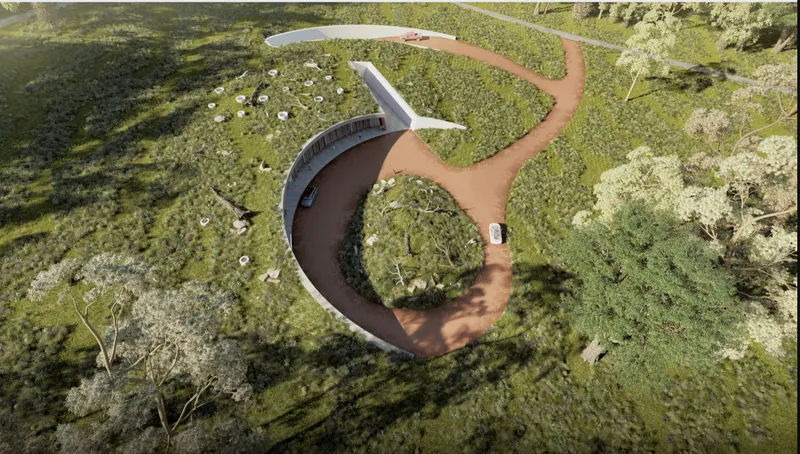
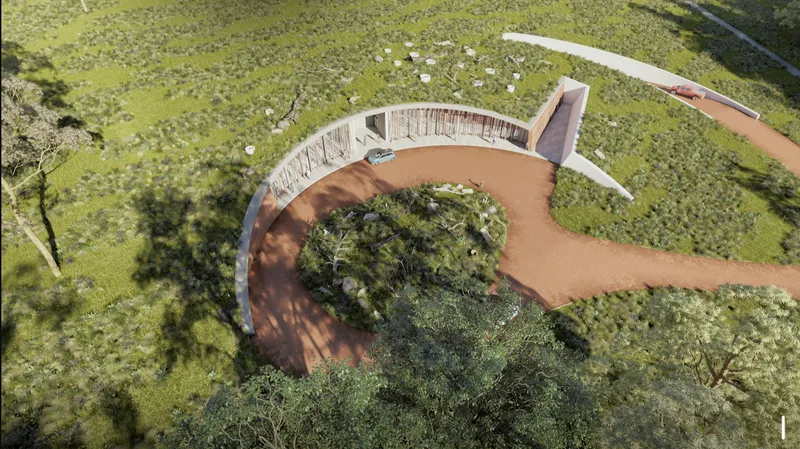
From above, the claw metaphor becomes legible. A curved concrete retaining wall sweeps around a looping red gravel drive, and the building tucks in behind it with its grass roof rising out of the terrain. At the centre sits a planted island, the circular courtyard the designer describes as both a visual and an ecological anchor. It is a smart inversion of the usual institutional plan: instead of a courtyard carved out of a building, this is a preserved piece of ground that the building wraps and protects.
The second aerial makes the edge condition clearer. The retaining wall does the hard structural work of holding back the earth, while a facade of timber fins softens the inner face of the curve. Because the vegetation continues over the roof, the architecture's visual footprint shrinks to a single arc of wall and glazing. The claw logic also organises the programme, allowing public functions to sit apart from treatment areas so that animals are spared unnecessary stress while visitors still gain a window into conservation work.
Timber Fins as a Stand of Eucalyptus Trunks
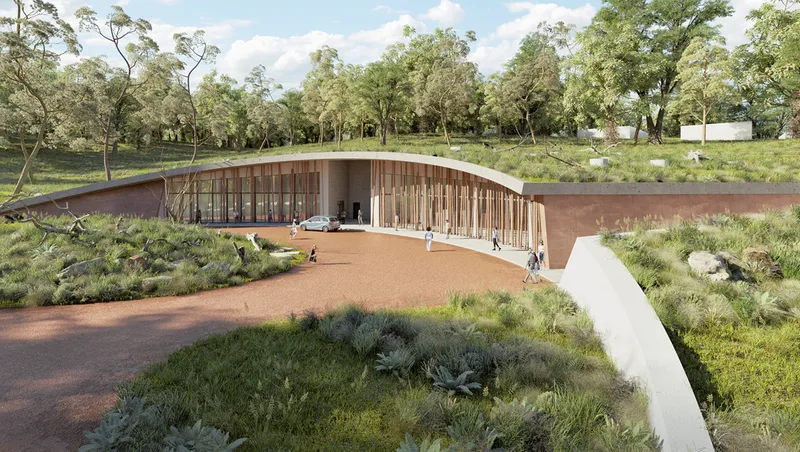
At eye level, the project's most persuasive gesture is its facade. Slender vertical timber elements line the glazed front, referencing the eucalyptus forests that serve as koalas' primary habitat and food source. Seen from the red gravel forecourt, the fins read like a row of thin trunks, blurring the line between building and woodland. They also do what a good screen should: filter views and light while letting the glazing behind them stay open to the landscape.
The grass roof sits low over this facade, so the building never presents a tall or monumental face to arriving visitors. Earth-toned paths and natural textures continue the palette underfoot. It is an approach that trades spectacle for continuity, and in the context of a facility whose users are easily stressed animals, that restraint is the right call.
Disappearing Into a Forest Clearing


The oblique and high aerials pull back to show the building in its woodland setting. The crescent sits low within a clearing, its red driveway winding through eucalyptus in dappled light, with a cluster of white outbuildings visible at the upper right. From this height the grass roof merges almost entirely with the surrounding ground cover, and what remains visible is mostly the path and the arc of the wall.
That winding path is doing more than providing access. The designer frames the circulation as gradual and contemplative, encouraging people to slow down as they move through the landscape. The curve lengthens the approach and keeps the full building from revealing itself at once, so arrival becomes a measured transition from forest to facility rather than an abrupt confrontation with an institution.
A Roof Built in Layers of Soil and Structure

The presentation board shows that the green roof is more than a surface finish. Diagrams break the building into its structural layers and detail a layered green roof build-up intended to improve thermal performance, water retention and ecological integration. A structural section clarifies how the curved roof sits into the terrain, while an interior view with seated visitors hints at the quieter, sheltered spaces beneath the earth cover.
This sheet grounds the metaphor in construction. An earth-sheltered building lives or dies by how it handles weight, moisture and insulation, and the decision to diagram these layers suggests the designer understands that the landscape-as-roof idea needs a credible technical basis. The fluid roof geometry, avoiding rigid lines in favour of forms drawn from nature, becomes believable once its assembly is laid out.
Why This Project Matters
Koalas Claw argues that a wildlife facility should be measured by how little it disturbs the ecosystem it serves. By letting the ground run over the roof, preserving a natural core at the heart of the plan and separating public and treatment zones, the proposal puts animal wellbeing at the centre of spatial decisions rather than treating it as an operational afterthought. The claw metaphor could easily have stayed decorative; here it shapes zoning, circulation and the relationship between inside and outside.
For a shortlisted competition entry, the project's real strength is its discipline. It resists the temptation to make a sculptural statement and instead commits to a low, earth-covered crescent, a timber screen that echoes eucalyptus trunks and a roof assembly that is thought through in section. As rehabilitation and conservation architecture becomes more urgent, this kind of quiet, landscape-first thinking offers a useful model: build less visibly, protect more deliberately.
View the Full Project
About the Designers
Designer: Chingiz Agharzayev
Enter a Design Competition on uni.xyz
uni.xyz runs architecture and design competitions year-round that reward proposals with spatial conviction and real site intelligence.
Project credits: Koalas Claw, by Chingiz Agharzayev Haven 2020 (uni.xyz).


Popular Articles
Popular articles from the community


Architekt Andreas Gruber Scatters 23 Dark Timber Chalets Across a South Tyrolean Forest Edge
In Molini di Tures, Amonti Chalets breaks a resort into a hamlet of gabled timber houses, with parking, storage and services pushed into the slope.

Jaramillo Van Sluys Arquitectura and Urbanismo Turn a Demolished Registry Lot in Quito into an Orchard Plaza
In Quito's Centro Histórico, a 2,800 m² plaza exposes the San Agustín convent wall and redraws its lost Augustinian orchard in volcanic stone.

GROUP A Strips a 1969 Rotterdam Harbor Headquarters to Its Frame and Wraps It in Timber Louvers
In Rotterdam's M4H harbor district, Ferro Offices reuses a 1969 frame, adds one timber storey and reaches BREEAM-NL Outstanding.

Cube Design Draws an Ecological Corridor Between Two Shenzhen Hills with the Nankai Building
Beside Shenzhen's container docks, the Nankai Building pairs stacked balconies with a climbing green screen to connect two hillsides across its height.

Similar Reads
You might also enjoy these articles
Healing Façade: A Modular Chapel System That Restores Ethiopia's Sacred Forests
Winner of the Eco-Chapel competition, this circular timber façade collects water from air to rebuild soil and reforest degraded Ethiopian landscapes.
Kaffeebühnen: Where Coffee Shop Architecture Becomes a Civic Stage in Vienna
A linear sequence of timber boxes, transparent shells, and open yards turns the Viennese café tradition into a public performance space.
Eco Chapel: A Modular Forest Pavilion That Grows Like the Landscape It Protects
Hexagonal timber modules weave through existing trees, turning a chapel into a living system for prayer, education, and reforestation.

Urban Forest: A Vertical Ecosystem for 5,000 Workers in Singapore's Changi Business Park
Radially stacked pods and layered green decks turn a 7-acre plot into 47 acres of ecological workspace projected for 2040.


Comments (0)
Please login or sign up to add comments
No comments yet. Be the first to comment!