
kooo architects Strip a Kyoto Sukiya House Back to Its Roots and Add a Garden Waterfall Between Buildings
In the wooded hills of Narutaki, a traditional residence sheds decades of piecemeal alterations to recover the spatial clarity of tea-house architecture.


Sukiya architecture is one of those rare building traditions that never actually went away. Born from the tea ceremony, it has quietly persisted in Kyoto for centuries, prizing restraint, natural materials, and a near-dissolving boundary between interior and garden. But survival is not the same as preservation. The House in Narutaki, completed in 2025 by kooo architects, is a case study in what happens when a Sukiya residence endures decades of uncoordinated changes: tatami rooms chopped into fragments, spatial flow interrupted, and the original relationship between architecture and landscape severed.
Led by Shinya and Ayaka Kojima, the renovation does something more difficult than building new. It peels back layers of alteration to recover the clarity the house once had, then introduces a detached two-storey annex and a man-made waterfall that flows down the sloping site between the two structures. The result is a 323 m² compound that feels simultaneously ancient and decisively contemporary, rooted in Narutaki's wooded hillside on the western edge of Kyoto.
The Doma as Spine
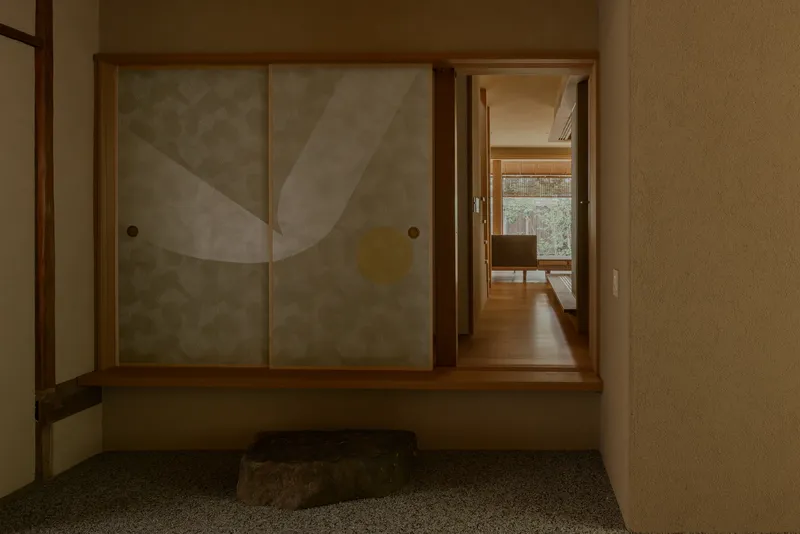
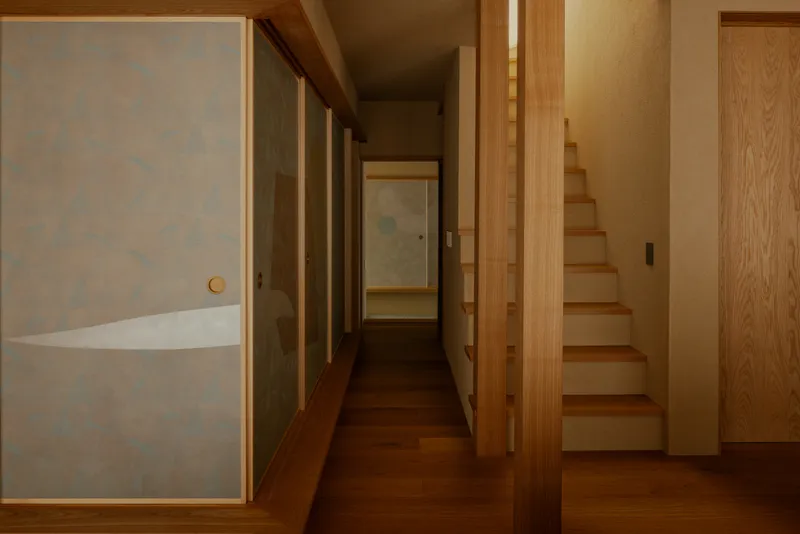
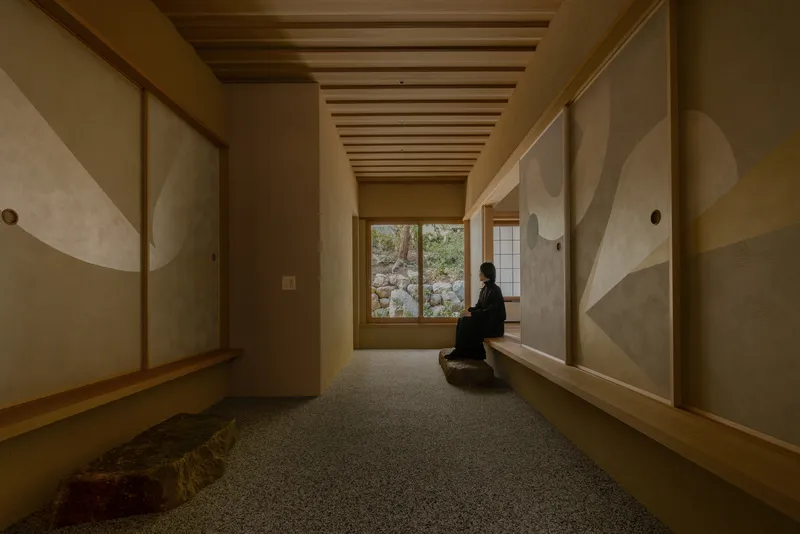
The most consequential move in the main house is the earthen-floored corridor, or doma, that bisects the ground floor from front to back. Starting at a stone-paved entrance with terrazzo detailing and translucent sliding doors, it runs straight through the building to the landscaped garden at the rear. This single gesture replaces the maze of small, fragmented rooms that previous renovations had created.
Walking the doma, you pass beneath exposed timber ceiling beams that register the building's structural history without sentimentality. The corridor is narrow enough to feel intentional, wide enough to breathe. Translucent panels and a timber staircase modulate light along its length, so the passage itself becomes a sequence of thresholds rather than mere circulation.
Rooms That Open, Not Enclose
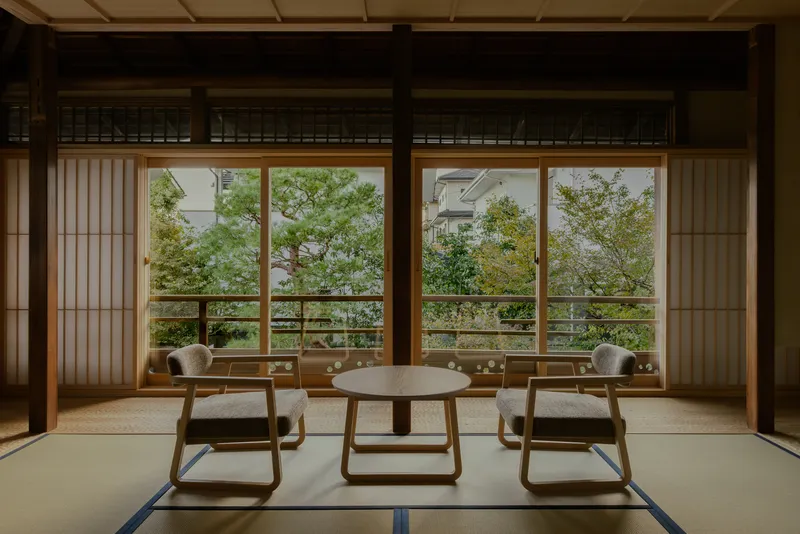
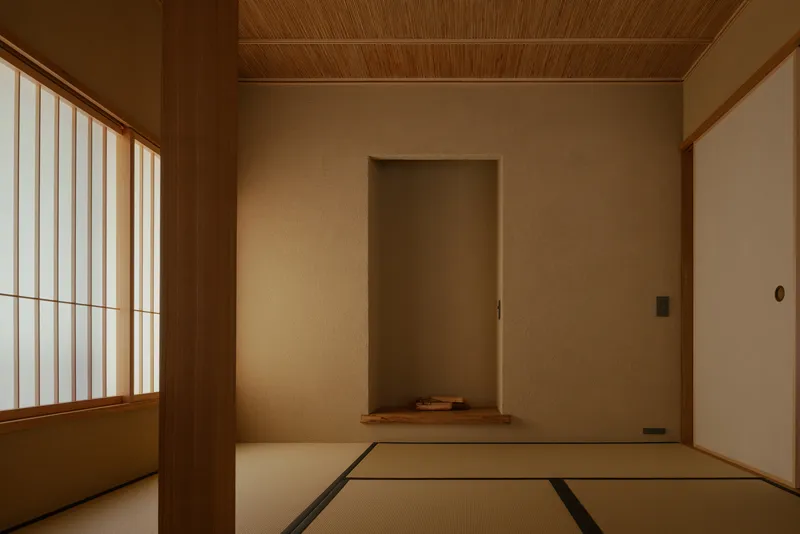
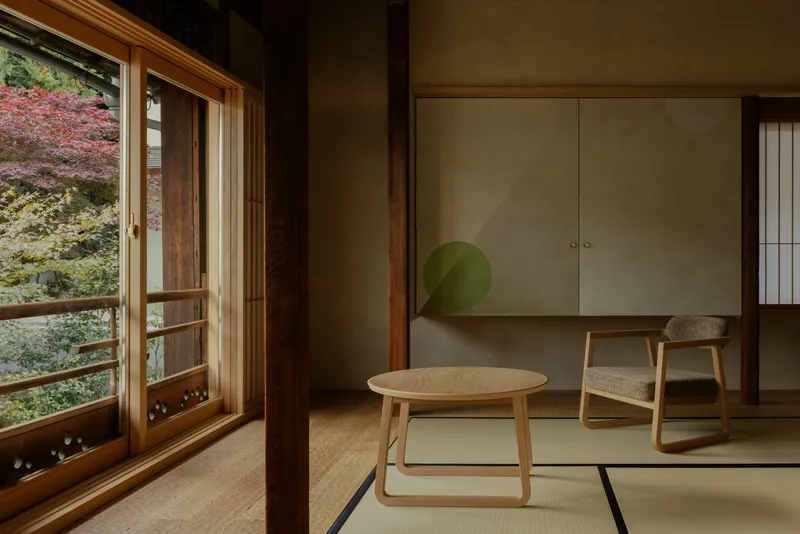
The reorganized tatami rooms demonstrate Sukiya's core argument: a room is defined less by its walls than by what it looks at. Shoji screens slide away to collapse the boundary between interior and garden, framing autumn foliage as precisely as a hanging scroll in a tokonoma alcove. Low wooden chairs and tables keep sightlines horizontal, directing the eye outward.
Juraku plaster on walls and ceilings gives each room a warm, mineral finish that absorbs light rather than reflecting it. The recessed alcove in one tatami room is a textbook example of Sukiya restraint: timber-lined ceiling, a single compositional gesture, nothing competing for attention. These are rooms designed for sitting still, which is harder to get right than it sounds.
Architecture Meets Garden at the Engawa
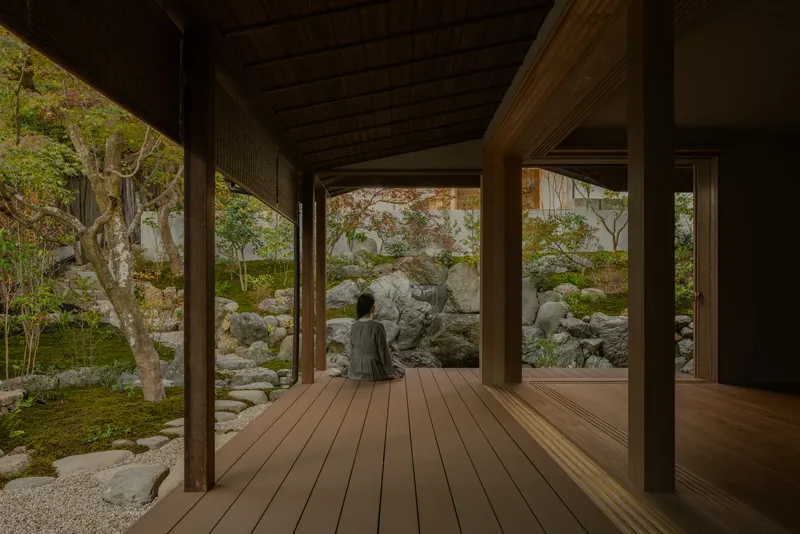
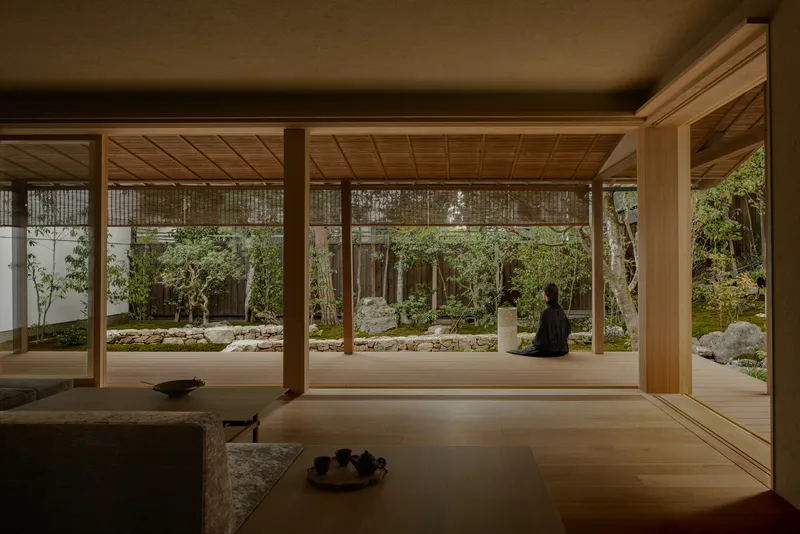
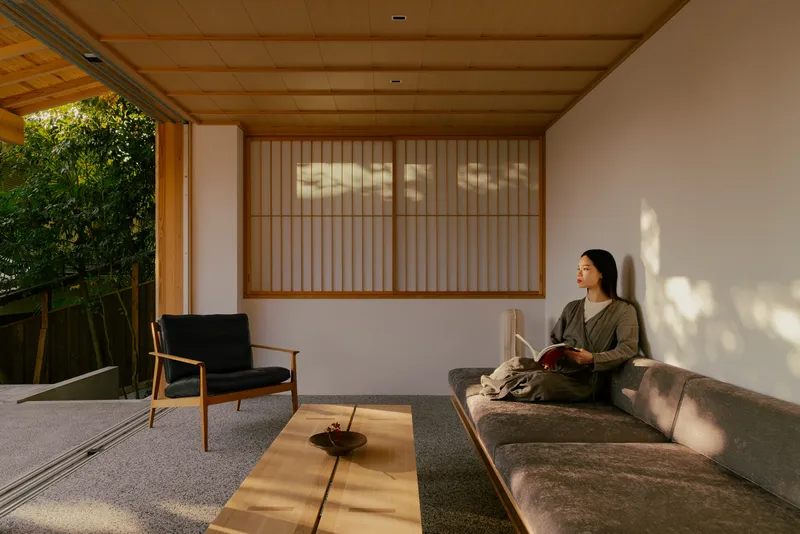
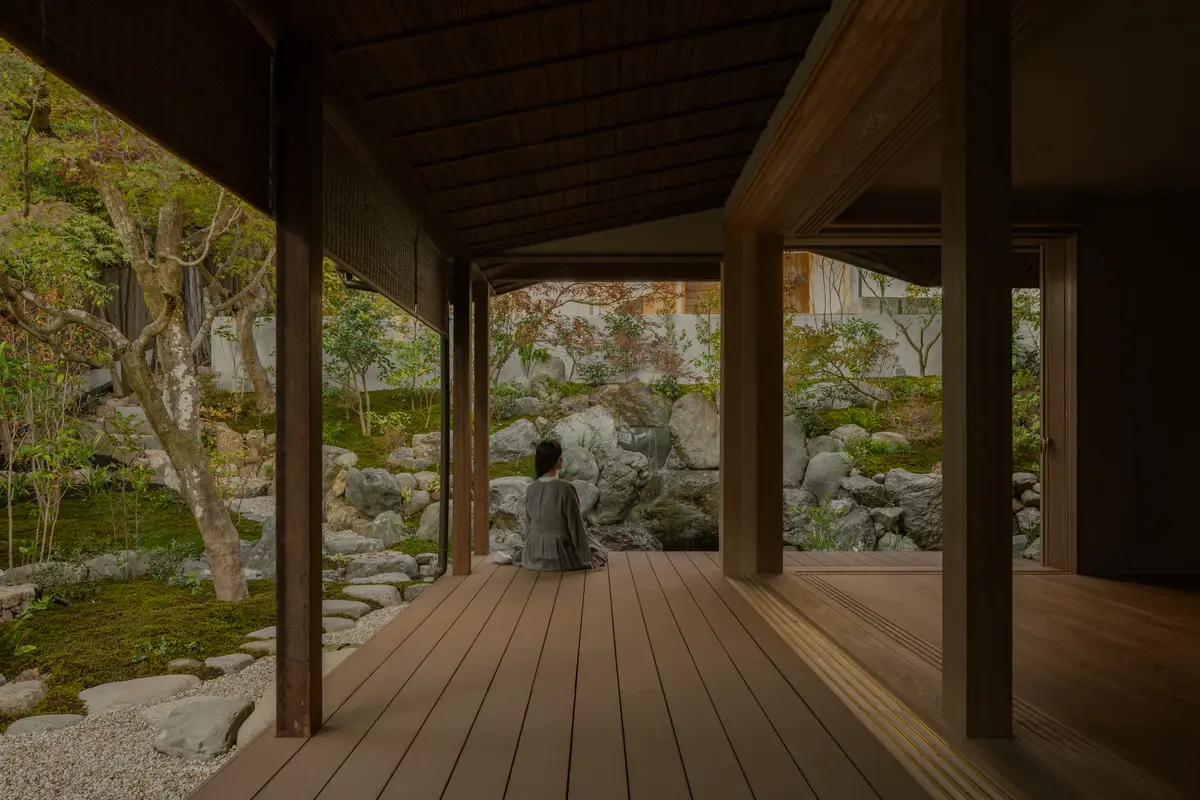
The engawa, the covered timber deck that wraps portions of the house, is where interior and landscape negotiate. It is neither fully inside nor fully outside, and that ambiguity is the point. One section faces a moss and stone garden in dappled afternoon light; another opens toward a rock garden with a seated Buddha sculpture. A curved bench on a covered terrace invites the kind of unhurried reading that contemporary life rarely permits.
The garden itself is not decoration. Seasonal plants ensure the view changes through the year, and large boulders anchor the composition against the wooded hillside. kooo architects understand that in Sukiya tradition, the garden is the building's other half. Neglect it, and the architecture loses its argument.
The Annex and the Waterfall
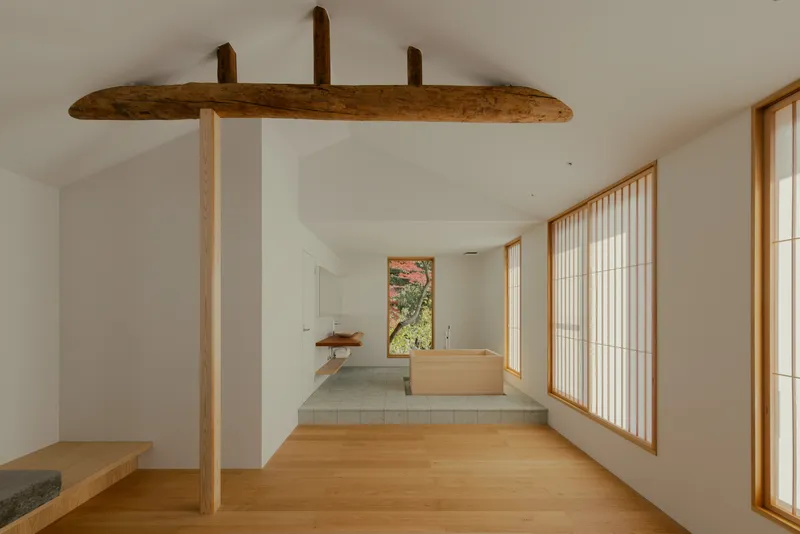
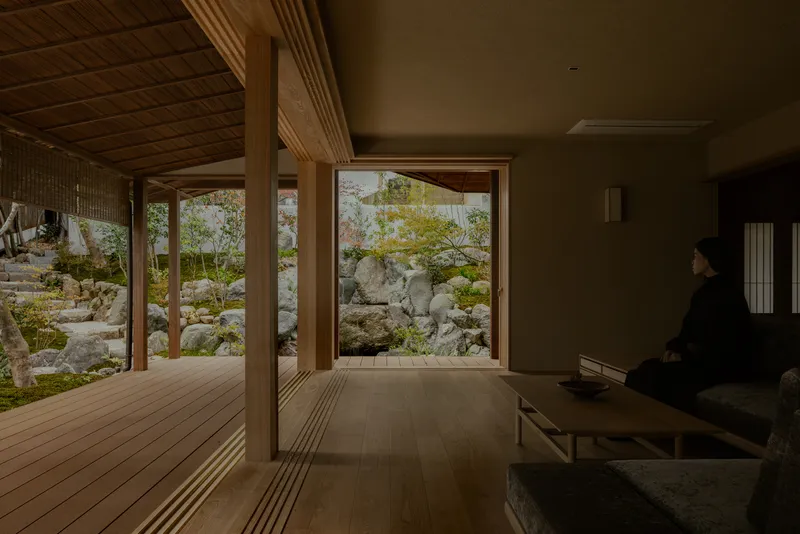
The detached annex introduces a hybrid structural logic: steel on the first floor, timber above. Inside, a white color scheme on walls and ceiling provides a neutral backdrop that lets cherry wood and salvaged timber beams hold visual weight. The effect is lighter and more contemporary than the main house, establishing a dialogue between old and new without forcing either to pretend to be the other.
Between the two buildings, a newly designed waterfall uses the site's natural gradient to flow down the western slope. It is a bold landscape intervention that simultaneously separates and connects the structures, creating an auditory threshold you cross when moving between them. One annex suite features a hinoki bath whose window frames a maple tree, collapsing the distance between bathing ritual and seasonal landscape in a way that feels deeply specific to this place.
Living and Dining in the Grain of the House
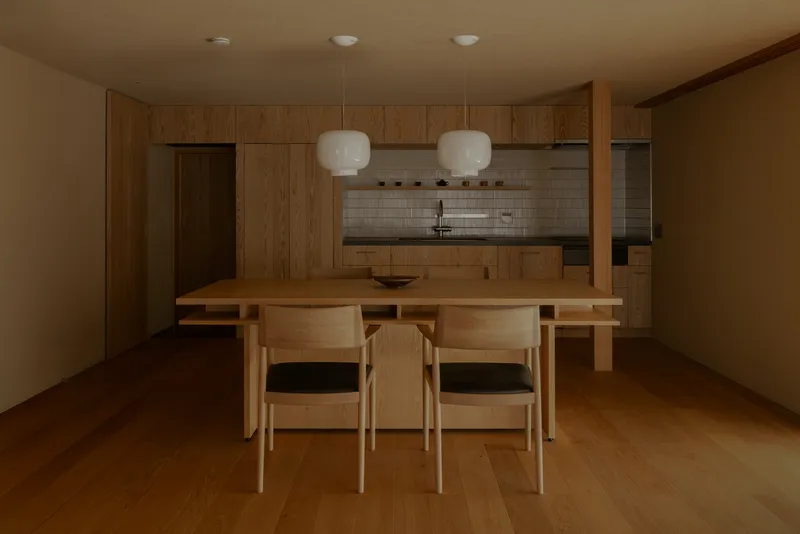
The LDK (living-dining-kitchen) occupies the most informal zone of the main house, with a timber table, chairs, and wood cabinetry beneath pendant lights that provide a warm, focused glow. Hardwood floors replace tatami here, signaling a shift in register from ceremonial to domestic. The cabinetry is simple, well-proportioned, and content to stay in the background.
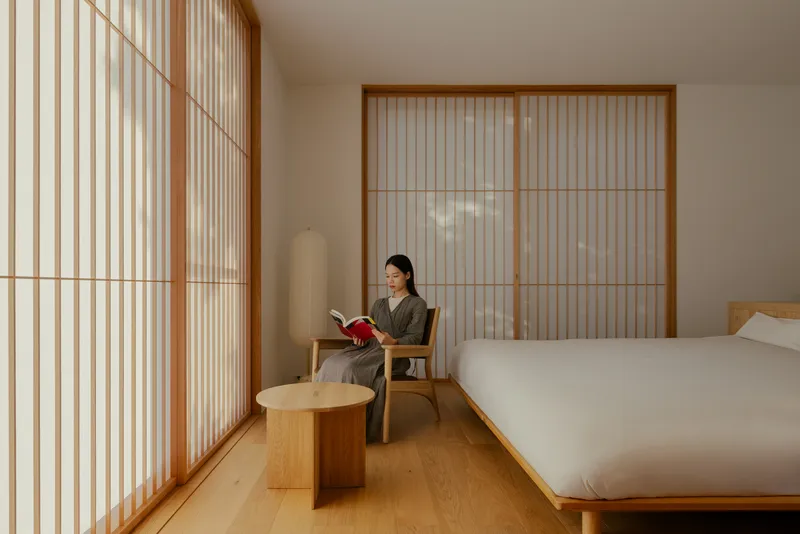
Upstairs in the annex, a bedroom with timber-framed translucent sliding screens shows how the architects modulate privacy without relying on opaque walls. The screens filter light into a soft wash, making the room feel enclosed but not shut off. It is an old technique executed with precision, and it works because the proportions are right.
Plans and Drawings
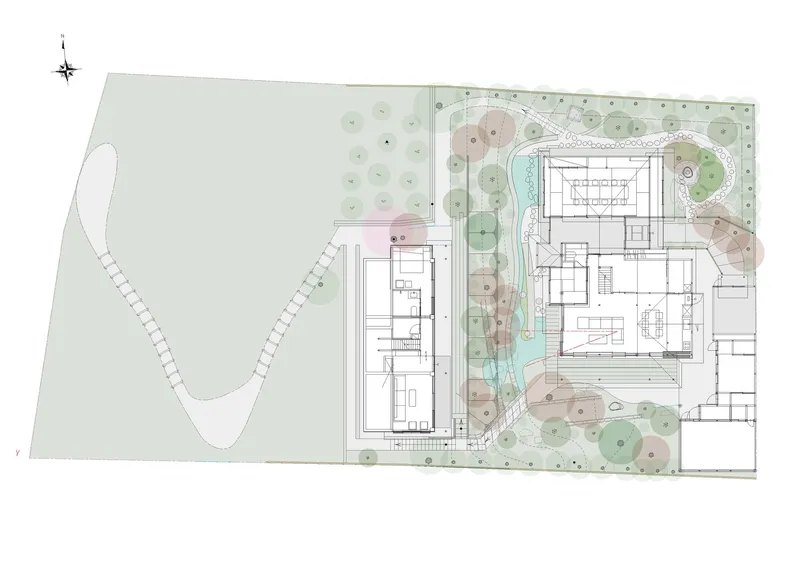
The site plan reveals the compound's dual-building strategy clearly: the main house and annex sit on either side of the central water feature, with planted landscape wrapping the perimeter. The waterfall's path down the slope reads as a natural drainage line that the architects formalized into a design element. You can also see how the doma in the main house aligns with the entrance axis, establishing the front-to-garden throughline that organizes the entire ground floor.
Why This Project Matters
Renovation projects rarely get the credit they deserve, partly because the architect's most important decisions are subtractive. At Narutaki, kooo architects removed more than they added, stripping away decades of well-meaning but spatially destructive alterations to recover a building's original intelligence. That takes confidence and a deep reading of the existing structure, qualities that don't photograph as dramatically as a new cantilever but matter more in the long run.
The project also offers a quiet rebuttal to the idea that traditional Japanese architecture is a finished chapter. Sukiya is not a museum style here; it is a living framework that accommodates contemporary program, hybrid structure, and new landscape interventions without losing coherence. The waterfall between the buildings is the project's signature gesture, but the real achievement is the restored spatial continuity inside the main house. In Kyoto, where heritage is both a resource and a burden, that balance is worth paying attention to.
House in Narutaki by kooo architects (Shinya Kojima, Ayaka Kojima). Narutaki, Kyoto, Japan. 323 m². Completed 2025. Photography by Keishin Horikoshi / SS.
About the Studio
Share Your Own Work on uni.xyz
If projects like this are the kind of work you want to make, uni.xyz is a place to publish your own, find collaborators, and enter design competitions.


Popular Articles
Popular articles from the community


Tsunami Convergenics: Turning Catastrophic Ocean Forces into Underwater Housing Infrastructure
A speculative underwater settlement off the coast of Onagawa, Japan, treats tsunamis and typhoons as energy sources rather than threats.

Cloaked Colonization: A Mobile Underwater Habitat That Moves Like a Fish
Micah Abaya's shortlisted EHC Pacific entry reimagines ocean settlement as a dispersed network of self-sustaining architectural organisms.

Singing Woman: Contemporary Architecture Inspired by Estonia’s Voice and the Sea
Singing Woman turns Estonia’s song culture into flowing opera house architecture, blending public life, landscape, sea, and national memory.

Opera by the Sea Estonia: Three Shells Dissolving Architecture into Tallinn's Coastline
A winning opera house proposal replaces monumental form with interconnected shells that blur the boundary between building, park and Baltic Sea.

Similar Reads
You might also enjoy these articles

Bao Huynh Watercolor Atelier: A Serene Art Retreat in Hội An
Bao Huynh Watercolor Atelier in Hội An blends multifunctional art spaces, sustainable design, local materials, and family-friendly living in a serene environment.

Atelier Macri Concept Store Interior Design by CASE-REAL
Atelier Macri store features a "ko" counter, walnut wood details, cork displays, blending retail, gallery, and seamless customer experiences.

Manuel Vargas Izquierdo Stadium and High-Performance Sports Center: Architectural Excellence in Jalpa de Méndez
The Manuel Vargas Izquierdo Stadium blends sustainable design, inclusive sports facilities, and cultural-inspired architecture, revitalizing Jalpa de Méndez’s public spaces.

KAKR Buluh Awar Hall: Revitalizing Community and Ecology Through Bamboo Architecture
Community built bamboo hall revitalizes Buluh Awar village, empowering youth, restoring ecology, celebrating vernacular craftsmanship through sustainable architecture and culture.

Explore House Competitions
Discover active competitions in this discipline

Challenge to design a portable theatre

Challenge to design a portable music platform

Challenge to design an open learning module for the elderly

Challenge to design mud housing for contemporary communities
Comments (0)
Please login or sign up to add comments
No comments yet. Be the first to comment!