

Kudaaram: A Modular Timber Pavilion Reclaiming Chennai's Congested Streets
A collapsible street shelter with green roofs and community seating transforms Mannady Street into a pedestrian-first corridor.


On Mannady Street in Chennai's George Town, two-wheelers colonize the pavement, shopfronts disappear behind parked vehicles, and pedestrians walk in the road because there is nowhere else to go. It is a condition replicated across thousands of Indian commercial streets: narrow rights-of-way overwhelmed by motorized encroachment, zero civic amenities, and no shade or rest for the people who actually keep the street economy alive. Kudaaram, Tamil for pavilion, is a precise architectural response to that condition. Rather than proposing a masterplan or a policy framework, it offers a single, repeatable timber module that can slot into the street edge and immediately reclaim ground for pedestrians.
The project is the work of Stany Babu and Pritika Akhil Kumar, who developed Kudaaram through on-ground surveys and community analysis in George Town, one of Chennai's oldest and most congested commercial districts. Their research identified a consistent set of complaints from residents and shopkeepers: traffic congestion, lack of green space, pavement encroachment, and the total absence of places to sit, rest, or gather safely. Kudaaram addresses all of these through a compact, modular shelter designed for replication across metropolitan Indian streets.
Mannady Street: Where Pavements Vanish Under Parked Vehicles
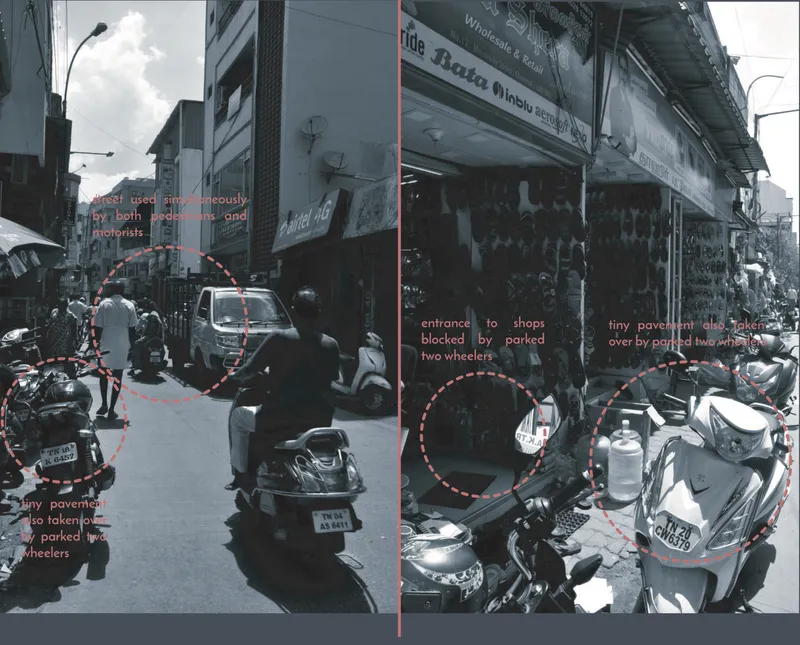
The annotated street view of Mannady Street makes the problem legible at a glance. Two-wheelers line both edges of the road in dense, unbroken rows, pushing pedestrians into active traffic lanes. Shopfronts are obscured, customer access is impeded, and the street functions exclusively as a vehicular corridor with a commercial afterthought. The designers' survey data reinforced what the photographs show: overcrowding, inadequate pedestrian infrastructure, and community disengagement are the dominant urban conditions in George Town.
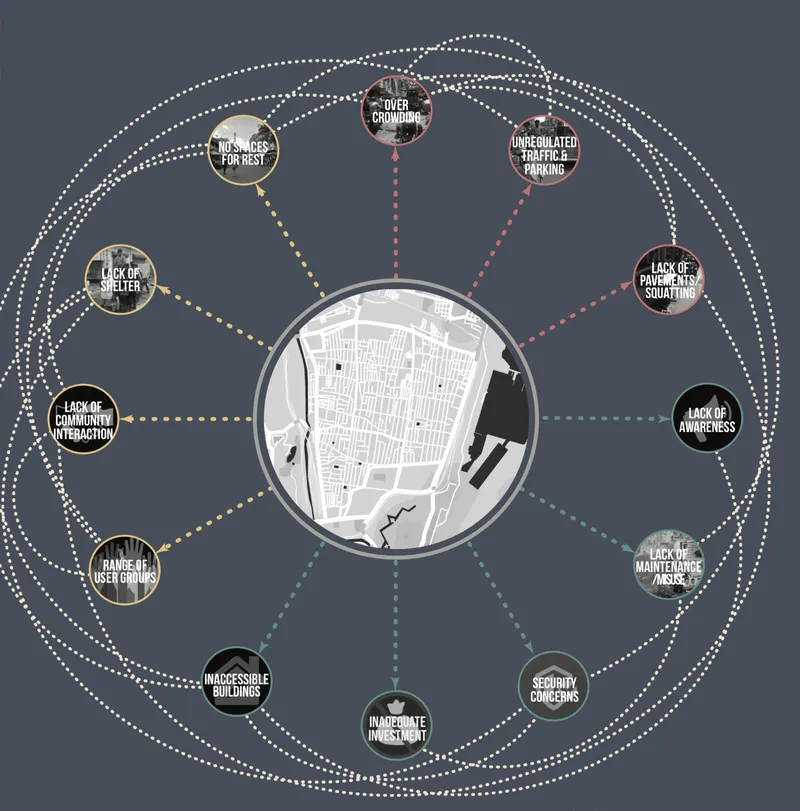
The radiating diagram contextualizes these street-level observations within a broader network of interconnected urban challenges. Traffic congestion, limited civic amenities, absence of green space, and encroachment are mapped as systemic issues rather than isolated complaints. This analytical framework is what gives Kudaaram its ambition: the module is not designed to fix one street corner but to serve as a prototype whose logic can propagate across any similarly afflicted corridor in an Indian city.
A Timber Frame with Collapsible Seating and a Living Roof
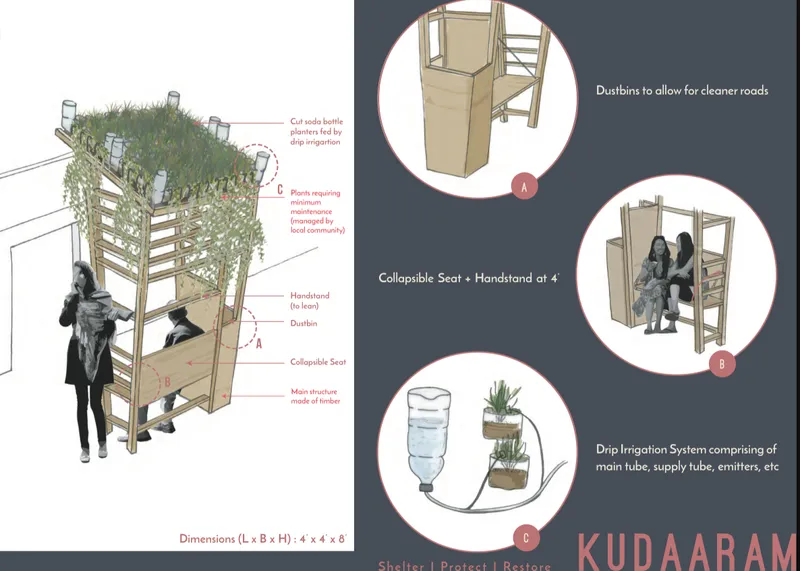
The isometric drawing reveals the anatomy of the Kudaaram module. A timber structural frame, locally sourced and designed for straightforward assembly, supports collapsible seating and leaning supports that can fold away when the street needs maximum throughput. The roof is a working landscape: planters filled with low-maintenance species sit above slatted timber screens, fed by a drip irrigation system that minimizes water consumption. Recycled bottle planters add an additional layer of ecological intent without increasing material cost. Integrated dustbins are built into the frame, addressing the chronic litter problem that accompanies any high-traffic Indian street.
What makes the design spatially intelligent is its flexibility. The collapsible elements mean the module can operate in two modes: an expanded configuration that offers seating, shade, and rest, and a compact configuration that clears the pavement for peak pedestrian flow. That duality is essential for a street like Mannady, where conditions change by the hour and any permanent installation risks becoming its own form of encroachment.
Shelter in the Street: Timber Screens and Planted Canopies Among Pedestrians

The street-level installation view is the most convincing image in the set. Timber-framed shelters with slatted walls stand along the pavement, their planted roofs creating a visible green canopy above the heads of passing pedestrians. The modules read as furniture rather than architecture: they do not block sightlines, they do not demand foundation work, and they maintain the porosity of the street edge. Pedestrians move through and around them naturally, which suggests the designers got the scale right.
Critically, Kudaaram is conceived as social infrastructure, not just physical infrastructure. The designers envision local communities maintaining the rooftop greenery, creating a shared investment in the module's upkeep and longevity. By positioning the shelters near vibrant street markets, the design supports the informal economy: people can rest, eat, and talk in safety rather than standing in traffic. That alignment between spatial design and existing social patterns is what separates a useful urban intervention from an imposed one.
Why This Project Matters
Indian cities are drowning in plans that operate at the scale of the masterplan or the policy document, while the street, the fundamental unit of public life, deteriorates one parked scooter at a time. Kudaaram works precisely because it operates at the scale of the street itself. A single module reclaims a few square meters of pavement, provides shade, offers a place to sit, introduces greenery, and organizes waste collection. Multiply that module across a corridor and you have transformed pedestrian experience without a single road widening or land acquisition.
Stany Babu and Pritika Akhil Kumar have produced a design argument that is both modest and ambitious. Modest in its material palette, its dimensions, and its claims. Ambitious in its insistence that small, repeatable, community-maintained interventions can accumulate into systemic urban change. For George Town and for the hundreds of Indian commercial streets that share its conditions, Kudaaram offers something rare: a solution that could actually be built tomorrow.
View the Full Project
About the Designers
Designers: Stany Babu, Pritika Akhil Kumar
Enter a Design Competition on uni.xyz
uni.xyz runs architecture and design competitions year-round that reward proposals with spatial conviction and real site intelligence.
Project credits: Kudaaram by Stany Babu, Pritika Akhil Kumar.


Popular Articles
Popular articles from the community

Cloaked Colonization: A Mobile Underwater Habitat That Moves Like a Fish
Micah Abaya's shortlisted EHC Pacific entry reimagines ocean settlement as a dispersed network of self-sustaining architectural organisms.

Opera on the Sea: Driftwood Logic Shapes a Timber Opera House on Estonia's Coast
Trevor Orgill's opera house translates the entangled drift of floating timber into a civic building where wood, water, and music converge.

Extended Shell: Retrofitting Kolkata's Balconies as Living Urban Thresholds
A modular retrofit system recovers the social and environmental intelligence of Kolkata's historic verandas for contemporary Park Street residents.

The Amber Palace Opera: A Geological Fiction Surfaces on Tallinn's Baltic Waterfront
Pierre Brillard reimagines a Baltic legend as a public landscape, opera house, and waterfront promenade rooted in Tallinn's coastal identity.

Similar Reads
You might also enjoy these articles
The Amber Palace Opera: A Geological Fiction Surfaces on Tallinn's Baltic Waterfront
Pierre Brillard reimagines a Baltic legend as a public landscape, opera house, and waterfront promenade rooted in Tallinn's coastal identity.
Dynamic Modules Shelter: A Telescopic Ring for Mountain Pilgrimage
A circular modular framework of steel, bamboo, and fabric grows vertically with demand, wrapping communal ground in adaptable shelter.

Singing Woman: Contemporary Architecture Inspired by Estonia’s Voice and the Sea
Singing Woman turns Estonia’s song culture into flowing opera house architecture, blending public life, landscape, sea, and national memory.

HYPERBLOCK: Flexible Urban Design for Barcelona’s Future City
HYPERBLOCK reimagines Barcelona as flexible urban design, layering density, daylight, public space and adaptable housing above Cerdà’s grid.


Comments (0)
Please login or sign up to add comments
No comments yet. Be the first to comment!