

Delordinaire Lifts Prefabricated Larch Cabins on Stilts Above a Frozen Quebec Lakeshore
La Cache Modular Residences perch 50 square meters of contemplative living above Lake Saint-Jean's snow-covered terrain.


Roughly 150 miles north of Quebec City, Lake Saint-Jean is the kind of landscape that resists domestication. Snow buries the terrain for months, the shoreline shifts with seasons, and the boreal canopy demands respect. Delordinaire, working in collaboration with Annie Sylvain Architects, responded to all of this by deciding to barely touch the ground. La Cache is a set of modular residences, each 50 square meters, fabricated north of Montreal and trucked to the lake, then raised on stilts so the land beneath them stays essentially unaltered.
What makes the project worth studying is not the fact that it is modular or prefabricated. Plenty of firms ship boxes to remote sites. The distinction here is a genuine commitment to site specificity within a standardized system. Each cabin's height and orientation are adjusted during installation to capture particular sun angles, particular views, particular wind patterns. The result is a typology that repeats structurally but never duplicates experientially. It is the difference between a product and a piece of architecture.
A Cluster That Reads Like a Village
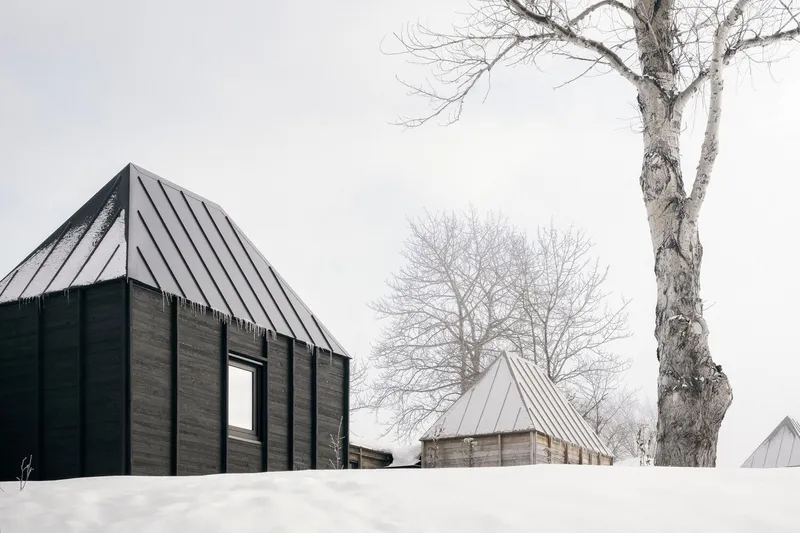
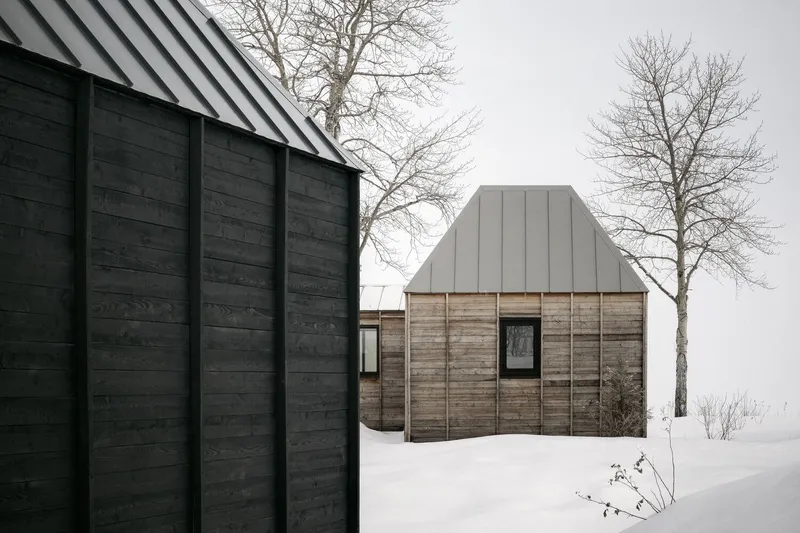
Seen from a distance, the cabins register as a loose settlement rather than a row of identical units. Gabled profiles, a nod to the vernacular pitched roofs of rural Quebec, are clad in larch and topped with standing seam metal. The volumes interconnect at varying angles, staggering along the slope so that no two share the same sight line to the lake. Bare winter trees thread through the gaps, reinforcing the sense that the buildings occupy clearings rather than a cleared site.
The clustering also generates social space between the units without formal landscaping. Originally a more elaborate landscape design was planned, but its absence has arguably strengthened the project: the snow, the trees, and the topography do the work instead.
Larch, Metal, and Winter Light
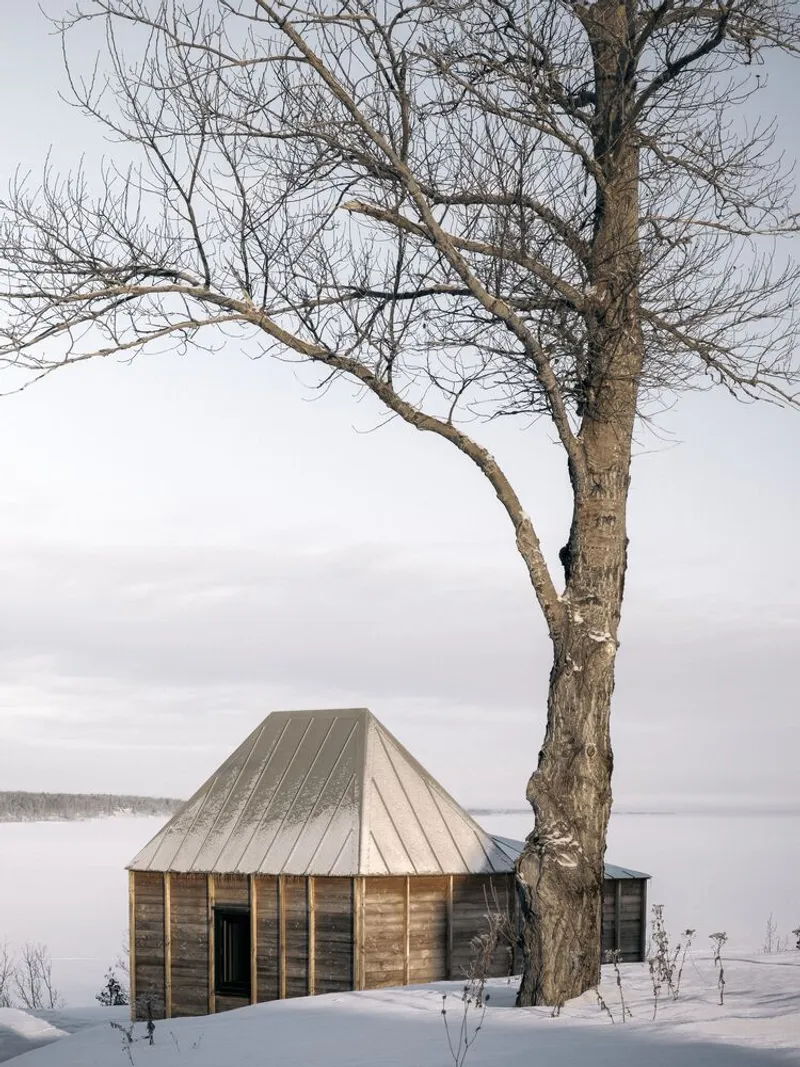
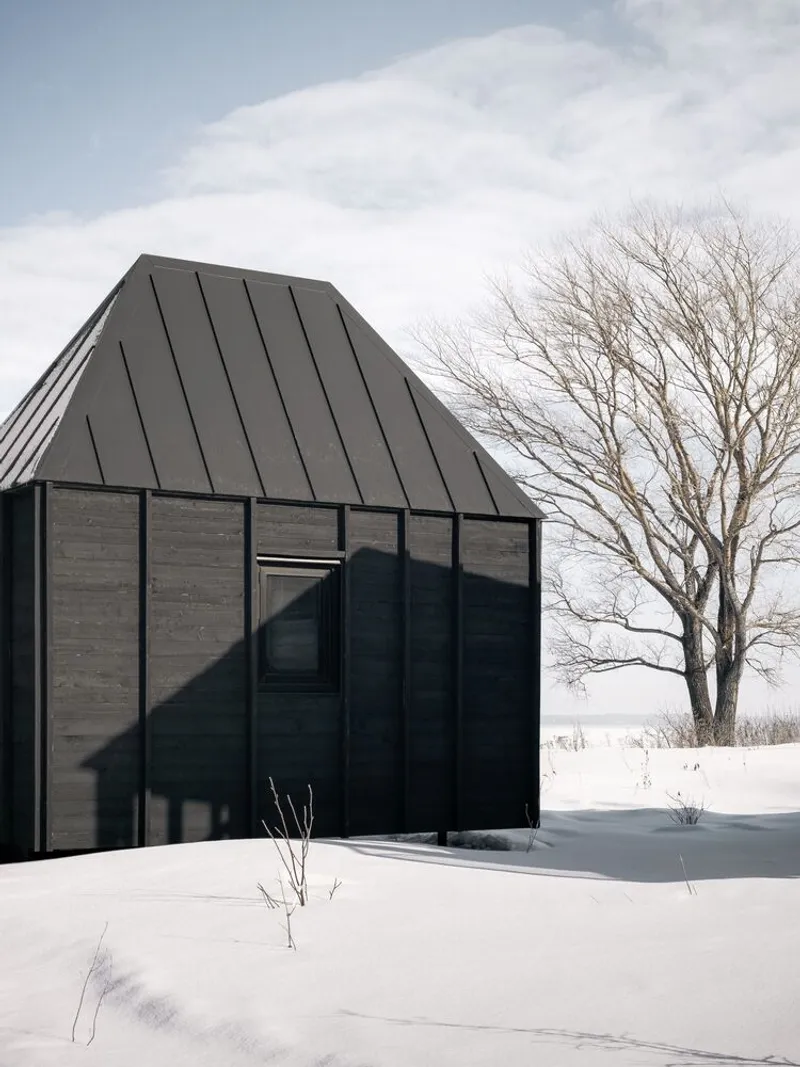
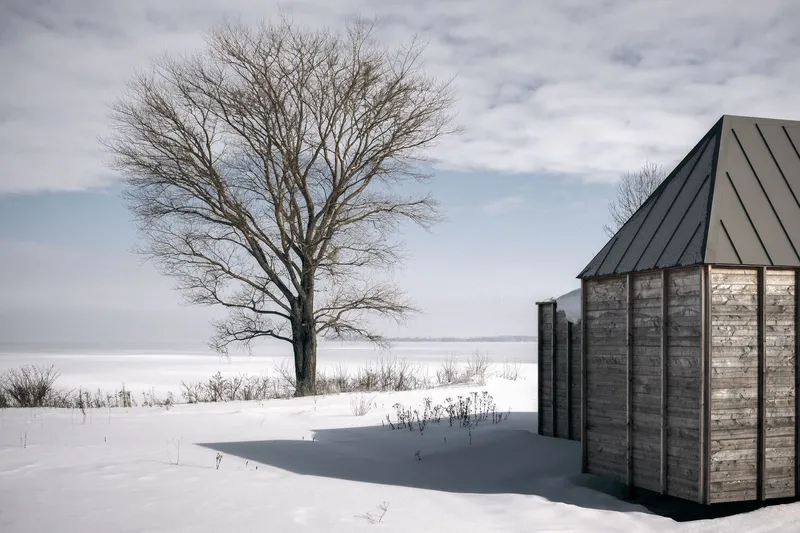
Larch is an underused cladding material in North American residential work, and La Cache makes a strong case for it. The wood weathers unevenly, picking up silver tones that shift with moisture and exposure. In photographs taken after the first winter, the vertical battens already show differentiation from cabin to cabin, each exterior recording its own microclimate. Against fresh snow, the warm amber of newer boards and the cooler grey of aged ones create a tonal range that synthetic materials cannot replicate.
The metal roofing plays a practical role beyond aesthetics: snow slides off the steep gables cleanly, reducing structural load. The roof seams run vertically, echoing the batten rhythm of the walls and lending each volume a taut, unified profile. Where the cladding meets the stilt structure below, the transition is deliberately abrupt. The cabins do not pretend to grow out of the earth. They hover above it, and the gap is the point.
Elevated Ground, Untouched Terrain
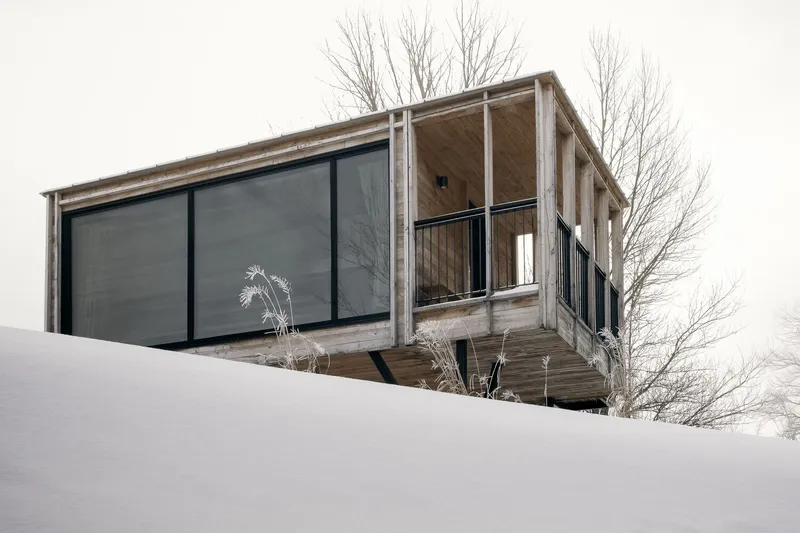
The stilt system is the project's most consequential decision. By eliminating conventional foundations, Delordinaire avoided excavation entirely. The natural grade, root systems, and drainage patterns remain intact beneath each cabin. In a cold climate with freeze-thaw cycles that can crack poured concrete within a decade, lifting the structure off the ground also reduces long-term maintenance risk. It is a strategy the studio first tested in its 2020 High House project in Saint-Ferréol-les-Neiges, and here it has been refined into a repeatable module.
A cantilevered deck extends from one volume, supported by timber posts and lined with a simple metal railing. In summer, the shaded ground beneath the cabins becomes a secondary outdoor room. In winter, the elevation puts residents at eye level with the upper branches of lakeside trees, a framing device that would be lost if the buildings sat at grade.
Interiors Pared to the Essential
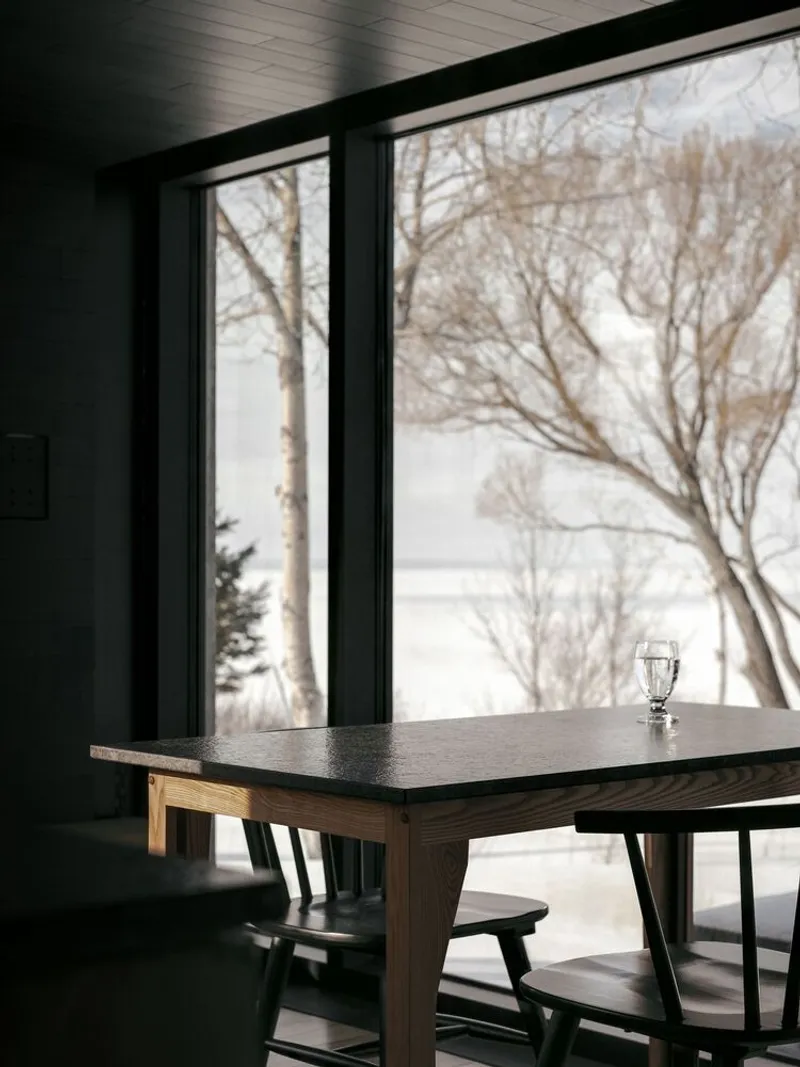
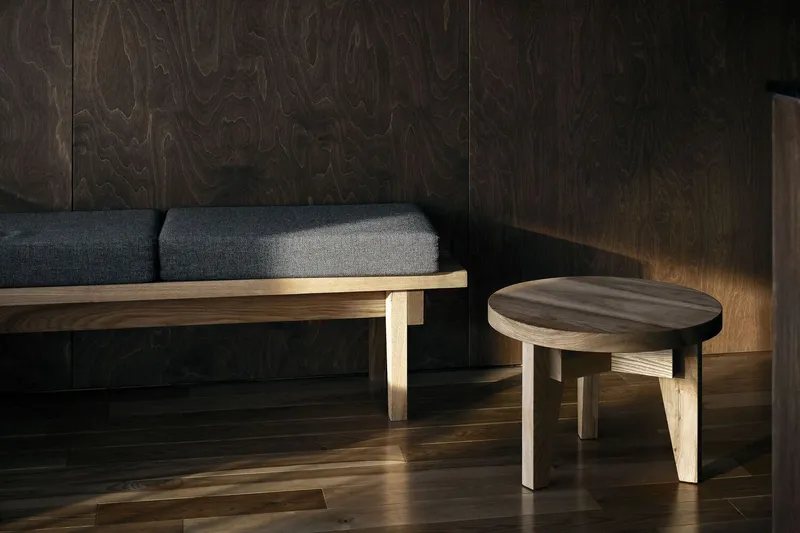
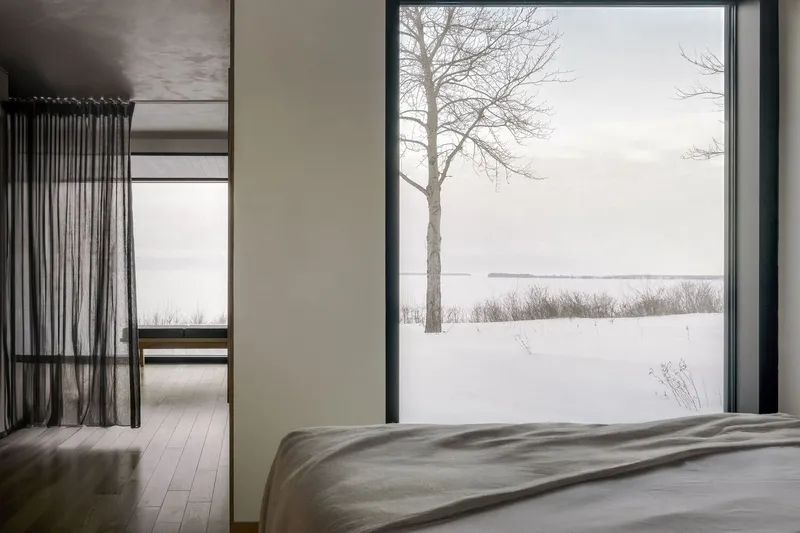
Delordinaire describes the interior as something closer to a hotel room than a fully furnished home: a place to drop your bags before heading outside. The lime-washed walls are pale and matte, absorbing winter light without glare. Built-in furniture is minimal. A dark wood dining table and a low bench with loose cushions are nearly the only objects in two of the rooms. The restraint is not ascetic posturing; it is a deliberate strategy to redirect attention outward.
The bedroom makes the argument most forcefully. Floor-to-ceiling glazing frames the frozen lakeshore, with only a sheer curtain filtering the view. Waking up in this room, the boundary between shelter and landscape reduces to a single pane of glass. The precisely proportioned openings throughout the cabin control where light enters and what it illuminates, producing interiors that change character across the day without any artificial intervention.
Prefabrication as Precision, Not Compromise
The modular parts are built from prefabricated wood panels and steel, assembled in a controlled environment before being transported to a remote lakefront site. For a 50 square meter dwelling, this process eliminates most of the waste, weather delays, and quality inconsistencies that plague conventional construction in northern climates. But what keeps La Cache from feeling like a kit house is the customization layer applied during installation. Orientation, elevation, and the relationship to adjacent units are all calibrated to each specific plot.
The environmental footprint argument matters, but so does the experiential one. Because the modules arrive tight and well-sealed, the cabins perform thermally without relying on oversized mechanical systems. The envelope does the work, and the openings are placed with enough care that passive ventilation and solar gain supplement heating and cooling. It is prefabrication deployed in service of architecture, not as a substitute for it.
Why This Project Matters
Modular housing has been promising revolution for decades and delivering mediocrity for most of that time. La Cache sidesteps the usual trap by treating the module as a starting condition, not a finished product. The intelligence of the project lies in the gap between what is standardized and what is specific: the same structural kit produces different spatial experiences depending on slope, sun, and sight line. That is a genuinely useful model for remote sites across Canada and beyond, where terrain varies but budgets and logistics demand repeatability.
More quietly, the project offers a corrective to the maximalist instinct that dominates lakefront development. At 50 square meters on stilts, La Cache proves that a small footprint and a light touch can produce a richer relationship with landscape than any sprawling vacation house. Delordinaire and Annie Sylvain Architects have not reinvented the cabin. They have clarified what it should be: a frame for paying attention.
La Cache Modular Residences by Delordinaire in collaboration with Annie Sylvain Architects. Lake Saint-Jean, Quebec, Canada. 50 m². Completed 2024. Photography by Felix Michaud.
About the Studio
Share Your Own Work on uni.xyz
If projects like this are the kind of work you want to make, uni.xyz is a place to publish your own, find collaborators, and enter design competitions.


Popular Articles
Popular articles from the community


ETEH Reworks the Shared Spaces of São Domingos School in Brazil Around Timber, Color and Hanging Plants
At São Domingos School in Brazil, 436 m² of hall, refectory and library are recast with timber joinery, a yellow and blue code and trailing greenery.


The Amber Palace Opera: A Geological Fiction Surfaces on Tallinn's Baltic Waterfront
Pierre Brillard reimagines a Baltic legend as a public landscape, opera house, and waterfront promenade rooted in Tallinn's coastal identity.

FCC Arquitectura Expands a Portuguese Granite House with a Board-Marked Concrete Wing
In Portugal, JV House pairs a cleaned-up whitewashed and granite dwelling with a timber-shuttered concrete extension, courtyards and a garden pool.

Cube Design Draws an Ecological Corridor Between Two Shenzhen Hills with the Nankai Building
Beside Shenzhen's container docks, the Nankai Building pairs stacked balconies with a climbing green screen to connect two hillsides across its height.

Similar Reads
You might also enjoy these articles


Hodi-Mandai Geram
Project Function: Preservation and revitalization of the Intangible heritage and socio-spatial identity of the Hodi by Housing, Cultural Memory Center, Sacred Grove, landscape, local tourism economy


Olio Towers: A Mid-Rise for Performers That Fuses Housing, Rehearsal, and Stage
Located blocks from Houston's Theater District, this modular tower stacks living units around a central performance atrium.

Oasis: Modular Green Housing Carved into Dhaka's Urban Fabric
A shortlisted Plugin Housing entry reclaims unauthorized settlements in Dhaka with stepped concrete volumes, green roofs, and ventilation-driven design.

Black Hole: A Floating Megastructure for the Post-Physical Era
Emiliano Mazzarotto envisions a spherical, self-scaling arena where e-sports, digital hotels, and holographic stadiums replace traditional public space.

Explore Housing Competitions
Discover active competitions in this discipline

Challenge to reimagine the Iron Throne

Photograph architecture without architects

Illustrate the lost glory of Angkor Wat - Render Challenge

Design challenge to reuse E-waste
Comments (0)
Please login or sign up to add comments
No comments yet. Be the first to comment!