
Plinthos Architects Carve Two Vacation Villas into a Naxos Hillside
La Natura Villas nestle into the rocky slopes of Naxos, pairing Cycladic restraint with courtyards that frame the Aegean.

On the Greek island of Naxos, where whitewashed volumes and dry stone walls have defined settlement patterns for centuries, Plinthos Architects and collaborator Stefania Ntinou have completed a pair of holiday houses that read less like imported luxury and more like geological fact. La Natura Villas, finished in 2024, comprises two 230 m² homes accessed by separate private roads and organized around a shared logic: follow the incline of the rock, capture the Aegean in every room, and let courtyards do the heavy lifting for light and ventilation.
What makes the project worth studying is its refusal to treat the Cycladic vernacular as a style to be quoted. Instead, the architects absorbed its principles: clustered volumes that step with topography, thick walls for thermal mass, outdoor rooms that matter as much as indoor ones. The result is a complex that, seen from the air, could pass for a fragment of village. Up close, terrazzo counters, full-height glazing, and planted gravel beds make the contemporary ambition unmistakable.
Reading the Slope
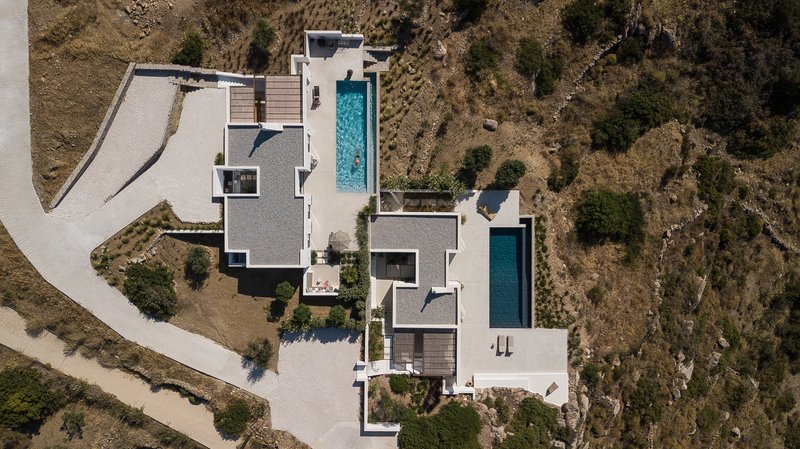
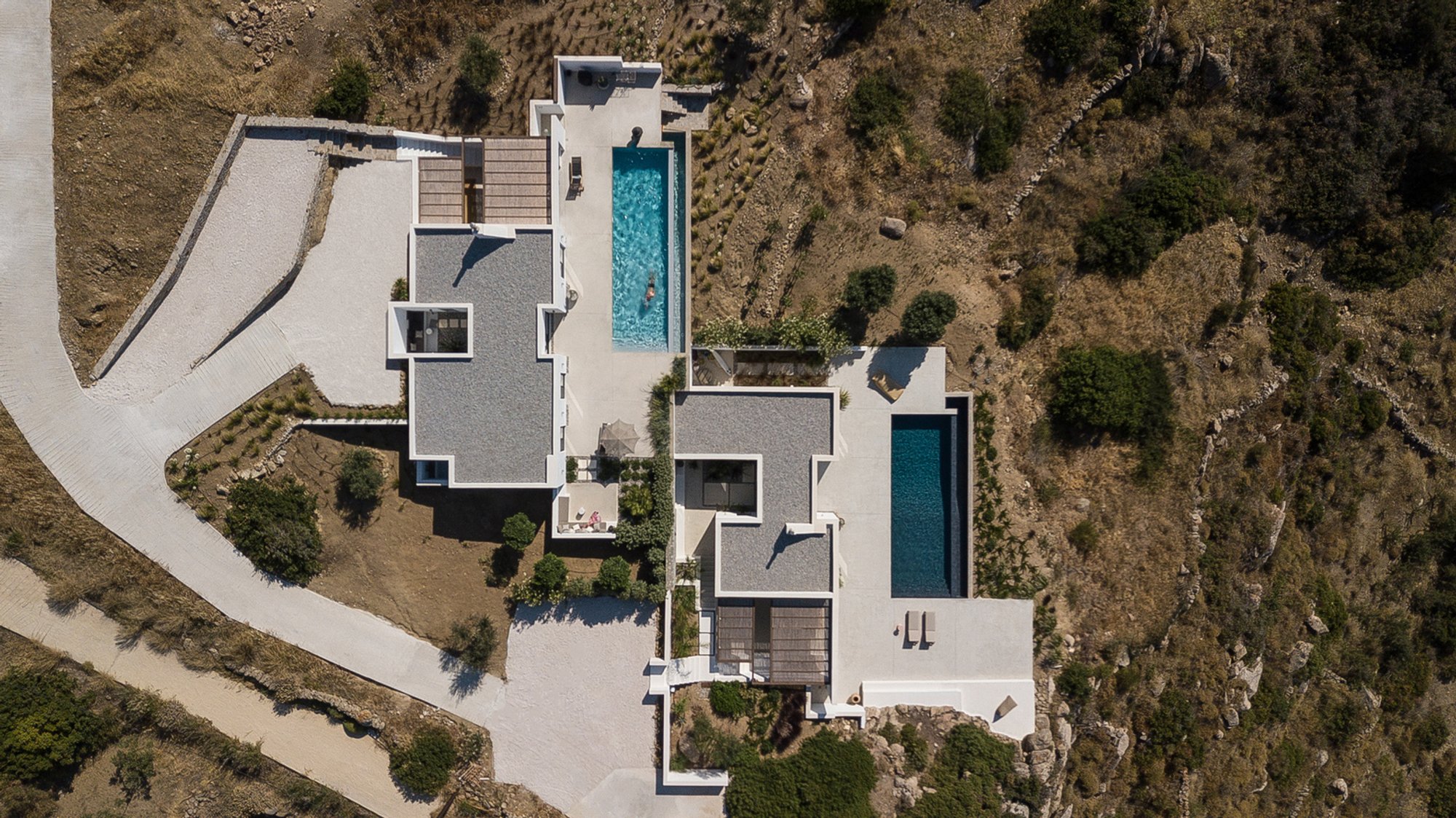
The aerial view tells the story most clearly. Two rectangular infinity pools anchor the composition while clusters of white volumes cascade down the rocky hillside, their flat roofs stepping in section like agricultural terraces. Nothing sits on a platform; everything negotiates the gradient. Private roads deliver each household to its own entrance, so the two families sharing the site never cross paths unless they choose to.
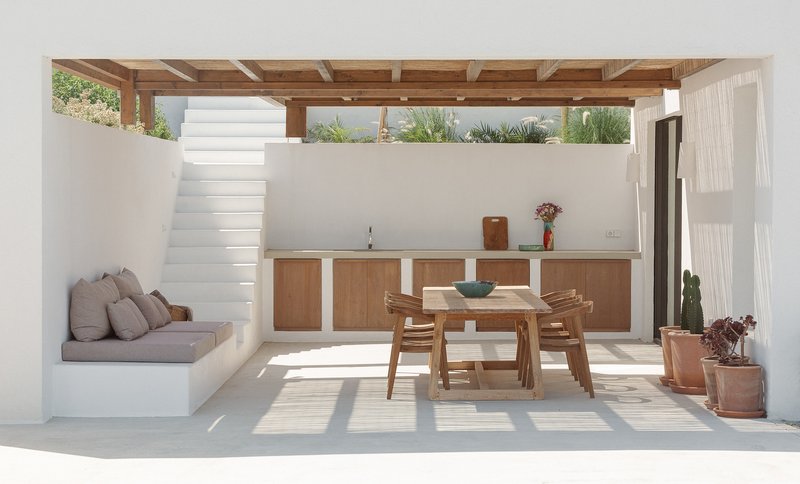
A timber pergola covers one of the principal outdoor terraces, creating a shaded zone that extends habitable space without adding enclosed volume. A staircase from this level climbs to a rooftop garden, stacking outdoor programs vertically in a compact footprint. The strategy is fundamentally Cycladic: when land is steep and sun is relentless, you build up and shade generously.
Courtyards as Climate Machines
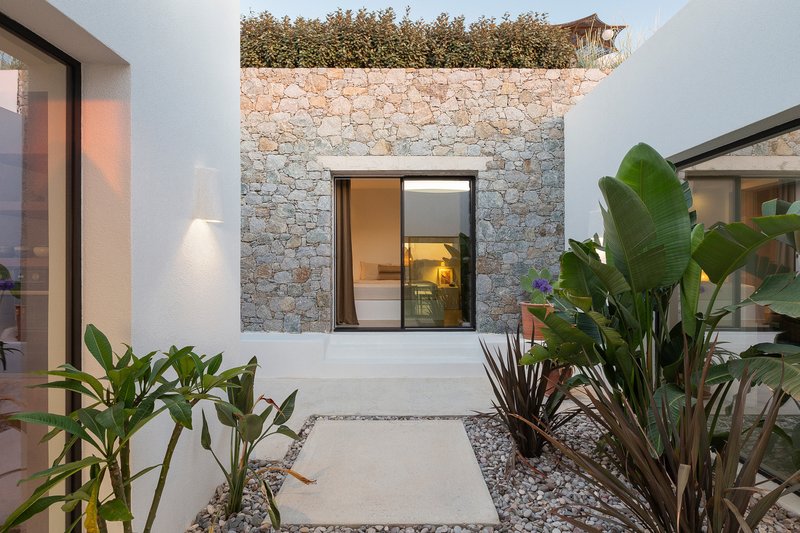
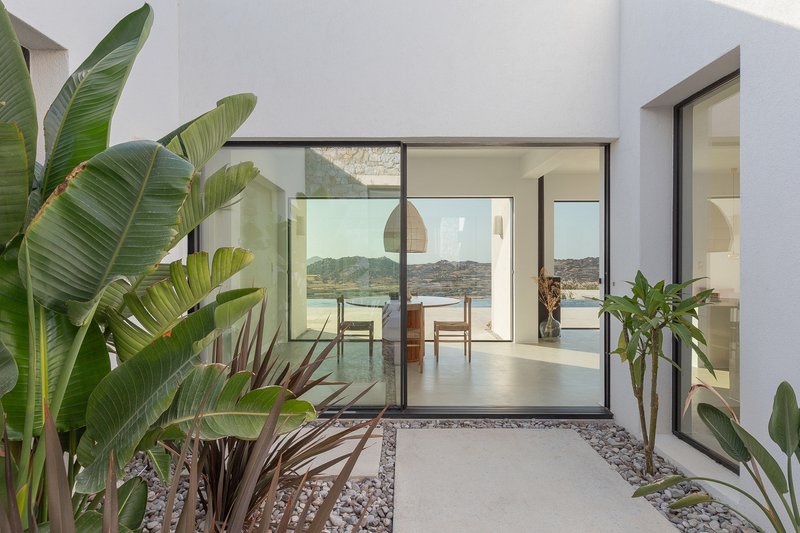
Two atriums sit at the heart of the plan, separating communal living areas from bedrooms and pulling different views of the island into the interior. One courtyard is framed by a rough stone wall with a single punched opening, its planted beds filled with banana palms and tropical foliage that soften the mineral palette. The other opens through full-height glass doors from the dining area onto a gravel terrace, blurring the line between eating inside and eating out.
These courtyards are not decorative. They channel breezes through the plan, reducing the need for mechanical cooling, and they provide visual depth in a building whose compact massing could easily feel compressed. By framing sky and vegetation rather than the distant sea, they also give occupants a sense of enclosure and intimacy that the panoramic views alone cannot deliver.
Material Restraint, Material Pleasure
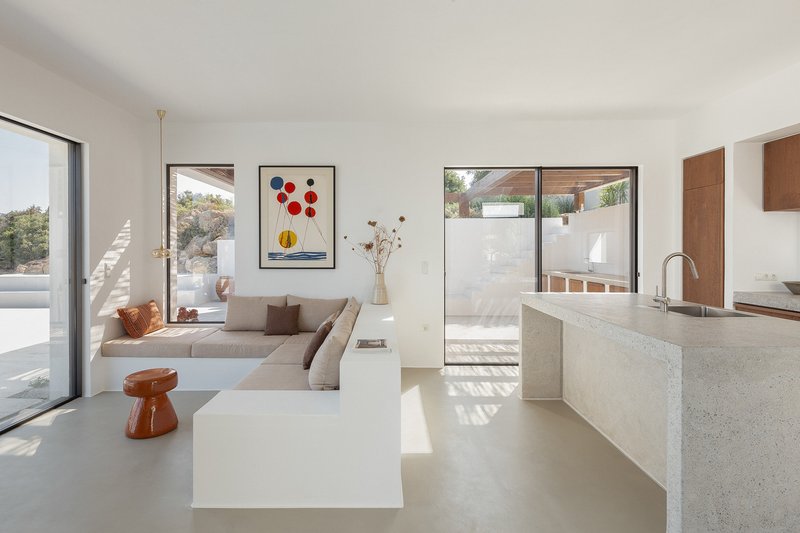
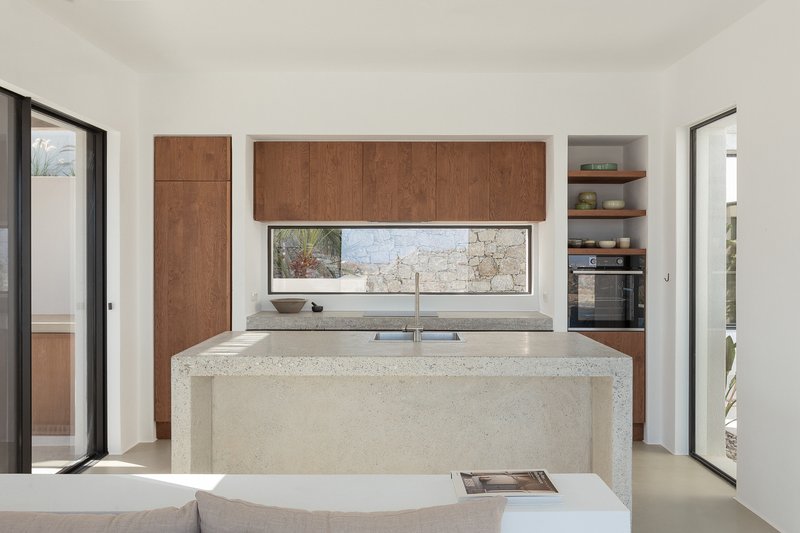
The interior palette is deliberately narrow: plaster walls, polished concrete floors, terrazzo surfaces on the kitchen island, and timber cabinetry that provides the only warm accent. The terrazzo is the star, its aggregate flecks catching light from the full-height glazing and lending the kitchen a weight that prevents the white walls from tipping into resort blandness. A horizontal strip window above the counter frames the stone courtyard wall at eye level while you cook, collapsing the distance between preparation and landscape.
Open-plan living rooms flow without corridor transitions, a move that keeps circulation area near zero and maximizes the usable footprint within the 230 m² envelope. The architects placed bedrooms at the plan's edges, each oriented to maintain visual connections with the outdoors through the courtyard voids. Privacy comes from staggered volumes, not from hallways.
Why This Project Matters
Vacation architecture in the Cyclades faces a familiar trap: mimic the village vernacular too closely and the result feels like a theme park; ignore it and the building looks stranded. Plinthos Architects and Stefania Ntinou navigate this tension by working at the level of principle rather than ornament. Clustered massing, courtyard ventilation, and a material palette drawn from the ground underfoot all derive from Cycladic building culture, yet the generous glazing, terrazzo detailing, and planted gravel beds belong firmly to the present.
La Natura Villas also demonstrates that a luxury brief does not require excess square footage. At 230 m² for the entire complex, the design achieves a sense of abundance through outdoor rooms, stacked terraces, and carefully framed views rather than through sheer volume. For anyone designing on a sloped Mediterranean site, this project offers a concise lesson: let the geology set the rules, and spend your budget on the spaces between the walls.
La Natura Villas, designed by Plinthos Architects in collaboration with Stefania Ntinou Architect. Naxos, Greece. 230 m². Completed 2024. Photography by Nikos Karampinis.
About the Studio
Share Your Own Work on uni.xyz
If projects like this are the kind of work you want to make, uni.xyz is a place to publish your own, find collaborators, and enter design competitions.




Popular Articles
Popular articles from the community

OMCM arquitectos Builds a Summer House in Paraguay from Quarry Waste Blocks and Three Sacred Trees
In the young hillside neighborhood of Altos, a 696-square-meter concrete volume hovers on six pillars around three preserved native Yvyraju trees.
Indiesalon Carves a Plywood Cave into a Seoul Bistro's Second Floor
Munhwa Bistro's second Seongsu branch wraps diners in a laminated timber vault laced with colored light and mirror illusions.
BLDUS Turns a 250-Square-Foot Screened Porch into a Pine Forest Temple in East Hampton
A gabled cedar pavilion mimics the rhythm of surrounding pines, anchoring a 1990s wooded home to its hollow in Long Island.

gru.a Builds a 70 m² Timber Shelter That Opens Like a Farm Door in Brazil's Valley of the Vines
In the mountainous region near Rio de Janeiro, a compact retreat uses plywood panels and deep eaves to blur the line between inside and out.


Similar Reads
You might also enjoy these articles

Olio Towers: A Mid-Rise for Performers That Fuses Housing, Rehearsal, and Stage
Located blocks from Houston's Theater District, this modular tower stacks living units around a central performance atrium.

Oasis: Modular Green Housing Carved into Dhaka's Urban Fabric
A shortlisted Plugin Housing entry reclaims unauthorized settlements in Dhaka with stepped concrete volumes, green roofs, and ventilation-driven design.

Black Hole: A Floating Megastructure for the Post-Physical Era
Emiliano Mazzarotto envisions a spherical, self-scaling arena where e-sports, digital hotels, and holographic stadiums replace traditional public space.
Compact & Sustainable Living in Piraeus: A Four-Level Family Home Built Around Light and Air
A narrow townhouse in one of Greece's densest port cities uses a central atrium and passive strategies to house three generations under one roof.


Explore Architecture Competitions
Discover active competitions in this discipline




The International Standard for Design Portfolios


The Global Benchmark for Architecture Dissertation Awards


The Global Benchmark for Graduation Excellence


Challenge to reimagine the Iron Throne
Comments (0)
Please login or sign up to add comments
No comments yet. Be the first to comment!