

La Secreta: Concrete and Timber on a Uruguayan Dune
Grimaldi-Nacht Arquitectos lifted a concrete house on V-columns above the dunes of Jose Ignacio, with timber screens, stone walls, and boulders in place.


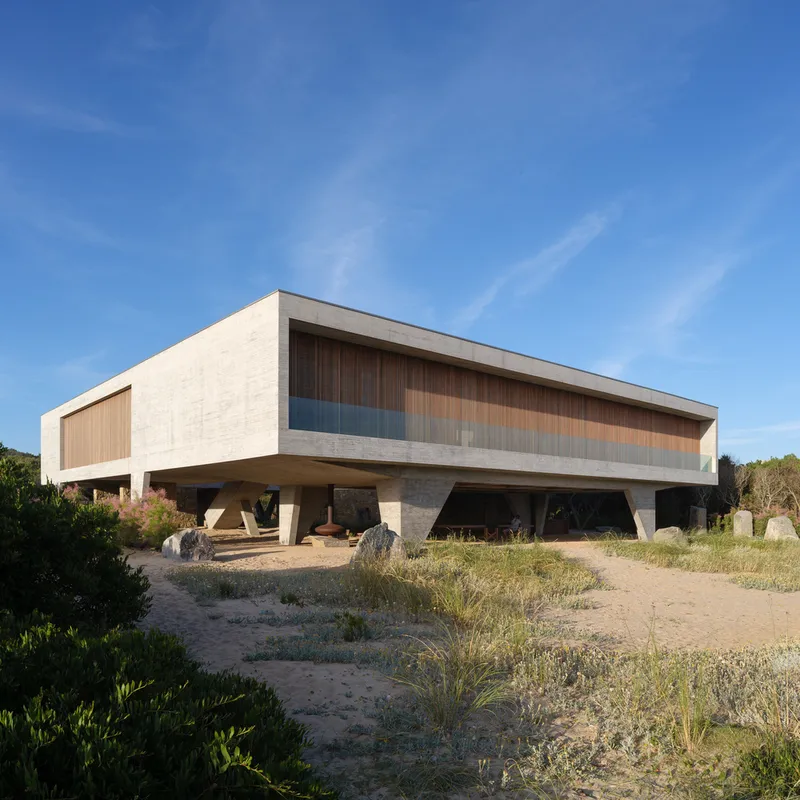
Jose Ignacio is a small coastal village on Uruguay's Atlantic shore, east of Punta del Este. The landscape is flat dunes, coastal scrub, and pine forests, with large boulders scattered across the sand. La Secreta House, designed by Grimaldi-Nacht Arquitectos, sits on a 2,500-square-metre plot between a three-metre-high dune cordon and the road. The house is a concrete box lifted on V-columns above the dune, with a timber louvre screen wrapping the upper volume and a dry-stone wall anchoring it to the ground. It is a house that hovers over its site rather than sitting on it.
The strategy is two levels with two different relationships to the landscape. The ground floor is open, shaded, and embedded in the dune: an outdoor living area under the concrete soffit with a fireplace, boulders left in place, and sandy ground. The upper floor is enclosed, private, and elevated: bedrooms, living spaces, and a pool courtyard with views over the dunes to the sea. The materials are three: exposed concrete, timber, and local stone.
The Site and the Dune
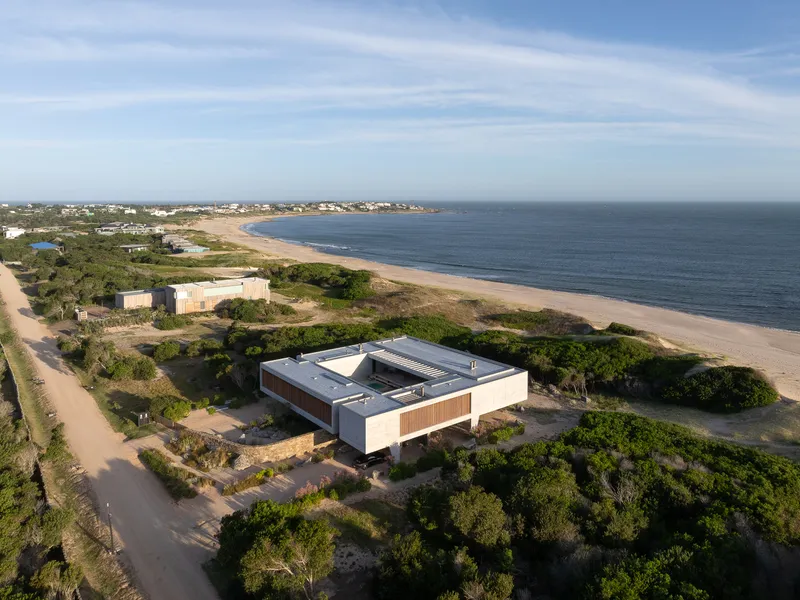
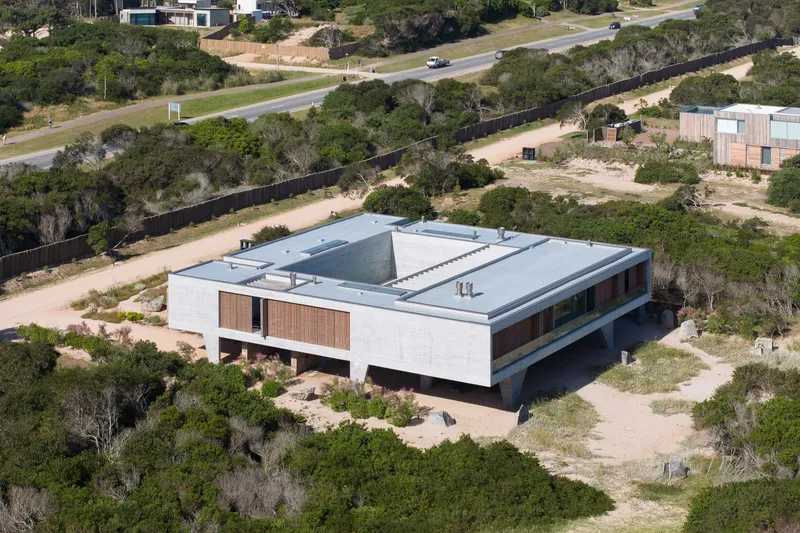
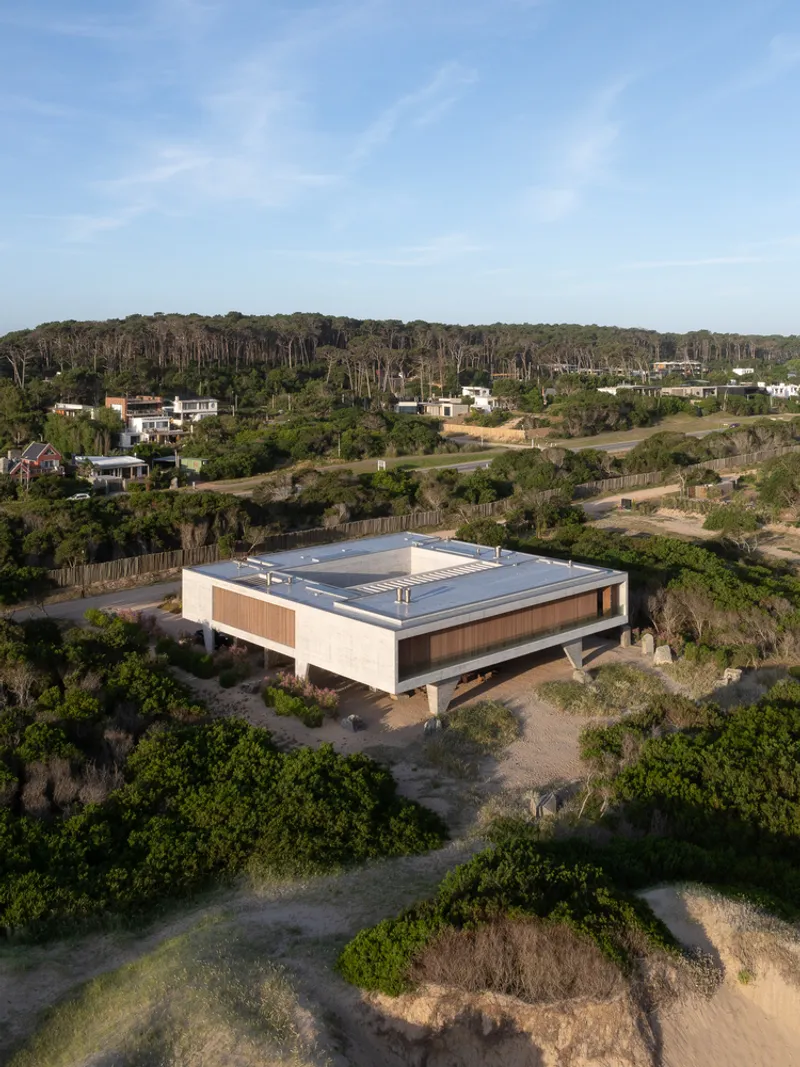
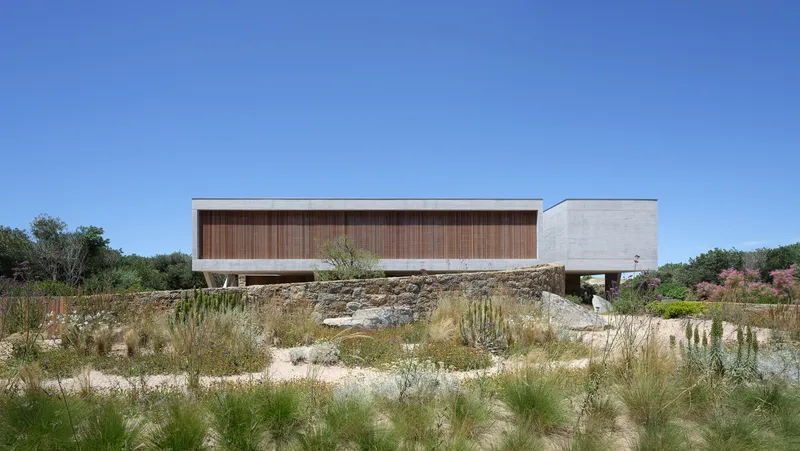
The aerial photographs show the house's position: a concrete rectangle placed between the dune cordon and the coastal forest, with the road and neighbouring houses to the north. The flat roof and the timber screen give the house a horizontal profile that sits below the treeline. From the beach side, the house reads as a bar of concrete and timber resting on the dune. From the road side, it is almost invisible behind the vegetation.
The Concrete Volume and the V-Columns
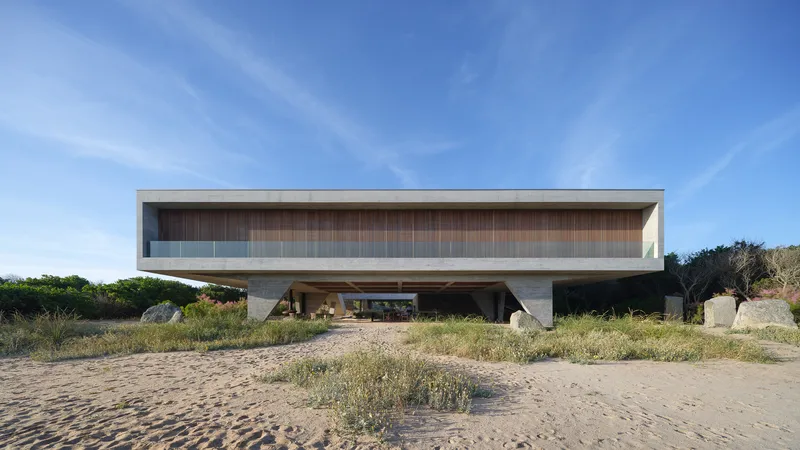
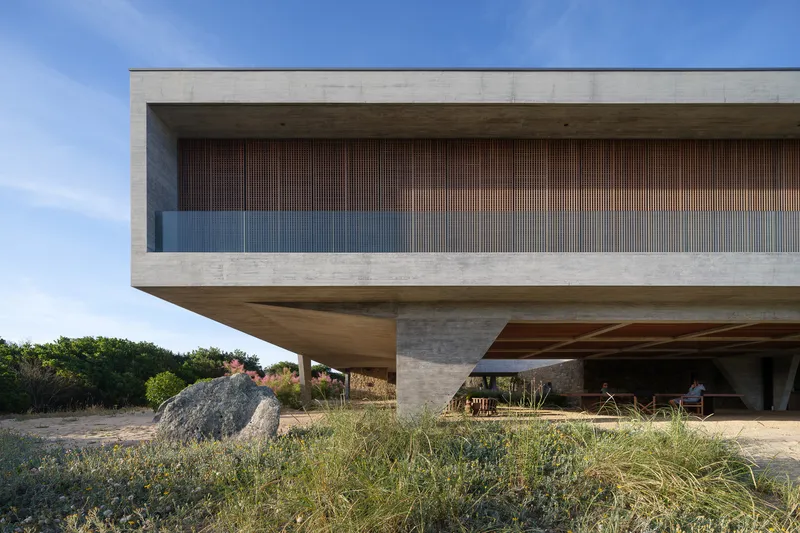
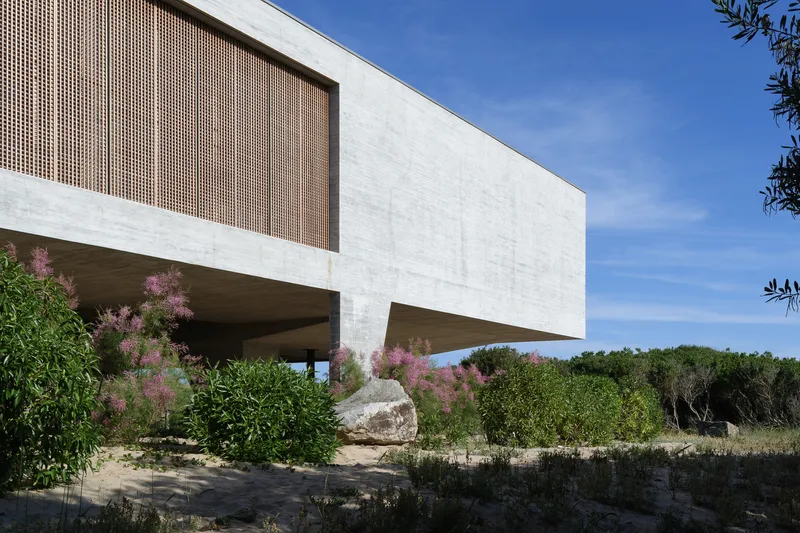
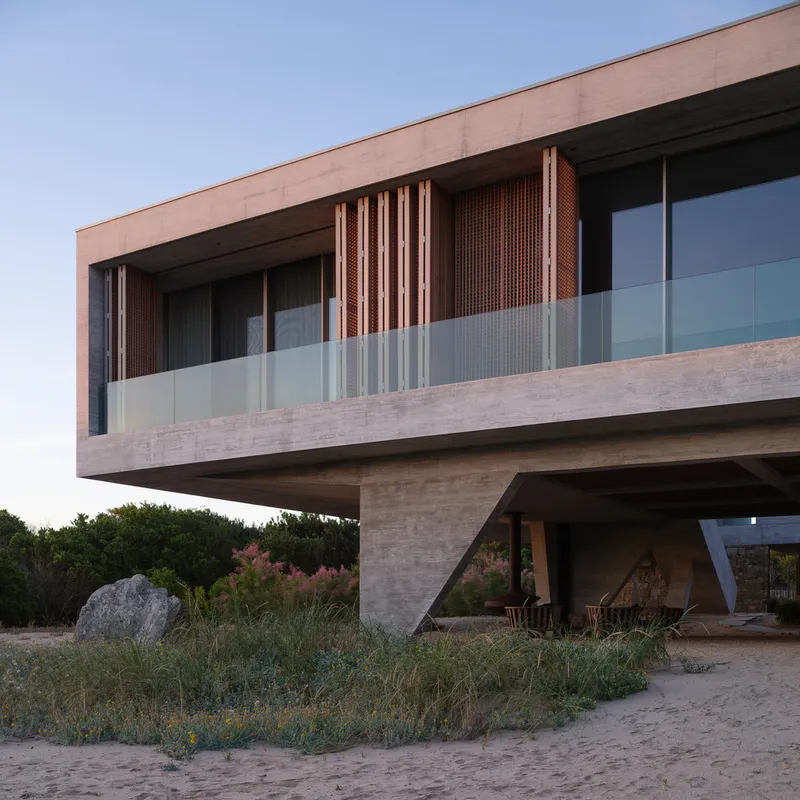
The upper volume is a cantilevered concrete box with a timber louvre screen on the beach-facing facade. It is lifted above the ground on tapered V-columns that touch down lightly on the sand. The cantilever is generous: the house extends well beyond its supports, creating a deep shaded zone beneath. Large boulders that were on the site before construction remain in place under the building and around its perimeter. The concrete is board-formed with a rough, honest texture.
The Entry and the Stone Wall
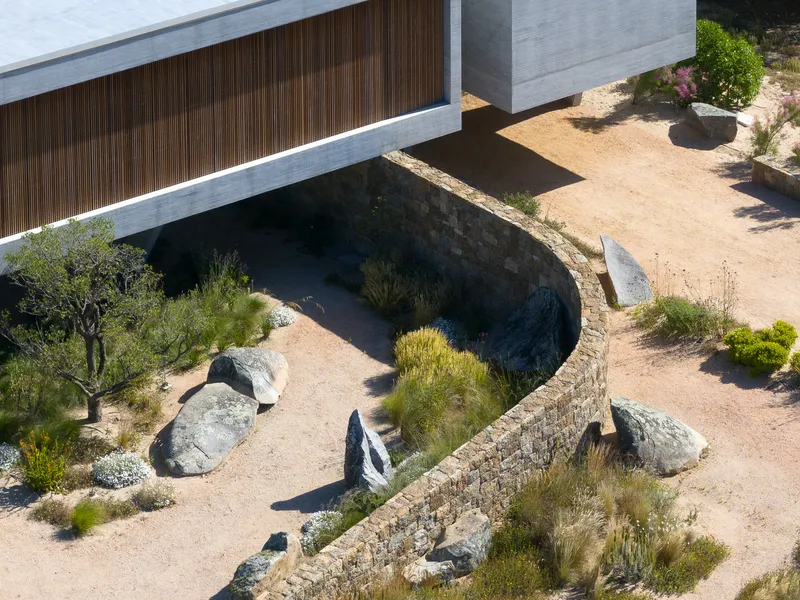
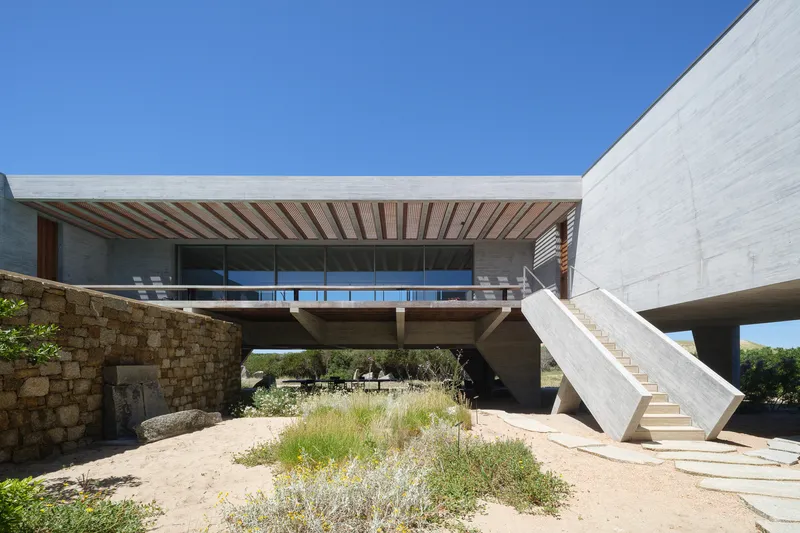
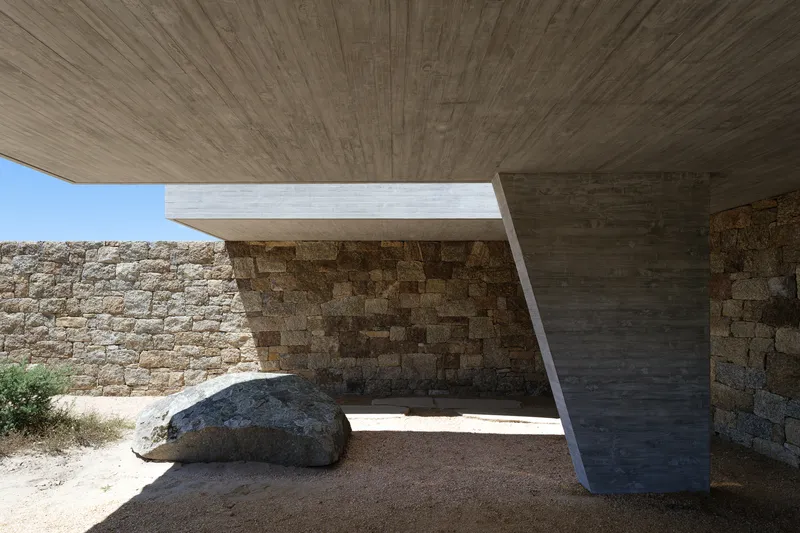
The approach is from the road side, guided by a curved dry-stone wall that leads visitors around boulders and native planting toward the courtyard. The wall is built from local stone, rough and uncoursed, and it curves beneath the cantilevered upper volume to define the entry sequence. The transition from the open dune landscape to the sheltered courtyard is gradual and deliberate. The stone wall is the oldest-looking element in the project, grounding the concrete and timber in the texture of the site.
The Pool Courtyard
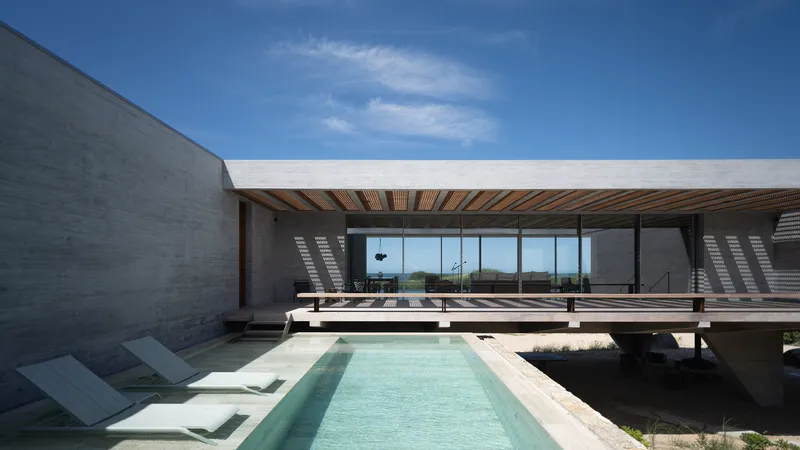
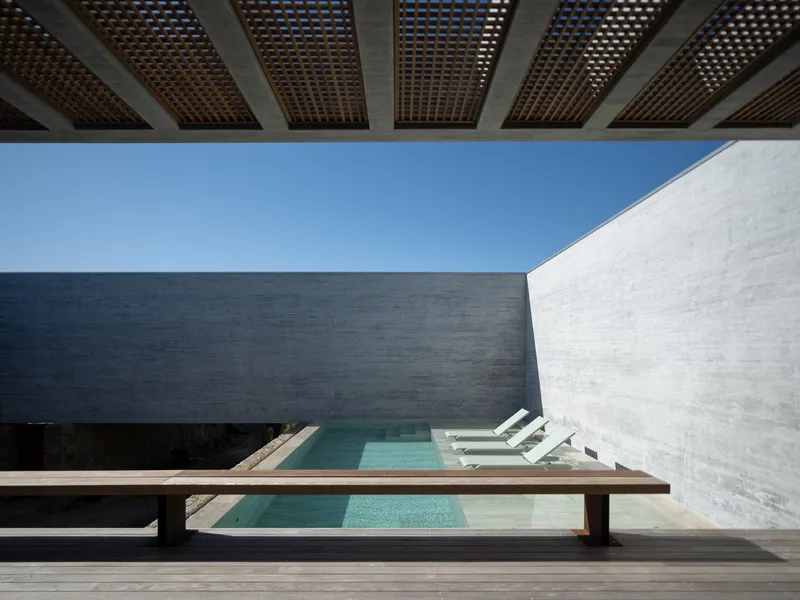
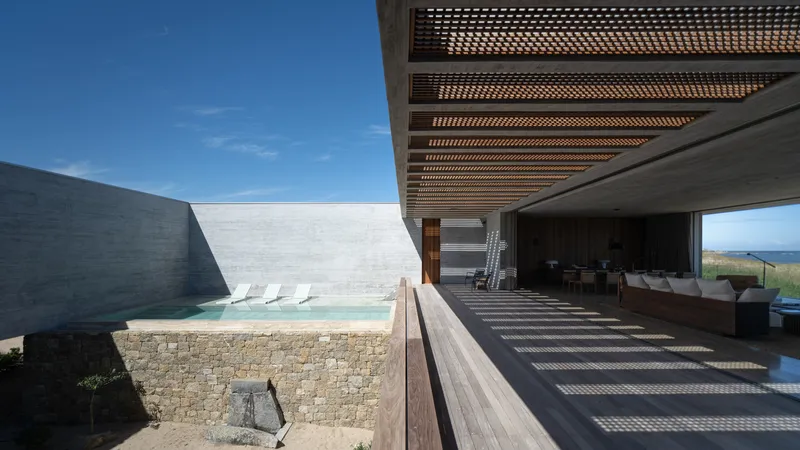
The pool courtyard is enclosed on three sides by high concrete and stone walls, with a timber pergola overhead. The turquoise plunge pool sits between the walls. White loungers line the edge. The pergola casts striped shadows across the deck and the water. The fourth side opens to the dunes and the sea. This is the most protected space in the house: shielded from wind, shaded from sun, and entirely private.
The Upper Floor: Timber, Concrete, and Views
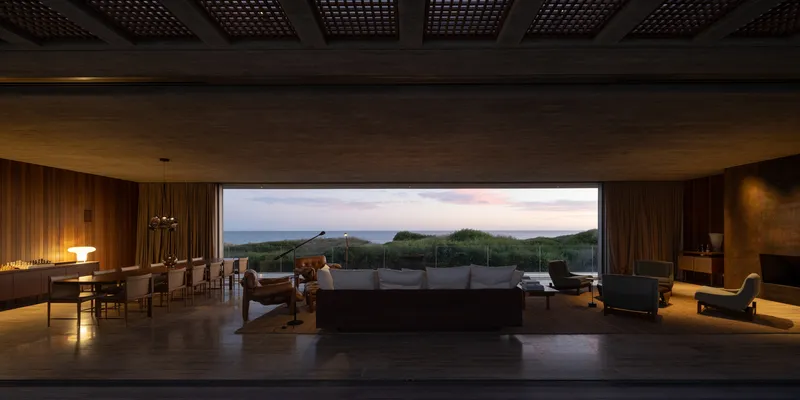
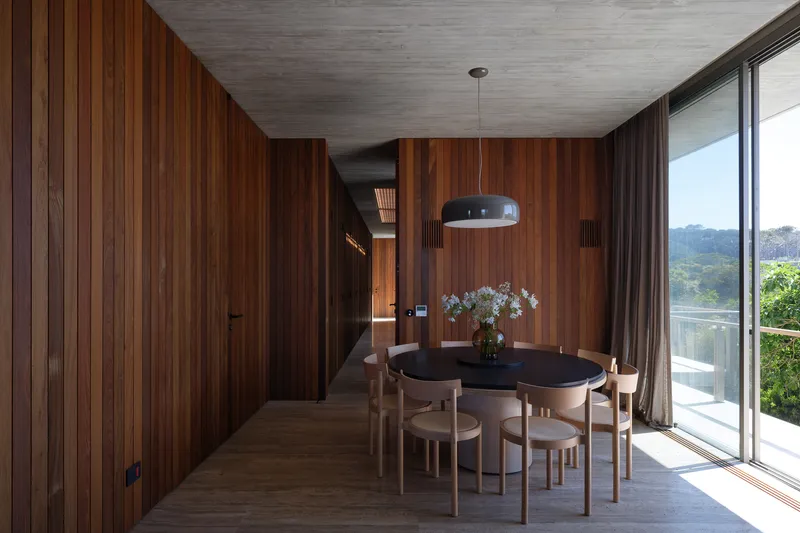
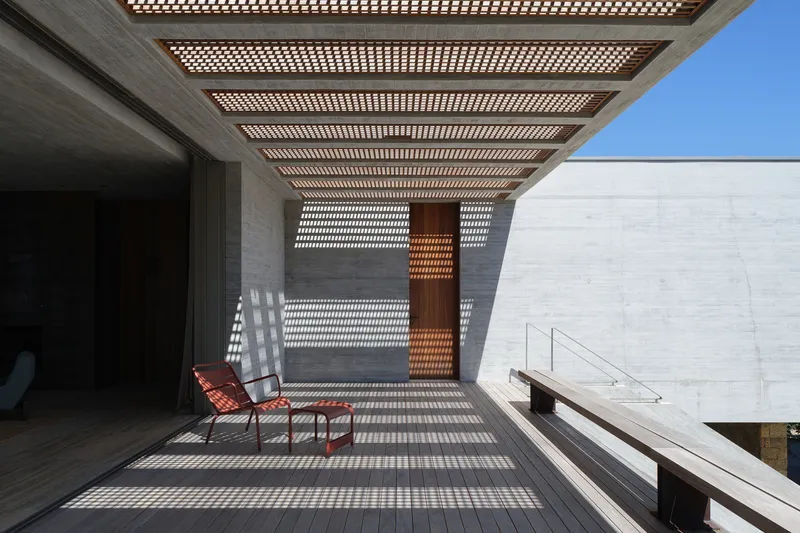
The upper-floor interiors are lined in dark timber: walls, ceilings, and coffered panels. The concrete structure is left exposed where it meets the timber. The living room has a full-width opening that frames the dunes and the sea as a single panoramic landscape. The dining room has a round table beside a floor-to-ceiling window. The terraces have timber lattice pergolas that cast striped shadows on the concrete floor.
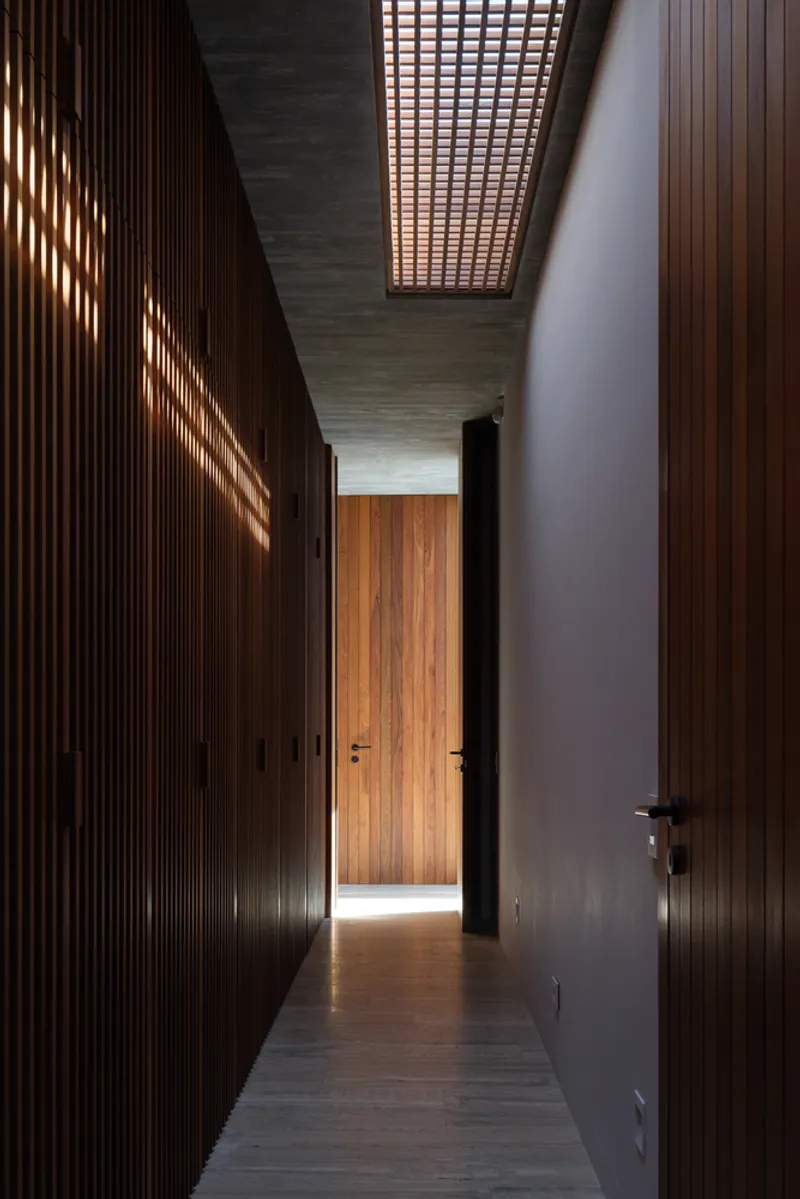
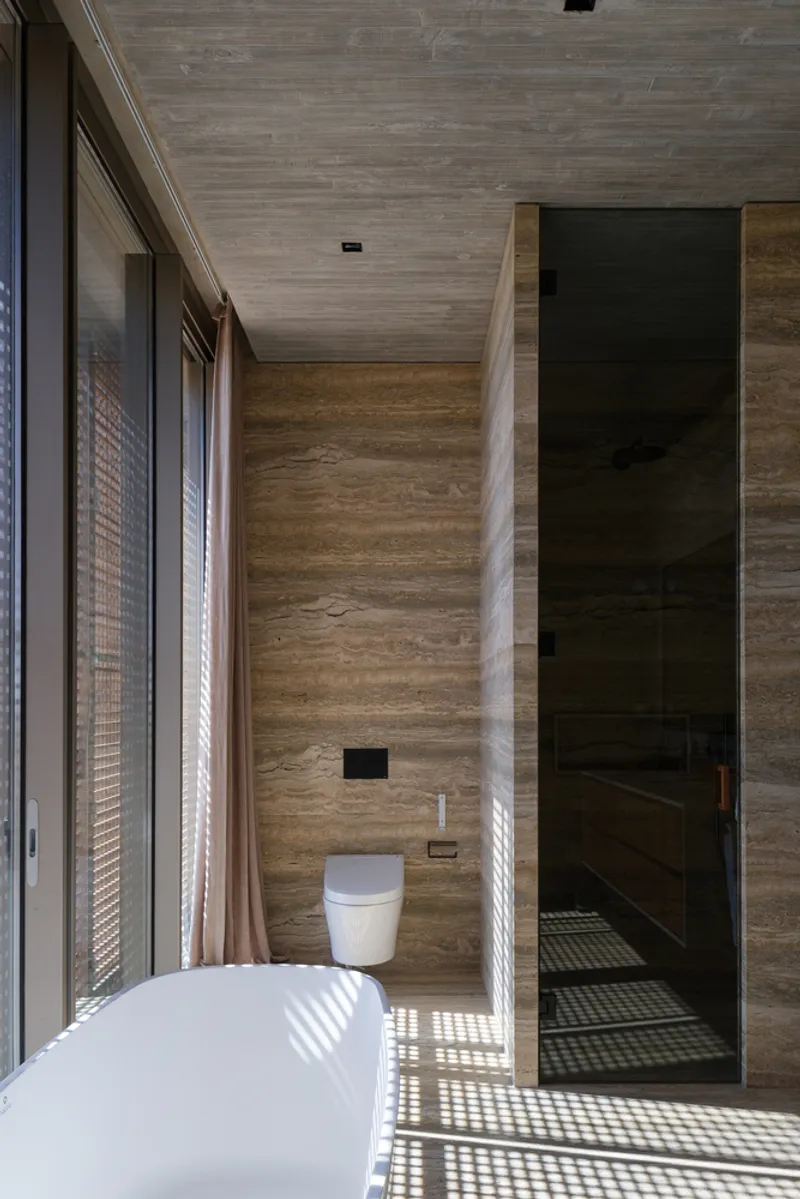
The corridor is a dark timber passage with a lattice ceiling that filters daylight from above. The bathroom has timber walls, a freestanding tub, and a lattice screen casting light patterns on the dark stone floor. Every interior space uses the contrast between dark timber and light concrete to create depth and warmth.
The Ground Level: Sand, Boulders, and Fireplace

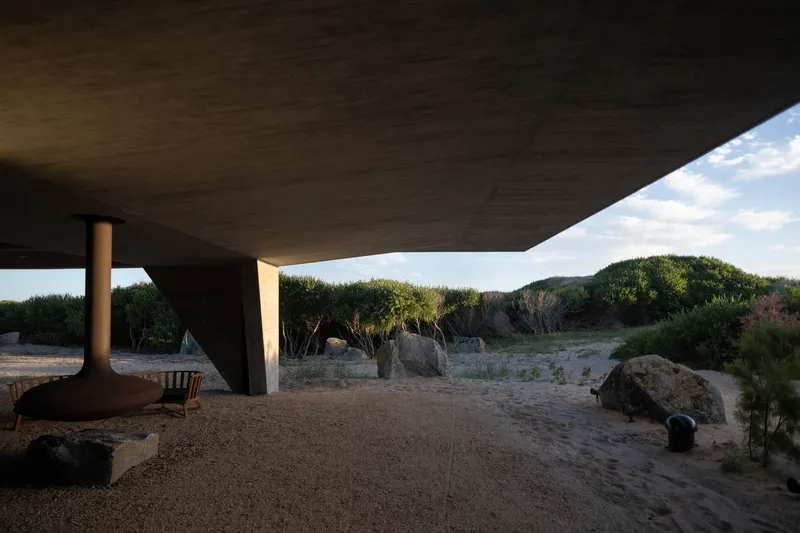
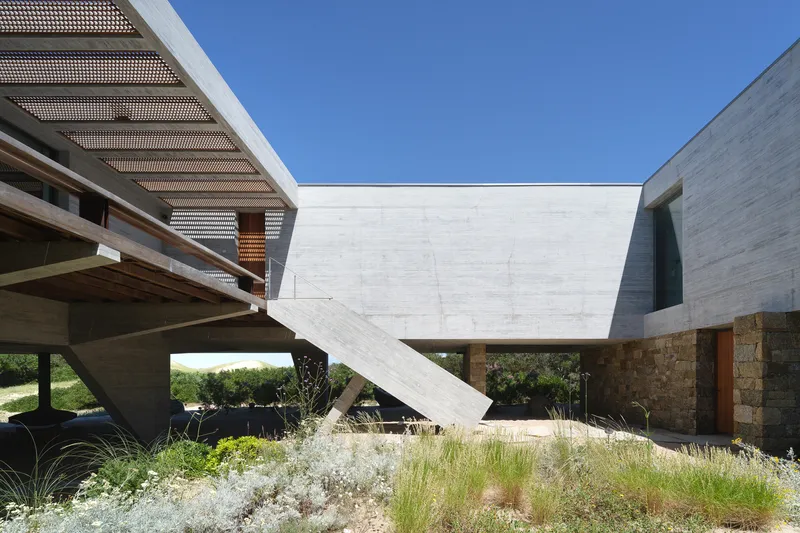
The ground level is not a conventional floor. It is the dune itself: sandy ground, stepping stones, boulders, and a freestanding outdoor fireplace under the concrete soffit. The V-columns and the beams create a shaded pavilion that is open on all sides. This is the social space for summer evenings: a fire, the sand, the sound of the sea, and the weight of the concrete above. The landscape passes through the building at ground level without interruption.
Why This Project Matters
Coastal houses in Uruguay and southern Brazil have become a laboratory for concrete and timber architecture over the last two decades, and La Secreta is one of the best recent examples. The V-columns, the cantilever, and the stone wall are not decorative gestures. They solve specific problems: lifting the house above flood-prone dunes, shading the ground level from the Atlantic sun, and anchoring a lightweight-looking structure in a windswept landscape. The boulders left in place are a statement of intent: the house adapts to the site, not the other way around.
If you are designing a coastal house, a house on a dune, or any building that needs to hover above its landscape, this project is worth studying for how concrete, timber, and stone can produce both monumentality and lightness.
About the Studio
Share Your Own Work on uni.xyz
If you are working on coastal residential architecture, concrete construction, or landscape-sensitive design, uni.xyz is a place to publish your work and connect with a global design community.
Project credits: La Secreta House by Grimaldi-Nacht Arquitectos. Faro de Jose Ignacio, Uruguay. Photographs: Javier Agustin Rojas.




Popular Articles
Popular articles from the community

EW PARK: Sustainable Architecture Reimagines the Future of Urban Parking
EW PARK reimagines city parking as a modular wooden tower combining automation, solar energy, electric mobility, and adaptable urban design.

Co-life: Sustainable Architecture for Age-Friendly Community Living
Co-life reimagines sustainable architecture for seniors through courtyards, rammed earth, shared gardens, and spaces designed for belonging.

AL-JANNAH: Sustainable Architecture and Permaculture for Afghan Widows
AL-JANNAH uses sustainable architecture and permaculture to create resilient oasis of housing, learning, work and renewal for Afghan widows.

Co-Life: Senior Housing Design That Reconnects Older Adults With the City
Co-Life reimagines senior housing design through healing gardens, shared streets, workshops, and a sustainable community across generations.


Similar Reads
You might also enjoy these articles


Hodi-Mandai Geram
Project Function: Preservation and revitalization of the Intangible heritage and socio-spatial identity of the Hodi by Housing, Cultural Memory Center, Sacred Grove, landscape, local tourism economy


Olio Towers: A Mid-Rise for Performers That Fuses Housing, Rehearsal, and Stage
Located blocks from Houston's Theater District, this modular tower stacks living units around a central performance atrium.

Oasis: Modular Green Housing Carved into Dhaka's Urban Fabric
A shortlisted Plugin Housing entry reclaims unauthorized settlements in Dhaka with stepped concrete volumes, green roofs, and ventilation-driven design.

Black Hole: A Floating Megastructure for the Post-Physical Era
Emiliano Mazzarotto envisions a spherical, self-scaling arena where e-sports, digital hotels, and holographic stadiums replace traditional public space.


Explore Architecture Competitions
Discover active competitions in this discipline



Challenge to reimagine the Iron Throne


Photograph architecture without architects


Illustrate the lost glory of Angkor Wat - Render Challenge


Design challenge to reuse E-waste
Comments (0)
Please login or sign up to add comments
No comments yet. Be the first to comment!