

LACUNA
Live Work and Play

Humans have been living in communities where they have born or have means of existence. However, we are getting isolated every day. Everybody has small group of friends and families, mostly feeling alone in this crowd. While we were already getting isolated because of the life standards, now there is a reason that me must be isolated; pandemic… While we are trying to adapt this situation, cities grow by developing the same typology and repeated infrastructures. It is becoming harder to find an isolated space and we must find place to breath in this conditions. Cities need to breath. We must have opportunity to be isolated, but also there should be reason to socializing; otherwise people would become more depressed and aggressive because of loneliness. So, there are two main concepts behind this design. How can be isolated while reducing the social anxiety and preserve the idea of community? What kind of spaces should be designed while letting the cities breath? We designed a complex that is against to the density of the city, which has gaps and green spaces. That’s why we called this complex as Lacuna which means “an unfilled space; a gap.”. Every space act like a module in the grid and there are gaps between the groups of modules which makes the complex spacious. Ground level covered with social activities integrated with the plants and trees. With the opening inside of the complex, we aimed to continue the green space around the site. Ground coverage is less than half of the site area with high density of green spaces. This is a complex that can be a meeting point for the local people where they can live, work and play. We used the “live” elements as an integrative design element that connects “work” and “play”. Play areas are arranged outside and inside of the building that are adaptive to weather conditions. The amphitheater in the courtyard may be closed and turned in to ice-skating place in the winter. There are also co-living areas that are merged into the living areas. “Play” modules and spaces are plugged in to the design homogeneously, on the other hand “work” modules are arranged as massive spaces since they need more privacy. So that, working people socialize and create a small community inside. There are four types of accommodation modules: s, m, l, xl with multiple options according to the areas and the ceilings height preferences. S, m and l modules arranged as groups with a rhythm in itself that can be observed from the façade meanwhile xl modules are separated. Although we wanted to create a community, we also believe that every community need subgroups. Every group has its own circulation, and every subgroup has terrace garden to be socialized with small amount group of people. This allows people to enjoy the atmosphere and the fresh air from outside while socializing. You cannot control the public spaces in the ground level, however by the level differences and accessibilities we aimed to control the number of crowds. Especially because of the pandemic we are trying to get our social life with small groups in the fresh air. It is good to have an open-air option near our apartments. Besides the grid’s solid restrictions because of its form, the programs are fused into each other and open plans making the spaces open for every possibility. There are co-living areas and the retractable commercial area that can be used according to the needs. Co-living are small places that repeats themselves vertically. It can serve every floor for basic needs or for the emergency situations. On the other hand, retractable commercial area is on the ground floor with a huge open space. It can be turned into pop up stores, offices, seminar rooms or health center by fallowing the main structure of the building with light panels. There are bridges which act more than a circulation element. Since, they are intersection points, there can be activities such as exhibitions or group activities. To sum up, this a complex with lots of parameters that considers the human psychology and sociology of the community. It is the harmony of unfilled spaces.


Popular Articles
Popular articles from the community

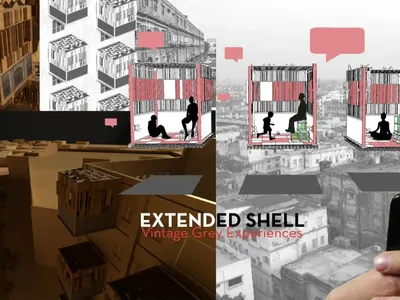
Extended Shell: Retrofitting Kolkata's Balconies as Living Urban Thresholds
A modular retrofit system recovers the social and environmental intelligence of Kolkata's historic verandas for contemporary Park Street residents.
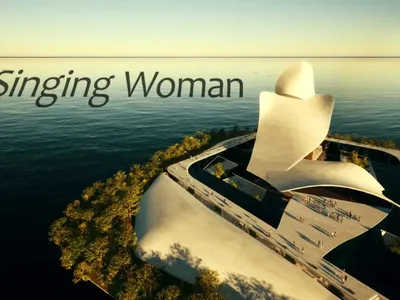
Singing Woman: An Opera House That Performs Before the Curtain Rises
Ovidiu Cristian Pavel's conceptual opera house translates Estonia's choral identity into a sculpted waterfront landmark facing the Baltic Sea.
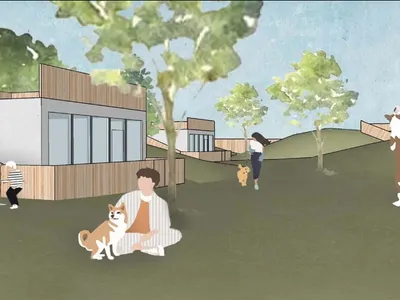
Temporary Home for Dogs: A Reversed Zoo Rethinks Animal Shelter Architecture
In Bucharest, a sinuous corridor and freed landscape flip the logic of containment, designing a shelter that works to make itself unnecessary.
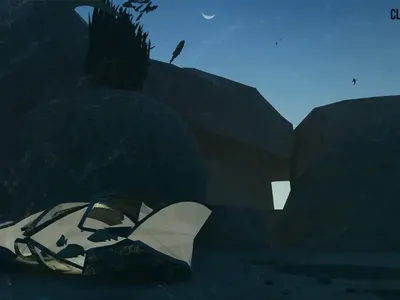
Cloaked Colonization: A Mobile Underwater Habitat That Moves Like a Fish
Micah Abaya's shortlisted EHC Pacific entry reimagines ocean settlement as a dispersed network of self-sustaining architectural organisms.

Similar Reads
You might also enjoy these articles

Shakur's House: Exposed Brick as an Interior Organiser in a 168 m² Mashhad Residence
Brick moves indoors in this Mashhad residence, where masonry walls, glass partitions and teal planes sequence a compact home without closing it off.
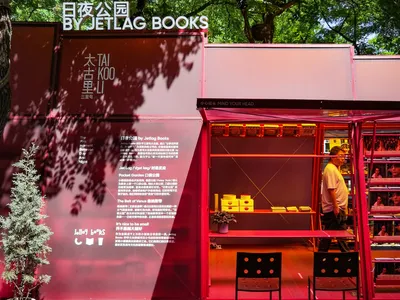
Day and Night Park: A Time-Based Urban Newsstand in Beijing
A temporary urban newsstand in Beijing blending travel, light, and reading through poetic colors, compact form, and community-focused design.

Modernist Patio Renovation in El Masnou, Barcelona by Oliver Segura Arquitectura + Cebrià Arquitectura
Modernist patio renovation blending tradition and innovation with a movable pool, leveled floors, and Catalan materials in El Masnou.
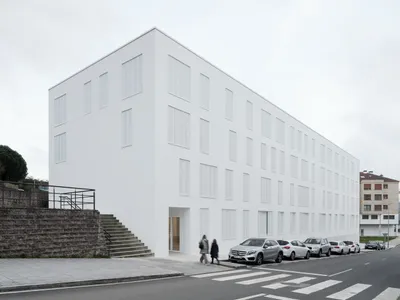
Alto Residencial Coop: Cooperative Housing Development in Santiago de Compostela by Carbajo Barrios Arquitectos
A linear cooperative housing complex blending white volumes and perforated metal façades, enhancing community living, natural light, privacy, and urban integration.

Explore Live-Work-Play Competitions
Discover active competitions in this discipline


Challenge to design locus for the upliftment of human rights

Design challenge to reuse E-waste
Comments (0)
Please login or sign up to add comments
No comments yet. Be the first to comment!