
Lagood
Colonizing the lagoon

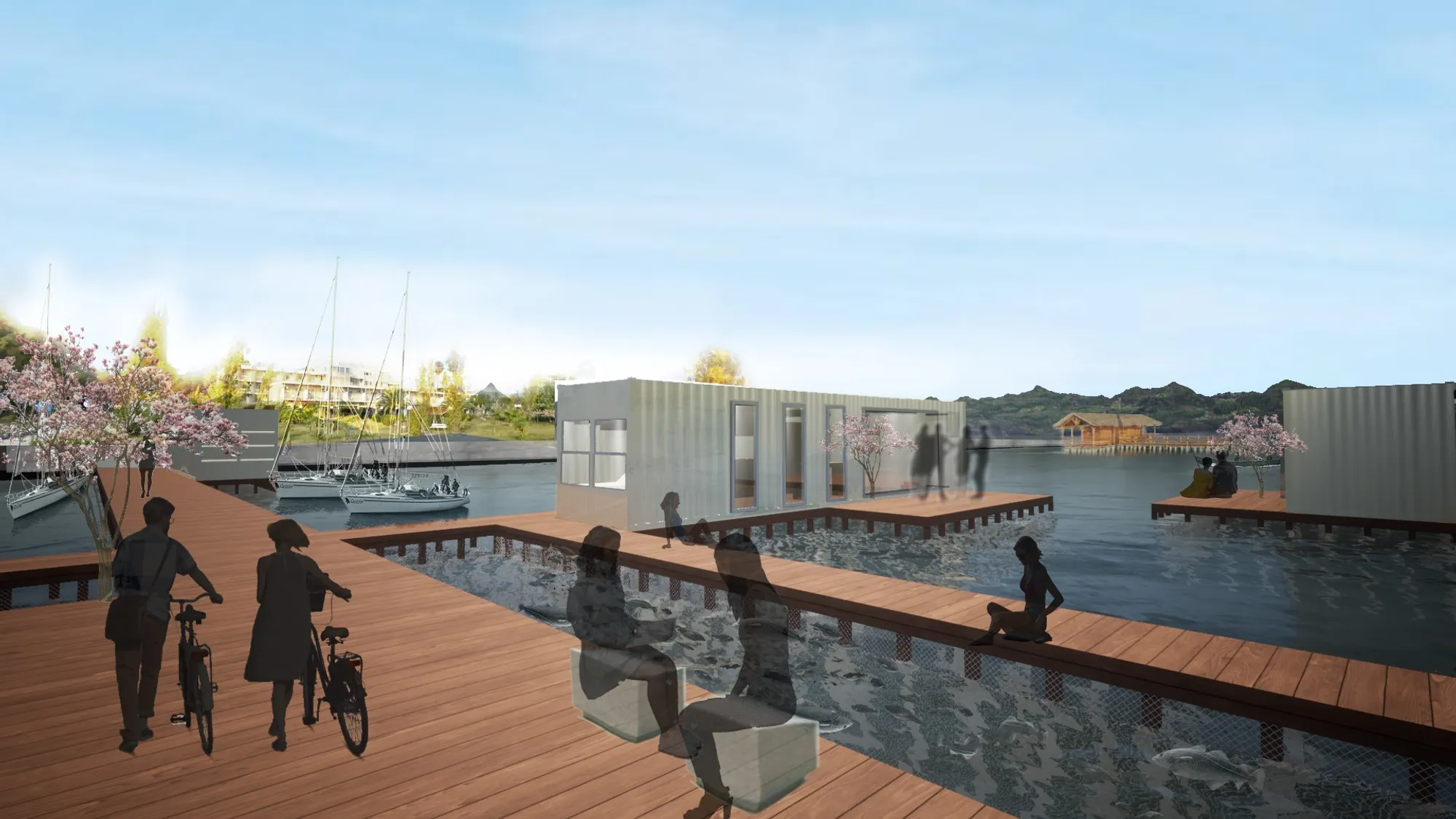
Our project for the competition will serve students attending the department of aquaculture and fisheries of the university of Patras, located at the city of Missolonghi Greece. Specifically, student housing complex will be placed at a natura protected lagoon in the broader area of Missolonghi. Due to the low depth of the lagoon. Due to the low depth of the lagoon, local fishermen used to build houses, supported on piles in this swallow water basin, which were called ‘Pellades’, the morphological features of which have become a landmark for this area. Being inspired by the uniqueness of the traditional lagoon houses in Missolonghi, we propose student housing units that preserve some of their features. By placing the student housing containers inside the lagoon, and over the shallow water, students will have the opportunity to observe the under-water life of the lagoon, farm fish in its warm water, and conduct research on various species typical of this aquatic environment.
The containers placed over the shallow water, supported by a system of timber piers, similar to that encountered in the traditional Pelladas housing, will create an island for hosting a community of students who share the same interests.
The housing complex will be placed in close proximity to a long roadway inside the lagoon that provides direct access to the Turlida island , a well-known beach resort, and the city of Missolonghi, where the university campus is located the student complex will be composed of a ) a set of 14 containers each one of which will serve as a student housing unit , and b) a container, along the pier that connects to the seashore, to be used as info-point but also for community services such as laundry, and for linen, tool and equipment storage.
Τhe housing units will be arranged in groups of two and will be placed around a central deck a long pear will be also created, that will function as a promenade that connects the island to the beach, it will also provide space for boats to moor. Smaller piers will connect the housing units to one another while in the center of the housing complex the spatial organization of the piers will permit the creations of small scale pools around the central deck, that can be used for fish farming and observation either independently or by connecting it with the other container. Each container serves as a housing unit for one student. Each housing unit is accessible from the central deck, has its own private deck with an unobstructed view to the sea.
The organization of the containers is in sets of two placed parallel to each other in a mirror arrangement of their floor plan, allows for the connection of the two units at their entry area. The reconfigurable entry walls of the units at their entry area give the option to the users to connect the living areas of the two units and to create a large multivalent common space between the two units that allows at the same time a transverse movement between the two private decks. This unified large space can facilitate student collaboration, but can also serve as a leisure or party space. In addition the placement of the containers in groups of two will increase the speed of the mild air breezes in the area in the circulation space between the two containers and will cool it during the summer.
In each container, wet spaces, furnishings and furniture, are all placed on one of the two long walls of the container, specifically a wall that faces the corridor between the two units that are placed next to each other. The furniture is also modular, can be easily stored to free most of the space when needed. It consists mostly of boxes that can be used either as sitting or for storage purposes.
The project tries to be as ecofriendly as possible and to combine quality of living and low-cost construction. The piers and the decks will be constructed from oak wood that is resistant to humidity. The containers will be supported by both metal and wooden piles. The exterior surfaces of the containers will be constructed of insulated metal panels and glass panes in their openings. In the interior all furnishings and furniture will be constructed of tinted wood panels. In the wet areas will be used ceramic tiles.
If there is a demand for more student housing, this typical island structure can be repeated as needed inside the lagoon in several locations.
We hope that by placing the containers in the Missolonghi lagoon, we will offer the Aquaculture and Fisheries Department student community an opportunity to live in this unique natural setting, and at the same time, it will encourage them to get acquainted and explore its aquatic environment.


Popular Articles
Popular articles from the community


Co-life: Sustainable Architecture for Age-Friendly Community Living
Co-life reimagines sustainable architecture for seniors through courtyards, rammed earth, shared gardens, and spaces designed for belonging.

Co-Life: Senior Housing Design That Reconnects Older Adults With the City
Co-Life reimagines senior housing design through healing gardens, shared streets, workshops, and a sustainable community across generations.

Riyadh For All: Intergenerational Urban Design for Active Aging in Rabat
Riyadh For All reimagines urban design in Rabat with intergenerational co-living, adaptive courtyards, and Moroccan cultural exchange today.

The Ocean Hive: Sustainable Architecture for a Self-Sufficient Civilization at Sea
The Ocean Hive imagines sustainable architecture at sea, where modular habitats, algae, wave power and ocean waste sustain a growing colony.


Similar Reads
You might also enjoy these articles

Day and Night Park: A Time-Based Urban Newsstand in Beijing
A temporary urban newsstand in Beijing blending travel, light, and reading through poetic colors, compact form, and community-focused design.

Modernist Patio Renovation in El Masnou, Barcelona by Oliver Segura Arquitectura + Cebrià Arquitectura
Modernist patio renovation blending tradition and innovation with a movable pool, leveled floors, and Catalan materials in El Masnou.

Alto Residencial Coop: Cooperative Housing Development in Santiago de Compostela by Carbajo Barrios Arquitectos
A linear cooperative housing complex blending white volumes and perforated metal façades, enhancing community living, natural light, privacy, and urban integration.
Vil Genis School by BPA ARCHITECTURE – Massy, France
Vil Genis School in Massy, France, features sustainable design, south-facing classrooms, community integration, accessible spaces, and modern educational architecture.


Explore Seaside Architecture Competitions
Discover active competitions in this discipline




Challenge to reimagine the Iron Throne


Photograph architecture without architects


Illustrate the lost glory of Angkor Wat - Render Challenge


Design challenge to reuse E-waste
Comments (0)
Please login or sign up to add comments
No comments yet. Be the first to comment!