
Lahdelma & Mahlamäki Build a Shtetl from Memory in the Lithuanian Countryside
A cluster of 40,000 aluminum-shingled roofs in Šeduva reimagines a Jewish village erased overnight in 1941.


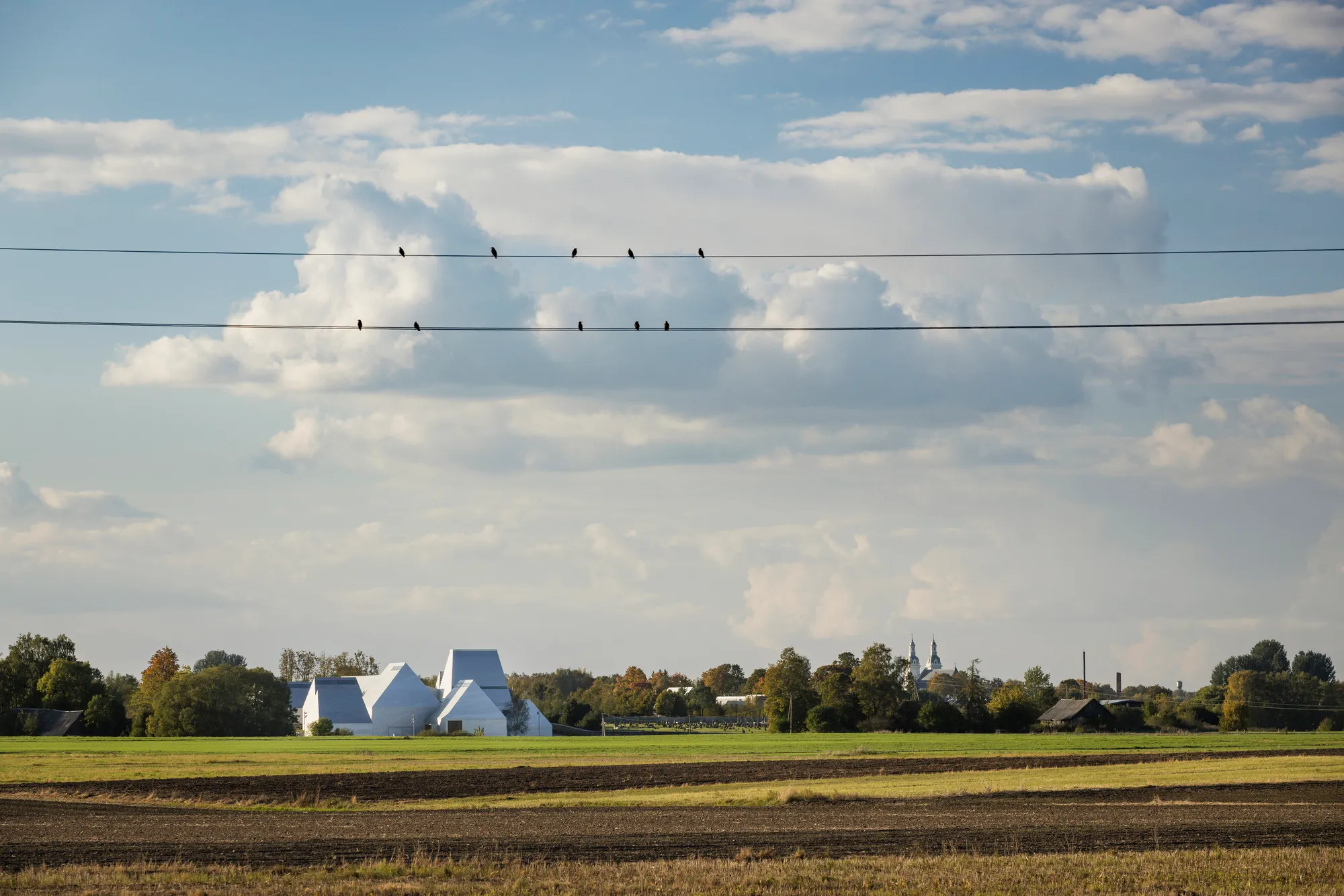
In August 1941, the Jewish village of Šeduva vanished. Its people, its synagogues, its streets, its routines: all destroyed in a matter of days during the Holocaust. Eight decades later, a museum has risen on the gentle slope in front of the town's surviving cemetery, not as a replica of what was lost, but as a kind of architectural hallucination of it. Designed by Finnish practice Lahdelma & Mahlamäki Architects, The Lost Shtetl Jewish Museum is a 4,900 square meter complex of minimalist hip-roofed volumes clad in 40,000 anodized aluminum shingles. From a distance, it reads like an entire townscape. Up close, it is a precisely calibrated sequence of galleries, libraries, and memorial spaces that move from daylight to darkness and back again.
What makes the project genuinely compelling is the way it refuses the conventions of both memorial architecture and museum design. It is not a single monolithic gesture. It is not a void or a scar in the landscape. Instead, it is additive, almost domestic in scale, with each volume roughly the size of a single-family house. The roofs point in different directions with varying pitches, producing a deliberate sculptural randomness that evokes the organic growth of a real village. The aluminum shingles, cut and layered to recall the wooden shingles of rural Lithuanian buildings, will weather over time. The museum is designed to age, to stay, and to change.
A Village That Never Was


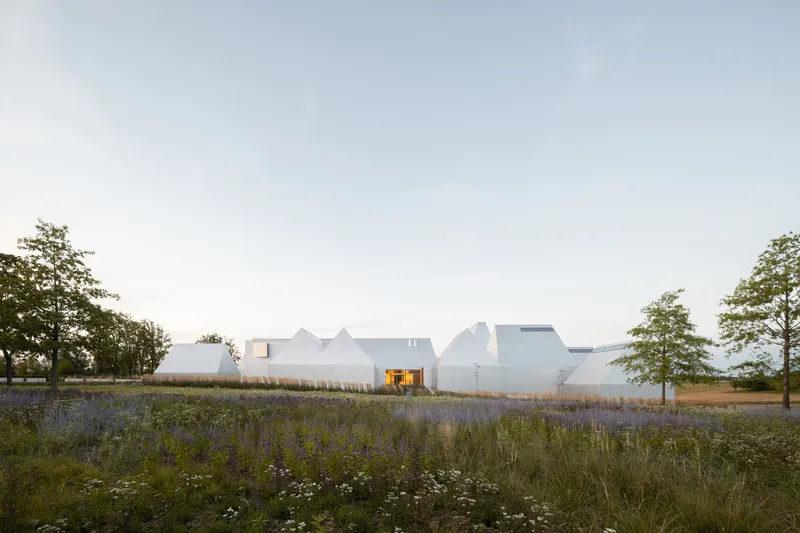
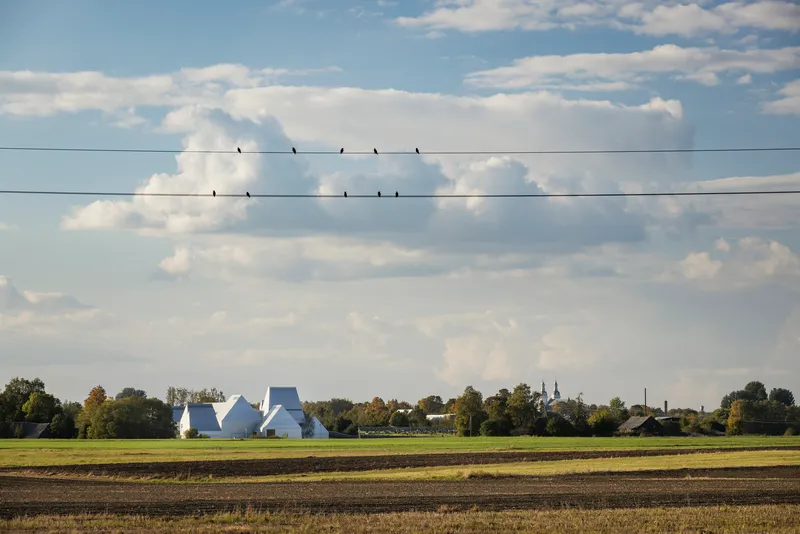
Seen from the air, the museum's silhouette is unmistakable: a cluster of peaked roofs and a longer linear wing stretching across open fields, bordered by autumn trees and the old burial ground. The composition is not accidental. The synagogue roof silhouette sits at the center, the tallest form in the group, and the surrounding volumes radiate outward with the looseness of a settlement rather than the rigidity of an institution. Rainer Mahlamäki's design takes the modest scale of Lithuanian farmhouses as its baseline, then abstracts it. There are no gables or porches, no historicist details. The white aluminum surfaces glow against ploughed earth and purple wildflowers, luminous and slightly alien.
The composition was also designed to expand. Before the museum was even completed, a new exhibition gallery was added without disrupting the original arrangement. That built-in adaptability is unusual for a memorial building. It suggests an institution that plans to grow its programming rather than freeze its architecture in a single commemorative gesture.
Materiality as Memory


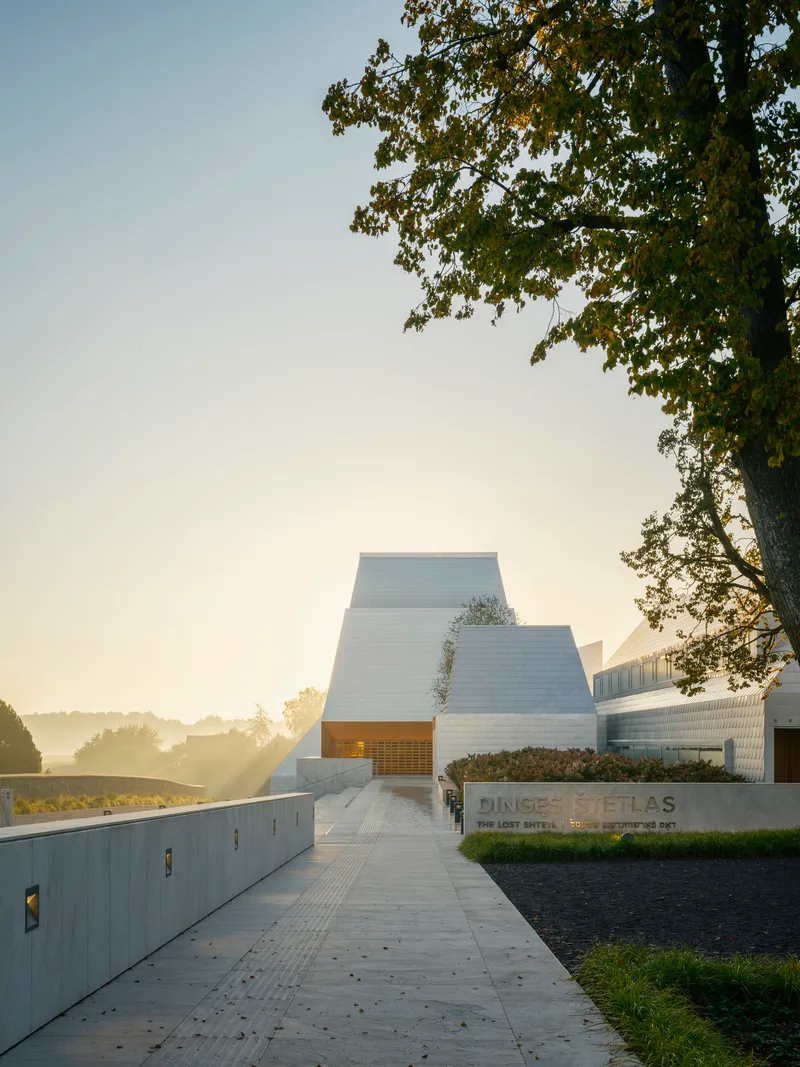
The marine aluminum cladding is the single most consequential material decision in the project. Cut and layered to mimic the rhythm of wooden shingles, the 40,000 pieces establish a visual dialogue with the weathered barns and farmhouses that dot the Lithuanian countryside. The choice is both referential and forward-looking: aluminum is durable, recyclable, and easy to repair. It will grey over time, much as the larch timber shelters in the surrounding memorial park will gradually silver. The architects have explicitly stated that every material was selected to "withstand the test of time," and the building reads as though it means to outlast its own century.
Beneath the shingles, the entire structure is cast-in-place reinforced concrete, a requirement of Lithuanian public construction legislation. Concreting some of the steeper roofs was reportedly a significant challenge, which is easy to believe when you see the angles involved. Light quartzite stone surfaces the floors and some walls, paired with oak, creating interiors that feel solid without feeling heavy.
Descent into the Narrative


The spatial sequence of the museum is organized around a descent. Visitors enter at ground level into a lobby conceived as a living room, then move downward into exhibition galleries located below the entrance floor, taking advantage of the site's gentle slope. The galleries operate on a black box principle, but the interior architecture never forgets the hip-roof forms above: each gallery's ceiling mirrors the peaked shape of its corresponding volume. Skylights cut along the roof ridges introduce controlled natural light, keeping the spaces from feeling entirely sealed off from the world outside.
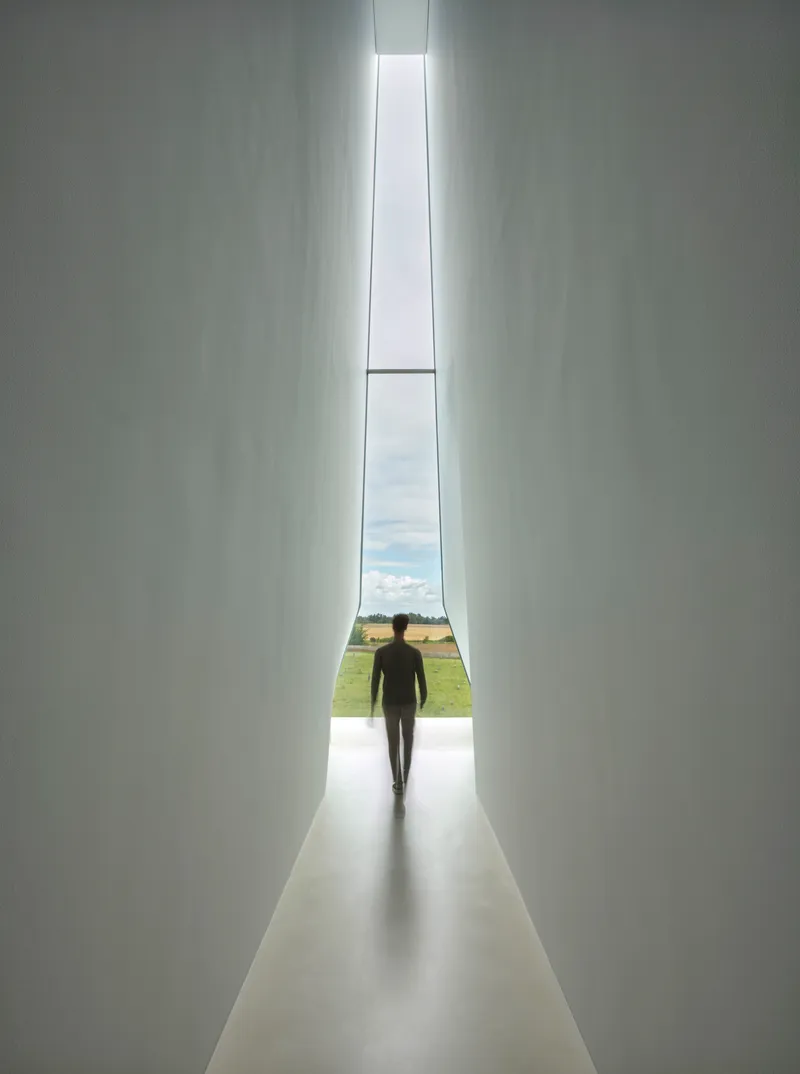
The emotional climax comes in the lower level, where visitors pass through the Canyon of Holocaust, a narrow, tall, dark space, before emerging into the Canyon of Hope, a tall white volume oriented toward the cemetery and the open fields beyond. It is a blunt spatial contrast, and deliberately so. The tall vertical window slot that frames a single figure walking toward the countryside is one of the most affecting moments in the building: a view of the land that survived when the people did not.
Light, Glass, and the Threshold


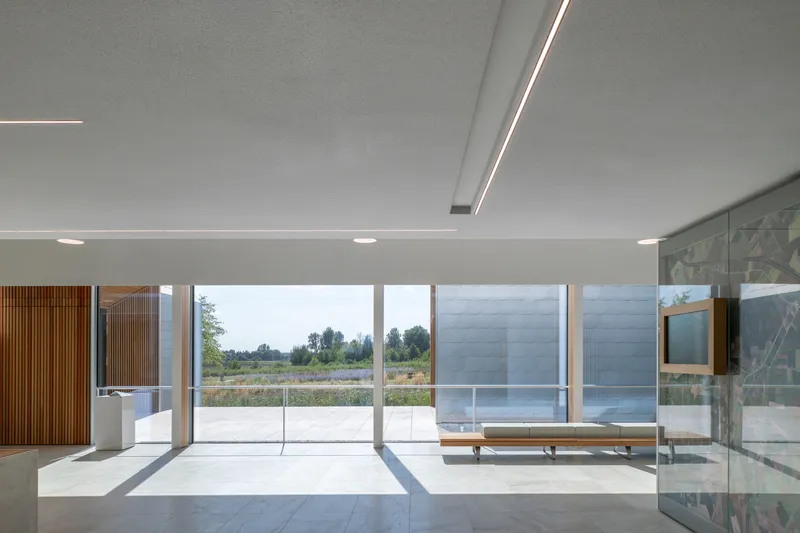
The entrance sequence deserves attention on its own terms. At dusk, the covered entry reveals a wall of illuminated amber glass blocks, mouth-blown pieces set into a wooden grid, glowing warmly beneath a timber ceiling. It is the most overtly expressive moment on the exterior, a threshold that signals transition from the open park into the interior world of the museum. Inside, vertical wood slat walls filter sunlight in the reading and educational spaces, while floor-to-ceiling glazing in the upper galleries offers carefully composed views of the surrounding landscape.
The interplay of concrete, timber, and light is handled with real restraint. Board-formed concrete stairs with illuminated treads sit next to curved timber walls with arched openings, and the junctions between materials feel considered rather than decorative. There is a monastic quietness to these spaces that suits their purpose.
Landscape as Ritual

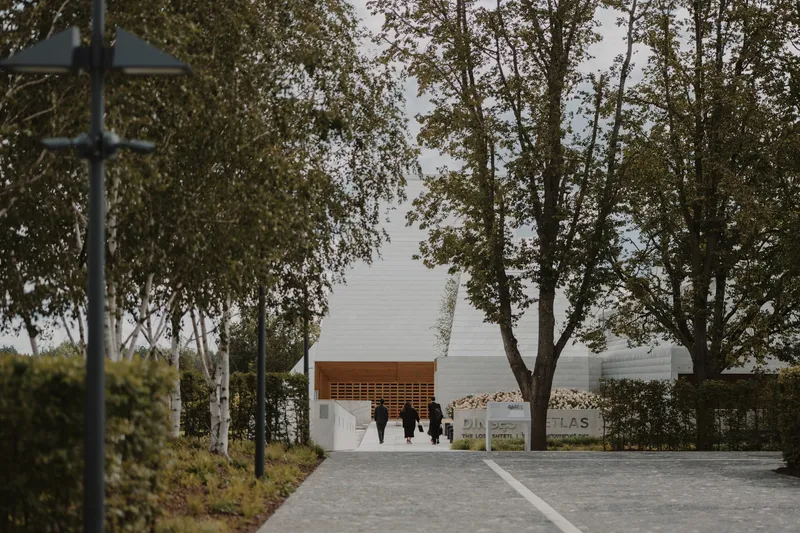
The memorial park, designed by Enea Landscape Architecture, is as integral to the project as the building itself. Old trees were preserved and many new ones planted, conceived as carbon dioxide reservoirs as well as spatial elements. Birch alleys, meadows, wetlands, and orchards recall the paths once walked by the village's inhabitants, a landscape of evocation rather than reconstruction. A pyramidal shingled structure reflected in a pond among flowering grasses adds a contemplative marker to the park. After construction, the site reportedly saw a resurgence of butterflies, bumblebees, and insects, a small ecological recovery that adds an unscripted layer of meaning.
Approaching the museum through the park, visitors move under timber canopies and through planted groves before the white volumes appear above the treeline. The journey from car park to entrance is paced to slow people down, to prepare them for what they are about to encounter. Larch shelters along the way will grey over time, becoming part of the landscape rather than standing apart from it.
Plans and Drawings
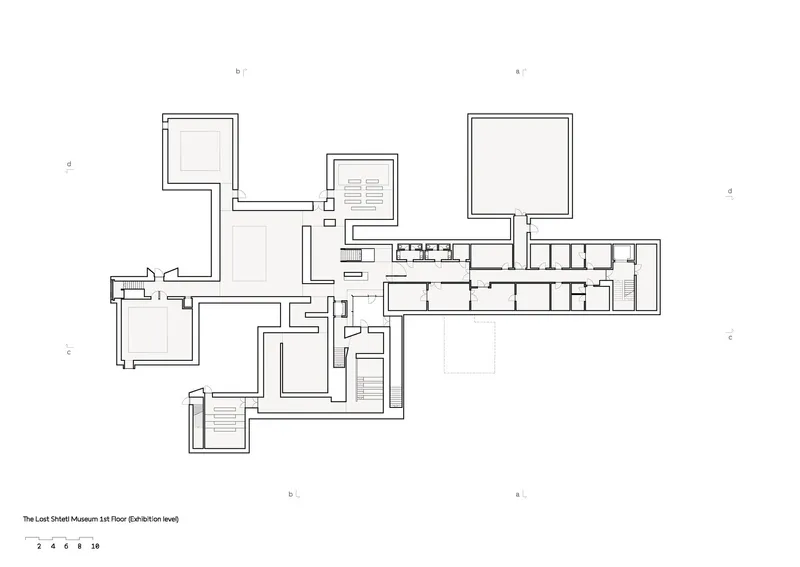
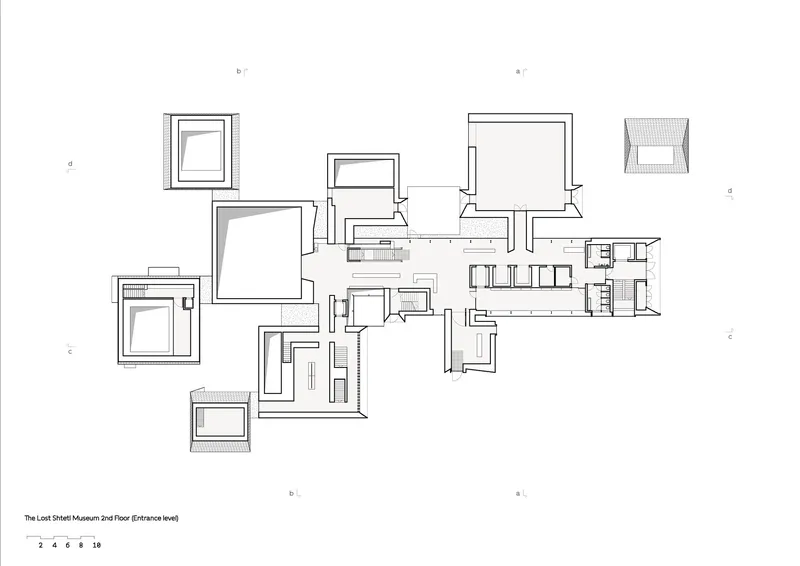
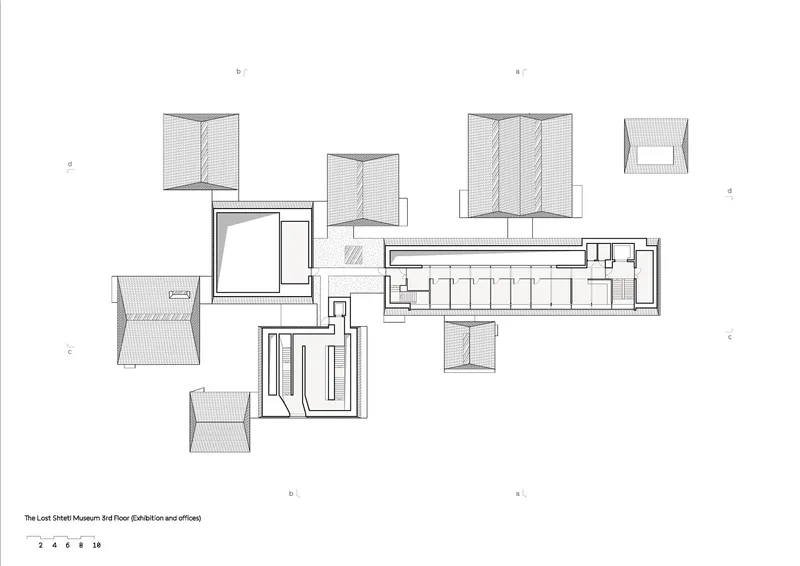
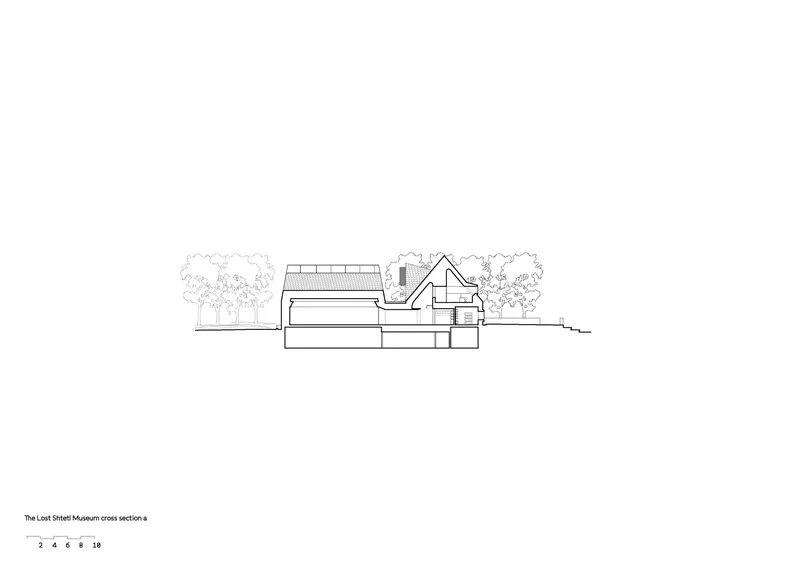

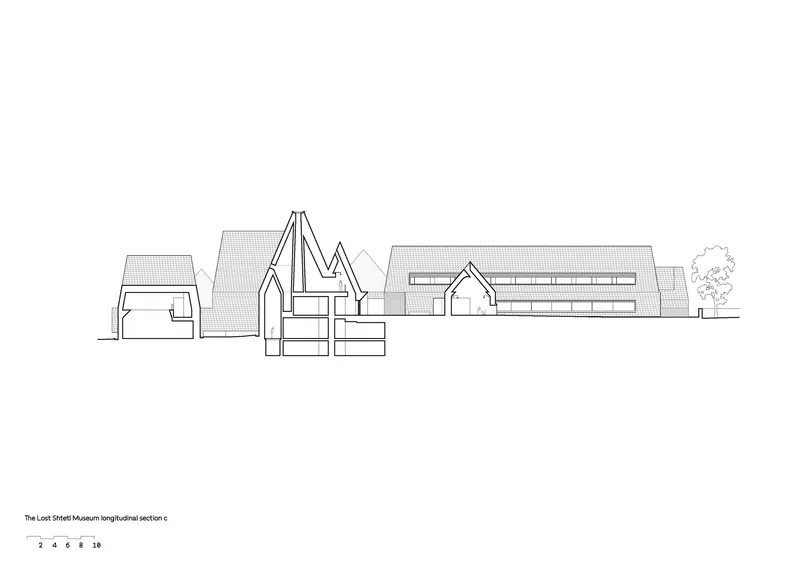
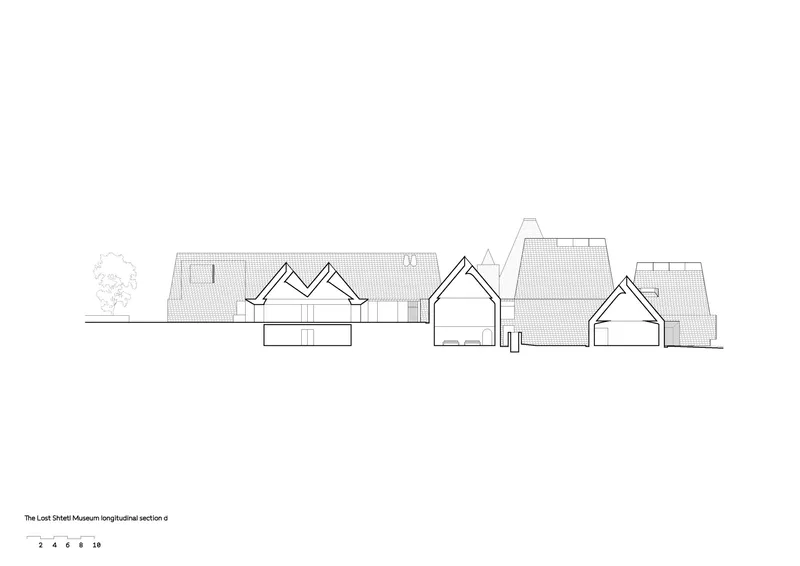
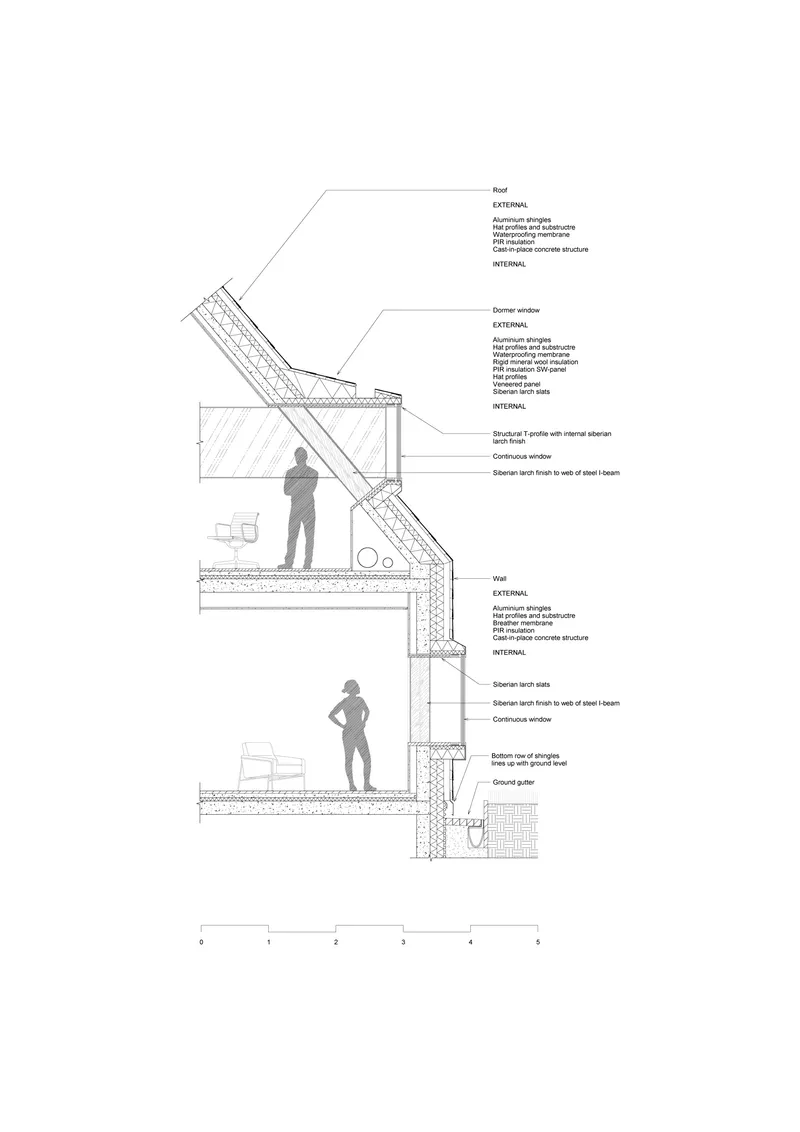
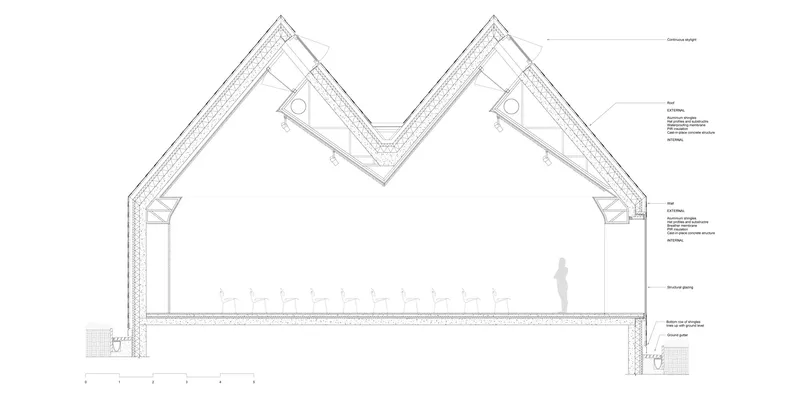
The floor plans reveal the full logic of the interconnected pavilions: each volume operates as a semi-independent room, linked by narrow passageways that compress space between larger galleries. The linear wing extends to the south, housing offices and support functions. In section, the varying roof pitches become legible as a deliberate strategy rather than an aesthetic whim. The gabled forms create dramatically different interior heights, from the low, intimate passages to the soaring Canyon of Hope. Detail sections show the split-level logic that allows the building to embed itself into the slope, keeping the entrance at grade while the exhibition spaces tunnel downward. The two human figures standing beneath the double-gabled roof structure give the clearest sense of the scale the architects were after: domestic, approachable, not monumental.
Why This Project Matters
Holocaust memorials and museums face a design problem that intensifies with every passing year: how to make an absence feel present without resorting to spectacle. The Lost Shtetl Museum answers this by building something that looks like a village but operates as an institution, a place that reads as familiar and domestic from the outside while containing a carefully orchestrated emotional journey within. The aluminum shingles, the hip roofs, the farmhouse scale: all of it draws on the vernacular of the Lithuanian countryside, on what is still there rather than what is gone. That rootedness gives the building a quiet authority that more abstract gestures often lack.
Lahdelma and Mahlamäki Architects have produced a building that is both conceptually rigorous and materially generous, one that rewards close looking and long visits. In a rural setting where the nearest major city is over an hour away, the museum's success will depend on its ability to draw people repeatedly, not just once. The expandable plan, the rich landscape, the library and event spaces, all suggest that the architects and their client are thinking in terms of decades, not opening-day headlines. That patience, more than any single detail, is what makes the project exceptional.
The Lost Shtetl Jewish Museum, designed by Lahdelma and Mahlamäki Architects. Šeduva, Lithuania. 4,900 m². Completed 2025. Landscape by Enea Landscape Architecture. Photography by Kuvatoimisto Kuvio, Aiste Rakauskaite, Andrew Lee, and The Lost Shtetl Museum.
About the Studio
Lahdelma & Mahlamäki Architects
Share Your Own Work on uni.xyz
If projects like this are the kind of work you want to make, uni.xyz is a place to publish your own, find collaborators, and enter design competitions.




Popular Articles
Popular articles from the community


Conexión: Biophilic Design Reimagines High-Rise Living in Hong Kong
Conexión reimagines high-rise living in Hong Kong through biophilic design, green facades, shared spaces, daylight, water and nature within.

Co-life: Sustainable Architecture for Age-Friendly Community Living
Co-life reimagines sustainable architecture for seniors through courtyards, rammed earth, shared gardens, and spaces designed for belonging.

AL-JANNAH: Sustainable Architecture and Permaculture for Afghan Widows
AL-JANNAH uses sustainable architecture and permaculture to create resilient oasis of housing, learning, work and renewal for Afghan widows.

The Earth Pod: 3D Printed Homes for Resilient Refugee Communities
The Earth Pod reimagines refugee housing through 3D printed homes made from clay, combining resilience, self-sufficiency, and rapid shelter.

Similar Reads
You might also enjoy these articles

Bao Huynh Watercolor Atelier: A Serene Art Retreat in Hội An
Bao Huynh Watercolor Atelier in Hội An blends multifunctional art spaces, sustainable design, local materials, and family-friendly living in a serene environment.

Atelier Macri Concept Store Interior Design by CASE-REAL
Atelier Macri store features a "ko" counter, walnut wood details, cork displays, blending retail, gallery, and seamless customer experiences.

Manuel Vargas Izquierdo Stadium and High-Performance Sports Center: Architectural Excellence in Jalpa de Méndez
The Manuel Vargas Izquierdo Stadium blends sustainable design, inclusive sports facilities, and cultural-inspired architecture, revitalizing Jalpa de Méndez’s public spaces.

KAKR Buluh Awar Hall: Revitalizing Community and Ecology Through Bamboo Architecture
Community built bamboo hall revitalizes Buluh Awar village, empowering youth, restoring ecology, celebrating vernacular craftsmanship through sustainable architecture and culture.


Explore Genetic Museum Competitions
Discover active competitions in this discipline



Challenge to reimagine the Iron Throne


Photograph architecture without architects


Illustrate the lost glory of Angkor Wat - Render Challenge


Bring back Drive In's
Comments (0)
Please login or sign up to add comments
No comments yet. Be the first to comment!