

Domain Architects Weave a Curved Glass Corridor Between Two 1930s Houses on a Chinese Lakeshore
A steel-and-glass bridge corridor connects restored timber-frame dwellings beside Nanbei Lake in Jiaxing, Zhejiang Province, China.


About a hundred meters from the southern shore of Nanbei Lake in Jiaxing, two timber-frame houses built in the 1930s sat quietly at the foot of a wooded hill. They were modest structures, each organized around a small courtyard called a "sky well," separated by ground that a seasonal creek had slowly eroded into a low depression. Domain Architects, led by Xu Xiaomeng, was tasked with turning them into a teahouse and rest stop for tourists visiting a scenic area known for its connection to traditional Chinese literati culture. The firm's answer was not demolition or heavy renovation, but a single decisive insertion: a curved, elevated bridge-corridor in steel and glass that links the two houses without quite touching either one.
What makes the project compelling is how much work one lightweight element does. The corridor is simultaneously a passageway, a viewing platform, a climate screen, and a structural provocation. It begins at a roofless volume in one house and terminates just beside the old wall of the other, barely grazing the existing fabric. That restraint, the decision to leave the 1930s houses essentially intact and let the new piece hover between them, gives the 245-square-meter project a clarity that larger interventions rarely achieve.
A Corridor That Floats Between Centuries
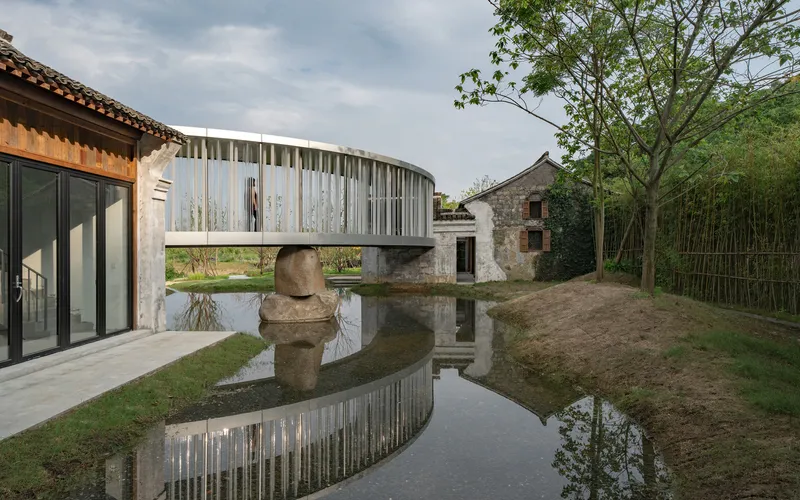
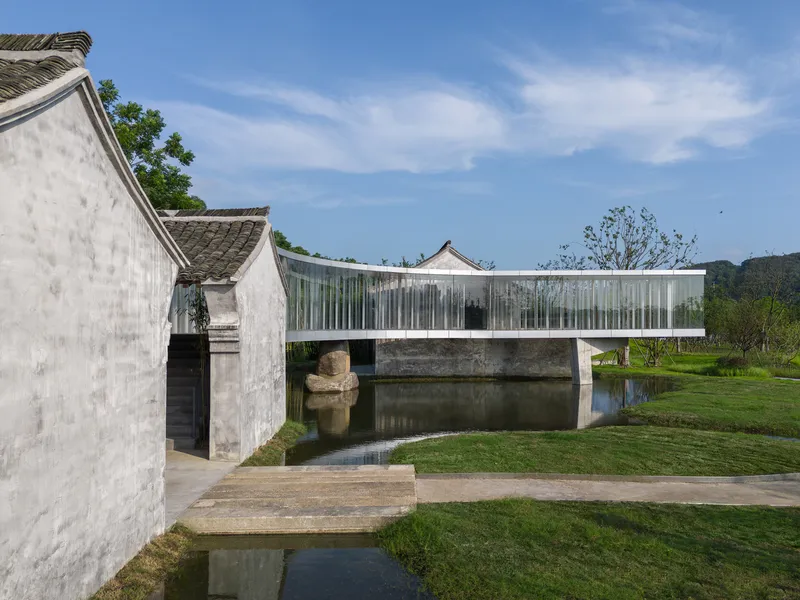
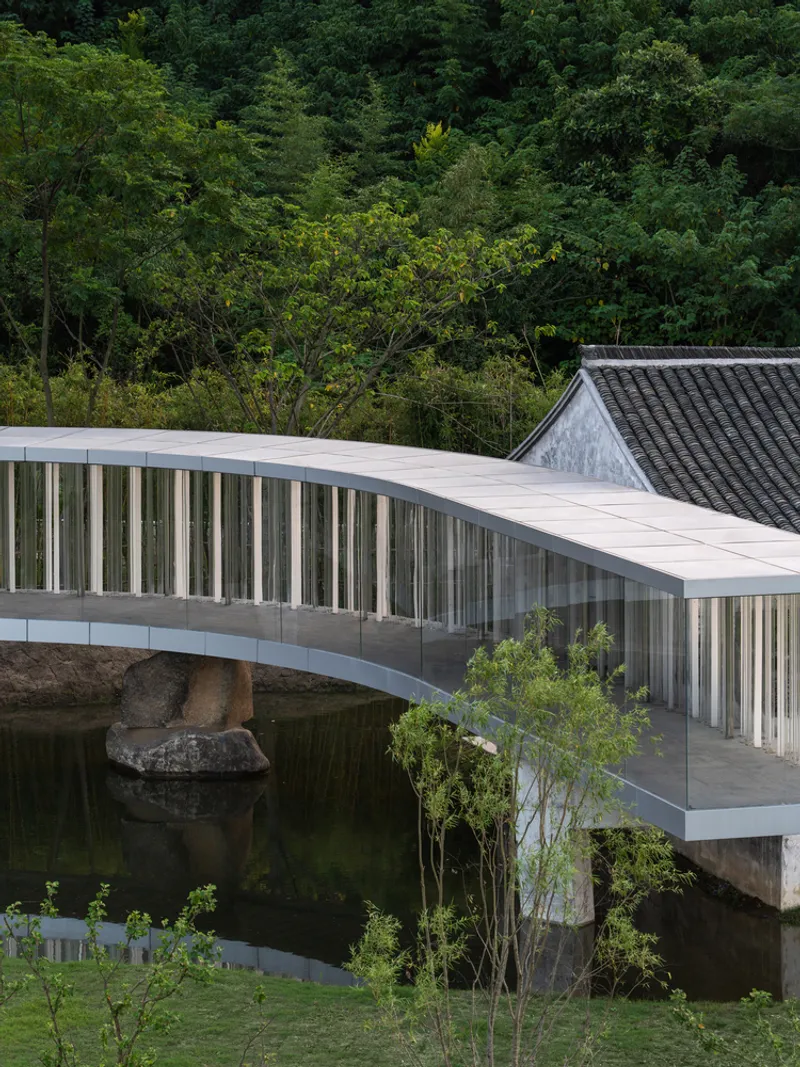
The bridge-corridor is the only substantial new structure on the site, and it reads as a single, swept gesture. Its curve traces an arc between the two houses, cantilevering outward on the lake side to maximize the view over the water. The single-sided cantilever posed the project's greatest engineering challenge: AND Office, the structural consultants, had to manage overall deformation to achieve rigidity while keeping the members slender enough to maintain the corridor's appearance of weightlessness.
Rather than relying on a uniform column grid, the structural system employs varied support forms: staircases that double as load paths, gable wall side-supports, local stone elements, and uniquely shaped concrete structures. The result is a bridge that appears to hover on no consistent logic, which is precisely the point. Regularity would have imposed a contemporary rhythm on the older buildings. Irregularity lets the corridor feel almost accidental, as though it grew between the houses rather than being engineered into place.
Two Faces: Glass Toward the Lake, Polycarbonate Toward the Hill
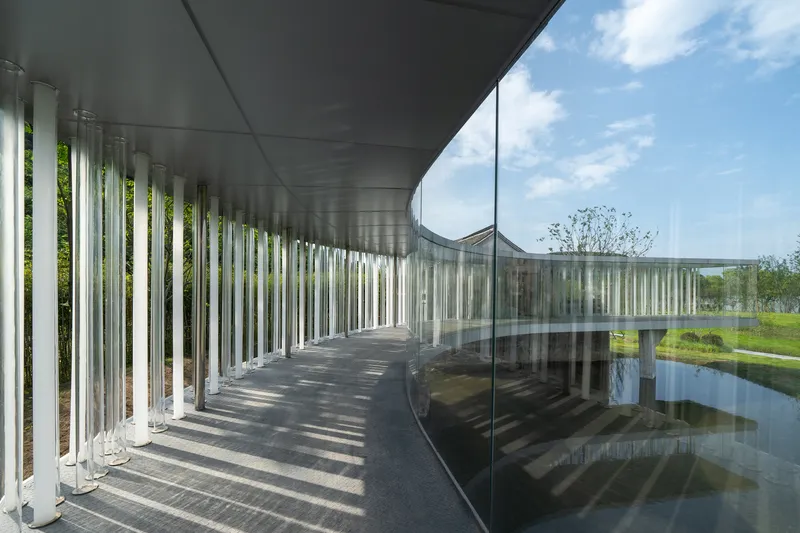
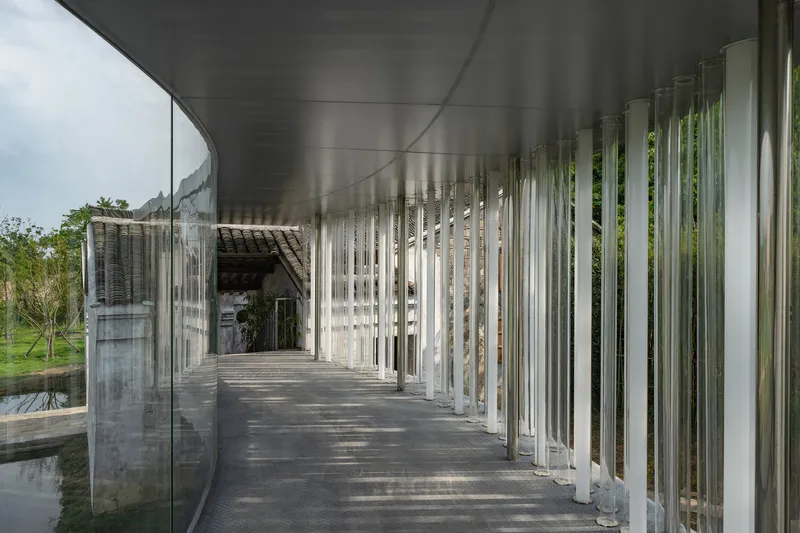
The corridor is not symmetrical in section. The lake-facing elevation is fully glazed, offering uninterrupted panoramas of Nanbei Lake. The hill-facing side is an entirely different condition: an irregular array of steel posts interspersed with clear and frosted polycarbonate tubes. The tubes filter daylight into soft, shifting patterns and allow air to pass through naturally, providing passive ventilation without mechanical systems.
Walk through the corridor and the contrast is immediate. On one side, the landscape is a single wide frame of water and sky. On the other, it fragments into vertical slices of green hillside, the polycarbonate tubes breaking the view the way bamboo screens filter a garden. The frosted tubes also disrupt the expected rhythm of the steel posts, introducing a visual syncopation that keeps the eye moving. It is a smart, low-tech move that transforms what could be a monotonous structural screen into an active surface.
The Courtyard as Scroll Painting
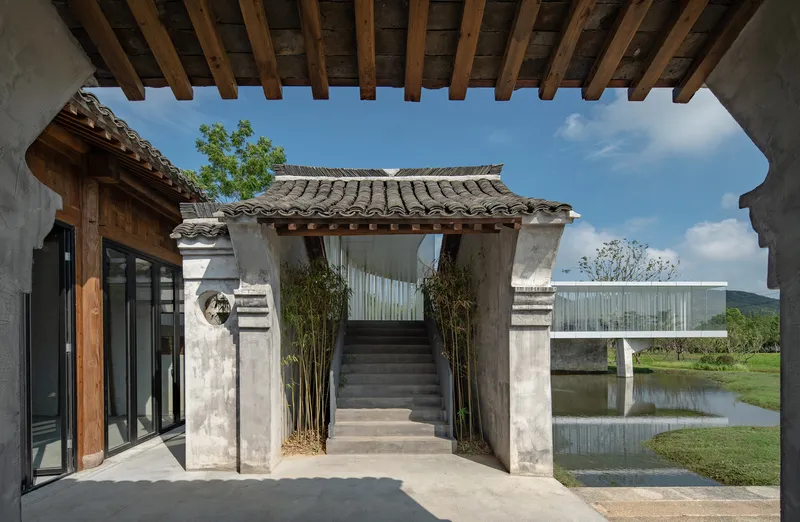
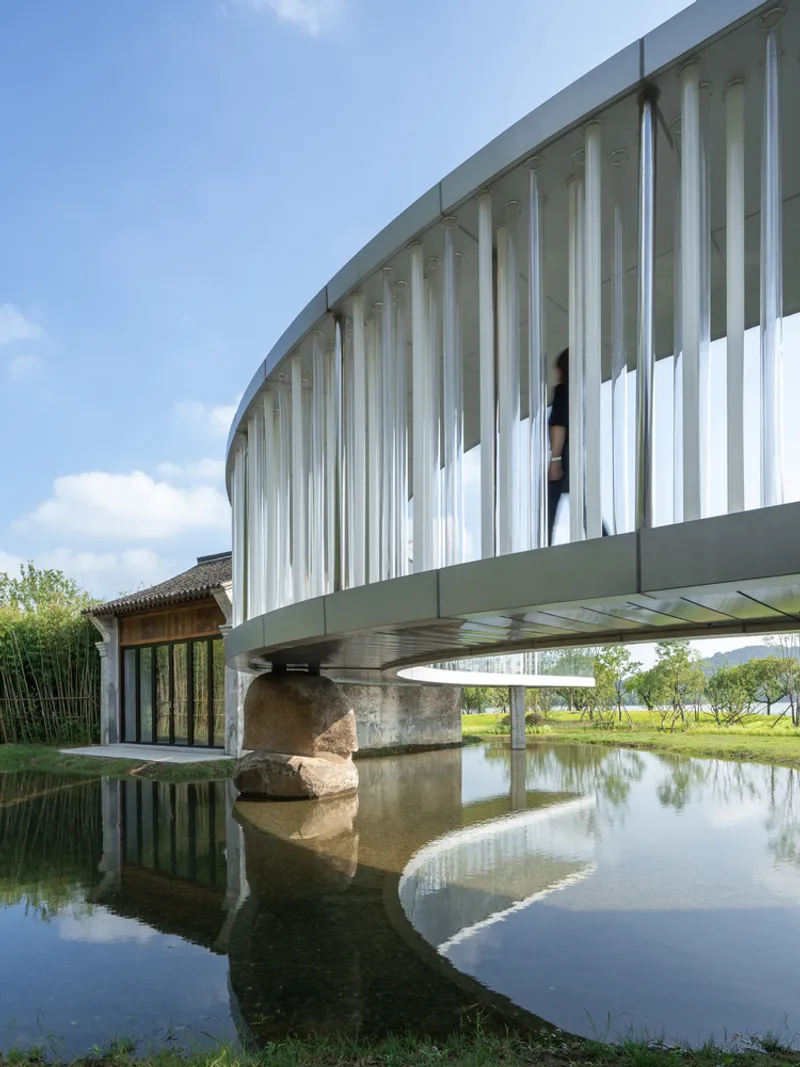
Domain Architects cite the traditional Chinese hand-scroll painting as a conceptual model, and the spatial sequence bears it out. In a scroll painting, the viewer unrolls the image progressively; scenes are experienced in time, not all at once. Here, the corridor functions as the scroll itself. As you move through it, the composition of lake, hill, courtyard, and old rooflines shifts continuously. No single vantage point captures the whole project, which is the design's central ambition: to make the architecture something you read rather than something you see.
The sky wells in each house reinforce this. They are not just light wells but frames, vertical apertures that compress the view upward before the corridor releases it horizontally. Passing from a sky well into the glazed bridge is a controlled decompression, moving from the intimate and enclosed to the panoramic and open.
Landscape as Co-Author
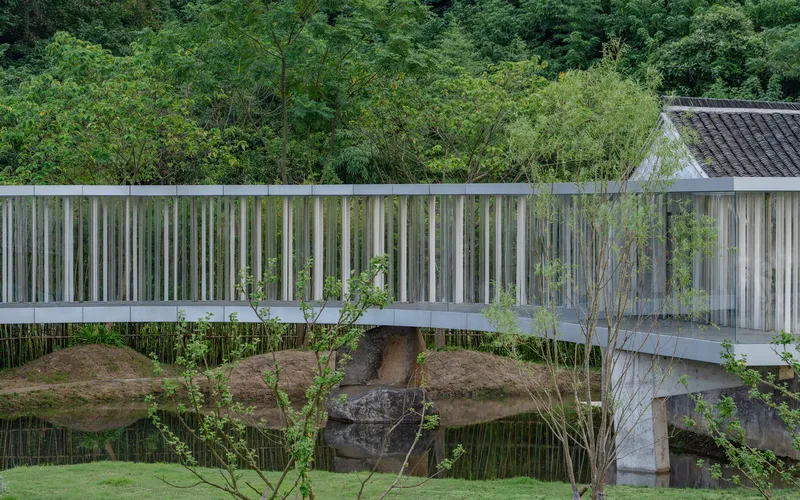
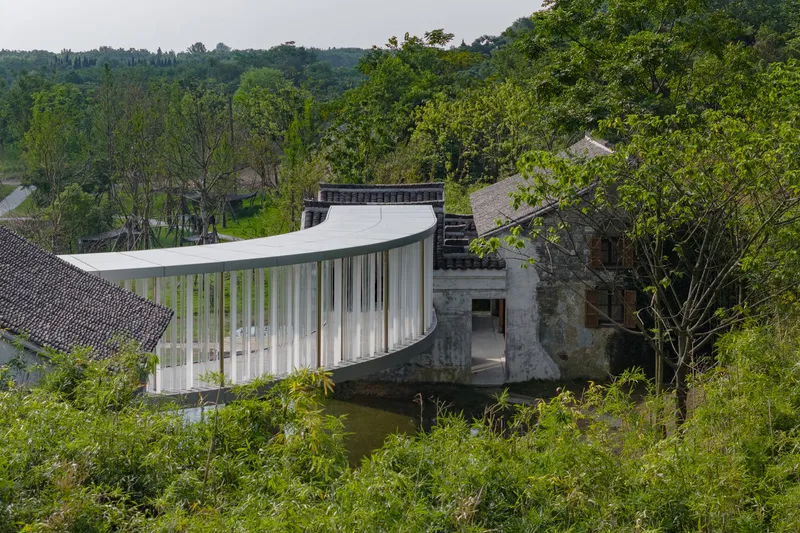
The eroded ground between the two houses has been turned into a shallow reflecting pond, accepting rather than fighting the seasonal creek that created it. A stone-slab bridge crosses the water, bamboo groves line the edges, and existing trees are retained in place. These elements are arranged to evoke the spatial relationships of a classical Chinese garden: path beside water, stone against plant, built form reflected in a still surface.
The reflecting pond does double duty. Practically, it manages stormwater by holding runoff that would otherwise continue eroding the site. Aesthetically, it gives the corridor a second life. At dusk, the illuminated bridge and its vertical fins appear twice: once overhead, once on the water's surface. The pond also mediates the scale difference between the smaller northern house and its larger neighbor, providing a horizontal plane that ties the two together at ground level while the corridor ties them together at roof level.
Preserving What Was Already There
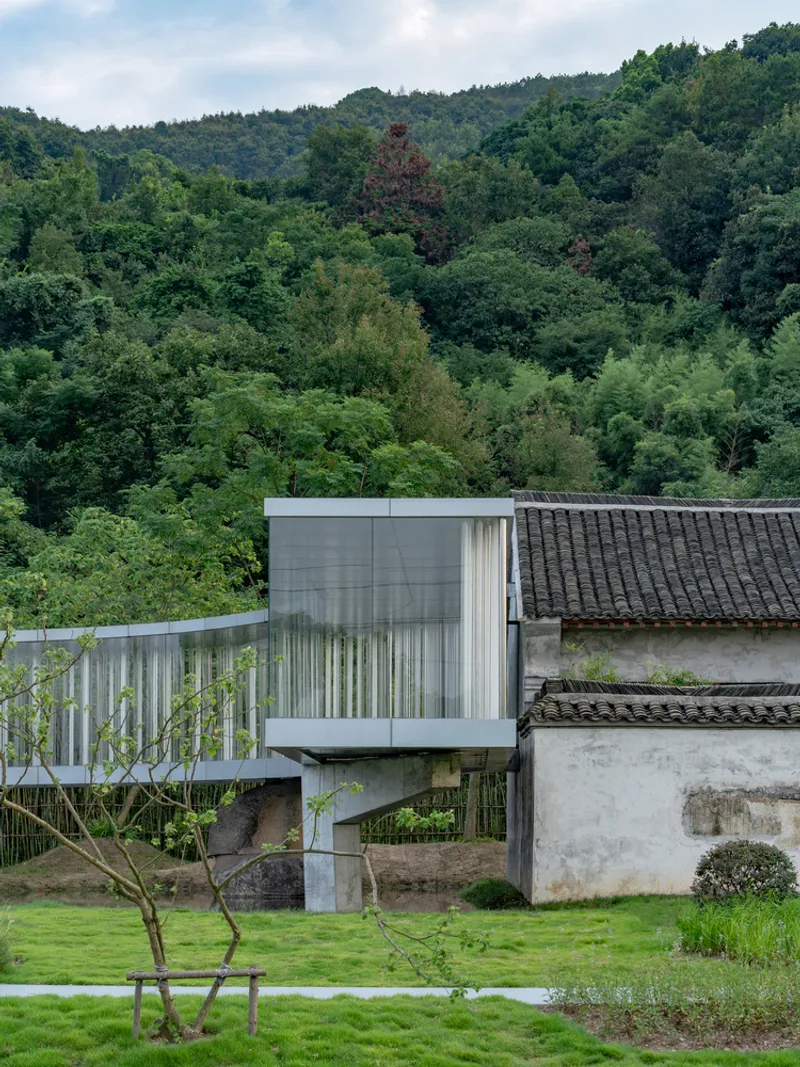
The minimal intervention strategy is evident in the details. The timber-frame structures of both houses remain intact. The only roof removed was on a single small volume, which now serves as the departure point for the bridge. Original masonry walls, whitewashed surfaces, and tiled roofs coexist with the steel-and-glass insertion without being subordinated to it. The corridor does not land on the old walls or penetrate the old roofs; it stops just short, leaving a gap that reads as deference.
Local stone appears in the structural supports, grounding the new work in the material palette of the region. Concrete elements are shaped individually rather than cast from repeating formwork, reinforcing the sense that the new structure was fitted to the old one rather than imposed on it. The distinction between old and new is always legible, never ambiguous, which is the correct ethical posture for heritage work of this kind.
Dusk and the View from Above
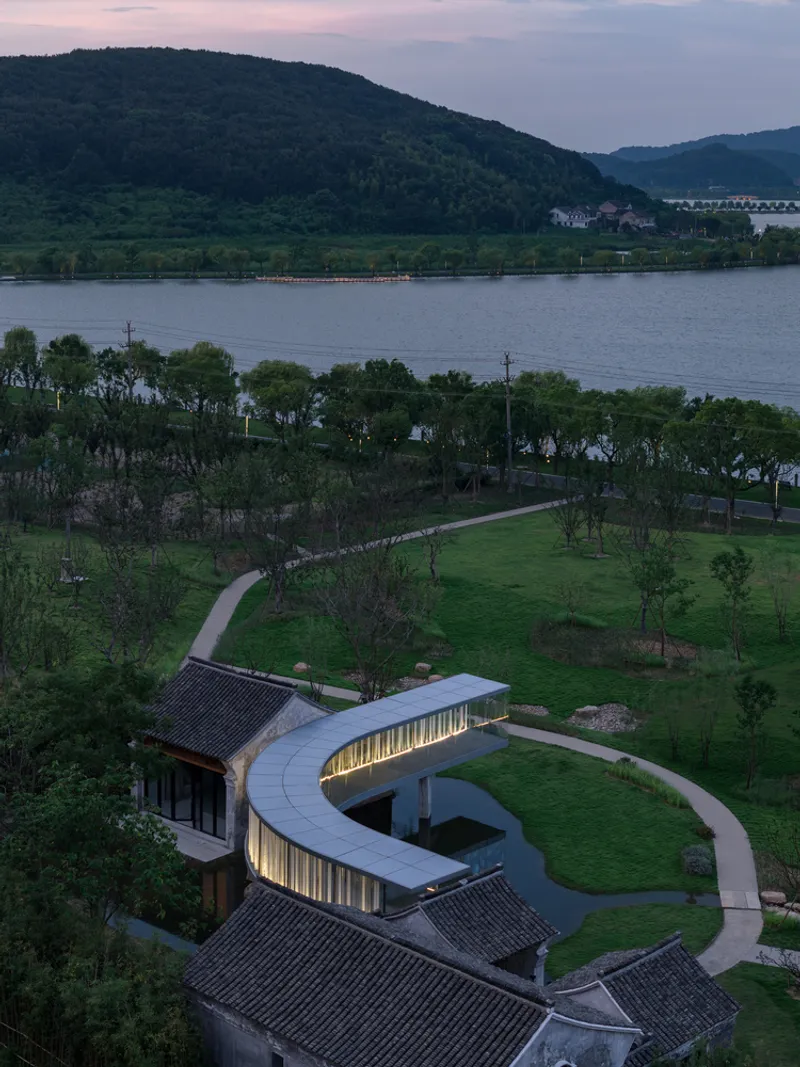
The aerial view at dusk reveals the project's full organizational logic. The curved corridor reads as a luminous arc connecting two dark, compact masses, with the terraced lawns stepping down toward the lake beyond. From above, the gesture is almost calligraphic: a single brushstroke laid across an existing composition. The glow of the interior light through the polycarbonate tubes transforms the hill-facing screen into a lantern, reversing the daytime condition. By day, the tubes filter light inward. By night, they project it outward.
Why This Project Matters
Heritage projects in China's scenic zones often default to one of two modes: wholesale reconstruction dressed in traditional ornament, or aggressive contemporary insertions that treat old buildings as backdrops. The Lakeside Teahouse avoids both. By limiting the new intervention to a single connecting element and letting the 1930s houses carry the program, Domain Architects demonstrate that the most powerful design decisions are often about what you choose not to build. The corridor adds a viewing experience that the original buildings could never have offered, but it does so without diminishing them.
The project also makes a quiet argument for structural ingenuity as an aesthetic tool. The varied, irregular supports, the polycarbonate screen, the cantilever over the lake: these are not decorative choices but engineering responses that happen to produce richly atmospheric spaces. When the structural logic of a building generates its sensory qualities, as it does here, the architecture feels inevitable rather than styled. At 245 square meters, the Lakeside Teahouse is small. Its ideas are not.
Lakeside Teahouse by Domain Architects (lead architect: Xu Xiaomeng; design team: Xu Xiaomeng, Hannah Wang; structural design: AND Office). Jiaxing, Zhejiang Province, China. 245 square meters. Completed 2023. Photography by Chao Zhang.
About the Studio
Share Your Own Work on uni.xyz
If projects like this are the kind of work you want to make, uni.xyz is a place to publish your own, find collaborators, and enter design competitions.


Popular Articles
Popular articles from the community


longwave studio Reorganizes a 112 m² Tainan Apartment Around the Daily Routines of a Family and Two Cats
In Tainan, Taiwan, birch plywood, rust-red furniture and a freestanding plaster wall link arrival, storage, work and family life in one apartment.

Juan García Correa, John González and Claudia Rueda Sink a Circular Amphitheater into a Manizales Engineering Building
On the La Nubia campus in Manizales, Colombia, the S1 Building folds labs and offices into a hillside of ramped lawns that double as a campus route.

David Ortega Stacks a Two-Story Mexico City Penthouse Around a Steel Stair and a Pergola-Shaded Roof Terrace
In Colonia Roma, a 300 m² penthouse uses oak joinery, a planted steel stair and a slatted roof pergola to make a new-build apartment feel like a house.

Cube Design Draws an Ecological Corridor Between Two Shenzhen Hills with the Nankai Building
Beside Shenzhen's container docks, the Nankai Building pairs stacked balconies with a climbing green screen to connect two hillsides across its height.

Similar Reads
You might also enjoy these articles


Hodi-Mandai Geram
Project Function: Preservation and revitalization of the Intangible heritage and socio-spatial identity of the Hodi by Housing, Cultural Memory Center, Sacred Grove, landscape, local tourism economy


Olio Towers: A Mid-Rise for Performers That Fuses Housing, Rehearsal, and Stage
Located blocks from Houston's Theater District, this modular tower stacks living units around a central performance atrium.

Oasis: Modular Green Housing Carved into Dhaka's Urban Fabric
A shortlisted Plugin Housing entry reclaims unauthorized settlements in Dhaka with stepped concrete volumes, green roofs, and ventilation-driven design.

Black Hole: A Floating Megastructure for the Post-Physical Era
Emiliano Mazzarotto envisions a spherical, self-scaling arena where e-sports, digital hotels, and holographic stadiums replace traditional public space.

Explore Architecture Competitions
Discover active competitions in this discipline

Challenge to reimagine the Iron Throne

Photograph architecture without architects

Illustrate the lost glory of Angkor Wat - Render Challenge

Design challenge to reuse E-waste
Comments (0)
Please login or sign up to add comments
No comments yet. Be the first to comment!