

Lalli Residence, Raipur: A Compact Home Shaped by Art, Flexibility, and Climate
Compact 700-square-foot artist’s home in Raipur featuring flexible open-plan living, red oxide façade, courtyards, and climate-responsive design.


Designed by My MAATI, the Lalli Residence in Raipur is a thoughtful exploration of compact residential architecture, where spatial efficiency, artistic freedom, and climate-responsive design come together within a modest 700-square-foot footprint. Completed in 2024, the house reflects a design philosophy rooted in simplicity, adaptability, and deep respect for its occupants’ lifestyle.

The residence sits on a narrow rectangular plot that once formed part of a larger ancestral property divided among three sisters. This subdivision resulted in limited buildable land, compelling the architects to rethink conventional residential planning. Rather than imposing rigid zoning, the design embraces openness and flexibility, allowing spaces to adapt to changing daily and creative needs.


Open Planning for a Creative Life
The client, a painter and avid art enthusiast, envisioned a home that could function beyond domestic routines. While the initial brief focused on a simple dwelling for a mother and her son, the requirement for large, multifunctional spaces transformed the project into a hybrid of home, studio, and exhibition venue. In response, the architects abandoned fixed floor plans in favor of fluid spatial arrangements that allow the interiors to shift effortlessly between living, working, and hosting.
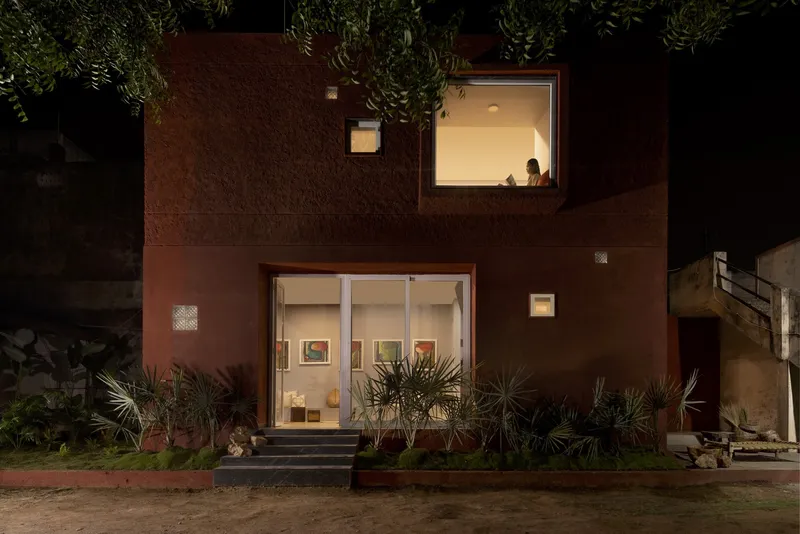
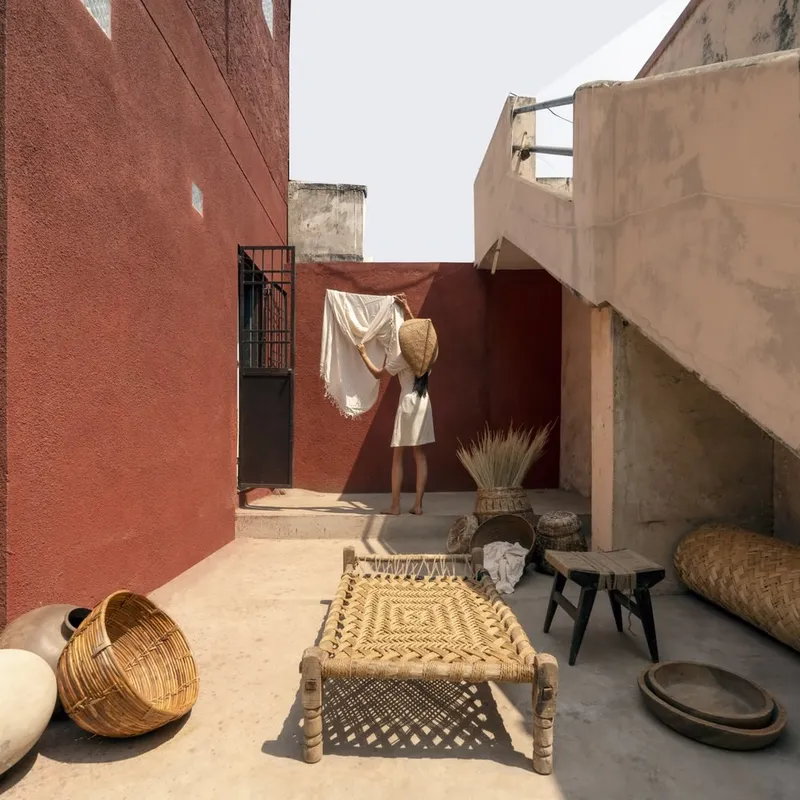
On the ground floor, a foyer cum living area occupies most of the plan, benefitting from generous openings that visually extend the interior into adjacent gardens and courtyards. These outdoor buffers flank the cuboidal mass of the house, improving ventilation and daylight while softening the compact volume. A custom window tucked beneath the staircase creates an intimate seating nook that frames direct views of the garden, dissolving the boundary between inside and outside.


Climate-Responsive Spatial Strategy
Functional spaces such as the kitchen and bathroom are strategically placed along the narrower southern edge of the house. This move minimizes heat gain while freeing up the rest of the floor for open use. The staircase, designed to be as narrow as comfortably possible, further conserves valuable square footage without compromising usability.
The first floor is intentionally reserved as a single, expansive master bedroom and studio space. By limiting permanent partitions, the room can easily transform from a private retreat into an exhibition hall or screening space. A movable floor mattress replaces a fixed bed, allowing the area to open up entirely when needed. Built-in storage along the western wall acts as both a thermal buffer against harsh afternoon sun and a display surface during exhibitions.


Material Expression and Exterior Identity
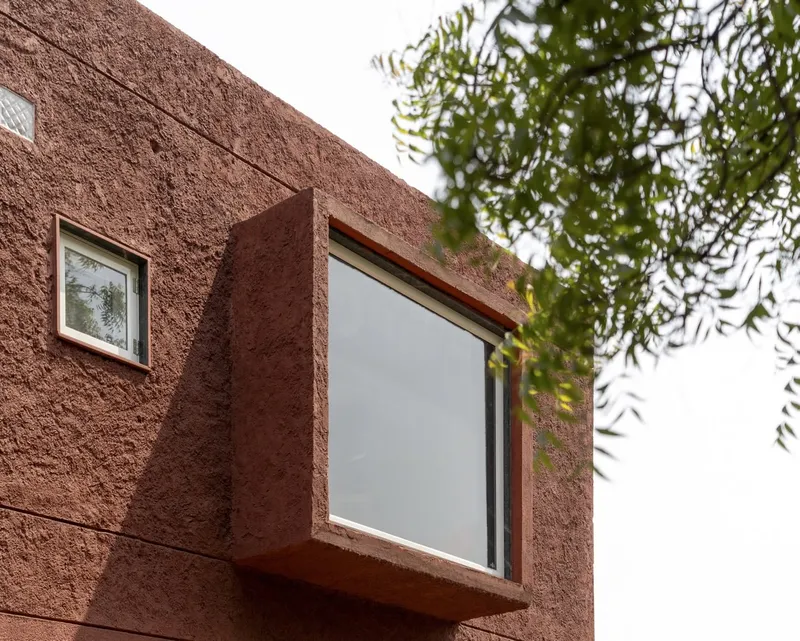
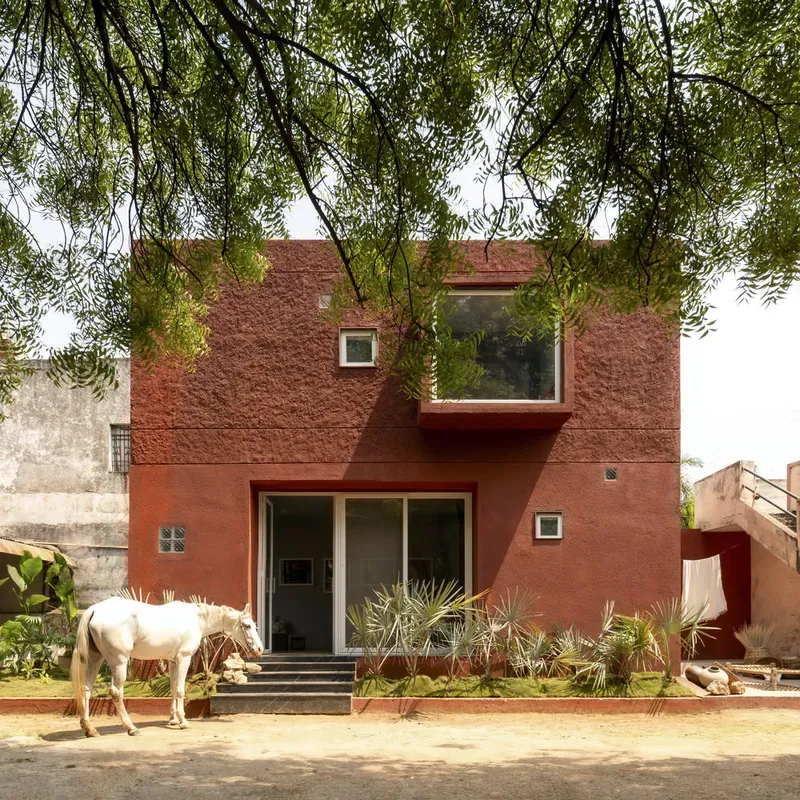
While spatial experimentation is concentrated indoors, the exterior draws its character from material honesty and symbolic expression. Inspired by the client’s name, the façade is finished in a deep red oxide plaster, lending the house a bold yet grounded presence. Subtle variations in surface roughness catch light differently throughout the day, adding depth to the otherwise minimal form. A simple horizontal groove between levels accentuates the building’s proportions without unnecessary ornamentation.
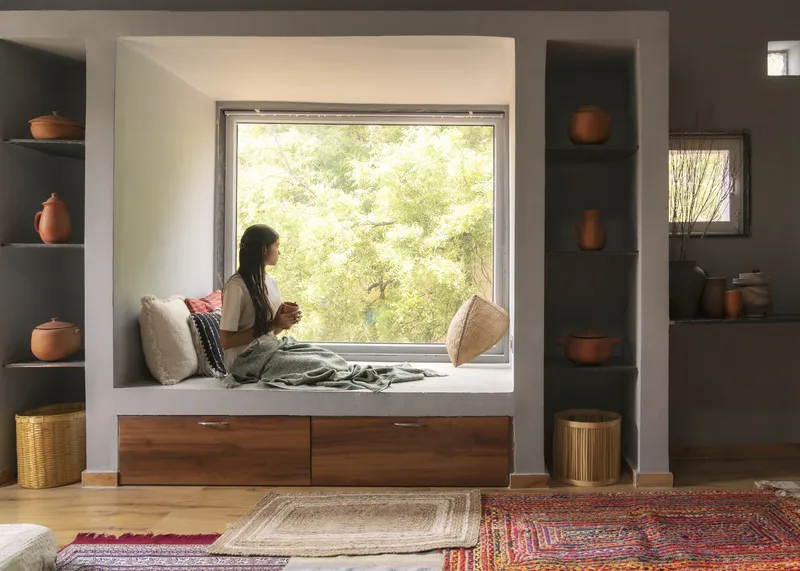
A projecting cove on the upper level responds to the client’s fondness for an existing neem tree outside the house. This shaded alcove, complete with built-in seating and a full-height window, becomes a contemplative spot overlooking greenery. Glass blocks and ceiling openings further enhance natural illumination, reducing reliance on artificial lighting.
Architecture as Everyday Enhancement
Led by Rishabh Jain, the Lalli Residence exemplifies how small urban homes can be deeply personal yet architecturally rigorous. Rather than making grand gestures, the project focuses on improving daily life through thoughtful planning, climatic sensitivity, and adaptable spaces. It stands as a quiet reminder that meaningful architecture often lies not in excess, but in precision, restraint, and empathy for those who inhabit it.

All photographs are works of
Yash Raj Jain


Popular Articles
Popular articles from the community


Singing Woman: An Opera House That Performs Before the Curtain Rises
Ovidiu Cristian Pavel's conceptual opera house translates Estonia's choral identity into a sculpted waterfront landmark facing the Baltic Sea.


David Ortega Stacks a Two-Story Mexico City Penthouse Around a Steel Stair and a Pergola-Shaded Roof Terrace
In Colonia Roma, a 300 m² penthouse uses oak joinery, a planted steel stair and a slatted roof pergola to make a new-build apartment feel like a house.

Opera on the Sea: Driftwood Logic Shapes a Timber Opera House on Estonia's Coast
Trevor Orgill's opera house translates the entangled drift of floating timber into a civic building where wood, water, and music converge.

Cube Design Draws an Ecological Corridor Between Two Shenzhen Hills with the Nankai Building
Beside Shenzhen's container docks, the Nankai Building pairs stacked balconies with a climbing green screen to connect two hillsides across its height.

Similar Reads
You might also enjoy these articles
Cube Design Draws an Ecological Corridor Between Two Shenzhen Hills with the Nankai Building
Beside Shenzhen's container docks, the Nankai Building pairs stacked balconies with a climbing green screen to connect two hillsides across its height.

Praksis A and Studio Sted Bend a Red Timber Cabin Across the Granite of Norway's Southern Coast
On the southern Norwegian coast, a 105 m² cabin follows the rock on slender posts, pairing red cladding outside with pine, brick and plywood within.
David Ortega Stacks a Two-Story Mexico City Penthouse Around a Steel Stair and a Pergola-Shaded Roof Terrace
In Colonia Roma, a 300 m² penthouse uses oak joinery, a planted steel stair and a slatted roof pergola to make a new-build apartment feel like a house.

PARALELA and LB2 Thread a Public Walkway Through the Base of a Las Condes Residential Tower
In Las Condes, Santiago, the Hamlet Building gives its fenceless ground floor to a 70-metre wooded passage linking two streets and the metro.

Explore Architecture Competitions
Discover active competitions in this discipline

Challenge to reimagine the Iron Throne

Photograph architecture without architects

Illustrate the lost glory of Angkor Wat - Render Challenge

Design challenge to reuse E-waste
Comments (0)
Please login or sign up to add comments
No comments yet. Be the first to comment!