
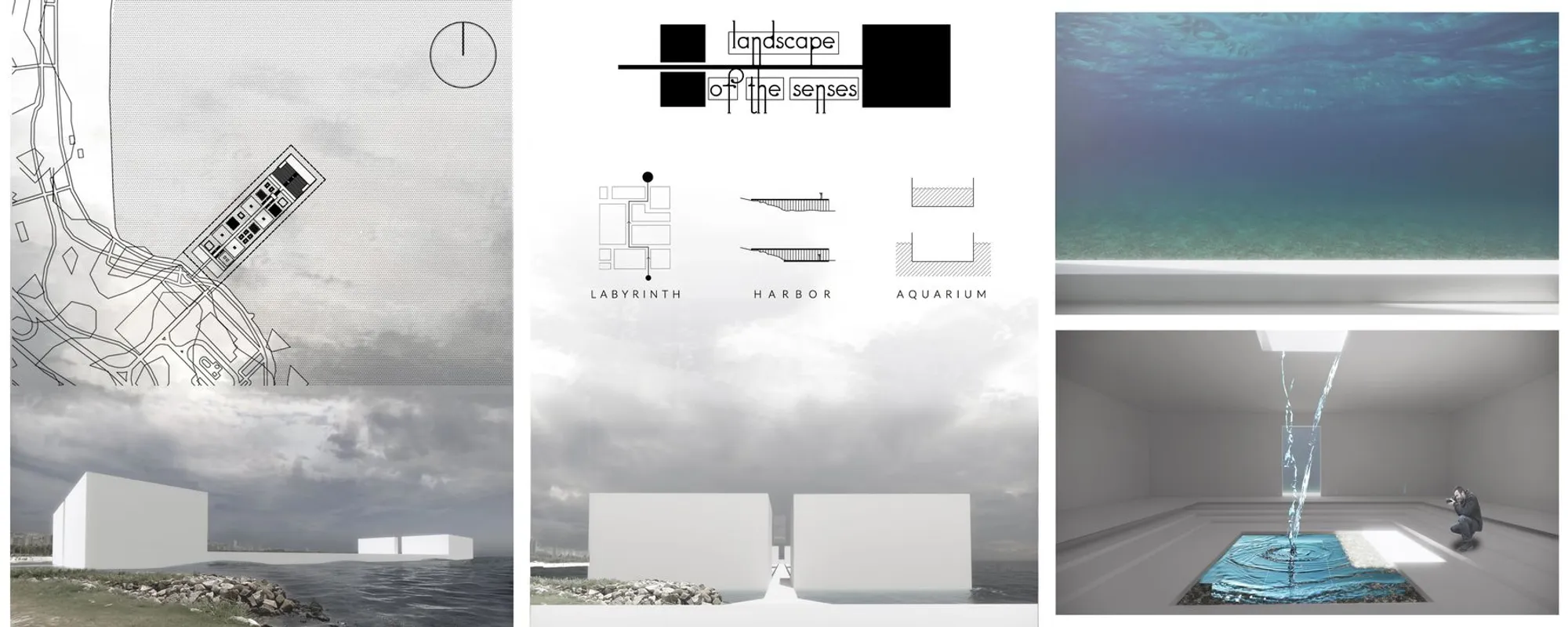
Landscape of the Senses: Architecture as a Multisensory Journey Along the Coast
Mateusz Mulica's conceptual project stretches white monolithic volumes into the sea, designing spaces for hearing, sight, smell, and touch.


Strip architecture of everything except what the body can register and you get something close to what "Landscape of the Senses" proposes: a building that exists not to be looked at but to be felt, heard, smelled, and moved through. Conceived by Mateusz Mulica, the project pushes back against the screen-flattened, visually consumed architecture of the present by engineering a linear sequence of sensory zones that guide visitors from shore into water, from sound into silence, from surface into depth.
Published as a conceptual project on uni.xyz, the design positions itself along a coastal landscape where white monolithic volumes extend into dark water on a pier-like structure. The site is deliberate: the threshold between land and sea becomes a spatial metaphor for the threshold between distraction and awareness. Mulica grounds the work in phenomenology, arguing that architecture must reclaim its role as an active participant in shaping emotion, memory, and connection rather than functioning as a backdrop for efficiency and repetition.
Three Archetypes Stretched Across the Water
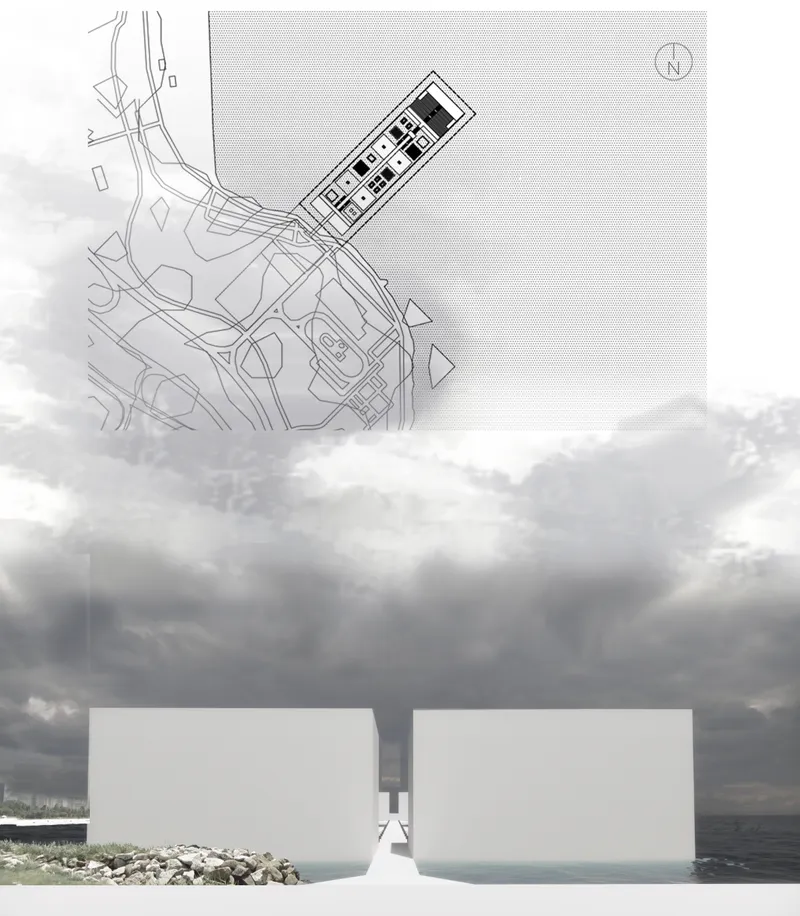
The project's form derives from three archetypal references: the labyrinth, the harbor, and the aquarium. The labyrinth introduces exploration and perceptual uncertainty. The harbor evokes arrival, transition, and the meditative quality of edges where land meets sea. The aquarium collapses the boundary between observer and environment, creating spaces of immersion. Together these concepts produce a linear, elongated building that reaches from a rocky shoreline out over the water, establishing a controlled visual axis and a defined spatial rhythm. The site plan, overlaid on a photograph of stormy skies, reveals how the white volumes sit in disciplined contrast to the turbulent landscape around them.
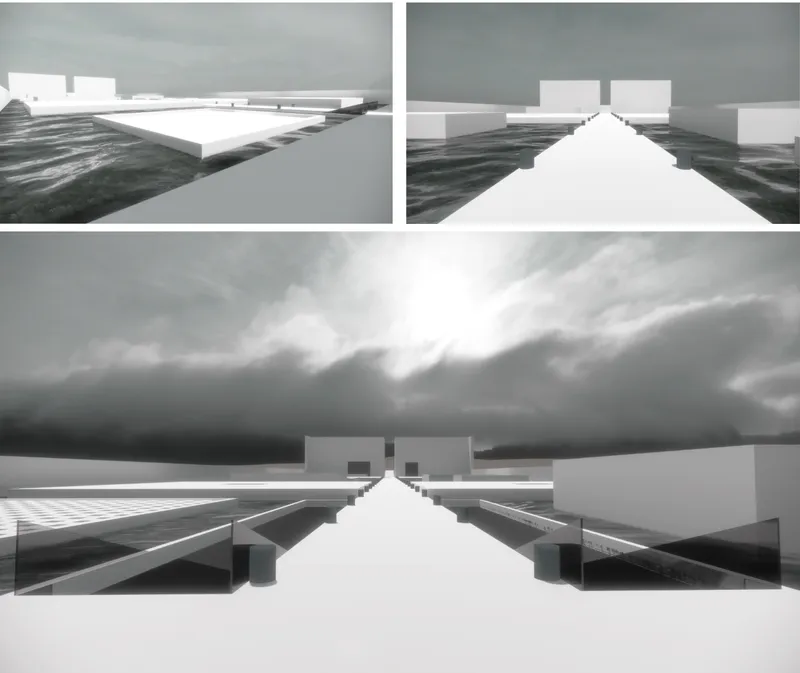
Model views reinforce the reading: two principal volumes connected by a narrow pier stretch toward distant mountains across dark water. The geometry is monolithic and calm, almost sacred in its minimalism. Mulica strips away ornamental distraction so that the senses can sharpen. The vastness of the coastal panorama and the restraint of the built form create a productive tension, one that positions the architecture as a threshold device rather than an object.
White Volumes Against Rocky Shore and Overcast Sky
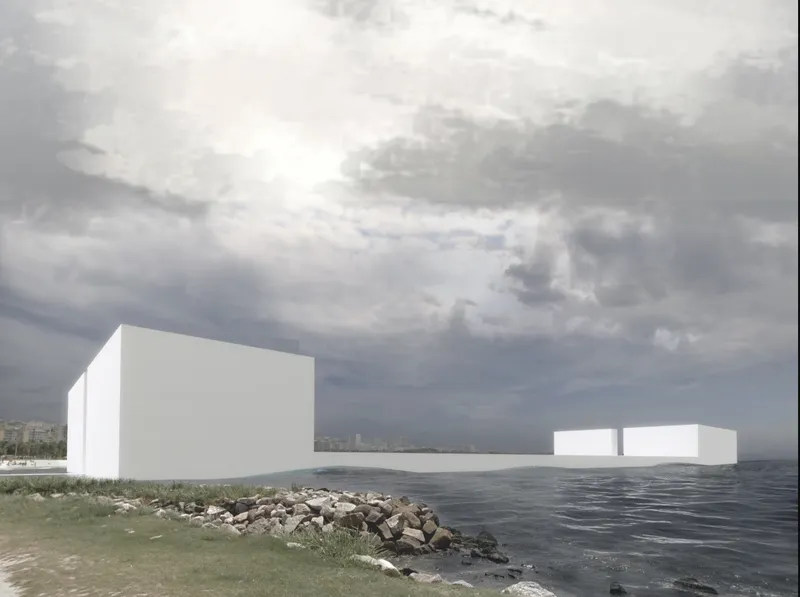
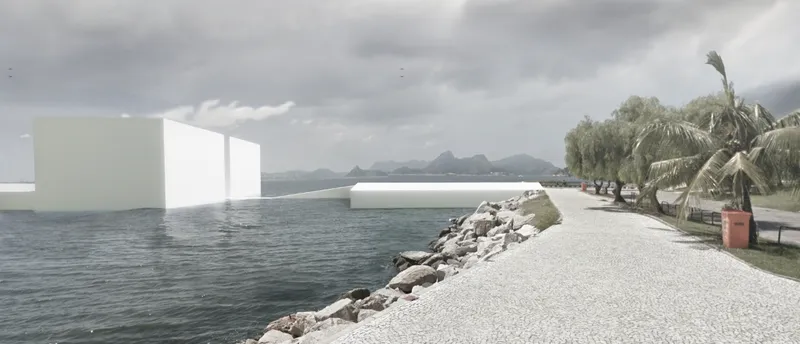
Seen from the shoreline, the white rectangular volumes appear to float offshore beyond a rocky edge lined with grasses. The overcast sky washes color from the scene, leaving the architecture to register as pure form against water and stone. From another angle, a coastal promenade with palm trees and rough rock establishes the human scale of arrival: visitors approach along a familiar public landscape before encountering something entirely unlike it. The contrast between the organic texture of the shore and the precision of the floating geometry is the project's first sensory provocation, a visual jolt that signals the shift from everyday perception into something more attentive.
Mulica uses this deliberate separation between land and building to reinforce his core argument. Architecture that can only be reached by crossing water demands a conscious decision to enter. The journey across the pier slows the body down, introduces the sound of water, wind, and changing air pressure. Before any interior threshold is crossed, the sensory recalibration has already begun.
Interior Zones: Sculpting Light, Water, and Silence
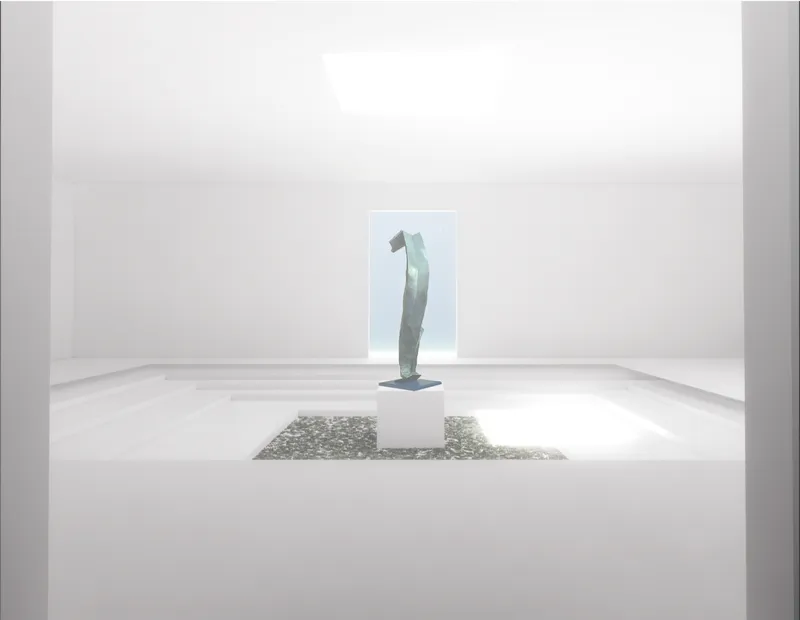
Inside, the building is divided into distinct sensory zones organized as an evolving narrative. Spaces dedicated to hearing use controlled acoustics, echo chambers, subtle water movements, and sound-filtered passages. Rooms for eyesight deploy carefully proportioned apertures, controlled daylight, and framed views of the sea. Smell is addressed through natural ventilation channels and curated environmental transitions. Touch surfaces introduce textural variation, temperature shifts, and semi-immersive sequences. The white interior gallery with a bronze sculpture on a gravel plinth, centered beneath a skylight, demonstrates how a single room can isolate vision: the cone of light, the weight of the figure, the crunch of gravel underfoot.
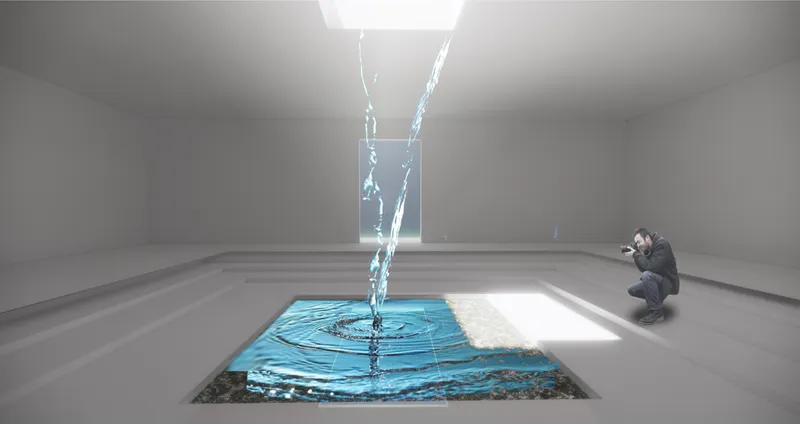
A second gallery space contains a water pool that catches and reflects sunlight across its surfaces. A visitor crouches beside it, camera in hand, but the real subject is the room itself, the way light bounces off water onto white walls, the way sound changes over a reflective surface. Mulica treats each room as a communication device, an emotional language spoken directly to the body. As users move through the sequence, each zone stimulates different sensory receptors, gradually peeling away what the designer calls the monotony of modern perception.
Phenomenology as Critique, Not Nostalgia
It would be easy to read this project as romantic escapism, a retreat from the complexities of contemporary practice. But Mulica frames it as critique. The dominance of one-dimensional digital communication, text messages, scrollable feeds, diagram-driven design, has detached people from embodied spatial experience. "Landscape of the Senses" does not reject technology; it rejects the assumption that efficiency and visual consumption are sufficient measures of architectural success. The project's insistence on proportion, rhythm, and immersion positions it within a phenomenological tradition that runs from Pallasmaa to Zumthor, updated here through a younger designer's frustration with the sensory poverty of much recent production.
Why This Project Matters
"Landscape of the Senses" matters because it asks a question that most conceptual projects avoid: what would architecture look like if it were designed for the entire body rather than the eye alone? The answer, in Mulica's formulation, is a building that functions less as shelter or spectacle and more as an instrument for recalibrating human perception. The linear sequence from shore to sea, from hearing to touch, from gravel to water, constructs a spatial argument that is difficult to absorb through images alone, which is precisely the point.
For students and young designers navigating an era of parametric fluency and render culture, the project offers a useful counterweight. It demonstrates that phenomenological ambition does not require complex geometry; it requires disciplined restraint, site intelligence, and a willingness to design for senses that architecture has largely forgotten. Mulica's coastal volumes, stark and silent against the storm, make a compelling case that the most radical move available to architects today might be the simplest: slow down, and let the body listen.
View the Full Project
About the Designers
Designer: Mateusz Mulica
Enter a Design Competition on uni.xyz
uni.xyz runs architecture and design competitions year-round that reward proposals with spatial conviction and real site intelligence.
Project credits: Landscape of the Senses by Mateusz Mulica.




Popular Articles
Popular articles from the community


The Musturak Paradise: Senior Living Architecture for a Connected Future in Temara, Morocco
The Musturak Paradise reimagines senior living architecture in Temara via private homes, social spaces, culture, community, and shared care.

Hill & Cross Opera: Sculptural Opera House Architecture Shaped by Tallinn’s Landscape and Identity
Hill & Cross Opera reimagines opera house architecture in Tallinn through its sculptural hill, civic plaza, glass wave and a luminous cross.

Lunar Spiral: Space Architecture Shaped by the Mathematics of the Universe
Lunar Spiral reimagines space architecture through Fibonacci geometry, lunar regolith, levitating habitats, and self-sustaining Moon living.

Riyadh For All: Intergenerational Urban Design for Active Aging in Rabat
Riyadh For All reimagines urban design in Rabat with intergenerational co-living, adaptive courtyards, and Moroccan cultural exchange today.

Similar Reads
You might also enjoy these articles
Lunar Spiral: Space Architecture Shaped by the Mathematics of the Universe
Lunar Spiral reimagines space architecture through Fibonacci geometry, lunar regolith, levitating habitats, and self-sustaining Moon living.
The Main Dream: Modular Architecture for Play, Learning, and Community
A modular playground turns recycled plastic into adaptable spaces where refugee children can play, build, learn, and reconnect.

Play: Fragments of Their World
Familiar architecture becomes modular playground design, creating safe spaces where displaced children can learn, connect, imagine and play.

Wadi Rum Observatory: Desert Architecture Designed for the Night Sky
Wadi Rum Observatory turns desert architecture into a quiet instrument for astronomy, hiding research spaces under Jordan's starlit terrain.


Comments (0)
Please login or sign up to add comments
No comments yet. Be the first to comment!