

Laneway Glass House by Brad Swartz Architect + Henry Wilson: A Vertical Masterpiece of Light, Space, and Urban Density
Compact laneway home in Sydney featuring glass-block façade, spiral staircase, and minimalist interiors by Brad Swartz Architect and Henry Wilson.


Nestled in the dense urban fabric of Darlinghurst, Sydney, the Laneway Glass House stands as a striking example of architectural ingenuity, adaptive reuse, and spatial efficiency. Designed through a five-year collaboration between Brad Swartz Architect and industrial designer Henry Wilson, this compact home transforms a former double tandem car space—measuring just 4.7 meters wide—into a three-storey vertical residence that champions the principles of simplicity, light, and beauty.


Reimagining the Laneway Home
Inspired by European typologies and the elegance of French urban living, the architects embraced a Palladian floor plan, flipping the traditional townhouse model. Instead of the typical stacked configuration, the design places the studio workspace at ground level, bedrooms and bathrooms on the middle floor, and reserves the top level for an open-plan living area, kitchen, and sun terrace. This reversal maximizes natural light, urban views, and privacy—essentials in a tight inner-city block.
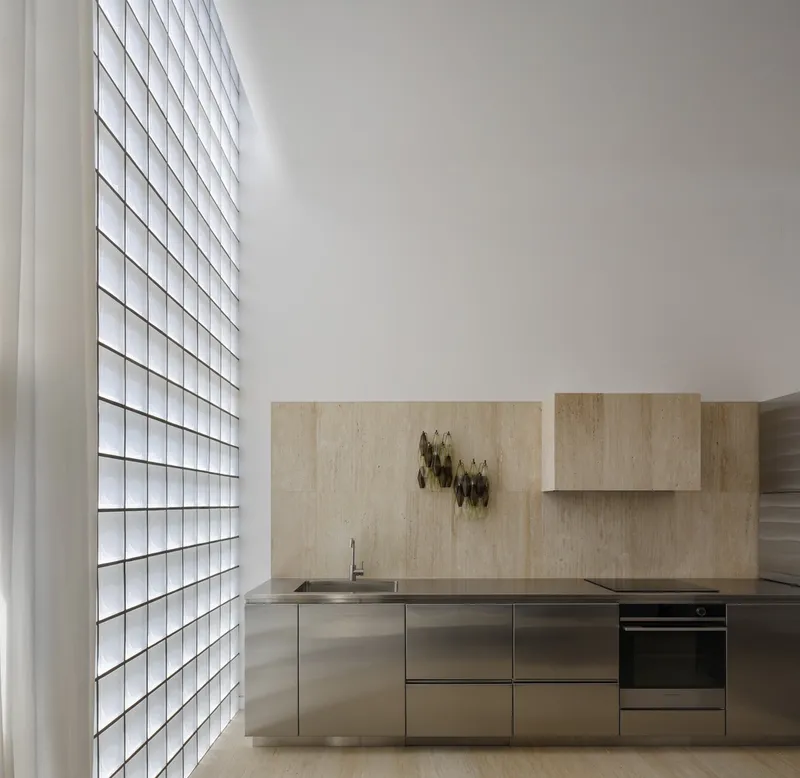
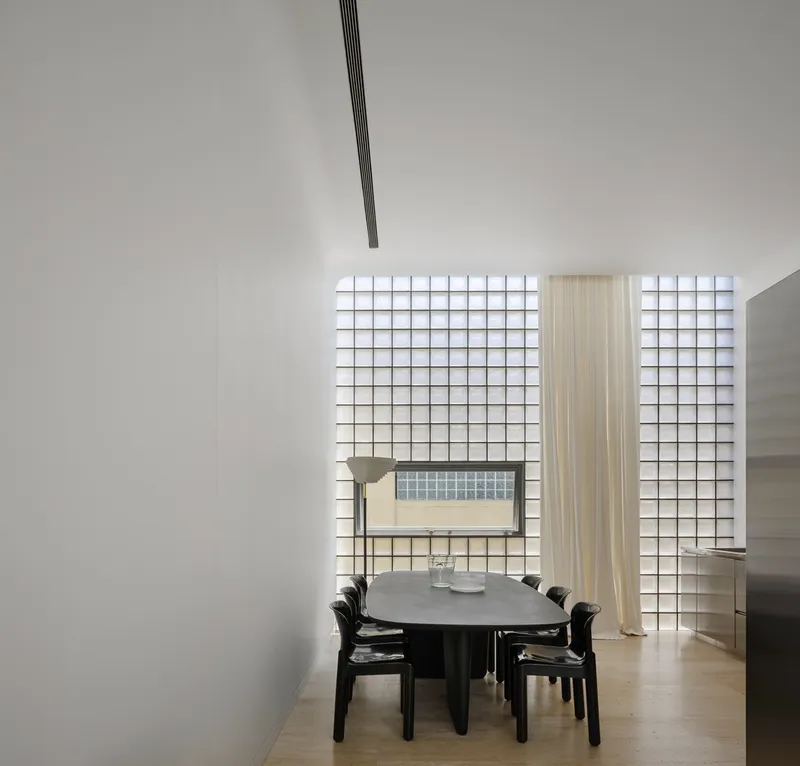
Spatial Strategy and Efficiency
Every square meter in the 141 m² interior is optimized. With only four square meters dedicated to circulation, the home flows effortlessly thanks to a concrete and steel spiral staircase, and a smartly integrated walk-through ensuite. Each level boasts generous ceiling heights, invoking a spatial richness typically reserved for grand terrace homes. The stair’s placement also opens up the interior, enabling unobstructed views across the full 4.7-meter width of the home.

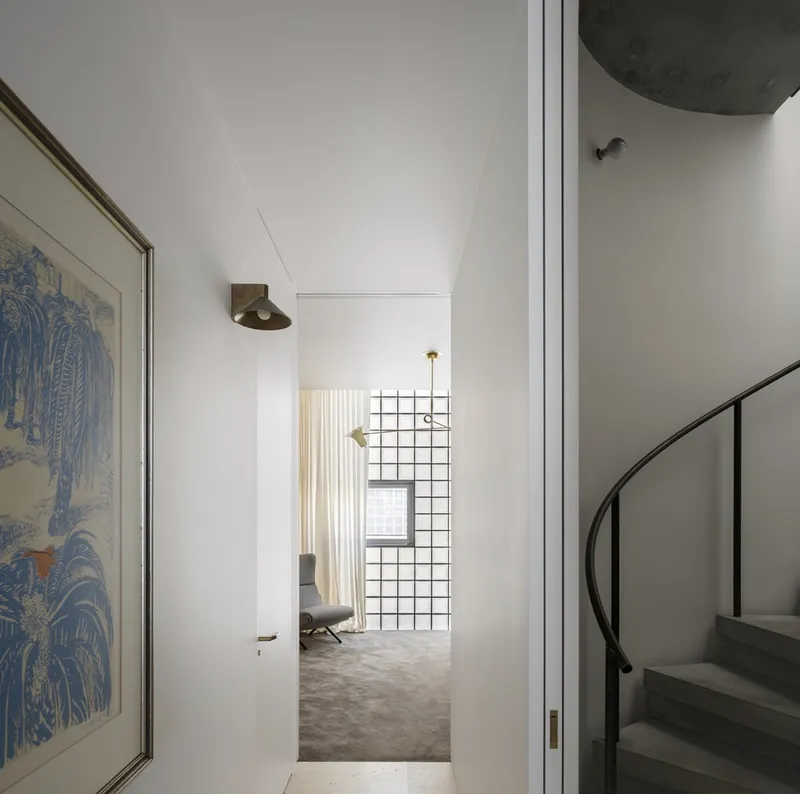
Material Honesty and Refined Detailing
Henry Wilson’s influence is evident in the home’s pared-back material palette, which merges elemental finishes with refined detailing. The burnished concrete slab at ground level is both durable and elegant, while travertine tiles without grout lines lend a luxurious, seamless feel to wet areas. Cost-effective yet expressive choices, such as sandblasted standard glass blocks, create a signature western elevation that softly diffuses daylight through all three floors—serving both aesthetic and passive lighting functions.


Sustainable Urban Infill
The Laneway Glass House is more than a compact dwelling—it is a case study in sustainable urban infill architecture. By reclaiming an underutilized site, the project avoids the excesses of overdevelopment and instead focuses on clever planning, thoughtful design, and spatial quality. It challenges the idea that dense housing needs to feel cramped or compromised.
Brad Swartz emphasizes this ethos: “What the building lacks in width, it more than makes up for in spatial volume and quality of light.” The result is a light-filled, tactile, and liveable space that exemplifies how small footprints can still accommodate ambitious architectural visions.


All Photographs are works of Tom Ferguson, Katherine Lu


Popular Articles
Popular articles from the community


LT2A and OPEN Architectes Thread a Brick and Glass High School Through a Wooded Belgian Campus
In Braine-l'Alleud, a 3,000 m² wing for Collège Cardinal Mercier pairs pale brick with a glazed colonnade, deferring to a small chapel and a dense wood.

U.GA Architects Wraps an Oval Rooftop Pool in Curved Board-Formed Concrete on Busan's Jeollidan-gil
In Busan's Jeonpo-dong, a 454 m² mixed-use block stacks a neighborhood facility, guest rooms and an oval rooftop pool inside spiraling concrete walls.

Juan García Correa, John González and Claudia Rueda Sink a Circular Amphitheater into a Manizales Engineering Building
On the La Nubia campus in Manizales, Colombia, the S1 Building folds labs and offices into a hillside of ramped lawns that double as a campus route.

Cube Design Draws an Ecological Corridor Between Two Shenzhen Hills with the Nankai Building
Beside Shenzhen's container docks, the Nankai Building pairs stacked balconies with a climbing green screen to connect two hillsides across its height.

Similar Reads
You might also enjoy these articles


Hodi-Mandai Geram
Project Function: Preservation and revitalization of the Intangible heritage and socio-spatial identity of the Hodi by Housing, Cultural Memory Center, Sacred Grove, landscape, local tourism economy


Olio Towers: A Mid-Rise for Performers That Fuses Housing, Rehearsal, and Stage
Located blocks from Houston's Theater District, this modular tower stacks living units around a central performance atrium.

Oasis: Modular Green Housing Carved into Dhaka's Urban Fabric
A shortlisted Plugin Housing entry reclaims unauthorized settlements in Dhaka with stepped concrete volumes, green roofs, and ventilation-driven design.

Black Hole: A Floating Megastructure for the Post-Physical Era
Emiliano Mazzarotto envisions a spherical, self-scaling arena where e-sports, digital hotels, and holographic stadiums replace traditional public space.

Explore Housing Competitions
Discover active competitions in this discipline

Challenge to reimagine the Iron Throne

Photograph architecture without architects

Illustrate the lost glory of Angkor Wat - Render Challenge

Design challenge to reuse E-waste
Comments (0)
Please login or sign up to add comments
No comments yet. Be the first to comment!