
Las Casas De Beata
Adaptive Social Housing Community for Students

How did the context of the site influence the design?
The design of the student housing considered the history of the site as an oil depot and its existing environment. It has the Pasig River to the north that used to be a major passageway during the Spanish colonization era but has turned derelict over the decades. Instead of the picturesque riverside view, the river allows noise from the sirens of passing barges and odor from the trash that has accumulated in the river to affect the surrounding area. Considering this, treatments for improving the olfactory and auditory quality inside the student housing have been applied.

What was the concept behind the project?
"Correa Design: The Integration of mandala to student housing spaces and technologies"
Going back to the basics, the form of the structure is inspired by the shape of a “Mandala”, a complex abstract design that is usually circular in form often deemed a diagram or symbol of an ideal universe popularized in Indian Culture, the shape invites the users and stakeholders to the new form for student housing. The form is elastic and scalable which allows the structure to easily expand while still connected to the main structure.
The main characteristics of a mandala are that it has broad dimensional geometric composition yet still measured, and as it symbolizes development, good luck, and attraction of wealth and success. It is well demonstrated that the geometric elements of a mandala have real, measurable benefits relative to such human performance as productivity, emotional well-being, stress reduction, learning, and healing. Thus, the overall concept shows how the facility sets the extensive design in motion.
Different schemes were made before arriving at the final form of the structure. Each scheme has its advantages and disadvantages.


First 2 schemes, A circular form that makes use of towers and a typical rectangular structure that is massive and bulky.

The 3rd scheme is a massive semi-circular structure instead of multiple towers. This would enable the structure to accommodate all the necessary facilities of student housing.

The 4th scheme is a hexagonal structure divided into 2 structures, a bulky core, and the cascading blanket. This form aims to emulate what Manila could be in the future. However, this form is not as inviting as the other forms due to the massiveness of the structure and its enclosed courtyard.
What other aspects were taken into consideration?
Economy/Feasibility
The project will also provide a livelihood for the local community of the site through employment in the facility and business center which encourages and educates the community. Helping students’ lodging will help nurture the future generations of the nation making it a vital part of the country for its economic and social significance.
Sustainability
The warm and humid climate has always been a major factor to be considered when building in the Philippines. Failing to answer this problem or consideration would most likely lead to the occupants making use of an air conditioner to improve their comfort thus leading to increased consumption of electricity. Another factor to be considered is the amount of natural light that penetrates the structure. Increasing the amount of natural light that reaches the building would lessen the use of artificial lighting and reduce the consumption of electricity The project solves these two considerations through the employment of passive cooling and sizable fenestrations. These strategies help reduce the building’s electrical consumption and in turn, would help reduce the number of greenhouse gasses released into the atmosphere. The structure also made use of operable brise soleil to provide and control the amount of light and heat the structure receives.
Health
As of 2020, the outbreak of coronavirus (Covid-19) pandemic also led to the provision for proper sanitation, social distancing, and hygienic conditions, being essential for the protection of human health. An environment in which students can safely study away from formal face-to-face academic learning may later have repercussions on one’s mental or psychological health.
How were the objectives of the project addressed?
The units for the twin sharing and solo studio are designed similarly with the difference of the solo studio having more area for the attached bathrooms. The modular units are sized uniformly with provisions for personalization for the students to incorporate their own personal touch.
In terms of economic solutions, regular-shaped rooms, and structures only needed typical construction methods to build. The structure is mostly made of reinforced concrete which is much cheaper compared to other construction materials in the Philippines. These solutions have been implemented to provide the students with opportunities to reduce living costs.
The design of the housing units features to improve the efficiency of the occupants. (Efficient: functionality balanced with aesthetics, creativity, and comfort achieved with minimal resources and smart solutions/interventions)
Lastly, common spaces have been provided such as the dining hall, co-working space, and the park where the occupants can socialize while doing different aspects of their routine. By having them eat together in a communal dining hall, they are more likely to make plans together outside the housing facility while sharing their meals. Studying and maintaining their physical health while being able to socialize also encourages them to do it more because of the added benefit of socialization.
What affected the massing and organization of elements?
Site
The massing within the site is situated in such a way that sightlines from the adjacent roads, from the West and South, are created towards the site using the buildings. This is then supplemented by a garden, which is made of diagonal pathways; Not only to create pathways leading to each circulation space of respective buildings but to also lead people into seeing the area through multiple angles and views. Rest areas and various vegetation also play as points-of-interests within these diagonals, acting as communal space.
Buildings
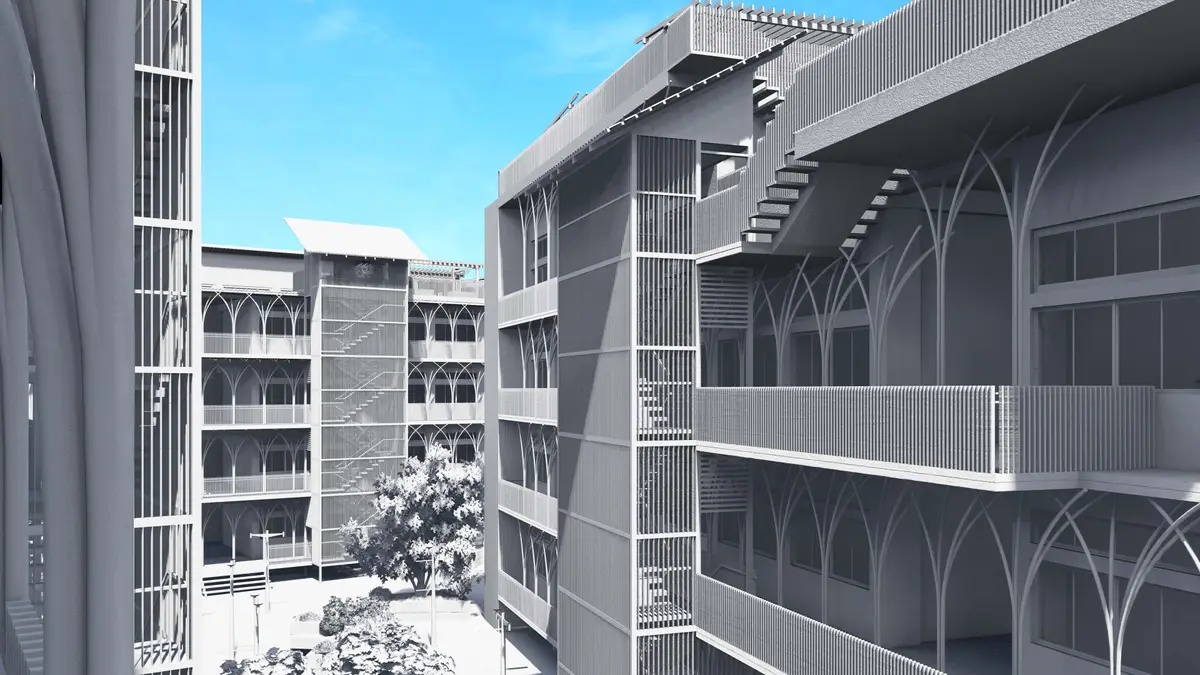
The three (3) buildings are much like matryoshka dolls; units within clusters, clusters within masses. A metric approach was used wherein units are connected using a central corridor and a common space to create clusters for ease of navigation.
These clusters are then situated next to each other, connected by an inner and outer corridor; An arch is located in between clusters of the inner corridor to alert the user that they are entering another cluster. These clusters create each floor and a collection of floors create the buildings seen on the site. Building A creates a terrace-like form which also helps in creating a diagonal site line towards the center of the site. Buildings B and C are similar, rectangular forms. These buildings are then faced toward the garden to create a major communal space.
Architecture
The louvers (mainly the railings and the stairwell) become the main feature in the circulation spaces towards and within the building. These are also present in the balconies of selected units for consistency. The stairwell, however, is composed of a steel frame with the louvers acting as jalousies, which can be turned and closed during gloomy weather.
A combination of the bahay kubo (Filipino vernacular house) and the bahay na bato (Common house during the Spanish colonization in the Philippines), the building is elevated with stilts and features a mixture of wood and concrete in place of stone.
The treelike arch was created to convey an arcade in the outer corridor which turned out to be one of the unique features of the design. The curves of the arches juxtapose the linear design of the modular units and clusters, making them stand out within the building. Lastly, the silhouette of the arches provides a seamless transition from the vegetation of the garden to the interiors.
How we chose the materials
The price is our primary consideration when choosing what material to use in the structure. So the structure is mostly made up of concrete since concrete is cheaper compared to wood in the Philippines. Accompanying this thought, turfgrass is used instead of real grass for the roof deck to reduce costs and minimize maintenance while still providing the same visual effect desired.
Expansion Plan
Spaces above the structures and the parking lot are allotted for future expansions. Floors can be added to the buildings to accommodate additional tenants/ students. Since the structure makes use of stilts, another building can be added above the parking area.
What would the structure look like in the future?
One of our considerations is the future plan for the old oil depot adjacent to the site. The government wants to turn it into a small green business district. The structure would blend in the neighborhood but would be bulkier in the future due to the added floors and buildings but it would still retain its rectangular form. The courtyard in the middle of the structure would be one of the few oases in the middle of the dense concrete jungle of Manila.


Popular Articles
Popular articles from the community


Cloaked Colonization: A Mobile Underwater Habitat That Moves Like a Fish
Micah Abaya's shortlisted EHC Pacific entry reimagines ocean settlement as a dispersed network of self-sustaining architectural organisms.

Tsunami Convergenics: Turning Catastrophic Ocean Forces into Underwater Housing Infrastructure
A speculative underwater settlement off the coast of Onagawa, Japan, treats tsunamis and typhoons as energy sources rather than threats.

Singing Woman: Contemporary Architecture Inspired by Estonia’s Voice and the Sea
Singing Woman turns Estonia’s song culture into flowing opera house architecture, blending public life, landscape, sea, and national memory.

Temporary Home for Dogs: A Reversed Zoo Rethinks Animal Shelter Architecture
In Bucharest, a sinuous corridor and freed landscape flip the logic of containment, designing a shelter that works to make itself unnecessary.

Similar Reads
You might also enjoy these articles

The Rhythm of Seasons
A Farmers' Market Connecting Nature and the City

More Than a Building-Designing a Living System
More Than a Building-Designing a Living System
Base Beyond
DESERT COMPOUND ARID: TOURISM OF ABSENCE AND ABUNDANCE


Comments (0)
Please login or sign up to add comments
No comments yet. Be the first to comment!