

Le Monstre de Clignancourt: A Parametric Architecture Intervention in Urban Voids
Parametric architecture transforms Paris urban void into a luminous ecological canopy, merging public space, light systems, and adaptive design.


In the evolving discourse of contemporary architecture, parametric architecture has emerged as a critical tool to reinterpret complex urban conditions. Le Monstre de Clignancourt, an Honorable Mention entry of the Salut Paris competition by Johan Steenberg, positions itself within this paradigm by transforming an overlooked infrastructural void into an adaptive, performative public environment.
Situated along the abandoned stretches of the Petite Ceinture in Paris, the project confronts a fundamental contradiction of the modern metropolis. As cities expand vertically to accommodate density, they increasingly detach from the ecological and material ground they inhabit. This proposal reframes that disconnect, not as a deficit, but as an opportunity to construct a new hybrid landscape where architecture, ecology, and social activity converge.
Reframing the Urban Void Through Parametric Systems
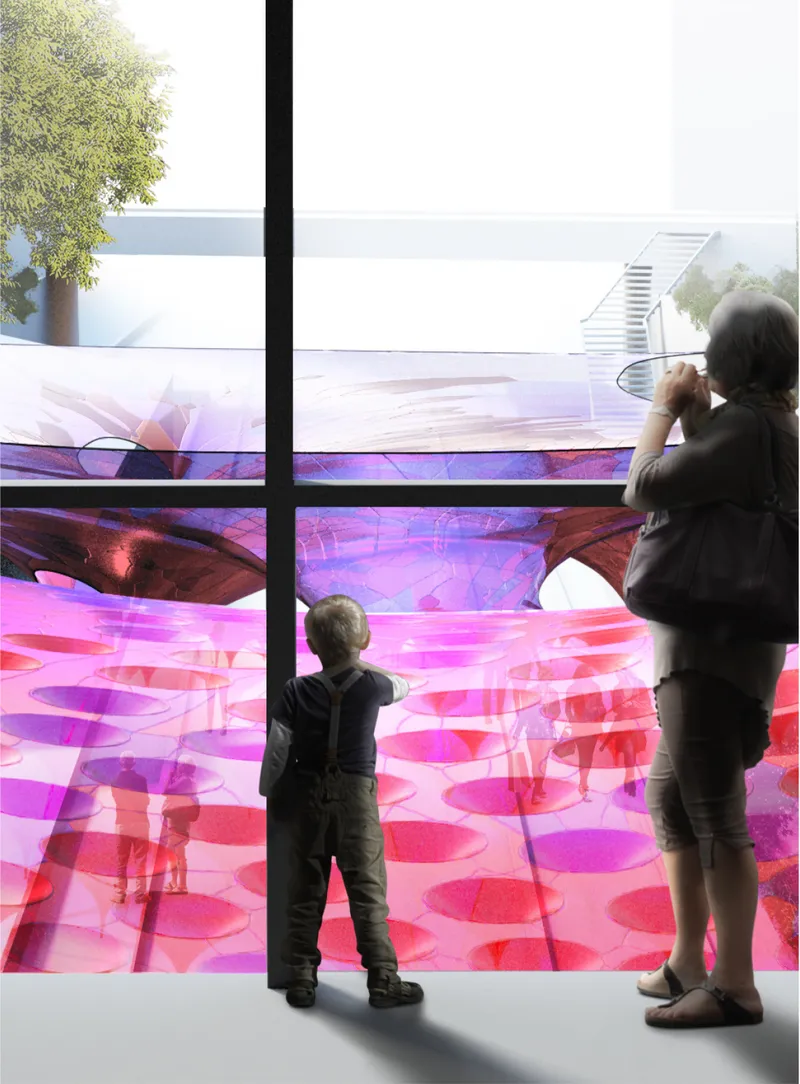
The project identifies the linear railway corridor as both a constraint and a latent spatial generator. Instead of interrupting or overwriting the existing infrastructure, the design introduces a continuous parametric canopy that operates as a connective surface across the site.
This canopy is not a static architectural object. It is conceived as a responsive system that adapts to programmatic, environmental, and spatial conditions. Its geometry stretches, dips, and expands to accommodate circulation, gathering, and ecological growth. The result is a fluid architectural language that enhances the inherent linearity of the site rather than opposing it.
By extending from tunnel interiors to open landscapes, the canopy creates a seamless transition between underground and surface conditions. It acts as a mediator between movement and pause, between transit and habitation.
Light as Material: Photosynthetic Architecture
One of the most technically compelling aspects of the proposal lies in its integration of fluorescent solar concentrator (LSC) technology. The canopy is embedded with a material system capable of capturing daylight and converting it into wavelengths optimized for plant growth.
This transforms the architectural surface into an active environmental agent. Light is not merely admitted or filtered, but recalibrated and redistributed. The canopy collects sunlight, concentrates it, and diffuses it into the subterranean and shaded areas of the site.
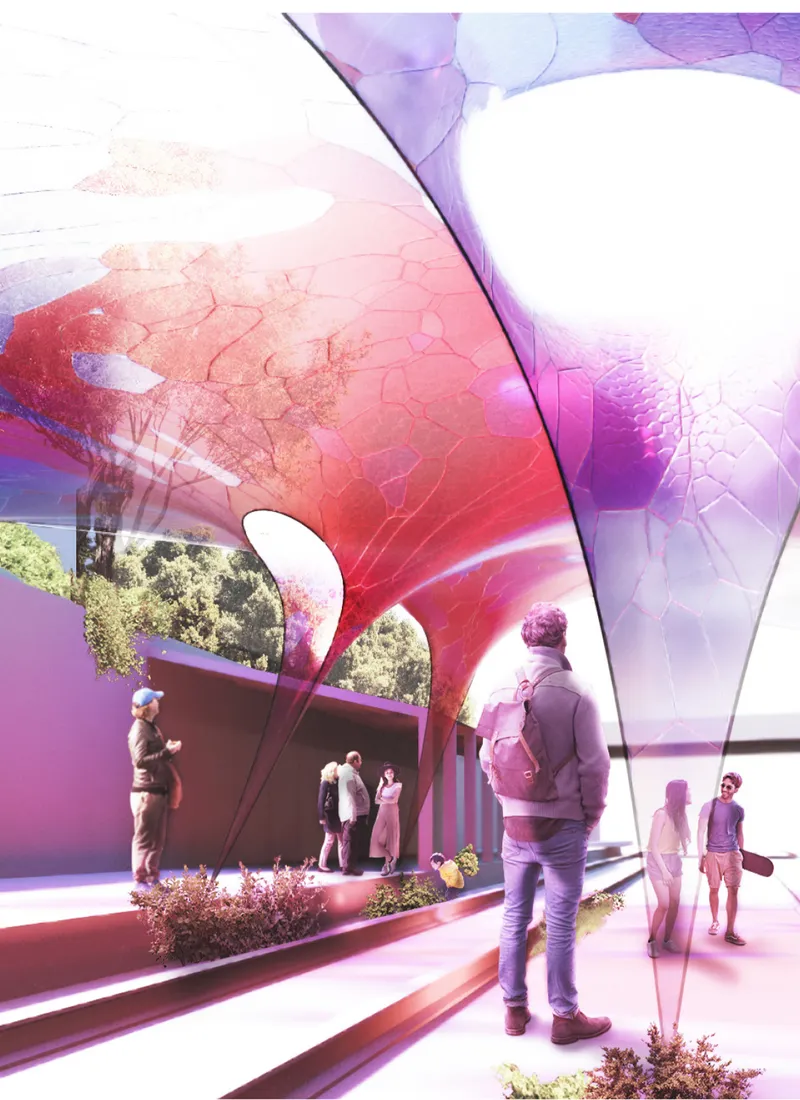
The effect is twofold. First, it enables vegetation to thrive in conditions that would otherwise be inhospitable. Second, it creates an immersive spatial atmosphere defined by gradients of magenta and violet light, evoking both natural and synthetic environments.
This approach situates the project within a broader trajectory of performative architecture, where material systems actively participate in ecological processes.
Programmatic Flexibility and Social Activation
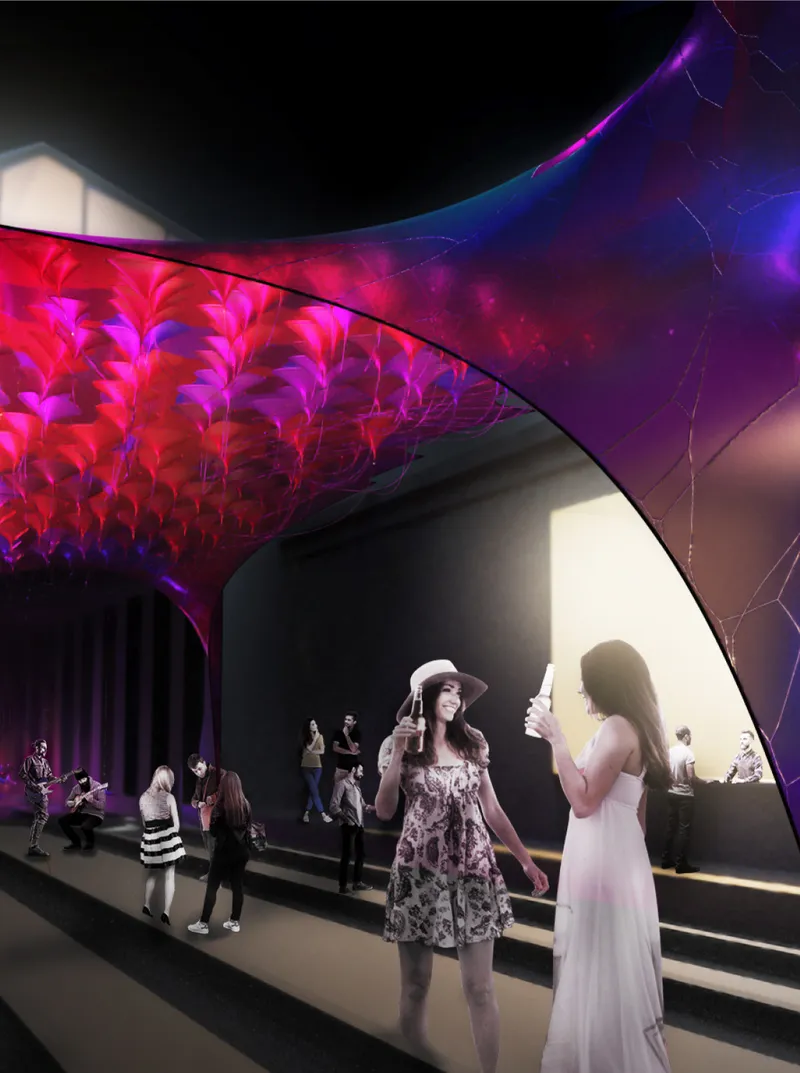
The project operates as an open framework rather than a fixed program. Under the canopy, a range of activities can coexist and evolve over time. Markets, workshops, performances, and informal gatherings are accommodated within a series of spatial variations generated by the parametric surface.
The central zone functions as a venue space, while peripheral areas support quieter, community-oriented uses such as urban agriculture and small-scale production. The design also anticipates temporal adaptability. Sections of the canopy can be enclosed or opened depending on climatic conditions or event requirements.
This flexibility aligns with contemporary approaches to public space design, where adaptability and user agency are prioritized over rigid programming.
Ecological Integration and Material Economy
At its core, Le Monstre de Clignancourt proposes a synthesis of architecture and ecology. The project incorporates greenhouse systems, water collection mechanisms, and biodiversity zones within its spatial framework.
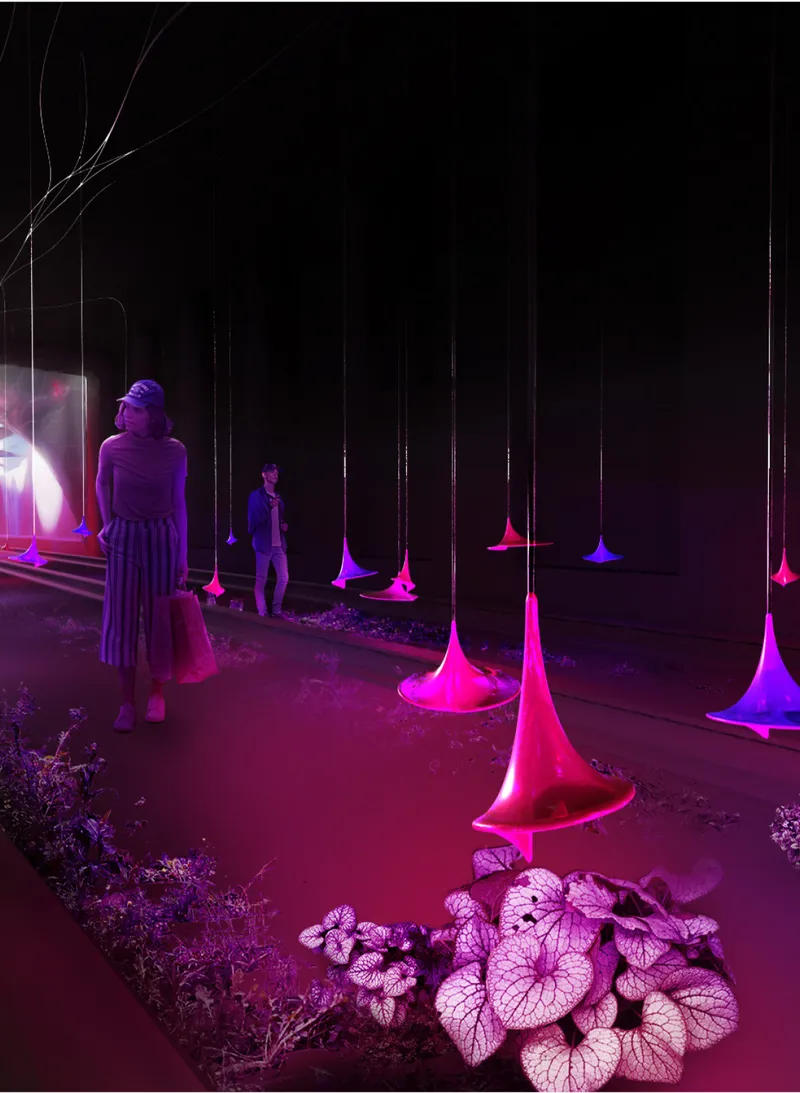
Rainwater is collected and directed through the canopy’s geometry, creating visible flows that animate the space. Vegetation is integrated both at ground level and within suspended systems, reinforcing the idea of growth emerging from the urban substrate.
Importantly, the design achieves this complexity through an economy of means. The canopy is conceived as a single continuous surface made from readily available polymers, leveraging material flexibility to achieve structural and spatial variation. This approach reduces construction complexity while enabling large-scale impact.
A Spatial Narrative: From Surface to Subterranean
The experiential sequence of the project is carefully choreographed. Visitors enter from the urban edge and descend into a transformed landscape where light, color, and form redefine their perception of the site.
Above ground, the canopy appears as a delicate, stretched membrane. Below, it becomes an immersive interior condition where light is concentrated and diffused. The tunnel, once a neglected infrastructural remnant, is reimagined as a luminous corridor of activity.
This vertical layering of experience reinforces the project’s conceptual ambition: to reconnect the city with its buried ecological and spatial potentials.
Jury Reflections
The project received strong recognition from the jury for its conceptual clarity and material efficiency.
Rachel Luchetti described the proposal as “overall an inspiring idea,” acknowledging its ability to reimagine neglected urban conditions through a compelling architectural narrative.
Fuensanta Nieto noted that “the concept of the floating surface could work if it incorporates both connections to the city and new spaces within it,” highlighting the importance of integrating the canopy with broader urban systems.
Manuel Zornoza emphasized that the “economy of means gives a surprising result,” pointing to the project’s strategic use of simple materials to achieve complex spatial and environmental effects.
Toward a New Urban Ecology
Le Monstre de Clignancourt ultimately positions parametric architecture not as a formal exercise, but as a tool for urban regeneration. By combining computational design logic with ecological performance and social inclusivity, the project proposes a new model for engaging with urban voids.
It challenges conventional distinctions between infrastructure, landscape, and architecture, instead offering a hybrid system that evolves over time. In doing so, it suggests that the future of cities may lie not in expansion alone, but in the intelligent reactivation of what has been left behind.
Through its integration of light, material, and program, the project demonstrates how architecture can operate simultaneously as structure, environment, and experience. It is within these layered conditions that the true potential of parametric architecture begins to emerge.


Popular Articles
Popular articles from the community


Manzana Morphosis: Stretching Barcelona's Grid into a Living Landscape for 2050
A radical reworking of the Eixample manzana turns density into a tool for generous public space, vertical ecology, and environmental performance.

Opera on the Sea: Driftwood Logic Shapes a Timber Opera House on Estonia's Coast
Trevor Orgill's opera house translates the entangled drift of floating timber into a civic building where wood, water, and music converge.

Faces of the Soviet Avant-Garde: Turning Moscow's Street Names into an Open-Air Museum
A network of sculptural installations across a Moscow residential district transforms forgotten architect names into spatial encounters with cultural memor

Opera by the Sea Estonia: Three Shells Dissolving Architecture into Tallinn's Coastline
A winning opera house proposal replaces monumental form with interconnected shells that blur the boundary between building, park and Baltic Sea.

Similar Reads
You might also enjoy these articles

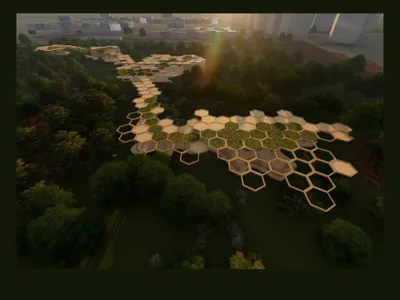
Eco Chapel: A Green Architecture Pavilion Designed in Symbiosis with the Forest
Eco Chapel uses green architecture to weave prayer, learning and reuse into a forest pavilion shaped by modular hexagonal canopies for life.
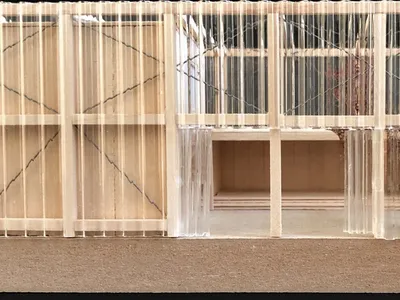
Kaffeebühnen: Coffee Shop Architecture Designed as a Civic Stage Between Vienna’s City and Park
Kaffeebühnen turns coffee shop architecture into a civic stage, linking Vienna’s park edge, urban life, warm timber yards, and coffee craft.
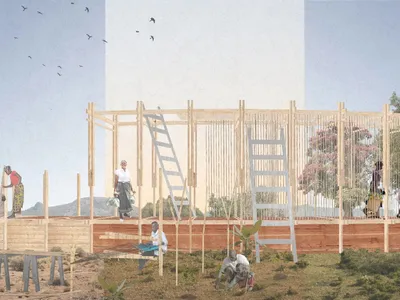
Healing Façade: Sustainable Architecture for Reforestation, Community, and Sacred Ecology in Ethiopia
Healing Façade reimagines sustainable architecture as a living wall that restores soil, catches water and renews Ethiopia's forest churches.


Urban Forest: A Vertical Ecosystem for 5,000 Workers in Singapore's Changi Business Park
Radially stacked pods and layered green decks turn a 7-acre plot into 47 acres of ecological workspace projected for 2040.

Explore Architecture Competitions
Discover active competitions in this discipline

Challenge to reimagine the Iron Throne

Photograph architecture without architects

Illustrate the lost glory of Angkor Wat - Render Challenge

Design challenge to reuse E-waste
Comments (0)
Please login or sign up to add comments
No comments yet. Be the first to comment!