
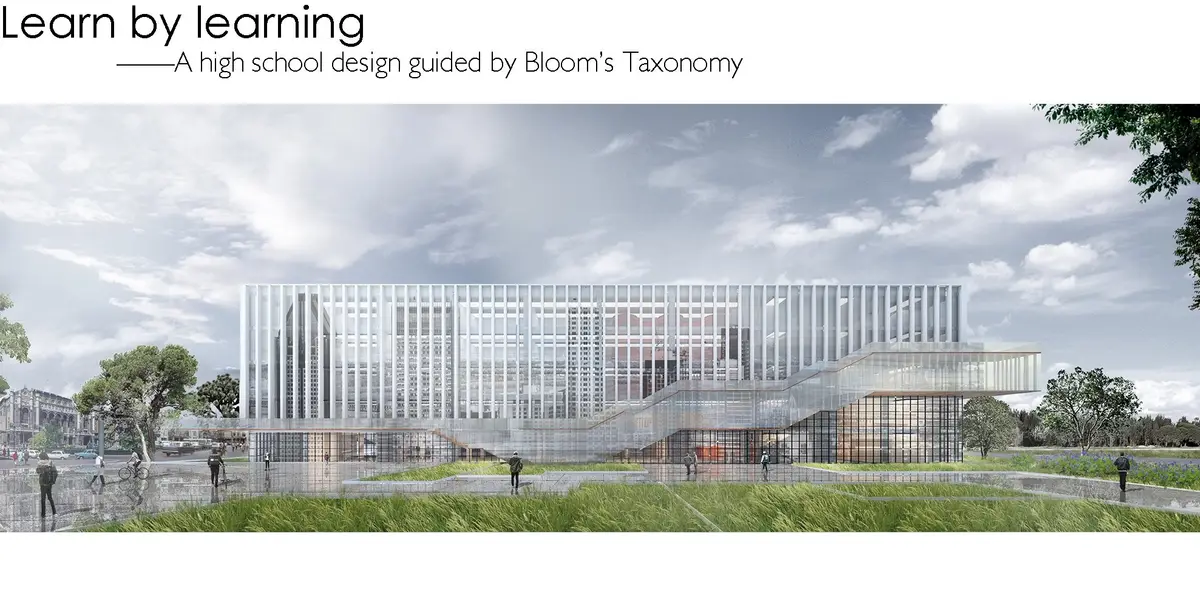
Learn by Learning: A High School That Builds Bloom's Taxonomy Into Its Plan
Zhenquan Fang turns thinking, feeling and doing into three interlocking spatial domains, with a spiraling atrium binding the school to its city.


Most schools are organised around where students sit. Learn by Learning is organised around how they think. The project takes Bloom's Taxonomy, a framework educators have used for decades to structure curricula, and treats it as a spatial generator for a high school. Knowledge, emotion and action stop being abstract learning objectives and become three distinct but connected families of space, each with its own architectural character.
Designed by Zhenquan Fang, the proposal received an Honorable Mention in School Of Thought 2020. Fang starts from a sharp critique: the traditional classroom, built for static knowledge transfer, no longer serves the cognitive, emotional and behavioural needs of students. The response is a school conceived as a learning ecosystem rather than a set of compartments, and as a civic presence rather than a closed institutional block.
Three Domains Replace the Corridor-and-Classroom Diagram
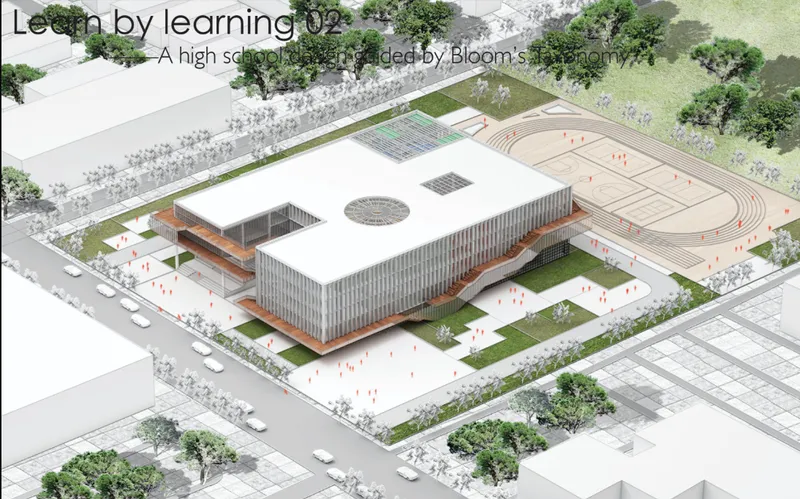
Bloom's model sorts learning into the cognitive, the affective and the psychomotor. Fang's move is to give each of these its own spatial zone and then make the transitions between them the real substance of the building. The familiar sequence of classroom, corridor and auditorium dissolves. In its place is a set of spatial sequences in which a student can move from thinking to feeling to doing without passing through a dead circulation zone.
This matters because it reframes the building as a pedagogical instrument instead of a passive enclosure. The architecture does more than accommodate a curriculum. It proposes one, suggesting that the order and adjacency of spaces can shape the order and adjacency of ideas.
Reading Pods to Canvas Zones: A Gradient of Concentration
The cognitive domain is not a single room type but a spectrum. Structured classrooms sit alongside canvas cognitive zones, virtual learning environments and personal reading pods, so a student can calibrate their surroundings to the task, whether that is solitary focus or group exchange. The emphasis on gradation is the strongest idea here: knowledge work is rarely all quiet or all collaborative, and the plan acknowledges that range.
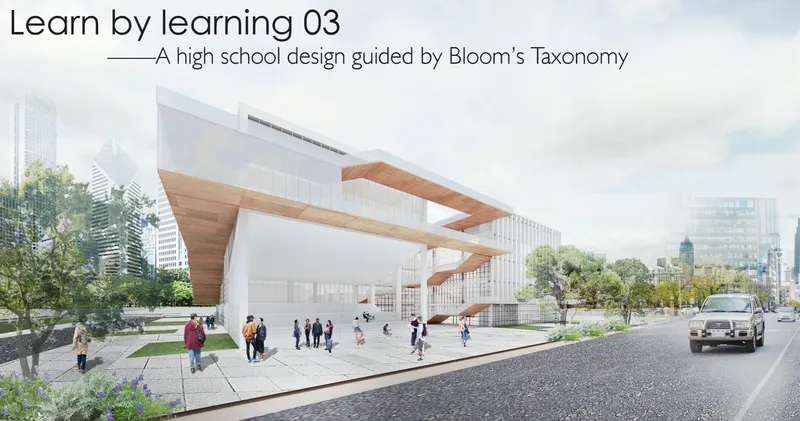
Transparency does much of the work. Visual connections between learning spaces weaken the boundaries between disciplines and invite cross-learning, a spatial expression of the higher tiers of Bloom's taxonomy, where analysis, evaluation and synthesis depend on seeing how fields relate to each other.
A Spiraling Atrium at the Academic Core, Ringed by Workshops
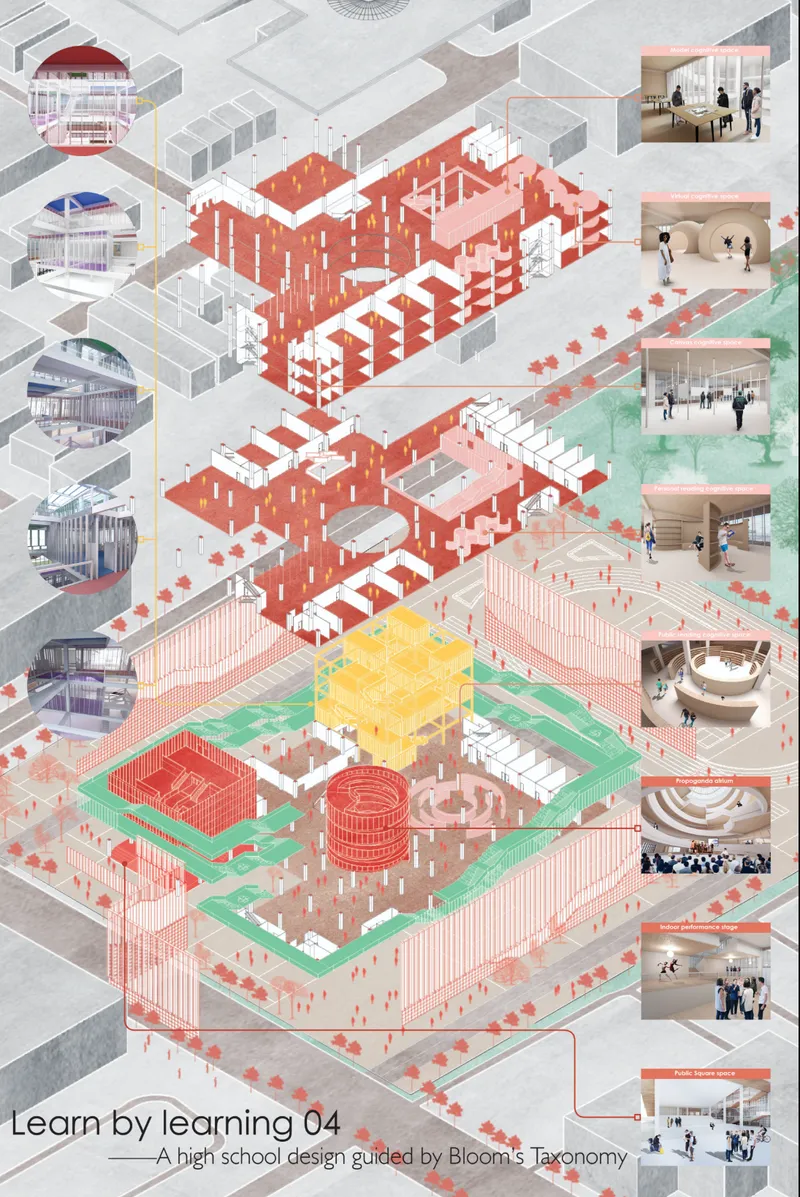
The affective domain centres on what Fang calls the "propaganda atrium", a spiraling, visually connected volume that acts as a social condenser. Its geometry allows students to observe, participate and perform from multiple levels at once. Indoor performance stages and public square spaces extend this emotional register of learning into presentation, debate and shared experience. Crucially, these social spaces are placed inside the academic core rather than pushed to its edges, a clear argument that emotional intelligence deserves the same spatial priority as cognitive development.
The psychomotor domain answers with modular practice units for artificial intelligence, art and design, debate and construction. A multi-platform strategy lets different activities run at the same time, while transparency between modules turns every workshop into a lesson for passers-by. The school becomes a place of production, where knowledge is continuously tested, revised and applied.
A Public Square as Threshold Between School and City
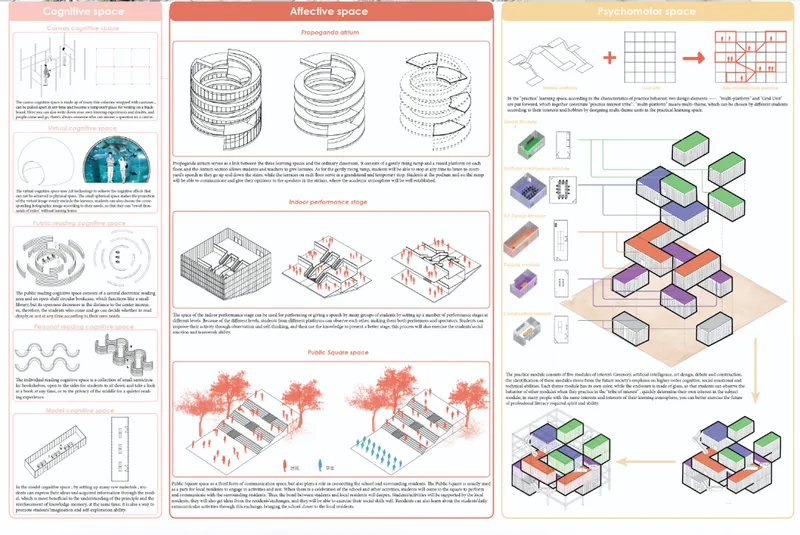
Fang refuses the walled campus. The site strategy introduces a public square that works as a threshold between the school and its surroundings, a space for gathering that belongs partly to students and partly to the city. This is the outward expression of the same logic that governs the interior: if learning happens through interaction and exposure, then the school's edge should invite contact rather than defend against it.
Why This Project Matters
Plenty of school proposals borrow the language of flexibility and openness. Learn by Learning stands out because it anchors those ambitions in an explicit pedagogical framework. By mapping Bloom's three domains onto three spatial families, Fang gives the design a testable logic: every space can be asked which kind of learning it serves and how it connects to the others.
The open question, as with any taxonomy turned into architecture, is whether real learning respects such tidy categories. The project's best answer lies in its transitions, transparency and spiraling atrium, the places where thinking, feeling and doing overlap. That insistence on overlap, more than the categories themselves, is what makes this Honorable Mention a useful provocation for anyone rethinking what a school should be.
View the Full Project
About the Designers
Designer: Zhenquan Fang
Enter a Design Competition on uni.xyz
uni.xyz runs architecture and design competitions year-round that reward proposals with spatial conviction and real site intelligence.
Project credits: Learn by Learning by Zhenquan Fang School Of Thought 2020 (uni.xyz).


Popular Articles
Popular articles from the community


Singing Woman: An Opera House That Performs Before the Curtain Rises
Ovidiu Cristian Pavel's conceptual opera house translates Estonia's choral identity into a sculpted waterfront landmark facing the Baltic Sea.

Opera on the Sea: Driftwood Logic Shapes a Timber Opera House on Estonia's Coast
Trevor Orgill's opera house translates the entangled drift of floating timber into a civic building where wood, water, and music converge.

The Amber Palace Opera: A Geological Fiction Surfaces on Tallinn's Baltic Waterfront
Pierre Brillard reimagines a Baltic legend as a public landscape, opera house, and waterfront promenade rooted in Tallinn's coastal identity.


David Ortega Stacks a Two-Story Mexico City Penthouse Around a Steel Stair and a Pergola-Shaded Roof Terrace
In Colonia Roma, a 300 m² penthouse uses oak joinery, a planted steel stair and a slatted roof pergola to make a new-build apartment feel like a house.

Similar Reads
You might also enjoy these articles
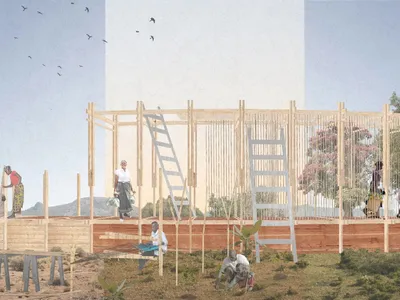
Healing Façade: A Modular Chapel System That Restores Ethiopia's Sacred Forests
Winner of the Eco-Chapel competition, this circular timber façade collects water from air to rebuild soil and reforest degraded Ethiopian landscapes.
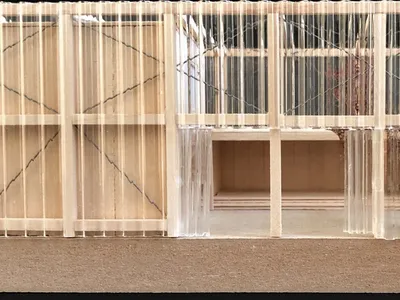
Kaffeebühnen: Where Coffee Shop Architecture Becomes a Civic Stage in Vienna
A linear sequence of timber boxes, transparent shells, and open yards turns the Viennese café tradition into a public performance space.
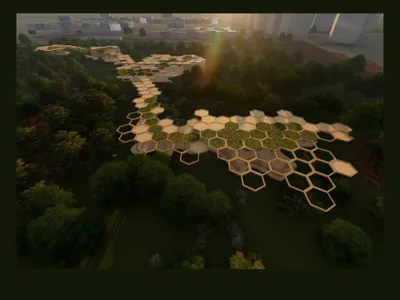
Eco Chapel: A Modular Forest Pavilion That Grows Like the Landscape It Protects
Hexagonal timber modules weave through existing trees, turning a chapel into a living system for prayer, education, and reforestation.


Urban Forest: A Vertical Ecosystem for 5,000 Workers in Singapore's Changi Business Park
Radially stacked pods and layered green decks turn a 7-acre plot into 47 acres of ecological workspace projected for 2040.

Explore Learning Spaces Competitions
Discover active competitions in this discipline

Challenge to design public laboratory

Challenge to reimagine the Iron Throne

Photograph architecture without architects

Illustrate the lost glory of Angkor Wat - Render Challenge
Comments (0)
Please login or sign up to add comments
No comments yet. Be the first to comment!