

KSM Architecture Wraps a Chennai Learning Center in Bamboo-Textured Concrete and Thermal Cavity Walls
A 760 sqm alternative school near the Besant Nagar seafront uses layered passive strategies to keep children cool without air conditioning.


Roughly 300 meters from the Bay of Bengal, on a compact 540 sqm plot in Besant Nagar, KSM Architecture has built a learning center that refuses to behave like a school. The Quest center, completed in 2021, serves children aged 8 to 16 who follow an 'unschooling' model, where curiosity rather than a fixed curriculum sets the agenda. The architecture mirrors that philosophy: there are no corridors channeling students from one box to the next, no uniform classrooms sealed behind closed doors. Instead, the building is a stack of interconnected volumes organized around a full-height central atrium, where an amphitheater, a library, classrooms, and a rooftop cafeteria flow into one another with deliberate informality.
What makes the project genuinely interesting, though, is the wall. In Chennai's punishing coastal heat, the east and west facades are the enemy. KSM's response is a 400mm composite cavity wall: a 300mm inner layer packed with 50mm XPS insulation, then a 25mm air gap, then a bamboo-shuttered GFRC panel acting as a self-shading outer skin. The south and north walls, by contrast, open up with full-length operable windows and aluminum aerofoil louvers, pulling the prevailing sea breeze straight through the building. It is a project where every surface has a thermal argument to make, and the result is a naturally ventilated school that stays comfortable year-round without mechanical cooling.
A Facade That Thinks in Layers
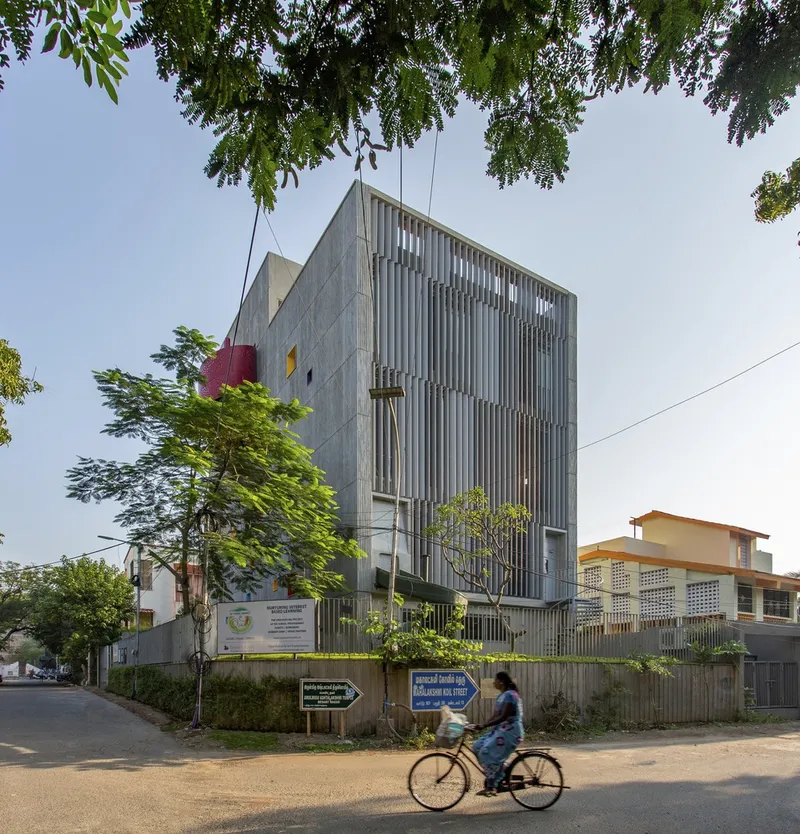
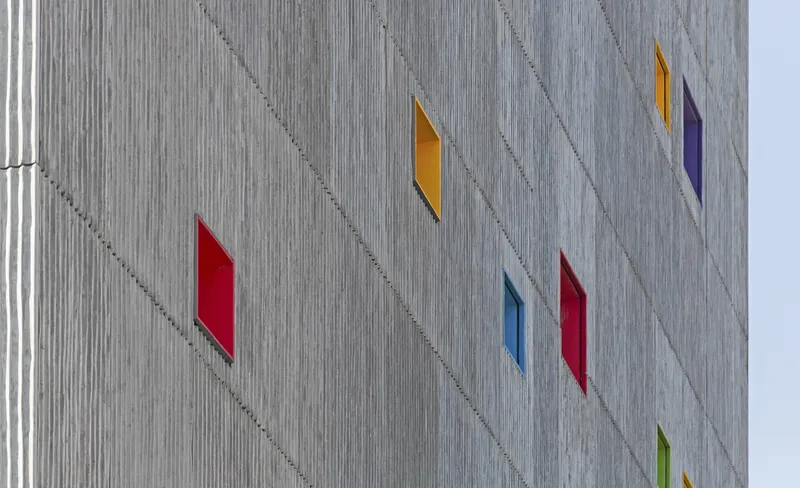
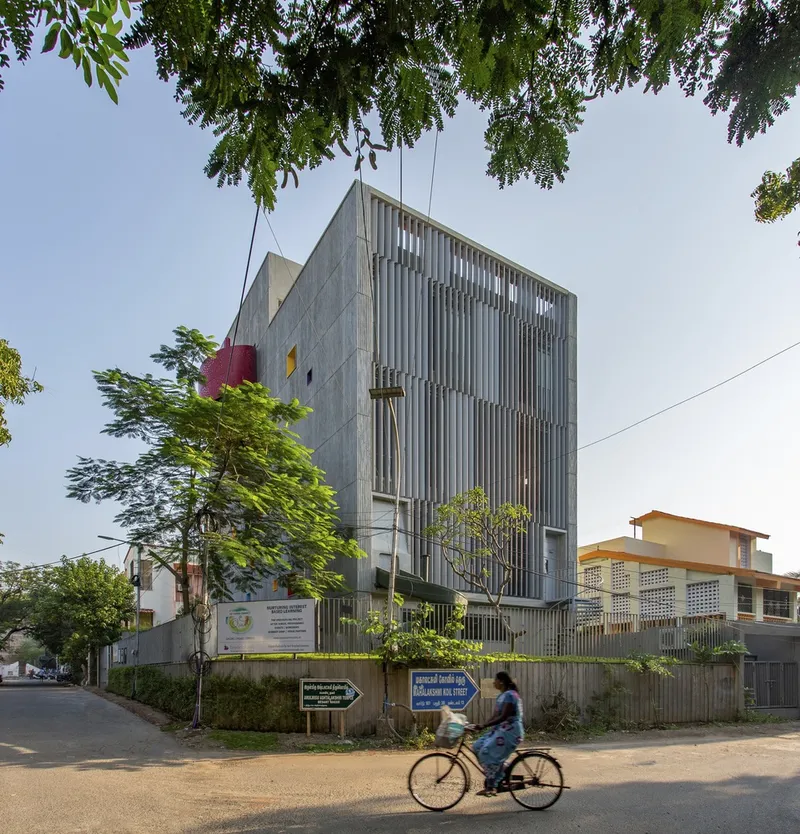
The building's street presence is dominated by vertically ribbed GFRC panels, their surfaces imprinted with the grain of bamboo shuttering. The texture reads as both raw and controlled, a concrete skin that carries the memory of an organic formwork. Scattered across the east and west walls, asymmetrical diamond-shaped openings punched in red, yellow, and purple break what would otherwise be a fortress-like mass. These colored apertures are deliberately few and small on these sun-battered sides, but they signal life inside and give the facade a playful resistance to solemnity.
The vertical aluminum aerofoil louvers on the south facade serve a different purpose entirely. Rather than blocking the sun, they filter the ambient breeze while deflecting glare, creating a shaded threshold between interior and street. Seen from the pavement with a cyclist passing, as in several of these shots, the building reads as porous on one axis and armored on the others. That selective openness is the whole climate strategy made visible.
The Central Atrium and Amphitheater
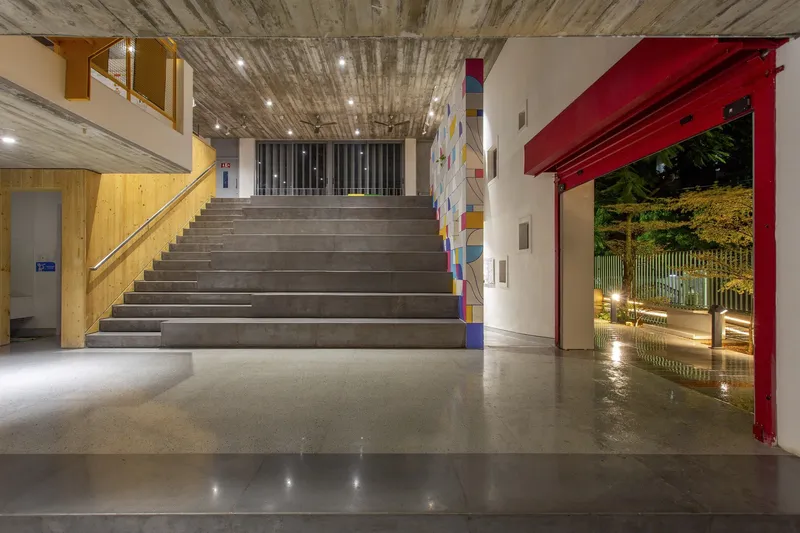
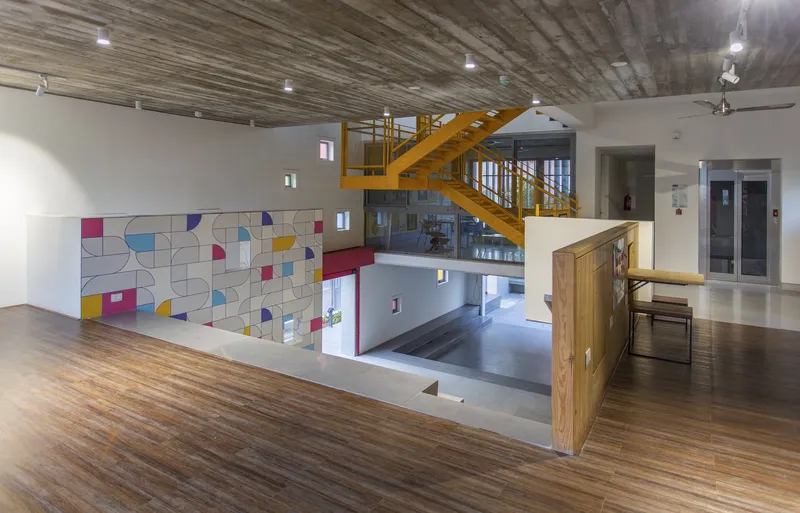
Step through the red roll-up door at ground level and the spatial logic reveals itself immediately. A wide concrete staircase rises from the lobby, doubling as an amphitheater that connects the arrival space to the library above in a single continuous volume. This is not a leftover circulation space dressed up with seating. It is the social core of the building, a place where a dozen children can sit for a group discussion or where one child can sprawl with a book. The exposed timber ceiling overhead adds warmth without fuss.
The five classrooms flanking this atrium benefit from visual connectivity across levels, so a student on the third floor can look down to the amphitheater below. For an unschooling environment, where activities shift unpredictably and age groups mix, this openness is not decorative but functional. It means no one is hidden away, and the building itself becomes a teaching tool about spatial relationships.
Color, Steel, and Vertical Circulation
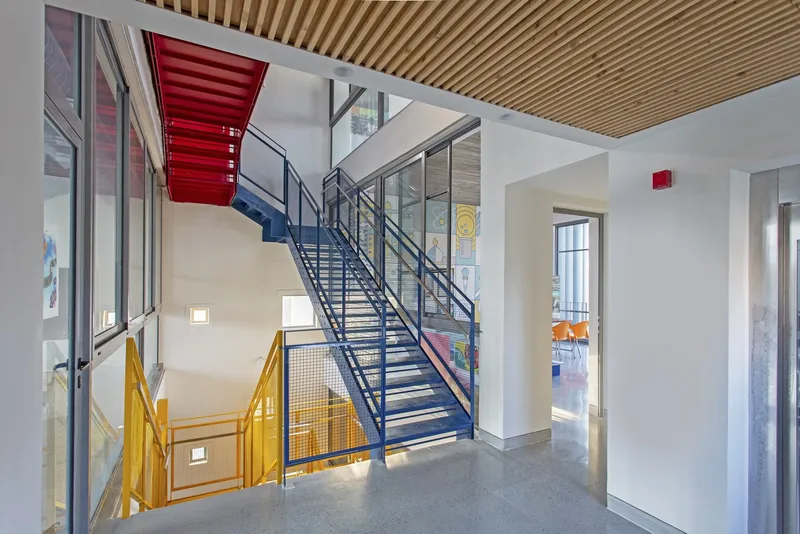
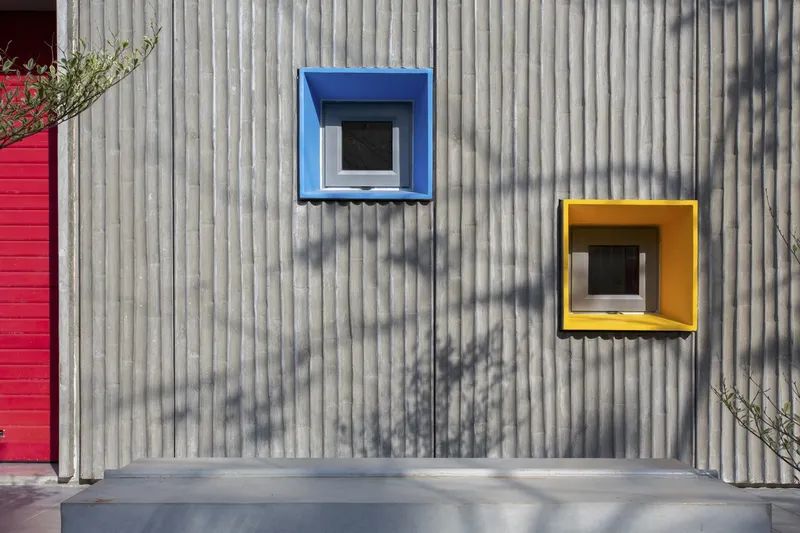
KSM deploys color sparingly but with conviction. The metal staircase threading through the atrium shifts between yellow and red, its industrial materiality softened by hue. Against the board-formed concrete walls and slatted timber ceilings, these steel elements register as precise insertions rather than afterthoughts. The corrugated metal surfaces on the exterior, punctuated by blue and yellow window frames, continue this logic: a limited palette applied with enough variation to feel alive.
At the fourth level, the staircase exits the building envelope and meets a spiral stair leading to the rooftop cafeteria. The transition from enclosed atrium to open terrace is abrupt and rewarding. A landscaped terrace opens to the south, and the prevailing breeze that the building has been channeling through its lower floors arrives here unobstructed. For a building designed around thermal comfort, making the rooftop genuinely pleasant rather than an afterthought is a smart move.
Interior Rooms That Resist Uniformity
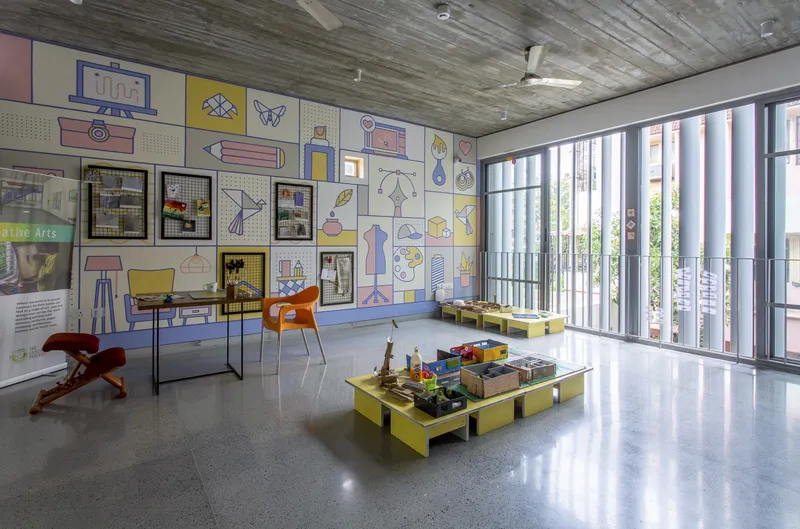
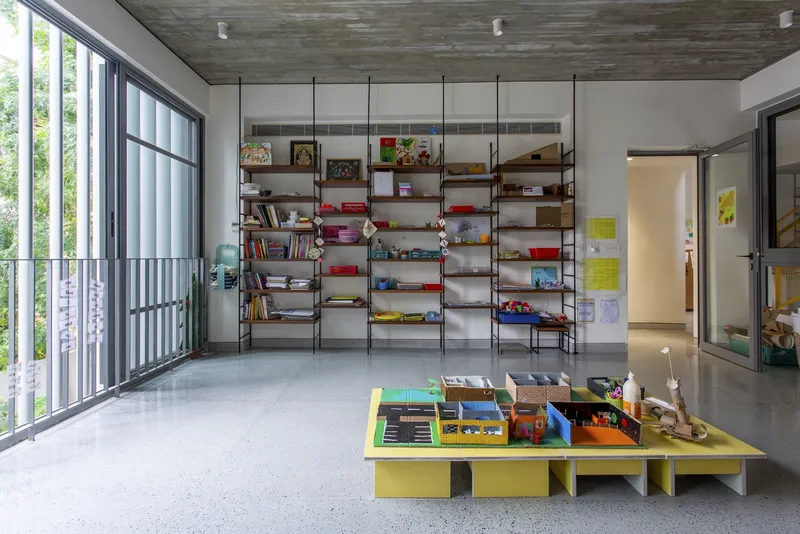
Inside the classrooms and library, KSM leans on a limited material vocabulary: polished terrazzo floors, exposed concrete ceilings, and timber accents. What keeps these rooms from feeling monotonous is the variation in how they are furnished and occupied. The library, with its floor-to-ceiling metal shelving and a low yellow table at the center, is deliberately casual. There is no formal reading desk, no implied hierarchy of seating. The illustrated mural walls in adjacent rooms add narrative texture without demanding attention.
The vertical louvers visible from inside the south-facing rooms cast rhythmic shadows across the floors, producing a natural clock of shifting light. Combined with the cross-ventilation from operable windows on opposite walls, these rooms achieve a quality of comfort that mechanical systems would struggle to replicate with the same subtlety. The absence of air conditioning is not a compromise here. It is a design position, and the layered wall system makes it credible.
Courtyard and Threshold
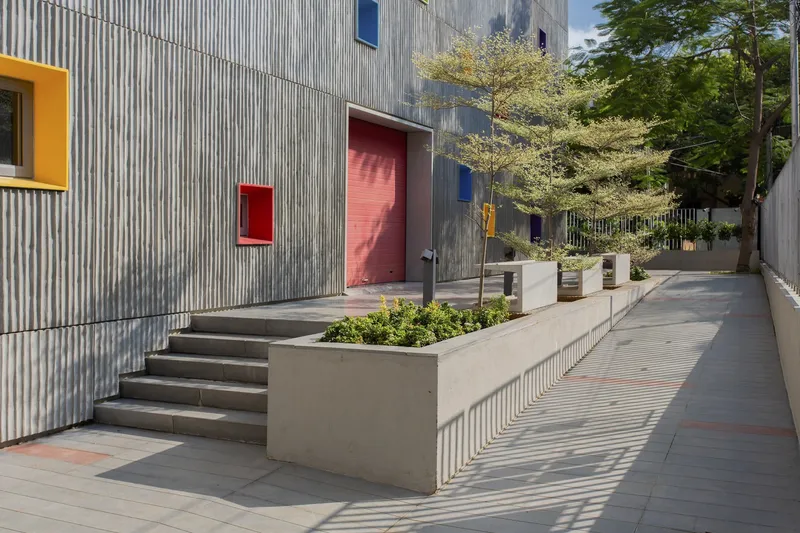
The tree-lined front court, accessible by both steps and ramp, mediates between the busy Besant Nagar street and the building's interior life. Concrete planters, dappled sunlight, and the corrugated facade with its colored openings create a threshold that is simultaneously urban and intimate. The raised garden on the southern side, designed to channel the sea breeze into the building, does double duty as an outdoor play space. A slide from the library drops children directly into this garden, collapsing the boundary between study and play with disarming literalness.
Why This Project Matters
The Learning Center at Quest is a small building with an outsized argument. In a city where most new construction defaults to sealed, air-conditioned boxes, KSM Architecture has demonstrated that a layered passive strategy, calibrated to Chennai's specific wind patterns and solar geometry, can produce a comfortable interior without mechanical cooling. The composite cavity wall system is not exotic technology; it is careful assembly of familiar materials (concrete, XPS, GFRC) in a sequence that makes thermal sense. That this approach costs less to operate and maintains a lower carbon footprint is almost beside the point. The real achievement is that the spaces feel good.
Equally significant is how the architecture responds to its pedagogical brief. Unschooling demands flexibility, visual openness, and a refusal to separate learning from living. The atrium, the amphitheater-staircase, the slide to the garden, and the rooftop cafeteria all serve an educational model that resists compartmentalization. KSM has not simply built an open-plan school. They have built a spatial argument for a different kind of education, one where the building itself participates in the learning.
Learning Center at Quest by KSM Architecture. Besant Nagar, Chennai, India. 760 sqm. 2021. Photography by Sreenag BRS.
About the Studio
Share Your Own Work on uni.xyz
If projects like this are the kind of work you want to make, uni.xyz is a place to publish your own, find collaborators, and enter design competitions.


Popular Articles
Popular articles from the community


FCC Arquitectura Expands a Portuguese Granite House with a Board-Marked Concrete Wing
In Portugal, JV House pairs a cleaned-up whitewashed and granite dwelling with a timber-shuttered concrete extension, courtyards and a garden pool.


The Amber Palace Opera: A Geological Fiction Surfaces on Tallinn's Baltic Waterfront
Pierre Brillard reimagines a Baltic legend as a public landscape, opera house, and waterfront promenade rooted in Tallinn's coastal identity.

Singing Woman: An Opera House That Performs Before the Curtain Rises
Ovidiu Cristian Pavel's conceptual opera house translates Estonia's choral identity into a sculpted waterfront landmark facing the Baltic Sea.

Opera on the Sea: Driftwood Logic Shapes a Timber Opera House on Estonia's Coast
Trevor Orgill's opera house translates the entangled drift of floating timber into a civic building where wood, water, and music converge.

Similar Reads
You might also enjoy these articles


Hodi-Mandai Geram
Project Function: Preservation and revitalization of the Intangible heritage and socio-spatial identity of the Hodi by Housing, Cultural Memory Center, Sacred Grove, landscape, local tourism economy


Olio Towers: A Mid-Rise for Performers That Fuses Housing, Rehearsal, and Stage
Located blocks from Houston's Theater District, this modular tower stacks living units around a central performance atrium.

Oasis: Modular Green Housing Carved into Dhaka's Urban Fabric
A shortlisted Plugin Housing entry reclaims unauthorized settlements in Dhaka with stepped concrete volumes, green roofs, and ventilation-driven design.

Black Hole: A Floating Megastructure for the Post-Physical Era
Emiliano Mazzarotto envisions a spherical, self-scaling arena where e-sports, digital hotels, and holographic stadiums replace traditional public space.

Explore Learning Spaces Competitions
Discover active competitions in this discipline

Challenge to design public laboratory

Challenge to reimagine the Iron Throne

Photograph architecture without architects

Illustrate the lost glory of Angkor Wat - Render Challenge
Comments (0)
Please login or sign up to add comments
No comments yet. Be the first to comment!