

Les Frères Tino House: A Contemporary Twin Chalet Retreat in Orford by Quinzhee Architecture
Two independent cedar-clad chalets connected by a central volume, offering minimalist interiors, mountain views, and a warm, nature-inspired retreat experience.


Les Frères Tino House by Quinzhee Architecture is a contemporary residential project in Orford, Canada, designed to celebrate nature, mountain living, and the serene landscape of Mont Orford. Completed in 2023, the 164 m² project features two independent chalets connected by a central service core, a thoughtful architectural response that harmonizes with the forested surroundings while offering elevated comfort for visitors.

A Triptych Architecture Rooted in Landscape
The design of Les Frères Tino revolves around three distinct volumes:
- Two independent rental chalets
- A central connecting service block
A long linear canopy creates a weather-protected walkway leading to each unit, enhancing both functionality and outdoor comfort throughout seasonal changes. The architecture embraces natural materials, cedar shingles on the exterior and pine board siding inside, allowing the buildings to blend seamlessly into the woodland context.
The two chalets are fully independent, enabling flexible use: they can be rented separately by families or booked together by a large group of up to 16 visitors. Although oriented differently, each chalet offers the same spatial experience and panoramic views.

Ground Floor: Functional Sleeping and Gear Storage Zones
The first floor is conceived as a mudroom-style entry and sleeping level, designed with outdoor sports enthusiasts in mind. Generous storage for skis, bikes, and gear accommodates the active lifestyle associated with Orford’s trails and mountains.
Minimalist bedrooms prioritize comfort and efficiency, using warm wood finishes and understated details to create calm, restorative spaces after a day outdoors.

Upper Floor: Light-Filled Social Spaces Framed by the Mountain
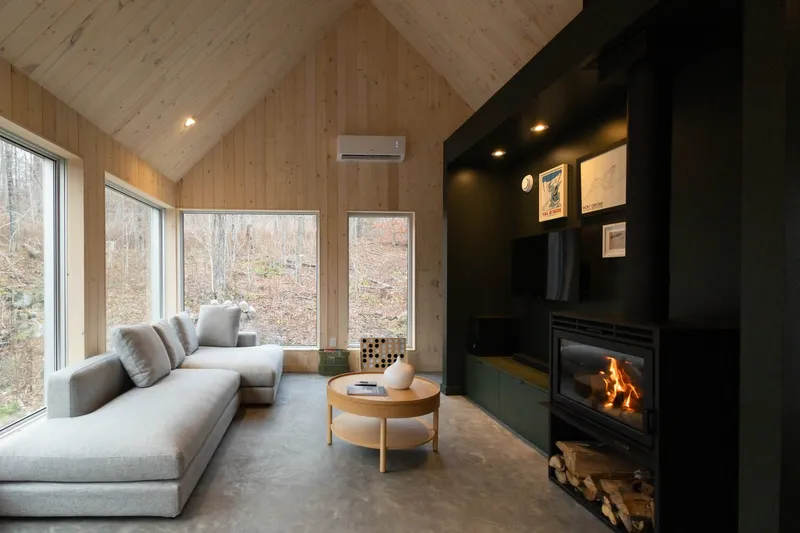
The upper floor hosts open-plan living spaces bathed in natural light. A cathedral ceiling enhances spatial drama, while a series of large windows perfectly frames views of Mont Orford. The living room, dining area, and kitchen converge in an inviting communal zone ideal for gatherings.
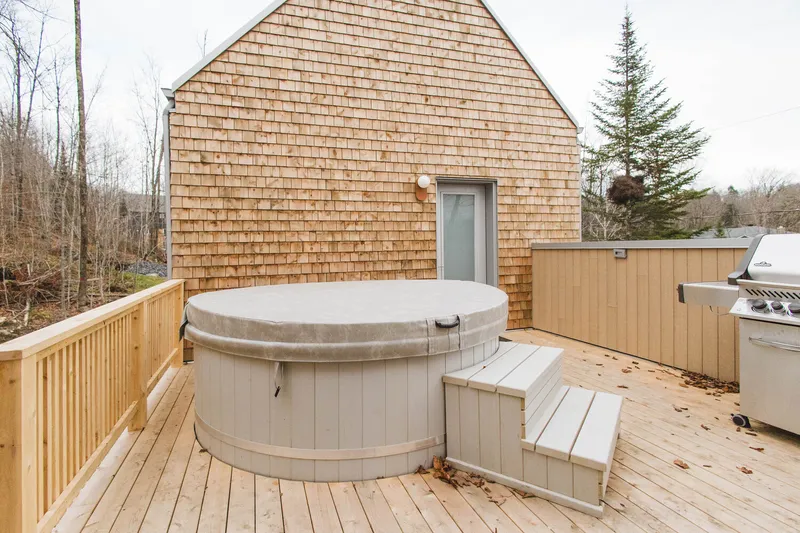
Both chalets share access to a roof-level outdoor terrace and spa, positioned atop the central service volume, an elevated retreat to unwind while immersed in nature.

Interior Design: Two Chalets, Two Distinct Identities
Interior design firm ParLauzé crafted atmospheres that are similar yet individually expressive. A bold, sculptural volume wraps around the kitchen and living space, creating each chalet’s visual anchor:
- One features a forest green tone
- The other uses a warm terracotta hue
Inspired by woodland colors and enhanced by abundant natural light, this central element houses kitchen cabinetry, built-ins, the staircase, and a compact powder room. Its clean geometry stands out against the more muted pine-clad walls and ceilings.
Concrete floors and wood paneling together deliver a minimalist yet warm aesthetic, balancing durability with coziness, ideal for a high-use rental environment.


A Tribute to Nature and Family Heritage
The project carries a personal narrative for its creators. The Tino name references a beloved family fishing camp cherished by the brothers behind the initiative. As Gabriel Clavet explains, the project is also a tribute to their father’s passions: time spent outdoors, working with wood, and appreciating the simple pleasures of nature.


All photographs are works of Maxime Messier




Popular Articles
Popular articles from the community


Hill & Cross Opera: Sculptural Opera House Architecture Shaped by Tallinn’s Landscape and Identity
Hill & Cross Opera reimagines opera house architecture in Tallinn through its sculptural hill, civic plaza, glass wave and a luminous cross.

Co-Life: Senior Housing Design That Reconnects Older Adults With the City
Co-Life reimagines senior housing design through healing gardens, shared streets, workshops, and a sustainable community across generations.

Conexión: Biophilic Design Reimagines High-Rise Living in Hong Kong
Conexión reimagines high-rise living in Hong Kong through biophilic design, green facades, shared spaces, daylight, water and nature within.

The Musturak Paradise: Senior Living Architecture for a Connected Future in Temara, Morocco
The Musturak Paradise reimagines senior living architecture in Temara via private homes, social spaces, culture, community, and shared care.


Similar Reads
You might also enjoy these articles


Hodi-Mandai Geram
Project Function: Preservation and revitalization of the Intangible heritage and socio-spatial identity of the Hodi by Housing, Cultural Memory Center, Sacred Grove, landscape, local tourism economy


Olio Towers: A Mid-Rise for Performers That Fuses Housing, Rehearsal, and Stage
Located blocks from Houston's Theater District, this modular tower stacks living units around a central performance atrium.

Oasis: Modular Green Housing Carved into Dhaka's Urban Fabric
A shortlisted Plugin Housing entry reclaims unauthorized settlements in Dhaka with stepped concrete volumes, green roofs, and ventilation-driven design.

Black Hole: A Floating Megastructure for the Post-Physical Era
Emiliano Mazzarotto envisions a spherical, self-scaling arena where e-sports, digital hotels, and holographic stadiums replace traditional public space.


Explore Residential Building Competitions
Discover active competitions in this discipline


Challenge to design mud housing for contemporary communities


Challenge to reimagine the Iron Throne


Photograph architecture without architects


Illustrate the lost glory of Angkor Wat - Render Challenge
Comments (0)
Please login or sign up to add comments
No comments yet. Be the first to comment!