
HEMAA Architectes Wraps a School in Mirrored Aluminum and Douglas Fir on a Hilltop Near Paris
A prefabricated timber school complex in Mareil-Marly uses reflective cladding and raw wood to dissolve into its tree-lined heritage site.

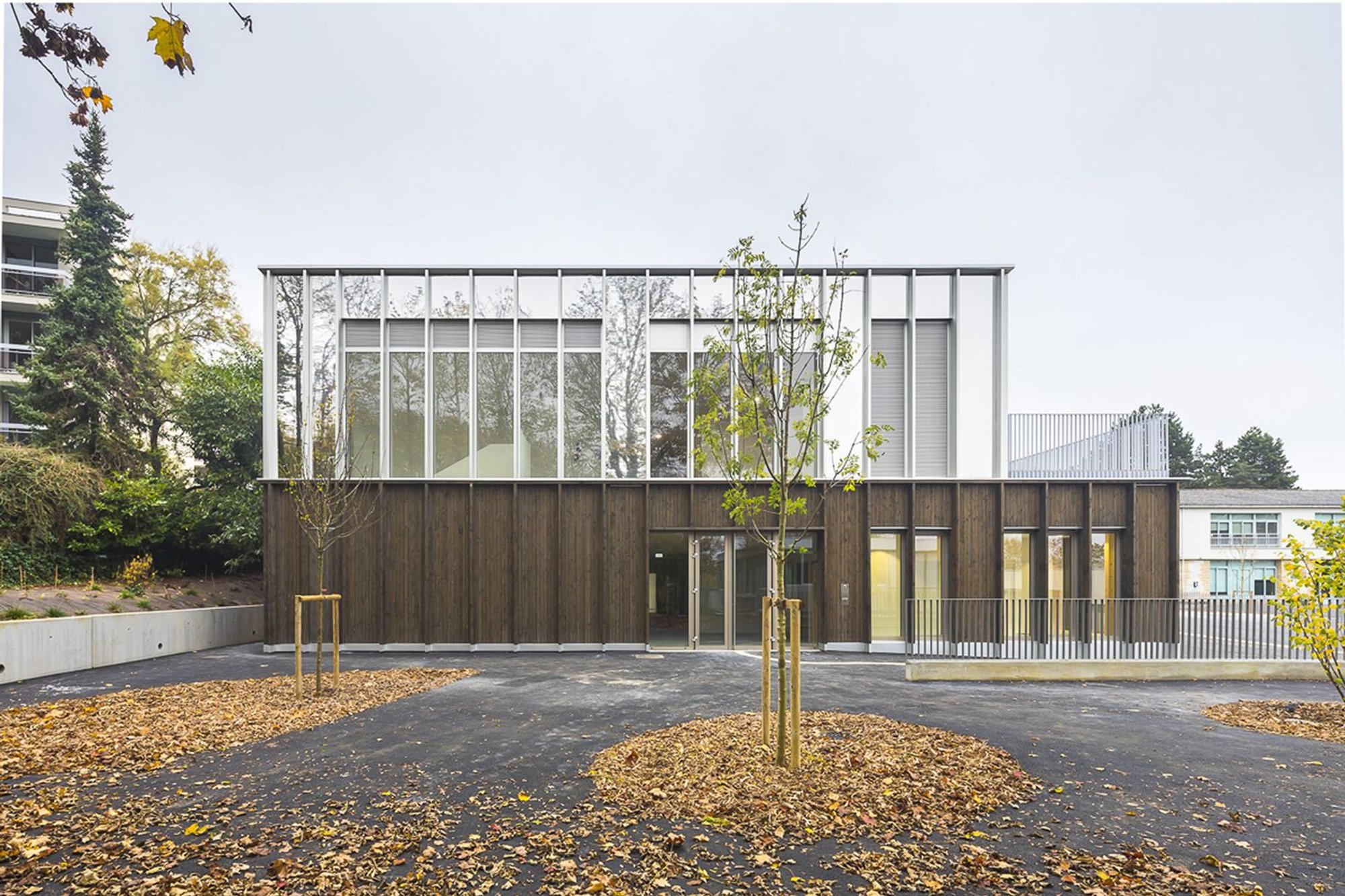
Building a school on an elevated heritage site, surrounded by remarkable trees and overlooking the Paris skyline, is the kind of brief that can go wrong in two directions: overly deferential mimicry or tone-deaf assertiveness. HEMAA Architectes, led by Charles Hesters and Pierre Martin-Saint-Etienne, found a third path in Mareil-Marly. Their Les Violettes School Complex and Recreation Center, completed in late 2024, uses a split material strategy to make nearly 2,000 square meters of program feel lighter and more provisional than it actually is. Pre-aged Douglas fir slats anchor the ground floor in a muted gray register, while mirrored aluminum panels on the upper level catch the canopy, the sky, and the shifting seasons, turning the building's mass into a kind of optical camouflage.
What makes the project genuinely worth studying is not its green credentials, though its E3C1 certification and prefabricated French timber structure are serious commitments. It is the spatial logic: two compact volumes pushed to the western edge of the site so that playgrounds get maximum area and wind protection, central corridors daylit by internal classroom windows, and kindergarten rooms that open directly onto permeable courtyards. The result is a school that treats its outdoor space as seriously as its indoor space, a rare discipline in institutional architecture.
A Facade That Refuses to Settle
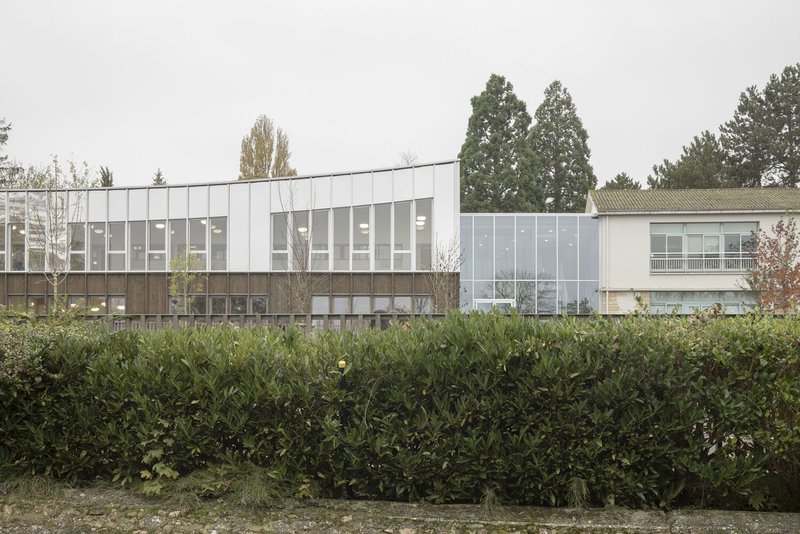
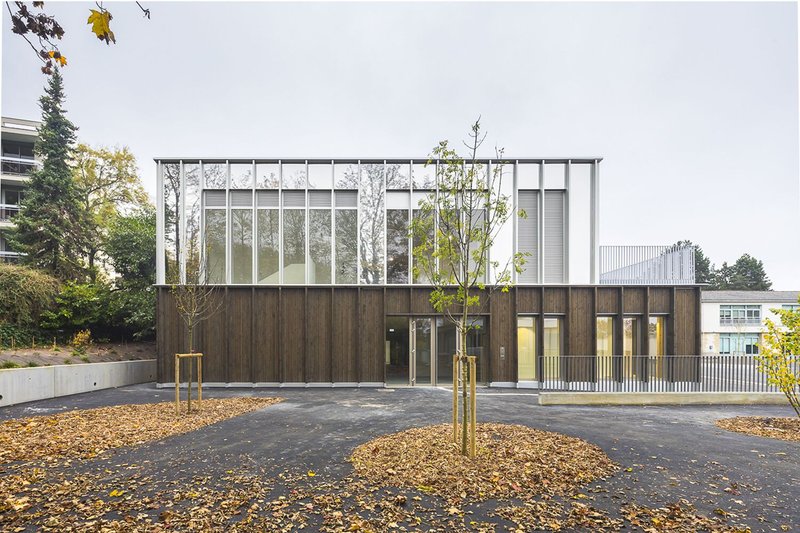
The dual-register facade is the project's most legible move. At ground level, vertical Douglas fir slats have been pre-aged to a silver-gray finish, a deliberate choice that eliminates the awkward weathering period most timber facades endure in their first years. The color reads as stone-like at a distance and distinctly wooden up close, giving the base a tactile warmth without the visual instability of fresh lumber.
Above, white-framed mirrored aluminum panels interspersed with generous glazing create a surface that never looks the same twice. Under overcast skies the upper volume recedes into pale gray; on clear days it throws back the crowns of the surrounding trees. This is not scenographic gimmickry. The panels reduce the perceived height of the building from across the heritage site, which matters when your neighbors include the town hall and a patchwork of structures spanning several architectural periods.
Timber Structure as Interior Finish
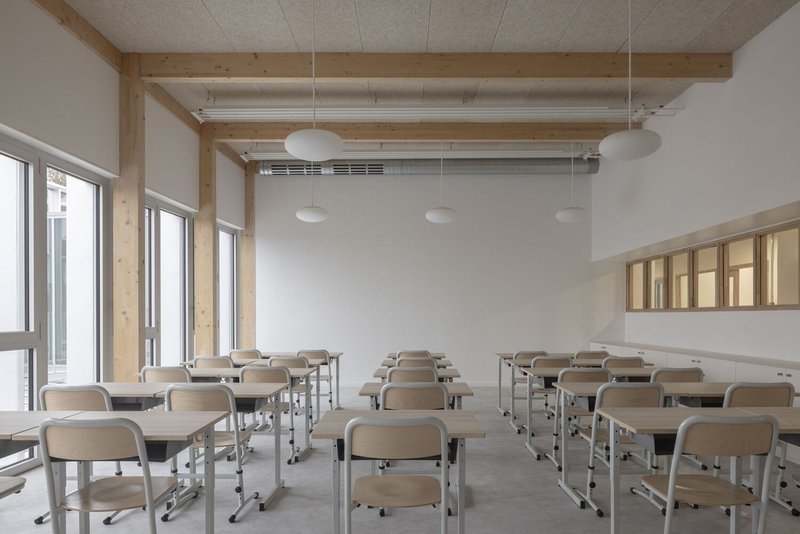
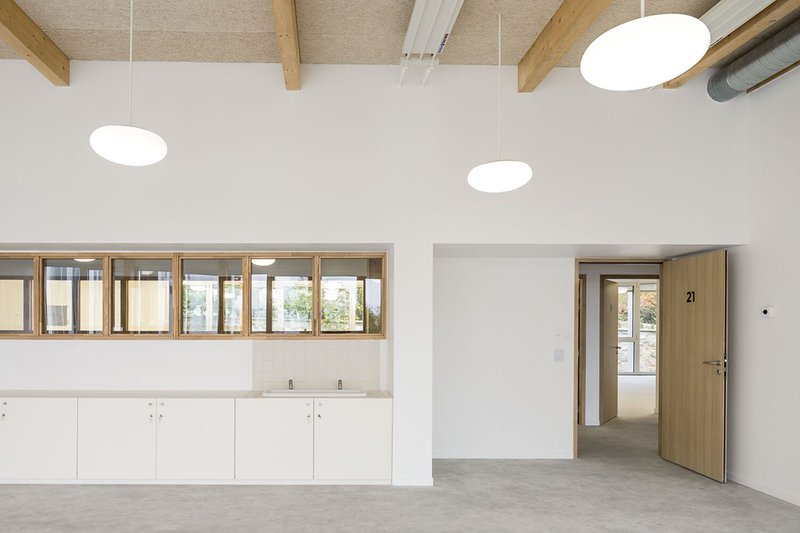
Inside the classrooms, the prefabricated French Douglas fir frame is left fully exposed. Beams and columns are not hidden behind plasterboard or suspended ceilings; they are the architecture. Compacted natural wood fiber panels sit between the structural bays for acoustic absorption, and the result is a ceiling plane that alternates between warm timber and soft, textured insulation. Disc pendant lights hang at intervals, providing even illumination without competing with the structural rhythm.
The decision to keep prefabricated concrete stabilization walls untreated pushes the interiors toward an honest, almost industrial palette. Combined with wood wool insulation and exposed utility runs, the rooms feel like workshops rather than decorated boxes. For young children learning to draw, build, and test, that register is exactly right.
Corridors That Earn Their Keep
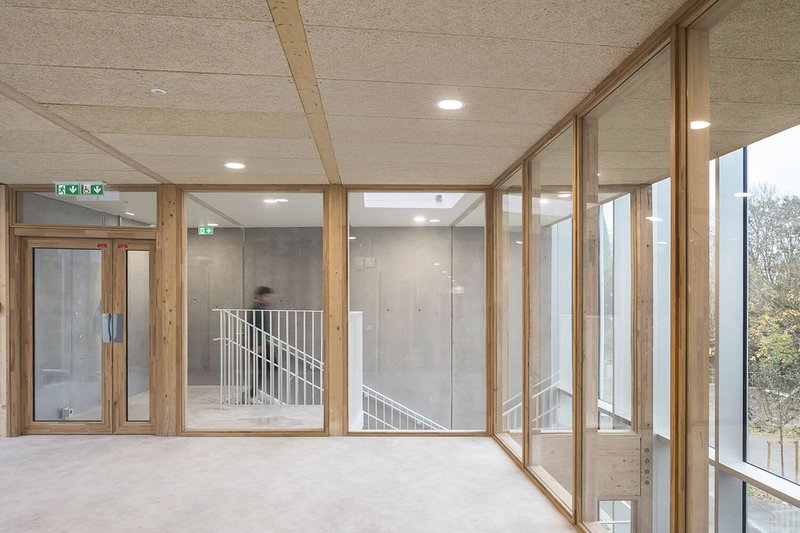
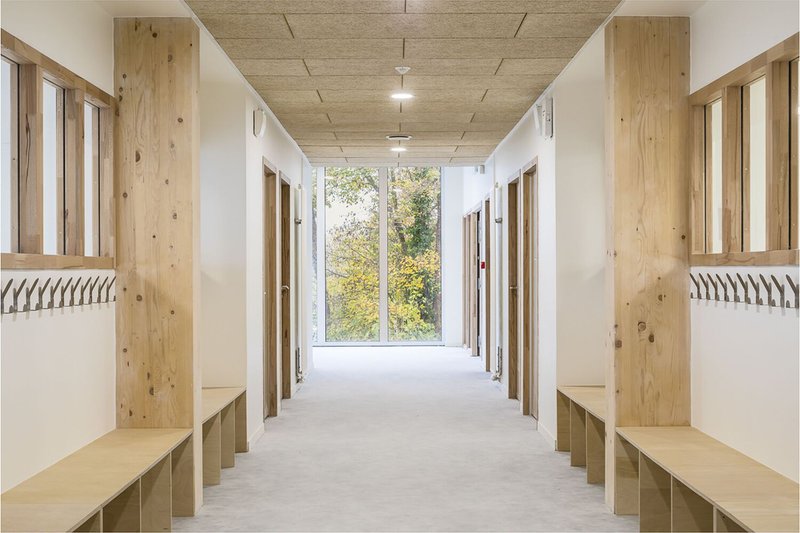
Central corridors in school buildings are usually sacrificial spaces: windowless, noisy, and tolerated only because they are efficient. HEMAA turned them into assets through two moves. First, interior windows between classrooms and corridors allow borrowed daylight to penetrate deep into the plan, so circulation never feels like a tunnel. Second, each corridor terminates in full-height glazing that frames a specific outdoor view, whether autumn foliage or the distant Parisian skyline.
Built-in timber benches along corridor walls suggest that these are not merely passages but also gathering spaces. The timber structural elements are consistent with the classroom interiors, creating material continuity that makes the whole building feel like a single, inhabitable wooden frame rather than a collection of discrete rooms connected by hallways.
The Threshold Between Inside and Out
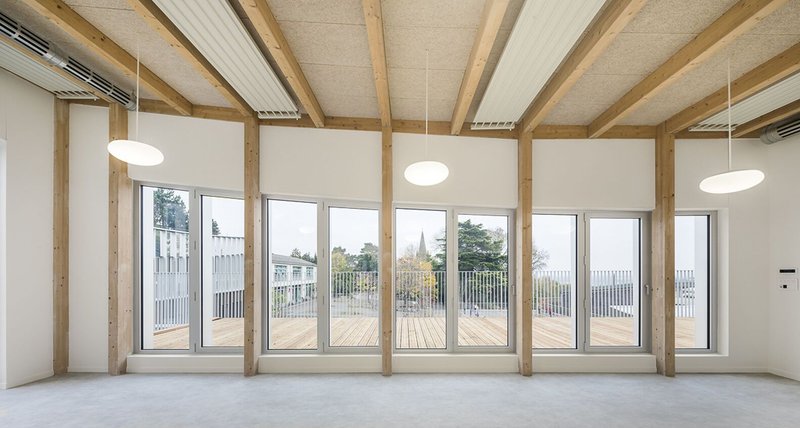
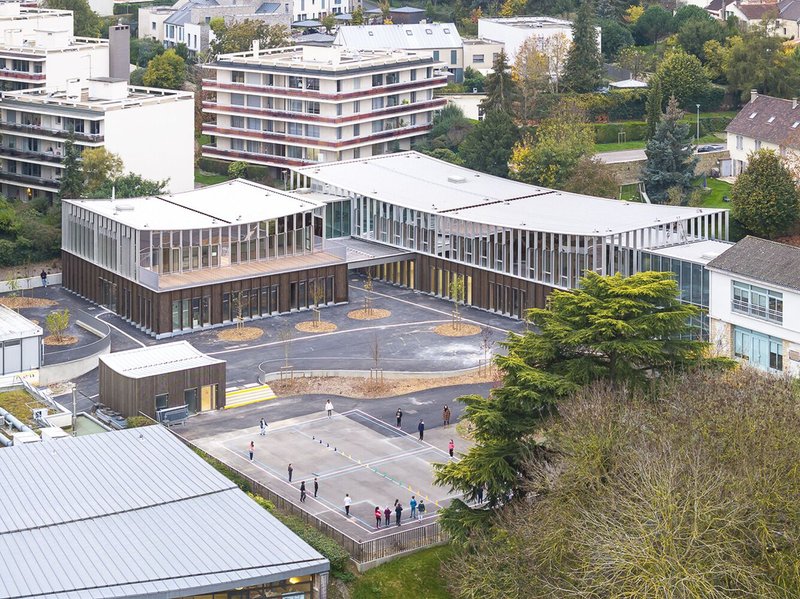
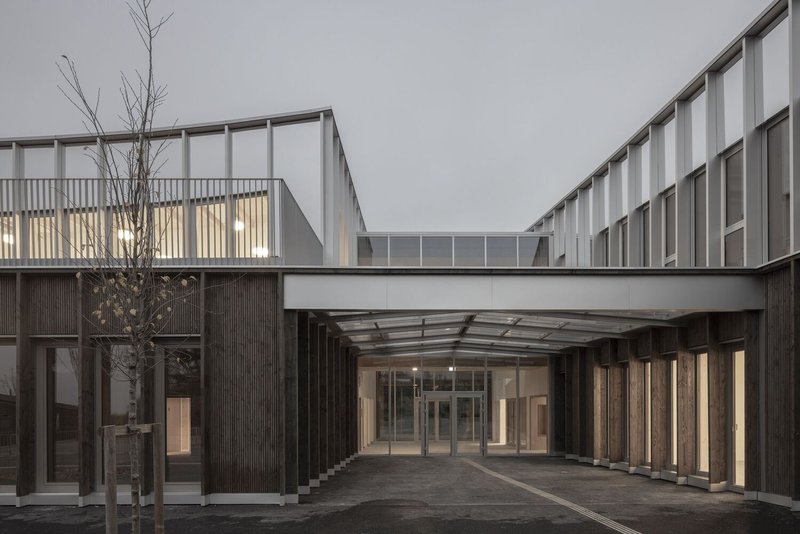
A recurring theme across the project is the careful calibration of thresholds. Floor-to-ceiling glazing opens onto timber decks, blurring the line between interior and courtyard. The covered entrance canopy, supported by exposed timber columns, extends the building's structural language outdoors, creating a sheltered zone that belongs neither fully to the school nor to the playground. These are generous, well-proportioned in-between spaces that invite lingering, not just transit.
The aerial view reveals the site strategy clearly: the two new volumes occupy the western edge, their compact footprints freeing the maximum possible area for playgrounds sheltered from prevailing winds. Surrounding residential buildings provide a domestic scale context, and the school's low profile and reflective upper cladding help it read as a respectful neighbor rather than an institutional interloper.
Why This Project Matters
Les Violettes is proof that prefabricated timber construction can deliver more than speed and sustainability metrics. By keeping the structure exposed, HEMAA turned a logistics decision into an architectural argument: the building teaches children something about how things are made simply by being honest about its own construction. The mirrored aluminum cladding, often dismissed as a novelty when used elsewhere, serves a genuine contextual purpose here, softening a new institutional building into a site that has accumulated its character over decades.
More broadly, the project demonstrates that compact, corridor-loaded school plans need not be dreary. Internal borrowed light, terminal views, and consistent material warmth turn a cost-driven plan type into something genuinely pleasant to inhabit. At €7.10 million for nearly 2,000 square meters of built area plus 2,800 square meters of outdoor space, this is pragmatic architecture that never looks or feels like a compromise. Schools built to this standard of care will age well, not just materially but in the memories of the children who use them.
Les Violettes School Complex and Recreation Center by HEMAA Architectes. Mareil-Marly, France. 2,000 m². Completed 2024. Photography by Sergio Grazia and Nicolas Da Silva.
About the Studio
Share Your Own Work on uni.xyz
If projects like this are the kind of work you want to make, uni.xyz is a place to publish your own, find collaborators, and enter design competitions.




Popular Articles
Popular articles from the community

YOAP Architects Round a Corner in Yeongcheon with a Cylindrical Community Hub
A 197-square-meter brick and ribbed-clad tower turns a forgotten alley corner in South Korea into a public garden with a low threshold.
RDTH architekti Rips Out Nearly Every Wall in a Prague Apartment and Replaces Them with Furniture
A 101-square-meter post-war flat in Prague trades rigid partitions for a single rotated furniture block, curtains, and glass concrete.
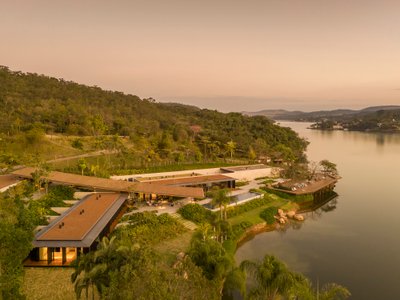
Bernardes Arquitetura Stretches a Timber Roof Along a Reservoir's Edge in Minas Gerais
Dam House in Itaúna lets a sweeping wooden canopy dissolve the boundary between hillside terrain and open water.
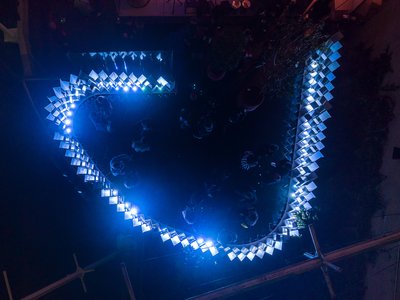
Rojkind Arquitectos and Think Parametric Build a Glueless Pavilion from 67 Interlocking Panels
A serpentine fiber-cement installation in Chapultepec Park celebrates a decade of architectural media in Mexico City.


Similar Reads
You might also enjoy these articles

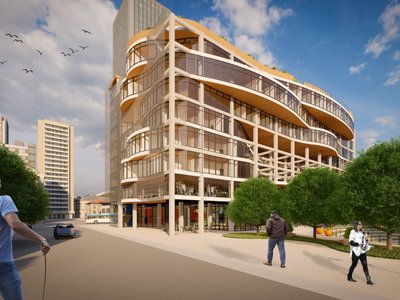
Olio Towers: A Mid-Rise for Performers That Fuses Housing, Rehearsal, and Stage
Located blocks from Houston's Theater District, this modular tower stacks living units around a central performance atrium.

Oasis: Modular Green Housing Carved into Dhaka's Urban Fabric
A shortlisted Plugin Housing entry reclaims unauthorized settlements in Dhaka with stepped concrete volumes, green roofs, and ventilation-driven design.

Black Hole: A Floating Megastructure for the Post-Physical Era
Emiliano Mazzarotto envisions a spherical, self-scaling arena where e-sports, digital hotels, and holographic stadiums replace traditional public space.
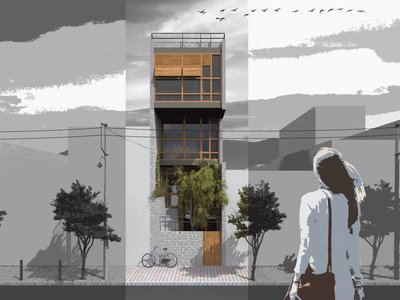
Compact & Sustainable Living in Piraeus: A Four-Level Family Home Built Around Light and Air
A narrow townhouse in one of Greece's densest port cities uses a central atrium and passive strategies to house three generations under one roof.


Explore Architecture Competitions
Discover active competitions in this discipline




The International Standard for Design Portfolios


The Global Benchmark for Architecture Dissertation Awards


The Global Benchmark for Graduation Excellence


Challenge to design public laboratory
Comments (0)
Please login or sign up to add comments
No comments yet. Be the first to comment!