
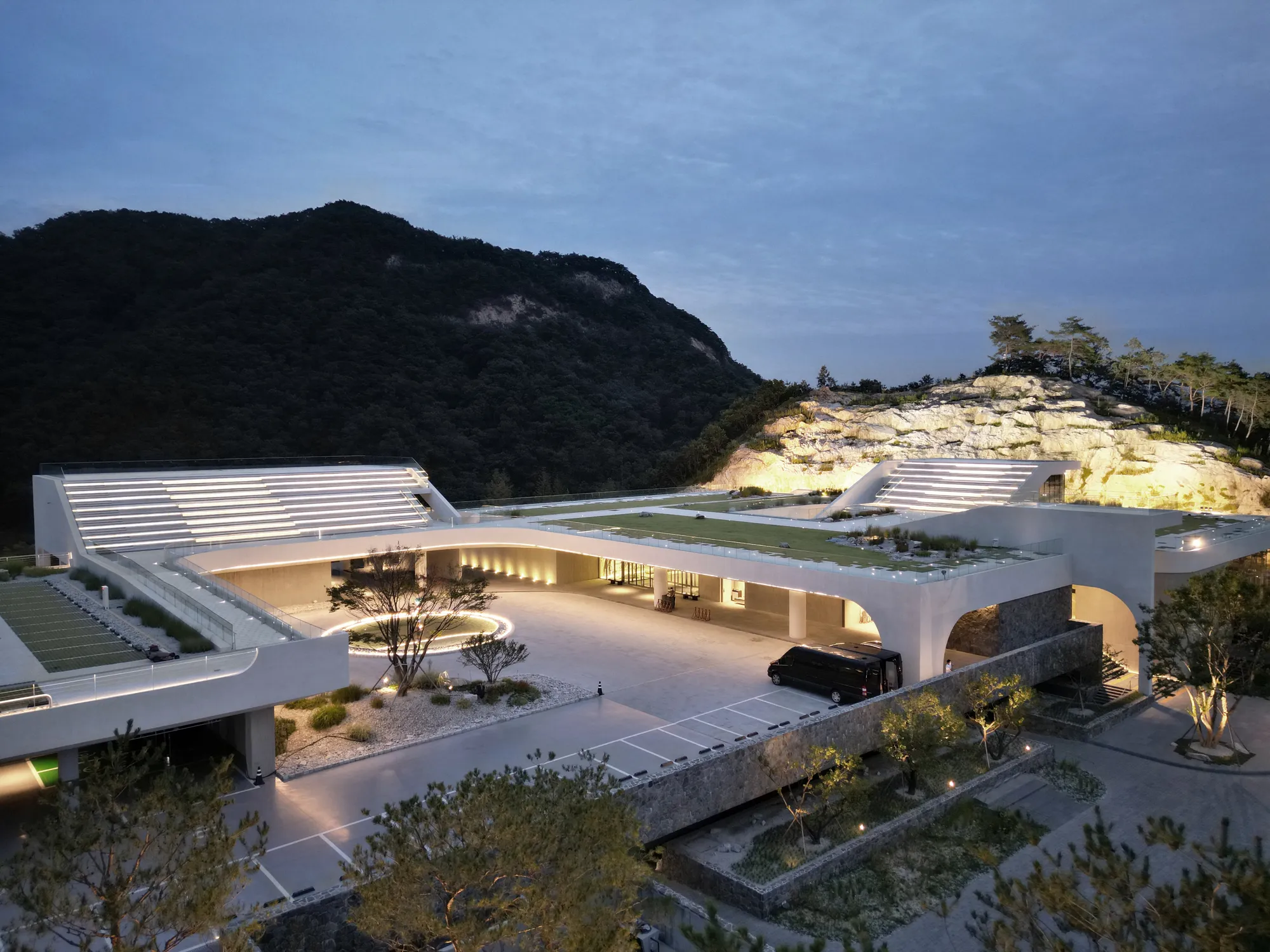
LESS ARCHITECTS Folds a Golf Clubhouse into the Mountains of Wonju as Artificial Topography
A 9,963 square meter clubhouse in South Korea's Oak Valley disappears into the hillside through layered green roofs and carved courtyards.


Golf clubhouses tend toward two familiar modes: the bloated lodge or the corporate glass box. LESS ARCHITECTS sidesteps both with a building that refuses to announce itself. Set into a valley between canyon walls in Wonju's Oak Valley, the Seongmunan CC Clubhouse reads less as a building and more as a geological event, a series of white concrete planes that terrace down a hillside and grow grass on their backs. The 9,963 square meter complex, commissioned by HDC Resort and completed in 2022, is positioned behind an existing hill so that the surrounding landscape remains the focal point. The architecture defers to the mountains, the Sum River, and the exposed limestone outcrops that define this part of Gangwon-do.
The project's name comes from an old local word meaning a village protected by a rock wall, and the building operates on the same principle. Rather than sitting on the land, it tucks into it, creating a layered topography that visitors traverse from river level to rooftop observatory. The result is a clubhouse that doubles as a walking course, connecting to existing trekking paths and the nearby Museum SAN. Every decision, from the low profile to the planted roofs, reinforces a single proposition: the building should be something you move through and over, not something you look at.
A Building That Behaves Like Ground
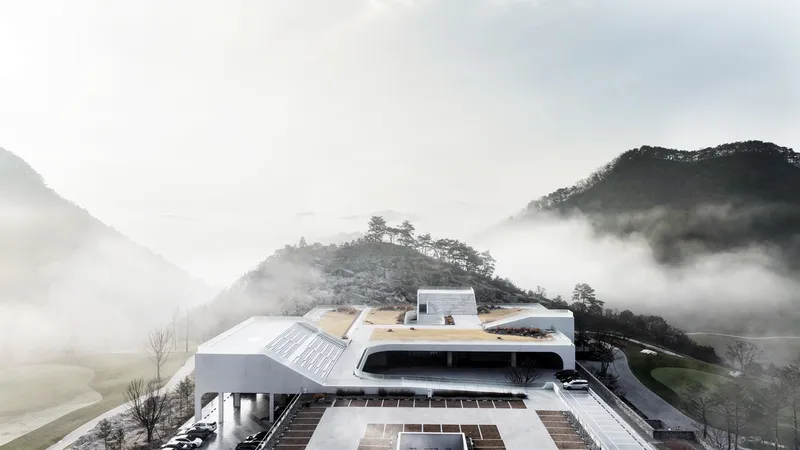
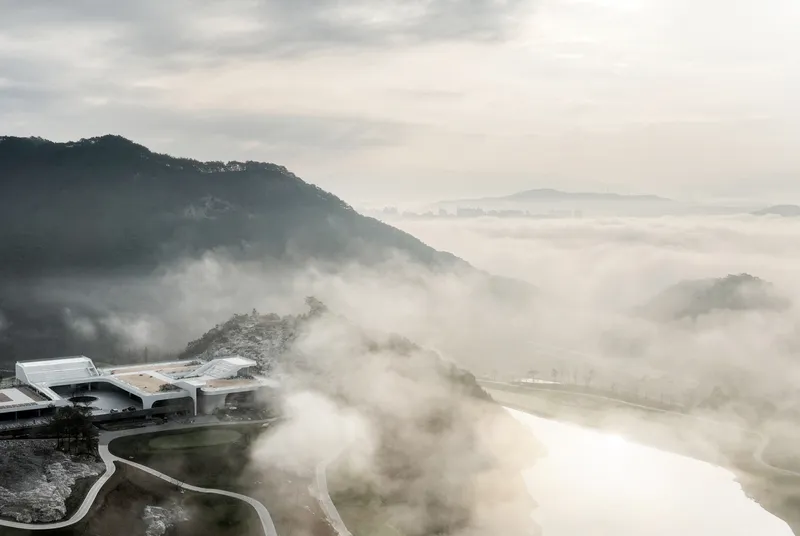
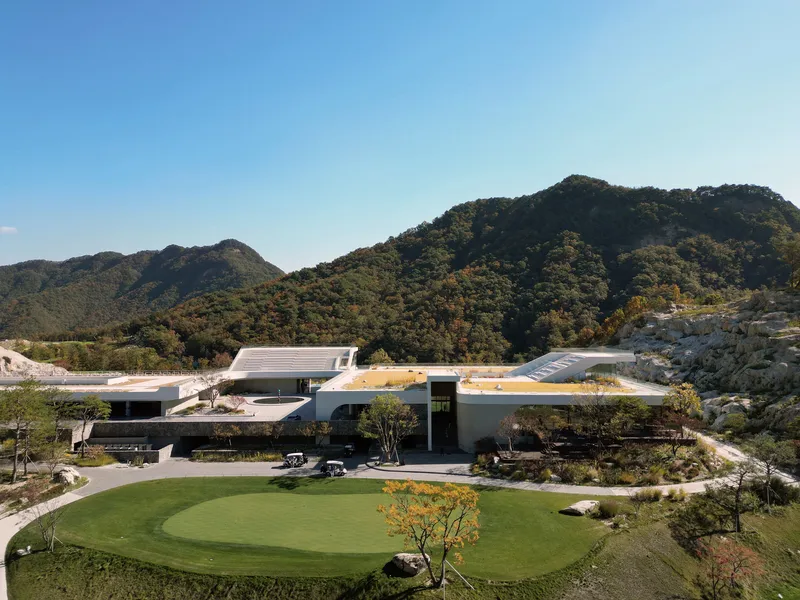
The aerial and mid-range views tell the story most clearly. From above, the clubhouse dissolves into its hillside context, its white ribbed roof volumes emerging from fog like ridgelines. The building's footprint covers only 0.52% of the enormous 1.37 million square meter site, a deliberate restraint that keeps the architecture subordinate to the terrain. The curved rooflines echo the contours of the surrounding mountains rather than imposing a competing geometry.
The decision to position the building low along the mountain range, placed along the valley rather than atop a hill, is the critical move. It means visitors arriving by car encounter landscape first and architecture second. Morning mist wraps the structure in exactly the way it wraps the adjacent pine forests, collapsing the distinction between what was built and what was always there.
Planted Roofs as Inhabitable Landscape
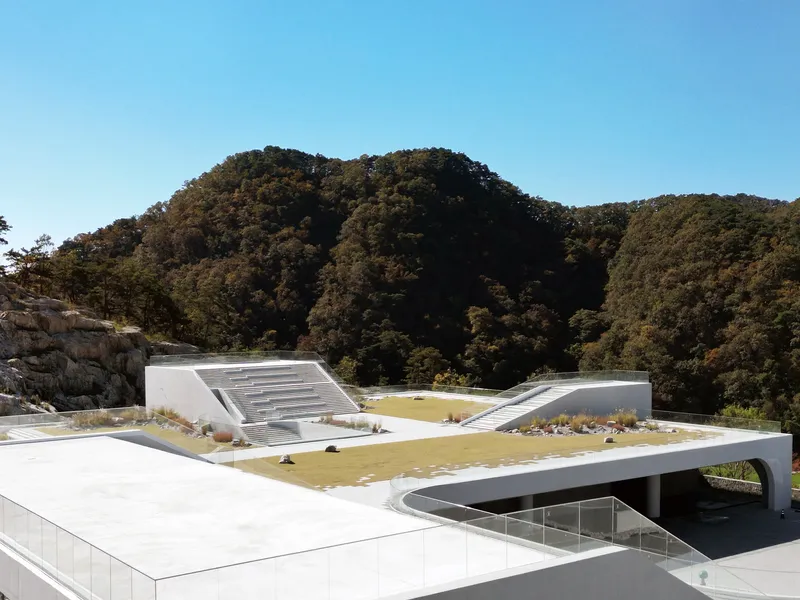

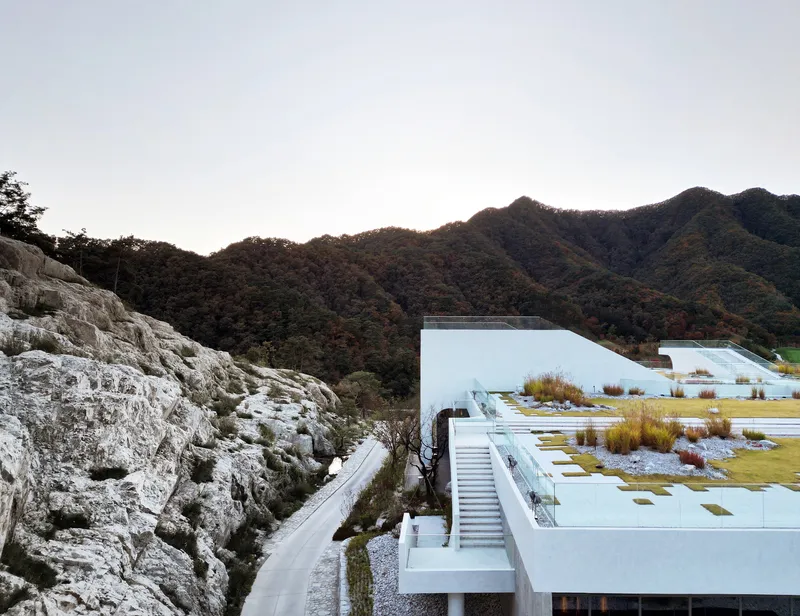
The green roofs here are not decorative gestures. They are the primary architectural surface, a series of stepped terraces planted with gravel beds and grass panels that visitors walk across on their way from the valley floor to the rooftop level. The building's section is its most important drawing: one story below ground, two above, with the roof functioning as a third public level that hosts a café, gallery, concert hall, and observatory. The planted surfaces also serve a passive energy strategy, insulating the concrete volumes below and reducing cooling loads in summer.
What makes this work is the commitment to continuity. The terraces don't feel like rooftops accessed by a stair; they feel like hillside clearings that happen to have architecture beneath them. Gravel, grass, and white concrete alternate without hierarchy. The planted planes step down the rocky hillside at dusk with a quietness that most resort architecture never achieves.
Concrete, Rock, and the Courtyard as Device

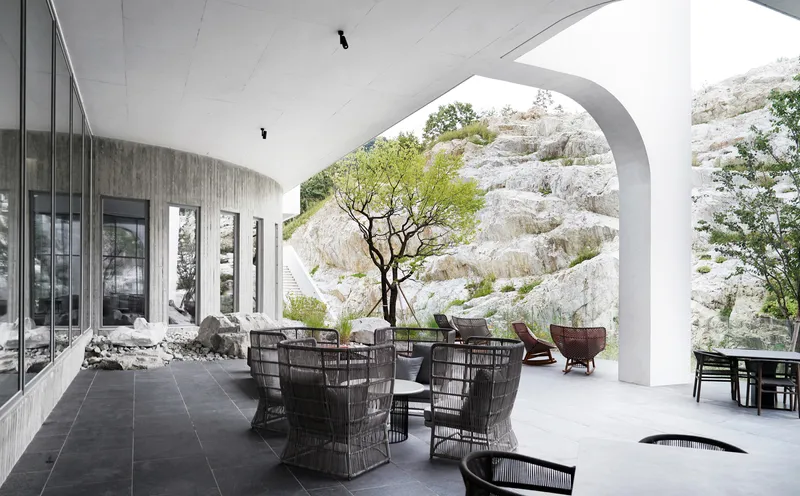

The exposed limestone outcrops on site are not obstacles but partners. LESS ARCHITECTS frames them through arched openings, floor-to-ceiling glass walls, and covered terraces, turning raw geology into the clubhouse's most compelling interior finish. Curved concrete columns and vaulted white ceilings create generously proportioned outdoor rooms where wicker furniture sits beneath barrel-vault soffits with direct sightlines to the cliff face.
The courtyards are not leftover space; they are spatial devices that pull daylight and views into the building's core. The central courtyard, visible from above with its green carpet, organizes circulation and orients the communal program. Smaller in-between spaces negotiate the gap between the existing topography and the interior, creating transitional zones that are neither fully inside nor outside. It is a strategy that owes something to traditional Korean madang courtyards, reinterpreted in concrete at resort scale.
Interior Atmosphere and Borrowed Scenery
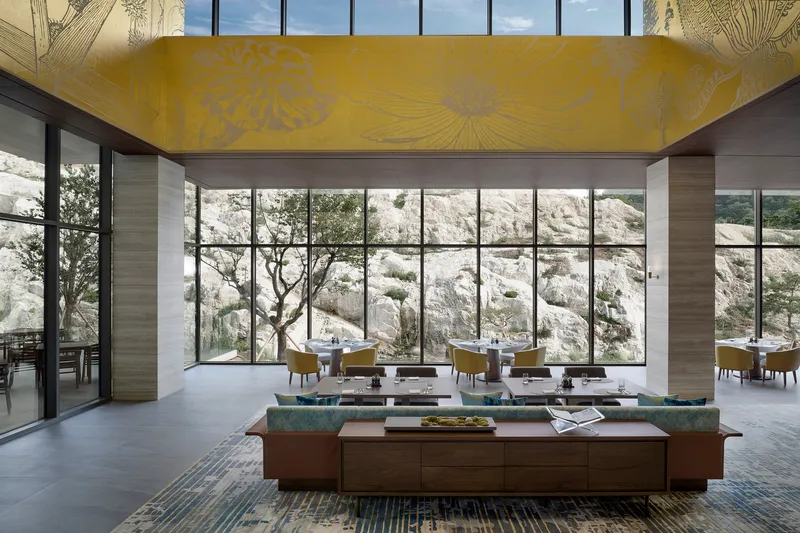
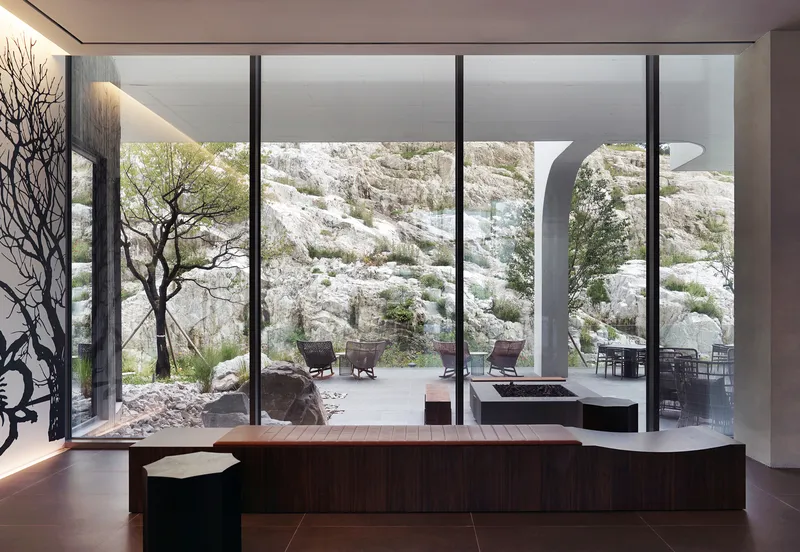

Inside, the building sustains its argument. A double-height lounge with a yellow floral ceiling panel demonstrates that LESS ARCHITECTS can produce moments of intensity when needed, but the real protagonist remains the view: limestone cliffs framed by floor-to-ceiling glass, seen through deep reveals that control glare and scale the panorama to the human eye. The glass walls function as picture planes, borrowing the mountain scenery in a manner that recalls the East Asian garden tradition of shakkei.
At twilight, the curved courtyard pool with its sculptural installation reflects the glazed colonnade and the mountains beyond, collapsing foreground and background into a single shimmering surface. The water features are part of a broader sustainability approach that includes wind corridors and canopy designs to manage the local microclimate, but their atmospheric contribution is equally significant. They slow visitors down, turning passage through the building into contemplation.
Entry Sequence and Exterior Detail

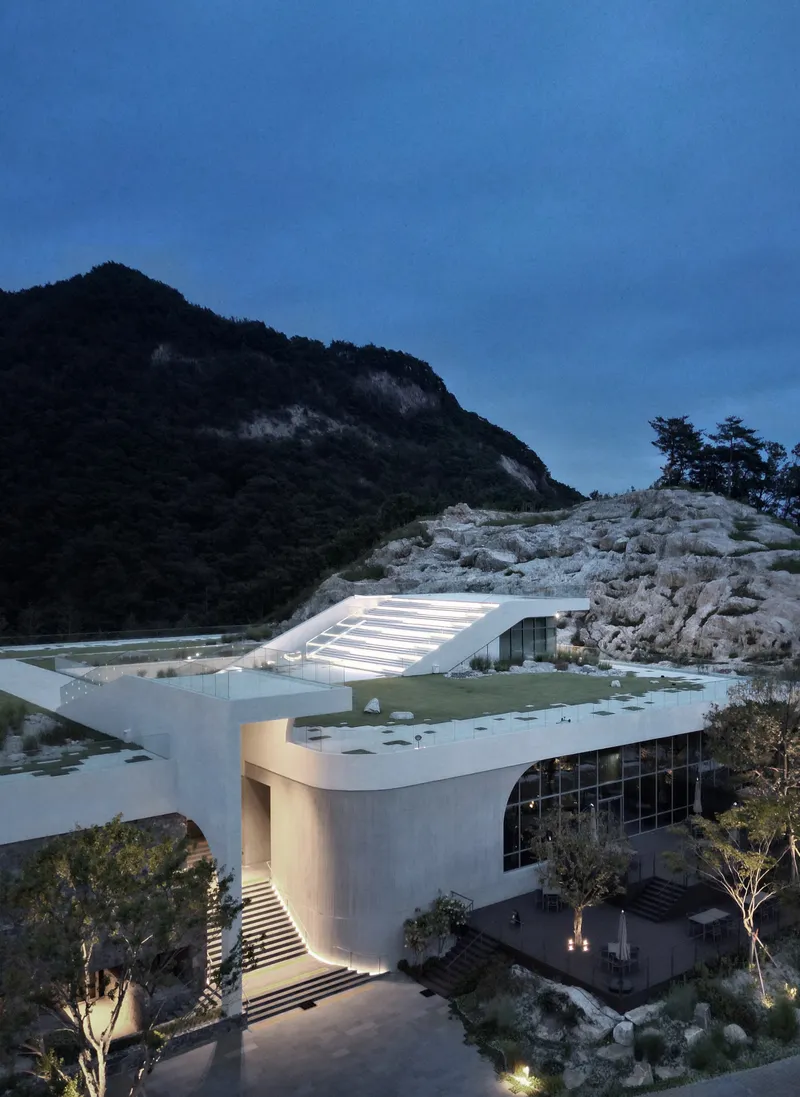
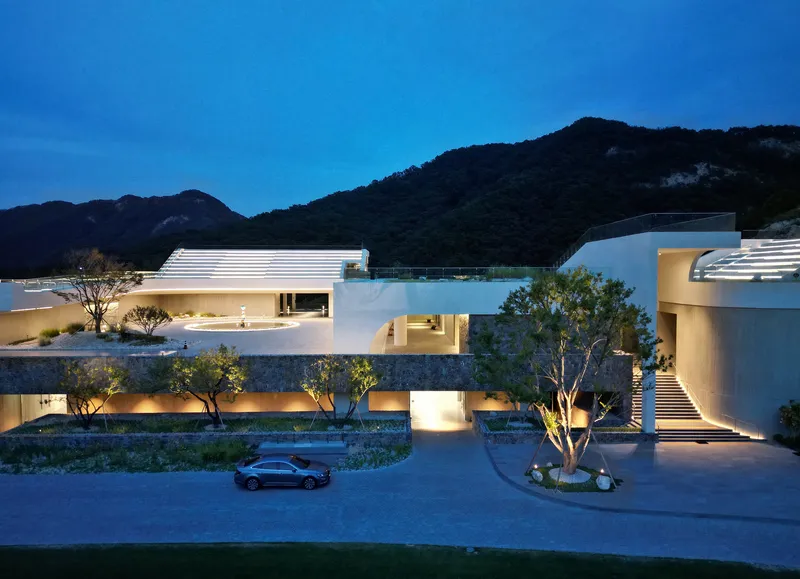
The entry canopy, with its timber staircase and glazed pavilion beneath white roof volumes, is the closest the building comes to a conventional architectural announcement. Even here, the gesture is restrained: a curved overhang rather than a grand portal, lit warmly at dusk so that it reads as a lantern tucked into the hillside. The ribbed roof surfaces pick up light in ways that change through the day, their linear texture creating a finer grain against the rough geology.
Vertical slat screens at the roof edges provide solar control while giving the complex a textile quality when seen from above. At night, the illuminated openings beneath the ribbed roofs turn the building into a constellation of warm rectangles against the dark mountain backdrop. The palette never wavers: white concrete, timber accents, glass, and planted surfaces. The discipline is absolute.
Winter and the Outlying Pavilion
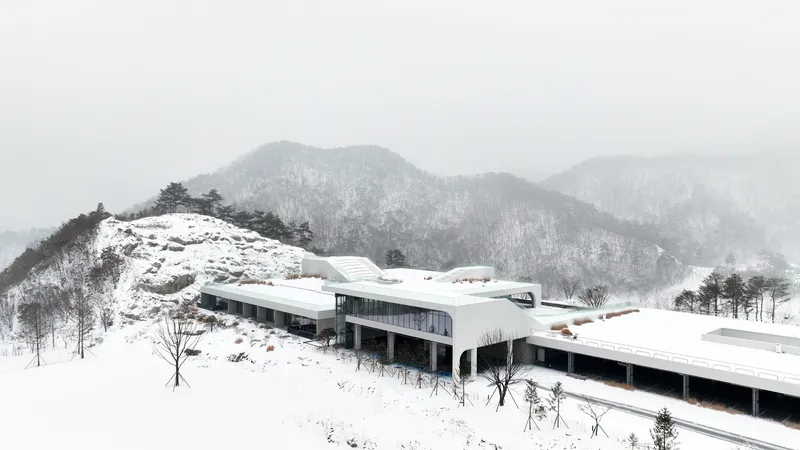
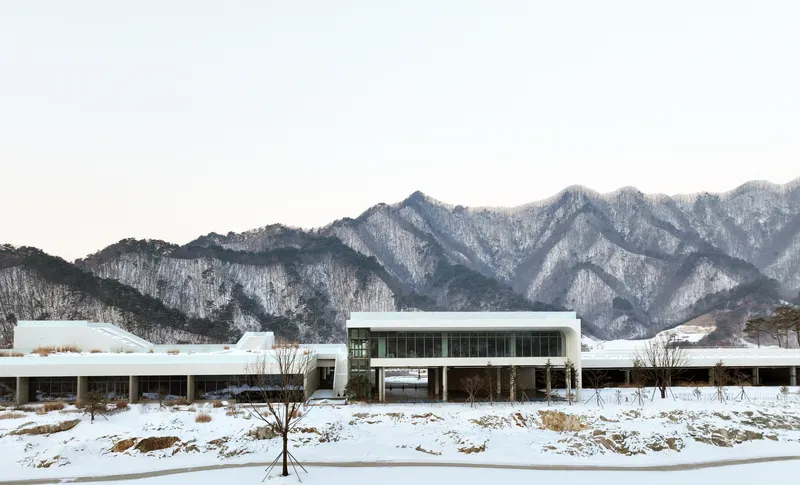

Snow reveals a building's relationship to the ground, and the Seongmunan clubhouse passes the test. In winter, the horizontal wings with their glazed facades and white roofs merge with the snowy hillside, the flat concrete planes nearly indistinguishable from the frozen terrain. A timber-clad pavilion on a separate hillside, angled toward the golf course, operates as a satellite element, its warmer material palette providing a counterpoint to the main complex's concrete severity.
The winter images also clarify the building's scale. What reads as a compact cluster in aerial photographs reveals itself as a substantial linear layout, multiple wings stretching across the slope. The low horizontal proportions keep the mass visually grounded even at nearly 10,000 square meters. The recessed glazed corridors sheltered by flat concrete soffits create covered walkways that function well in Gangwon-do's cold, snowy winters.
Plans and Drawings

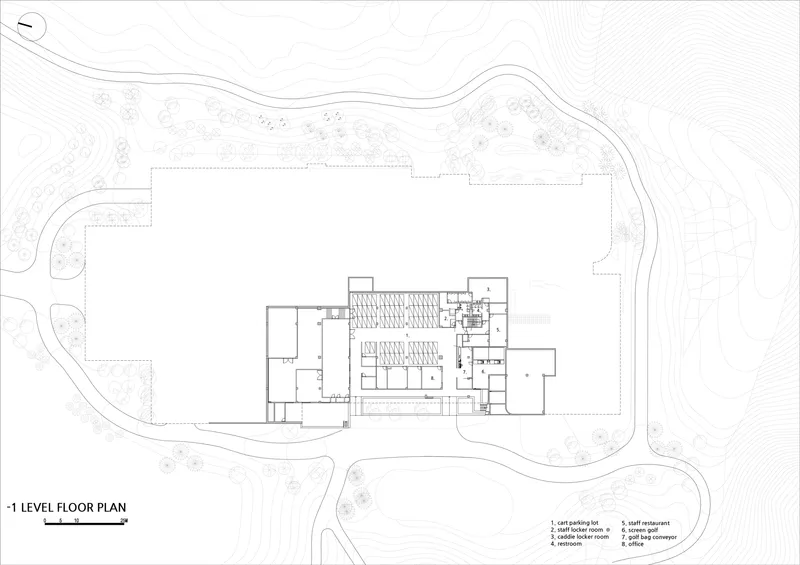
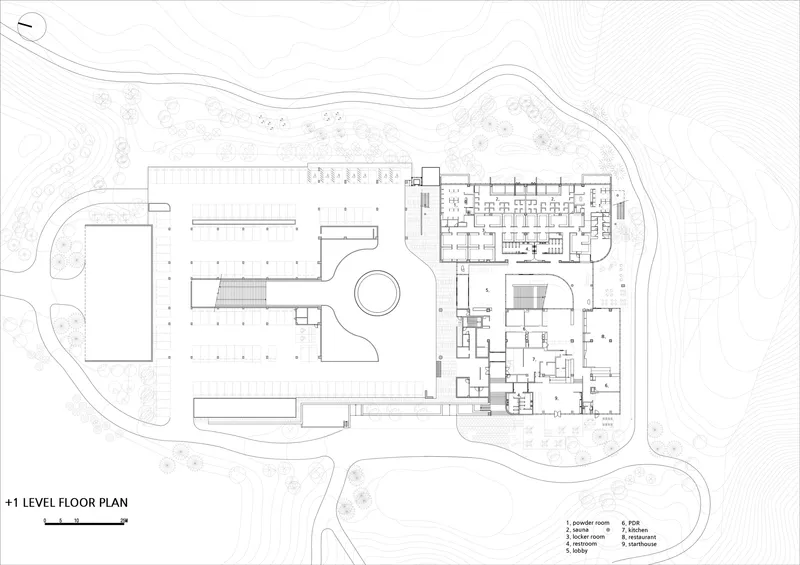
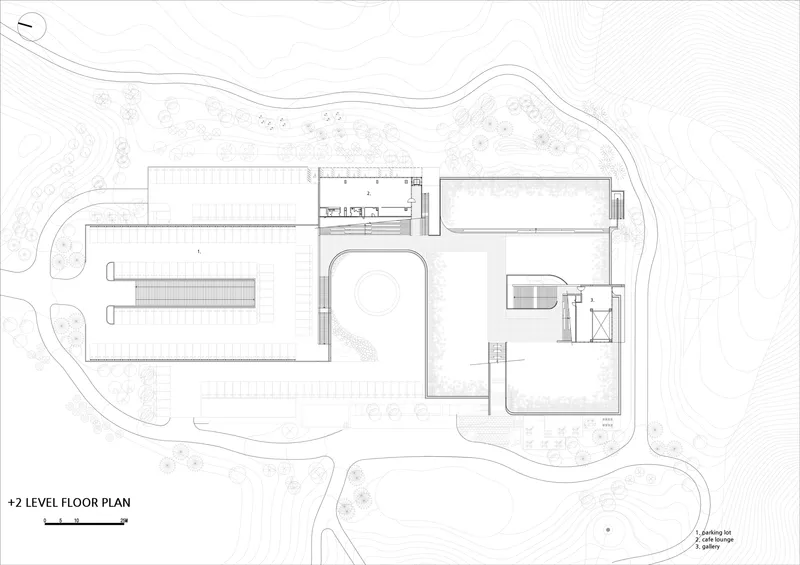


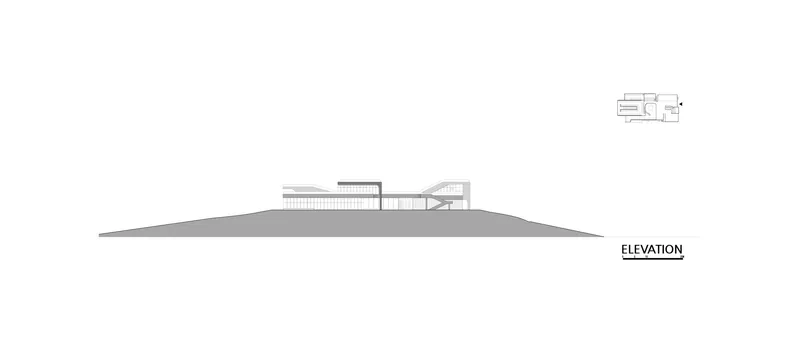
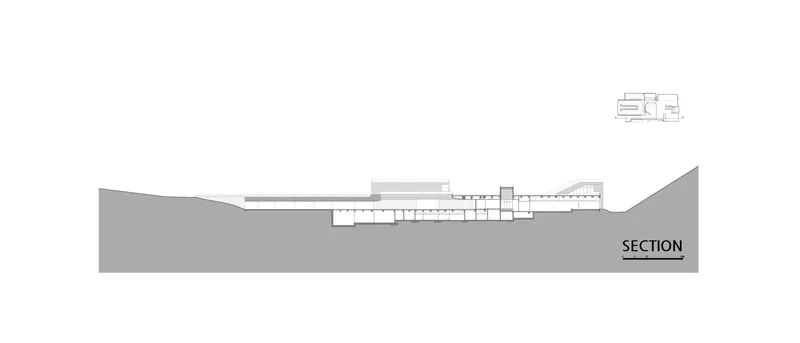
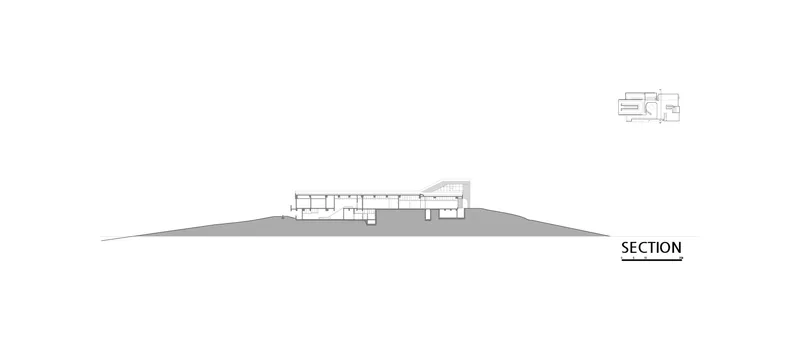
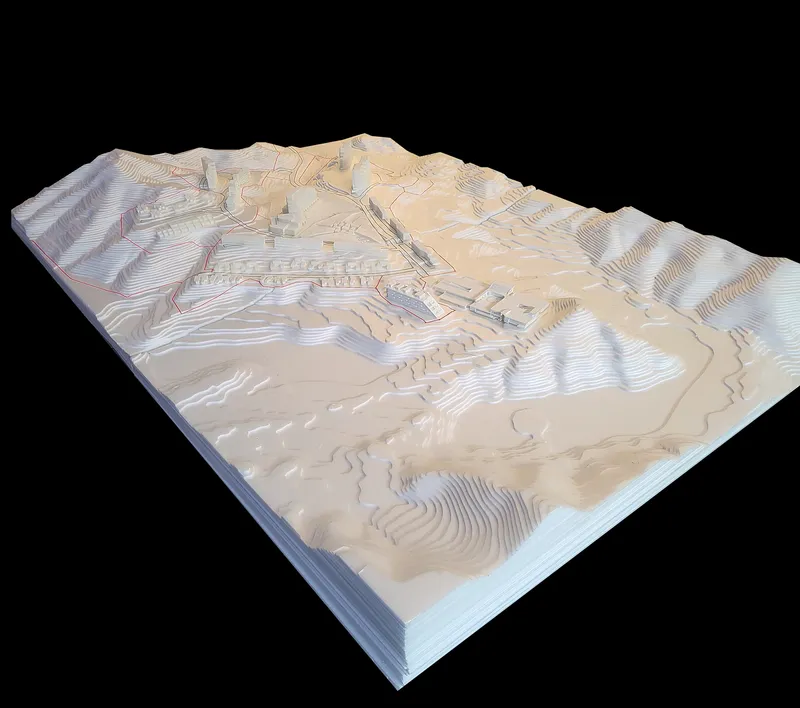
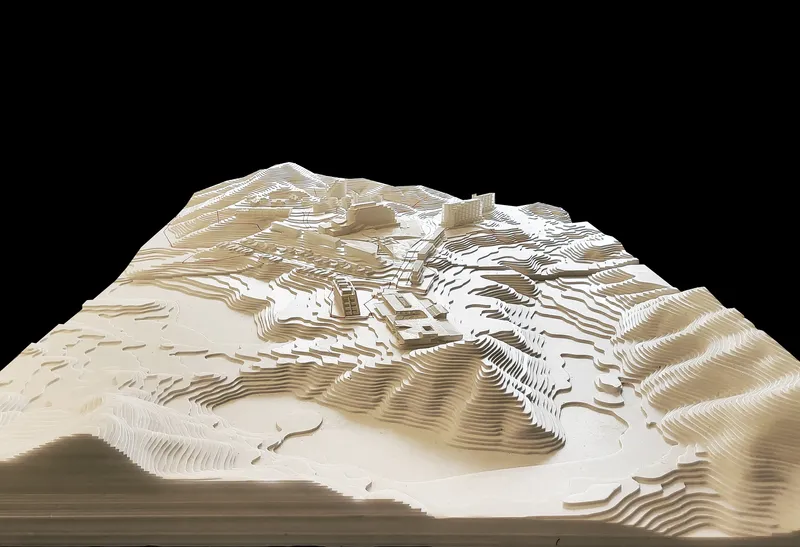
The axonometric diagrams trace the design logic from site analysis through massing, showing how the building's form was derived from the existing contours rather than imposed on them. Four floor plans, from B1 through the roof level, reveal how the program distributes across the slope: the lower levels embed into the terrain and handle service and support functions, while the upper levels open up to terraces and views. A central circular element at roof level, likely the observatory or concert hall, anchors the composition.
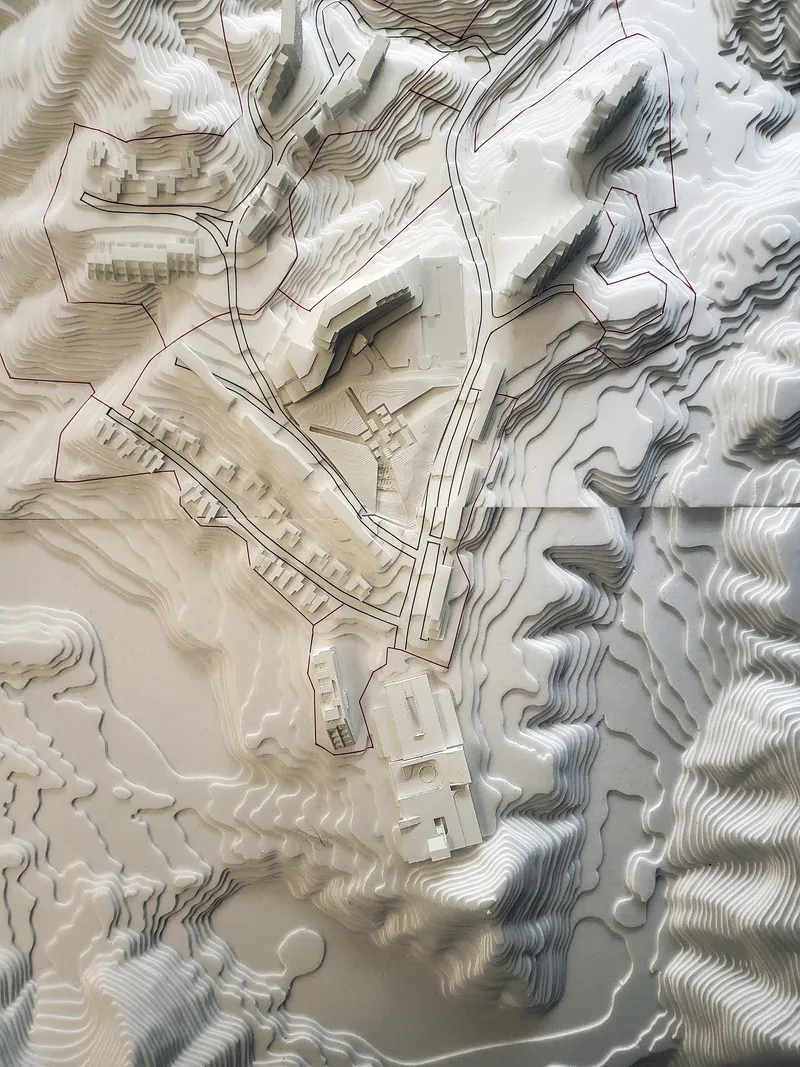
The sections are the most instructive drawings. They show interior spaces stepping down through the sloped terrain in a continuous cascade, with the building's linear layout following the hillside gradient. The elevations confirm what the photographs suggest: the building never rises above the treeline. The physical topographic models, built in layered contours, demonstrate the care with which LESS ARCHITECTS studied the relationship between their volumes and the surrounding landforms. The clustered buildings nestle into the model's terrain with the same inevitability they achieve on site.
Why This Project Matters
Resort architecture operates under conflicting pressures: it must attract visitors while preserving the landscape that makes a place worth visiting. Most projects fail at one end or the other, producing either invisible sheds or attention-seeking icons. The Seongmunan CC Clubhouse finds a third way. By treating the building itself as landscape, LESS ARCHITECTS created a structure that adds recreational program, cultural amenity, and architectural ambition to a valley without diminishing its character. The building coverage ratio of 0.52% is not just a number; it is a design ethic made measurable.
The deeper lesson is about section. In an era fixated on plan and facade, this project insists that the most consequential design decisions happen vertically: where the building meets the ground, how the roof becomes a floor, where the interior yields to the courtyard. LESS ARCHITECTS have produced a clubhouse that golfers will enjoy and architects should study, not because it solves every problem of sustainable resort design, but because it demonstrates that a building of this scale can be both ambitious and self-effacing. That is a harder trick than it looks.
Seongmunan CC Clubhouse by LESS ARCHITECTS. Located in Wonju-si, Gangwon-do, South Korea. 9,963 m². Completed 2022. Client: HDC Resort.
About the Studio
Share Your Own Work on uni.xyz
If projects like this are the kind of work you want to make, uni.xyz is a place to publish your own, find collaborators, and enter design competitions.


Popular Articles
Popular articles from the community


Riyadh For All: Intergenerational Urban Design for Active Aging in Rabat
Riyadh For All reimagines urban design in Rabat with intergenerational co-living, adaptive courtyards, and Moroccan cultural exchange today.

AL-JANNAH: Sustainable Architecture and Permaculture for Afghan Widows
AL-JANNAH uses sustainable architecture and permaculture to create resilient oasis of housing, learning, work and renewal for Afghan widows.

The Earth Pod: 3D Printed Homes for Resilient Refugee Communities
The Earth Pod reimagines refugee housing through 3D printed homes made from clay, combining resilience, self-sufficiency, and rapid shelter.

The Ocean Hive: Sustainable Architecture for a Self-Sufficient Civilization at Sea
The Ocean Hive imagines sustainable architecture at sea, where modular habitats, algae, wave power and ocean waste sustain a growing colony.

Similar Reads
You might also enjoy these articles

Bao Huynh Watercolor Atelier: A Serene Art Retreat in Hội An
Bao Huynh Watercolor Atelier in Hội An blends multifunctional art spaces, sustainable design, local materials, and family-friendly living in a serene environment.

Atelier Macri Concept Store Interior Design by CASE-REAL
Atelier Macri store features a "ko" counter, walnut wood details, cork displays, blending retail, gallery, and seamless customer experiences.

Manuel Vargas Izquierdo Stadium and High-Performance Sports Center: Architectural Excellence in Jalpa de Méndez
The Manuel Vargas Izquierdo Stadium blends sustainable design, inclusive sports facilities, and cultural-inspired architecture, revitalizing Jalpa de Méndez’s public spaces.

KAKR Buluh Awar Hall: Revitalizing Community and Ecology Through Bamboo Architecture
Community built bamboo hall revitalizes Buluh Awar village, empowering youth, restoring ecology, celebrating vernacular craftsmanship through sustainable architecture and culture.

Explore Community Center Competitions
Discover active competitions in this discipline



Challenge to reimagine the Iron Throne


Photograph architecture without architects


Illustrate the lost glory of Angkor Wat - Render Challenge


Design challenge to reuse E-waste
Comments (0)
Please login or sign up to add comments
No comments yet. Be the first to comment!